
For decades, the image of the Indian soldier was almost exclusively male an archetype shaped by history, tradition, and structural limitations.
Yet over the past three decades, a quiet but transformative shift has unfolded within the ranks of the Indian Army. Women have not merely entered the institution; they have reshaped its internal culture, expanded its operational diversity, and challenged long-standing assumptions about gender roles in defence services.
The story of women officers and soldiers in the Indian Army is not simply about representation it is about resilience, institutional reform, and the evolution of a modern democratic force. The induction of women into the Army began in the early 1990s when they were commissioned as officers in select branches.
Initially restricted to Short Service Commissions and limited arms and services, their participation reflected a cautious institutional opening. Over time, however, demonstrated professionalism, consistent performance, and changing societal expectations catalysed deeper reform.
The expansion of roles, greater access to command opportunities, and judicial affirmation of gender equality accelerated the pace of integration. Breaking barriers in a traditionally male-dominated institution required more than policy amendments.
It demanded cultural adaptation, infrastructure reform, and attitudinal change. Women officers entering the Army navigated dual challenges meeting rigorous professional standards while confronting implicit biases regarding capability and endurance.
Gradually, competence replaced scepticism. Performance became the most persuasive argument. In recent years, landmark developments have significantly strengthened the position of women within the Army.
The grant of Permanent Commission in multiple branches provided long-term career stability and institutional parity. Women officers began assuming command appointments an essential milestone that shifted the discourse from participation to leadership.
Their presence in decision-making positions reaffirmed the foundational principle that leadership in uniform is defined by merit, discipline, and professional excellence rather than gender.
The induction of women into the Corps of Military Police marked another historic development, expanding opportunities beyond officer ranks to include soldier-level roles.
Although still evolving, this step signalled institutional confidence in widening participation while maintaining uniform training standards.
The Army’s ethos remains clear: professionalism and operational capability are non-negotiable benchmarks.
Today, women officers serve across diverse arms and services Signals, Engineers, Intelligence, Logistics, Army Aviation, Air Defence, and the Medical Corps. Their responsibilities encompass operational planning, technical coordination, administrative command, field deployment, and high-altitude postings.
In counter-insurgency environments and extreme terrains, women officers have demonstrated resilience equal to operational demands. Their integration reflects normalization rather than exception.
Beyond core operational responsibilities, women officers contribute significantly to institutional innovation and civil-military engagement. In culturally sensitive areas such as Jammu & Kashmir and the Northeast, their presence enhances outreach initiatives, medical camps, and awareness programs.
In communities where interaction with women may otherwise be socially restricted, women officers serve as effective bridges between the Army and local populations, strengthening trust and inclusivity.
The symbolic power of women in uniform cannot be overstated. For young girls in remote villages, witnessing a woman officer lead a formation, address a gathering, or command a unit expands the horizon of possibility.
Representation transforms aspiration. When daughters of farmers, teachers, and daily wage earners don the olive-green uniform, it signals that national service transcends geography, socio-economic background, and gender.
Institutional change has not been frictionless. Integrating women into a force built on long-standing traditions required infrastructural adjustments accommodation arrangements, equipment considerations, and gender-sensitive administrative mechanisms. Yet these adaptations represent modernization rather than concession.
A professional military evolves in alignment with constitutional values while preserving its operational core. The evolution of women’s participation also reflects India’s broader constitutional commitment to equality. Judicial affirmations granting Permanent Commission to women officers reinforced the principle that opportunity within national institutions must mirror democratic ideals. These decisions strengthened not only gender parity but also the moral legitimacy of the institution.
Critics have occasionally questioned whether expanded gender integration might affect combat readiness. However, both international military experience and domestic evidence indicate that professional standards not gender determine effectiveness. The Indian Army’s training systems ensure that all officers and soldiers meet rigorous operational benchmarks. Capability remains the defining criterion. Leadership dynamics within the Army have also evolved with greater inclusion. Modern conflict environments demand not only tactical competence but also negotiation skills, emotional intelligence, and cultural sensitivity.
In counter-insurgency and peacekeeping missions, these attributes enhance operational effectiveness. Women officers have contributed meaningfully to such multidimensional roles. On the international stage, women officers strengthen India’s representation in United Nations peacekeeping operations. Their engagement with civilian populations, especially women and children affected by conflict, reinforces India’s image as a progressive contributor to global stability and humanitarian engagement.
In border regions, women officers embody resilience emerging from vulnerability. Several hail from districts historically affected by conflict and instability. Their journeys from frontier villages to positions of leadership within the Army illustrate a cycle of empowerment: communities once dependent on protection now produce protectors.
The trajectory of reform becomes clearer when viewed through the individual journeys of trailblazing officers who redefined precedent. Lieutenant General Madhuri Kanitkar rose to the rank of Lieutenant General in the Armed Forces Medical Services, becoming one of the few women to attain a three-star rank. A distinguished pediatric nephrologist, she served as Dean of the Armed Forces Medical College (AFMC), Pune, and later as Deputy Chief of Integrated Defence Staff (Medical).
Her elevation represented the breaking of institutional ceilings at the highest professional levels. Earlier, Lieutenant General Punita Arora made history as the first woman in the Indian Armed Forces to achieve the rank of Lieutenant General. Having also held the rank of Vice Admiral in the Indian Navy’s medical services, her career marked a decisive moment in demonstrating that senior command ranks were attainable for women.
In operational visibility, Captain Tania Shergill became the first woman officer to lead an all-male contingent during the Army Day Parade in 2020. As an officer of the Corps of Signals, her leadership symbolized operational confidence and public recognition of women’s competence.
The Corps of Engineers witnessed a landmark development when Captain Shiva Chauhan became the first woman officer to be operationally deployed on the Siachen Glacier one of the world’s most challenging military environments. Her deployment signified institutional readiness to assign women officers to extreme high-altitude operational roles.
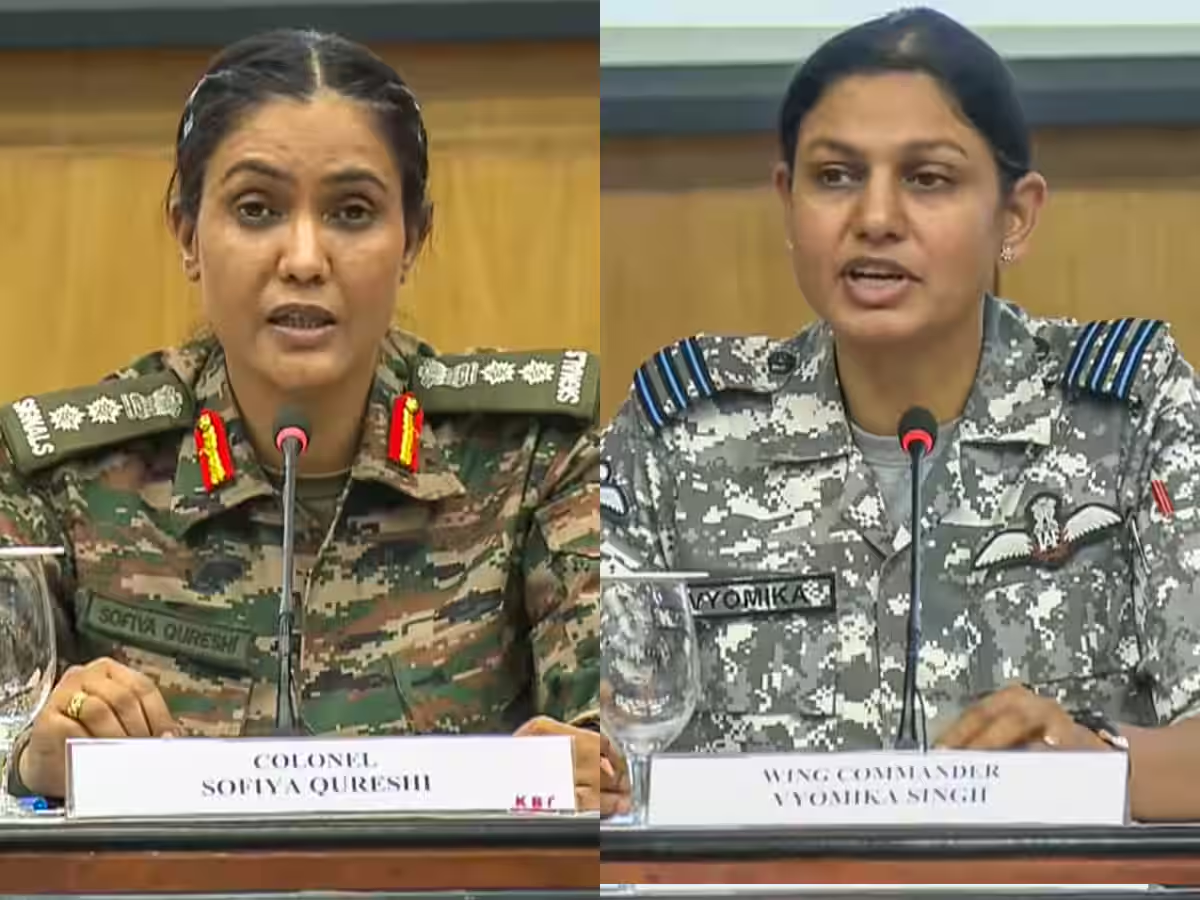
Colonel Sofiya Qureshi gained prominence as the first woman officer to lead an Indian Army contingent in a multinational military exercise. An officer of the Corps of Signals, she later represented the Army in strategic briefings, reinforcing confidence in women officers in high-responsibility communication roles.
Similarly, Colonel Geeta Rana became one of the first women officers selected to command an independent field unit following the Supreme Court ruling on Permanent Commission.
Her appointment reflected the transition from symbolic participation to substantive command authority. At the foundational stage of transformation, Priya Jhingan, often referred to as “Lady Cadet No. 001,” holds historical significance as one of the first women inducted into the Army in 1992. Her pioneering entry paved the way for subsequent generations.
Together, these officers represent layered transformation from medical leadership to glacier deployment, from parade command to field unit command. Their careers demonstrate that the breaking of barriers has evolved from symbolic milestones into operational normalization. The journey toward full parity continues.
Ongoing discussions regarding expanded combat roles and equal opportunity across all arms reflect institutional introspection. Such debates signify maturity rather than discord. A confident institution evaluates reform while safeguarding its core ethos. Ultimately, the story of women officers and soldiers in the Indian Army is one of disciplined transformation.
It reflects an institution rooted in tradition yet responsive to constitutional values. It demonstrates that strength and equality are not opposing forces but complementary pillars of modern nationhood.
Breaking barriers is not an event but a sustained process. Each batch of women cadets entering military academies adds to a growing legacy of perseverance. Each command appointment reinforces institutional credibility.
Each woman officer addressing a gathering in a remote border village reshapes imagination. When the olive-green uniform is worn by sons and daughters alike, the message is unmistakable: national service belongs to all.
The evolution of women’s leadership within the Indian Army affirms that professionalism, dedication, and courage transcend gender and that the future of national defence is strengthened, not diminished, by inclusion.