
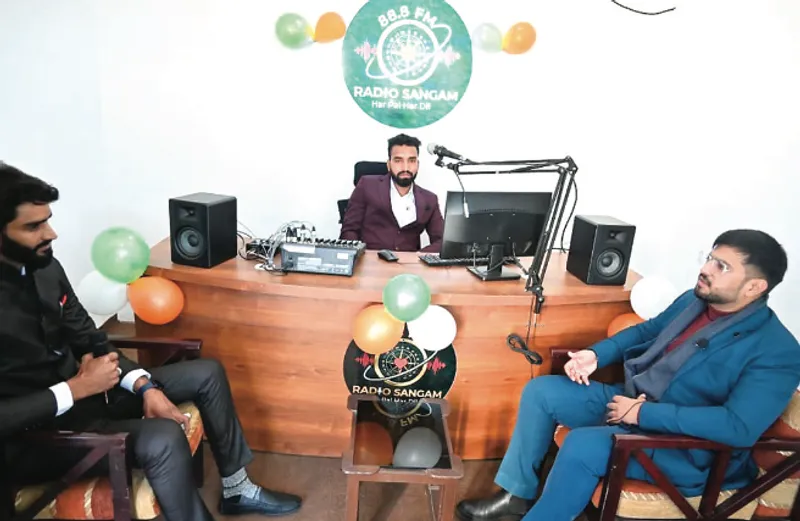
Community Radio Stations (CRS) represent one of the most localized and participatory forms of media within India’s communication ecosystem. Unlike commercial broadcasting, which prioritizes mass markets, or national broadcasting that operates at scale, community radio is hyper-local, low-power, and community-owned in spirit.
Its relevance becomes particularly pronounced in geographically remote, socio-economically vulnerable, and border regions where information asymmetry often limits access to government schemes, public services, and credible news.
In such settings, CRS serves as a vital bridge between policy architecture and lived experience. India’s community radio policy framework enables educational institutions, non-profit organizations, and community-based groups to establish stations tailored to specific local populations. Operating within limited transmission radii and covering nearby villages, these stations produce content in local languages and dialects, ensuring cultural relatability and accessibility.
This linguistic intimacy distinguishes community radio from mainstream media and builds a foundation of trust among listeners. In border districts, terrain barriers, intermittent internet access, and limited newspaper circulation frequently restrict information flow. Community radio mitigates these constraints by broadcasting government advisories, agricultural guidance, health awareness campaigns, skill-development opportunities, and disaster alerts.
In regions prone to natural disasters or security-related disruptions, CRS functions as a real-time information lifeline. Timely and verified announcements reduce panic, counter misinformation, and enable coordinated community responses. One of the most significant contributions of CRS lies in translating complex policy frameworks into accessible communication.
Government schemes often involve eligibility criteria, documentation processes, and procedural formalities that can appear overwhelming to rural residents. Community radio simplifies these complexities through storytelling, interviews with local officials, interactive question-and-answer sessions, and dramatized explanations.
Instead of abstract administrative language, listeners hear relatable narratives that clarify benefits and processes. This reduces exclusion caused by lack of awareness and enhances effective implementation at the grassroots level.
CRS also strengthens participatory democracy by facilitating two-way communication. Listeners can call in, share grievances, seek clarifications, and suggest discussion topics. Such engagement enhances transparency and accountability. When citizens understand their entitlements and responsibilities, leakages decline and governance outcomes improve.
In this manner, community radio becomes not just an information platform but a participatory civic space. Women and youth engagement is another defining dimension of community radio. CRS initiatives frequently train local volunteers in scripting, recording, editing, and anchoring programs. Young participants acquire technical and communication skills that enhance employability and confidence. Women-led broadcasts address maternal health, sanitation, nutrition, education, financial literacy, and social challenges that may otherwise remain under-discussed in conservative settings.
The microphone becomes a tool of empowerment, enabling marginalized voices to shape discourse and influence community priorities. In sensitive border environments where rumour and misinformation can spread rapidly, trusted local broadcasting plays a stabilizing role. Because CRS is rooted in community credibility, its messaging carries authenticity and acceptance. It can dispel false narratives, clarify official announcements, and reinforce calm during periods of tension. This localized counter-narrative capacity carries strategic significance in frontier regions.
Culturally, community radio preserves oral traditions, folk music, poetry, and dialect storytelling. By broadcasting local heritage and shared memories, CRS strengthens social cohesion and intergenerational continuity. When communities hear their own languages and lived experiences reflected on air, representation deepens belonging and reinforces identity.
Community radio initiatives in the Pir Panjal region, particularly Sadaa-e-Pir Panjal and Radio Pir Panjal, are playing a transformative role in strengthening grassroots communication across the border districts of Jammu & Kashmir. Operating in culturally rooted and linguistically familiar formats, these stations have emerged as trusted platforms for broadcasting educational content, health awareness programs, agricultural advisories, youth engagement discussions, and information about government welfare schemes.
In geographically sensitive areas where connectivity gaps and terrain barriers limit mainstream media outreach, these CRS platforms ensure that timely and verified information reaches remote villages. Beyond dissemination, they nurture local talent by training youth as radio jockeys, content creators, and technical operators, fostering community ownership and skill development.
By promoting local culture, countering misinformation, and encouraging participatory dialogue, Sadaa-e-Pir Panjaal and Radio Pir Panjaal are not merely broadcasting stations they are instruments of social cohesion, democratic awareness, and developmental empowerment in the border belt.