
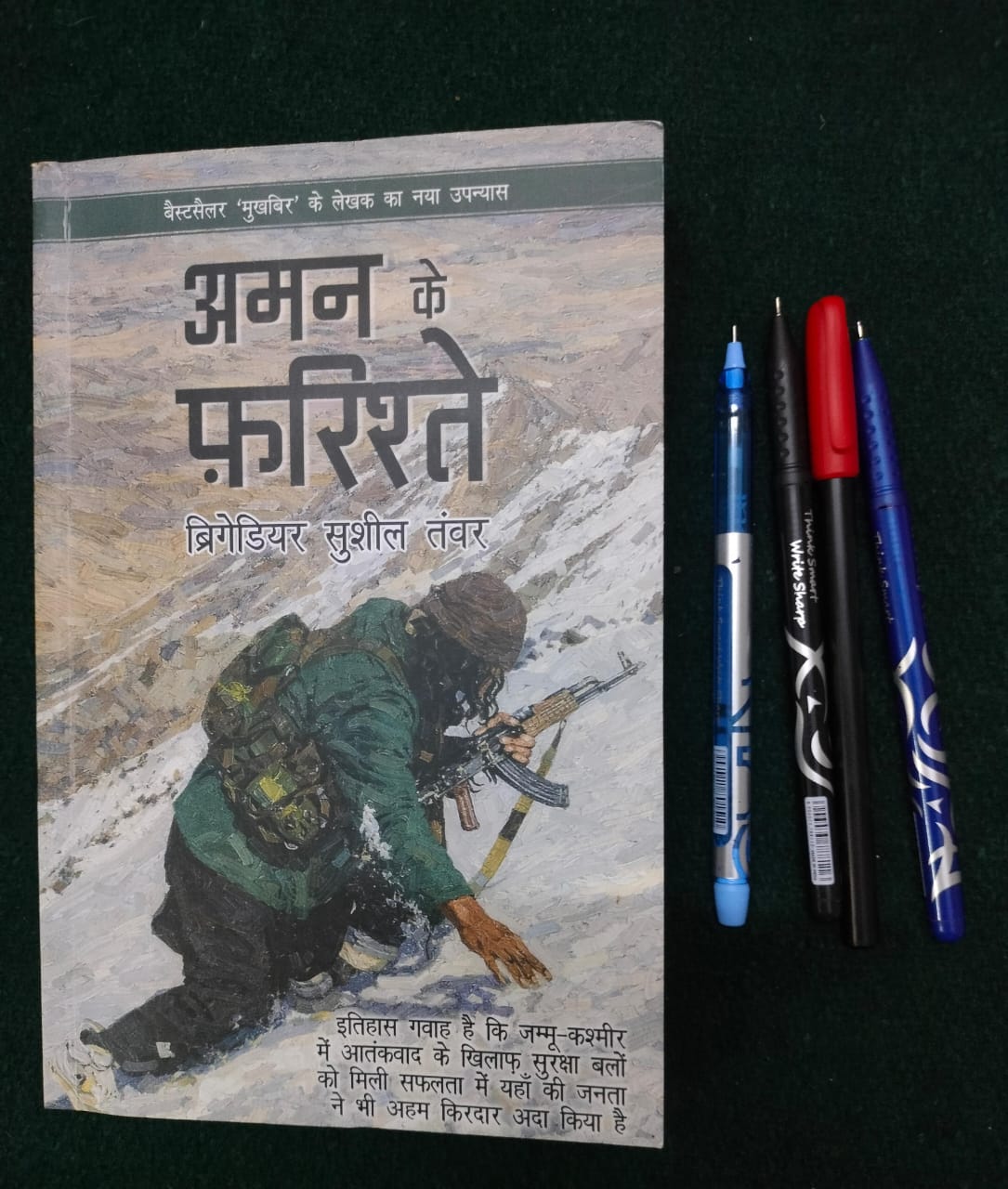
Aman Ke Farishtey by Brigadier Sushil Tanwar, in my view, is not just a novel it is a reflection of a reality that many people hear about, but very few truly understand.
The book connects deeply with the ground situation of the Peer Panjaal region, especially areas like Poonch and Rajouri, where the fight against terrorism has been long, complex, and ongoing.
As I read the book, I felt that it closely matches the realities we have seen and lived ourselves.
The story of Surankote is not just fiction it reflects real conditions shaped by incidents like the brutal ambush near Dera Ki Gali, where District and Sessions Judge Vijay Kumar Phool was killed along with his security personnel and a companion in 2001.
This was not just an attack, but a clear sign of how strong and organised the terror network had become in the Peer Panjaal belt and locals used to call Surankote as “Chota Pakistan”.
The book presents this terror ecosystem very realistically. The way it describes hidden camps, communication systems, and the role of terrain matches what actually existed on the ground before major operations like Operation Sarp Vinash.
The connection with the Hill kaka area and the destruction of terrorist infrastructure during that operation is clearly reflected in the story.
For me, the character of Captain Ashish Chauhan is not just a hero of the story he represents how intelligence officers actually evolve in such situations. He starts as a young and energetic officer but slowly becomes more careful, practical, and strong.
His personality shows two sides he is kind and understanding with local people, but during operations he becomes strict and focused. This shows the real mental pressure and responsibility that officers carry in such conflict zones.
What makes this book even more personal for us is that we are the people who have faced the maximum impact of Pakistan-backed proxy groups active in the Peer Panjaal region. I still remember the time when vehicles were not allowed to move on roads after 4:00 PM.
Fear was real, and daily life was controlled by the presence of terrorism. Movement, trade, education everything was affected.
One of the most understated yet powerful aspects of Aman Ke Farishtey is how it quietly brings alive the cultural fabric of the Peer Panjaal region.
Without long descriptions or forced explanations, the narrative naturally weaves in elements like the warmth of noon chai shared in local homes, the distant yet familiar call of the azaan echoing through the valleys, and the discipline and devotion of roza during Ramadan.
These moments may appear small, but they add depth to the story, reminding the reader that beyond operations, intelligence networks, and conflict, there exists a living, breathing society rooted in tradition and faith.
This subtle portrayal makes the story more authentic, showing that even in areas affected by terrorism, daily life continues with dignity, culture, and resilience.
Those who have not lived through that time may read this book as a story, but for us, it is a memory. That is why Operation Sarp Vinash was not just a military success it was a turning point in our lives. It did not only destroy terror modules; it became the stepping stone towards peace in the region.
It broke the backbone of organized terrorism in the hills and gave people the confidence to live normally again. The silence of guns that followed was not accidental it was earned through sacrifice and planning.
One of the strongest points of the book, in my opinion, is its focus on local people. The informers, or Mukhbirs, and ordinary civilians are shown as key players in maintaining peace. In the Peer Panjaal region, where it is not possible to have army presence everywhere due to tough terrain, it is the trust between people and forces that becomes most important. The book clearly shows that intelligence is built on relationships, not just surveillance.
But where my thinking goes beyond the book is in what happened after the period it shows. The novel reflects a time when operations like Sarp Vinash had weakened terrorism and brought relative peace. However, after around 2005, this calm also gave time to Pakistan’s ISI to rethink and rebuild its strategy.
Over the next fifteen years, a new kind of threat developed a hybrid terror ecosystem. This system is not as visible as before. It works through small groups, local support, and sudden attacks.
Because of this, even today, the region continues to face challenges. More than sixty people have lost their lives in the Peer Panjaal region in recent years. This shows that even though the old structure of terrorism was destroyed, a new form has emerged and is still active.
In this context, Aman Ke Farishtey becomes even more important. It helps us understand how such systems work from building trust to gathering intelligence and handling human emotions.
The Rajouri Poonch belt of the Peer Panjaal region has witnessed a clear shift in the nature of terrorism from silent rebuilding to high-impact attacks and now to a more decentralised hybrid model.
The early years saw infiltration and quiet revival of networks, but by 2023 the region experienced a sharp escalation with incidents like the Dhangri civilian killings, the Bhata Dhurian ambush, and the Dera Ki Gali attack, where both civilians and security forces were targeted with precision. These attacks were marked by the use of forest cover, elevated positions, and detailed surveillance, showing deep familiarity with terrain.
Encounters in areas like Kalakote and the Shah Satar forest belt further highlighted how terrorists had shifted into dense interiors, avoiding permanent bases and operating in small, mobile groups.
In the years that followed, the pattern evolved further fewer large attacks but a sustained presence through hidden modules, overground worker networks, and sporadic strikes.
This evolution makes one thing clear terrorism in the Peer Panjaal has not disappeared; it has adapted, and continues to operate in a more covert but equally dangerous form, constantly testing the security grid and the resilience of the region.
In the Peer Panjaal region, one of the most critical lessons from years of counter-terror operations is that human intelligence remains irreplaceable.
While technology, surveillance systems, and artificial intelligence have strengthened monitoring and detection capabilities, they cannot substitute the depth, accuracy, and context that comes from human sources.
Information shared by locals, informers, and ground-level networks carries insights that no sensor or algorithm can fully capture intent, behaviour, trust, and hidden movements within communities.
In such terrain, where dense forests and scattered habitations limit technological reach, it is human intelligence that has consistently played a decisive role in identifying threats and preventing attacks.
Over-reliance on technology without strengthening human intelligence networks can create blind spots, because machines may detect movement, but only humans can interpret motives.
This reality reinforces a fundamental truth of counter-insurgency in the Peer Panjaal peace and security are ultimately sustained not just by systems and tools, but by people, trust, and timely human inputs.
At the same time, it also indirectly shows how these systems can return if constant attention is not given.
The characters in the book like Sarpanch Nur Mohammad, Bashir Lohar, Hamid, and Ashraf Ghazi show different sides of society in conflict areas. Some choose peace, some choose violence, and some are caught in between. Their stories make it clear that the situation on the ground is never simple.
What I believe strongly is this no one can connect with Aman Ke Farishtey more deeply than the residents of Rajouri and Poonch. For others, it may be a well-written novel, but for us, it is a lived experience put into words. It reflects our past, explains our present, and warns us about the future.
In the end, the book is both a tribute and a reminder. It is a tribute to those who worked silently, officers, informers, and ordinary people to bring peace. And it is a reminder that peace in the Peer Panjaal is not permanent; it has to be protected every day.
The story of our region is still being written and Aman Ke Farishtey helps the world understand it.