
What we are witnessing today is not merely West Asia being dragged into war by Israel and America. That is the surface. Beneath it lies a deeper and more calculated reality a global system where conflict is increasingly intertwined with commerce, particularly the commerce of weapons.
Wars are no longer just fought on ideological or territorial grounds. They are sustained, prolonged, and at times conveniently escalated in a way that keeps the global defence industry alive and thriving.
Asian countries, many of them developing and already burdened with internal challenges, are gradually being pulled into this cycle forced to upgrade arsenals, sign defence deals, and align with powerful military-industrial blocs led by the United States, Israel, and their allies.
This is not to deny traditional causes of conflict, but to acknowledge that modern warfare has acquired an economic dimension that cannot be ignored.
In this evolving global order, the Indian subcontinent remains one of the most sensitive flashpoints. India and Pakistan, despite decades of hostility, have largely avoided full-scale war in recent years due to strategic restraint and nuclear deterrence.
Yet, the underlying tensions have never disappeared.
Today, the situation feels different.
Diplomacy appears weakened. Global institutions that once acted as buffers are losing their moral authority. The language of negotiation is being replaced by the language of assertion.
In such an environment, even a minor trigger has the potential to escalate disproportionately.
To assume that confrontation is impossible would be naive.
To ignore the changing nature of that confrontation would be even more dangerous.
There was a time when institutions like the United Nations symbolized collective global conscience, and alliances like NATO operated within defined strategic limits.
Today, their relevance is increasingly questioned.
Resolutions are passed but rarely enforced. Conflicts continue despite international outrage. Power has become more unilateral, less accountable, and more openly driven by national interest than ever before.
When global moderators weaken, regional tensions intensify. Developing regions especially in Asia become the most vulnerable to this shift.
At the same time, one cannot ignore the undercurrent within India itself. A nation as vast and diverse as India naturally carries multiple layers of political, social, and economic tensions.
Elections across regions, rising political polarization, and the constant churn of public sentiment create an environment where internal narratives can quickly intersect with external pressures.
The challenge is not just to recognize this undercurrent, but to understand how it can be managed with vision, responsibility, and long-term thinking something that often gets overshadowed in the immediacy of electoral politics.
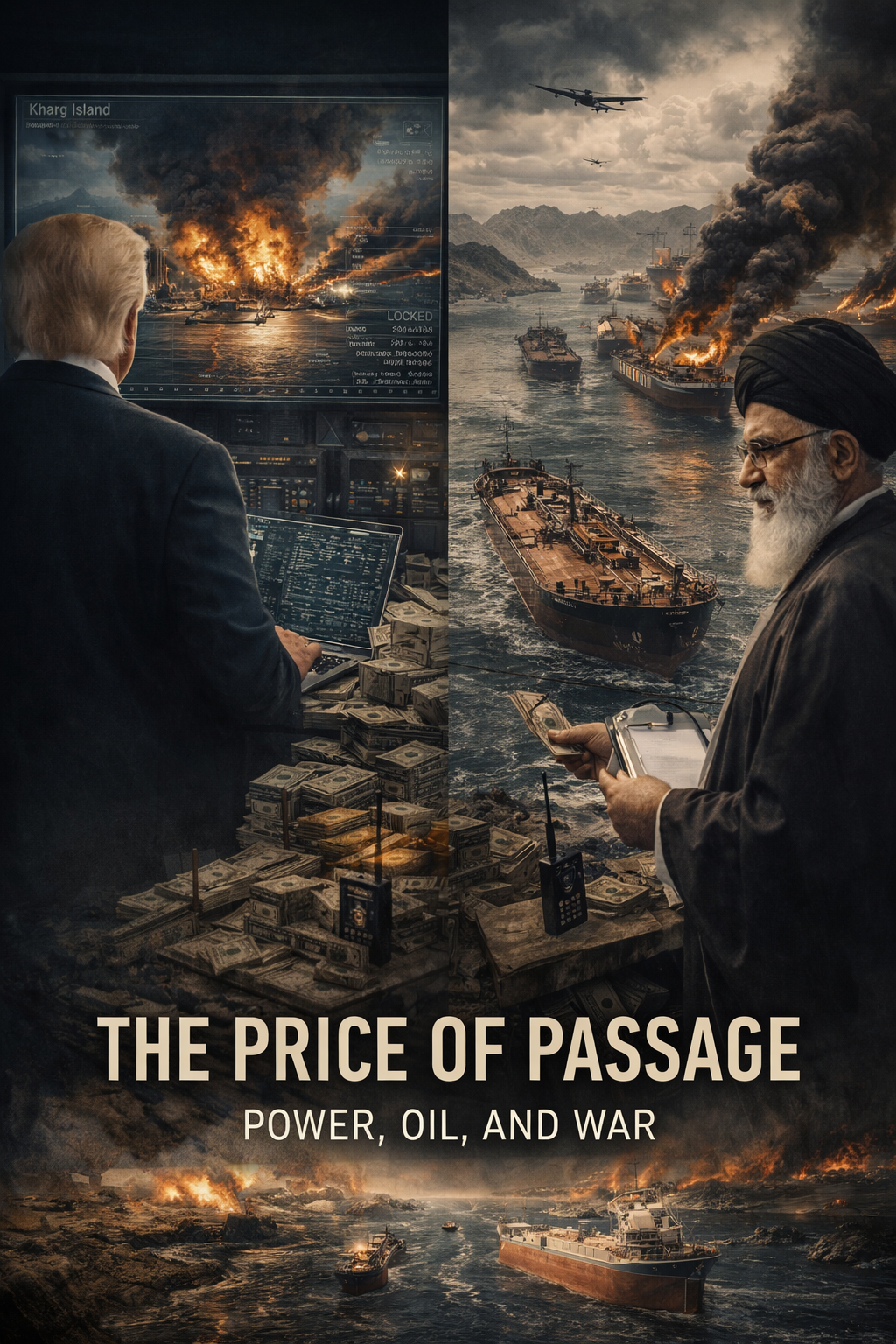
The immediate aftermath of a direct military confrontation between Israel, the United States, and Iran has extended far beyond the battlefield. Strategic assets such as oil terminals, ports, and critical infrastructure have become primary targets, disrupting not only regional stability but also global energy lifelines.
The Strait of Hormuz through which a significant portion of the world’s oil supply passes is witnessing heightened militarization and temporary closures.
Such a scenario has not just escalated tensions in West Asia but sent shockwaves across continents, affecting supply chains, shipping routes, and geopolitical alignments.
Global markets are reacting with immediate volatility. Oil prices have surged unpredictably, impacting everything from transportation to manufacturing costs worldwide. Stock markets, particularly in emerging economies, are experiencing sharp fluctuations as investor confidence is weakening.
Inflationary pressures is intensifying, currencies destabilizing, and nations heavily dependent on energy imports are facing severe economic strain. In such a climate, the defence industry is paradoxically witnessing accelerated growth, as countries are rushing to secure military capabilities amid rising uncertainty, further reinforcing the cycle where conflict and commerce feed into each other.
For India, the implications are both complex and critical. As a major energy importer with deep economic and diaspora ties to West Asia, India has to navigate a delicate balance between strategic autonomy and global alignment.
Ensuring energy security, protecting trade routes, and safeguarding Indian nationals in the region has to become immediate priorities.
At the same time, this evolving situation underscores the need for India to strengthen internal resilience, economically, politically, and militarily, while continuing to advocate for diplomatic stability.
The key takeaway is clear: in a world where conflict is increasingly systemic, India’s greatest strength will lie not just in its power, but in its ability to anticipate, adapt, and act with strategic foresight.
The experiences of Afghanistan, the Kurds, Iraq, Pakistan, Bangladesh, Nepal, Afghanistan again under shifting power games, and South Lebanon demonstrate a consistent principle America and Israel ultimately prioritize their strategic interests over alliance loyalty.
Partnerships are transactional, not emotional. That is the hard grammar of geopolitics.
For India, the key lesson is not distrust but preparedness.
India must cooperate where cooperation strengthens us.
India must benefit where engagement delivers technology, defence capability, intelligence, agriculture innovation, and economic growth.
But India must never become dependent.
An Israel policy in India that appears one-dimensional or overly aligned cannot succeed in the long run.
India’s greatest strength has always been strategic autonomy the ability to maintain relations with Israel, Iran, the Gulf, Russia, and America simultaneously without surrendering sovereign decision-making.
If we move as if we are operating from the playbook of an American think tank, even when certain strategic reports categorize India Pakistan conflict scenarios in secondary tiers of priority, we risk reducing our diplomatic flexibility. No major power writes another nation’s grand strategy for its benefit alone.
Internal security challenges today are far more complex than external threats.
Emotional narratives imported from foreign battlefields can create internal fault lines.
Social cohesion, intelligence preparedness, cyber monitoring, economic resilience, and border management must receive more attention than symbolic foreign policy optics.
There is also the larger strategic question of regional balance.
America’s fluctuating engagement with Pakistan over decades shows how regional equations are adjusted according to larger global interests. India must remain alert, self-reliant, and confident not reactive.
BRICS, despite its promise, has struggled to fully achieve its core agenda of counterbalancing Western-led institutions and building a truly multipolar order with stronger Global South representation.
Multipolarity cannot be declared; it must be built through economic power, institutional depth, and long-term strategy.
Perhaps the most striking reality of our times is this: nations are no longer pretending.
Political agendas are no longer hidden behind diplomacy they are increasingly visible, unapologetic, and assertive.
Alliances are shaped by interest, not ideology.
Conflicts are justified in the language of security, but often sustained by deeper strategic and economic motivations.
This is a world stripped of illusions.
This is not a call for fear, but for awareness.
Understanding the changing nature of global conflict is essential, especially for countries like India that sit at the intersection of multiple geopolitical pressures.
The future will not be shaped merely by military strength, but by strategic clarity, internal stability, and the ability to navigate a world where the lines between war, economics, and politics are increasingly blurred.
In such a world, the biggest risk is not conflict itself but failing to understand the forces driving it.