
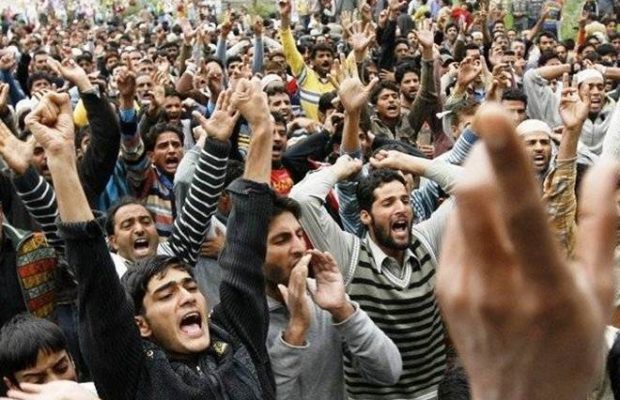
In occupied Gilgit-Baltistan, protests were held against the worst inflation, rising petroleum prices, power load shedding and water scarcity.People of occupied Gilgit-Baltistan once again took to the streets, protesting against the worst inflation, sharp hike in prices of petroleum products, power load shedding and water scarcity.People from various political and religious parties as well as the Association of Traders’ Trade Union and other schools of thought participated.Protests were organised by civil society Baltistan while there are reports that there was a protest by the Action Committee at the main market in Gilgit as well.
Why enforced disappearances in Pakistan go unpunished

Islamabad High Court [IHC] Chief Justice Athar Minallah’s directions that the Federal Government should serve notices on General Pervez Musharraf and all other “successor Chief Executives” [former Prime Ministers] to explain why legal proceedings should not be initiated against them for alleged “subversion of the Constitution” through “undeclared tacit approval of the policy regarding enforced disappearances,” is indeed praise worthy. Yet, despite Chief Justice [CJ] Minallah’s well-meaning and determined legal crusade against the rampant scourge of enforced disappearances in Pakistan, to expect that this repulsive trend would now become extinct, may well turn out to be a case of gross overoptimism.
In democracies, the ultimate responsibility for actions of the various organs of state rests on the elected government and hence, holding those who served as ‘chief executives’ and prime ministers responsible for their failure to prevent enforced disappearances, is perfectly in order. However, those heading the organ responsible for this horrific crime against humanity too have a constitutional responsibility in ensuring that their respective departments function efficiently and remain within the ambit of law.
Unfortunately, due the legislature being firmly under the army’s control, Pakistan isn’t exactly what a democracy should be. Consequently, prime ministers sitting in Islamabad have just no control over the Generals in Rawalpindi whose officers and soldiers are unabashedly following the barbaric strategy of using enforced disappearances as a tool to terrorise into submission, marginalised and persecuted communities, compelled to pick up guns against the state. So, making prime ministers the sole fall-guys as far as enforced disappearances are concerned may not be fair.
In his court order, IHC CJ Minallah has justified this action by stating that the government’s “undeclared tacit approval” of enforced disappearances is tantamount to “high treason” as it was “putting national security at risk by allowing the involvement of law enforcing agencies, particularly the Armed Forces.” While legal experts may be in a better position to analyse and comment on this issue, but for a layman, this court order seems to have summarily absolved the army’s top brass of any culpability in this case.
It’s no secret that the Pakistan army [alongwith intelligence agencies and paramilitary forces under its command] is brazenly orchestrating enforced disappearances by its own volition and without any reference to, or sanction from, the government. So, isn’t it strange that even when prime ministers have neither any direct/ indirect role, nor the knowledge of such acts, they would still be held responsible for enforced disappearances?
In his court orders, the IHC CJ has accepted the “involvement of law enforcing agencies, particularly the Armed Forces,” in enforced disappearances. Hence, alongwith the prime ministers, who on account of being the functional heads of the government, shouldn’t army chiefs who too are responsible for the unsoldierly-conduct of armed forces, para militaries and intelligence agencies they command also come under the accountability purview?
This is why CJ Minallah’s failure in directing the Federal Government to seek an explanation from Pakistan army chiefs as to why legal proceedings should not be initiated against them for enforced disappearances, is to say the least, inexplicable. Furthermore, doesn’t such a palpably subjective approach further reinforce IHC judge Justice Shaukat Aziz Siddiqui’s admission before the Rawalpindi Bar Association in 2018 that “Today the judiciary and media have come in the control of ‘Bandookwala’ [army] and that “In different cases, the ISI forms benches of its choice to get desired results”?
The Pakistan army itself doesn’t seem to have any qualms in admitting involvement of its rank and file in enforced disappearances. In 2019, while answering a question on this very issue, the then former Director General [DG] of Pakistan army’s media wing Inter Services Public Relations [ISPR] Maj Gen Asif Ghafoor officially acknowledged the army’s complicity in orchestrating enforced disappearances in Pakistan by saying “We don’t want any person to go missing but where there is a war, you have to do a number of [undesirable] things.”
Infact, airing Pakistan army’s collective view of being above the law, the DGISPR had the gall to justify enforced disappearances by saying, “It is said that everything is fair in love and war. War occurs to be ruthless”! Yet, for reasons unknown, the otherwise proactive judiciary in Pakistan failed to take suo moto cognisance of the army’s official spokesperson’s incriminating admissions regarding enforced disappearances.
Could this be a possible manifestation of Justice Siddiqui’s assertion that Pakistan’s judiciary is being controlled by “bandookwallas”?
Readers may recall that Rawalpindi took umbrage to Justice Siddiqui’s accusations of judicial interference levelled against the Pakistan army [in general] and ISI [in particular]. DGISPR issued a statement criticising the comments made by the IHC Justice and informing everyone that “honourable Supreme Court of Pakistan [SPC] has been requested [ by Pakistan army] to initiate appropriate process to ascertain the veracity of the allegations and take actions accordingly.”
What investigations were carried out by SCP with respect to Justice Siddiqui’s claims, or its findings of whether his allegations are true or false haven’t been made public. However, it would be logical to assume that if found guilty, then SCP should have proceeded against him to “safeguard the sanctity and credibility of the state institutions,” [as requested by the Pakistan army]. However, if Justice Siddiqui’s assertion were credible, then he should have been allowed to continue in office after being privately counselled by the Chief Justice of Pakistan to be more discreet while commenting on any military related issues.
However, neither happened. Instead, in a surprising move, Supreme Judicial Council of Pakistan recommended Justice Siddiqui’s removal from office for “displaying a conduct unbecoming of a judge” [without providing any further details to justify this decision], and the President of Pakistan unquestioningly and promptly accepted the same. So, expressing scepticism on the outcome of IHC CJ Minallah’s initiative to rid Pakistan of the enforced menace, isn’t being pessimistic- it’s being realistic, because at the end of the day, one thing is certain- in Pakistan, it doesn’t pay to mess around with the army.
And if you still don’t believe me, ask former prime ministers Nawaz Sharif and Imran Khan Niazi!
Kashmiri Pandits must be armed for self defence
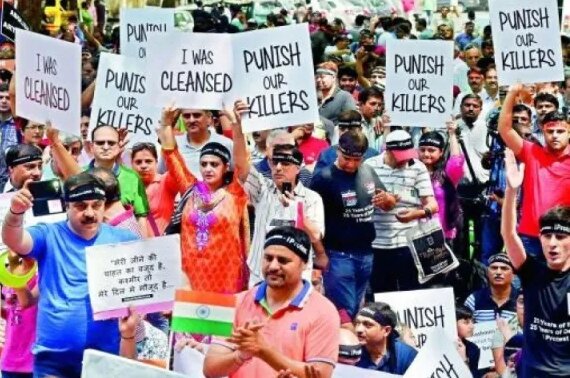
Killings in cold-blood continue unabated in the Kashmir valley. In the last few months a lot of innocent lives have succumbed in Kashmir to the hatred of a few and designs of some state and non-state actors. Vijay Kumar a bank employee in Kulgam, Rahul Bhat a Kashmiri Hindu Pandit Clerk in Budgam, a Hindu lady school teacher, Hindu migrant laborer, the list is growing by the day. What to think of men who would shoot at unsuspecting and unarmed men and women – brazen impotence and sheer madness? Sympathetic Muslims and non-Muslims have become targets of the terrorist attacks.
It is quite evident that the terror acts have been perpetrated to convey a message and the message is pretty much the same (since 1990s) – “Leave Kashmir or die”.
The ability to strike at a time and place of one’s choosing at un-suspecting targets may be easy, but can it be executed with such impunity without the active support of some locals?
Reasons for Increasing Terrorist Attacks
(a) Proclaim a challenge to a strong central political leadership that revoked Article 370.
(b) Angst over revocation of Article 370.
(c) Angst over return of Kashmiri Hindu Pandits back to the Kashmir valley.
(d) Challenge rehabilitation efforts of Kashmiri Hindu Pandit.
(e) Make local administration’s job difficult.
(f) Prevent influx of non-native business and industry.
(g) Make the destination un-attractive for foreign investment.
(h) Reset the environment within the Kashmir valley to the times when terror reigned supreme.
(i) De-stabilise the return of Kashmiri awam to the mainstream.
It is for the political dispensation to conceive of a solution to this prolonged stratagem of terror by our foes. To battle a diabolic design, seemingly draconian solutions may have to be adopted. The use of technology like facial recognition to combat terror is already employed by countries like the USA.
Possible solutions
(a) Arm the Kashmiri Hindu Pandit both physically and mentally. Train them on the use of fire arms, use of communication systems, etc., for their self-protection.
(b) Identification of vulnerable persons, communities, pockets of habitation that require protection and arrange for the same as practicable.
(c) Establish a larger and more effective local spy network.
(d) Use of technology such as facial recognition (FACE).
(e) Use of drones for surveillance by day and night.
(f) Use of armed drones for deterrence.
Response of all stakeholders shall have a bearing to the Kashmir woe. The Government of India and Administrator of Kashmir, majority community, minority communities, security forces, intelligence agencies and media – all need to play their parts diligently to ensure peace and progress.
The government has to communicate to the Kashmiri awam very clearly their objectives and methodologies for achieving those objectives. That must necessarily include their views on taking all communities together, handling dissent, and managing disturbance & terrorism. A clear communication is vital to keep distrust at bay and give a chance for all communities and enterprises to thrive in fairness. The need to balance securing freedom / viewpoints of minority communities against protecting legitimate interests / viewpoints of majority will be a challenge to contend with. The use of pervasive technologies like FACE that are invasive in nature ought to be undertaken with empathy and ethically. The need to dispel concerns of people abundantly before deploying such technology cannot be over-emphasized.
Understanding needs to dawn on the majority community that their progress is tied to the progress of other minority communities in the region. In a spirit of brotherhood, the conscientious ought to be more vocal in their support to the minorities and make genuine efforts to integrate the minorities. Only a people’s movement that propagates shunning of hate and violence can change the tide.
The chorus call of the Kashmiri Hindu Pandit community to the government for protection, or witness another mass exodus of the community from the valley is questionable. The community needs to understand that the meek will be bullied. They have to stand up on their two feet and “face the devil if not take the fight to him”. They have to stop running, become mentally strong and rise up to the occasion. The government, administration and the security forces can only provide protection as much as their bandwidths permit. To expect protection all times of day and night and at every nook and cranny is being unreal. Therefore, the Kashmiri Hindu Pandit community needs to train themselves for self-protection and become self-reliant. Sacrifices will have to be made. The community will have to be prepared for the same. Time demands they be brave and fight for survival and for their homeland. They have the backing of the government, security apparatus and the people of India, this time round. If they choose to get bullied, their survival in Kashmir will be jeopardized permanently. So, it is time for Kashmiri Hindu Pandit to stop threatening the government about mass exodus and face the challenge squarely.
Winning hearts and minds of the local population while discharging their duties firmly is a “constant” that security forces have to deliver on. Coordination between the administration, army, police, state intelligence bureau and other security forces and their integration over technology platforms like facial recognition and other surveillance grids will require diligence and maturity.
Time appears ripe for highlighting and effectively publicizing the plight of Kashmiris in PoK to the Kashmiri awam and the politico-socio-economic state of Pakistan. Native media has an onerous role to play in showcasing the evolution of a failed state like Pakistan and benefits of a mature democracy like India.Kashmir was and has always been an integral and inalienable part of India. The prosperity of Kashmir rests on the shoulders of all stakeholders and their ability to live with “plurality”.
Prof. Vaknin on Misogyny and Misandry

Prof. Shmuel “Sam” Vaknin (YouTube, Twitter, Instagram, Facebook, Amazon, LinkedIn, Google Scholar) is the author of Malignant Self-love: Narcissism Revisited (Amazon) and After the Rain: How the West Lost the East (Amazon) as well as many other books and ebooks about topics in psychology, relationships, philosophy, economics, international affairs, and award-winning short fiction. He was Senior Business Correspondent for United Press International (February, 2001 – April, 2003), CEO of Narcissus Publications (April, 1997 – April 2013), Editor-in-Chief of Global Politician (January, 2011 -), a columnist for PopMatters, eBookWeb, Bellaonline, and Central Europe Review, an editor for The Open Directory and Suite101 (Categories: Mental Health and Central East Europe), and a contributor to Middle East Times, a contributing writer to The American Chronicle Media Group, Columnist and Analyst for Nova Makedonija, Fokus, and Kapital, Founding Analyst of The Analyst Network, former president of the Israeli chapter of the Unification Church‘s Professors for World Peace Academy, and served in the Israeli Defense Forces (1979-1982). He has been awarded Israel’s Council of Culture and Art Prize for Maiden Prose (1997), The Rotary Club Award for Social Studies (1976), and the Bilateral Relations Studies Award of the American Embassy in Israel (1978), among other awards. He is Visiting Professor of Psychology, Southern Federal University, Rostov-on-Don, Russia (September, 2017 to present), Professor of Finance and Psychology in SIAS-CIAPS (Centre for International Advanced and Professional Studies) (April, 2012 to present), a Senior Correspondent for New York Daily Sun (January, 2015 – Present), and Columnist for Allied Newspapers Group (January, 2015 – Present). He lives in Skopje, North Macedonia with his wife, Lidija Rangelovska. Here we talk about misogyny and misandry.
*Previous interviews listed chronologically after interview.*
Scott Douglas Jacobsen: Misogyny and misandry, what defines them?
Prof. Shmuel “Sam” Vaknin: Misogyny and misandry are forms of inverted gender dysphoria, actually. It is hatred, resentment, and revulsion brought on by the opposite sex. It encompasses all aspects and dimensions of the hate figure and in this sense, it is akin to racism.
Jacobsen: Historically, how have misogyny and misandry manifested in partnerships, in individual social settings, and in cultures at large?
Vaknin: Misogyny has been the patriarchal organizing principles of all societies from the agricultural revolution to this very day. It permeated all institutions, from the family to the Church to the state.
Misogyny was mainly intended to restrict the freedoms of women in order to prevent them from procreating extradyadically and thus secure the intergenerational transfer of wealth to the male’s rightful offspring.
Misandry is the reaction of some waves of feminism in the past 150 years or so. It is visceral and bitter, but not nearly as organized and institutionalized as misogyny.
Recently both are on the increase.
Jacobsen: As you note in several productions, there are obvious cases of a ‘rollback’ of women’s rights in the United States through murmurings of repeals of Roe v Wade and in state legislatures, in Russia with the (re-)legalization – in a manner of speaking – of domestic abuse, in Afghanistan with women confined to the home, in Ethiopia with sexual violence (by Ethiopian and Eritrean forces), in Turkey via withdrawal from the Istanbul Convention, and in online hate groups comprised of resentful, bitter, anomic, hopeless, potentially mentally ill, batches of men in MGTOW (Men Going Their Own Way), Black Pillers, Red Pillers, Incels (Involuntary Celibates), generic male supremacists, PUAs (Pick Up Artists), MRM men (Men’s Rights Movement), TFLers (True Forced Loners), and so on. These men, young and old alike, seem composed of anomie, despair, and porcelain, transmogrified into contempt for the Other. Do these seem like a disunified variegated ‘wave’ of anti-women sentiments and acts by men online and offline around the world?
Vaknin: Some men are fighting back against what they perceive to be the ominous usurpation of rights and powers by women. They are also aghast at the way women have appropriated stereotypical male behaviors, such as promiscuity.
The counter-movement started off in disparate groups but now has coalesced into an agenda that is promoted by lawmakers all over the world. The backlash is fierce. Men are still the gatekeepers in most countries in the world. This doesn’t bode well for women. Legal rights and access to services such as healthcare and educations are being rolled back and freedoms are curtailed.
Women are bound to be radicalized by such counter-reform. They are likely to become way more militant and masculinized. They are shunning men in growing numbers and resorting to male substitutes even when it comes to procreation: donor sperm and IVF.
Jacobsen: What seems like the psychology of the men with the authority to impose these ‘rollbacks’ in legislation and socio-cultural life?
Vaknin: This is a state of panic, both moral and operational. Inter-gender morality was imposed by men in order to preserve the “purity” of women and their role as domestic comforters-in-chief. As power shifted from men to women, this ideal has been shattered.
Moreover, women emulate aggressive, ambitious men. In multiple studies, women described themselves in exclusively masculine terms. They have been taking away men’s jobs for well over a hundred years now. They are way more educated than men so men feel absolutely threatened, very much like a species going extinct.
Men who react adversely to the ascendance of women and the emergence of a unigender world via legislation and politics are anxious, sociosexually restricted, narcissistic (but not psychopathic), insecure, and, in some cases, with a conflicted sexual and gender identity.
Jacobsen: What seems like the psychology of the men in these international, disparate online groups, who even create their own lingo, patois?
Vaknin: These are rabid misogynists who have created an ideology around their deep-seated, irrational, and pathological hatred. They have primitive defenses, are highly narcissistic and even psychopathic, and tend to externalize aggression. They tend to hold grudges and grievances, ruminate and fixate, and be vengeful and hypervigilant.
Jacobsen: You agree with First Wave Feminism and Second Wave Feminism, and disagree with Third Wave Feminism and Fourth Wave Feminism. What defines them?
Vaknin: First and second wave feminisms (in plural: there are many schools) were focused on leveling the playing field and fighting abusive and exploitative practices such as prostitution and pornography.
Starting with the suffragettes, they focused on the franchise (the right to vote), equal wages, access (to healthcare, education, the workplace, daycare), revising the dress code (“rational dress”), the right to own and dispose of property, and converting marriage from indentured bondage to an intimate, hopefully lifelong equal partnership.
The third wave was a psychopathic outgrowth. While claiming to be inclusive and permissive, it was a defiant and reckless attempt to “empower” women by eliminating all boundaries, conventions, and mores of any kind in all fields of life.
What women have garnered from the confluence of the three waves is that they should make their careers the pivot of their lives, avoid meaningful, committed relationships with men, and pursue sex as a pastime with any man.
Ironically, the third wave played right into the hands of predatory men (“players”) who took advantage of the newfangled promiscuity while assiduously avoiding any hint of commitment or investment. Third wave feminists internalized the male gaze (“internalized oppression”) and pride themselves on being “sluts”.
The fourth wave of feminism is focused on real problems such as sexual harassment, rape, and body shaming as well as intersectionality (discrimination of women who belong to more than one minority). In many ways, it is an offshoot of second wave feminism.
Jacobsen: Even within these four waves of feminism, what seem like the most laudable portions and the most contemptible parts of each?
Vaknin: First, second, and fourth wave feminisms are legitimate movements which have improved and strengthened societies around the world by integrating women in the social and economic fabrics of their milieus.
The third wave was utterly destructive. It hijacked the feminist message and precipitated the gender wars which are threatening to undo the accomplishments of the first and second waves.
Moreover: corporate interested coopted the messaging of the third wave to encourage women to remain single and promiscuous in order to encourage their participation in the labor force and thus convert them into consumers.
Jacobsen: Since history cannot be rewritten in actuality, though can be erased and rewritten in records, what might Fifth Wave Feminism incorporate as lessons from the previous four to correct course from the clear antipathy between the sexes – maintaining the proper equalitarian victories and jettisoning the improper inegalitarian losses?
Vaknin: Feminism needs to fight the patriarchy and its discriminatory practices – not men. It needs to recognize that men and women are equal, but not identical. It needs to encourage women to adopt boundaried sexuality and the formation of intimate partnerships, cohabitation households, and families with men (or women, if they are so inclined). It needs to expose the way business and the third wave end up disempowering women like never before.
Jacobsen: How can science on sex and gender clarify the fact from the fiction, as the sea floor of these waves – so to speak? Something to set limits on conversation based on reality in contrast to discourses entirely in the realm of fantasy.
Vaknin: I dealt with this at length in the interview I gave you about gender wars https://newsintervention.com/prof-sam-vaknin-on-the-gender-wars/
Jacobsen: How might such a fifth wave grounded in science inform international human rights discourse, national legislation, sociocultural lives, families, and individual self-identification?
Vaknin: Women are not a minority. Numerically, they are a majority. Their situation is reminiscent of apartheid in South Africa and needs to be tackled with the same tools: nonviolent resistance; truth and reconciliation; a peaceful and consensual transfer of power; an integrated society with no discrimination or subterfuge; equal rights and obligations while recognizing the uniqueness of each constituency.
Shoshanim: Thanks much, Prof. Samuel.
Vaknin: You are very welcome. May we both live to see the day men and women love each other the way they should.
Previous Electronic ‘Print’ Interviews (Hyperlinks Active for Titles)
“Prof. Sam Vaknin on Narcissism in General”
(News Intervention: January 28, 2022)
“Prof. Sam Vaknin on Cold Therapy (New Treatment Modality)”
(News Intervention: January 30, 2022)
“Prof. Sam Vaknin on Giftedness and IQ”
(News Intervention: February 2, 2022)
“Prof. Sam Vaknin on Religion”
(News Intervention: February 11, 2022)
“Prof. Sam Vaknin on Science and Reality”
(News Intervention: April 30, 2022)
“Prof. Sam Vaknin on the Gender Wars”
(News Intervention: May 21, 2022)
“Prof. Sam Vaknin on Psychological Growth”
(News Intervention: May 24, 2022)
“Prof. Sam Vaknin on Structure, Function, Society, and Survival”
(News Intervention: May 26, 2022)
“Prof. Vaknin on Chronon Field Theory and Time Asymmetry”
(News Intervention: May 28, 2022)
“Prof. Vaknin on Genius and Insanity”
(News Intervention: June 1, 2022)
“Prof. Vaknin on Freedom of Expression”
(News Intervention: June 10, 2022)
Previous Interviews Read by Prof. Vaknin (Hyperlinks Active for Titles)
“How to Become the REAL YOU (Interview, News Intervention)”
(Prof. Sam Vaknin: January 26, 2022)
“Insider View on Narcissism: What Makes Narcissist Tick (News Intervention)”
(Prof. Sam Vaknin: January 29, 2022)
“Curing Your Narcissist (News Intervention Interview)”
(Prof. Sam Vaknin: January 31, 2022)
“Genius or Gifted? IQ and Beyond (News Intervention Interview)”
(Prof. Sam Vaknin: February 3, 2022)
“Thrive: Your Future Path to Growth and Change (News Intervention Interview)”
(Prof. Sam Vaknin: May 25, 2022)
Previous Interviews Interpreted by Prof. Vaknin (Hyperlinks Active for Titles)
“Your Narcissist: Madman or Genius? (Based on News Intervention Interview)”
(Prof. Sam Vaknin: June 3, 2022)
Image Credit: Sam Vaknin.
Americans More Skeptical of the God Concept Than Ever

Belief in God in the United States, probably in the Western world generally, is at an all-time low. Between 1944 and 2011,the belief in God in the United States remained above 90%. In 2017, it dropped to 87%.
Now, with changes in the religious and theistic landscape of American society, we are watching the erosion of theistic belief on the order of millions of people per year. The number is now 81%.
Atheists, agnostics, and the like, have been and continue to be an increasing demographic in the United States. The most likely groups to witness this decline are Democrats at 72%, young adults at 68%, and liberals at 62%.
Interestingly, no change appears to have happened to married adults and conservatives. These reflect more dramatic changes in the attendance at religious services in the United States. Less than 50% of Americans are explicit members of a church, mosque, or synagogue, and 36% having confidence in organized religion.
Most American citizens have doubts about the existence of God, while 19% have no belief in God. These shifts appear driven mostly by the young.
With files from Gallup
International Introductory Review of High-I.Q. Publications

*Updated June 15, 2022.*
*If not included/missed, and if wanting inclusion, please send an email to Scott.Douglas.Jacobsen@Gmail.Com, then I can include the publication in the listing. I want everyone included in the international community here.*
High-I.Q. societies continue to give a modicum of fascination to me. Whenever I think the trail ends, other people come forward and present new information and material. In general, where one finds individuals with numerical, spatial, verbal, or reasoning talent, or all of the aforementioned, one tends to find individuals in professions demanding intellectual facility. When others want, typically, a digital community, a safe space for communication, correspondence, and the like; the high-I.Q. communities give such place for quiet felicity in interaction with the like-talented.
Publications, in this sense, provide a platform for the members to show talents, interests, thoughts, and productions. A short-form list of found publications will be listed at the end of the article. This resource will be built on the listing of non-defunct societies listed in” World Intelligence Network Addendum I – Non-Defunct Societies Membership” with some extensions. The purpose is to catalogue some high-I.Q. publications for individuals curious about the high-I.Q. communities and as a piece of personal curiosity. The prior non-defunct societies, as follows:
1. The Cogito Society
2. The International High IQ Society of Nathan Haselbauer
3. The Deep Brain Society of Anna Maria Santoro and Vincenzo D’Onofrio
4. Mensa Society of Lancelot Ware and Roland Berrill
5. The High Potentials Society of Max Tiefenbacher
6. Intertel of Ralph Haines
7. The Top One Percent Society (TOPS) of Dr. Ronald K. Hoeflin
8. The Colloquy Society of Julia Cachia
9. The CIVIQ Society of Dr. Evangelos Katsioulis
10. The Glia Society of Paul Cooijmans
11. International Society for Philosophical Enquiries/International Society for Philosophical Inquiry (ISPE) of Christopher Harding
12. The Triple Nine Society (TNS) of Richard Canty, Dr. Ronald Hoeflin, Ronald Penner, Edgar Van Vleck, and Kevin Langdon
13. The AtlantIQ Society of Beatrice Rescazzi and Moreno Casalegno
14. The EpIQ Society of Chris Chsioufis
15. The IQuadrivium Society of Karyn S. Huntting
16. The Society for Intellectually Gifted Individuals with Disabilities of Nathaniel David Durham/Nate Durham with assistant Lyla Durham
17. The Encefálica Society of Luis Enrique Pérez Ostoa
18. The Greatest Minds Society of Roberto A. Rodriguez Cruz
19. The Mysterium Society of Greg A. Grove
20. The Sigma II Society of Hindemburg Melão
21. The Mind Society of Hernan R. Chang
22. The Infinity International Society (IIS) of Jeffrey Osgood
23. The Sigma III Society of Hindemburg Melão
24. The Milenija Society of Dr. Ivan Ivec and Mislav Predavec
3.13 Sigma to 4.8 Sigma
25. ISI-Society of Dr. Jonathan Wai
26. Epida Society of Fernando Barbosa Neto
27. SPIQR Society of Marco Ripà
28. Vertex Society of Stevan M. Damjanovic
29. Epimetheus Society of Dr. Ronald K. Hoeflin
30. HELLIQ Society of Dr. Evangelos Katsioulis
31. Prometheus Society of Dr. Ronald K. Hoeflin
32. Sigma IV Society of Hindemburg Melão
33. Tetra Society of Mislav Predavec
34. UltraNet Society/Ultranet of Dr. Gina Langan (formerly Gina LoSasso/Gina Losasso) and Christopher Langan/Chris Langan/Christopher Michael Langan
35. GenerIQ Society of Mislav Predavec
36. Mega Society of Dr. Ronald K. Hoeflin
37. Omega Society of Dr. Ronald K. Hoeflin
38. Pi Society of Dr. Nikos Lygeros/Dr. Nik Lygeros
5. Sigma to 7. Sigma
39. Mega International Society/Mega International of Dr. Gina Langan (formerly Gina LoSasso/Gina Losasso) and Christopher Langan/Chris Langan/Christopher Michael Langan
40. OLYMPIQ Society of Dr. Evangelos Katsioulis
41. PolymathIQ Society of Ron Altmann
42. Sigma V Society of Hindemburg Melão
43. Ultima Society of Dr. Ivan Ivec
44. GIGA Society of Paul Cooijmans
45. Sigma VI Society of Hindemburg Melão
46. Grail Society of Paul Cooijmans
47. Tera Society of R. Young
The overlay following this listing will incorporate descriptive commentary for some societies based on the listing followed by newer resources outside of the previous listing:
1. The Cogito Society
No found publication for The Cogito Society.
2. The International High IQ Society of Nathan Haselbauer
Duly note, Nathan Haselbauer is deceased. He committed suicide. The International High IQ Society appears functional with some provisions for members regarding correspondence and discussion, while no formally listed publication, as follows:
When you join IHIQS, you get a membership certificate and you can become a part of our online community to participate in forum discussions, learn from top experts, connect with intelligent people and advance yourself.
We have a private online forum at our website and are available on Facebook as well as LinkedIn and Instagram. We currently have no offline events, but other members may well live close by. As long as you “kick the ball and not the player”, you will find yourself in an open-minded environment where you are allowed to kick the ball quite hard.
You do not have access to a representative publication. You have access to a private online forum, Meta/Facebook discussions, LinkedIn, and Instagram.
3. The Deep Brain Society of Anna Maria Santoro and Vincenzo D’Onofrio
A publication, Profondamente (DeepBrain Society Magazine/DeepBrain Magazine), is listed with the Executive Editor, Anna Maria Santoro. Contributors are not remunerated for submissions. This may be a pervasive fact with high-I.Q. society publications. Two issues have been published: 2010 and June, 2012.
4. Mensa Society of Lancelot Ware and Roland Berrill
Mensa World Journal is the flagship international publication of ‘Mensa Society’ or Mensa International. It replaced the International Journal in 2013.
5. The High Potentials Society of Max Tiefenbacher
There is a listed point or not to a Society Magazine. However, finding a hyperlink to such a point of reference is not present, perhaps, this remains only accessible to members. I hold no formal memberships in any high-I.Q. society, as I take this as an independent journalistic endeavour. Thus, a publication or magazine may exist, though the access may be restricted to members and not the general public.
6. Intertel of Ralph Haines
Intertel has a flagship publication, Integra. Its members are encouraged to contribute to it. They state, “Because members of Intertel are so geographically widespread, communication is very important. All members are encouraged to contribute to Integra, the Journal of Intertel, published ten times a year. In addition, regional newsletters are published periodically, and many members correspond via e-mail or a growing variety of online forums. There is an annual gathering (this year in Prague), and the various regions schedule social activities.”
7. The Top One Percent Society (TOPS) of Dr. Ronald K. Hoeflin
Termite is the official publication of TOPS. It appears as if limited to members.
8. The Colloquy Society of Julia Cachia
A flagship publication does not appear available. However, a series of articles are open for reading to an interested community.
9. The CIVIQ Society of Dr. Evangelos Katsioulis
No individual publication appears to exist for The CIVIQ Society. However, its umbrella World Intelligence Network’s flagship publication is Phenomenon.
10. The Glia Society of Paul Cooijmans
Thoth is its flagship publication. The Glia Society website states, “The journal “Thoth” is available only to members and appears in digital format. It guarantees absolute freedom of speech and has no editorial changes or censorship of any kind. Thoth is filled with members’ submissions, and occasionally contains material by others.
Thoth has a variable number of pages of A5 size. Images are frequently included.
Thoth is named after the Egyptian moon god, who weighed the hearts of the deceased to determine if they would be admitted to the hereafter or, if the examination was failed, torn apart by a monster. Thoth is also the name used by the future Grail Society member.”
11. International Society for Philosophical Enquiries/International Society for Philosophical Inquiry (ISPE) of Christopher Harding
Telicom is its flagship publication. It has a robust presentation online as a provision for its membership. This appears to be – out of the 11 examined so far – one of the more publicly well-presented publications.
12. The Triple Nine Society (TNS) of Richard Canty, Dr. Ronald Hoeflin, Ronald Penner, Edgar Van Vleck, and Kevin Langdon
Vidya is the official publication of the Triple Nine Society. It states, “Vidya content is exclusively provided by members. There are personal stories and experiences, semi-scientific articles, puzzles, pictures, poems, news about the society – and everything in-between. Below are some articles that will hopefully give you an impression of the diversity you can expect in TNS. And they are good reads, too.”
13. The AtlantIQ Society of Beatrice Rescazzi and Moreno Casalegno
Leonardo is the official publication of the AtlantIQ Society. It has 48 issues to date. It amounts to a multi-society publication hosted on the new AtlantIQ Society website. They state, “These are the issues of the new Leonardo – the magazine of the AtlantIQ Society, STHIQ Society and the Creative Genius Society – and the previous AtlantIQ Society Members’ Magazine issues. They are freely readable and downloadable by everyone.
This is a multimedia magazine: you can click on photos and links to know more about the article you are reading.
You can easily read the magazine after clicking the image links and going full screen (click the square button in the lower right side of the preview window).”
14. The EpIQ Society of Chris Chsioufis
A magazine connected to EpIQ Society via the IQ Nexus is IQ Nexus Journal.
15. The IQuadrivium Society of Karyn S. Huntting
No discernible publication exists for The Iquadrivium Society.
16. The Society for Intellectually Gifted Individuals with Disabilities of Nathaniel David Durham/Nate Durham with assistant Lyla Durham
No publication appears to exist for The Society for Intellectually Gifted Individuals with Disabilities.
17. The Encefálica Society of Luis Enrique Pérez Ostoa
No discoverable publications for The Encefálica Society.
18. The Greatest Minds Society of Roberto A. Rodriguez Cruz
No found publication for The Greatest Minds Society.
19. The Mysterium Society of Greg A. Grove
No apparent publication for The Mysterium Society.
20. The Sigma II Society of Hindemburg Melão
No apparent flagship publication for this society, though under the rubric of the Sigma Society. Sigma Society website has a database of articles relevant to its international community of about 200+ members.
21. The Mind Society of Hernan R. Chang
No formal publication exists for Mind Society. However, the society exists a means by which members can communicate with other members without affiliation with other societies.
22. The Infinity International Society (IIS) of Jeffrey Osgood
Its publication exists under the rubric of IQ Nexus, where IQ Nexus Journal amounts to the journal for The Infinity International Society and others.
23. The Sigma III Society of Hindemburg Melão
No apparent flagship publication for this society, though under the rubric of the Sigma Society. Sigma Society website has a database of articles relevant to its international community of about 200+ members.
24. The Milenija Society of Dr. Ivan Ivec and Mislav Predavec
No apparent publication at this time. Nonetheless, Ivan Ivec retired from test construction. Mislav Predavec may be different.
3.13 Sigma to 4.8 Sigma
25. ISI-Society of Dr. Jonathan Wai
The Isi-s Discussion Group, WIN Board: WIN, and IQ Nexus forum, exist for communication of members. No formal publication found at this time for ISI-Society.
26. Epida Society of Fernando Barbosa Neto
No publication at this time.
27. SPIQR Society of Marco Ripà
No flagship publication at this time. In fact, membership considerations are suspended at the moment.
28. Vertex Society of Stevan M. Damjanovic
Zero publications for Vertex Society.
29. Epimetheus Society of Dr. Ronald K. Hoeflin
A section of the website states “Termite.” This may be a reference to the aforementioned publication Termite for TOPS.
30. HELLIQ Society of Dr. Evangelos Katsioulis
No individual publication appears to exist for The HELLIQ Society. However, its umbrella World Intelligence Network’s flagship publication is Phenomenon.
31. Prometheus Society of Dr. Ronald K. Hoeflin
An interesting and distinct setup for The Prometheus Society. They have a primary forum discussion group entitled The Fire List. It is open to Prometheus Society members and subscribers. Its flagship publication is Gift of Fire published 0 to 10 times per year available to members and subscribers.
32. Sigma IV Society of Hindemburg Melão
No apparent flagship publication for this society, though under the rubric of the Sigma Society. Sigma Society website has a database of articles relevant to its international community of about 200+ members.
33. Tetra Society of Mislav Predavec
No discernible publication for Tetra Society.
34. UltraNet Society/Ultranet of Dr. Gina Langan (formerly Gina LoSasso/Gina Losasso) and Christopher Langan/Chris Langan/Christopher Michael Langan
An online Meta/Facebook group discussion exists with administrators and moderators as Christopher Michael Langan/Chris Langan/Christopher Langan (brother of Mark Langan, Jeffrey Langan, and Colter Langan, and son of the late Mary Chappelle Langan-Hansen), Dr. Gina Langan, Torbjørn Brenna, Freidank Eike, Erin J. Morgart, and Laney Ellis. No formal publication appears to exist.
35. GenerIQ Society of Mislav Predavec
No publication discernible for GenerIQ Society.
36. Mega Society of Dr. Ronald K. Hoeflin
Noesis: The Journal of the Mega Society or Noesis is the flagship publication of the Mega Society.
37. Omega Society of Dr. Ronald K. Hoeflin
A section of the website states “Termite.” This may be a reference to the aforementioned publication Termite for TOPS and for the Epimetheus Society.
38. Pi Society of Dr. Nikos Lygeros/Dr. Nik Lygeros
Its journal appears to be Perfection.
5. Sigma to 7. Sigma
39. Mega International Society/Mega International of Dr. Gina Langan (formerly Gina LoSasso/Gina Losasso) and Christopher Langan/Chris Langan/Christopher Michael Langan
Noesis-E and Ubiquity were publications of the larger non-profit organization The Mega Foundation of the same individuals.
40. OLYMPIQ Society of Dr. Evangelos Katsioulis
No individual publication appears to exist for The OLYMPIQ Society. However, its umbrella World Intelligence Network’s flagship publication is Phenomenon.
41. PolymathIQ Society of Ron Altmann
No discernible publication
42. Sigma V Society of Hindemburg Melão
No apparent flagship publication for this society, though under the rubric of the Sigma Society. Sigma Society website has a database of articles relevant to its international community of about 200+ members.
43. Ultima Society of Dr. Ivan Ivec
No found publication.
44. GIGA Society of Paul Cooijmans
A members-only publication named Nemesis is active.
45. Sigma VI Society of Hindemburg Melão
No apparent flagship publication for this society, though under the rubric of the Sigma Society. Sigma Society website has a database of articles relevant to its international community of about 200+ members.
46. Grail Society of Paul Cooijmans
G is the publication, unpublished to date.
47. Tera Society of R. Young
Minds that Matter is the publication with one issue in October, 2014 by Editor Moira Greyland.
The shorthand of this listing of 47 with publications can be cut down. The total of 47, in reality, has about 21 discernible publications. While, within a little bit of analysis, these have plenty of replication. So, even further, the 21 would, in fact, be fewer. To start, those 21 would be the following:
The Deep Brain Society of Anna Maria Santoro and Vincenzo D’Onofrio has the publication Profondamente (DeepBrain Society Magazine/DeepBrain Magazine).
Mensa Society of Lancelot Ware and Roland Berrill has the publication Mensa World Journal.
Intertel of Ralph Haines has the publication Integra.
The Top One Percent Society (TOPS) of Dr. Ronald K. Hoeflin has the publication Termite.
The Glia Society of Paul Cooijmans has the publication Thoth.
International Society for Philosophical Enquiries/International Society for Philosophical Inquiry (ISPE) of Christopher Harding has the publication Telicom.
The Triple Nine Society (TNS) of Richard Canty, Dr. Ronald Hoeflin, Ronald Penner, Edgar Van Vleck, and Kevin Langdon has the publication Vidya.
The AtlantIQ Society of Beatrice Rescazzi and Moreno Casalegno has the publication Leonardo.
The EpIQ Society of Chris Chsioufis has the publication IQ Nexus Journal.
The Infinity International Society (IIS) of Jeffrey Osgood has the publication IQ Nexus Journal.
Epimetheus Society of Dr. Ronald K. Hoeflin may have the publication Termite.
HELLIQ Society of Dr. Evangelos Katsioulis has the publication Phenomenon.
Prometheus Society of Dr. Ronald K. Hoeflin has the publication Gift of Fire.
Mega Society of Dr. Ronald K. Hoeflin has the publication Noesis: The Journal of the Mega Society.
Omega Society of Dr. Ronald K. Hoeflin may have the publication Termite.
Pi Society of Dr. Nikos Lygeros/Dr. Nik Lygeros has the publication Perfection.
Mega International Society/Mega International of Dr. Gina Langan (formerly Gina LoSasso/Gina Losasso) and Christopher Langan/Chris Langan/Christopher Michael Langan have, or had, the publications Noesis-E and Ubiquity.
OLYMPIQ Society of Dr. Evangelos Katsioulis has the publication Phenomenon.
GIGA Society of Paul Cooijmans has the publication Nemesis.
Grail Society of Paul Cooijmans has the publication G.
Tera Society of R. Young has the publication Minds that Matter.
Yet, when looking at these 21 without replication and with more recent activity, we find 10:
- Mensa World Journal.
- Thoth.
- Telicom.
- Vidya.
- Leonardo.
- Phenomenon.
- Gift of Fire.
- Noesis: The Journal of the Mega Society.
- Perfection.
- Nemesis.
Even eliminating ones only meant for once new membership arrives or has clear presentation to the public or to the membership, we have fewer in number with 8:
- Mensa World Journal.
- Thoth.
- Telicom.
- Vidya.
- Leonardo.
- Phenomenon.
- Gift of Fire.
- Noesis: The Journal of the Mega Society.
Others with an honourable mention with three issues intermittently published in the last couple of years, or so, are Deus VULT of CatholIQ Society with Domogoj Domo Kutle/Domagoj Kutle BScEE, Dalibor Marincic MEng, Patrick O’Shea, PhD, Mislav Predavec, Stephan Wagner Damianowitsch, Iakovos Koukas PhD, Thomas Hally, Phillip Power, Kirk Raymond Butt, PhD, DTh, Eick Sternhagen, PhD, Sandra Schlick, PhD, Ivan Ivec, PhD, Dalibor Marincic, MEng, and Patrick O`Shea, PhD., and USIA Research Journal of United Sigma Intelligence Association (formerly United Sigma Korea) with Bryan Kim/YoungHoon Bryan Kim/YoungHoon Kim and Ian Bott, and GENIUS: Proceedings and Publications of the GENIUS High IQ Network/GENIUS: Journal of the GENIUS High IQ Network of The GENIUS High IQ Network with Iakovos Koukas and Daniel Pohl.
Deus VULT listed as a semi-newsletter in the first issue and as a journal in the latest issue. USIA Research Journal listed as published irregularly. GENIUS: Proceedings and Publications of the GENIUS High IQ Network/GENIUS: Journal of the GENIUS High IQ Network with four issues: “Gnorizon,” “Logicon,” “Thymicon,” and “Noemon,” standing for science/knowledge, logic/philosophy, art/literature, and intelligence/psychology, respectively. If incorporating these with the list of 8, we have 11 active high-I.Q. publications with variations in provisions, rarities, frequency, length, style, content, and tone:
2. Thoth.
3. Telicom.
4. Vidya.
5. Leonardo.
6. Phenomenon.
7. Gift of Fire.
8. Noesis: The Journal of the Mega Society.
9. Deus VULT.
10. USIA Research Journal.
11. GENIUS: Proceedings and Publications of the GENIUS High IQ Network/GENIUS: Journal of the GENIUS High IQ Network.
Not everyone, clearly, but it’s a start – there you go; well done to all, and to your communities, as such, murmurs in the void with some eyes watching and comprehending.
Photo by Milad Fakurian on Unsplash
Yet another girl raped in POK

According to reports from Pakistani occupied Kashmir, a rapist kidnapped a sixth-grade girl and raped her for 15 days in Bagh, Malout area of POK. Bagh police has rescued the child victim and arrested the culprit from Sawabi Peshawar.Details of the case was provided by the mother of the victim, Salamat Jan, widow of Muhammad Mushtaq (late)Malout resident. She reported that Saddam, a resident of Sangar, a suburb of Malout had called her daughter, who is his student and is also his cousin.The girl is studying in class 6 and is 11 years old. He brought the girl from home saying that her mother had gone to the garden in the morning who had now become ill and was admitted in the hospital. When Saddam reached the garden with the victim,he said that the hospital staff had referred her mother to Pindi and hence that they should go to Pindi.He took her to Rawalpindi and the girl had no idea about Rawalpindi and then took her to Swabi where her sister-in-law also lived. He locked her in a room in Swabi and then raped her for 15 days.The garden police station refused to accept the FIR .In the meantime, with the help of AC Bagh Benesh Jaral Sahiba the FIR was registered.Then, 15 days later, the family was informed that the girl was at her sister-in-law’s house in Swabi.When the police reached the place , the family first denied, but the police tightened up a little then they helped them to arrest the rapist Saddam and rescue the girl.The family of the girl and her lawyers have appealed to human rights organizations and judiciary to bring justice to the girl.
Stains Upon the Stains

Richard May (“May-Tzu”/“MayTzu”/“Mayzi”) is a Member of the Mega Society based on a qualifying score on the Mega Test (before 1995) prior to the compromise of the Mega Test and Co-Editor of Noesis: The Journal of the Mega Society. In self-description, May states: “Not even forgotten in the cosmic microwave background (CMB), I’m an Amish yuppie, born near the rarified regions of Laputa, then and often, above suburban Boston. I’ve done occasional consulting and frequent Sisyphean shlepping. Kafka and Munch have been my therapists and allies. Occasionally I’ve strived to descend from the mists to attain the mythic orientation known as having one’s feet upon the Earth. An ailurophile and a cerebrotonic ectomorph, I write for beings which do not, and never will, exist — writings for no one. I’ve been awarded an M.A. degree, mirabile dictu, in the humanities/philosophy, and U.S. patent for a board game of possible interest to extraterrestrials. I’m a member of the Mega Society, the Omega Society and formerly of Mensa. I’m the founder of the Exa Society, the transfinite Aleph-3 Society and of the renowned Laputans Manqué. I’m a biographee in Who’s Who in the Brane World. My interests include the realization of the idea of humans as incomplete beings with the capacity to complete their own evolution by effecting a change in their being and consciousness. In a moment of presence to myself in inner silence, when I see Richard May’s non-being, ‘I’ am. You can meet me if you go to an empty room.” Some other resources include Stains Upon the Silence: something for no one, McGinnis Genealogy of Crown Point, New York: Hiram Porter McGinnis, Swines List, Solipsist Soliloquies, Board Game, Lulu blog, Memoir of a Non-Irish Non-Jew, and May-Tzu’s posterous. Recently, we released an ebook, here (hyperlinked).
Scott Douglas Jacobsen: Where does the original book’s title Stains Upon the Silence start? Who coined it? What is the idea behind it?
Richard May: Please allow me to quote one of the innumerable people who do not know Richard May/May-Tzu viz. Richard May/May-Tzu at the beginning of our second interview:
Richard May[1],[2]*: I think the expression that “each word is a stain upon the silence” originated with Samuel Beckett, who may have implied that his words were less true and beautiful than silence. The silence of pure consciousness in the moment is suggested to and by me, but not necessarily meant by Beckett, analogous to sunyata, the Buddhistic void.
“— Something for no one” anticipates that the book is unlikely to immediately be made into a hit TV series or become a popular film. Only the subset of the general population with both fairly high cognitive ability and a degree of “right-brainedness” and/or appreciation of artistic creativity are likely to value the work. These two factors probably have a correlation of about zero (0). So this is not a large potential audience.
Jacobsen: Its structure seems almost ‘damn-it-all’ as if not there, though discernible in snippets. What is the intended “structure” if any of Stains Upon the Silence?
May: I just arranged material which had been published in Noesis, and, hence in some sense vetted, sequentially in what appeared to be to me an not entirely random order by meanings. But each writing was done separately and independently of the others, so in fact there is only little order.
Jacobsen: You were the second person to earn a perfect score on the verbal section of the Mega Test of Ronald Hoeflin, the first being Marilyn vos Savant (Marilyn Mach vos Savant), which permitted entrance into the Mega Society. A theoretical 1-in-a-million high-I.Q. society based out of the United States of America, primarily, though international if considering an online environment for readers and contributors to the journal, Noesis: The Journal of the Mega Society. You are the Co-Editor with Ken Shea of Noesis. Even with these, for the most part, as you note, you have avoided the media. Why avoid the media?
May: I have little respect for the rather biased main stream media today. I have no desire to be famous. How does it enhance me if I have, or imagine that I have, millions of drooling fans and even less privacy? Some may use media attention to make money, which is a different matter. My persona or false personality should not be propped up, especially by strangers or by imaginary ‘friends’ on Meta or whatever.
Jacobsen: With these decades of avoiding the media when intermittent opportunities arose for you, when I asked for In-Sight Publishing, why accept the interview(s)?
May: Your interviews with Rick Rosner had been published in Noesis, so I thought you probably would not do a drive by shooting.
Jacobsen: The interviews, so far, carried into 11 sessions, which shows commitment and patience from you. Why stick it out?
May: Maybe these interviews are my children, pathetic from a normal perspective, I suppose. But at least I don’t have to change their diapers. The shit remains right where it is — in the interview. I don’t have to pay their college tuition either. And I don’t need to have the Nature inspired delusion that I am my genes and will somehow live on in my progeny.
Jacobsen: Our first formal book production became Stains Upon the Stains. Why choose this title?
May: If my writings are stains upon the silence, then my commentary on the writings would be stains upon the stains, if I’m lucky.
Jacobsen: What can readers future-past or past-future ‘expect’?
May: My hope, of course, is that this will all be made into a major motion picture that no one will go to.
Jacobsen: Thanks, Chard.
May: I’m only a shard of chard now. But thank you and you are very welcome.
Canadian Pastor Bruxy Cavey Alleged Sexual Assault Cases Continue

Bruxy Cavey (57), disgraced Canadian pastor, has been charged with sexual assault against an adult female. Cavey is a pastor of one of the largest churches in Canada, The Meeting House. It has 20 campuses across Ontario. The charge came May 31.
In March, Cavey was requested to resign from post as a pastor of the church in March of 2022. The March request came after an independent investigator found Cavey had a years-long sexual relationship with a member of the church.
The church investigator stated the prior relationship was “sexual harassment” and an “abuse of power.” Detective Jeremy Miller, Hamilton Police Service, stated the unit received a “publication ban.” This means some information cannot be released to the public.
Cavey came voluntarily to the police station. He was charged and released. He will appear in court on June 27. The alleged assault happened off church property in Hamilton. Days after resignation, two more allegations of sexual misconduct emerged against Cavey.
In a June 6 press release, the Hamilton police believe more victims may be extant. Cavey considered the first accusations as true and “an extramarital affair.” No statute of limitations exists for criminal charges brought on sexual assault in Canada.
Consent in Level 1 sexual assault, as brought to Cavey, means the abuse of trust, power, or authority.
With files from Religion News Service
Photo by John Price on Unsplash
Ride On Time in Triumph: Canadian Equestrianism and Injuries

Injuries remain common in all sports. Each comes with statistical tendencies in injury rates and severities. Equestrianism harbours its own unfortunate cases, even among the most accomplished riders in the sport’s Canadian history.
Not a lot of up-to-date information exists on the rates of injuries in the 2020s for equestrians, however, the Government of Canada has some statistics from 1996 archived. I could be wrong here. At the time, 48.1% of injuries were children 10-to-14 years of age. For riders, this, probably, makes sense as those are the ages many youths enter into horse riding.
As with anyone entering a sport for the first time, injuries will occur. 76.5% of all equestrian injuries were women. Again, this makes a lot of sense, as most of the riders are women in Canada, if agglomerating the participation numbers over all age cohorts. Those with more experience in the industry would be able to provide plausible reasons as to the injuries occurring in the summer (40.9%), the weekends (46.9%), and between 12:00 and 20:00 (62.2%).
These statistics seem to tell a story of summer weekends between 12:00 and 20:00 as the most likely time for injury, especially amongst 10-to-14-year-old girls. The majority of these injuries (62.1%) happened when the rider fell from the horse. As someone new to the industry, this is commonly stated. It’s dangerous to ride a horse. If you ride, you’re going to fall. If you fall, you’ll likely get hurt. Regardless, take some Advil and get back on the horse, the day is still here, and long.
In the industry, in equestrianism, in Canada, the risk of injury is high. Yet, as I have witnessed in working in the industry, the people, mostly women – who tolerate me (lucky me), remain devoted to the activity. They love riding. They love horses, particularly theirs. They love the social life. They love the art and sport of horsemanship. In Canada, one could, with a neologism, legitimately quip, “The art and sport of Horsewomanship.”
As stated in the first article entitled “Canadian Equitation Equation Introduction: Langley, Horse Capital of B.C.,” the major players in the history and active communities of equestrianism can be catalogued rather tightly: “Amy Millar, Eric Lamaze, Erynn Ballard/Erynn L. Ballard, Ian Millar, James Day, James Elder, Jill Henselwood, Laura Balisky (Tidball-Balisky/Tidball), Lisa Carlsen, Mac Cone, Mario Deslauriers, Michel Vaillancourt, Nicole Walker, Thomas (Tom) Gayford, Tiffany Foster, Yann Candele.” I am happy to include others. Neither snubbing nor ignoring, merely an organic development of knowledge from a base zero.
Others exist. Yet, the aforementioned comprise a close-knit listing of the country’s best in class over a span of several decades, as noted by Olympic participation, for example. The natural question in a brief look at statistics more than a quarter of a century old: “What about the most accomplished riders?” Indeed, they have experienced extreme injuries, several of them. The biographical data may be disparate for some.
Nonetheless, these individuals will partake of a natural consequence of riding horses for a long time and jumping at the 1.60m level. One could infer: If jumping higher, then falling farther, so injuries being more severe when occurring.
By the way, equestrians state things in a particular patois. They have a world unto themselves, thus a lingo, too. In this manner, most Canadians would state 1.60 metres as “one point six zero metres.” Equestrians say, “A metre sixty.” Language always gives people away. Horse people, in this way, have a consistency with everyone else, in nuanced speech acts and patterns delineating a linguistic culture.
Let’s look at them alphabetically from first name, as presented above:
Amy Millar does not seem to have suffered a major injury when looking into popular reportage. Unless, naturally, or of course, I am missing a narrative. The only period of requiring time away from riding appears to be giving birth (son, Alexander; daughter, Lily).
Eric Lamaze, as some commentators note, looks as if deserving of a book devoted to his professional narrative. The death of Hickstead with an acute aortic rupture at competition, the cocaine basis for rejection in competing with an overturn of the decision by an arbitrator (and cold medication, diet pills, and cocaine, in a later occasion), the Olympic medals and comebacks, the battle with brain cancer, and, most recently, the announcement of formal retirement in March of 2022, can set some points of future reflection and writing. As this particular article’s foci are injuries, he was out for three weeks from a foot injury with aggressive surgery involving screws at one time, which seems minor to other eventualities of personal choices, in some considerations, and happenstances of unfortunate fate, in others.
Erynn Ballard/Erynn L. Ballard, in May of 2013, fell and broke a collarbone and damaged a shoulder joint. This resulted in nerve damage and a nearly paralyzed arm. Within one year, she returned. Another story of triumph amongst Canadian equestrians.
Ian Millar, “Captain Canada,” had an accident at his farm in Perth in October, 2020. He was 74-years-old. When riding a young mare that reared her hind legs, came down hard and spun around, Millar went through the air, landed, and the mare came down on him 3 times. He suffered major blood loss in his left arm above the elbow. He reported seeing nerves and muscles in the injury. He returned after treatment to his home in about 6 hours.
James Day harbours an incredible equestrian pedigree in Canadian show jumping history. To his credit, as far as I can find, I do not see a history of a major injury for Day.
James Elder, similar to Day and of the same pedigree, I cannot find an explicit story – perhaps, due to the historical nature of the accomplishments and legacy – about an injury.
Jill Henselwood, similar to Day and Elder, did not acquire a major injury in the midst of performing in a basic review of some online resource. For a period of her career, Henselwood had significant luck, by some reportage.
Laura Balisky (Laura Tidball-Balisky/Laura Tidball), first Canadian and youngest woman to win both the ASPCA Maclay Medal Final (1980) and the AHSA Medal Finals, does not seem to have a significant injury on the records in a simple examination of records.
Lisa Carlsen, as another without an apparent record of injury, seems to have come out unscathed in the major injury department of Canadian equestrians.
Mac Cone appears to only have an injured horse hindering career progression on the record.
Mario Deslauriers did not appear to suffer a significant injury. In fact, he simply appears remarkable for returning after 33 years to the sport.
Michel Vaillancourt did not suffer from a major injury. However, his father, in fact, died from an accident in 1971, where his mount fell on him, which seems particularly tragic for a young man.
Nicole Walker had an incident, according to her, of ingesting coca tea, which lead to a drug test resulting in cocaine metabolite benzoylecgonine identification. A Prohibited Substance under the World Anti-Doping Agency (WADA) Code, this resulted, eventually, in Canada’s disqualification from the 2020 team spot at Tokyo. Panam Sports accepted the coca leaf consumption claim. She suffered a more serious professional injury of the knee. She tore the ACL or anterior cruciate ligament, had minor tears of other ligaments, and fractured the fibular head. She recovered by 2021 and has been competing successfully. Another rising story of success and triumph.
Thomas (Tom) Gayford has been a historical figure, as with James Day and Jim Elder, as highly successful figures in Canadian show jumping. However, as with Day and Elder, I cannot find a significant injury of the gentleman. Although, one can find lots of medals.
Tiffany Foster, when schooling an inexperienced 6-year-old mare, attempted to teach the mare to jump a line of small jumps measuring about one metre in height, or a cavalettis, slower than before. Something bad happened. Next thing Foster knew, she woke up, face in the sand with “searing pain” – then unconscious again. She awoke strapped-up in an emergency room in a local hospital. She had a burst fracture at the T-6 vertebrae, loose bone particles floated around her spinal cord. An 8-hour surgery led to “a plate, six screws, six clips, and two titanium rods inserted, and [her] spine fused from T-2 to T-10.”
Yann Candele, as with others, does not appear to have suffered a major injury, while being a successful international show jumper for Canada.
Injuries don’t always happen to equestrians. When they happen at the highest level, they tend to be significant and require weeks to months of reparative work. All this analysis side-steps the lifelong issues, potentially, sitting before all equestrians with issues of the hip, back, and elsewhere, due to the strain on the body from riding. These side-stepped issues are not pins, screws, bolts, and titanium plates; they’re gradual erosion of the body in an all-consuming, entirely demanding professional sport. Others can be examined of prominence in equestrianism in Canada, and more in-depth research can be done. Nonetheless, all this says, “It’s a lifestyle.”
Life lesson: Apparently, injuries are common at all levels, sometimes highly damaging physically, with international show jumping as a do-or-die sport; bottom line, equestrians make a ‘beast of burden’ do something almost civilized, somewhat human-like, with an ever-present risk of bodily damage at all stages and ages.
Photo by Anna Claire Schellenberg on Unsplash