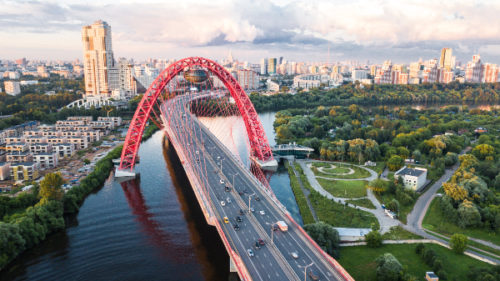
The United States Commission on International Religious Freedom (USCIRF) released a report on regulations of
religion and an anti-cult movement ongoing. The Soviet Union era lives with us.
Its impact, more precisely, lives on within the lives and communities of today’s
Russians because of the impacts on the freedom of religion
As has been reported before, there is a dual-issue implicated
here. There is internal repression of the Jehovah’s Witness membership by the
Watchtower. While, at the same time, the freedom of religion would stipulate a
freedom to practice religion, which the Russian and other governments violate
via not respecting this, because of the various forms of legislative
restrictions and governmental authorities’ crackdowns on these various groups.
The report from the USCIRF proposes some means by which to
combat the violations to the rights of the Jehovah’s Witnesses to practice
religion freely. One was recommending that the United States government state “Russia, Tajikistan, and Turkmenistan as ‘countries of particular concern’
for their ongoing, systematic, and egregious religious freedom violations, and
include Kazakhstan and Uzbekistan on its Special Watch List.”
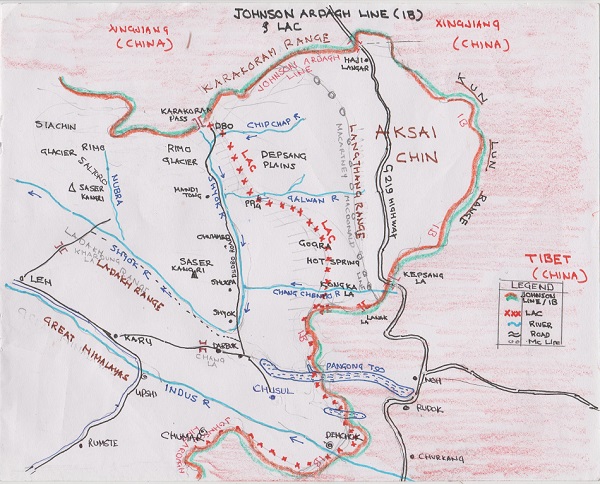
The East Ladakh LAC (Line of Actual Control) imbroglio has been written about and discussed threadbare in the digital, print and TV with a range of emotions moving from despair a la ‘repeat of 1962’ to jubilation of an ‘all-powerful New India’, ready to ‘give a bloody nose’ to China.
Pragmatic Analysis and Overview of Chinese Actions along the LAC in East Ladakh
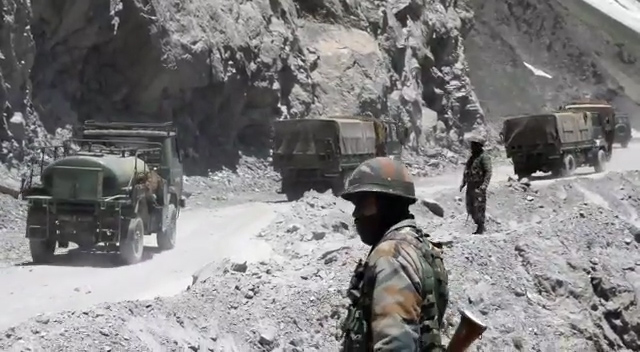
There has obviously been an intelligence and military oversight, either in terms of interpretation of Chinese intentions or of carrying out suitable counter measures like moving up formation reserves, forward posturing of artillery and mechanised forces, increasing patrolling and surveillance activities, strengthening of posts, and deploying mobile reserves to fill in the gaps. I would like to add, that hindsight is always easy to predict! Unlike the methodology followed every summer by China and India, this time the Chinese PLA exercised closer than usual to the LAC, and stayed put, which allowed the Chinese troops normally deployed in Tibet, to move forward and occupy the previously un-held areas. On the other hand, Indian troops including some formations from outside Ladakh region, ostensibly due to COVID-19 did not carry out corresponding exercises, which normally acted as a countervailing force to prevent exactly such a situation from happening.
One must accept that intentions of Chinese movement forward from their exercise areas to the LAC (to some extent it would have been camouflaged under the garb of regular border troops affiliated to those areas) should have been identified as unusual and alarming. Misreading Chinese intentions and initial hesitant response added to the confusion. China’s greatest strength in TAR (Tibet Autonomous Region) lies in its infrastructure in terms of rail link to Lhasa from mainland, numerous airfields, multiple roads of entry from hinterland to forward locations/LAC, its logistical stamina and smooth supply chain, providing capability to deploy large quantum of formations ranging from mechanized/motorized, artillery, army aviation, engineers, air defence, rocket forces, communication and surveillance units and most importantly logistic supply chains, in an operationally quick time frame.
To sum up, China’s wherewithal to mobilise is truly impressive and vast in scale. Notwithstanding the above, we acted with great alacrity by our expeditious commensurate mirror deployment, mobilization of the IAF (Indian Air Force), combat hardened formations and troops, terrain familiarization and altitude acclimatisation, and mobilization of additional reserves. Tactically and operationally in East Ladakh our Army and IAF is fully confident and capable of handling all challenges without getting militarily embarrassed. By all accounts China’s well laid out plans to gain valuable strategic territory and embarrass the Indian Armed Forces and India has been stalled at least temporarily. In fact, China would risk embarrassment if it continues the misadventure, as even a stalemate by India will indicate China’s loss of face, to which they hold tremendous importance.
Starting late January/February 2020, the PLA began what was viewed as routine mobilisation for annual exercises in Xinjiang, which borders Ladakh. As brought out earlier, this year in a major departure from the earlier annual exercises, PLA troops for the first time moved closer to the border, while border frontier troops remained in forward areas. There was sufficient visibility and knowledge about PLA moving into TAR (Tibet Autonomous Region). In January 2020, President Xi Jinping issued a new Training Mobilisation Order (TMO) for strengthening military training in real combat conditions and “to maintain a high level of readiness”. The new order updated the 2019 TMO, which was the first such order to be signed by Pres Xi, and had called for implementing new military training guidelines announced by him in 2018 to improve combat readiness.
This dramatically altered the pattern of annual exercises and China’s forward deployment posture, not just with India but also in other theatres, where tensions have flared this summer including Japan, Taiwan and in the South and East China Sea (SCS and ECS). It called for confrontational training to assess commanders in real-time combat situations and deal with a multi-front situation. This TMO (Training Mobilisation Order) is likely to be in place till at least 2021. And if this input is true, it is extremely bold and in keeping with President Xi’s hurry to achieve the ‘China Dream’, and partially explains the goings on. Their aim is to deliberately cause disruption, but emerge with strategic gains whilst showcasing its rising CNP (Comprehensive National Power) to the world. India especially the Armed Forces needs to prepare for a new normal urgently, and has to plan, equip and play accordingly.
The Why?
China’s military operational movement along LAC is just one vertical of its plan and it has a larger aim. Explanations offered about Chinese apprehensions of our LAC infrastructure build up specially the Darbuk-Shyok-DBO road and our probing actions, for its aggressive actions in East Ladakh are tactical at best and miss the larger strategic picture. China has moved everywhere near simultaneously, from Taiwan, Japan, Vietnam, to even Philippines (against Duarte who was willing to be China’s lackey), Nepal, Bhutan and even Russia. China is indicating its willingness to take on the so called liberal democratic world order established by USA and her allies especially in Asia which China considers as its strategic playground.
China’s actions also intend to showcase its CNP (Comprehensive National Power) and demonstrate its domination of Asia; any other power including the superpower USA will need to deal with China. China is showcasing its capability and capacity to move on from COVID-19 and simultaneously engage militarily and provocatively (belligerent actions against 27 immediate and near continental and maritime neighbours) in South China Sea and East China Sea, and India, and economical and diplomatic coercion elsewhere.
This is no ‘off the cuff measure’, but a planned and thought out strategic manoeuvre. China plans to resolve the turbulence created, after making strategic gains/inroads at the time of its choosing indicating its growing stature and Comprehensive National Power (CNP) to the world. Incidentally, China is not going to implode, as a very large population of middle income citizens support this regime as it has brought them prosperity for the price of sacrificing some freedom.
Specifically, China’s raison d’être to move against India is due to India being a direct competitor for strategic space and possible impediment to China’s aspirations to become a superpower. Also, India’s continued opposition to BRI (Belt and Road Initiative) and CPEC (China-Pakistan Economic Corridor) which is nothing less than existential for CCP (Chinese Communist Party) that has invested billions of dollars into it, and China sees it as being the gateway to multi-lateral trade and influence. Another reason for China’s move against India is to coerce her into accepting the BRI or at best not oppose it, because China fears losing access to the Gwadar Port that reduces its dependence on Malacca Straits. Further, India’s abrogation of Article 370 and her justifiable seeking and announcing its resolve to get back the entire sovereign territory of erstwhile J&K which includes Gilgit-Baltistan and Aksai Chin; and the high probability of India becoming the main beneficiary of economic, manufacturing and trade pullout from China; putting India down as also to create an unstable security environment will dissuade other countries from re-locating to India.
China’s Aggressive Posturing
While the World is battling COVID-19 and its effects in other domains, China (Chinese Communist Party to be more precise) led by Xi Jinping is changing the global status quo. Like a high-stakes gambler, China has rolled the dice, to see what it can win on the security and geo-political front. Muscle flexing has been impressive; intimidating or sinking fishing vessels (Vietnam, Malaysia, Philippines, even Japan); threatening SE Asia naval ships by locking missiles; conducting exercises to intimidate and develop specific skills needed to invade Taiwan; use of belligerent language at all adversaries including stating intent of “reunifaction of Taiwan” openly; activities in exclusive economic zones of neighbours Japan included; changing status quo along LAC, an already tense unresolved land boundary with India and finally the ‘wolf diplomacy’ a recent phenomenon knowing its adverse impact (perhaps that is the point!).
International Reactions
Aggrieved and angry about COVID-19, which added to the frustration and growing realization of a challenger in the global order, USA followed by her allies mainly from the Western World have reacted with alacrity and alarm at China’s belligerent actions which threaten to change the global power equation. Many other nations are watching from the sidelines as China’s CNP (Comprehensive National Power), and economic might (considerable) and hold on their sovereignty could get strengthened if China gets away relatively unscathed. US Secretary of State Mike Pompeo has stated that China’s pursuit of offshore resources in parts of the South China Sea is “completely unlawful”.
In its latest Annual Defence Report/White paper, Japanese Prime Minister Shinzo Abe’s government criticized Beijing for “relentlessly” attempting to undermine Tokyo’s administration of the Senkaku Islands in the ECS (East China Sea), even at a time when international coordination is required to contain the virus. The document rebuked China over its persistent attempts to “unilaterally change the status quo” in the ECS. The white paper also referred to China’s unilateral creation of two administrative districts in the SCS (South China Sea), in which Beijing has overlapping claims with Brunei, Malaysia, the Philippines, Vietnam and Taiwan. The two districts are named Xisha and Nansha, using the Chinese names for the disputed Paracel and Spratly Islands, respectively.
Aerial view of the Senkaku Islands of Japan. China’s claim over Senkaku Islands has increased its tensions with Tokyo.
Concurrently, a comprehensive Pacific Deterrence Initiative is being formulated. US has announced and is currently rebalancing and redeploying its forces to counter future threats emanating from China, which includes increasing ‘freedom of navigation’ patrols in Taiwan Straits, more military and economic aid to Taiwan, and deploying two aircraft carrier battle groups to the South China Sea. Aligned countries are coalescing either bilaterally or through groupings like QUAD (and Plus) to meet the Chinese challenge.
Chinese strengths in IT, hardware, manufacturing, infrastructure are being weakened using multiple fronts. India’s ban on 59 Chinese apps, as also resolve to ban Chinese participation in sensitive sectors (including Huawai and ZTE) has been applauded and has acted as a catalyst for others to emulate. China will be justified if it feels it is ‘strategically isolated by the liberal democratic West’. The jury however, is still out regarding the outcome, as most nations are finding out to their dismay, that China has considerable economic and political clout and has enmeshed itself so intimately into others nations economic fabric, that it will be very difficult to exorcise it, and it will come at a great cost.
India’s resolve and response, coupled with the June 15 bloody clash between Indian and PLA troops appears to have surprised the Chinese strategic community. Their utterances/debates instead of bringing consensus has widened the differences on ‘how to deal with a more confident India and a professional battle hardened Armed Forces’.
The Hawk School in China
This school headed by India watchers Lin Minwang and Zhang Jiadong, from Fudan University, and Li Hongmei from the Shanghai Institutes for International Studies (SIIS) among others, believe that the present conflict is an “inevitable result” of what they perceive as “India’s long-standing speculative strategy on the China-India border”. Beijing getting wary of India’s pronouncements (abrogation of Article 370, taking erstwhile J&K back including Aksai Chin), growing alliances and infrastructure surge all along Northern borders had “fed up” and China “had to teach India a lesson”.
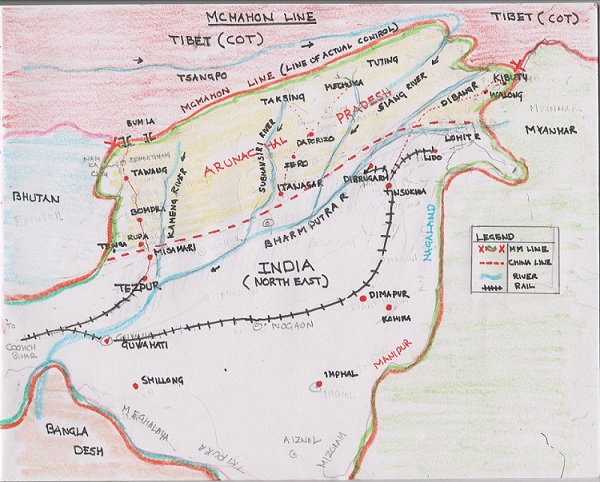
They feel our growing alignment with USA and China’s adversaries (Japan, Australia, Vietnam etc) is taking India further away from rapprochement, becoming a ‘quasi ally of USA with no reversal, and possibility of border settlement getting grimmer. Within this unstable global security environment and a paranoid USA, the earlier system of effective management of bilateral differences has crumbled beyond control, periodic violent conflicts, they predict, are the “new normal” in China-India ties. To deal with a resurgent India, Chinese hardliners suggest a policy of “three nos”: “no weakness, no concession and no defensive defence”. In other words, China should take all opportunities to crack down on India, take the initiative to hit it hard whenever possible. This, they feel will make relations more stable like after 1962. They interpolate that China must be ready for belligerent moves across the entire LAC, from the McMahon Line in the east to the Aksai Chin area in the west; take the initiative to attack and seize territories under India’s control from Kashmir to Arunachal Pradesh, and weaken India internally, by supporting the cause of Maoists, Naga separatists and Kashmiris.
The Moderate School in China
This school which has political thinkers and professors such as Zheng Yongnian and Yu Longyu among others, have opined that Chinese actions and reactions in places like Galwan have remained mostly tactical/reactive and without any clear strategic intent. This has stoked nationalism in India and united the otherwise divided nation against China, harming China’s interests and might even draw China into an untimely military conflict. If China-India ties are damaged beyond repair, they warn, India alone or in association with other countries will cause “endless trouble for China”. For instance, an openly hostile India will use every possible means to prevent China from reaching the Indian Ocean. They feel that strategically, it is not advisable to launch proactive military conflict against India, “a big country with comparable military strength”, at this point in time. While China enjoys superiority in most fields like weapon systems and logistical strength, India too enjoys some strengths in war experience, acclimatization, shorter supply lines, and terrain familiarity. They predict that if the conflict ends in a short period of time, it will benefit China. But if it is prolonged, China will be disadvantaged.
What China may eventually try to achieve
I agree with Antara Singh who concluded in her article in The Hindu, that China would aim at attaining a comprehensive and overwhelming geo-political and strategic advantage vis-à-vis India, which cannot be altered by war.
Anticipating Round Two
It will be wise to acknowledge that China’s moves along the LAC (even in Sikkim) is part of a larger strategic game plan. China has mobilized a large force, and possibly had more devious designs of altering the status quo permanently along the LAC in its favour. For this China may have been willing to use limited force with a very effective and formidable non-kinetic campaign prior, during and after the larger tactical actions. China would have employed its fairly new Strategic Support Force for conducting information and psychological, network-centric, electronic and electo-magnetic spectrum operations while concurrently using its CNP (Comprehensive National Power) to provide a legal, economic, diplomatic narrative. As stated earlier, while our robust tactical response by our brave soldiers at the tactical level and expeditious mirror deployments by Army and IAF at operational level has surprised and stymied the Chinese temporarily, we MUST plan for the worst case contingency ranging from a localized conflict to a full scale war. The trust built up over decades by abiding by the CBMs (confidence building measures) and border management agreements (barring the odd one-off incidents) has been permanently broken.
The Chinese respect strength and resolve. It is time to build our National Multi Domain capabilities as that is how China will fight a larger scale war. You can ignore China’s asymmetric superiority in comprehensive national power (CNP), infrastructure capacities, military capabilities, cunning and deceit, diplomatic and political clout at your own peril. Numerous China watchers have rightly asserted that China has managed to alienate the youth of new India, which is a very large percentage of Indian population. While we continue strengthening and cementing other domains of diplomacy, economy, strategic balancing through alliances and bilateral agreements and increase our CNP (comprehensive national power), our focus must be ‘atma nirbharta’ and ensuring a potent, visible, modern, multi-domain operations capable armed forces including strategic forces command (full spectrum capability).
For this; expeditious raising of Theatre commands; placing all forces (ITBP) along LAC under Indian Army; rapid growth of our Navy to manage our ‘Maritime Policy’ of dominating the Indian Ocean Region (the domain of vital importance); IAF capability for a multi-front role; re-energised mountain strike corps; strategic lift capability; potent C5ISTAR system (Command, Control, Communication, Computer, Cyber, Intelligence, Surveillance, Target Acquisition and Reconnaissance); are the main ingredients. We must build our deterrence capabilities to ensure fulfillment of our national vision and goals.
To conclude, the LAC imbroglio will serve as a defining moment in our country’s history, and India will emerge as strong, resilient, resurgent and confident to take its natural place as the pivotal balancing power amongst the comity of nations in the world.
Faisal Saeed Al Mutar is
an interesting person, and a friend and colleague. He founded Ideas Beyond
Borders, which is a 501(c)3 nonprofit organization. Its purpose is to empower
and improve the initiatives in the Middle East devoted to dispelling various forms
of misinformation in the region.
One of the major barriers for the Middle East and North Africa region has to do with language. There simply and purely is a gap in international literacy because much of the West is grounded in the English language and much of the Middle East and North Africa region is in Arabic. This can create a barrier for international entry for the minds of the non-bilingual or non-English speaking in the Middle East and North Africa. Other works of Ideas Beyond Borders are humanitarian efforts.
Lisa Pirovano, Communications
Director at Ideas Beyond Borders, on one recent effort, stated, “This
effort includes working with local distribution partners to deliver 15,000 N95
masks to public hospitals facing dire PPE shortages, as well as 100,000
surgical masks and more than 50,000 meals to communities in need.”
Many areas are in poverty, lack education, and are
wracked with sectarian violence. This is the context of life for other human
beings throughout the Middle East and North Africa region. While these areas
are dealing with life and death issues, a compound on top of these
aforementioned, potentially a multiplier, is the issue of proper information
and then the coronavirus.
“The COVID-19 pandemic is being exploited by extremists
and authoritarians alike, both digitally and offline. I’ve seen it before when
my own community was taken over by extremist groups; they hand out blankets,
they give water bottles on severely hot days in Baghdad, and in the case of
COVID-19, they hand out masks and food to build trust,” Ideas Beyond Borders
Founder, Faisal Saeed Al Mutar, stated, “When the pandemic is over, that’s what
people remember, and it makes them even more vulnerable to believing extremist
ideas. Ideas Beyond Borders is beating extremists to it. We’re handing out food
and masks simply because it’s the right thing to do, and we ask nothing in
return.”
The name of this new effort is the Stop the Spread (of coronavirus and misinformation) campaign, so as to provide a counter push from the rather large amounts of public health misinformation available in the region. This effort can provide a means by which the public can develop a healthier possibility of survival as communities and peoples in the Middle East and North Africa region.
Not only misinformation, but there are also deliberate spreading of bad information, disinformation, via the common means of conspiracy theories. Many in North America are familiar with the common sources including Alex Jones, Breitbart, Louis Farrakhan, and others. The program or intiative launched in March with distribution to 4.5 million Middle East and North Africa region youth.
Ideas Beyond Borders stated, “It… includes dozens of
videos, infographics, and articles on the virus. The recent campaign expansion
also expands these efforts, including translation of mental health resources,
as well as a significant increase in video production.”
This is one among a large number fo efforts by Ideas
Beyond Borders to provide “a positive alternative to the extremism, authoritarianism,
censorship, and violence that plagues the Middle East.” Many of their efforts
are for translation from English into Arabic and the sharing around the world
with the intent to foster some critical thought, as well as the advancement of
civil and human rights, pluralism, and science, in the Middle East, primarily,
and the Middle East and North Africa region in general.
Some provide to the populations for the development of the critical communities by the local populations.
In the Mahabharata, the Kauravas had better warriors and generals than the Pandavas; their forces were also much larger and better trained. It was on this strategic calculation that Prince Duryodhana decided to fight against the Pandavas. The Pandavas won because they had Dharma (Righteousness) on their side. The Kaurava generals were not convinced about the righteousness and justification of the claims made by Prince Duryodhana; they were fighting more due to pledged loyalty than a conviction for the cause. This weakness led to their destruction and that of the entire Kaurava Army.
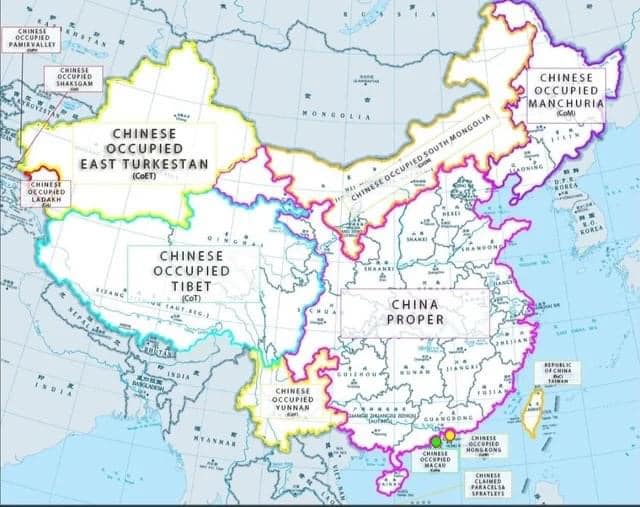
If we apply the same template to the situation between India and China we can conclude that the Chinese are going through the paces with a distinct lack of conviction. To move from mainland China through thousands of kilometres of China-Occupied Tibet (COT) and China-Occupied East Turkestan (COET) and then lay claim on territory that has been a part of another country for millenniums is neither righteous nor justified. There is also no support for the cause coming from the Chinese people. Such a misadventure, therefore, distinctly lacks courage of conviction and has left the Chinese soldiers confused and scared; their resolve to fight stands seriously eroded. Their situation, therefore, is the same as that of the Kaurava Army – the numerical strength is present but courage of conviction is lacking.
Indian Army, on the other hand, is fighting for a cause that is absolutely righteous, justified and close to the heart of all Indians who are backing their forces completely. Ladakh is a region which our noble ancestors gave their lives to defend in 1962. There is no way that the present generation of Indian soldiers will let down their ancestors. Indian Army, therefore, is in the same situation as the Pandava Army.
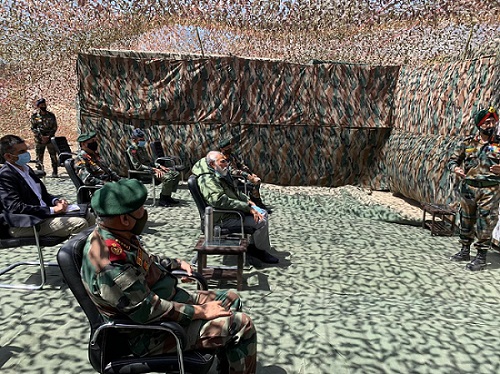
The morale of the nation received a considerable boost when Prime Minister Narendra Modi visited Ladakh on July 3. He met the injured soldiers in the hospital and then gave a very motivating speech to the troops deployed in the region. “Our enemies have seen your fire and also your fury,” he said. “Your courage is higher than the heights where you are serving today… Not only me, the entire nation believes in you. We all are proud of you,” he added. More significantly, the Prime Minister quoted a Bhagwad Gita Shlok (verse) “Veer Bhogya Vasundhara” which means “the brave shall inherit the world” and in an oblique reference to Chinese perfidy said, “This is the era of development. The whole world has made up its mind against expansionism.”
Earlier, a lucid insight was given by Ram Madhav, National General Secretary of the Bhartiya Janata Party, in the course of a discussion with prominent domain experts through a webinar. He said that China is pursuing the military doctrine of “victory without war” as advocated by their legendary strategist Sun Tsu. The attempt is to register nibbling land grab victories against India without firing a bullet. This is the reason behind China not agreeing to the demarcation of the LAC and yet not firing a single bullet over the last many decades.
Ram Madhav went on to very emphatically maintain that India, under the ruling NDA government, has adopted a counter policy of claiming ownership of the LAC as perceived by her. The circumstances have made untenable the nibbling policy that China had so successfully applied for decades and which saw them, in 2013, coming 19 kms into Indian territory in Depsang and pitching tents. The government of India, under the BJP, will always strive for peace, but with self respect. India will not accept humiliating compromises anymore and if this makes China prone to misadventures then India will respond adequately and assertively. An application of this policy and posture has been witnessed in Doklam earlier and in Eastern Ladakh now. “We do not want war, but, we will not settle for the peace of the graveyard,” said Ram Madhav very categorically. He further added that India is improving infrastructure in Ladakh at a very rapid pace and will continue to do so.
There is absolute truth in what Ram Madhav has said and in what the whole of India believes. Ladakh has been a part of India since millenniums. It came under Sikh rule in 1834. After the first Anglo-Sikh War (1845-46), the British, in accordance with the Treaty of Amritsar, sold the territories of Kashmir, Gilgit-Baltistan and Ladakh to Gulab Singh, the Dogra Rajah (King) of Jammu for a sum of Rupees 7.5 million. Thus was created the state of Jammu and Kashmir with the title of Maharaja bestowed upon Gulab Singh by the British.
Jammu and Kashmir remained a princely state all through the British rule and the Dogras administered Ladakh as a Wazarat (principality). When India gained independence, Maharaja Hari Singh signed the Instrument of Accession on October 26, 1947, effective October, 27 1947, making Jammu and Kashmir an integral part of India. Hence, there remains no doubt about Ladakh being a part of India.
The Chinese Communist Party (CCP) was created in 1921 and came to power in 1949 much after the boundary between Tibet and Ladakh had already been finalised by the British through the Simla Convention of 1914. CCP has forcefully annexed its own mainland and so many adjoining regions like Tibet, East Turkestan, Mongolia etc. It definitely has no claims on these annexed territories what to talk of Ladakh or any other Indian territory.
Even if one concedes to a small edge in military capacity of China, it is the professionalism of the Indian Army, its commitment to the nation and its noble legacy that will prevail. The PLA is a politicised force used more for keeping the iron control of the CCP on the subjugated people, especially COT and COET.
Citizens of India have every reason to have faith in and feel pride for the government and the Army of the nation who are taking all necessary actions to safeguard national interest and sovereignty and are achieving great success in their endeavours. The need of the hour is to stand by them and boost their morale.
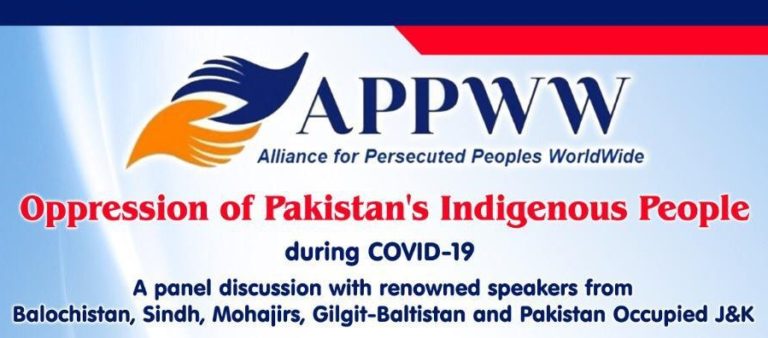
An international NGO “Alliance for Persecuted People Worldwide” (APPWW) recently organised a panel discussion on “Oppression of Pakistan’s Indigenous People.” The discussion was held in the backdrop of COVID-19 pandemic. Eminent persons representing the many oppressed regions of Pakistan and their people through various political parties, organisations and institutions were invited to speak in the discussion. The views give a deep insight into the very critical state of affairs within Pakistan as aggravated by the COVID-19 crisis.
The situation in Gilgit-Baltistan was explained by Senge Hasnan Sering, Director of Institute of Gilgit-Baltistan Studies and an international activist for the cause of freedom of his people from occupation and oppression by Pakistan. He said that since Gilgit-Baltistan is not a constitutional part of Pakistan there is a deeply embedded mindset of treating it as a colony. Now, the colonisation process has become two fold with China also getting involved in exploitation of the natural resources and the people of the region.
The situation created by the COVID-19 pandemic has given an opportunity to the exploitative forces to go for massive land grab. There has been a huge movement of troops in the region at a time when people need medicines and yet armed forces are being sent in. In fact, COVID-19 quarantine centres for Pakistan Army personnel have been set up in Gilgit-Baltistan to keep them away from the media glare in Punjab, and these facilities are not open to the locals.
As it is, the region is short of medical facilities like hospitals and medical institutions and is now grappling with critical shortage in supply of medicines. For cash strapped Pakistan, Gilgit-Baltistan holds no priority whatsoever, hence, the feeble infrastructure has been stretched to breaking point. Spread of Coronavirus through China-Pakistan Economic Corridor (CPEC) is also overwhelming the people. The Pakistan government is mulling over the feasibility of opening the region to tourists which will further enhance the risk factor. Senge Sering concluded with a demand for the justified amalgamation of the region with India.
The situation in Balochistan, another province forcefully amalgamated into Pakistan and witnessing a violent independence struggle as a consequence, was explained by Nabi Baksh Baloch, US Representative of the Baloch National Movement (BNM). He particularly emphasised the distressing lack of Personal Protective Equipment (PPE) for the doctors which leaves them very vulnerable to infection. Those from within the medical fraternity who agitated for PPE were jailed by the authorities. This insensitive act by the authorities is the only instance of its kind in the world where a government is arresting and harassing doctors during a medical emergency of such huge proportions.
As in the case of Gilgit-Baltistan, in Balochistan also, the Pakistan Army is leveraging the situation to strengthen its occupation of the region and suppress the legitimate aspirations of the people.
Zafar Sahito, representing Jeay Sindh Muttahida Mahaz (JSMM) spoke of the historical significance of Sindh in the context of overall Indian civilisation. In this ageless region the famed and legendary Saraswati River once flowed and the Vedas were written. It finds mention in both Ramayana and Mahabharta. In the modern context, Sindh was the first province to financially uplift Pakistan with its industrial and commercial expertise. Now the proud and civilised people of Sindh have been made subservient to the Pakistan’s Punjabi elite which has no regard for their economic potential or civilisational roots.
Rehan Ibadat, central organiser of the Muttahida Qaumi Movement (MQM) a Sindh-based political party that represents the Mohajirs (Muslims from India who opted to go to Pakistan) said that his people are facing lack of education opportunities, lack of job opportunities and are being persecuted. Quite emotionally he said, “this is not what the Mohajirs came to Pakistan for.”
With regards to the COVID-19 situation both emphasised that the federal government has not shown any keenness to impose a lockdown on the cash cow region of the country which led to a rapid spread of the pandemic. Ultimately, it fell upon the provincial government to put its foot down and impose the lockdown. By then a lot of damage had been done; thousands of cases with a huge spike in deaths in the region have gone unreported.
Tarek Fatah, a Canada-based senior journalist of Pakistani origin opined in the webinar that Pakistan died as a nation in 1971 when 60% of its population and the complete eastern segment chose to seek independence, leading to the creation of Bangladesh. What is now left of Pakistan had nothing to do with the movement that led to the partition of the country, North-West Frontier Province, Sindh, Balochistan, and territories of Pakistan-Occupied Jammu and Kashmir did not make any demands for a separate Muslim nation. The concept was thrust upon them by the partition. The aforementioned provinces do not subscribe to the concept even today and are agitating to break the shackles of West Punjab imposed over them through blatant use of military might.
The second catastrophe, according to Tarek Fatah, was the imposition of Urdu as an official language of the new country. The language came from central India and to an extent from Punjab, the remainder of so-called Pakistan has no affinity with the language. It has over time created a cultural schism in the entire region. Tarek Fatah concluded by saying that internal contradictions in Pakistan are so intense that a breakup of the so-called nation is inevitable; it is only a question of time.
The world has changed manifold but the problems in Pakistan do not change. It is so because all provinces of Pakistan should be separate nations in their own right but are being forcefully subjugated and exploited by the Punjabi rulers. Sadly, until the breakup foretold by Tarek Fatah does not become reality inhumane suppression accompanied by gross human rights violations will continue. The world leaders should step in to help free the people from the shackles of de-facto military rule, supported by terrorists and fundamentalist militant warlords.
A group of 144 veterans have written a letter to the President of India and the Prime Minister, raising their concerns related to the stand off between Indian Army and People’s Liberation Army of China. Okay, I agree that it is a step in the right direction and it is a matter of great pride for India to see a group of veterans involved in military issues even after hanging their uniform.
The Chetwode Motto that places national interest at the top of an officer’s mind space is not a commitment meant only till they are in service, rather it is a way of life and approach that an officer is expected to adopt. It carries on till he or she lives. It is these ethos that a soldier is expected to live upto. In light of this it is important that the action by 144 veterans needs to be analysed and assessed for its righteousness.
Firstly, who are these 144 veterans and do the qualify to make the assertions that they have made? They have contended that the Galwan Valley incident happened “because of failure at one or more levels in the political, civil and military establishments.” On this, their demand is that an inquiry be carried out to fix the accountability.
The most important question is whether these veterans are competent enough to raise the issue of failure? How do they say whether the incident was a failure or a strategic success? Moreover, which arm do they belong to, whether they have tenanted appointments at strategic or operational levels and lastly, how much do they know about Ladakh and its operational dynamics? If they qualify on these counts then they would agree that intelligence and operations against Chinese is a completely different ball game. China is a closed society with political, social, cyber and media isolation. The information or intelligence about their military is not so readily available.
Moreover, PLA’s intention when it undertakes mobilization in the garb of training or other routine activities is difficult to discern. There are agreements, to which both India and China were expected to abide by and such an act was not expected from China. The mechanics of Chinese mobilization was such that initially they moved smaller body of troops into the PP14, 15, 17 and Pangong Tso areas. When these troops were challenged by the Indian Army or ITBP, they pushed in additional troops.
While all this was happening, Indian Army was not unaware or sitting tightly. Starting with forward mobilization of troops already present in Ladakh region. Very soon we started hearing about additional reinforcements of the Indian Army movement. Within no time India Army had more troops than Chinese and the Indian Air Force was poised to take on operations. It is this might which got reflected in the violent clash of June 15 at Galwan Valley.
With Chinese Army going back on their words about not deploying any of their troops or military infrastructure on Indian side of the LAC, Col. Santosh Babu led his patrol to express the resolve of ensuring territorial integrity to Chinese troops. Can an Army weak on ground, unaware about the strength and disposition of Chinese troops, take such a bold step. China once again broke the trust and reacted in an unruly and unethical way. Does an Army like India’s expect another Army like that of the PLA (People’s Liberation Army) about such response to the overture of peace? Even at this instant at Galwan Valley, did India Army take it lying down? No, it gave back to the PLA in stronger measures and the results are known. So, where was the failure in all this?
Secondly, any gentleman who has been part of this wonderful organisation called the Indian Army must know that even if there are mistakes or errors of judgement about enemy’s intentions, these are dealt with post the situation is over. The 144 veterans joining hands to question the Indian Army while it is still dealing with the enemy reflects the true nature of their intent. Why such a haste? Why such a hurry? Was some timeline to be followed by them? Such a behaviour smacks of some ulterior motives which the time will reveal.
Thirdly, their demand for release of the Henderson Brooks report of 1962 to be released and their demand that the “government expeditiously conclude boundary agreements with all neighbours, especially China and Pakistan” indicates two aspects. One, Henderson Brooks report is a document which has remained secret despite the change of several governments at New Delhi. Its contents may have patterns, mechanics and drills that should not be formally declared. They can rest assured that all measures that were reflected in the report must have been acted upon within the years after 1962, Indian armed forces have become at par with PLA, rather better. Two, their desire that New Delhi must conclude boundary dispute with China expeditiously is a function of both the countries. If it had not been a complicated one, 22 rounds of talks at Senior Representatives level would have headed for a conclusion. China is a country which in an environment of COVID-19 thinks it prudent to take several nations head on or venture to initiate World War-III. Veterans’ demand (expectedly with good intellect and reason) looks like an immature and childish act.
Resolution of boundary dispute calls for engaging China from the position of strength. Just because government or the Indian Army is not giving out the minute to minute commentary, it does not mean that there has been any let up. Who knows, at the end of the day, this entire act of aggression by China turns out to be strategic victory and the detractors, veterans or civilians have to bite the dust.
Fourthly, 144 gentlemen who have been in uniform for decades are expected to understand the nuances of having military, para military and Central Armed Police Force (CAPF). Their nuanced view that CAPF be employed for counter-insurgency operations or manning borders is an expression that does not indicate the view from professionals. Expressing such unprofessional outlook by these veterans simply means that even the common man should not pay any heed to them, what to talk about the Prime Minister or President. However, if they claim to be professionals then they must accept this act as a huge mistake, putting the reputation of this community at stake.
Fifthly, those who are expressing the views that Chinese mobilization of forces was an intelligence or operational failure need to grant that post Kargil, a lot of mechanisms, resources and organizations have come into existence. There’s a lot of horizontal and vertical sharing of information and assessment that takes place. While against china, the intelligence may not be as strong as it is against Pakistan, but no one should infer what the veterans are attempting to infer.
One of the serving officers had once said: “While veterans were in active service, we all granted that they did their job well and the nation trusted their leadership. When others are in their old boots and at the helm, why don’t they grant them a similar honor. Least, the current lot needs to be given the benefit of doubt, till things are over and the outcomes are known. This generation is equally capable and professional. This too has followed the dictum of Chetwode Motto.”
It appears that China has played its pre-planned game on the Sino-Indian border in Eastern Ladakh on time. It synchronized with a particular situation developing in Pakistan. It will be remembered that China’s reaction to the Indian Parliament’s J&K State Reorganization Act 2019 was cryptic but very significant as we look at the hindsight. China had said that converting the Ladakh region into a Union Territory was a matter of concern for her. Commentators remained content with the simplistic explanation that China has never accepted the existing LAC as an international border in Ladakh and has been laying claims to large chunks of territory in Eastern Ladakh. It will also be recollected that in the Sino-Indian conflict of 1962, China grabbed a large chunk of Indian Territory in Aksai Chin and did not return it.
China waited just to gauge how much Pakistan could achieve on an international level to mould opinion against India’s reorganization plan in Kashmir. Major powers of the world accepted Indian argument that reorganization was an internal matter. Finding no takers of her lament in the comity of nations, Pakistan did some nuke-rattling allowing some minions in the Council of Ministers to boast of half a kilogram weighing nuclear weapons. India did not budge. In doing so Pakistan volunteered to become the laughing stock for the entire world.
Finally, Pakistan decided to intensify the only option of intensifying cross border firing, shelling and infiltration in Kashmir, making Kashmir Valley jihadists and gangsters pro-active and concentrating on media hype to malign India, as a “Nazi and Fascist regime” pursuing the policy of holocaust of Indian Muslims. Now PM Imran Khan has become an advocate of not Kashmiri but also of nearly 20 crore Indian Muslims. He managed to hook up the non-Semitic Islamic States of Turkey, Malaysia and Iran as supporters of his “Muslim Holocaust” theory. But it cut no ice either with the Western democracies or even with OIC (Organisation of Islamic Cooperation) with 53 Islamic States as its members.
Hence for several months by now, we have recurring firing and shelling from across the border on some sensitive posts to which Indian forces respond as per necessity. In the meanwhile, during the past four months, Indian security forces have liquidated 148 Pakistani infiltrators and Kashmiri armed jihadi insurgents.
Finding that Kashmiri separatist and secessionist leaders like Syed Ali Shah Geelani and Moulvi Umar failed to provoke large or small scale public protest rallies in Kashmir against the Reorganization Act, the ISI decided to sideline them. Instead, it picked up a younger group of Kashmiri Muslim Jamaat-e-Islami activists stationed either in Muzaffarabad or Rawalpindi. As the Modi government had come down with a heavy hand on the hawala transactions — primary funding channel for the Kashmir militancy — ISI inducted narcotics trafficking and drug pedaling in Kashmir as it had done during the Khalistan movement in Punjab. This starved Geelani and his lust for large funds and no accounts for expenditure hurt his ego. In utter desperation, he declared his disassociation with Hurriyat (G).
The gradual depletion of fresh recruits for militant cadres, effective implementation of “Operation All Out” by Indian Generals, a substantial reduction in hawala funding, increasing dissatisfaction of locals in the Kashmir valley with the lawless jihadis and their role in providing intelligence to the security forces about the hideouts of militants, all combined to assure China that Pakistan was on the verge of losing its game in Kashmir. In addition to an adequate response to Pakistan’s border shelling and pushing infiltrators into Kashmir, India issued a strict warning to Pakistan to vacate the parts of original J&K State illegally occupied by Pakistan.
These are the factors that became a catalyst to China’s sudden aggression in Eastern Ladakh. Somehow, Beijing began to believe that India has drawn up the plan of recapturing its areas under the control of Pakistan. China planned intrusion at a few points but it should be noted that she had bigger plans and different intentions. If India captured Gilgit, the world community will endorse India’s right to retrieve the part of the state under illegal occupation of Pakistan and China. That would jeopardize the entire scheme of Karakorum Highway as well as the CPEC. If that happened China’s boast of being a world power would sink to its nadir. Hence one can explain the logic behind China’s massive build-up in the Galwan region.
But Beijing hardly expected a mighty retaliatory jab by India. When PM Modi thundered that the era of expansionism was over, Beijing found that the entire democratic world stood behind the Indian Prime Minister. President Xi Jinping opened his eyes to a completely new strategic scenario in the Asian Continent. He began to realise what it meant to throw a challenge to the entire democratic world particularly India, the largest democracy of the world. The world stood behind the iron man of India who they found adequately qualified to lead the Third World War if unleashed by autocratic, theocratic and pro-military regimes on the globe.
Where do we go from here? Seven decade-old concepts of China that she can ride roughly shod over the borders of her neighbours stand shattered and rent asunder. The democratic world and their militaries have identified the enemy that tries to look at them with an eyeball to eyeball stance. Their policy vis-a-vis the dragon would be (a) to disable Beijing’s financial and economic hegemony over the world, and (b) to insulate India-Pacific region against Chinese belligerence. It could also mean naval blockade of China. In such a scenario China will be adorned with the so-called Necklace of Pearls. We know that China will desire to live as a peaceful neighbour of India but that will happen only when her wings are clipped and she is denied flight beyond her existing geographical borders.
The 4,000 square mile of the state of Jammu and Kashmir, which is under Pakistan’s control, has recently signed $2.4 billion deal with China and the Pakistani government for electricity generation. This project is called the Kohala Power Project. In Pakistan-occupied Kashmir (POK), there’s a government called the Azad Kashmir Government. Although puppet governments of the occupiers cannot be called a representative government of the people nor can they be recognized. But if any kind of project is based on 4,000 square miles, then the right to control it should be with the Azad Kashmir Government. That is, the state of Jammu and Kashmir.
On this basis, if any country enters into an agreement with the state of Jammu and Kashmir then it should be with the so-called Azad Kashmir Government and not with the government of occupying Pakistan.
What a shame that the Pakistani state, its rulers and its people call it “Azad Kashmir” and fool the world that Pakistan-administered Kashmir is free, the people here have the right to rule, while the reality is just the opposite. Part of the state of Jammu and Kashmir, popularly known as “Azad Kashmir”, is not independent but is completely occupied.
The role of the AJK government in all other mega projects, including the $2.4 billion Kohala Power Project agreement between China and Pakistan, is merely to facilitate the looting of state resources by the ruling classes of Occupying Pakistan. Generations have been playing the role of facilitators and flatterers.
The people have the right and control over the resources of the state. All such mega projects are the property of the people, but the tragedy is that the occupation of the ruling class extends. Lost rulers arrange the luxuries of their descendants by strengthening their ambitions. In return for this flattery and facilitation, the upper classes of the occupying state give them rule over the people. And this class is, the GHQ (General Headquarters).
Before implementing these projects, the lands, poverty, health etc. of the people are not taken into consideration. The already devastated people will suffer further humiliation and disgrace. In our slave society, the occupier has begun to give birth to new forms of looting.
POK’s state apparatus, which has the role to protect the property of people, is being sabotaged through such schemes. In this whole process, the leadership of all traditional political parties, including the government, is silent as their job is to flatter and facilitate.
The people of POK, and especially the youth, must resist the plunder of resources. They must demand public authority and control over state resources. To save their resources, they have to be organized, progressive and the nationalist organizations have to come up with a clear and solid policy such that all patriotic and people-friendly forces can be organized. Jammu and Kashmir People’s National Party (JKPNP) has started a campaign. The youth must debate about this campaign. They must raise questions, mobilize the people because if we do not do this today, tomorrow will not give us time, the water will pass through our head leaving only destruction and everything else will be washed away.
Balochistan Liberation Front (BLF) Spokesperson Major Gwahram Baloch said the Baloch Freedom Fighters (Sarmachaars) attacked a convoy of five vehicles of the Pakistan Army in Gichk area of Panjgoor, occupied Balochistan on Tuesday. The BLF attack damaged all five vehicles and killed more than 20 Pakistani personnel, including the officer on board.
Major Gwahram Baloch gave details of this attack while talking to the media from an undisclosed location. He explained that this morning (Tuesday) Sarmachaars attacked a convoy of five vehicles of Pakistan Army in Gichk area of Panjgoor district. “At Mok-e-Kandag, Sarmachaars (Freedom Fighters) ambushed the occupying forces with rockets and automatic heavy weapons.”
The BLF attack damaged all five Pakistani vehicles and killed more than 20 personnel, including the Pakistan Army officer on board. “The Pakistani Army came under heavy attack in a few minutes and later not a single bullet was fired by them. A few years ago, a BLF attack in the same area had killed several army personnel, including a Pakistani colonel named Waheed, whose video went viral, and because of this, all Baloch websites, social media pages and video channels were blocked in Pakistan. Video of today’s attack will also be released soon,” said Major Gwahram Baloch. He said that these attacks will continue till the independence of Balochistan.
Pakistan Army and its intelligence agencies have been killing Baloch people at their whims. Over the last several months Pakistan Army has used helicopter gunships and heavy machine guns to fire at the unarmed hapless Baloch people across occupied Balochistan. Pakistan’s human rights violations continue unabated as the world and UNO refuse to condemn Pakistan’s actions.
Sikhs For Justice (SFJ) is a maverick US-based organisation whose stated objective is to carve out Punjab as an independent nation from within the Indian Union. On July 4, in a most detestable and disgusting act, the organisation launched a website through a Russian portal. The website states that ‘indigenous’ people of Punjab, irrespective of the religion that they belong to and living anywhere in the world, can register themselves for ‘Punjab Referendum 2020,’ and avail an opportunity to vote on their future political status as an independent nation.
On September 20, 2019 the Indian government had declared SFJ an unlawful association under Sub-Section (1) and (3) of Section 3 of the Unlawful Activities (Prevention) Act (UAPA), 1967. On July 1, the government went a step further and declared Gurpatwant Singh Pannu, the prime mover and legal advisor of SFJ, an ‘individual terrorist’ under the fourth schedule of UAPA, 1967. Gurpatwant Singh Pannu is charged with making an attempt to revive militancy in Punjab through anti-national activities and involvement in the Khalistan movement.
As punjabfree.ru got activated the government banned 40 websites linked to the SFJ. “On recommendations of MHA, MeitY (Ministry of Electronics and Information Technology), has issued orders under Section 69A of the I.T. Act, 2000, for blocking 40 websites of SFJ,” stated a Union Ministry of Home Affairs (MHA) order on the subject. The Punjab and Haryana High Court, while disposing a Public Interest Litigation (PIL) seeking steps against SFJ, directed “necessary action” by the authorities concerned. The State of Punjab told the High Court that 16 FIRs had been registered against the organisation and 116 WhatsApp groups related to the organisation have been blocked.
Such is the abhorrence for SFJ in Punjab that, in an animating and unusual situation, all opposition parties fully supported the decisions of the central government to ban the organisation, designate Pannu an individual terrorist and block its communication tools.
“Intelligence reports had indicated that the SFJ
was backed by Pakistan-based ISI. Terrorism has to be fought jointly,” said
Sunil Jakhar, President Punjab Pradesh Congress Committee (PPCC).
“Referendum
2020 was just a drama by those who hate India,” said Sukhbir Badal, chief
of the Shromani Akali Dal (SAD).
It was in the year 2007, when Gurpatwant Singh Pannu, a New York-based attorney who provided legal services to asylum seekers in the US established the SFJ (Sikhs For Justice) with his brother Avtar Singh as the President. He set an absurd narrative of separating Punjab from the Indian Union, the largest democracy in the world.
It is difficult to clearly substantiate whether ISI was the mastermind of the plan or became a part of it later. What is certain is that, as the activities of the group gained momentum, the signature of ISI became more visible. SFJ websites, sikhsforjustics.org and 2020referendum.org, shared domains and sourced content from a Karachi-based website “snip.pk”. The personal websites of several SFJ activists, including that of Gurpatwant Singh Pannu, were linked to the same Pakistani website.
The organisation could only garner negligible numbers of supporters from the Sikh community and, as such, existed in isolation for many years. It then hit upon the idea of leveraging online means to grow further and thus was initiated the concept of “Punjab Referendum 2020.” On Sunday, 12 August 2018, a handful of Sikh Diaspora campaigners assembled at London’s Trafalgar Square to unveil plans for the referendum.
Flush with funds from the ISI, the organisation
went ahead with all kinds of anti-national activities and especially provoked
the Sikh youth, to declare a war against India. It roped in many journalists to
speak about its evil cause. It used social media optimally for its propaganda. The
Indian media needs to be credited for not having fallen to the bait. Gurpatwant
Pannu and SFJ faced strong criticism and ridicule by Indian media across the
board.
In the meantime, ISI attempted to increase proliferation of drugs, arms and terrorism in Punjab. An investigation by the Punjab Police of SFJ’s involvement established that the organisation assisted ISI in the conduct of such subversive activities. A special effort was made to use the Kartarpur corridor as a conduit for all nefarious activities. However, alert intelligence agencies in Punjab as well as the NIA, R&AW etc. did not allow fructification of their designs.
Interestingly, Pannu is not ready to associate with the indigenous separatist elements of Punjab. He projects himself as the sole messiah of evil separatism and says that the Khalistan movement has commenced on July 4, 2020. Pannu avoids queries about its successful culmination by saying that he is not an astrologer. This posture is causing resentment among those like Simranjit Singh Mann who look upon the movement as their own brainchild nurtured over many years. Pannu prefers the individual path, probably due to financial considerations. With time he will declare the referendum as successful and then approach the UNO with a request for intervention. No such intervention is feasible but for him the pot will keep boiling and the money will keep coming in.
Punjabis will never accept any movement
that seeks to separate them from the Indian Union. For them there can never be
a repeat of 1947. Many like
Simranjit Singh Mann and his political party Shromani Akali Dal (Amritsar) have
fought elections on the grounds of separatism and have been consistently
rejected by the people.
The young Punjabis are too engrossed in their aspirations to be pulled into the murky waters of secessionism and separatism. Among the third and fourth generation Sikh Diaspora as well, there is hardly any attraction towards the calls for Khalistan. In fact, selection of the word “Khalistan” which has a distinct Muslim connotation is quire repulsive and objectionable to the Sikhs.
Due to the firm and timely action taken by New Delhi and support given by all political parties as well as the people of Punjab, the “Punjab Referendum 2020” has been reduced to an exercise in futility. Now, SFJ, under extreme pressure from the Indian media and intellectuals has said that the referendum is unofficial in nature and, as such, is not legally binding.
It is because of its flawed ideology and inherent contradiction that the SFJ movement has found no takers in Punjab. Its obnoxious tilt towards Pakistan has further exposed it as a stooge of the ISI with financial gain as its only objective. It is, therefore, no wonder then that the appeal to clip the wings of SFJ gained a universal political signature in Punjab.
We use cookies on our website to give you the most relevant experience by remembering your preferences and repeat visits. By clicking “Accept All”, you consent to the use of ALL the cookies. However, you may visit "Cookie Settings" to provide a controlled consent.
This website uses cookies to improve your experience while you navigate through the website. Out of these, the cookies that are categorized as necessary are stored on your browser as they are essential for the working of basic functionalities of the website. We also use third-party cookies that help us analyze and understand how you use this website. These cookies will be stored in your browser only with your consent. You also have the option to opt-out of these cookies. But opting out of some of these cookies may affect your browsing experience.
Functional cookies help to perform certain functionalities like sharing the content of the website on social media platforms, collect feedbacks, and other third-party features.
Performance cookies are used to understand and analyze the key performance indexes of the website which helps in delivering a better user experience for the visitors.
Analytical cookies are used to understand how visitors interact with the website. These cookies help provide information on metrics the number of visitors, bounce rate, traffic source, etc.
Advertisement cookies are used to provide visitors with relevant ads and marketing campaigns. These cookies track visitors across websites and collect information to provide customized ads.
Necessary cookies are absolutely essential for the website to function properly. These cookies ensure basic functionalities and security features of the website, anonymously.
Cookie
Duration
Description
cookielawinfo-checkbox-analytics
11 months
This cookie is set by GDPR Cookie Consent plugin. The cookie is used to store the user consent for the cookies in the category "Analytics".
cookielawinfo-checkbox-functional
11 months
The cookie is set by GDPR cookie consent to record the user consent for the cookies in the category "Functional".
cookielawinfo-checkbox-necessary
11 months
This cookie is set by GDPR Cookie Consent plugin. The cookies is used to store the user consent for the cookies in the category "Necessary".
cookielawinfo-checkbox-others
11 months
This cookie is set by GDPR Cookie Consent plugin. The cookie is used to store the user consent for the cookies in the category "Other.
cookielawinfo-checkbox-performance
11 months
This cookie is set by GDPR Cookie Consent plugin. The cookie is used to store the user consent for the cookies in the category "Performance".
viewed_cookie_policy
11 months
The cookie is set by the GDPR Cookie Consent plugin and is used to store whether or not user has consented to the use of cookies. It does not store any personal data.