
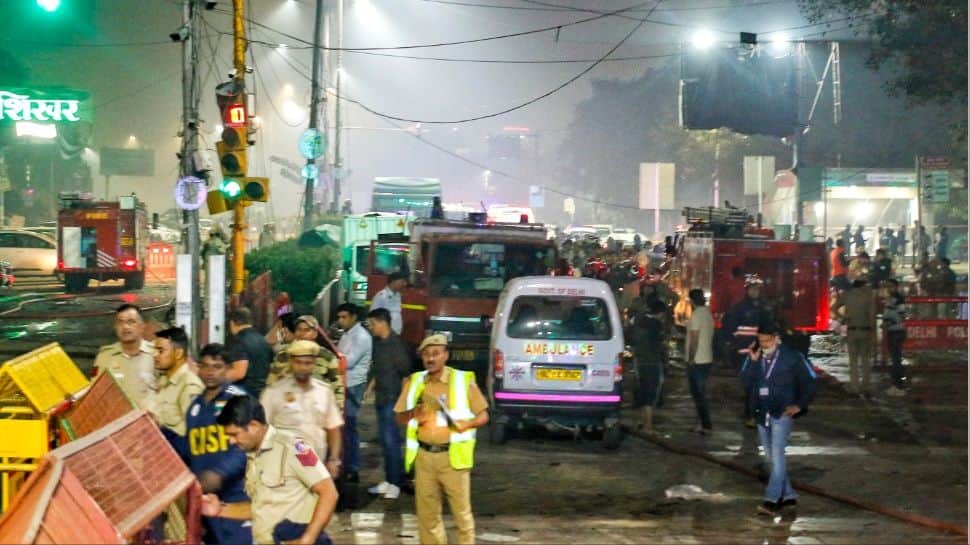
The blast in Delhi was more than an intelligence failure or a tragic act of terror. It was a warning—one that points to deeper structural, ideological and cultural fractures that have been ignored for too long. Every major terror incident forces us to revisit the uncomfortable question: Why does radicalisation continue to find fertile ground across certain pockets of the Muslim world, and why do these ideological fault lines spill across borders with such ease? To understand this, we must step beyond immediate political narratives and confront the deeper roots of the crisis.
A Legacy of Turbulence
Islam’s early political history was shaped by constant conflict. The Prophet Muhammad’s lifetime was marked by battles for consolidation, and the period immediately after his death was one of violent succession struggles. Caliphs Umar, Uthman and Ali all met assassinations; Imam Hasan too died under violent circumstances. This formative turbulence left an imprint: the idea of “jihad” entered the religious vocabulary not merely as a spiritual struggle, but as a sanctified tool of political assertion. Over centuries, this vocabulary got amplified by other related terms, creating a language that shaped the mindset where force was not an aberration but an accepted instrument of preserving faith and authority.
This historical memory continues to echo in contemporary struggles, making the teaching and practice of non-violence far more challenging.
When Culture is Squeezed Out
Civilisations soften through culture. Art, music, dance, theatre, sculpture and literature expand the imagination and weaken the hold of dogma. Yet, many orthodox interpretations within Islam have long discouraged or prohibited these very expressions. The anxiety about the arts has deprived many Muslim societies of the cultural buffers that moderate extremism.
This does not diminish the grand contributions of individual Muslims—from the architecture of Andalusia to the poetry of Rumi and Ghalib. But these flourished when thinkers and artists transcended the strictest boundaries of theology. Creativity survived despite orthodoxy, not in harmony with it. Where culture is throttled, dogma grows teeth.
Modern States in Peril
A distressing pattern is visible across several Muslim-majority societies: fragile democracies, authoritarian politics, shrinking civic freedoms, and the persistent persecution of minorities. When states fail to create avenues for dissent, cultural expression and open debate, alternate radical networks step in—often transnational in character, well-funded, and ideologically rigid.
The Delhi blast must be located within this global reality. Violent extremism is not born in a vacuum; it flows through ideological pipelines that often originate far beyond India’s borders, powered by sermons, online propaganda, and political developments in West Asia, Afghanistan and Pakistan. Dismissing the linkage between Islamism and terrorism as mere propaganda or “Islamophobia” does not help anyone—not Muslim societies, and certainly not victims of terror.
Self-denial cannot be a strategy for survival especially when a multilayered web of funding from Turkey and Qatar, charity from Gulf, handlers based at Turkey and training camps based in Pakistan join hands to infiltrate the minds of Indian muslims, that too doctors, to engineer a series of blasts to rock the country. How does a Muslim defend the undefendable?
Education Without Enlightenment
One of the most troubling paradoxes of our time is the rise of highly educated yet deeply indoctrinated individuals. Doctors, engineers, and technocrats from Muslim backgrounds often show excellence in professional domains while simultaneously resisting intellectual scrutiny of their religious beliefs.
This is not accidental. In several Islamic institutions, modern scientific training coexists with rigid doctrinal teaching. Students learn complicated anatomy or engineering equations in one classroom, and in another, absorb sermons that warn against questioning scripture. This duality produces individuals with professional competence but ideological rigidity—a potent combination when exposed to radical narratives.
Thus, even when economic conditions improve, the psychological grip of doctrinaire thinking remains intact. If radicalisation is to be reversed, education must liberate the mind, not divide it. The theological leaders must rewrite the unethical interpretation of teachings and take the ownership for correcting the wrongs. Likewise, governments of Islamic nations must take the lead in resurrecting Islam from the dogma and reinvesting the vocabulary of non-violence.
The Imperative of Internal Reform
The global conversation around Islam often collapses into two camps: Those who see Islam as inherently violent and those who insist that the religion is a monolithic victim of misinterpretation. Both positions are oversimplified. The reality is more complex and demands nuance: Islam today stands at a crossroads where internal reform is not only desirable but essential anti-dote for the venom which is fast becoming synonymous with Islam.
Several steps are indispensable:
- Keep faith private and keep devotion must remain within the personal sphere, not the political domain. Even use of loudspeakers at mosques and processions on streets may be stopped as a step towards reformation.
- Open religious texts to scrutiny – The Qur’an, Hadith and the Prophet’s biography must be open to debate, reinterpretation and academic criticism. Suppression only breeds resentment and radicalism.
- Abandon dreams of a Sharia-governed state – Modern nations demand secular constitutions that protect all citizens equally. Non muslim minorities must be protected by the State and not to fend for themselves. What is happening in Pakistan and Bangladesh is horrendous.
- Shift from madrasa dependency to universal schooling – Education must nurture curiosity, not conformity. There may be madrasas that are models for ideal education, but overall they are being identified as the institutions for breeding radical ideologies. The products in turn breed violence. This nexus or perception of nexus must be dismantled.
- Reclaim culture – Music, art, theatre and literature must return to public life as instruments of social healing. Nothing can be declared as male specific activity, not open to females. The acts such as declaring fatwa against “all girls band” in Kashmir few years ago by the Grand Mufti, should be treated as a criminal act. People misusing religious authority must be taken to task.
- Reconsider puritanical dress codes – Burqa and hijab are not merely garments; they often symbolise deeper gender segregation and inequality.
- Respect diverse beliefs – Tolerance must extend to non-Muslims and atheists alike.
- Prioritise national identity over transnational religious identity – Loyalty must flow toward the land where one lives, not imagined global umma politics.
- Embrace family planning and gender equality – No society can progress while half its population remains restricted by theology.
These steps are not anti-Islam; they are pro-civilisation.
Reform or Darkness
Every major religious tradition has experienced internal upheavals and reforms—Christianity through the Reformation, Hinduism through social movements, Judaism through philosophical renewal. Islam’s moment for self-renewal is overdue. Without introspection and change, radicalisation will continue to feed tragedies like the Delhi blast. The answer does not lie in denial, outrage or defensive rhetoric. It lies in the courage to reform.
If the foundational issues remain unaddressed, the world will witness more violence—and Muslim societies themselves will face the gravest consequences.
The Delhi blast is not just a terrorist act. It is a signal from the future: reform now, or brace for a deeper and darker crisis.