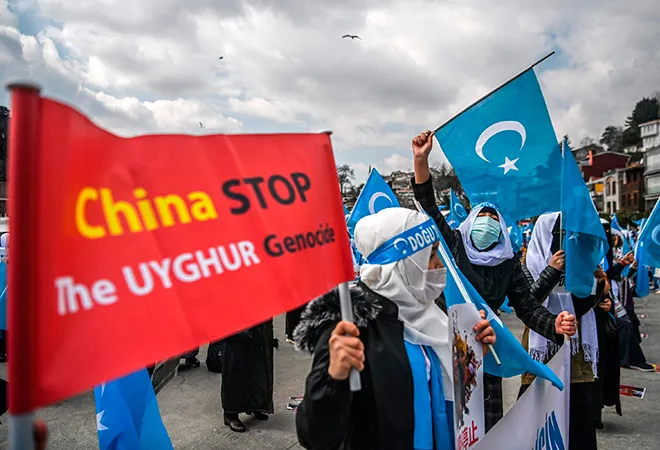
Social and human rights activist Shunichi Fujiki delivered a powerful message during the 38th meeting of the United Nations Human Rights Council, shining a spotlight on the suffering of the Uyghur community in Xinjiang due to the actions of Mainland China.
Expressing deep concern, Fujiki highlighted the systematic human rights abuses faced by the Uyghurs in Xinjiang. He emphasized China’s refusal to allow access to the region, making it difficult to independently verify reports of discrimination, arbitrary detention, and forced labor.
Despite the obstacles, mounting evidence from NGOs, journalists, and academics reveals a troubling pattern of human rights violations. Fujiki outlined China’s attempts to erase the unique Uyghur identity and culture through mass detentions in so-called “vocational training centers,” which effectively serve as internment camps. These facilities subject individuals to political indoctrination, forced labor, and attempts at cultural assimilation.
Uyghur Crisis
Referring to a 2023 report by the UN Committee on the Elimination of Racial Discrimination, Fujiki raised concerns about mass surveillance, restrictions on religious practices, and forced sterilizations.
Fujiki urged the UNHRC to take immediate action, calling for free access to Xinjiang for observers, including UN human rights experts, the release of arbitrarily detained individuals, and a comprehensive investigation into allegations of torture, forced labor, and cultural assimilation.
Additionally, he appealed to member states to enact legislation prohibiting the import of goods produced with forced labor in Xinjiang. Fujiki emphasized the urgent need for decisive actions to address the oppressive conditions faced by the Uyghur community.
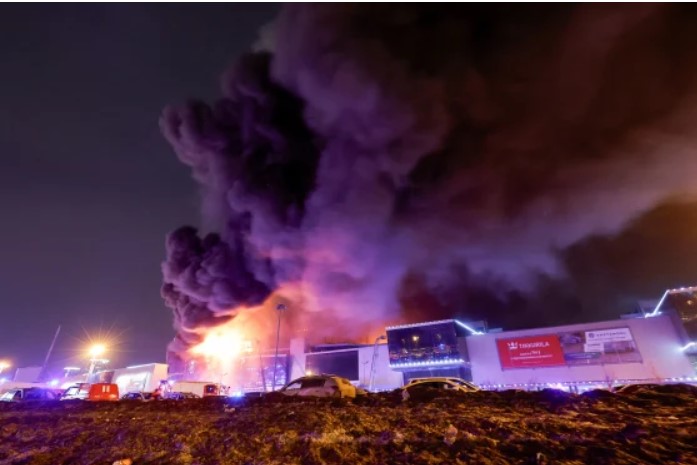
A horrific terrorist attack in Russia has left over 60 people dead while about 115 are injured. The attack rocked the Crocus City Hall music venue in Krasnogorsk, Moscow Region, resulting in the tragic loss of over 60 lives, with concerns that the death toll could escalate further, as stated by Russia’s Investigative Committee. Vital evidence, including weapons and ammunition, has been secured from the crime scene, with comprehensive investigations, encompassing genetic, ballistic, and fingerprint analysis, already underway.
Reports from the Russian news agency RIA Novosti, based on the accounts of its correspondent on site, depict a harrowing scene, with three unmasked gunmen in camouflage attire perpetrating the assault by indiscriminately firing upon concertgoers and detonating incendiary bombs.
“At about 20:00, several armed men in camouflage burst into Crocus. Footage published online shows people with machine guns cold-bloodedly shooting at point-blank range everyone who gets in their way and rushing into the concert hall. The same thing happens there. At the same time, one is holding an object resembling a smoke bomb in his hands. Between the second and third call, at least three men in camouflage and without masks ran through the stalls”, stated RIA Novosti.
The perpetrators swiftly fled the scene in a Renault car, evading immediate apprehension.
Viral image of alleged terrorists involved in Crocus City Hall attack
Putin pays condolences
In response to the tragedy, President Vladimir Putin conveyed his condolences to the victims and their families, wishing the injured a swift recovery. Deputy Prime Minister Tatyana Golikova relayed the president’s appreciation for the dedicated efforts of medical personnel in treating the wounded. “We together with [Russian Health Minister] Mikhail A. [Murashko] reported to the president on the state of health of patients, the president wished all a recovery and conveyed compliments to doctors,” she told the media.
Maria Zakharova, spokesperson for Russia’s foreign ministry, unequivocally condemned the attack as a “bloody terrorist act”, calling for robust condemnation from the international community. Although ISIS has claimed responsibility for the atrocity through its affiliated news agency Amaq on Telegram, no substantiated evidence has been provided to corroborate this assertion and it has not yet been confirmed.
The heinous attack has elicited widespread condemnation and expressions of solidarity from nations globally, including the United States, India, EU member states, Qatar, Egypt, Turkey, Uzbekistan, Armenia, and Azerbaijan.
Deadliest terrorist attack in Russia in two decades
This devastating incident marks the deadliest terrorist assault on Russian soil in years, surpassing the toll of previous atrocities. It unfolded on the evening of March 22 when gunmen initiated a shooting rampage before triggering an explosion, resulting in a fire that engulfed a significant portion of the Crocus City Hall building.
In the aftermath, firefighters evacuated over 100 individuals from the building’s basement and launched rooftop rescue operations. The attack stands as the deadliest in two decades since the Beslan school hostage crisis in 2004, which claimed the lives of 334 individuals, including numerous children.
US’ claim of sharing intel
Meanwhile, the US has stated that it had warned Russia of eminent terrorist attack after it issued advisory to its citizen in the country on March 7. Earlier this month, the U.S. Government had information about a planned terrorist attack in Moscow — potentially targeting large gatherings, to include concerts — which prompted the State Department to issue a public advisory to Americans in Russia,” NSC spokesperson Adrienne Watson said.
She went on to say, “The U.S. Government also shared this information with Russian authorities in accordance with its longstanding ‘duty to warn’ policy.” Although, Russia has not verified such claims. However, 3 days ago, Russian President’s remarked was aired in which he veiledly lamented US by accusing the West of “provocative statements” about potential terror attacks in Russia, and dismissed them. Reportedly, Putin said, “I’ll remind you of recent, let’s say directly, provocative statements of certain official Western structures about potential terror attacks in Russia.” He also said, “All of this looks like obvious blackmail and an attempt to intimidate, destabilize our country.”
Russia slams US for its denial of Ukraine involvement
Apart from that the statement of White House denying the role of Ukraine in the attack has also met with scathing response from the Russian side. White House has said that it had no initial indication that Ukraine was involved in a “terrible” attack on a concert hall in Moscow. National Security Council spokesman John Kirby, while giving the above details, also stated that the US had still been gathering information about the attack.
Responding to White House statement, Maria Zakharova, Russian Foreign Ministry spokesperson lambasted white House in an X post. She said, “The White House said it sees no indication that Ukraine or Ukrainians were involved in the terrorist attack in Moscow. On what basis do officials in Washington draw any conclusions in the midst of the tragedy about anyone’s involvement? If the United States has or had reliable information on this matter, it must be immediately handed over to the Russian side.”
“And if there is no such data, then the White House has no right to issue indulgences to anyone. All those involved, according to the Russian leadership, will be identified by the competent authorities,” she tweeted.
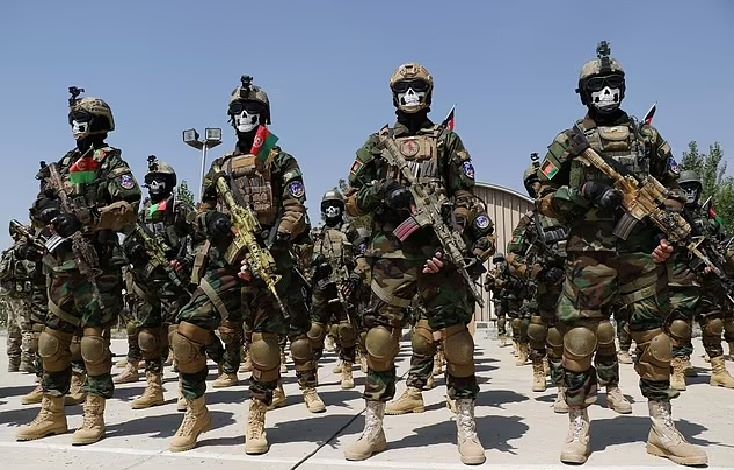
The Tehreek-e-Taliban has reportedly formed a specialised force, armed with cutting-edge weaponry, as part of its strategic efforts to advance its objectives. According to reports, this newly established force has been equipped with state-of-the-art training and lethal armaments. Among its arsenal are modern weapons such as sniper guns, launchers, laser guns, and various other sophisticated arms.
Additionally, terrorists of this specialised force have been outfitted with standard commando uniforms to enhance their operational efficiency. The training regimen for this force is said to encompass a wide array of skills, including camouflage techniques and internationally recognized combat training. This comprehensive training underscores the group’s growing combat capabilities that could potentially escalate the terror incidents and subsequent instability in the region. The establishment of a dedicated intelligence force within the Tehreek-e-Taliban Pakistan aims to expedite its operations and bolster its effectiveness in achieving its objectives.
The emergence of this specialized force underscores the evolving nature of extremism and the terror group’s efforts to adapt to contemporary warfare tactics and technologies.
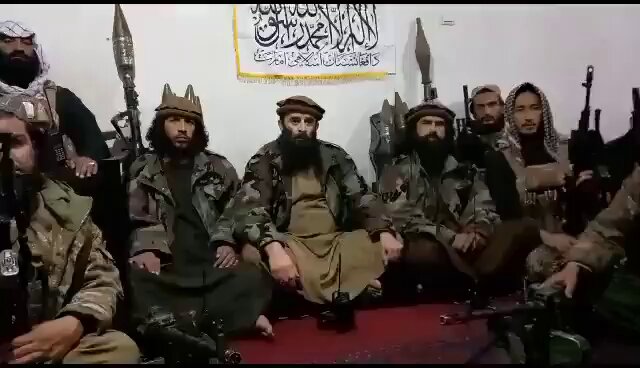
In the midst of escalating tensions between Afghanistan and Pakistan, Abdul Hamid Khorasani, an ethnic Tajik commander of the Taliban hailing from Panjshir, has ignited a storm with his recent warning to Pakistan Army. In a video Khorasani boldly threatens to overthrow Pak ‘establishment’, vowing to wipe it from the face of the planet.
Addressing Pakistan Army Chief Asim Munir, Khorasani’s remarks shows the volatile situation simmering along the border shared by these neighboring nations. “The holy warriors of TTP shall soon overthrow your infidel and oppressive government. Pakistan shall be eradicated from the face of the planet upon the orders of Mullah Hebatullah,” said Khorasani in the video.
#Panjshiri#Tajik#Taliban commander Abdul Hamid Khorasani: My message to @Jan_Achakzai, Asim Munir, Asif Zardari is that Afghans defeated the British, Russia, and USA. Pakistan is insignificant for us. Taliban fighters and TTP together will fight Pakistan's apostate army. pic.twitter.com/rRZpQzpWM3
In another video, Khorasani directed his message to Jan Achakzai, Minister for Information and Public Relations in Pak-occupied-Balochistan, who had issued a warning to the Taliban via social media.
“If another terrorist attack takes place in Pakistan, the Taliban have already been warned. There will be no other option. Pakistan will quickly enter Afghanistan and directly connect to Central Asia by capturing the Wakhan Corridor,” Achakzai had posted.
In response, the Tajik Taliban commander issued a chilling message, stating, “My message to Jan Achakzai, Asim Munir, Asif Zardari is that Afghans defeated the British, Russia, and USA. Pakistan is insignificant for us. Taliban fighters and TTP together will fight Pakistan’s apostate army.”
Abdul Hamid Khorasani, a controversial Tajik commander from Panjshir, responded to a X/ Twitter post by the Pakistan's caretaker minister of information, @Jan_Achakzai, stating that Afghanistan has defeated formidable adversaries like the British Empire, #Russia, and #America,… pic.twitter.com/QYeU5kgmK1
These warnings, broadcasted across social media platforms, highlights the deep-seated animosity between certain factions within Afghanistan and Pakistan. Khorasani’s affiliation with the Panjshir-based Taliban faction adds layers of complexity to an already fragile and deteriorating relationship between the two nations.
This argument comes as Pakistan’s Defense Minister, Khawaja Asif, says they don’t want to fight with Afghanistan. But he warns that if Afghanistan doesn’t deal with anti-Pakistan terrorists on its soil who target Pakistan, Pakistan might block trade routes as a consequence.
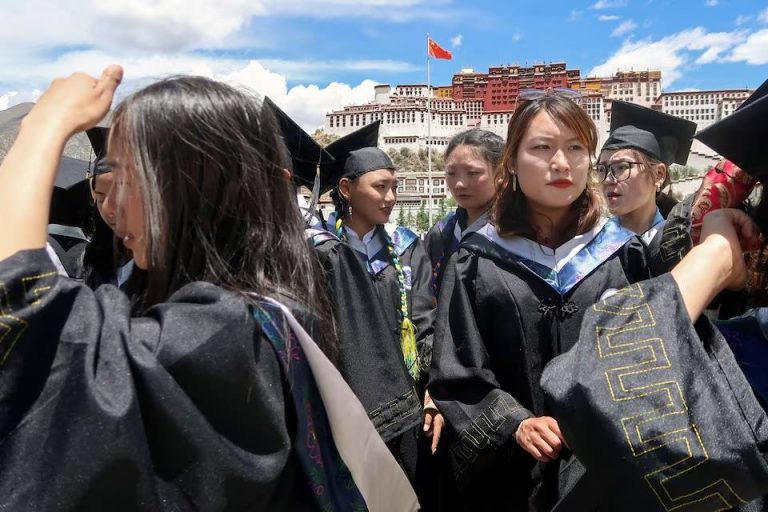
In a concerning development, the Chinese puppet government in Tibet is enticing investors from other regions of China with the promise of allowing their children to take university entrance exams in the region. This opportunity is offered in exchange for a substantial investment of at least $400,000, raising eyebrows over potential exploitation of what is perceived as an easier scoring system in Tibet.
What’s in the new notification for Tibet
As per a notification released by the China-imposed Tibetan education department and investment promotion bureau, businesspersons are required to uphold their investments in the region for a minimum of five years.
According to the notice, their businesses must be officially registered in Tibet for at least three years, must fulfil tax obligations within the region, and annually employ a workforce of no less than five individuals.
The announcement further states that eligible students must possess permanent residency status in Tibet for over three years and have completed at least one year of high school education
With Tibet boasting a population that is 90% ethnic Tibetan, it has been reported to have the lowest barriers in the gaokao exam across China. This advantage becomes a key edge for millions of students annually, aiming to secure lucrative white-collar jobs through the competitive “gaokao” entrance examinations.
Recent reports suggest that in 2023, a student in Tibet scoring at least 300 out of 750 on the entrance exam would have qualified for an undergraduate place at more than 1,200 universities nationwide. In stark contrast, students taking the exam in Beijing were required to achieve a significantly higher score of 448.
Deprives ethnic population of education and opportunities
However, concerns have been raised regarding China’s attempt to legitimise its students’ admissions under the Tibet quota, potentially diminishing educational opportunities for regional students. Previously, Chinese students resorted to falsifying documents to secure admissions under the Tibetan provincial Gaokao merit. Despite assertions from the education department under the puppet regime of China in Tibet promising crackdowns on fake documented students, recent rule changes have lowered essential qualifications for outsider students. Previously, outsider students were required to undergo education in Tibet for a minimum of three years, but this has now been reduced to just one year.
Notably, in June 2023 last year China imposed Mandarin as the mandatory language for college entrance exams across China. Prior to that the regional languages were also included in the mode of examinations. Similarly in 2022, China introduced Model 2 Education System which made it compulsory for the schools to follow educational curriculum only in Mandarin. Evidently, China is sabotaging or scrapping every feature that makes Tibet an autonomous region. Unfortunately, the latest provisions are just a new thread in the string to assimilate the Chinese population in Tibet and conceive the demographic changes in the region.
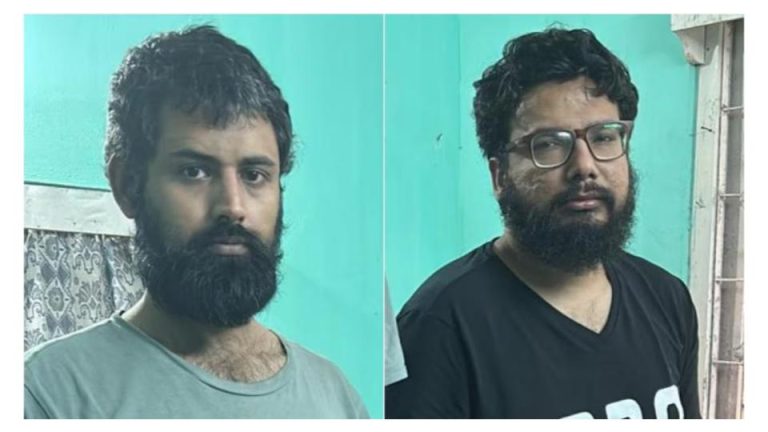
Two top leaders of ISIS in India were apprehended near the international border after crossing from Bangladesh, by Assam Police on Wednesday. They were planning sabotage activities and were apprehended from the Dharmasala area by the Special Task Force following a tip-off.
The individuals, identified as Haris Farooqi, also known as Harish Ajmal Farukhi, and his associate Anurag Singh, alias Rehan, were intercepted by a Special Task Force (STF) team deployed to the Dhubri sector based on intelligence received from sister agencies. The suspects, wanted by the National Investigation Agency (NIA), were caught in the Dharmasala area of Dhubri after crossing the international border.
Based on specific input, two top-rung leaders of ISIS in India were apprehended from the Dharmasala area of Dhubri Sector and brought to the STF office in Guwahati. The accused are also wanted accused of NIA. They have been identified as Haris Farooqi @ Harish Ajmal Farukhi of… pic.twitter.com/1Zi4xAHha3
Assam Police Chief Public Relations Officer Pranabjyoti Goswami stated that both suspects were detained and later brought to the STF office in Guwahati. Farooqi hails from Dehradun, Uttarakhand, while Singh is from Panipat, Haryana. Singh’s wife is reportedly a Bangladeshi national, and he converted to Islam.
“Based on specific input, two top-rung leaders of ISIS in India were apprehended from the Dharmasala area of Dhubri Sector and brought to the STF office in Guwahati. The accused are also wanted accused of NIA,” Goswami said.
ISIS
Described as highly indoctrinated and motivated members of ISIS in India, the arrested individuals were involved in recruitment, terror funding, and planning terror acts using improvised explosive devices (IEDs). They are accused of furthering the ISIS cause in India through conspiracies for recruitment, terror funding, and terror acts using IEDs in various locations across the country.
The STF noted that both individuals face multiple cases registered against them by the NIA in New Delhi and the Anti-Terrorist Squad (ATS) in Lucknow. The STF in Assam intends to hand over the accused to the NIA for further legal proceedings.
Goswami mentioned that information from sister agencies indicated that two high-ranking ISIS leaders in India, present in Bangladesh, would enter the country via the Dhubri sector for sabotage activities.
Acting on this intel, a team was dispatched to locate and apprehend them. “A search operation was conducted in the international border area to apprehend the suspects. Around 4:15 am on March 20, they were intercepted in the Dharmasala area of Dhubri after crossing the international border,” he explained.
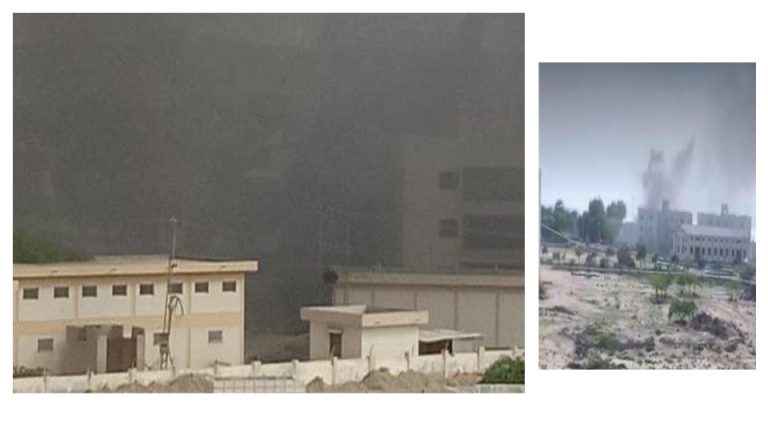
A major attack has occurred in the coastal city of Gwadar in Pak-occupied-Balochistan, marked by heavy gunfire and explosions near the Marine Drive Gwadar Port Authority (GPA) Complex and the Gwadar Development Authority (GDA) offices. The facility is a sensitive zone and a cornerstone of the China-Pakistan Economic Corridor (CPEC), Pakistan’s major recent infrastructure and investment project.
The Baloch Liberation Army’s (BLA) Majeed Brigade has claimed responsibility for the assault. According to a BLA statement, the attack, which commenced at 3:30 p.m., targeted the ISI (Inter-Services Intelligence) and MI (Military Intelligence) offices, representing the second significant operation by the Majeed Brigade in two months.
Initial reports and visual evidence indicated a fierce confrontation between the fighters and Army, resulting in multiple buildings ablaze near Marine Drive. This area, known for housing sensitive state and Chinese facilities, shows the significance of this attack. Dr. Imran of Military Intelligence has also been reported killed, with several others wounded or killed.
#Gwadar: In its latest statement, #BLA claims 25 personnel from Navy, ISI, & MI were killed, while 8 insurgents died.
Among the 8️⃣, 3 insurgents were graduates in Commerce, Chemistry, and Political Science, while one was previously disappeared and faced torture in detention. https://t.co/x5TtIqHEHs
The BLA has stated that over twenty-five Army personnel were killed, demonstrating a high level of bravery. Spokesperson Jeeyand Baloch said in the statement that among the casualties were two commissioned officers, 6 military intelligence, 8 ISI, and 14 army and navy personnel. The main headquarters of Pakistan’s intelligence agencies ISI and MI, situated on Gwadar Marine Drive, were targeted during the attack. The attack persisted for several hours, resulting in the deaths of numerous Pakistan military intelligence and ISI personnel. Pakistani Navy commandos attempting to aid the Army were also killed.
Commissioner Saeed Ahmed Umrani of Makuran reported individuals entering the Gwadar Port Authority Complex, initiating gunfire and explosions. “A large contingent of police and security forces has arrived at the scene, and intense firing continues,” he stated.
On 20 March 2024, a group of eight terrorists attempted to enter Port Authority Colony in Gwadar, which was successfully thwarted by the security forces personnel. pic.twitter.com/n1fO5nrq58
Pak Army retaliated, leading to hours-long exchange before Senior Superintendent of Gwadar Police Zohaib Mohsin said that eight fighters were gunned down but later revised the count to seven. He further added that two Army personnel died in the firing. However, it is a common practice for Pak Army to falsify information regarding casualties in Army.
In November, over 14 Pakistan Army personnel were killed after an attack on two vehicles in Gwadar. The military vehicles came under attack while moving from Pasni to Ormara in the coastal district.
Gwadar Port, integral to the China-Pakistan Economic Corridor (CPEC), is being developed with Chinese assistance. BLA has adamantly opposed Chinese presence and the exploitation of Pak-occupied-Balochistan’s resources by China in cooperation with Pakistan.
Despite its wealth in natural resources, Pak-occupied-Balochistan remains Pakistan’s poorest province, with approximately 15 million of its 240 million population residing there.
For the BLA, the number of soldiers killed in such a militarized zone like Gwadar may not be significant. However, launching an attack within Gwadar, particularly at a crucial location in the heart of the city, is a significant accomplishment for the BLA, garnering both domestic and international attention to the Baloch fight for independence. Balochistan has faced marginalization, violence and genocide by the Pakistan Army, following its illegal occupation in 1948 by Pakistan .
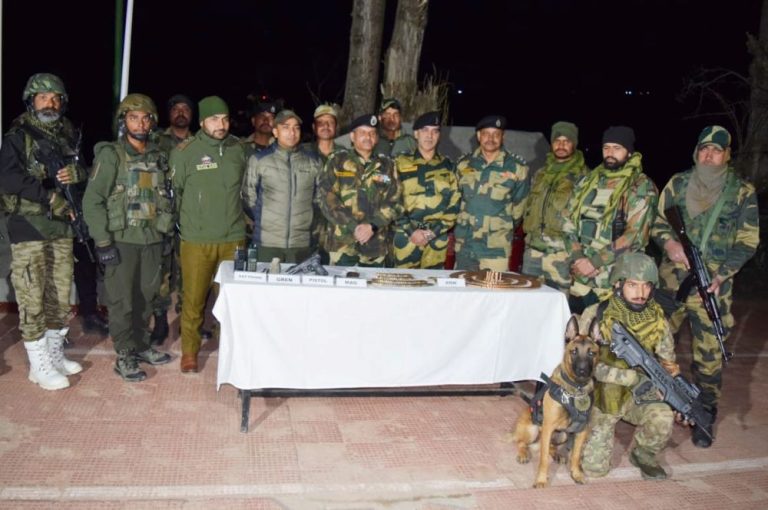
In a significant development, Border Security Force (BSF) personnel, in collaboration with the Indian Army and the Jammu and Kashmir Police, uncovered a large cache of arms and ammunition in Kupwara district on Wednesday, March 20.
The operation, conducted following specific intelligence inputs, led to the discovery of a substantial amount of weaponry. According to BSF reports, the seizure included a 9 mm Pistol with 01 magazine containing 29 rounds, along with 01 magazine of AK 47 carrying 400 rounds. Additionally, 02 communication sets, 01 improvised explosive device (IED), 01 hand grenade, and other war-like stores were recovered from a hideout in Rangwar, Kupwara.
BSF took to the social media platform ‘X’ to announce the operation’s success, stating, “On specific intelligence of #BSF, a joint search operation was launched by @BSF_Kashmir, #IndianArmy & #JKP at Rangwar, #Kupwara today & recovered, 9 mm Pistol with 01 mag 29 Rds, 01 mag of AK 47/400 Rds, 02 Comn Sets, 01 IED, 01 Hand Grenade & other war-like stores from a hideout.”
On specific intelligence of #BSF, a joint search operation was launched by @BSF_Kashmir, #IndianArmy & #JKP at Rangwar, #Kupwara today & recovered, 9 mm Pistol with 01 mag 29 Rds,01 mag of AK 47/400 Rds,02 Comn Sets, 01 IED, 01 Hand Grenade & other war-like stores from a hideout. pic.twitter.com/kiPRPL6dB1
The terror revival plots have been busted by the security forces in J&K in the past also. Apparently, the security forces have tightened the noose on the networks of terrorists operative based out of Pakistan, and as a result, the terror incidents have nosedived in the valley. Meantime, the administration is trying to propagate the idea of growth and development in the mindset of youth.
Clearly, this has created chaos among the extremists as the misguided youth remained their biggest asset in the valley throughout the decades. Hence, various terror revival plots are being orchestrated, but fatefully the security forces seem not only vigilant and cooperatively working but also getting ground support from the locals in sweeping separatism and terrorism out of J&K.
In a display of courage and valour, the Baloch Liberation Army (BLA) attacked the Pakistan Army in three separate incidents across Pak-occupied-Balochistan. According to BLA spokesperson Jeeyand Baloch, these attacks occurred in Tump, Zamran, and Mastung, resulting in the death of four Army personnel and injury to five others.
In Tump, located in Kech district, BLA fighters targeted Pak Army engaged in an offensive operation. Amidst the military’s advancement, BLA fighters ambushed them, leading to the immediate death of three personnel. Furthermore, in Mastung, BLA targeted a security post within the main Army camp using a hand grenade, injuring three personnel.
BLA
Later on, BLA fighters fired grenades and automatic weapons at a military post in Zamran’s Koh Tan area. This resulted in the death of one and injury to at least two others. Furthermore, the BLA launched an attack on the Pakistan Army in Bolan, employing a remotely controlled IED to target a military vehicle in the Margat area of Bolan. The explosion resulted in death of three personnel and complete destruction of the vehicle.
The damage inflicted on the Army was significant, demonstrating the BLA’s unwavering commitment to an independent Balochistan. Since the forceful and brutal occupation by the Pakistan Army in 1928, Balochistan has endured a painful environment. To liberate their motherland from this brutal occupation, freedom fighters of the BLA and BLF have taken up arms and chosen to resist the evil, oppressive force in power.
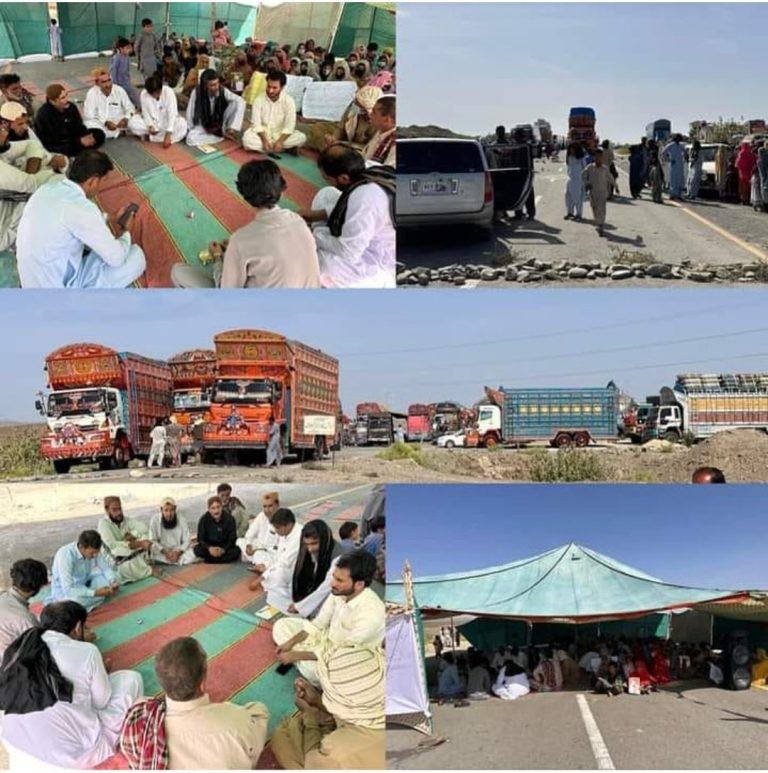
Tensions rise as the families of two missing students, Shoaib Baloch and Khudadad Siraj, seek answers regarding their whereabouts. Shoaib Baloch, the son of Khan Mohammed and a student at Bolan Medical College in Quetta, was abducted from his home in Food City, Taunsa Sharif, on March 9, 2024.
Shoaib Baloch, son of Khan Mohammed, is a student at Bolan Medical College, Quetta. He was forcibly disappeared on March 9th, 2024, from his home located at Food City in Taunsa Sharif. His family has been protesting across various platforms for his safe release. We stand in… pic.twitter.com/w9HkeBRzHL
His family’s relentless protests for his safe return have echoed across various platforms, demanding justice and accountability for his disappearance. Simultaneously, another protest rages on in the Kech area for the recovery of Khudadad Siraj.
Hailing from the village of Karki in Pak-occupied-Balochistan, Khudadad Siraj, a medical student in Sargodha, Punjab, was allegedly taken by security forces, adding fuel to the outcry against enforced disappearances in the country.
خداداد سراج کی بازیابی کی خاطر احتجاجی دھرنا کیچ کے علاقے کرکی جاری ہے۔
This isn’t an isolated incident. The Voice for Baloch Missing Persons (VBMP), a human rights group, has documented thousands of such disappearances. These abductions target not just students, but journalists, activists, and anyone deemed a threat by the Pak Army. The families of the disappeared are left with agonizing uncertainty, often receiving the bodies of their loved ones years later, if at all.
We use cookies on our website to give you the most relevant experience by remembering your preferences and repeat visits. By clicking “Accept All”, you consent to the use of ALL the cookies. However, you may visit "Cookie Settings" to provide a controlled consent.
This website uses cookies to improve your experience while you navigate through the website. Out of these, the cookies that are categorized as necessary are stored on your browser as they are essential for the working of basic functionalities of the website. We also use third-party cookies that help us analyze and understand how you use this website. These cookies will be stored in your browser only with your consent. You also have the option to opt-out of these cookies. But opting out of some of these cookies may affect your browsing experience.
Functional cookies help to perform certain functionalities like sharing the content of the website on social media platforms, collect feedbacks, and other third-party features.
Performance cookies are used to understand and analyze the key performance indexes of the website which helps in delivering a better user experience for the visitors.
Analytical cookies are used to understand how visitors interact with the website. These cookies help provide information on metrics the number of visitors, bounce rate, traffic source, etc.
Advertisement cookies are used to provide visitors with relevant ads and marketing campaigns. These cookies track visitors across websites and collect information to provide customized ads.
Necessary cookies are absolutely essential for the website to function properly. These cookies ensure basic functionalities and security features of the website, anonymously.
Cookie
Duration
Description
cookielawinfo-checkbox-analytics
11 months
This cookie is set by GDPR Cookie Consent plugin. The cookie is used to store the user consent for the cookies in the category "Analytics".
cookielawinfo-checkbox-functional
11 months
The cookie is set by GDPR cookie consent to record the user consent for the cookies in the category "Functional".
cookielawinfo-checkbox-necessary
11 months
This cookie is set by GDPR Cookie Consent plugin. The cookies is used to store the user consent for the cookies in the category "Necessary".
cookielawinfo-checkbox-others
11 months
This cookie is set by GDPR Cookie Consent plugin. The cookie is used to store the user consent for the cookies in the category "Other.
cookielawinfo-checkbox-performance
11 months
This cookie is set by GDPR Cookie Consent plugin. The cookie is used to store the user consent for the cookies in the category "Performance".
viewed_cookie_policy
11 months
The cookie is set by the GDPR Cookie Consent plugin and is used to store whether or not user has consented to the use of cookies. It does not store any personal data.