Home Blog Page 130

Protest in Germany against Pakistan Army’s atrocities in Pak-occupied Balochistan

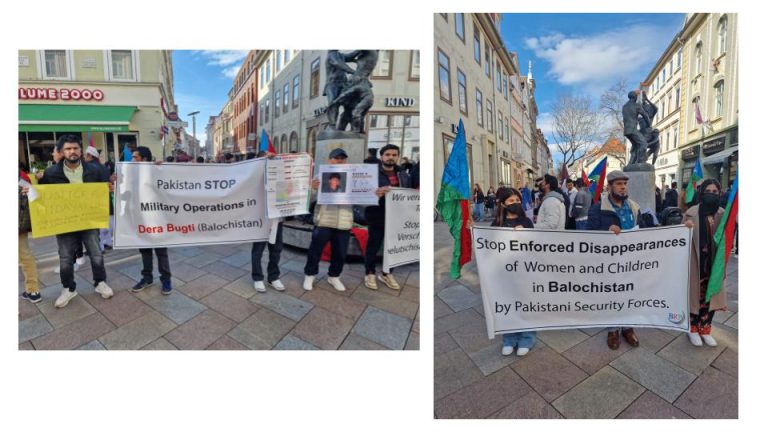
In a recent development, the Baloch Republican Party has reported a protest demonstration in the city of Gottingen, Germany, against the ongoing military operations by the Pak Army in Pak-occupied Balochistan. The demonstration aimed to draw attention to forced disappearances and fake encounters that have led to the tragic deaths of young individuals in the resource-rich troubled region.

Protesters voiced their concerns over the continuous rise in military aggression by the Pakistan Army in Pak-occupied- Balochistan. According to their accounts, a recent military operation in Bolan specifically targeted a significant number of people, subjecting them to forced disappearances. Disturbingly, reports emerged of local homes being set ablaze and their livestock being looted during these operations.

The activists further emphasized that thousands of cases of forced disappearances persist across Pak-occupied Balochistan, with Dera Bugti as one of the affected areas. In response to these atrocities, the Baloch Republican Party appealed to international human rights organizations and the global community, urging them to take a stance against Army-sponsored terrorism.

Baloch activists, through their rallies and campaigns on foreign soil, are working to bring attention to the challenges and dreams of the Baloch people, both within and outside Pakistan.

These activists are actively participating in a petition, urging international authorities to address the ongoing hardships faced by their community. They are specifically calling on the United Nations and human rights organizations to intervene and hold those responsible for the crimes in Balochistan accountable. To ensure a thorough investigation, the activists are advocating for a fact-finding mission led by the United Nations Working Group.

Balochistan, known as one of Pakistan’s most underdeveloped regions, has faced numerous atrocities committed by the Army and its intelligence agency, Inter-Services Intelligence (ISI). These actions include abductions, killings, and torture, creating an atmosphere of fear among the Baloch people. Injustice and alienation have driven Baloch individuals to voice their concerns on the international platform against the oppression they face.

Pak PM calls for Kashmir resolution; POJK residents condemn occupation

The rigged election and delayed elections in Pakistan has ultimately yielded a coalition government under Shahbaz Sharif. Clearly, the newly formed government with Shahbaz Sharif as Pak PM is against the will of the people and has been imposed on them by the autocratic Pakistan Army.

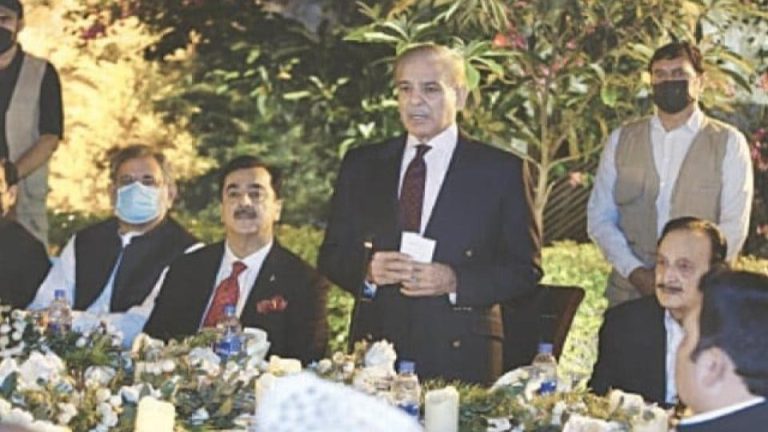
Nevertheless, after weeks of uncertainty Shahbaz Sharif took oath and made his first speech. Like every erstwhile Prime Minister, he towed the line pitched by the Pakistan Army and seemed pleasing his masters in uniform.

In his remarks he made a mention of Kashmir and asked his fellow parliamentarians to pass a resolution for the freedom of Kashmir along with Palestine. He said, “Let’s all come together…and the National Assembly should pass a resolution for the freedom of Kashmiris and Palestinians.”

In the later part of speech, he claimed that the expenditure of the same National Assembly is being met by the borrowed money. Interestingly, his latter statement shows lack of any desire for his former statement and that Kashmir’s mention in the address is just a political gimmick as, keeping aside Kashmir for some time, his country struggles even to address the most basic problem of scarcity of food.

His statement also shows that he lacks the most basic political acumen as he is talking to free an already free Jammu and Kashmir while the portion under his illegal control has been destroyed by his predecessors in past 75 years. Currently J&K and POJK have unimaginable differences when it comes to development, growth and upcoming future.

POJK: Conditions worse than a failed state

The statement on Kashmir by Pak PM does not resonate with the ground reality. While he is invoking Kashmir as something important for Pakistan, the inhabitants of POJK, are actually, themselves fed up with him and his illegitimate control. Under 75 years of colonial exploitation, POJK has become worse than any failed state.

With due consideration, it has been more than six months since people of POJK are protesting across the region, which Pakistan, obviously, is trying to hide from the world. Their demands centred around the right of wheat flour, electricity among others.

These protests are the result of resentment of the people as Pakistan exploits POJK resources to produce electricity and then sells it back to them on higher prices. So now angered people in POJK have boycotted paying electricity bills for months now. Their Charter of Demands has gone unnoticed and most expansive and unprecedented protests have ensued since then, involving women, children, men and elderly.

Despite knowing this, Pak PM has the audacity to call for Jammu and Kashmir’s freedom which has far better facilities for its population. Road and rail connectivity, world class infrastructure, robust economic push, thriving tourism and diverse start-ups are some of the important developmental aspects of Jammu and Kashmir today. Interestingly, J&K and POJK have same cliffs, riverine system with flowing estuaries, same geographical conditions, same environment, similar resources, still just because of an unjust border line the conditions are drastically different.

J&K: Integral part for India, means of exploitation for Pak

The difference is just because of the fact that India considers Jammu and Kashmir as its integral part and Pakistan considers POJK as an additional territory which is only to be exploited for its own means. While Pak PM’s statement is audacious, and senseless, it is also hilarious because to put forward any claim the most important thing that a politician must consider is the feasibility and moral obligation of his claim. While there is no feasibility of his statement, his moral obligation can only be to set free POJK from Pak’s illegal occupation so that it can have a bright future with India.

It becomes evident from the fact that just a couple of days ago, people in Pak occupied J&K’s Poonch were protesting calling out Pakistan to make it clear that whether they could fulfil their demands or not, failing which they warned to move to the markets of other side Poonch (J&K, India).

So, Pak PM has made non-sensical call on Kashmir when people of POJK are searching for every type of possibilities to get their rights back which includes indulging with the mainland J&K.

Therefore, Pakistan’s newly chosen PM, who is going to serve for his second term has shown with his statement that he has no idea of what is happening in Kashmir and has no vision for the development of POJK. He is only making political comments on Kashmir to please his masters and appease the people of Pakistan- who are habitual of getting pleased by delusional dreams- to legitimse his government which is formed out of rigged election with no popular support.


Gwadar residents protest Chief Minister’s visit over inadequate flood crisis response

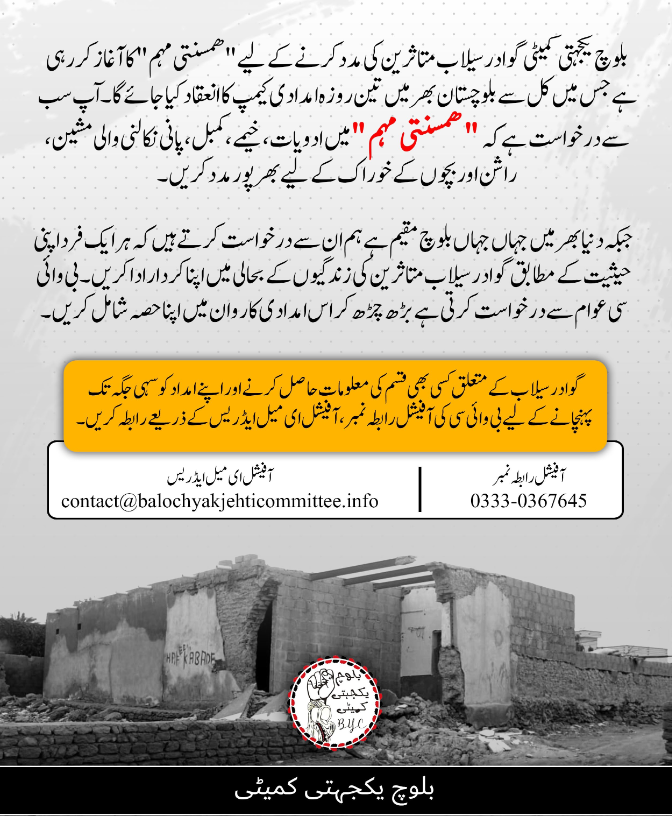
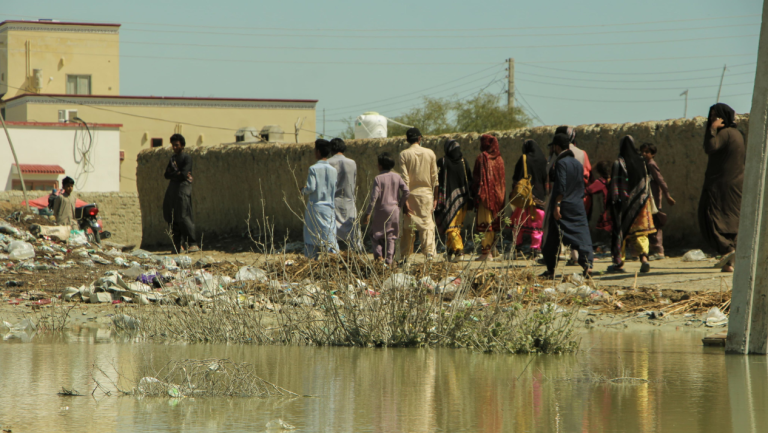
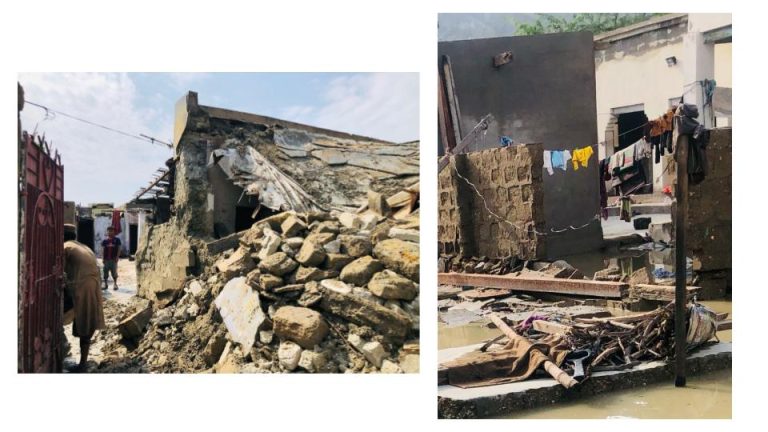
Recently, during Chief Minister Jam Kamal Khan’s visit to Gwadar residents strongly protested, bringing the convoy to a standstill. The incident occurred when locals from TTSC Colony blocked Airport Road at Tahiri Plaza, citing the inadequate response to the flooding crisis in Gwadar in Pak-occupied Balochistan.

For the past six days, residents have been suffering as their homes have been submerged in 5 to 6 feet of water due to flood in the region, with no assistance from the district administration and provincial authority. The torrential rains have not only left large areas inaccessible but have also resulted in a shortage of essential supplies, exacerbating the challenges faced by the people of Gwadar.

Protesters urged immediate and robust relief efforts in the rain-affected regions, emphasizing the need for prompt rescue operations. The situation in Gwadar mirrors the plight of other areas in Pak-occupied Balochistan, where floodwaters have breached residential areas, causing significant damage and hampering the delivery of aid.

Gwadar’s Paradox

Notably, the ongoing heavy rains have not spared Gwadar, prompting residents and organizations to hold the Pakistan and Chinese projects accountable. The projects of the brutal Pak Army and their Chinese ally have obstructed the natural flow of water, leading to the inundation of the city, and heightening tensions among the affected population.

The much-hyped infrastructure projects that the Chinese promised the Army at the cost of the Baloch community have fallen short; locals grapple with basics like clean water and electricity. And the recent rains have further exposed the city’s vulnerability. The promised benefits of development seem elusive for those it aimed to uplift.

This prompts us to ask who truly benefits from Gwadar’s development. While the Army and Chinese revel in newfound prosperity, the true owners of the land struggle to meet basic needs.

Shehbaz Sharif becomes Prime Minister of Pakistan for second time

Islamabad, Pakistan – Shehbaz Sharif has been elected as the Prime Minister of Pakistan for a second term as the outcome of the rigged election. The vote, held on February 8, was marred by rigging and delayed results.

In a session on Sunday, the National Assembly, the lower house of parliament, convened to elect the premier. Shehbaz Sharif secured 201 votes out of 336, surpassing the required minimum of 169 votes. His rival, Omar Ayub Khan, received 92 votes.

The Sunday Assembly session experienced a delayed and chaotic start as PTI-backed SIC legislators called Shehbaz “Thieves!” Because of corruption cases against the Sharif brothers.

Nawaz Sharif faced a corruption conviction in 2018, leading him to a self-imposed exile in the United Kingdom. He returned in October of the preceding year to participate in the polls.

The Pakistan Muslim League Nawaz Party (PMLN), led by his brother and another puppet former Prime Minister Nawaz Sharif, secured 73 seats, while their longtime rivals, the Pakistan People’s Party (PPP), won 54 seats.

The PTI party, led by Imran Khan but emerged as the largest group with 93 seats. Despite winning the majority of seats in the February 8 general election, PTI faced challenges from the PML-N and PPP’s power-sharing deal, potentially sidelining Imran Khan’s return to power. 

Imran Khan has been incarcerated and handed a minimum 10-year prison sentence for various offences, such as corruption and disclosing state secrets. In February, a district court sentenced Khan and his wife to an additional seven years in prison, asserting that their 2018 marriage breached the law. Khan maintains that the charges are politically motivated.

Shehbaz Sharif, aged 72, served as prime minister until August last year when the National Assembly was dissolved for the caretaker government to conduct national elections.

Shehbaz Sharif, the younger brother of three-time Prime Minister Nawaz Sharif, founded the Pakistan Muslim League-Nawaz (PMLN) party, currently in alliance with the PPP to form the government.

Despite the opposition’s claims of rigging, Shehbaz Sharif’s return is expected to bring challenges, including economic difficulties and protests from loyal supporters of Imran Khan. Sharif will need to address the nation’s worsening poverty and engage in talks with the International Monetary Fund (IMF) for an economic deal.

In his speech, Sharif expressed gratitude to his allies and emphasized his commitment to political stability, promising to work closely with all provinces. The opposition, however, continued to protest, accusing Sharif of electoral irregularities.

Enforced disappearances in Pak-occupied Balochistan by Pak Army continues unabated

After skipping summons in the Baloch missing students’ case twice, Pakistan’s ex-caretaker Prime Minister Anwarul Haq Kakar finally appeared in the Islamabad High Court [IHC] last Wednesday. The summons had been issued by Islamabad High Court [IHC] senior Puisne Judge Mohsin Akhtar Kayani hearing a petition filed by human rights lawyer Imaan Mazari regarding enforced disappearance of 59 Baloch students.

Remarking that the “Caretaker prime minister should not consider coming to court as an insult,” Justice Kayani noted that “Even after 21 hearings, the absence of positive results [on recovery of the missing students] is an insult to the Constitution of Pakistan.” He accordingly wrote in his order that “There is no way out except to summon the prime minister, ministers, and secretaries to inform the court why the matter is not being given due importance.” 

However, rather than accepting institutional failure and informing the court about the steps being taken to recover the missing Baloch students, Kakar instead tried to obfuscate the issue by going on a tangent. Brazenly absolving the government of any lapses, he went on to complain that “The series of accusations [of rampant enforced disappearances in Balochistan] leveled against the state every other day should stop.”

Kakar’s complete lack of concern about enforced disappearances in Balochistan became evident when he told a reporter while leaving the court he had “defended the allegations against the state in the name of enforced disappearances.” Though extremely shameful, this irresponsible utterance comes as no big surprise as it’s not the first time that the powers-that-be in Pakistan have exhibited such a callous attitude towards the brutalised people of Balochistan.

In April 2019, while replying to Geo TV anchor Hamid Mir’s query of enforced disappearances in Balochistan, the then Director General [DG] of Pakistan Army’s media wing Inter Services Public Relations [ISPR] Maj Gen Asif Ghafoor had the gall to say that “You have a deep attachment with missing persons [but] so have we. We don’t wish that anyone should be missing. But when it’s war, you have to do a lot of [unpleasant] things- as they say, all is fair in love and war; war is very ruthless.” [Emphasis added].

Three months later, in a tweet DGISPR admitted that some missing people include “Those with the state [who] are under legal process.” The acknowledgement that those “under legal process” are being forcibly disappeared as a matter of routine is indeed very disturbing as it’s an unambiguous admission of the Pakistan Army’s complicity in orchestrating enforced disappearances through various agencies and covert ‘death squads’ that operate in Balochistan under its command.

The issue of enforced disappearances in Pakistan is so acute that the Human Rights Watch World Report 2019 on Pakistan which states, “During counter-terrorism operations, Pakistani security forces often are responsible for serious human rights violations including torture, enforced disappearances, detention without charge, and extrajudicial killings. . . Counterterrorism laws also continue to be misused as an instrument of political coercion. Authorities do not allow independent monitoring of trials in military courts and many defendants are denied the right to a fair trial.” [Emphasis added].

One would run out of space to list out all incidents of enforced disappearances in Balochistan as they run into thousands. Nevertheless, two such cases deserve mention as they indicate the dizzy heights of institutional impunity. The first incident is one that grabbed international attention on April 26, 2010, when Asian Human Rights Commission [AHRC] issued an urgent appeal [AHRC-UAC-053-2010] soliciting public support through appeals to concerned authorities on Pakistan’s High Court’s inability to recover 35 year old Baloch person named Jalil Reki Baloch who was abducted by persons in plain clothes on 13 February 2009.”

Two things make this AHRC appeal more disconcerting. One, it clearly states that Jalil Baloch is still missing fifteen months after his arrest by plain clothed intelligence agents, and despite admissions by officials that he is in custody.” [Emphasis added], and two, there’s a specific mention that Although the Supreme Court has made strong efforts to address the issue of disappearances in Pakistan it remains unable to hold military staff, such as those from the Inter Services Intelligence (ISI) Agency answerable for illegal arrests and detentions.” [Emphasis added].

The AHRC appeal campaign failed to locate or save Baloch. Two years and eight months after he was forcibly disappeared in broad daylight in the presence of numerous witnesses, Baloch’s dead body with gruesome torture marks was recovered near Turbat city in Kech district of Balochistan. He had been shot through the heart execution-style and ended up as yet another name in the long list of Pakistan Army’s infamous ‘kill and dump’ victims.

The second case is more recent and concerns the enforced disappearance and extrajudicial killing of another Baloch named Balaach Mola Bakhsh, which confirms that Pakistan Army’s abduct, kill and dump policy continues unabated.

Bakhsh was abducted by Counter Terrorism Department [CTD] personnel from his house in Turbat on October 29 last year. However, a First Information Report against him was filed by CTD only after 22 days in which it was alleged that Baalach was apprehended on November 20 and five kg explosives were found in his possession. He was produced in court by CTD on November 21.

On November 23, CTD claimed that four terrorists of a “proscribed group” had been killed in an encounter in Turbat the previous night. Surprisingly, Baalach [who was then on remand in CTD custody] was listed as one amongst the terrorists killed. This barefaced extrajudicial killing led to massive public outcry and to cover their crime, CTD changed its original version and claimed that Baalach was killed in crossfire when he was leading a CTD team to a terrorist hideout.

This incident sparked the December 2023 March against Baloch Genocide and has brought back the issue of enforced disappearances in Balochistan under international scrutiny. Unfortunately, just like in the past, no country or international rights organisation has given this disturbing trend the importance it rightly deserves. And so, while no one grudges Pakistan shedding copious tears on the killing of Palestinians in Gaza, the fact that neither Islamabad or Rawalpindi is losing sleep over continuing enforced disappearances in Balochistan exposes its perverse duplicity.

Tailpiece: While Kakar may pride himself for having “defended the allegations against the state in the name of enforced disappearances,” he’s explicitly implicated Rawalpindi on this issue. Just three months ago, the ex-caretaker prime minister had during a TV interview admitted that “[the] state has no hand in these [enforced] disappearances” but accepted that “most times, the security forces pick up the people who’re involved in activities which are against the law.” [Emphasis added].

Similarly, in an undated video shot before he became Prime Minister, Imran Khan can be heard telling an audience that “Our Army [is] bombing people in Balochistan; how can we bomb our own people? Is there any army [there that] you are bombing? It is our own people with their children, and it is important to understand [that we are just bombing our people. Just think about the immorality of bombing villages with the women and children.”

Is any further proof of Pakistan Army’s active involvement in enforced disappearances required? 

J&K: LG Sinha unveils “New Jammu and Kashmir Start-up Policy 2024-27”

In a significant move to boost entrepreneurship and innovation, Lieutenant Governor Manoj Sinha launched the ‘New Jammu & Kashmir Start-up Policy- 2024-27,’ with a vision to establish 2,000 startups in the Union Territory by 2027. The policy, announced at the Avinya Startup Summit, aims to create a conducive environment for startups, providing them with comprehensive support and incentives.

The comprehensive New Jammu and Kashmir Start-up Policy offers a range of benefits, including patent-related assistance, financial aid for mentorship to recognized startups, facilitation for Department for the Promotion of Industry and Internal Trade (DPIIT) registration, and additional need-based support to startups operating in diverse fields, as highlighted by Sinha.

During the launch, Lieutenant Governor Sinha extended an invitation to potential investors from across the country to explore the opportunities in the Union Territory and contribute to its growth journey.

The new policy, approved by the Jammu and Kashmir administrative council on February 22, supersedes the startup policy implemented in 2018. It places a particular emphasis on providing entrepreneurship facilities to students and women, as well as extending support to entrepreneurs through government, private, and high-net-worth individuals (HNIs) for establishing startups.

Describing the policy as a “giant leap for startups and innovators,” Lieutenant Governor Sinha emphasized its meticulous drafting, aiming to establish 2,000 startups in the Union Territory by 2027. He underlined the administration’s commitment to fostering a dynamic entrepreneurial ecosystem.

Key features of the policy include the establishment of a Rs 250 crore Venture Capital Fund, with an initial infusion of Rs 25 crore from the administration. This fund is designed to provide crucial support for growth, early-stage financial handholding, and encouragement for the development of viable business models.

Diverse and robust start-up ecosystem

LG Sinha also discussed the challenges and growth opportunities in different sectors in Jammu and Kashmir. Reportedly, the Union Territory currently boasts 722 registered start-ups, with a notable focus on gender inclusivity, including 254 women-led startups.

The startup ecosystem in Jammu & Kashmir exhibits a diverse landscape, with construction and engineering leading the way, constituting 49 percent of the total startups. Other prominent sectors include Skill Development, Oil & Gas Transportation, IT Consulting, Business Support Services, Food Processing, and Agri-Tech. This diverse landscape showcases the entrepreneurial spirit and the presence of startups across various industries in the region.

Pak Army raids house of Presidential candidate & anti Pak establishment Mehmood Khan Achakzai

A sudden and controversial police raid on the residence of Pakhtunkhwa Milli Awami Party (PkMAP) leader and presidential candidate Mehmood Khan Achakzai in Quetta, Pak occupied Balochistan has ignited a fresh wave of discussions, prompting allegations of political interference by the Pakistan Army. The incident comes at a critical juncture, just days after Achakzai declared his candidacy for the upcoming Presidential elections to be held on March 9, garnering support from Imran Khan’s PTI and the Sunni Ittehad Council coalition.

Mehmood Khan Achakzai, known for his vocal criticism of the military’s role in politics, recently accused the Pakistan Army of meddling in political affairs and rigging elections to manipulate results against the will of the people. This outspoken stance has placed him in the spotlight and drawn attention from various quarters.

Raid without magistrate order

The controversial raid, which PkMAP claims was conducted without a proper magistrate order, took place at Mehmood Khan Achakzai’s residence. According to the party’s central secretary general, Abdul Rahim Ziaratwal, the operation resulted in the arrest of a personal guard in possession of a licensed weapon. The absence of a magistrate’s order has raised legal questions surrounding the raid, and PkMAP is denouncing the actions, labelling them as an infringement on the sanctity of Achakzai’s home.

Meanwhile, former Caretaker Information Minister of Balochistan, Jan Achakzai said that the raid was conducted to evict the illegal occupant in front of Achakzai’s house and the guards were arrested for obstructing the police from dispensing their duty. However, the timing of the action narrates a completely different story.

Accordingly, during a press conference, Ziaratwal emphasized the lack of legal justification for the raid, pointing out that a substantial police force was involved. The timing of the operation is significant, occurring shortly after Achakzai’s public condemnation of electoral rigging and his identification of those responsible in the National Assembly. Hence, the PkMAP views this incident as a deliberate attempt to intimidate its leadership and stifle its voice against perceived electoral injustices.

Students & parents protest against shortage of school teachers in Pakistan-occupied Gilgit-Baltistan

Nagar, occupied Gilgit-Baltistan: In a chilling demonstration of frustration and desperation, student protest have emerged in Dadimal, Nagar. Along with students, their parents also have taken to the streets to protest the dire shortage of school teachers, leaving the region’s education system in shambles. The extreme cold and snow have not deterred the determined protesters, who demand immediate action to address the ongoing crisis.

The lack of qualified teachers has prevented the commencement of middle classes, affecting the academic progress of countless students. Shockingly, those teachers appointed to address the issue find themselves posted in other schools, exacerbating the problem and leaving the students and parents in Dadimal Nagar in a state of dismay.

This alarming situation is not isolated, as recently, girl students in Ghizer also staged a protest, blocking Ghizer Road near Basin Khari Park. The common denominator in both cases is the scarcity and transfer of teachers, an issue that has persisted for decades.

The student protest in Dadimal Nagar adds to a growing list of student demonstrations against the perceived injustices in the education system. Surprisingly, since past year, students from various groups – girls, boys, school, and college students – have voiced their discontent, revealing a broader dissatisfaction with the Pakistani-imposed education system.

Earlier this year, students from Karakoram International University protested for weeks, highlighting the same critical issue of non-availability of teaching staff. The persistence of such student protest underscores the urgent need for comprehensive reforms in the education sector in occupied Gilgit-Baltistan. Clearly, in a bid to maintain control over the region, Pakistan deliberately withholds an adequate teaching staff, viewing education as a potential threat to its illegal occupation and subsequent basis of misinformation along with long promoted misconception of freedom.

Pak-occupied Balochistan: BNM slams Pakistan Army of war crimes in Bolan

In a troubling development, the Baloch National Movement’s spokesperson has raised alarm over the ongoing military operations in the Bolan, Sabi, and Harnai regions of Pak-occupied-Balochistan. Expressing deep concern, the spokesperson criticized the international community’s silence, as it is providing Pakistan with the opportunity to intensify military aggression in the resource-rich region.

The military has sealed off entry and exit routes of regions through shelling and bombing, leading to the confinement of civilian population. The complete restriction on the movement of the trapped population is extremely challenging as it becomes an obstacle in obtaining accurate information about the ground reality.

Indiscriminate shelling and bombing have inflicted severe harm on the civilian population, disrupting their daily lives. The hardships faced by those trapped, including limited access to food, medical treatment, and the fate of individuals subjected to enforced disappearances hangs in limbo.

Ongoing military operations

One of the deeply troubling incidents highlighted by the spokesperson involves the Army’s siege of the house of Alian in the Shaban region, connected to Sabi. The Army has detained women and children, subjecting them to forced disappearances. Similarly, in the Dhadar region, the Army has taken into custody herdsman ‘Malay’ and the women and children of his relatives and subjecting them to enforced disappearances.

The ongoing military operations, which have persisted for the past ten days, paint a grim picture of human tragedies. Women are being used as human shields, exacerbating the humanitarian crisis as a result of the Pak Army’s brutality during the nine-day military onslaught. Additionally, the depletion of food reserves and the lack of medical treatment for the injured are adding to the pain of the affected Baloch population.

The Baloch National Movement spokesperson underscored that the people in Bolan and surrounding areas, primarily engaged in agriculture and livestock, are now facing further deprivation as the Army has taken control of their livestock, their source of livelihood.

This escalation of Army’s aggression against the Baloch nation is nothing less than war crimes by Pakistan Army, this is a tactic to discourage Baloch resistance and movements for independence. The Baloch community, for decades, has faced violence and atrocities by the Pak Army.

Not only have they been abducted at gunpoint, but they have also been tortured and killed under Pakistani ‘establishment’s kill-and-dump policy. The international community should break its silence and address the humanitarian catastrophe in Pak-occupied-Balochistan.

Sindh: Hindus protest against recurring thefts in temples and lack of action from the police

In a poignant display of frustration, Pakistan’s minority Hindu community gathered outside the Jhuddo Press Club in Mirpurkhas to protest against the perceived failure of the police to apprehend a bold gang of thieves. The protesters, carrying placards and banners, claimed that the Shiv Mahadev temple had been targeted three times in the past one-and-a-half months.

The demonstration unfolded as the community sought to draw attention to the recurring thefts as well as the apparent lack of action by local law enforcement. Chanting slogans against the police, the protesters informed the media that they had repeatedly alerted authorities about an unknown group of thieves who had broken into the temple multiple times, stealing gold jewelry, valuables, and antiques.

Despite lodging several complaints, the protesters expressed dissatisfaction, stating that the police had not taken notice of the crimes thus far. They demanded immediate action from the Deputy Inspector General (DIG) Mirpurkhas and the Senior Superintendent of Police (SSP) to ensure the recovery of the stolen goods.

The demonstrators stressed the urgency of the situation and called on the police to not only arrest the criminals responsible for the thefts but also ensure they face appropriate legal consequences. The community’s protest highlights the need for swift and effective measures to address the security concerns of minority communities and protect places of worship. The minorities, especially Hindus have been primarily targeted because of different religion. The bigoted Islamists have in past vandalised and plundered temples in Pakistan. The incident is latest and underscores a need for urgent redressal of persecution of Hindus.