Home Blog Page 135

Pak Army forcibly disappears three individuals from Karachi & Awaran district of POB

Recently, three individuals from the Awaran and Karachi districts of Pak-occupied Balochistan have been forcibly disappeared by the oppressive Pak Army.

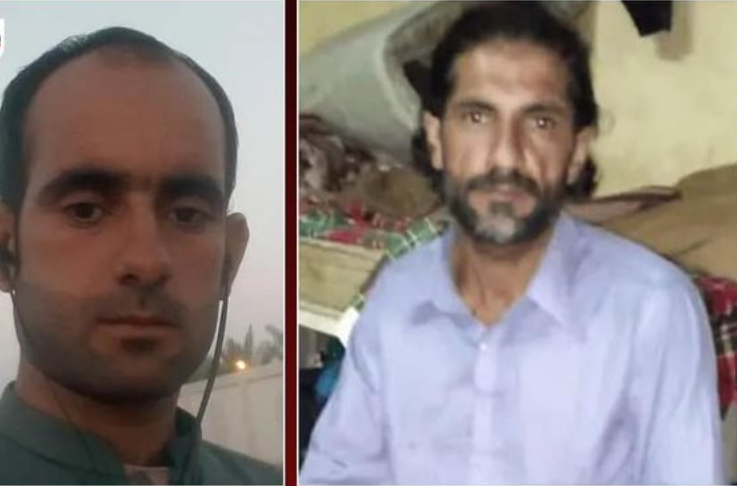
The victim is identified as Shakar Khan who was forcibly taken into custody by the Pak Army on February 9, 2024, in Karachi city when he was travelling back home from vacation in the United Arab Emirates (UAE). He is reportedly a labourer by trade.

In a separate incident, the victim is identified as Nasrullah, son of Dost Muhammad and Mumtaz, son of Nawaz, both residents of Garrahi Geshkor, who were forcibly detained in the Awaran district. Reportedly, the Pak Army summoned them to an Army camp in Awaran and since then, their whereabouts remain unknown.

These cases are not uncommon and are reported daily. Since the Pak Army forcibly occupied their region on March 27, 1948, the people of Pak-occupied Balochistan have been fighting against the atrocities and Baloch genocide committed by the Pak Army. Examples of these atrocities include frequent home invasions, disappearances, staged encounters, target killings, torture, embarrassment at checkpoints, and kidnappings for ransom.

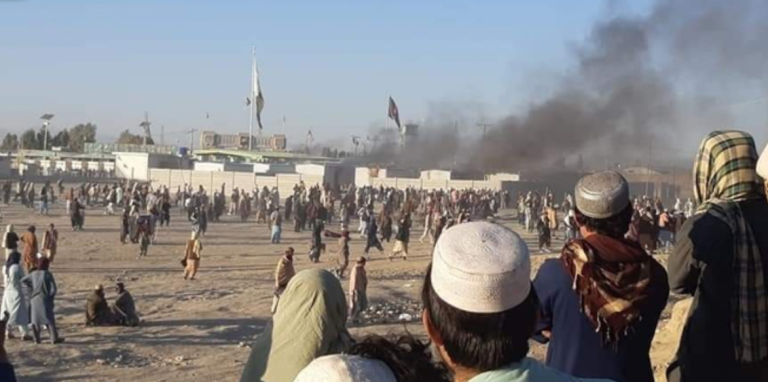
Tensions escalate at Chaman Border after Pak backed authorities disperse protestors

PA late-night operation by Chaman’s puppet authorities was conducted to disperse the protestors opposing the government’s stringent visa policy at the Pakistan-Afghan border which resulted in multiple arrests.

The sit-in protest was ongoing for four months and it escalated after the protestors blocked the entrance to the Chaman passport office with a container on Sunday and Monday night.

The local administration and the Frontier Corps (FC) moved to take down the barricades and arrested key figures, including a well-known protest leader Sadiq Achakzai. The traffic was severely disrupted as a result of calls for a shutter-down strike and the closure of the Chaman-Quetta international highway.

The protesters threw stones at the FC fort during more altercations outside the District Police Officer’s (DPO) office. Even after FC staff used tear gas to scatter the protestors, many of them persisted, indicating their intent to carry out the demonstration.

The Laghari Union’s general secretary, Ghousullah Achakzai, declared that the protests would go on until Sadiq Achakzai and the other protestors who were being held were freed. Protests have been ongoing since the government’s strict visa policy has led to widespread job losses in Chaman and increased unrest at the border.

Controversial appointments in govt posts ignite protests in Pak-occupied Gilgit-Baltistan

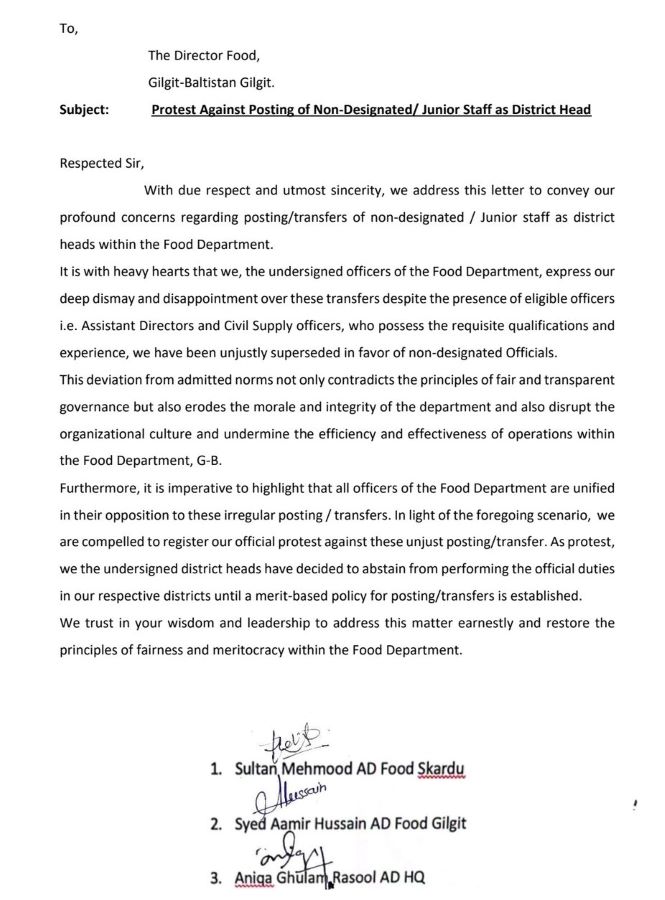
The administration of Pakistan occupied Gilgit Baltistan (POGB) has remained under a strict scrutiny and control of Pakistan, this could be understood by a fact that it uses its regional apparatus called POGB government to install its favourite people at the helm of important affairs. Interestingly, this had proved to be a successful attempt to control the illegally occupied Gilgit Baltistan. In the latest move, it has again adopted the same tactic to sieve out the people-oriented officials in the food department. The occupying government in POGB has named undesignated and junior staff as the head of district, causing dismay in the senior officials of Assistant Director rank, who are far more eligible and possess requisite qualifications and experience.     

Criticising the occupying government’s step, some of the officials like Sultan Mehmood AD Skardu, Syed Aamir Hussian AD Gilgit and Aniga Ghulam Rasool AD HQ wrote a letter to the Food director of POGB calling the move as contradictory to the “principles of fair and transparent governance“ and erodes the “morale and integrity of department.”

Food Department officials abandon all work in protest

Accordingly, food department officials have announced an unending protest abandoning the work until a merit-based transfer-posting system is established. Notably, a few weeks ago, the people of POGB were on the streets for wheat. Pakistan and its puppet government have taken a hostage of people and their resources who are getting their rights like alms, in turn they are not even given proper wheat. The recent move is guided by the same mindset to position those who are not loyal to people but the occupying government so that the crucial amenities like food gets to the people on their terms.

Essentially, this is another move to keep a strong hold of the people. No entity that calls itself a government would try to bypass the merit to place people under its patronage to some of the most crucial positions, especially when those candidates are incompetent and ineligible.

The move made is apparently a challenge to the people and demands them to get their shoelace tight as they may get into another friction with the occupying government in near future, only this time it would be related to food department.    

Pak police opens fire on sit-on protestors for assassination of Sindhi nationalist

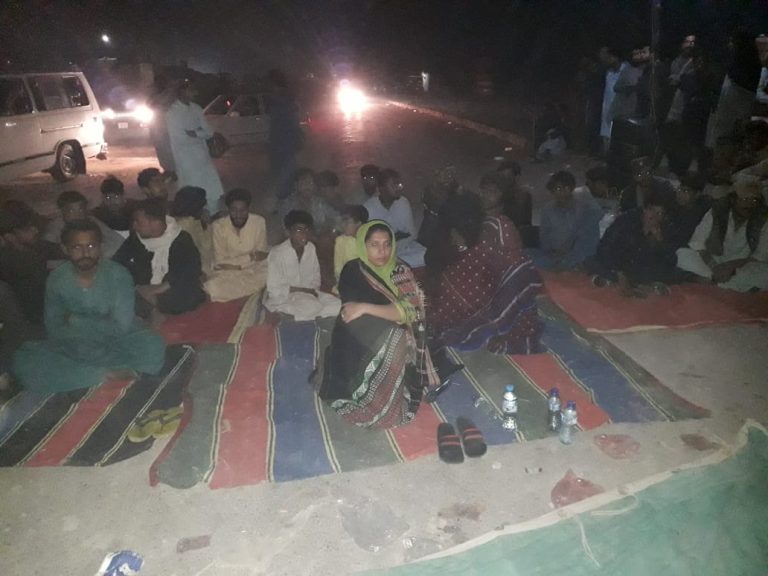
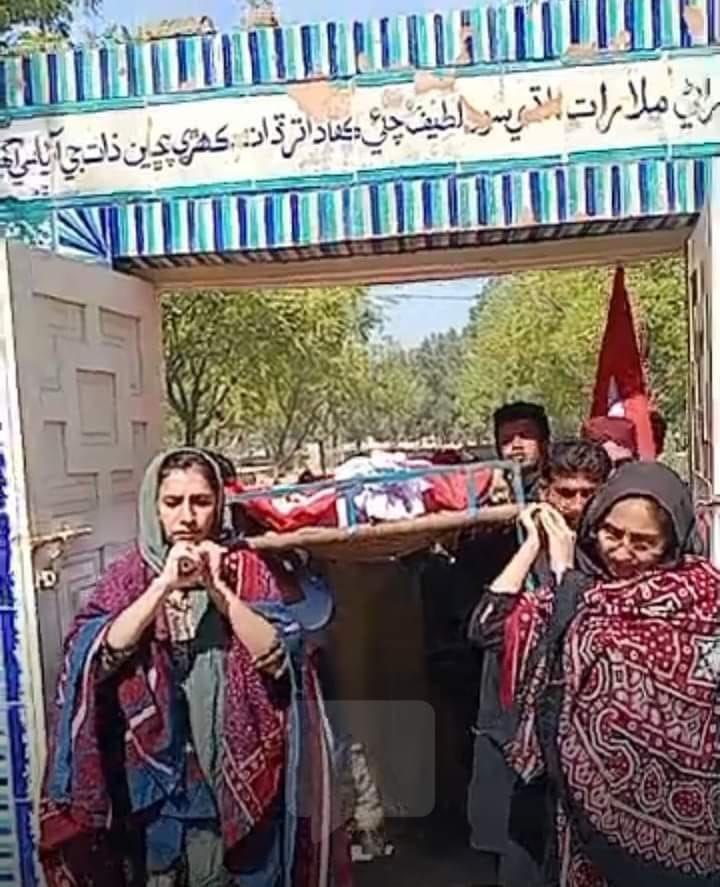
In a concerning development, the Nasirabad police fired indiscriminately into the air near the sit-in led by Sorath and Sasui Lohar, daughters of the assassinated Sindhi nationalist Hidayat Lohar. The incident unfolded as the protesters persisted their demand for justice and the registration of an FIR (First Information Report) regarding their father’s assassination.

Hidayat Lohar was assassinated by assailants backed by the Pakistan Army. Despite having substantial evidence, the daughters faced rejection when attempting to file an FIR with the Naseerabad Police. As of now, no FIR has been registered in connection to the assassination, prompting Sorath and Sasui to stage a sit-in protest.

The protesters are steadfast in their straightforward demand – the registration of the FIR – yet the police have refused to comply, instead resorting to intimidating tactics. The incident marks a disturbing turn as law enforcement employs force to suppress the peaceful protest, raising concerns about the state of justice and freedom of expression in the region.

Sorath and Sasui Lohar’s sit-in is not only a plea for justice but also a powerful stance against the tyranny and impunity of the Pakistani establishment. Nevertheless, the unfolding events spotlight a broader issue of challenges faced by those seeking justice in the face of powerful entities.

As the daughters of slain Sindhi nationalist continue their protest, the incident has gained attention, prompting questions about the role of law enforcement in safeguarding the rights of citizens and addressing grievances. The unfolding situation requires a closer examination of the circumstances surrounding Hidayat Lohar’s assassination and a transparent investigation into the matter to ensure justice prevails.

Turkey detains six men for spying on Uyghurs for China

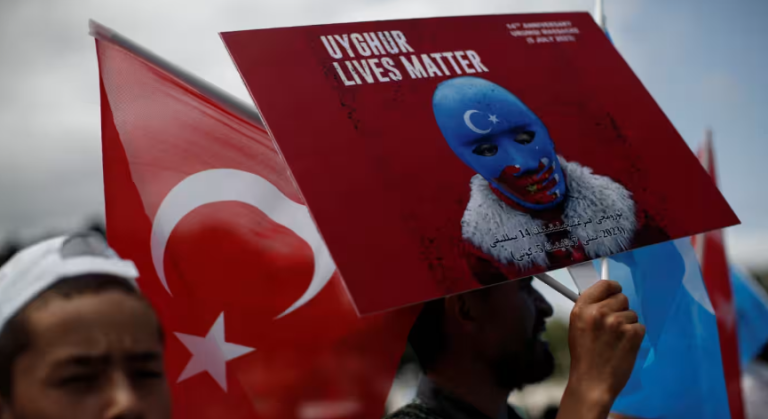
The Turkish police detained six persons in Istanbul, on Tuesday, for allegedly spying on prominent Uyghurs and are looking for more, as per the state-run Anadolu Agency. The six individuals are also charged with spying on institutions and associations connected to the Uyghur community and providing Chinese intelligence with information.

Reportedly, the Istanbul chief prosecutor’s terrorism and organised crime bureau conducted the investigation that led to the arrests. The nationalities of the suspects and the date of the arrests were not mentioned in the report.

With 50,000 or so, Turkey is thought to be home to the greatest Uyghur population outside of Central Asia. It shares ethnic, linguistic and religious ties with the Uyghur community in China. Because of this, the public and government in Turkey have a great deal of sympathy for the plight of the Uyghurs in China’s Xinjiang region.

Turkey’s foreign policy is designed to create a balance between its rising power China and its western allies. It opposes Beijing’s demands that Uyghurs be extradited from Turkey but supports China’s Belt and Road Initiative.

An extradition treaty was signed between the two countries in 2017 but has awaited ratification by the Turkish parliament since 2019. In recent years, Turkish authorities have increased their efforts to disrupt spy networks. Thirty-four persons were detained by police in January on suspicion of spying for Israel’s Mossad intelligence agency on Palestinians residing in Turkey. Authorities detained several Iranians in 2022 on suspicion of plotting to murder Israelis in Turkey.

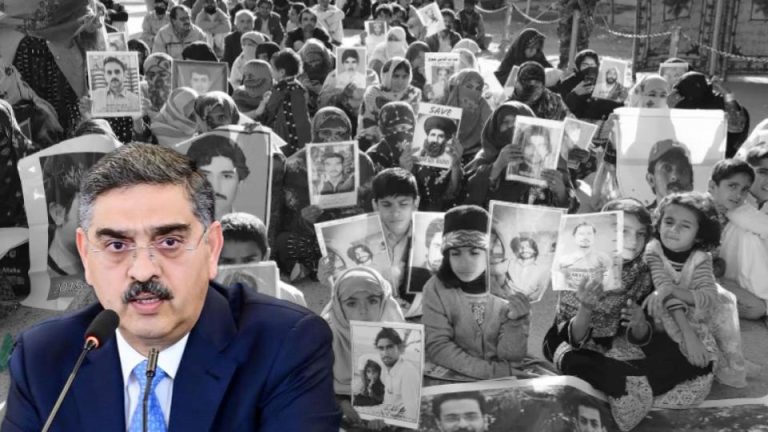
IHC reissues summons to PM Kakar over missing Baloch students

The Islamabad High Court (IHC) has issued a written order and, reasserted its previous directives, compelling caretaker Prime Minister Anwaar-ul-Haq Kakar and relevant ministry secretaries to personally attend an upcoming hearing on Monday (19th Feb) regarding the case of missing Baloch students.
In a written order issued by Justice Mohsin Akhtar Kayani on Sunday, the 4-page document emphasized the imperative presence of the Prime Minister and the secretaries of defense, human rights, and interior ministries at the scheduled hearing on February 19 at 10 am.
During the last hearing on February 13, the court specifically instructed the interim prime minister to appear before the bench. Despite a plea for adjournment due to the unavailability of the attorney general, Justice Kayani rejected the request, asserting that individuals implicated in enforced disappearances should face the death penalty.
“People involved [in enforced disappearances] should be given the death penalty twice,” remarked Justice Kayani, directing the caretaker PM to explain not registering a case against him.
PM Kakar to Appear
While the advocate general sought more time in the case, Justice Kayani declined the request, maintaining the court’s stance. This marks the second summons for PM Kakar by the IHC, with the last summons occurring on November 29, 2023, in response to a case filed by Advocate Imaan Mazari. On that occasion, the prime minister did not appear, citing his absence from the country.
The gravity of the situation can be gauged from the fact that a report by the non-governmental organization Defence of Human Rights (DHR) revealed an alarming increase in enforced disappearances in Pakistan in 2023. According to the report, 51 more cases were reported, bringing the total to 3,120 cases. The DHR disclosed that 595 individuals were released, 246 were traced, and 88 cases resulted in extrajudicial killings.
However, it should be noted that the reported numbers are lower than the actual cases. The Baloch community, for decades, has faced violence and atrocities by the Pak Army. Not only have they been abducted at gunpoint, but they have also been tortured and killed under Pakistan’s ‘establishment’s kill-and-dump policy. Even children and elderly women are shot and killed. These incidents reveal the gruesome regime under which the ethnic community of this resource-rich region resides.

Baloch National Movement awareness campaigns in London comes to an end

The recent segment of the awareness campaign launched by the Baloch National Movement (BNM) on the atrocities faced by the Baloch community by the Pak Army in London, has been concluded. During the phase of this campaign, the BNM activists distributed pamphlets in London.

In their social media post, BNM UK stated that the awareness program named “Unveiling The Baloch Struggle” will be organised in various locations in the UK. The UK cell of the Baloch National Movement commenced the campaign on February 17 this year. During the phase of this campaign, the BNM activists distributed pamphlets and raised awareness for the Baloch community in London.

Balochistan is a land of rich history, diverse cultures, and immense natural resources. However, since the occupation of Balochistan by Pakistan in 1948, the Balochis have faced systematic discrimination and exploitation. The Pak establishment has denied the Baloch their right to self-determination, suppressing their political aspirations and exploiting their natural resources for its benefit. This exploitation has led to widespread poverty, environmental degradation, and the displacement of Baloch communities.

The people of Balochistan under the control of the Pak Army have endured a persistent struggle against the atrocities and genocide perpetrated by the Pak Army. These egregious acts include frequent home invasions, disappearances, staged encounters, target killings, torture, embarrassment at checkpoints, and kidnappings for ransom.

The international community should recognize the Baloch people’s basic fundamental right to life and should conduct independent investigations into human rights violations in Balochistan and hold the Pak establishment accountable for its actions.

Amnesty International demands impartial investigation in Sindhi nationalist assassination

Amnesty International South Asia has called for an independent, impartial, and prompt investigation into the killing of Sindhi political activist and teacher, Hidayatullah Lohar. The plea emphasizes the need to ensure accountability for the perpetrators without resorting to the death penalty.

Hidayatullah Lohar, a school teacher and prominent political activist, was fatally attacked by two unidentified assailants in Naseerabad while en route to his school. Despite persistent demands and an ongoing sit-in protest by his daughters, Sasui and Sorath Lohar – both prominent activists advocating against enforced disappearances – no First Information Report (FIR) has been registered in connection with the incident.

Pak policy of enforced disappearance

Lohar’s tragic killing sheds light on the perilous conditions faced by activists and human rights defenders in their pursuit of justice. His history is marred by a previous incident in 2017 when he was forcibly disappeared by the Pakistan Army, only to be released two and a half years later in May 2019. During this period, the establishment allegedly pressured Lohar’s daughters to cease their struggle against enforced disappearances and terminate their protests, using the release of their father as leverage.

The incident underscores the broader issue of enforced disappearances in Pakistan, where dissenting voices often face abduction and intimidation. Hidayat Lohar’s case serves as a recent and poignant example of the challenges faced by those who question the establishment.

Amnesty International’s call for an independent investigation is a significant step towards addressing the enforced disappearance policy of the Pakistan Army. The international human rights organization emphasizes the importance of unveiling the truth behind Lohar’s killing, seeking justice for the slain activist, and holding those responsible accountable.

As Pakistan grapples with concerns over the suppression of dissent, the attention drawn by Amnesty International amplifies the urgency of addressing human rights violations and ensuring a transparent and fair legal process for those advocating for justice and accountability.

POGB: Protesters torch Pak Army run SIM cards in anti-Pak telecom outcry

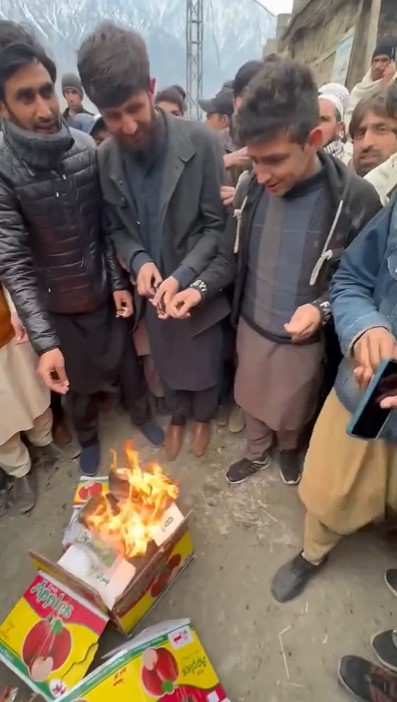
In a symbolic act of protest, approximately 150 youths in Darel initiated a SCO SIM burning campaign on February 18th, with 180 SCOM SIMs set ablaze amid chants of “SCOM Murdabad.” The campaign was sparked by growing frustration over the weak signal strength of the Pakistani establishment-owned telecom service. The demonstrators voiced their dissatisfaction with the service, accusing the Special Communication Organization (SCO) of financial exploitation.

The crux of the issue lies in the failure of the SCO to provide reliable internet services despite hefty charges for internet packages. Reports suggest that the internet, which people paid for, remained non-functional, leading to mounting grievances. This incident, while seemingly small, resonates deeply with the local population, reflecting a broader sentiment of dissatisfaction with the Pakistani establishment.

The dissatisfaction goes beyond connectivity issues. Darel, like many other areas in Pakistan-occupied Gilgit Baltistan (POGB), faces challenges related to basic amenities such as wheat, electricity, water, and education.

More disturbing is the fact that despite the scarcity of most basic amenities, the prices have been indiscriminately high because of the exploitative policies of Pakistan and its puppet regime in Pakistan occupied Gilgit Baltistan (POGB).

SCO: A tool to keep people in dark

Furthermore, the combination of exorbitant prices and weak signals is a tactic to control information flow, preventing the populace from gaining a clear understanding of the challenges they face. This control over communication is seen as an attempt to keep the people of POGB in the dark about their own plight and the larger geopolitical context.

It is noteworthy that for the past 77 years, the people of POGB lived under the illusion of freedom, largely shaped by Pakistan’s narrative through controlled media. However, the advent of the internet and social media has unravelled the reality faster than anticipated by Pakistani establishment. Pakistan, cognizant of the internet’s role in awakening the masses, is strategically using its control over the only telecom service provider to stifle dissent and maintain control over the narrative.

As the SCOM SIM burning campaign unfolds, it sheds light on the intersection of connectivity issues, economic exploitation, and information control in POGB. The incident underscores the need for addressing not only the technical challenges but also the broader socio-economic and political concerns facing the region.

Murder of Sindhi rights advocate by Paki establishment unites oppressed people across Pakistan

After the Pak establishment-sponsored brutal assassination of their father Hidayat Lohar, Sindhi nationalist’s daughters and the prominent voice of missing persons are on a sit-in protest against the establishment and its notoriety.

A couple of days ago, Hidayat Lohar was brutally killed by the assailants affiliated with the Pakistan Army. According to his daughters, Sorath Lohar and Sasui Lohar, their father was getting death threats since past few weeks before he was killed. Hiddayat Lohar has been a prominent figure in the struggle of Sindhis. Be it the issue of enforced disappearances or the Sindhi rights, he always remained at the fore front. In 2017, he was himself abducted by the regime and was subsequently disappeared.

Daughters of Hidayat Lohar protest for FIR

Hidayat Lohar, who was a school teacher, was also the leader of Voice of Missing Persons of Sindh (VMPS), an organisation at the helm of the challenge to the establishment sponsored enforced disappearances. As he has been killed, his daughters are calling out the Pakistan Army and demanding an FIR in the assailants, whose details are with them. But, since the establishment is itself the culprit, it is trying to stave off the issue. And hence, the brave Sindhi daughters of Hidayat Lohar are sitting in protest at the Naseerabad Highway.

Meanwhile, Sorath and Sasui have also denied a visit to the police station to register the FIR, having a clear idea of the notoriety and extra-judicial acts employed by the establishment. They have demanded that their FIR must be registered at the sit-in in front of protestors. As of now, the sit-in has seen participation from various walks of life. Sorath and Sasui are getting support and consolation from across Pakistan.

Notably, by the continuous act of curbing legal framework and acting as fascist regime, Pakistan has led to the unification of oppressed community across Pakistan. Earlier, the simultaneous crackdown on Baloch in Islamabad long march and on Pashtuns in Chaman has raised hopes for a unified resistance from Baloch and Pashtuns. Now Hidayat Lohar’s killing and subsequent support from across communities marks another incident that shows the need of a combined struggle against the brutal Pakistani regime.