Home Blog Page 485

Malaika Arora drops ‘Khan’ from her name

Hindi film actor Malaika Arora-Khan has dropped “Khan” from her surname. She had suffixed “Khan” to her surname after her marriage to actor Arbaaz Khan, the brother of Hindi film industry’s superstar Salman Khan. Malaika and Arbaaz had divorced in May 2017 but she continued to use full name with “Khan” appended to her family name in public and in her social media accounts.

Malaika shot to fame with her popular dance number “Chal Chaiyya Chaiyya” in the 1998 super hit Hindi film “Dil se”.

Malaika Arora announced the riddance of Khan from her surname by updating her Instagram account. It’s now malaikaaroraofficial. Malaika had been using Khan in her social media accounts even after a year of her divorce with Arbaaz Khan.

The film industry’s grapevine in Mumbai is rife with talks that Malaika is dating another actor Arjun Kapoor. The two have often been spotted together at public functions.

The gun has served no purpose in Kashmir

0

Hurriyat (M) Chairman, Mirwaiz Umar Farooq, has recently tweeted that the number of Kashmiris killed by security forces in 2018 has crossed the 400 mark. He has appealed to the international community to, “help stop the massacre of Kashmiris unleashed by Indian forces.” The tweet has come as a prelude to a decision of the Joint Resistance Leadership (JRL) of Kashmir to observe Human Rights Week from December 3 onwards. The appeal should have set alarm bells ringing all over the world, but surprisingly, it has not elicited any response.

A careful collation of the civilian fatalities that occurred in 2018 gives a different picture, altogether. At the outset it is necessary to note that the collation done for the purpose of this article is not based on any official figures, it is a consolidation of what has been reported by the media. There could be some errors due to oversight but, in no case, will these inaccuracies be more than 3 to 5 %.

From the data available, the number of Kashmiris killed due to firing on mobs by security forces during incidents of stone pelting and other forms of violent activity is between 40 and 45. This also includes civilians killed when mobs attempted to disrupt operations by the security forces. Even if this figure is increased by a whopping 100%, it does not reach to even a quarter of what Mirwaiz is claiming.

Another 45 to 50 civilians have been killed in circumstances that are controversial as both the security forces and militants blame each other for the deaths. However, even after giving benefit of doubt to Mirwaiz by assuming that security forces are also responsible for these killings, the number adds up to 85 or a maximum of 95 civilian fatalities. If we once again increase this cumulative figure by 100 %, the total number falls woefully short of the figure given by Mirwaiz.

Yet, since it is inconceivable that the Hurriyat (M) Chairman could have made an error of such glaring proportions, it becomes incumbent to give maximum leverage to the wording of the tweet which speaks of the “number of Kashmiris killed up to now this year.”  The scope, therefore, can be enlarged to include deaths of all Kashmiris due to militancy related reasons including local militants killed during this year.  About 150 to 200 local militants have been killed by security forces in 2018, but this figure includes foreign terrorists as well. If we take 125 to 150 as the figure for Kashmiri militants killed, the total goes up to 205 or 235.

These figures do not reach anywhere near the quoted figure of 400. In his tweet Mirwaiz has attributed 400 deaths to “Indian forces” but the total fatalities (both confirmed and alleged) caused by “Indian forces” remains much lower than what he is claiming. 40 to 45 J&K Policemen have been killed in militancy related incidents during this year but technically speaking these figures cannot be included since Mirwaiz has qualified in his tweet that he is specifically referring to Kashmiris killed by “Indian forces.” However, even if we add these numbers the figure of 400 fatalities still eludes us.

If the number of civilians killed by unknown gunmen is also taken into account then we may get a bit nearer to the fatality figure of 400 given by Mirwaiz. The militants may have accused Indian forces and intelligence agencies for these killings, but despite this, the international community isn’t likely to accept this version for two reasons. First, most of these deceased were killed on suspicions of having passed on information about militants to security forces. Second, the hand of militant groups in such killings have already been revealed by Hizbul Mujahideen (HM) which has accepted responsibility for many such killings and even put out videos of these on social media.

It is being assumed mostly that the international community exhibits lack of concern regarding what is happening in Kashmir and it does not respond to the appeals of the Hurriyat. This impression is far from the truth. Being a potential flash point that could trigger off an armed confrontation between the two nuclear states of India and Pakistan, attention of the world remains focused on Kashmir and the international community will, under no circumstances, permit any “massacre” here (as the Mirwaiz has tweeted).

The most likely reason for the international community’s lack of concern could be the wide disparity in the fatality figures tweeted by Mirwaiz and the respective data that various countries keep compiling with pinpoint accuracy. Therefore, Hurriyat (M) should either give a detailed breakdown of the 400 deaths or if there has been some error while counting fatalities, then he should have the grace to admit the same.

Be that as it may, even one fatality, civilian or military, is too much for any civilized society to bear and every effort needs to be directed towards ensuring that the same does not happen. It is here that the political leadership and civil society of Kashmir, including the Hurriyat, needs to play a proactive role. The violent activity and human rights violations by terrorists resulting in numerous deaths need to be stopped. The international community may be more responsive to the aspirations of Kashmir community if they are expressed peacefully and within the ambit of internationally accepted political norms. It is quite evident that the gun has not served the purpose of Kashmir it would be a good idea to opt for a second option that is based on peaceful means. There is no point in losing the youth to the cult of violence. One can only hope that peace will become a reality in Kashmir in the near future, the people have suffered enough.

Society needs to nurture a child’s inquisitive mind

Allow me to begin by asking a question-what is that one word which could aptly describe the current global socio-political scenario? Disturbing, agonizing or painful? We all might differ in our choice of the word but there is something common to all the sufferings of the global community and this “something” is at the root of these problems.

It’s hunger– not for food, but for power, thirst– not for water, but for the blood of all those who beg to differ. But, differ we must, for that is how we were created. The human world is very strictly operating on the Darwinian principle and each one of us is striving not just to survive but to reap the richest dividend for oneself.

In this race to supremacy, the notions of morality, ethics, values and principles that were supposed to be the cornerstone of our social being have gone for a toss. People are being butchered, nature is being strangled and as if all this was not enough, the entire socio-cultural fabric which is the unique selling proposition of a pluralistic society is being targeted with a vicious agenda forcing us to live in an atmosphere of constant fear, the fear of threat to our identity, our existence, our freedom and our rights, be it personal, social, religious or intellectual. Out of all these, the threat to our identity is ostensibly a matter of biggest concern for the demagogues of the world.

Sadly, most of their followers never question the notion of Identity that is thrust upon them. It is this very notion which is used to ignite communal passion and generate a feeling of “Us versus Them.”

But why am I discussing it here? Well, I just want to ascertain the role of the institution called “school” in building the kind of world we are living in today.

As an educator, I often wonder whether we have been able to rise above the “bread and butter” aim of education to achieve the higher aims. Hasn’t our education system failed to fulfill the social aims? Have we succeeded in developing the spirit of co-operation, universal brotherhood, mutual respect and tolerance? Do we train the heart to awaken the deepest feelings of empathy and fellowship, or is the mind being trained to question the popular discourse on social issues or develop the art of self-regulation?  Unfortunately, the answer to all these questions is a big ‘NO’ which brings us to ask – why? To answer this we need to reflect on the nature of education as a process. Isn’t Education itself a political activity which has always been used as a tool by each socio-political group to further their own causes and most often by the dominant group to maintain its hegemony? Can we then, ever think of creating a peace loving society based on the concept of harmonious co-existence through education?

If you are curious to know whether I am offering a solution/an alternative, then I am sorry to disappoint but I was just thinking aloud. The answers to these questions are not easy, The job of the educators is to train minds to think, discuss, debate and question not just those in seats of power but also the existing dominant socio-cultural views and practices. Educators and teachers can initiate thoughts within schools and colleges but then that’s just the beginning. The society as a whole needs to nurture this inquisitive mind, only then can we become civilized in true sense.

G20: India seeks active cooperation against fugitive economic offenders

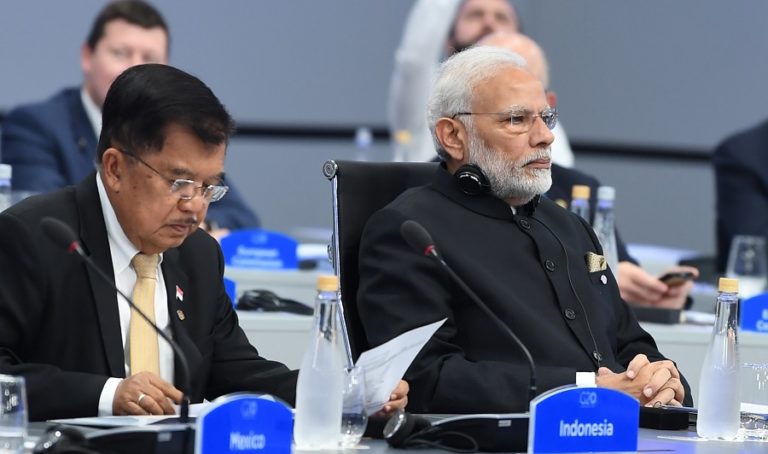
India presented a nine-point agenda at the ongoing G20 summit seeking “strong and active cooperation” among member nations to rein in fugitive economic offenders. Prime Minister Narendra Modi clearly spelt out the points during the session on international trade, international finance and tax systems. The G20 summit being held at Buenos Aires, Argentina.

Modi’s nine-point agenda sought cooperation with other nations in the legal processes that include “effective freezing of the proceeds of crime, early return of the offenders and efficient repatriation of the proceeds of crime”, so that the menace of fugitive economic offenders are dealt with comprehensively and efficiently.

This agenda assumes significance since India has been grappling with a slew of economic offender fugitives that include liquor baron Vijay Mallya, diamond trader Mehul Chowksi, diamond jewellery designer and trader Nirav Modi and the cricket administrator Lalit Modi, among several others.

Here’s the list of Nine Points suggested by Indian Prime Minister Narendra Modi to G20 for action against fugitive economic offenders and recovery of their assets

1. Strong and active cooperation across G-20 countries to deal comprehensively and efficiently with the menace of fugitive economic offenders.
2. Cooperation in the legal processes such as effective freezing of the proceeds of crime, early return of the offenders and efficient repatriation of the proceeds of crime should be enhanced and streamlined.
3. Joint effort by G-20 countries to form a mechanism that denies entry and safe havens to all fugitive economic offenders.
4. Principles of United Nations Convention Against Corruption (UNCAC), United Nations Convention Against Transnational Organized Crime (UNOTC), especially related to “International Cooperation” should be fully and effectively implemented.
5. FATF (Financial Action Task Force) should be called upon to assign priority and focus to establishing international co-operation that leads to timely and comprehensive exchange of information between the competent authorities and FIUs (Financial Intelligence Units).
6. FATF should be tasked to formulate a standard definition of fugitive economic offenders.
7. FATF should also develop a set of commonly agreed and standardized procedures related to identification, extradition and judicial proceedings for dealing with fugitive economic offenders to provide guidance and assistance to G20 countries, subject to their domestic law.
8. Common platform should be set up for sharing experiences and best practices including successful cases of extradition, gaps in existing systems of extradition and legal assistance.
9. G20 Forum should consider initiating work on locating properties of economic offenders who have a tax debt in the country of their residence for its recovery.

Implement NRC in all Indian states

0

National Register of Citizens (NRC) in Assam is the first step to clear India of illegal migrants. Instead of demonizing NRC, it should be our tool to identify nefarious foreign squatters. In the long run, this will be in national interest.  

It is no surprise for a nation of million quarrelling voices to denounce the draft list of the National Register of Citizens (NRC), published on July 30, 2018, which identifies residents of Assam as citizens and foreigners. Our problem is that we hesitate to take pride in our national identity and prefer to live in a state of constant denial. It eminently suits the political opportunists and forces that benefit from fishing in troubled waters to keep the status of Indians vague and their Indian-ness submerged in permanent uncertainties. But people of Assam chose not to allow this ambiguity to haunt them for ever.

After independence, original residents of Assam kept vociferously demanding identification of infiltrators in their state. In response, a National Register of Citizens was prepared in 1951, which left them more agitated.

In later years, the state witnessed huge influx of illegal migrants from Bangladesh, deepening their fear that they would soon be marginalised in their own land. Consequently, an unprecedented violence rocked the state for weeks, that forced the late Congress Prime Minister Rajiv Gandhi to sign the Assam Accord on August 15, 1985. It stipulated that the NRC of 1951 would be updated with names of only those which had appeared in the electoral rolls of March 1971 or who had clinching proof to support their claims of being original residents.

But the intent of Congress to do an honest job of the Accord was never there. Since illegal Bangladeshi Muslims formed their captive vote bank, they could not afford to take the process of updating NRC to its logical end. There were, of course, a few in their ranks who saw danger to the national security from the unabated invasion of illegal migrants, but they had no defining say. The Ministry of Home Affairs also put up number of assessments, based on inputs from intelligence agencies to highlight the adverse impact of illegal migration on country’s security and territorial integrity but of no avail.

The Supreme Court finally took a call on a petition by the aggrieved Assamese people and passed an order in 2013, directing the Registrar General of India to update the NRC of 1951 as per the criteria, laid down in the Assam Accord. The Congress once again delayed the process, apprehensive of its adverse impact on the parliamentary elections in 2014 and the state elections, a year later. However, with BJP forming its government both at the centre and in the state NRC updating picked up steam. By December 1st, 2017 vetting of the claims of 1.9 crore out of a total 3.29 crore applicants was completed and on July 30, 2018, the second NRC draft was released after verifying claims of the remaining applicants. 2 crore 89 lakh and 83 thousand persons were found legal residents, while 40 lakh 7 thousand were declared ineligible. Two lakh 48 thousand voters whose names had been listed in the electoral rolls as on March 24, 1971 were identified as ‘doubtful.’

However, all those who missed the list have been given another chance to submit their land records, passports, birth certificates, education certificates and at least one document that links them to their ancestors to prove their bona fides as Assamese citizens. The final NRC list is due for release in December 2018, thus bringing curtains on the confusion prevailing since 1947 as to who is an Indian citizen in Assam and who is a foreigner.

The reactions to the publication of NRC have been diverse but mostly myopic. Congress is caught in a bind of its own making as it cannot support preparation of the NRC list for fear of losing Muslim votes, particularly of illegal immigrants, nor reject it outright as it had initiated the process. It has therefore latched on to omission of a few names from the list and criticised the entire exercise as communally and politically motivated. It has also found fault with the application of criteria in determining the eligibility of applicants. Some discrepancies are indeed glaring but in any enumerative exercise of this magnitude and complexity, such errors are common. The July NRC list is not cast in stone and will surely be corrected under the Supreme Court’s supervision to ensure that all genuine claimants make it to the final list in December this year.

For BJP, a fierce and consistent opponent of Bangladeshi illegal immigrants, NRC has come very handy. It seems determined not to allow protests to prevent the publication of the final list in December 2018. With large number of illegal migrants, mostly Muslims, disenfranchised, it is electorally a win-win situation for the party.

The irrepressible West Bengal Chief Minister Ms. Mamata Banerjee has her own reasons to see nightmares. She hallucinates that NRC will unleash a blood bath and a civil war in the country. Ms. Banerjee seems unaware that the issue of illegal Bangladeshi migrants hardly affects the lives of ninety percent Indians. She goes on to accuse that names of Bengalis have been deliberately excluded to keep Assam only for the Assamese people. This trend, she argues, will irreparably harm internal migration which is required for country’s economic development and social cohesiveness. She conveniently ignores the fact that it is not only Bengalis but the names of several people from Nepal and other parts of India that do not figure in the July NRC list. In fact, she herself is to be partly blamed for exclusion of Bengalis because her officials are yet to verify particulars of over 1.5 lakh Bengalis and submit those to the Registrar, in-charge of the NRC. Her fear is that if the demand of NRC picks up in West Bengal and gets implemented, she may see the end of her electoral dominance.

Her other secular compatriots in the SP, BSP, RJD, JD(S), NCP, AAP and CPM, must oppose because they cannot afford to be seen towards working against the interests of Muslims for their electoral survival. MIM and Muslim clerics go to another extreme. They smell a sinister design by the BJP to use NRC to drive out Muslims and start Hinduizing Assam and later, the rest of India. The reality is that the list has made no distinction between illegal Muslim or Hindu migrants from Bangladesh.

Views of liberal columnists are simply grotesque. A writer peevishly chooses words like arbitrary, divisive, whimsical, inhuman and unimplementable to describe the NRC. The Supreme Court which is monitoring this exercise should take an umbrage to this. An imaginative commentator believes that BJP is master at inventing enemies prior to elections and this time it has invented Bangladeshi immigrants in the garb of NRC as its enemy, eight months before the 2019 parliamentary elections. A political commentator mocks that Assam has no business ‘whining’ when far greater numbers of illegal Bangladeshi immigrants have infiltrated in West Bengal. He conveniently forgets that the cultural and linguistic ethos of people in Assam and West Bengal are vastly different. What agitates an Assamese is not the growth in Muslim population which went up by 63% vis-à-vis Hindus that grew by 34% during 1971-2012 but the assault that illegal migrants have launched against their hearth, culture and language. The number of those who spoke Assamese was 61% in 1991 but got reduced to 57% at the end of 2012 while Bangla speakers rose from 27% to 31% during the same period. This situation was unacceptable to genuine residents of Assam.

The host of cynics and baiters have several questions to ask the union government, if the final NRC list gets published. For example, is it right to turn citizens into refugees in their own land. Why is the world’s largest democracy rendering lakhs of its people stateless and forcing them to live the life of political, social and economic exclusion? How can people be denied of citizenship who have worked, voted and paid taxes? Will those excluded from the final list be declared stateless and deprived of voting rights, social welfare benefits, employment and all fundamental rights? With Bangladesh refusing to accept any illegal Bangladeshi immigrants, will they still be forcibly pushed back and killed if they resist deportation? Will they be kept in detention camps, devoid of basic amenities? Is the government not deliberately creating a reservoir of disconnected, angry people to become the breeding ground of terrorists? Is it necessary to create a situation which is bound to be universally condemned by the watchdogs of human rights? And finally, why can’t the present demographic changes be accepted as fait accompli and a system be put in place to ensure that the need for NRC never arises by reinforcing border policing and making punitive provisions for those who encourage, shelter and settle illegal immigrants from across the border? These questions are like putting cart before the horse and, living numb in the fear of unknown.

The time is not for dwelling on fears but cracking the whip. The NRC list needs to be published on schedule and Assam be given the right to know who amongst them, is an Indian citizen and who is a foreigner. The people, parliament and the judiciary can subsequently decide where to settle the illegal residents and what rights can be given to them. If they are unable to find a way out, then they can draw lessons from Japan, Thailand, Indonesia, Malaysia, Singapore, Myanmar, US, UK, Canada, France, Germany and other European countries on how to treat illegal migrants, who remain deprived of the protection of citizenship from the country where they come to, and the nationality of the country from where they come from.

There is no dearth of choices as to how far a country can go in accommodating interests of stateless persons. These include treating them as pariahs or aliens, putting restrictions on their movement, the number of children they can have, kind of employment they can take up, education, work and on acquiring property, providing them social security and health care benefits and opportunities of working in non-government sectors, naturalizing them but not letting them vote or join civil services and security forces and whether to deprive them of life, liberty and property without due process of law.

The country can choose any or most of these options, keeping in view its civilizational values, security concerns and its economic and social capacity to absorb the illegal immigrants. To many, even these measures may appear insufficient. But it needs to be understood that if we prevaricate and postpone taking a tough decision for fear of what may or may not happen, we will create more problems for the safety, stability and economic progress of the country in the long run. Instead of drowning NRC in our petty squabbles and warped priorities, we should seriously consider extending this process gradually to all states in India. It will have two salutary effects. We will have an identity to call ourselves as citizens of India and foreign immigrants will think twice before stepping illegally into India due to the huge uncertainties that will await them on their arrival.

From Nuns to None: #MeToo & #ChurchToo

The number of nuns continues its precipitous decline in overall numbers. Also, they have begun to come out, calling out sexual abuse within the church.

Looking at the overall numbers of the nuns in the province of Quebec in Canada, we can monitor decline in the numbers of the faithful women in the monasteries decline over decades from its height.

The history, apparently, runs back about 400 years ago in the history of Quebec. But now, the most devout women in the Roman Catholic world are beginning to decline in numbers and age – as a reflection of religion in general in North America – and wither into the dark. The number of Roman Catholic nuns in Quebec province of Canada, in total or raw numbers, touched a high of 47,000 in 1961. Now, the number has decreased to fewer than 6,000 with the mean age above 80. This portends poorly for the Christian faith’s largest sect or tradition in Quebec.

It amounts to an augury for the future of Canada with respect to much religious faith. Something akin to a hollowing out of the faiths; if not in raw numbers, then in the seriousness with which individual believers take their religious faith.

I feel for the sisters in the loss of long-term culture. Not fun for anyone to lose a sense of place and purpose. However, other issues may dwarf this as the sexual misconduct claims continue to pour out of the religious institutions and organizations throughout the country and the world. By implication, many more remain unreported.

The continued decline of the faithful has not been helped by the continual deluge of sexual abuse case settlements. One, recently, amounted to tens of millions of dollars. One nun stopped attendance at a regular confession because of a priest forcing himself on her. The rape happened when she was “recounting her sins to him in a university classroom nearly 20 years ago.” Apparently, this sister was silenced due to the vows of obedience to the hierarchs of the Roman Catholic Church and its attendant orthodoxy in addition to the shame and guilt coming from the rape.

By the reportage, she appeared to remain stuck in one of the first stages of trauma: denial. Ignore it, it did not happen, then everything will be better. It will go away.

Now, more have begun to come forward to tell their own narratives of abuse and secrecy from within the Roman Catholic Church, where the abusers are bishops and priests.

The cases continue to emerge not in isolated incidents, countries, or even regions; they exist in Africa, Asia, Europe, and South America. The queries may emerge, as they do for me, about the hierarchical structure itself.

The unquestioned power of men who hold the levers, whether in traditional-conservative structures seen in much of the Roman Catholic Church or in liberal-progressive institutions observed in much of the culture of Hollywood.

In terms of sexual violence, the core perpetrators tend to be men in both institutions; women tend to be the main victims. Within the increasing prominence of the anti-sexual violence and justice movements in social media and elsewhere, the church is having a moment and nuns account for a portion of it.

The sexual violence perpetrated, for example, by the Vatican in the 1990s in Africa was not dealt with or handled – euphemisms in both cases – sufficiently, or at all. One of the most prominent individuals who has been charged with sexual misconduct is the sexual abuse and harassment of seminarians by the American Cardinal Theodore McCarrick.

A leading expert of the church sexual abuse and abuse of power history, Karlijn Demasure, stated, “I am so sad that it took so long for this to come into the open, because there were reports long ago… I hope that now actions will be taken to take care of the victims and put an end to this kind of abuse.”

Demasure continued, “They (the priests) can always say ‘she wanted it’… It is also difficult to get rid of the opinion that it is always the woman who seduces the man, and not vice versa.”

The references provide rather extensive coverage on the issues of both a decline in the number of Quebecois nuns, so provincial, and then the sexual abuse #MeToo moment, so international.

Book Review: The Zero-Cost Mission and The Wily Agent

0

Stories about spies, intelligence agencies and covert operations always make for a captivating read. Probably because it’s seldom that any information trickles down from this arcane yet fascinating world of intelligence services. Quite often intelligence officers and sleuths create myths about themselves and weave fictional stories around their operations, which further shrouds the modus operandi of these agencies. It’s in this backdrop that when a former intelligence officer decides to share stories about covert operations and intelligence gathering in a foreign land that makes his book a thriller and a page turner.

Amar Bhushan, an Indian Police Service (IPS) officer spent most part of his career at various arms of the Indian intelligence agencies. His longest tenure was at the Research and Analysis Wing. Bhushan retired a long time ago and decided to share the stories of two covert operations undertaken by India’s external intelligence agency. The Zero-Cost Mission and The Wily Agent are two separate stories packed into one book by HarperCollins India as part of its Spy Master Series.

Sujal Rath, protagonist of The Zero-Cost Mission is a daring officer at the Research and Analysis Wing. Reports have been pouring in about the build-up of Jamaat-e-Islami facilities in Bangladesh that are being used by Pakistan’s Inter-Services Intelligence—the ISI, to foment trouble in India by orchestrating terror attacks. There is an urgent need to demolish Jamaat facilities located deep within Bangladesh. This seemingly impossible covert operation is dangerous and only the best officer can execute it with surgical precision.

Sujal is handpicked to execute this perilous operation within the territorial limits of Bangladesh. Sujal’s track record of operational brilliance, integrity and commitment ride over his negatives about disregard to the strict command structure and bureaucratic paper work. The agency’s Chief, its South Asia Head and Bangladesh desk officer put their faith in Sujal’s operational abilities to execute this operation. After much reluctance and persuasion Sujal takes up the task, relocates to Calcutta (now Kolkata) leaving his ailing wife and children only to find the boss of Calcutta office waiting with a bunch of conspiracy theories in order to derail the covert operation and put Sujal in the dock.

What follows is the story of grit and determination of an officer who almost single-handedly prepares for this high stakes mission to destroy Jamaat facilities within Bangladesh. Just when the operation gets into its final execution stage Sujal comes to know that all resources including the much necessary funds for this operation have been withdrawn. It’s then that Sujal faces the biggest dilemma of his life, either to go on with the tide, quit the operation mid-way and lobby for a sinecure posting elsewhere, or, put national security and India’s interests above everything else and fight back. Sujal decides to stake everything for the sake of India’s security. And this is where the title gets its name –The Zero-Cost Mission– a mission that was accomplished without the requisite funds from official sources. Any further details about this story in the review could spoil the thrill of reading Amar Bhushan’s novel.

“The Wily Agent” is a separate story in this book. Jeevnathan the protagonist in The Wily Agent is head of the Dhaka unit of R&AW. He is introduced to a source nicknamed Rehman, who is employed at the Bangladesh Foreign Office and well placed to gather sensitive information that could be of great importance to India’s strategic interests. But then Rehman has an insatiable thirst for money who keeps Jeevnathan and his protégé Kabir on their toes about the veracity of information being made available. Jeevnathan has to constantly fight his battle on two fronts by keeping the over-zealous Rehman in check who goes into a hiring spree and ropes in several other recruits to source information in order to make an extra buck. On the other, Jeevnathan has to deal with his intractable bosses in Delhi who are dipped in arrogance and live in a bubble world often dismissing genuine intelligence reports as farce. Jeevnathan uses all possible tricks up his sleeve to keep his bosses on the right side while also making an over-zealous Rehman work according to the requirements. The Wily Agent is a roller coaster ride that offers valuable insights and details the difficulties of intelligence gathering in an alien land which is much different than what the movies depict. Ironically, both these stories will soon be made into feature films.

The author has deftly used fictional names, characters and settings to keep the organisational integrity of R&AW secure. The anonymity of sources and officers also remains intact due to use of fictional names and settings.

Personally while reading through The Zero-Cost Mission about the battle, stress and strain borne by Sujal, I was reminded of the struggles endured by Howard Roark the protagonist in Fountainhead—the cult fiction novel by Ayn Rand. Probably, it’s this similarity that makes one yearn for much more details. The emotional upheaval that Sujal goes through and further details of Jeevnathan’s exchanges with arrogant and mediocre officers who do not mind jeopardizing India’s security for their petty benefits could have been elaborated more. Yet even in the current crisp storytelling format the twin stories form an interesting and captivating read.

This is the second book by Amar Bhushan, the author. His first book was “Escape to Nowhere”. Bhushan has chosen fictional storytelling that are based on facts to explain the workings and perils of operations undertaken by India’s premiere intelligence agency.

Author: Amar Bhushan
Publisher: HarperCollins India
Price: Rs 200/-
204 pages

The everlasting birthday present

1


A few months ago I was on a quiet saunter with Stuti, my daughter, when I crossed the neighbourhood shopping complex. Holding my hand she pointed towards the sweets shop asking for a chocolate.
“Which one?” I asked.
“Ummmm…..okkkayy…..this….i will settle for this one,” she said finding it difficult to zero in on one particular type.
Chocolates are her weakness and if permitted then she could have them for lunch!!! But, Stuti knows that I allow this indulgence of hers only to an extent. She always gets upset with my objection to her over-indulgence in chocolates. “Chocolates are so tasty….why don’t you give me a whole bag of chocolates to eat everyday?,” is her response every time I object. “You will spoil your health if you eat too much chocolates,” I try to reason out with her, every time.
Well, that day I was happy that she asked for only one chocolate. I happily bought one for her, playfully tore away it’s wrapper and gave the chocolate bar to her. And we walked ahead.
 A few minutes later, Stuti, while still eating the chocolate said, “You know Papa…my teacher says that during earlier times our planet earth was very beautiful but we have now made it very dirty.”
“Hmmm….okay,” I nodded, glad that my daughter showed concern towards the environment at such young age. She was merely five years old, then.
As if suddenly, I realised and looked at her. I realised that I had thrown the chocolate’s wrapper on the road instead of disposing it off in a dustbin. I apologised to her. She smiled and we turned back to pick up the wrapper from the road side.
Several months have passed since this incident, but I still vividly remember this and ‘am writing about it today. Why?
Well, today Stuti has turned six years old and I could not think of a better Birthday Gift than to take a pledge that I will never ever commit any act that dirties our environment and the Mother Earth. Years later, when I will be no more, it is the earth, the rivers, the mountains, the environment that will still be with Stuti and I wish they remain clean so that my daughter stays in good health.
Happy Birthday Stuti !!!

Terrorists like Naveed Jatt are a scourge of humanity. His elimination was imperative

0

Naveed Jatt, a terrorist of Pakistani origin operating in Kashmir since 2012 has been killed. He came into the limelight in recent months due to his involvement in the gruesome murder of Shujaat Bukhari, a Kashmiri Muslim journalist of repute and Editor of Rising Kashmir—the local newspaper of Jammu & Kashmir. Bukhari was gunned down ruthlessly by three terrorists on June 14, 2018 as he came out of his office, two of his security guards were also killed in the incident. Naveed Jatt was the leader of terrorist team that carried out these murders.

Killing of any living being is considered to be a sin in Islam. Naveed Jatt committed this sin with impunity many times over. A day before the killing of Shujaat Bukhari, Jatt was involved in an attack on a CRPF camp at Achabal in District Anantnag, Kashmir, in which two CRPF personnel were killed. As the top commander in Kashmir of foreign terrorist organisation, Lashkar-e-Toiba (LeT), he spearheaded the abduction and killing of innocent Kashmiri youth on the pretext of their being police informers. Actually the abduction and killing was carried out to intimidate and terrify the youth into following the path of terrorism. It was required to be done because the requisite numbers to sustain terrorism in Kashmir was not forthcoming.

Naveed Jatt, therefore, was a blot on the noble religion that he professed to be fighting for and by killing him the security forces have done a great service to humanity and particularly to the people of Kashmir. Jatt, sadly, knew no better since he was pushed into this path by his own countrymen. He was indoctrinated into the so-called path of Jihad from his childhood by the Pakistani terror machinery. The son of an ex-Army man hailing from Multan, he was sent into a Madrasa for his education. He studied barely up to the fourth standard before being selected for training as a terrorist in the LeT facility at Dakhan, Pakistan. He was infiltrated into Kashmir in 2012 when he had just stepped into his teens.

In 2012, Jatt was caught in a cordon laid out by an Indian Army unit, 62 Rashtriya Rifles. He was apprehended and sent into police custody from where he managed to escape in February this year. The daring escape from a hospital converted him into a hero. Buoyed by his newly created persona he indulged in a spate of killings and atrocities before being neutralised on November 26, 2018.

The counter terrorist operation in which Jatt was eliminated exhibited the seamless synergy with which security forces are functioning in Jammu & Kashmir. He was on the intelligence radar since his escape from custody and an elaborate dragnet was laid out to get him. He reportedly got caught in cordons earlier too but managed to escape with the assistance of locals. This time round the security forces reacted swiftly to the intelligence report and cordoned the house where he and his accomplices were hiding. The joint operation witnessed the Army going in for the cordon and search while the police and paramilitary forces remained deployed to ward off local involvement.

The counter-terrorist operation was carried out in a surgical manner, leading to the killing of Jatt and one more terrorist. Locals did try to disrupt the operation with heavy stone pelting but they could not do so. One CRPF soldier is reported to have sustained injuries in the stone pelting.

The Director General of Jammu & Kashmir Police, Dilbag Singh, has termed this as a very successful operation and one amongst many this week that have led to the elimination of top terrorist leadership in the Kashmir Valley. He has, very rightly, said that a case will be taken up with the Union Home Ministry to hand over the body of the terrorist to Pakistan from where he hails. “Jihad in the name of Islam amounts to making a fool out of the people. It is Kashmiris who are being killed,’’ he added.

The Chief of Army Staff, General Bipin Rawat, has also expressed satisfaction at the manner in which counter terrorist operations are being conducted in Jammu and Kashmir, particularly the elimination of the top leadership which has a significant foreign signature. “We are achieving success in eliminating the top leadership of terrorists in Kashmir,” said the Army Chief.

A question is being raised about the continued recruitment of locals into the folds of terrorism which does not allow the terrorist numbers to fall down from a particular threshold despite the operational success being achieved. A big reason behind the recruitment is the likes of Naveed Jatt who use every possible means from indoctrination to outright intimidation of the target youth and their families for getting the required numbers. Experts and senior security personnel are of the opinion that sustained elimination of top terrorist leadership that comprises mainly of foreign nationals will bring down the recruitment level drastically. “There is a decline in militancy recruitment and people are cooperating with us,” says DGP Dilbag Singh.

There is every reason to acknowledge and appreciate the exemplary manner in which the security forces in Jammu & Kashmir are working to rid the region of the curse of terrorism. The various agencies are working in close cooperation and with total synergy. The end result is incisive counter-terrorist operations carried out with minimum collateral damage. The assistance being given by local people and the free hand given by the government has also a big role to play. The end result is the elimination of scourges like Naveed Jatt who are causing immense suffering to innocent common people of the state.

The success of the security forces is a means to the end and not an end by itself. It will pay maximum dividends if the civil society of the state, its parents, elders, religious and political leaders, intelligentsia get together and motivate the youth to resist all efforts to indoctrinate them into the path of terrorism. Once a lid is put on terrorist recruitment all political, economic and social issues will automatically fall in place. One hopes to see a new dawn of peace and prosperity in Kashmir whose people have suffered more than their share of violence over the years.

Coffee with Kashmir’s ex-terrorist

0

He gave furtive glances as he walked in and shook hands with me. I asked if he was okay as he seemed a bit uneasy. “I am fine, but I have to be cautious,” he replied as he stressed upon the word ‘cautious’.

He was an ex-terrorist.

Let’s call him Salim. This is not his real name, he did give me his real name but requested not to reveal it else his family might get in grave danger.

Salim met me at an upmarket coffee shop in the heart of Srinagar, the summer capital of Jammu Kashmir. “I am done with guns and my infatuation with all this Azadi stuff is over. Now, I only aspire to lead a normal life, take care of my wife, kids…” Salim spoke in a soft voice.
But why on earth did you ever pick up a gun? I asked cutting him short. Salim had said that he held a masters in commerce and was an expert on cyber security. By his own admission he could have easily secured a decent job.

“I was trapped,” Salim said without batting his eyelids. He added that one of his friends introduced him to a few people after Friday sermons at the local mosque in Shopian. These ‘friends’ often loaned him small amounts saying Salim is very well qualified to get a decent job and could easily repay them back. In return, Salim was required to iron out minor software glitches for them.

“Before I could realise I had taken a few lakh rupees from them to buy a high-end laptop and smartphone. I was still without a job. One day I was asked to come for a small gathering to ‘discuss’ about Kashmir. And that day changed my life for ever,” Salim said as he tried to fight the tears that had welled up in his eyes. I thought of myself as a Ghazi who was fighting for Kashmir’s Azadi so as to create an Islamic Caliphate, he added.

Instead of the laptop’s keyboard, his fingers now moved on the triggers of automatic rifles.

Salim was arrested by the Indian security forces from Gulmarg and had to serve a four-year sentence on various charges. His father abandoned him saying he brought disgrace to the family.

Does he think of going back to the life of guns and rejoin the Islamic struggle? “There was nothing Islamic about Kashmir struggle. What we were told before joining ranks and what we actually did was completely different. The foreign mercenaries who joined us in our Kashmir struggle were interested only in money and in women. They expected us to work as pimps for them. Is this an Islamic struggle?” he blurted out a volley of expletives in Kashmiri for his ex-comrades in arms.

Different terrorist groups active in Kashmir Valley receive funds in the name of Islam and so they have a vested interest to keep this Kashmir issue alive. I understood all this only after I fell into their trap, Salim explained further.

The terrorist groups with whom Salim worked earlier have since put him on their hit list as they consider him to be a threat to themselves. He explained that different names of terrorist groups are mere covers and all groups share a common agenda. Salim changes his address quite often and over the last couple of years has changed close to twenty homes.

This is tough considering that he is married and has two children. His requirements are simple: A job, a house and a decent school for his children. Yet, this is extremely difficult for him.

Salim’s eyes were fixed on a family sitting right across our table. After a brief pause he said that young boys at an impressionable age fall easily to the glib talk about Kashmir’s Azadi and think of themselves as a part of global Islamic struggle. “At a young age you hardly know much about history and politics. All you have is loads of energy, passion and a romantic desire. They know how to use and harvest your passion. They just use the cover of Islam to further their devious designs. A gun in our hands at a young age gives a sense of immense power and then there’s the pride associated with being a part of the struggle to establish Islamic Caliphate. I have understood their games very well. I have been through hell and I know their reality.”

Who are these ‘they’ you refer to? I was curious to know.

‘They’ are our handlers. These people could be from Pakistan or their agents in Kashmir often known as over ground workers, Salim explained. I later asked Salim about the defining moment when truth about armed struggle in Kashmir dawned upon him.

“After some time I was asked to commit robberies and shoot at my innocent Kashmiri brethren who refused to believe in Kashmir’s Azadi. At this time I realised that I am a petty criminal and not a Ghazi as I had believed myself to be. I was lucky to be arrested and get a chance to start afresh.”

Did he kill any innocent Kashmiri? Salim stayed mum to this question and stared blankly at the ground. A minute later he only said every moment I repent about my sins to Allah. “Not every terrorist is as lucky as me. Once they join ranks they are stuck till they get killed.”