Home Blog Page 143

Pakistan’s prejudiced conduct forces Ahmadiyyas to not vote in the upcoming general elections

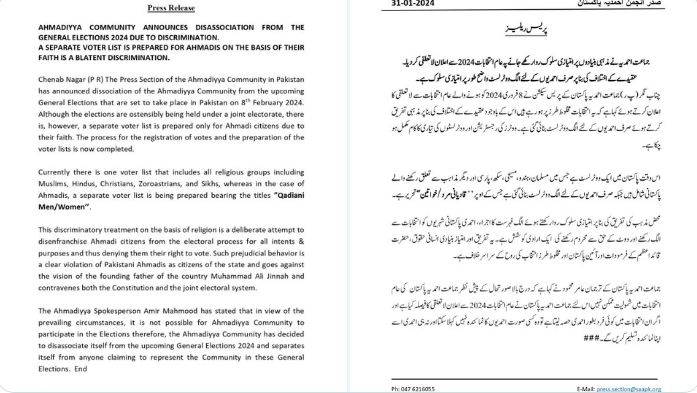
In a recent press statement, the Ahmadiyya Community in Pakistan, through its Press Section, has announced its decision to dissociate from the upcoming General Elections scheduled for 8 February 2024. The move is a response to the discriminatory treatment in the electoral process.

The Ahmadiyya Community, a religious minority in Pakistan, claims that despite the elections being ostensibly held under a joint electorate, a separate voter list has been prepared exclusively for Ahmadi citizens based on their faith. Unlike other religious groups like Muslims, Hindus, Christians, Zoroastrians, and Sikhs, Ahmadis find themselves listed under the title “Qadiani Men/Women”, a distinction that the community deems prejudicial and an attempt to disenfranchise its members.

Press statement of Ahmadiyya community (Photo: X)

An attempt to disfranchise Ahmadiyyas

This unique categorization of Ahmadis in a separate voter list is seen as a deliberate effort to marginalize and exclude, the already discriminated community from the political process, denying them the right to vote. The Ahmadiyya Community argues that such treatment contradicts the vision of Pakistan’s founding father, Muhammad Ali Jinnah, and is a violation of both the Constitution and the principles of the joint electoral system.

Amir Mahmood, the spokesperson for the Ahmadiyya Community, expressed the community’s stance in the face of these challenges. Mahmood stated that given the prevailing circumstances, it is not feasible for the Ahmadiyya Community to actively participate in the upcoming General Elections. Consequently, the community has decided to disassociate itself from the electoral process and has distanced itself from any individuals claiming to represent the community in these elections.

This decision underscores the community’s commitment to standing against discrimination and a violation of their fundamental rights. Significantly, the Ahmadiyya community in Pakistan received an official classification as non-Muslims through a constitutional decree in 1974. Additionally, in 1984, Pakistan stripped them of the right to self-identify as Muslims.

Multiple rockets ambush Pak Army camp in Hoshab, Pak-occupied Balochistan

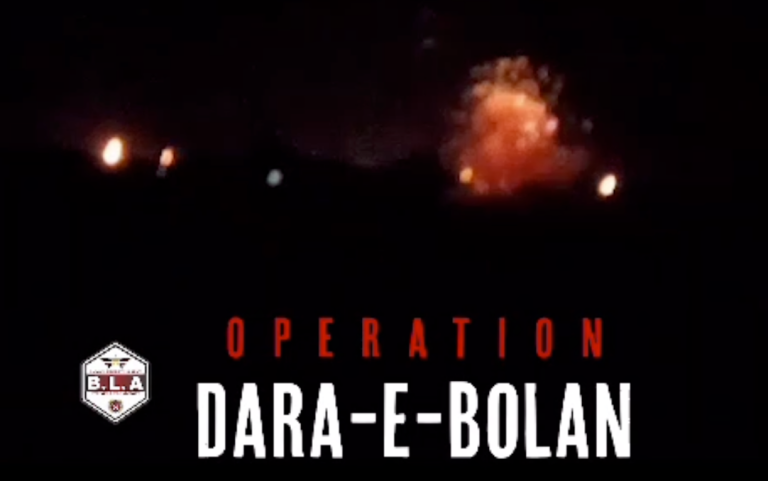
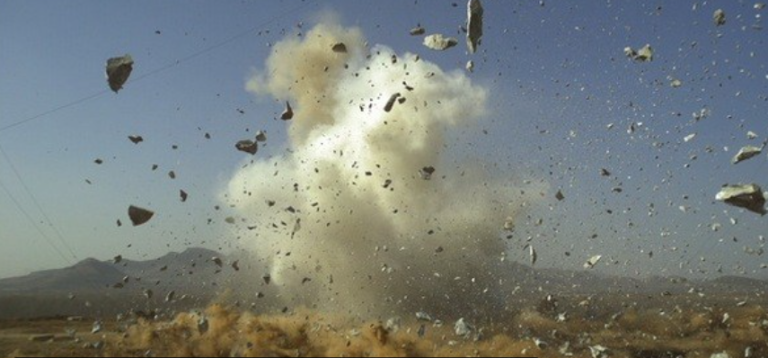
Recently, a dozen rockets were fired at the Pakistan Army camp in Hosab, Pak-occupied Balochistan. The attack came from an unknown direction and the area echoed with the explosions, additionally, intense gunfire was heard during that time.

As of yet, the authorities have not stated their stance on the damages.

Although Baloch armed freedom fighters are present in the mentioned area no one has claimed responsibility for this attack yet.

Meanwhile, an attack on a vehicle transporting minerals in the Kalat district of occupied Balochistan and a gas pipeline in the Mirpur Khas area of occupied Sindh was carried out by unidentified armed men.

They reportedly bombed a natural gas pipeline on Tuesday night that travels from Sui, Balochistan, to Punjab, close to the Sindhi city of Mirpur Khas. The explosion forced the suspension of gas service in some areas.

Authorities immediately cordoned off the area and began a search and rescue operation. In the meantime, there was also an attack on a natural gas well in Pir Koh, Dera Bugti. It has not yet been determined whether there are any more reports on this incident.

Similarly, in Kalat’s Khanezai neighbourhood, a car transporting minerals was ambushed by unidentified armed men. No casualties from the attack were reported. So far, the responsibility for the aforementioned attacks has not been claimed by anyone.

Since the Pak Army occupied Balochistan in March 1948, they have committed human rights violence and the Baloch genocide. The resource-rich region has been inflicted with the brutal “kill and dump” policy, enforced disappearances, indiscriminate shooting and extra-judicial killings. To remove the Pak Army and their violence, freedom fighters have emerged in the region. Their sole motive is to seek independence and protect the Baloch ethnic group from the atrocities.

Coordination Committee of occupied Baltistan affirms support for united POGB demands

Shedding the clouds of uncertainty over their stand, the Coordination Committee of occupied-Baltistan has made it apparent that they are unwavering in their commitment to stand with the demands of the united Pakistan occupied Gilgit-Baltistan (POGB), as put forward by the Awami Action Committee in the form of a charter of demands.

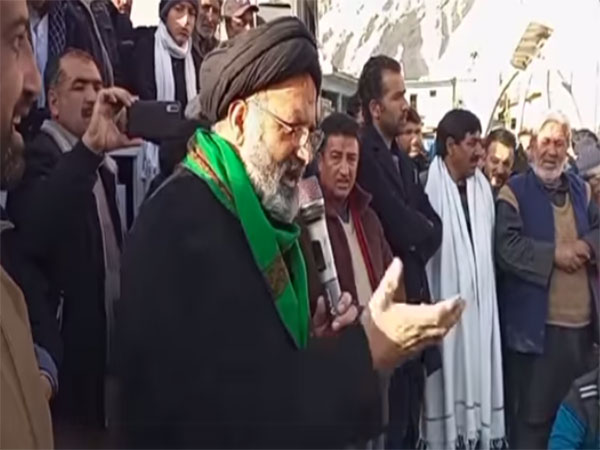
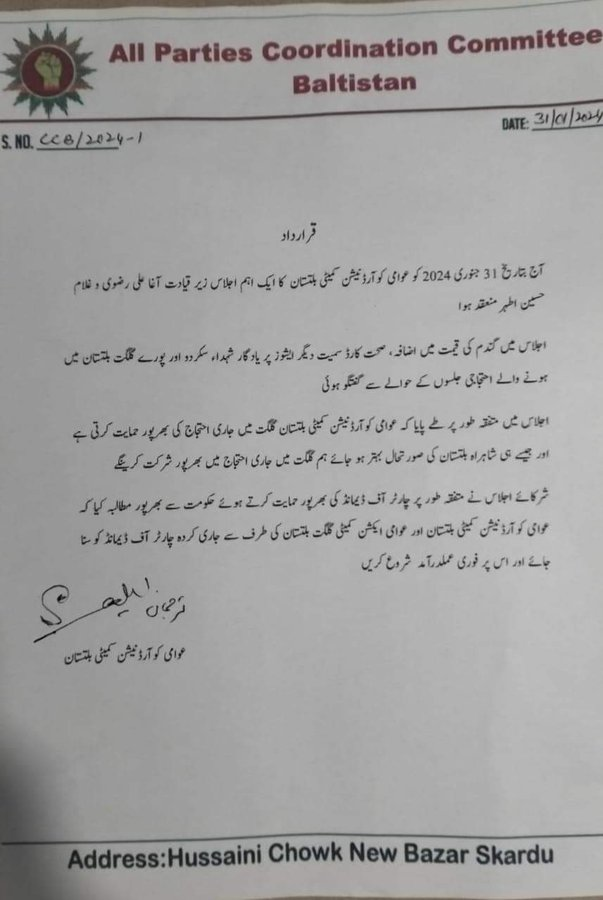
On January 31, the All Part Coordination Committee of Baltistan held a meeting under Agha Ali Rizvi and Ghulam Hussain Azhar. After the meeting, a decision was reached, and an announcement was made. In a letter issued by the All Part Coordination Committee, it was stated that the committee fully endorses and extends support to the ongoing protest. It also mentioned that as soon as Shahrah-e-Baltistan (Jaglot to Skardu road) would be cleared, the caravan will reach and join the Ittehad Chowk Dharna.

Copy of statement of All Party Coordination Committee Baltistan (Photo: X)

Notably, after the occupying government revoked the notification of December 26, which abolished the subsidy, Agha Ali Rizvi stated that the main demand for protest was the wheat subsidy and since it was reinstated, they would now move towards solving other issues through dialogue. This created apprehensions for the further course of action of POGB protest. Additionally, the convoy of Nagar also returned following the occupying government. And hence, the statement of coordination committee of Baltistan is significant and has come as a positive response to the ongoing struggle.

Sixty year old dies while protesting in Pak-occupied Gilgit-Baltistan for basic rights

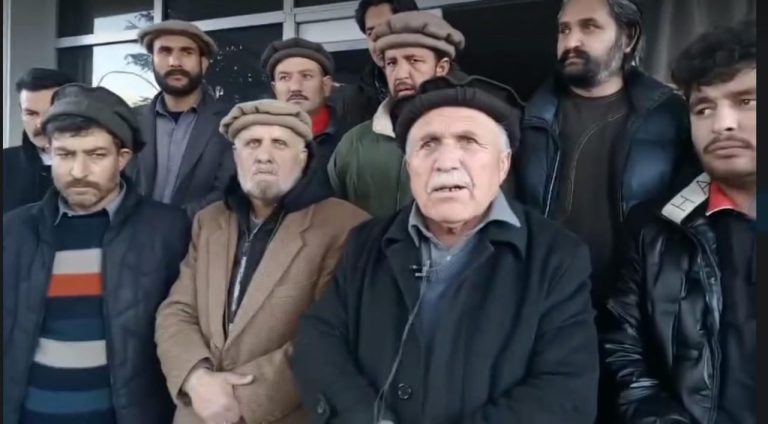
In a heart-wrenching turn of events, a sixty-year-old man participating in the sit-in at Etihad Chowk in Gilgit, Pakistan occupied Gilgit-Baltistan (POGB), has lost his life while protesting for the wheat subsidy and other demands. Hailing from the Yasin district, the elderly man joined the Etihad Chowk sit-in four days ago, braving the bone-chilling winter conditions.

The unfortunate incident occurred when the protester, dedicated to the cause, succumbed to a cardiac arrest, shedding light on the arduous circumstances faced by those advocating for their rights in the region.

The incident adds poignancy to the arguments put forth by the people of POGB, asserting that they are under the rule of a colonial regime. Amidst freezing temperatures, hundreds of thousands of people across POGB continue their protests, demanding their basic rights. However, the occupying government seems to downplay the gravity of the situation, anticipating that the protests will naturally dissipate.

The sacrifice of individual protestors, like the elderly man, not only deepens the sorrow within the community but also fuels anger and determination among the protestors. Such sacrifices serve to intensify the resolve of the people, making them more resolute and aggressive in their pursuit of justice and rights, vowing to persist until their aspirations are fulfilled.

As the news of the elderly protester’s demise reverberates through the region, it becomes a poignant symbol of the ongoing struggle for basic rights in Pakistan occupied Gilgit-Baltistan, marking a solemn moment in the fight against perceived injustice and neglect by the occupying authorities.

Sindhi students pay a heavy price at Karachi university for protesting against fee hike

In a concerning turn of events, some of the Sindhi students at Karachi University have been expelled for staging a hunger strike in protest against the university policies. The University of Karachi, instead of addressing the students’ concerns, chose to issue expulsion letters, raising questions about discrimination against Sindhi background individuals in Pakistan.

The expulsion comes after students protested against an abrupt fee hike and other grievances such as the implementation of the KSP-POLICY, discriminatory practices, and cultural heritage concerns. The administration’s alleged indifference to these issues fuelled the protests, pushing students to resort to a hunger strike as a final effort to draw attention to their demands.

Copy of expulsion letter (Photo: Social Media)

Earlier developments saw some students being arrested, underscoring the university’s uncompromising stance on dissent. The entire situation highlights a lack of space for dialogue and discussion within the university. Instead of heeding the rightful demands of the students, the administration chose a path of suppression, first through arrests and now through expulsions.

The Jeay Sindh Freedom Movement (JSFM) has also condemned the decision of the university. JSFM took to X, formerly twitter, warning the university that if the decision of expulsion of the students is not taken back, they would start the protest.

This episode at Karachi University sheds light on the broader issue of discrimination and repression faced by Sindhi-background individuals, with concerns mounting over the state of academic freedom and the right to dissent in Pakistani universities.

Dr Sabiha Baloch addresses crowd at the national gathering of Baloch Yakjehti Committee

Dr. Sabiha Baloch addressed the crowd at Shahwani Stadium Shawal disseminating information about the history of the Baloch Yakjehti Committee (BYC) and the march against genocide from Shahwani Stadium Shawal on January 27, 2024.

In her speech, she stated that the public meeting of the Baloch Yakjehti Committee has emerged as a milestone in the Baloch genocide movement. The Baloch people from Karachi to DG Khan and from Barkhan to Turbat have united and come together to prove that they will no longer silently bear the loss of their loved ones.

Despite the criticism and threats, people from every corner and almost every village of Pak-occupied Balochistan have stepped out to become part of a collective consciousness. This social consciousness encourages the Baloch people in the face of oppression to raise their slogan of resistance for the sake of their national identity and survival.

BYC’s movement on Baloch genocide has gained momentum for a very long, the Baloch people are unified and committed to exposing and opposing the grave injustices committed by the Pak Army. These public gatherings and demonstrations are increasing the strength of the Baloch genocide movement and the atrocities that the Baloch community faces from the oppressive Pak Army since forcefully occupying Balochistan on March 27, 1948.

Occupying Pak-occupied Gilgit-Baltistan government hoodwinks protestors ;forms 6 member committee

In the picturesque region of Pakistan occupied Gilgit-Baltistan (POGB), the political landscape is charged with tension as protests spearheaded by the Awami Action Committee show no signs of abating. The occupying government has initiated a deceptive response, in the form of a 6-member committee, to engage with various stakeholders and find a comprehensive solution to the burgeoning public discontent.

Copy of order constituting 6-member committee (Photo: X)

Objectives of the Committee

The newly formed committee, is tasked with engaging representatives from political, religious, social, and business communities across the region. The primary goals include seeking input and workable options on the issues and demands raised by the protestors. Regular sessions and meetings will be conducted to analyse and deliberate on emerging public issues with the aim of finding amicable and urgent solutions.

Moreover, the committee is mandated to underscore resolvable public issues, collaboratively decide on a work plan within the existing legal framework and financial constraints of the occupying government. But interestingly, this is the only bone of contention as protestors have realised that existing legal framework is there to exploit the POGB and hence any negotiation under the existing framework would eventually lead to nothing but dissent. As stated by Awami Action Committee leader Ehsan Advocate recently, the main problem is the imposition of assembly through the colonial order. Accordingly, the only intention of the Pakistani establishment to impose the Assembly was to continue the exploitation of the region, which they always did, without being answerable to the people of POGB directly. The whole intention was to keep the struggle and fight of the people up to themselves.

Clash of Agendas: Protestors Demand Autonomy

While the committee’s formation might look as a step towards addressing public concerns, the protestors affiliated with the Awami Action Committee, being aware of the consequences of such committees, remain resolute in their demands for autonomy. The occupying government’s formation of the committee is a deceptive effort to somehow deflate the protest. And hence, their Charter of Demands, consisting of 15 points, calls for the detachment of Pakistan from significant stakes in Pakistan occupied Gilgit-Baltistan (POGB).

Furthermore, the protestors had firmly asserted that without the fulfilment of their 15-point Charter of Demands, they will not disband and will continue the protest. And at the core of their demands is the call for autonomy, a proposition that challenges the very political status of POGB which led to its subjugation at the hands of the regime in Islamabad.

Explosion in Sibi (POB) kills four and injures dozen

Recently, an explosion took place near a PTI rally in the Sibi district of Pak-occupied Balochistan on Tuesday that resulted in the death of at least four individuals and injuring dozens.

The blast took place near Faisal Bank on Iqbal road, at an election rally of Pakistan Tehreek-e-Insaf (PTI) and soon after the explosion the Pak Army cordoned off the area and launched an investigation.

The victims of the explosion have been shifted to Civil Hospital in Sibi. Zakaullah Gujjar, the Station House Officer told the media that the injured victims of the explosion are in critical condition and the death toll could rise.

The deceased are identified as Hammad Khan, son of Sarwar Khan, Abdul Waasay, son of Abdul Basti, Muhammad Rafiq, son of Hussain Bakhsh and one individual identity remains unknown.

The explosion at the PTI rally in Sibi has been noted by the Election Commission, which has instructed the Chief Secretary and the Inspector General of Pak-occupied Balochistan to provide a report on the event. But no group or individual has so far taken responsibility for the bombing.

Pak-occupied Balochistan has been in shambles since the Pak Army captured it on March 27, 1948, and since then Baloch people have been subjected to systematic assaults like home invasions, torture, enforced disappearances, kidnappings for ransom and target killings by the Pak Army.