Home Blog Page 167

5 held by J&K police in trafficking of Rohingya women from Bangladesh into the state

Bandipora police announced the arrest of five individuals, including a Rohingya man, in connection with an alleged human trafficking racket. The crackdown, led by the Hajin police station, followed a tip-off regarding the trafficking of Rohingya women from Bangladesh. These women were reportedly being coerced into marrying locals in the union territory of Jammu and Kashmir for financial gain.

In an official statement on X, Bandipora Police confirmed the arrest of the five individuals involved in the trafficking operation. Among the arrested is Manzoor Alam, a Rohingya individual implicated in the trafficking network. The accused allegedly facilitated the trafficking of Rohingya women through Bangladesh and orchestrated their marriages with locals in exchange for monetary benefits.

Authorities anticipate unveiling further details regarding the case during a press conference scheduled for Tuesday. This arrest sheds light on the gravity of human trafficking issues and the exploitation of vulnerable individuals within the region.

The issues of illegal Rohingyas settlement in Jammu and Kashmir has been a hot topic of debate across India. While official number of Rohingya settlers in Jammu and Kashmir during the time of BJP-PDP coalition government was around 5,700, it was anticipated that the real number was significantly high. Reportedly, this number has further risen to approximately 13,700.

Nonetheless, the action comes after a panel was setup by the J&K Home Department to identify illegal foreigners residing the UT. Accordingly, the panel was directed to prepare a monthly report which would be presented to the Union Home Ministry.

Baloch Liberation Army eliminates Pakistan Army operative Shabbir Bizenjo

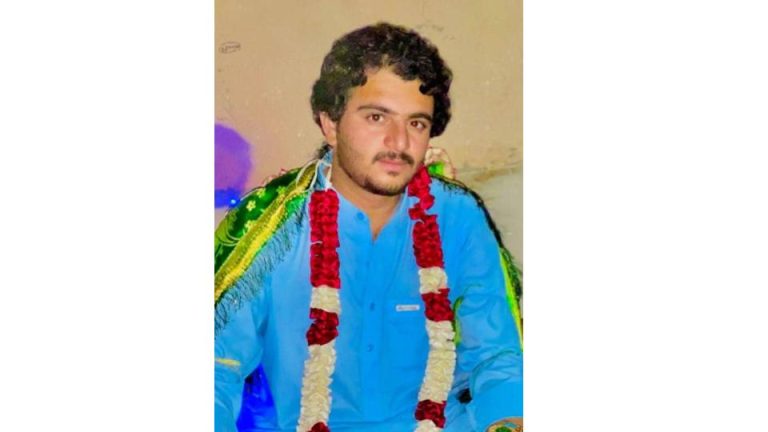
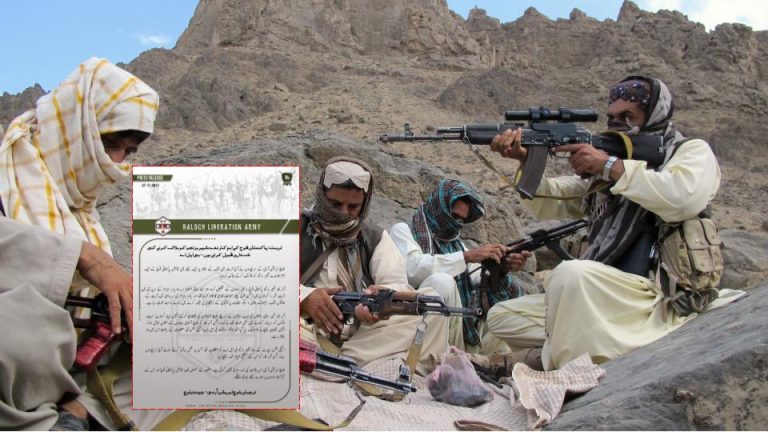
TURBAT – In a bold targeted operation, the Baloch Liberation Army (BLA) has eliminated Shabbir Bizenjo, a key operative of the Pakistan Army’s notorious death squad. The operation took place at the Dunk location in Turbat, effectively disrupting the Army’s nefarious activities in the region, Pak-occupied-Balochistan.

Shabbir Bizenjo was a notorious figure known for his involvement in the so-called “death squad” formed by the Pakistan Army and intelligence agencies. He was responsible for facilitating the Army’s operations in Turbat city and Gardanwah under the supervision of Yasir Bahram. Bizenjo was also directly involved in grabbing people’s lands, causing immense hardship and suffering to the Baloch community.

Shiber, another accomplice of Shabbir Bizenjo, also played a crucial role in identifying Baloch youths through social networking websites and making them disappear. He was tasked to infiltrate the BLA and harm its fighters, however, timely intelligence thwarted his plans. Shabbir Bizenjo had been on the BLA’s radar following an intelligence report. Acting on this information, BLA commanders successfully eliminated the enemy operative. The BLA’s Sarmachars executed a precise operation, eliminating the enemy agent once and for all.

“The Baloch Liberation Army claims full responsibility for this operation”, declared Jayand Baloch, BLA spokesperson. “Our attacks on the occupying Pakistan Army and its collaborators will continue until we achieve our ultimate goal of independence for Balochistan.” The Baloch Liberation Army (BLA) confirms its involvement in this operation. The BLA remains committed to carrying out attacks against the occupying Pakistan Army and its partners until the ultimate goal of liberation is achieved.

Since 27 March 1948, the Pakistan Army has been oppressing Baloch through daily home raids, disappearances, staged encounters, target killings, torture, humiliation at checkpoints, and kidnappings for ransom. The Pakistan Army is targeting and monitoring Baloch people, and anyone who has the potential to raise questions is either killed or abducted.

Suicide attack in Khyber-Pakhtunkhwa injures 10 Pak soldiers

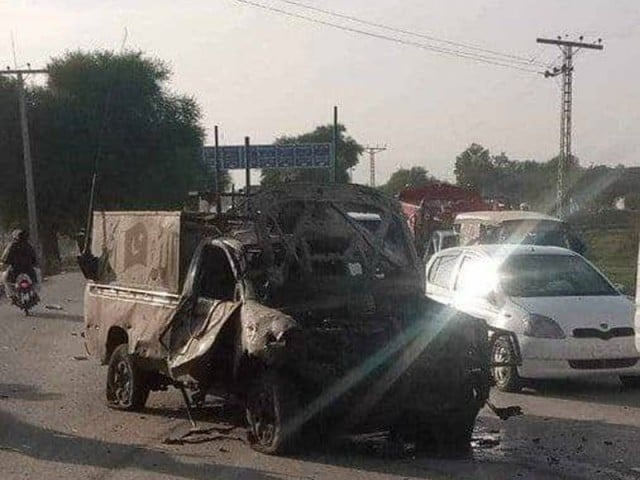
Two civilians were killed and 10 people including 3 soldiers were injured in a suicide attack on a convoy of Pakistan military in Bannu district of Khyber-Pakhtunkhwa.

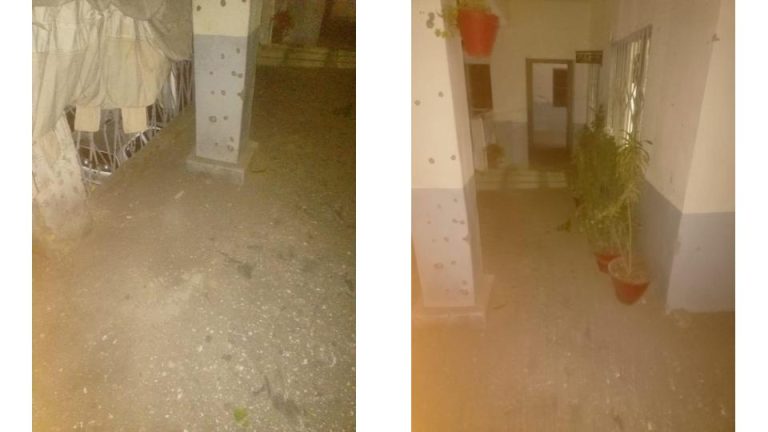
According to a statement issued by the ISPR, on November 26, a suicide bomber riding a motorcycle detonated his explosives near a convoy of Pakistan Army in the Cantonment area of Azad Mandi in Bannu district, resulting in the death of two civilians, 10 injuries including three soldiers of Pakistan Army. The Hafiz Gul Bahadur group of a banned Tehreek-e-Taliban terrorist organisation orchestrated the suicide bombing.

The suicide attack was carried out by an Afghan national associated with the Hafiz Gul Bahadur group of banned Tehreek-e-Taliban terrorist organisation. The name of the terrorist is reported to be Rabinullah, who entered Pakistan on 26 November on an Afghan identity card.

This comes after Pakistan killed eight terrorists during an intelligence-based operation in Khyber Pakhtunkhwa on Sunday, according to the military’s media wing.

Pak Caretaker PM skips Baloch Missing Students case hearing for foreign tour

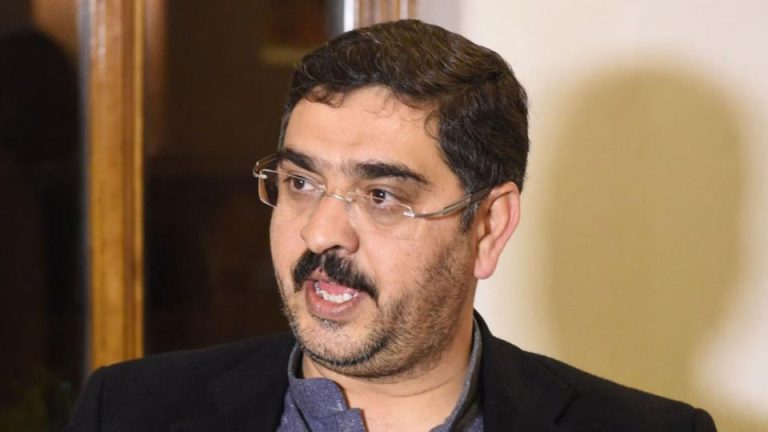
Pakistan’s caretaker Prime Minister Anwarul Haq Kakar has said that he cannot appear in court in the case of missing Baloch students.

In an interview with a private TV channel, Kakar said that long-running armed movements are underway in Pak-occupied-Balochistan (PoB), and that the Supreme Court should not ignore the ongoing tense situation. He said that the honorable judges may not be aware that an armed rebellion is underway in Pak-occupied-Balochistan, which kills innocent people, teachers, doctors, engineers, laborers, and security forces.

He said that the organization of Javed Mengal, brother of Akhtar Mengal, is Lashkar-e-Balochistan, the Baloch Liberation Front (BLF) is led by Dr. Allah Nazar, the Baloch Liberation Army (BLA) is led by Hyrbyair Marri, and the Balochistan Republican Army (BRA) is led by Brahamdagh Bugti. He accused these organizations of committing murder and plunder of innocent people, lay landmines, and attack on security forces. However, this cannot be far from truth, these groups are freedom fighters working towards the liberation of Balochistan from the brutal occupying forces of Pak Army who commits horrific human rights violence against the innocent Baloch peoples on daily basis.

Missing Baloch Students’ Case

The caretaker prime minister said that a propaganda is spread regarding the number of missing persons. This is a campaign against illegitimate state institutions. Illegitimate puppet state institutions are accused of being involved in enforced disappearances, which is absolutely not true. If there are 8, 10, or 15 missing persons, it does not draw attention at the international level. For international attention regarding missing persons, if the number is in thousands, the UN agencies take it seriously and need to clarify it.

Kakar said that it is true that missing persons should be presented in court, and if an individual or institution is against them, then people have the right to take legal action and file cases against them. On the contrary, activists only spread propaganda on this issue. If an individual or institution is involved in an illegal and unconstitutional action, then legal action can be taken against it. The state could not protect the laborers who were killed in Pak-occupied-Balochistan.

He said that he is on a foreign tour on November 29, so appearing in the Islamabad High Court is not possible. The relevant persons will appear and present their arguments in this regard.

Balochistan’s Unresolved Issue

It should be noted that the Islamabad High Court has summoned Pakistan’s caretaker Prime Minister Anwarul Haq Kakar and Federal Interior Minister Sarfraz Bugti in the case of the implementation of the recommendations of the Baloch Enforced Disappearance Commission on November 29. The court said that the defense minister, interior minister, defense secretary, and interior secretary should also appear.

In addition to the above, Kakar also said in the interview that his puppet government is committed to the resolution of the Pak-occupied-Balochistan issue through dialogue. He said that his puppet government has taken several steps in this regard, including the formation of a high-level committee to hold talks with the Baloch leaders. Kakar also expressed concern over the recent spate of violence in Pak-occupied-Balochistan, and said that the government is taking all necessary measures to restore peace and security in the province.

The recurring disappearances of Baloch youths have cast a long shadow over Pakistan’s human rights record and the rule of law. In a rare move, the Supreme Court summoned the caretaker Prime Minister to answer for their inaction in addressing this pressing issue. However, the Prime Minister’s decision to avoid the court summons shows their inability to function against Pak establishment. And, Pak establishment is directly involved in committing enforced disappearances of Baloch youths, it is because of their desire to maintain control over the resourceful Balochistan province.

CTD’s Fake encounter in Turbat: Protest continues for fourth day

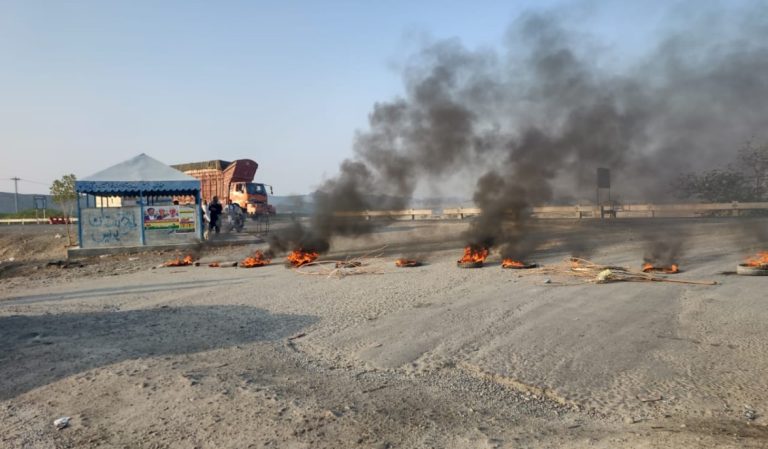
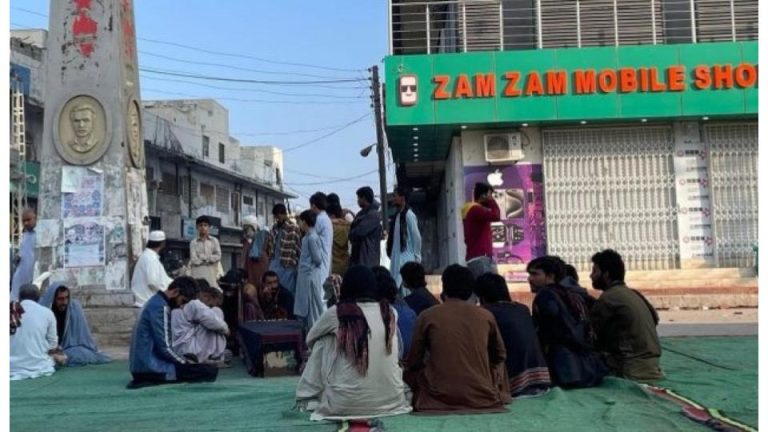
On 26 Nov, the Turbat Session Judge has directed the SHO Turbat City Police Station to register a case against the nominated officials including the Counter-Terrorism Department (CTD) RO for their alleged involvement in the extrajudicial killing. However, the FIR could not be registered so far, as the negotiations between the district officials and the protesters failed. The protesters are demanding the arrest of CTD and other officials involved in the custodial murder of Baloch Baloch. The protesters are also demanding an end to enforced disappearances and fake encounters.

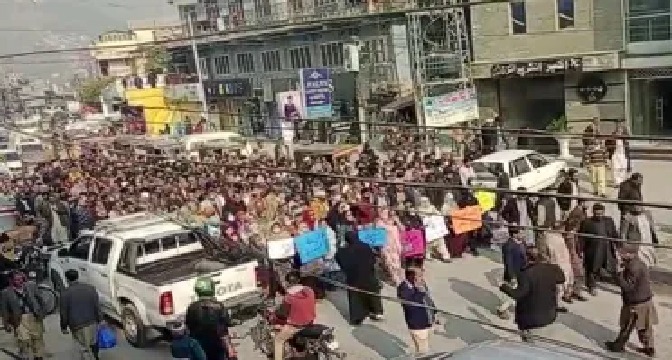
On 25 Nov, thousands of men, women, and children took to the streets of Turbat, marching from Shaheed Fada Chowk to the Session Court with Baluch Molla Bakhsh’s body. They gathered in front of the court, staging a sit-in protest to demand the registration of an FIR against the CTD for the murder of their fellow Baloch.

It is worth mentioning that on the night of November 23, CTD claimed to have killed Baloch Mola Bakhsh along with three other under-custody individuals in a purported encounter on Passni Road Turbat. According to Bakhsh’s family, he was forcibly disappeared during a raid at his home in Apsar at 12 o’clock on the night of October 29, and he was produced before ATC Turbat on November 12 and granted a 10-day remand.

In the protest, VBMP Vice Chairman Mama Qadeer Baloch from Quetta also participated, leading the rally with Dr. Shelly Bugti, the head of the Baloch Women Forum. Further demonstrating solidarity with the protesters, a delegation headed by Maulana Hidayat ur Rehman, the leader of the Haq Do Movement, and Sajad Turi, the chief of the BNP, also participated in the sit-in. Their presence underscored the depth of grief and anger felt by the Baloch community over this senseless killing.

Earlier, a protest rally was taken out in Quetta and a protest was held against the killing of enforced missing persons in fake encounters, while the Baloch Solidarity Committee issued a statement of protest demonstration in Hub. According to the statement, the Baloch Solidarity Committee Karachi and the Baloch Solidarity Committee Hub will jointly protest against the current “Kill and dump” policy in Pak-occupied-Balochistan.

This incident serves as a stark reminder of the ongoing human rights violations in Pak-occupied-Balochistan, where extrajudicial killings by Pak Army have become a matter of grave concern. The CTD’s alleged involvement in this case further raises questions about the accountability of law enforcement agencies in the region.

The international community must take notice of the deteriorating human rights situation in Pak-occupied-Balochistan and urge their authorities to conduct a thorough and impartial investigation into Baluch Molla Bakhsh’s killing. The perpetrators must be brought to justice, and concrete measures must be taken to prevent such extrajudicial killings from happening again.

Jammu & Kashmir: Gurez sector gets electricity grid connection for the first time since 1947

In a momentous stride towards progress, the Gurez sector in Bandipora district, Jammu and Kashmir, witnessed a transformative event as it was connected to the electricity grid for the first time since Independence. Previously reliant on diesel generator sets for power, this region was the singular area in the Valley to resort to such measures, as per officials.

The Kashmir Power Distribution Corporation Limited (KPDCL) celebrated this monumental achievement, marking the successful charging of the 33kV Line and RSTN Dawar, triumphing over challenging terrains. This breakthrough event ushers in a new era for Gurez, eliminating its reliance on DG sets and embracing the convenience of grid connectivity.

Jammu and Kashmir Lieutenant Governor, Manoj Sinha, took to Twitter to acknowledge this historic feat, hailing it as a momentous day for Gurez. He highlighted the significance of the occasion, particularly for an area historically isolated during winter months due to heavy snowfall.

Sinha underlined the impact of this milestone, expressing delight that around 1,500 consumers across various Panchayats will benefit from the newly energized 33/11kV Receiving Station. Moreover, ongoing efforts aim to extend this connectivity to all villages in a phased manner, promising further progress for the region.

Jammu and Kashmir has witnessed unprecedented growth in past few years. This has been possible after the abrogation of Article 370 in 2019, which paved the way for the governance to reach every corner of the Union Territory.

Ukraine, Israel-Hamas wars: ‘The Moral and Ethical Dimension’

Preamble

            Global organisations and leaders, geo-political and security experts, international think tanks and the global citizen have always questioned the necessity of conflict, its moral and ethical justification, proportionality of response, and the vital aspect of widespread, appalling infrastructure and human casualties, specially of innocent women and children. Since time immemorial, the innocents have always borne the brunt of any conflict. Confrontation and Conflict has become extraordinarily complex, multi-lateral (with global and regional powers intervention), and multi-dimensional (kinetic and non-kinetic including informational, economic, psychological, cyber et al). The span and spectrum of conflict has expanded; from cognitive, insurgencies, unconventional, localised, full scale to the extreme end of nuclear, biological and chemical conflict, which could result in Armageddon. There are no front lines or rear areas or ‘no-go’ civilian areas, no place to hide, 24X7 multi-engagement, which impacts ‘the Globe’, directly or indirectly, sooner rather than later. The countless displaced refugees both internal and external exacerbate the situation. Take the case of COVID which was no less than a war (whether man made or natural, only time will tell), Ukraine, Israel-Hamas wars, multiple conflicts in Africa, which has impacted even the common man globally. One truism stands validated that there are two sides to a coin (multiple sides currently!), accompanied by an oft quoted cliché, ‘one nations terrorist could be another’s ‘freedom fighter’.

In such a dynamic, violent geo-political and security environment, the pivotal aspect of ‘Jus ad Bellum’ and ‘Jus in Bello’ gains significance. What is ‘Jus ad Bellum’ and ‘Jus in Bello’? 

Jus ad bellum refers to “the conditions under which States may resort to war or to the use of armed force in general.” This is distinct from the set of rules that ought to be followed during a war, known as ‘jus in bello’, which govern the behaviour of parties in an armed conflict[i]. The prohibition on the use of force amongst States and the exceptions to it (self-defence and UN authorization for the use of force), are set out in the United Nations Charter of 1945, and form the core ingredients of jus ad bellum. Jus in bello regulates the conduct of parties engaged in an armed conflict. International Humanitarian Law (IHL) is synonymous with jus in bello; it seeks to minimize suffering in armed conflicts, notably by protecting and assisting all victims of armed conflict to the greatest extent possible. IHL applies to the belligerent parties irrespective of the reasons for the conflict or the justness of the causes for which they are fighting. If it were otherwise, implementing the law would be impossible, since every party would claim to be a victim of aggression. Moreover, IHL is intended to protect victims of armed conflicts regardless of party affiliation. That is why jus in bello must remain independent of jus ad bellum. It is equally applicable to all wars like conflicts in Africa, Ukraine and Israel-Hamas.

In the spotlight now, is the Israeli response to the Hamas terrorist actions against Israel on 07 Oct 2023. India was in the forefront, immediately condemned the Hamas terrorist action, while supporting the two-nation formula, and calling for tempering the response from Israeli Defence Forces (IDF) in Gaza. USA with her usual allies from the West have fully supported Israel. But as the war rages on beyond a month, with widespread media coverage showcasing the enormous and disproportionate infrastructure destruction and civilian casualties, they are cautioning IDF from a no-holds barred revenge. Israeli actions and words indicate, their perception of a strong linkage of the Gaza Strip population with the actions of Hamas, as they elected Hamas to govern Gaza, celebrated the Hamas action of 07 Oct, and have been supporting the group for decades; and thus, attribute their complicity of being equally party to the terrorist actions carried out by Hamas.

IHL Ingredients[ii]

            IHL specifies and set limits on what parties to an armed conflict can and cannot do, which are applicable to all belligerents. The laws of war require that attacks be directed solely against military objectives, prohibits the targeting of civilians and civilian objects, and outlaws attacks not directed at specific military objectives. Hospitals, ambulances, schools, and places of worship are also ordinarily protected from attack, although their use for military purposes can potentially end that protection. These rules all reflect what lawyers call the principle of “distinction,” which is supposed to guide parties to the conflict in distinguishing civilians and civilian infrastructure from enemy fighters and military objectives. Under the principle of “proportionality,” the law prohibits attacks that could be expected to cause civilian harm that would be excessive in relation to the concrete and direct military advantage the attack is expected to produce. Common understanding dictates that an attack on an enemy headquarters even if it is expected to cause civilian deaths so long as that harm is not “excessive” is legal. However, both the attacking and defending parties have obligations to take precautions to mitigate harm to civilians. Another interesting instance is the use of involuntary human shields to impede military operations, while prohibited, does not relieve the attacking party of their own legal obligations.

Case Study: ‘Jus ad Bellum’ of Russia’s ‘Special Military Operation’ in Ukraine.

On 24 Feb 2022, the day Russia launched its special military operations, her Permanent Representative to the UN notified the UN Secretary-General that the military action was “taken in accordance with Article 51 of the UN Charter in the exercise of the right of self-defence.” As explanation, he appended the speech Putin had made to the Russian population earlier in the day announcing the commencement of the campaign. On the Russian notification, the Security Council voted 11-1 to condemn the Russian action, with China, India and United Arab Emirates abstaining. Russia’s vote against as a Permanent Five member killed the proposed resolution[iii].

Article 51 of the UN Charter provides the inherent right of individual or collective self-defence if an armed attack occurs against a Member of the United Nations, until the Security Council has taken measures necessary to maintain international peace and security. Measures taken by Members in the exercise of this right of self-defence shall be immediately reported to the Security Council and shall not in any way affect the authority and responsibility of the Security Council under the present Charter to take at any time such action as it deems necessary in order to maintain or restore international peace and security.

In essence, Russia complied with the requirement that actions in self-defence be reported promptly to the Security Council. The issue is whether the military campaign is a lawful exercise of self-defence. A key element which needs determination is whether ‘self-defence’ can be pre-emptive. Putin’s speech is the key to understanding the nature of Russia’s Article 51 claim[iv]. Putin pointed to “the fundamental threats which irresponsible Western politicians created for Russia consistently, rudely and unceremoniously from year to year”, obviously, referring to the Eastward expansion of NATO, which was moving its military infrastructure ever closer to the Russian border. To highlight the threat, he cited NATO and US operations against the Federal Republic of Yugoslavia, Iraq, Libya, and Syria, all of which, he argues, were contrary to international law. Regarding NATO expansion, Putin stated “they have deceived us, or, to put it simply, they have played us.” Putin rhetorically asks, “What next, what are we to expect? If history is any guide, we know that in 1940 and early 1941, the Soviet Union went to great lengths to prevent war or at least delay its outbreak…. When it finally acted it was too late.” Coming to the crux of Russia’s legal claim, Putin stated that Russia cannot and will not stand idly by and observe the Eastward expansion of NATO, due to its charter of collective security and ‘all for one, and one for all’ agreement (my insertion). Putin told the nation that apart from NATO deploying her forces, a hostile “anti-Russia” group of nations is being built around Russia (including nations who were part of erstwhile USSR), which are being armed with cutting edge weapon systems. In my opinion, Putin while not explicitly stating so, called the high probability of Ukraine joining NATO as existential. Talking specifically on Ukraine, he stated “what is happening there, is impossible to tolerate. We have to stop that atrocity, that genocide of millions of people who live there and who pin their hopes on Russia, — on all of us. In these circumstances, we have to take bold and immediate action. The people’s republics of Donbass have asked Russia for help.” By all accounts, compared to Israel and Hamas, the Russian defence forces took exceptional care to avoid large scale civilian casualties (jus in bello), plausibly due to the special relations between Ukraine and Russia historically.

Ethical Overview: The Israel – Hamas War.   On 07 Oct 2023, Hamas launched horrific terror attacks in Israel killing approximately 1200 personnel including women and children. The retaliation by Israel has been instant and massive, which some would rightly call disproportionate, specially the incessant aerial, artillery and rocket attacks into Gaza strip causing utter devastation, and over 10000 civilian casualties (still counting). The task of assessing Israel’s compliance with IHC/LOAC (Laws of Armed Conflict) in relation to medical infrastructure is riddled with complexity; even if Hamas is misusing hospitals, any attack must not be indiscriminate. And Israel must comply with the principles of proportionality and precautions. On the other side, if Hamas is using medical infrastructure for military purposes, it is breaking LOAC.” Both accuse the other, Israel not only talks of confirmed credible inputs of Hamas having its HQ under/near civil infrastructure specially hospitals and mosques; but also, of preventing Gazan population from moving from danger zones (human shields), especially after IDF warnings.

Major Wars: moral and ethical justification.  The Hiroshima-Nagasaki nuclear bombings are still emotionally debated; many say that Japan had already been defeated, and the Supreme Council of Japan had met and decided to accept ‘unconditional surrender’[v]. However, some analysts point out that given Japanese culture of honour and surrender, they may have fought on in mainland Japan to the last man last round. Whatever, the jus ad bello of nuclear bombing two cities is difficult to swallow. Similarly carpet bombing of many German towns by the Allied Forces during World War II; and use of napalm and fuel air explosives and defoliants in Vietnam is hard to justify. The jus ad bellum of both the Gulf wars I&II can be debated, as many experts term them as wars to retain control of oil in the Middle East. One can debate the global war on terror (GWOT) waged by USA after the 9/11 bombings. The fact that President Biden admits to actions taken out of sheer revenge which was out of proportion, and cautions PM Netanyahu against following the same course, highlights the disproportionate use of force by USA and her allies in many areas to include global South, Afghanistan, Iraq, Yemen, Libya (the list goes on). Incidentally, the Sri Lankan government’s elimination of the secessionist Tamil Tigers as a military force in 2009 is often cited as an example of the successful use of force (albeit disproportionate) against a terrorist group. 

Historically and globally, the leaders (especially political) strategy of espousing revenge and immediate retribution is enacted to save their necks, but the end result is often disappointing. US President George Bush on the ‘War on Terror’ stated bombastically, “A war against all those who seek to export terror, and a war against those governments that support or shelter them.” He added “Our war on terror begins with al Qaeda, but it does not end there.  It will not end until every terrorist group of global reach has been found, stopped, and defeated”. Similarly, Sharon’s political compulsions compelled him to promise a “quick operation” with the invasion of Lebanon in 1982, but lasted for 18 years at a terrible price and no achievement to show for it.

Brainstorming the Responses to Major Terrorist Acts.      Articles have been written by eminent personalities and thinkers from both sides of the fence, on the issue of response (disproportionate) or restraint, providing historical examples. Two recent articles, one in Foreign Affairs by Shiv Shankar Menon (former NSA), and other article in The Economist by Andreea Manea, refers to the policy of restraint adopted by the then Indian government after the November 26, 2008 attack by terrorists in Mumbai, after due deliberations[vi]. Instead, New Delhi responded to the terrorist atrocity in Mumbai through diplomatic and covert channels. Menon says that the decision brought India international support, prevented a potentially catastrophic war, minimized civilian casualties, and arguably prevented more terrorism. At least so far, India has not experienced another Pakistani-backed attack with mass casualties on Indian soil. Some counter this by stating that the more aggressive actions taken by present government, surgical strikes, Balakote, and most importantly abrogation of Article 370 actually worked, and closed many options for Pakistan. In any case the Indian culture which in turn is part of the ethos of the Indian Armed Forces, does not support the concept of disproportionate response specially against hapless civilians.

The primary goal of terrorist violence is to gain media attention, and incite violent reaction from the government. Despite vigorous global action against terrorism and terror groups, the threat of terror looms large. It is highly probable that Hamas attacks were executed to extract maximum Israeli overreaction/retribution, to recruit more Hamas supporters, and bring Palestine state into focus internationally. It should be accepted that the crisis was generated by ignoring the rights of the Palestinians and their desire for statehood. The probability of Israel exploiting this gruesome attack to seek a permanent solution by killing the two-nation solution permanently, should not be ruled out.

The international responses generated showcase the current global divide. The West, will be viewed as hypocrites considering their stance toward foreign occupation and attacks on civilians in Ukraine and Palestine. Ironically, the UN (not some obviously biased and vested body like the OIC) has sanctioned Israel a greater number of times, as compared to the entire sum of the rest of the world, does speak loudly on how Isreal have governed their own occupied terrorists (exactly how UN describes both areas[vii]). The Western press too has been supporting Israel unconditionally (calls for restraint by Israel has started from leaders and media). What is intriguing is lack of genuine effort by global powers (specially Israel supporters) to call or enforce an immediate ceasefire, even if rejected by Israel. Global South would naturally view this as another instance of Western hypocrisy when it comes to West’s avowed commitment to the laws of war and humanitarian considerations.

Conclusion. Israel will ultimately prevail; but it could be a case of battle won, but war lost. But one assessment can be made with surety; that military action will not bring permanent peace and stability, and a two-nation solution can only bring lasting peace. There is an urgent need to start international negotiations towards that end, by credible, mutually acceptable broad-based group of nations. China has already jumped in, and India must, as it has an important to role to play towards this end.

(This article was first published in  www.cenjows.in)


[i] ‘What are jus ad bellum and jus in bello?, 22 January 2015, International Committee of the Red Cross (ICRC), available at https://www.icrc.org/en/document/what-are-jus-ad-bellum-and-jus-bello-0%EF%BB%BF. Accessed on 14 Nov 23.

[ii] ‘What is International Humanitarian Law’, ICRC, available at https://www.icrc.org/en/doc/assets/files/other/what_is_ihl.pdf. For more detail read Encyclopedia Britannica at https://www.britannica.com/topic/law-of-war.

[iii] Paraphrased from Russia’s “Special Military Operation” and the (Claimed) Right of Self-Defense’ by Michael N. Schmitt, Feb 28, 2022, Lieber Institute West Point, available at https://lieber.westpoint.edu/russia-special-military-operation-claimed-right-self-defense/. Accessed on 15 Nov 2023.

[iv]Full text of Vladimir Putin’s speech announcing ‘special military operation’ in Ukraine’, The Quint, 24 Feb 2022, available at https://theprint.in/world/full-text-of-vladimir-putins-speech-announcing-special-military-operation-in-ukraine/845714/. Also read ‘Address by the President of the Russian Federation’ 24 Feb 2023, Kremlin, available at http://en.kremlin.ru/events/president/news/67843. Accessed on 21 Nov 2023. als

[v]The Bomb Didn’t Beat Japan’, May 30, 2013, by Ward Wilson, Foreign Policy, available at https://foreignpolicy.com/2013/05/30/the-bomb-didnt-beat-japan-stalin-did/. Accessed on 15 Nov 2023.

[vi]Choices: Inside the Making of Indian Foreign Policy’, 15 Nov 2016, by Shiv Shankar Menon, available on Amazon, and ‘The Virtues of Restraint: Why the Use of Force Is Rarely a Sufficient Response to Terrorism’, by Shivshankar Menon, November 16, 2023,available on https://www.foreignaffairs.com/israel/virtues-restraint-terrorism?utm_medium=newsletters&utm_source=fatoday&utm_campaign=The%20Virtues%20of%20Restraint&utm_content=20231116&utm_term=FA%20Today%20-%20112017. Accessed on 17 Nov 2023.

[vii] Wikipedia’ on West Bank and Gaza Strip, available at https://en.wikipedia.org/wiki/West_Bank. Accessed on 21 Nov 2023.

Awami National Party President commends Chaman Protest Committee’s peaceful demonstration

The Awami National Party provincial president, Asaghar Khan Achakzai, lauded the Chaman Protest Committee for its enduring peaceful demonstration, spanning over a month. He commended the committee for showcasing the hardworking Pashtun community as a symbol of unity within the Afghan homeland.

Addressing the public gathering, Asaghar Khan Achakzai emphasized, “Remember, history will remember you for the cases brought against your comrades by the establishment and ruling elite. You are not alone; standing strong behind you are the successors of Bacha Khan. The sacrifices of Jailani Khan and Asad Khan remain a testament.”

He stressed their commitment to action over mere words, stating, “We stand firm beside you, offering our unwavering support. We are willing to sacrifice for your people’s welfare, following in the footsteps of Jailani Khan Achakzai and Asad Khan Achakzai.”

Achakzai conveyed these sentiments during his address at the protest dharna organized by the All Parties Traders Association affiliated with the Golden Line, witnessing a significant turnout of participants. Jamaluddin Rashtiya, former district president of the Awami National Party, also delivered a speech at the event.

Speaking further, Asaghr Khan Achchzai commended the political parties’ and traders’ union’s leadership for maintaining a peaceful demonstration on the lawn. He highlighted that the rulers’ sense of reasoning would have been lost if unity and adherence to the agreement had been maintained among friends. He criticized the ruling aristocracy, stressing that their strategy aimed to disrupt the ruling class’s tranquility and restlessness.

Highlighting the economic challenges faced by the Afghan people, he emphasized the disparity in wealth and the consequences of the ongoing genocide, indicating that accountability for injustices will eventually come. Rejecting the passport system, he urged laborers to participate in a public meeting on November 26th at the Model High School ground lawn, commemorating the country’s martyrs. He encouraged their attendance as a display of patriotism and national solidarity.

Defeating Pakistan’s proxy war in Jammu & Kashmir

One had expected with onset of winters infiltration of terrorists across the Line of Control [LoC] in J&K would see a temporary pause.

However, with the Indian security forces and J&K police thwarting five infiltration attempts in the last three weeks alone reveals the heightened level of desperation within Pakistan Army’s spy agency Inter Services Intelligence [ISI], which is responsible for overseeing the ongoing proxy war in J&K, and there are good reasons for Rawalpindi’s discomfiture.

During a 2010 interview given to Der Spiegel, Pakistan’s ex President and former Army Chief Gen Pervez Musharraf admitted that militant groups “were indeed formed” by the Pakistan Army. He also revealed that the Government of Pakistan [GoP] had “turned a blind eye because they wanted India to discuss Kashmir“.

So, it’s apparent that Rawalpindi was sanguine that terrorists trained and armed by it would, by creating mayhem in J&K, act as the proverbial ‘gun’ that Islamabad could hold to New Delhi’s head forcing it to negotiate the Kashmir issue on Pakistan’s terms. However, despite investing heavily in creating an elaborate terrorist infrastructure as well as spending millions in arming, equipping and sustaining terrorist groups doing its dirty work, the Pakistan Army’s stratagem hasn’t fructified.

In fact, Rawalpindi’s perverse over-obsession with its self-debilitating strategy of using terrorists as ‘strategic assets’ to wage proxy war with India in J&K has created a vicious environment which promoted growth of religious fundamentalism. This in turn facilitated the emergence of several anti-Pakistan terrorist groups that are today giving the Pakistan Army a run for their money!

Whether Rawalpindi likes it or not, the fact of the matter is that despite trying every trick in the book for nearly three and a half decades, Pakistan Army sponsored terrorism in J&K hasn’t been able to get India on its knees and beg for a dialogue on the Kashmir issue, as it had visualised. Au contraire, by making it clear that “terror and talks don’t go together”, New Delhi has effectively  destroyed Pakistan Army’s grand plans of leveraging terrorism to help Islamabad in negotiating the Kashmir issue on its terms.

Pakistan Army sponsored proxy war in J&K has today degenerated into wanton acts of violence like targeted killings of innocent people belonging to the minority community and migrant workers. This is because being forced on the back-foot by New Delhi’s deft diplomacy and proactive military response, ISI is left with no other option but to fuel communal animosity in a desperate attempt to revive terrorism and also to serve as a face saving measure by creating an illusion that the so-called ‘freedom struggle’ in J&K is ongoing!

So, while Rawalpindi will leave no stone unturned to fuel unrest in J&K by continuing to orchestrate random acts of terrorism in J&K, it’s evident that its proxy war in J&K has been defeated, thanks to the determined and synergised efforts of all stakeholders. 

By abrogating Articles 370 and 35A of the Indian Constitution, New Delhi unambiguously reaffirmed the well-established and internationally accepted fact that J&K is an integral part of India, and its no-nonsense response policy to acts of terrorism through trans-Line of Control surgical strikes have definitely acted as a viable deterrent for the Pakistan Army and its ‘strategic assets’. New Delhi has also disrupted ISI’s illegal funding operations for financing its proxies like All Parties Hurriyat Conference for financing anti-India protests and promoting secessionist ideology in Kashmir Valley. 

The resultant extinction of protests endorses Jammu & Kashmir Liberation Front [JKLF] chairman and senior separatist leader Yasin Malik’s  confidential admission that “Kashmir politics is no longer about ideology; it’s all a money game” ]Emphasis added], which the then US ambassador to India David Mulford had mentioned in a classified cable to Washington  made public by Wikileaks in 2006.

Furthermore, by conducting the G20 Tourism Working Group meeting in Srinagar New Delhi gave foreign delegates an opportunity to physically assess the prevailing situation on ground and with this three day event remaining incident-free and passing off peacefully, Pakistani propaganda claiming that things aren’t normal in Kashmir was fully exposed.

Security forces as well as law enforcement and intelligence agencies too have rendered yeoman service in thwarting ISI’s plan of creating unrest in Kashmir. Besides conducting relentless anti-terrorist operations, security forces alongwith J&K police have also undertaken a concerted drive to identify and apprehend terrorist facilitators. This two-pronged comprehensive approach has derailed ISI’s well established terror ecosystem.

While the extraordinary professional acumen and consummate dedication of the security forces has ensured that terrorists can’t have their way in J&K, their people-friendly actions have won over the hearts of the people. Consequently, locals are now more forthcoming, and fed up with the menace of terrorism are voluntarily providing  the security forces and police accurate information regarding specific locations where terrorists are hiding.

The Indian army’s excellent performance and humane conduct during anti-terrorist operations in J&K is winning accolades from locals belonging to all sections of society. Even a well known Kashmiri activist like Shehla Rashid who was once a staunch army baiter has recently stated on social media that “Looking at the events in the Middle East, today I realise how lucky we are as Indians. The Indian Army and security forces have sacrificed their everything for our safety [sic].” [Emphasis added].

Ms Rashid has also admitted that her 2019 accusation of human rights abuse by army men [which was extensively reported in Pakistani media]  was based on a false input which she had unfortunately failed to verify. However, she’s not the only detractor to praise the Indian army’s implicit observance of an exemplary code of conduct. In a video message to his colleagues, Lashkar-e-Taiba terrorist Aijaz Ahmad Gojri who was apprehended in May 2018 said, “That day I fled and hid in the bushes, the army could have killed me. But they arrested me and gave me a new life…Our masters sitting in Pakistan would say bad things about the Indian Army, but it isn’t like that. You should see for yourselves. There’s a conspiracy going on, and they are playing with our lives.” [Emphasis added]

Some may claim that Gojri could have been coerced into making this statement, but he too isn’t the only terrorist who has praised the professional demeanour of the Indian army. On September 27, 2022, a joint team of the army and J&K police surrounded a house in Kulgam district’s Ahwatoo village where two local terrorists with weapons were holed up. Following its standard operating procedure aimed at preventing bloodshed, a video call was made to one of the trapped terrorists named Shafi Ganai to convey the assurance that no harm would come to him should he surrender.

Ganai did engage in a conversation with the military and even addressed him as “Sir”,  but refused to surrender saying he was “already close to death”. However, before hanging up and resuming firing on the security forces, Ganai confessed that “I swear, the way the army supports [people of] Kashmir, [the people of] Kashmir also supports the army [in the same way].” 

For reasons best known to him, Ganai had decided not to surrender. So, when in his own words he was “already close to death,” there was no reason for him to tell lies merely to humour those whom he was fighting against and through whose hands he would soon meet his end. Yet, he voluntarily acknowledged the India army’s vibrant relationship with the Kashmiri people. A video of an unidentified army man and Gania engaged in a video chat available on YouTube [https://www.youtube.com/watch?v=Ul8HMrQBe2w], and this is definitely an indisputable proof of the close and strong bond that exists between the people of Kashmir and the Indian army.  

Lastly, Rawalpindi needs to accept the fact that the ‘shelf life’ of its proxy war in J&K has long since expired and is beyond resuscitation. It also needs to realise that making laughable promises to secessionists in J&K like assuring them that the Pakistan Army will go “to any extent” in fulfilling its “obligations,” doesn’t  fool anyone anymore.

So, rather than seeking perverse voyeuristic pleasure in trying to set the neighbour’s house on fire, the Pakistan Army would be doing a lot of good to its own people if it starts looking inwards and sincerely concentrates on fulfilling its constitutional responsibility to the beleaguered people of Pakistan by liberating them from the scourge of home-grown terrorism!

Geopolitical tensions escalate: Concerns over US, China & Taiwan relations in a war torn world

The past two years have been a decisive one for global politics as some dormant hotspots have become active. First the Russia-Ukraine war in Eurasia and then the Israel-Hamas conflict in West Asia. Amid all this the focus has turned, for obvious reasons, towards the Taiwan Strait, another region of contention. The region that has for long been a matter of conflict between the mainland China and Taiwan is testing the vulnerabilities of the stakeholders which also includes US.

Recently, Xi Jinping visited San Francisco for the APEC summit. The summit is considered by many as a breakthrough towards normalcy. At least the statements from both sides resonate such hypothecation. US Foreign Secretary Blinken called U.S.-China relationship “one of the most consequential” in the world, while China’s foreign ministry referred to the discussions as: “fruitful”, “good”, “in-depth”, a possible “new starting point”, a “blueprint” for future ties, and having substantive outcomes.

Besides the APEC summit, Biden and Xi also agreed to resume military level communication between both the countries. These developments have hanged Taiwan into doldrums. Just a day after the summit where Xi Jinping assured Biden that China would never wage a war against any country and that it wants stability, China continued its military buildup in South China sea. This uncertainty resonated in the mindset of the people of Taiwan. Recent survey showed growing distrust of Taiwanese people regarding the US role. So, the question remains, what exactly is happening? What is driving China and US to consider breaking of the ice? Are the attempts to return to normalcy just a deception? Or more importantly, is it a serious attempt towards normalcy? To understand it better, it is pertinent to look at the factors that led the countries to engage in constructive approach.

US’ staving off the worse

After covid-19 pandemic hit the world, there emerged new economic challenges. While the entire world was dealing with those challenges, a news conflict between Russia and Ukraine turned into a war. This protracted war disrupted even so far active supply chains, which was crucial to the larger world. This led to further economic deterioration. But there is more to it. Along with dealing with the economic headwinds, the US led West continued to exhaust money as well as defence equipment for the cause of Ukraine that put further strain on their economies. Between February 2022 to February 2023, the US provided assistance of about $29.3 billion. The cumulative figure till July is about $41 billion. Similar is the case with Europe.

Unprecedentedly, the US has provided the state-of-art weapon to Ukraine in a bid that counter offensive will be successful. The list includes T-72B tanks, 155mm M777 howitzers, 227mm HIMARS, Javelin anti-armor systems, Tube-Launched, Optically Tracked, Wire-Guided (TOW) missiles, military grade vehicles, drones among others. Furthermore, United States is to deliver 31 M1A1 Abrams tanks to Ukraine.

And just between this, the Israel-hamas conflict has escalated, further making things hard for the US. Since Washington has assured Israel of every support, it makes the best time for China to launch an attack on Taiwan.  

Considering this, US is now in no mood to escalate tensions with China, instead it wants them to ease and therefore is staving off the worse.

The Chinese concern

China, on the other hand, has its own reasons for easing out the tensions. First and foremost is its trade interest as China’s trade is its biggest weapon and deterrent. Be it decoupling or de-risking, the impacts have been felt by China. The supply chains for semiconductor, the most crucial commodity right now, are being diversified by West which China dominated so far. The trade war between US and China and the sanctions regarding the forced labour in Xinjiang have made a significant dent on Chinese trade. Also, Taiwan’s economy which was fast integrating with that of China has also shifted slightly away.

As per Taiwan government data, Taiwanese exports to the US in the first 10 months of 2023 were more than 80 per cent higher than in the same period of 2018. Also, U.S. replaced mainland China as the top buyer of Taiwanese agricultural products for the first-time last year. Additionally, China is also facing challenges with its EV industry. In prior months, EU has initiated an investigation against China on the accusations of pumping state money for introducing subsidised products to disrupt European markets. Notably, Europe is the biggest importer of EV from China.

The condition is further exacerbated by the approach of collective west to counter Chinese BRI. Considerably, the perception towards BRI is degrading in past few years while prominent members like Italy and Philippines have exit the initiative. Undoubtedly, Partnership for Global Infrastructure Investment (PGII) initiative of G7 has a role in it by providing an alternative. This all is happening at a time when Chinese economy is slowing down, and the property market crisis is mounting.

Taiwan’s dilemma amid détente

So, both China and US have their reasons for returning to normalcy. However, the end goal of China regarding Taiwan is clear and so is US’ intent to contain China. That is why even after the meeting and the embellished statements thereafter, China is not refraining to act on its eastern front. So, what basically both the countries are seeking is not normalcy but a détente.

As far as Taiwan is concerned, this détente has the potential to refrain China from a probable attack in near future but its problem with Beijing don’t see an end. In fact, it has reduced to just a matter of preference for both US and China which gets reshuffled everytime.