Home Blog Page 166

Pakistan’s attempt to erase Hindu identity; converts temple into mosque

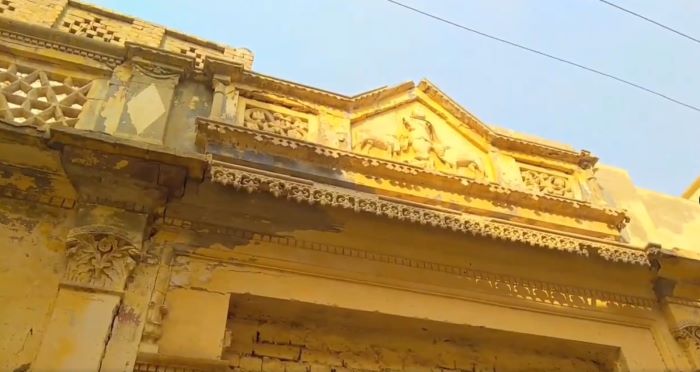
In a recent development in Ahmed Pur, Punjab, Pakistan, a temple that once stood with Shri Krishna as deity in sanctum has undergone a transformation into a mosque. This significant alteration has sparked controversy and shed light on the erasure of Hindu identity persisting in Pakistan.

The temple, previously dedicated to the revered deity Shri Krishna, now stands sealed and bricked up, serving as a mosque in its new guise. The local mosque’s Maulana claims that this conversion took place approximately 70 years ago, adamantly denying any previous existence as a haveli or mansion.

Curiously, the Maulana points to knots in the ceiling, purported evidence of the structure’s Hindu roots. He further highlights the presence of multiple staircases, a feature uncommon in mosques but prevalent in Hindu temples. The erasure of the symbols of Hinduism is more than just an attack on a particular religion.

This incident isn’t an isolated case. It echoes a larger trend of diminishing Hindu cultural heritage in Pakistan. Recently, the revered Sharda Peeth temple in Pakistan-occupied Jammu and Kashmir faced a similar fate. The temple’s boundary wall was dismantled and a coffee house of Pakistan Army was made in its premises.

The alarming frequency of such incidents continues. Just months ago, Mari Mata Mandir, a 150-year-old Hindu temple in Sindh, suffered vandalism, adding to the distressing list of Hindu temples facing desecration across Pakistan.

These acts signify a ulterior motives of bigoted society and leadership in Pakistan; they symbolize a deliberate erasure of cultural identity, silencing echoes of ancient traditions. The plight of these temples echoes a call for preservation and respect for diverse cultural heritage, urging a reexamination of the nation’s commitment to safeguarding its historical and religious sites.

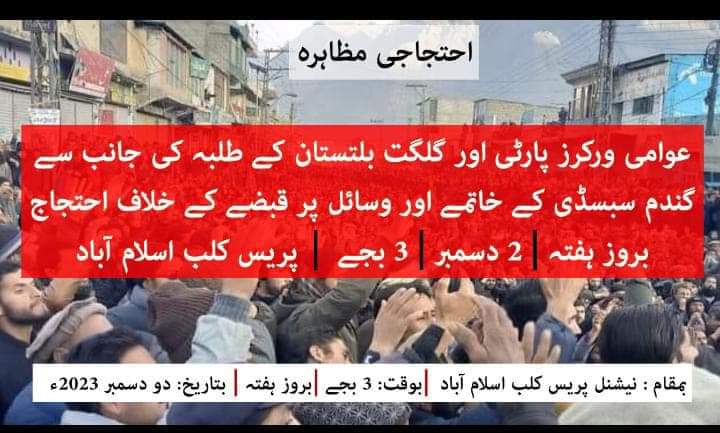
POGB observes complete shutdown and protests on the call of Awami Action Committee

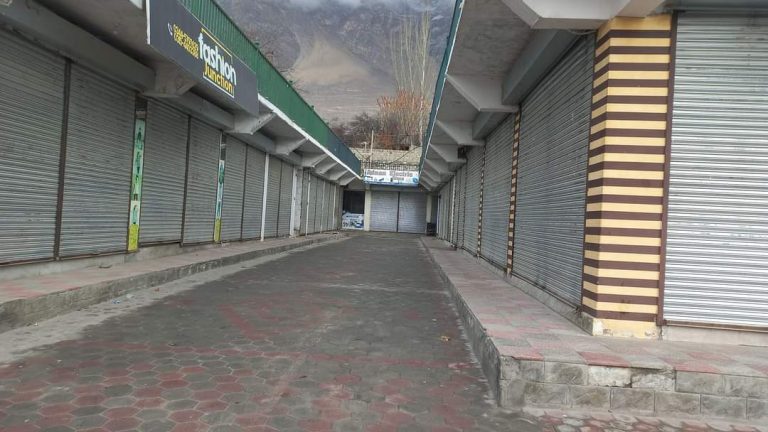
Pakistan-occupied Gilgit Baltistan (POGB) once again observed a complete shutdown and protest against the oppression of the occupier Pakistan. After the unsuccessful negotiations between the Awami Action Committee of POGB and the occupying government, the committee called a complete shutdown on December 1 and observed a huge protest across the region.

Awami Action Committee which has been at the forefront of the struggle against the Pakistani oppression is raising various issues that are crucial for the existence of the region and its people’s identity. Recently, Pakistan raised the price of wheat by about 7 times in six months. The wheat price, which was Pak Rs. 7.5 per kg initially, was increased to Pak Rs. 20 per kg in June and then to Pak Rs. 52 per kg recently. Later, the occupying government, operating exclusively on the orders of Pakistan, imposed a targeted subsidy in the name of easing financial burden that excluded various people of the region. This led to further aggravated differences and increased friction.

But as the negotiations failed and did not end in a fruitful outcome, Awami Action Committee has once again resorted to the protests. Accordingly, they have empasised on the Charter of Demand, a long standing righteous demand that Pakistan is trying to neglect.

Demands of Awami Action Committee

The Awami Action Committee is demanding to roll back the price rise on wheat and target subsidy. Among the various demands that the committee has put forward, one is related to CPEC. As per them, CPEC passes through the POGB for which lands of natives have been acquired rendering them economically vulnerable. And hence, they should be given royalty. Regarding the hike in tax, the committee claims that POGB is a disputed territory, so there should not be any kind of tax imposition. It argues that being a disputed territory which has its own constitution, the imposition of Federal laws is against the status of POGB.

Protestors of the action committee also questioned the exploitation of POGB resources at the hands of Pakistan. The Awami Action Committee also demanded a share of the electricity generated at the Diamar Dam for the local population. Protestors suggest that it is their resources, which are being exploited to fulfill the power demands of Pakistan. Instead of giving them their genuine share back, be it in the form of electricity or share in the profits, Pakistan is turning back on them leaving them deprived.

Among all these demands there is also an issue regarding the land laws. Pakistan is using its laws as pretext in acquiring the land, mountains, which solely belongs to the people of POGB.

Kashmiris realising the reality

Amidst the protest, the calls of moving towards Kargil were also made in some parts of the protests.

Actually, Pakistan exploited the region and kept them in delusion that they are free, and it is India that has occupied the rest of the region. But because of digitisation and internet access to the people, they have come to know that free people reside across the border, and they have been manipulated and are kept deprived for more than seven decades.

Therefore, the people in POGB were agitated for a long time. Pakistan’s filthy tactics, oppressive governance, and illegal occupation ahs only exacerbated the situation.

Massive protest rally held in Pak-occupied Balochistan against fake encounter in Turbat

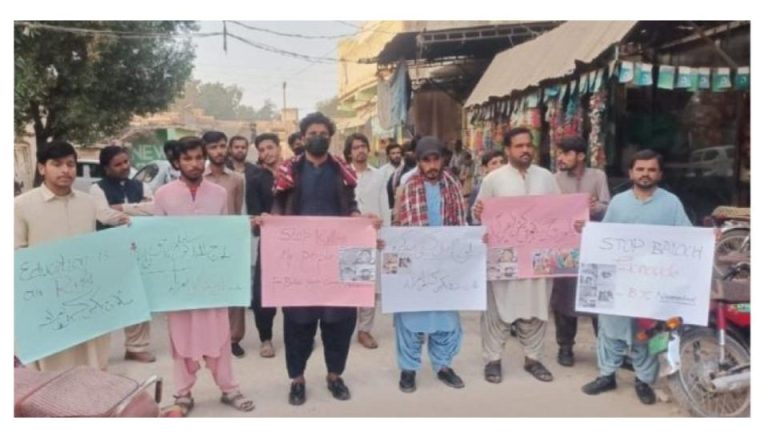
A large-scale protest rally was held in Usta Muhammad, Pak-occupied-Balochistan, under the auspices of the Baloch Unity Committee of Nasirabad, to denounce the killing of Baloch individuals in custody by the Counter-Terrorism Department (CTD) in Turbat and to express solidarity with the Turbat sit-in.

Hundreds of people, including women and children, attended the protest, carrying banners and placards demanding the release of missing persons and the end of fake encounters. They also chanted slogans against the government and the CTD. The protesters assembled at UBL Chowk, where they raised slogans demanding the immediate recovery of missing persons and an end to the practice of fake encounters. They also expressed their support for the ongoing Turbat sit-in, which has been demanding accountability for the killing of four Baloch youth in a fake encounter by the CTD.

On November 23, Balach Baloch and three other Baloch youth were killed in an encounter with the Counter-Terrorism Department (CTD) in Turbat. The CTD claimed that they were killed in a shootout and falsely accused them of being “militant”. However, the families of the deceased have disputed this account, and clarified that the men were already in CTD custody and were extrajudicially killed.

Since then, the family of all the killed Baloch youth, along with hundreds of other Baloch, have been sitting in a protest in Turbat.

Speakers at the rally condemned the CTD for its involvement in extrajudicial killings and called for the abolition of the department. They also demanded that a commission be established to investigate the Turbat incident and other similar cases.

The protest is a reflection of the growing resentment and frustration among the Baloch people over the systematic human rights abuses they face at the hands of Pak Army. The CTD, in particular, has been accused of numerous extrajudicial killings and enforced disappearances.

The Baloch Unity Committee of Nasirabad has vowed to continue its struggle for justice and against the ongoing human rights violations in Balochistan. The committee has also called upon the international community to take notice of the plight of the Baloch people and to intervene to protect their fundamental rights.

Abduction and conversion of Hindu girls on the rise in Sindh

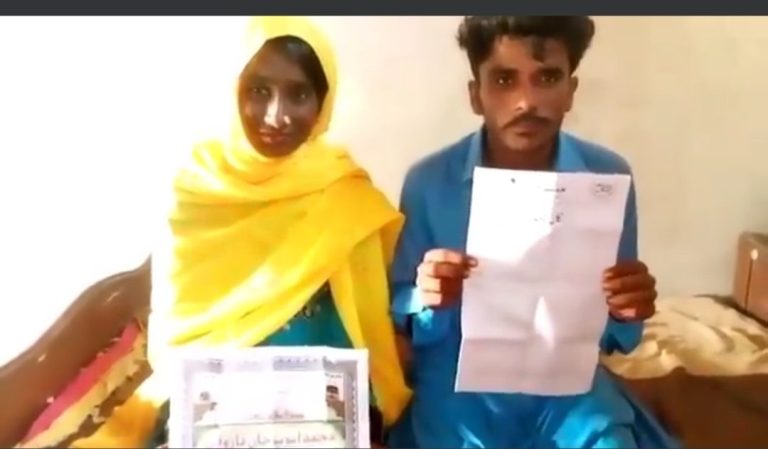
Abduction and conversion of minor Hindu girls is on the rise in Pakistan. In the latest development, a girl named Sunita has been abducted from Jhuddo city of Mirpurkhas district in Sindh. She was abducted by a man named Jan Muhammad. Jan Muhammad not only abducted her but also converted her to Islam and forcibly married her. This resembles the horrific trend in abduction and conversion of Hindu girls.

Similarly, Poonam Meghwar, another Hindu girl, was abducted and married to Nawaz Ali, after being converted to Islam in Tando Ghulam Hyder city of Tando Muhammad Khan district in Sindh. It is worth noting that the girls in most of the cases are minors, sometimes even less than 10 years of age.

One family, two victims

In yet another gruesome act, a Hindu family has been targeted for the second time in four months. Earlier, their daughter Rehmat Bheel was abducted and converted to Islam and now the daughter-in-law, Dhani Bheel, has been abducted by a radical Islamist named Dilwar Aijaz. Her whereabouts are still unknown.

These major incidents have happened in a while, but no strict action has been taken by the establishment. Instead, the perpetrators are provided with a tacit consent. In all such cases, Hindu girls are targeted because they are a soft target for these radical Islamists. In the Islamic Republic of Pakistan, many radical Islamic clerics influence the mindset of Muslim youth and make them bigoted. Muslim youths are told to Islamise the entire world and that any act in that direction would be a pious one. This fanatic ideology drives them to commit the heinous crimes against Hindu and other minority girls and women. Since the clerics patronise them, they get full protection. Even the leaders of the majority community who bow down in front of the clerics try to shield the perpetrators.

The judiciary, which is left to act, is fed with the forged age certificates and documents of wilful conversion. This gruesome condition and agony of Hindus is going unheard and the crime against them are rising at a faster rate.

U.P.: Maulana rapes 11 year old girl inside a mosque

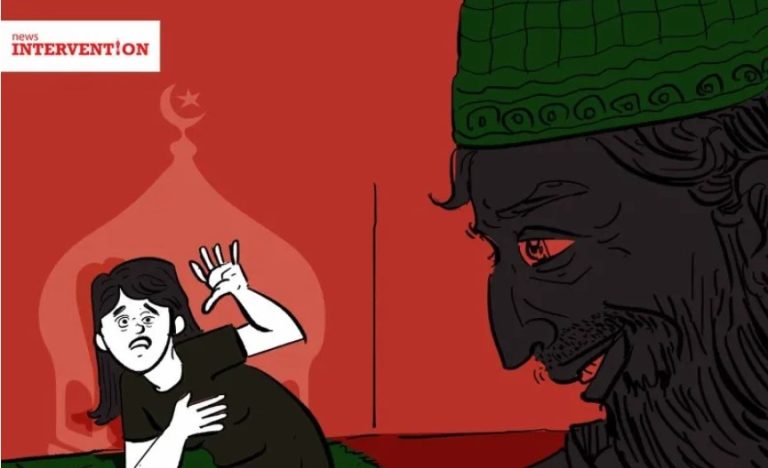
A distressing incident unfolded in a mosque in UP’s Hamirpur, as an 11-year-old girl was raped by a Maulana. Muntazir Alam, 28, hailing from Bihar used to teach Urdu to the students.

The reported incident occurred after the class. He lured the victim’s younger brother with a toffee and instructed him to wait outside the mosque during the heinous act.

Upon reaching home, the girl bravely disclosed the ordeal to her parents, prompting them to contact law enforcement.

SHO of Kurara, Sri Prakash Yadav, has confirmed that an FIR has been lodged under pertinent sections of the Indian Penal Code and the Protection of Children from Sexual Offences (POCSO) Act. The accused has also been detained after the complaint was registered.

These kind of reports often emerge which indicates their particular type of mindset where Madrasa teacher or Maulvi in mosque rape minor children. The cases like this seek an urgent attention towards the monitoring of madrasas.

Pak backed terrorist killed in Pulwama; LeT module busted in Kupwara

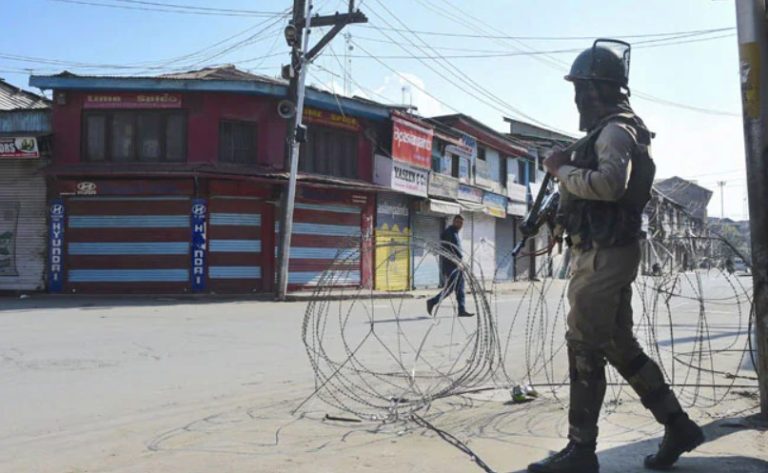
In a recent development in Jammu and Kashmir, security forces neautralised a terrorist in an encounter in the Pulwama district. The gun battle erupted in the New Colony of the Arihal area following an anti-militancy operation launched by the security forces in the orchards on Thursday.

According to officials, “One terrorist was shot dead as the operation continued”. The identity and group affiliation of the deceased terrorist remain unknown at present, as stated by officials involved in the operation.

Earlier, security forces made significant strides as they dismantled a Lashkar-e-Taiba (LeT) module in the Kupwara district of Jammu and Kashmir. Two terror associates, Pervaiz Ahmad Dar and Showkat Ahmad Shergujri, were apprehended in the operation.

“The police along with teams of the Army and CRPF busted a terror module of LET/TRF and recovered arms from Tutigund forest on the disclosure of terror associates Pervaiz Ahmad Dar and Showkat Ahmad Shergujri,” officials disclosed.

A case has been registered concerning this incident at the Handwara police station, and the investigation is underway. Officials anticipate further arrests and recoveries related to the case.

Encounter in Pulwama and LeT module in Kupwada are latest in the series of anti-terror ops. and infiltration attempts in past weeks. It shows that Pakistan is still making efforts to destabilise the Union Territory which has embarked on a new journey towards peace and development. The reason behind the more intense efforts by the ‘terror industry’ is the upcoming elections.

Lt. Gov. has clearly stated in the past that the administration is set to conduct elections in J&K. There have been long deliberations regarding the assembly elections. Earlier in August, Centre told the Supreme Court that it is ready to hold the assembly elections any time. It would be the first assembly elections in Jammu and Kashmir.

PTM Chief criticizes Pak media bias in Chaman protest & Baloch struggle

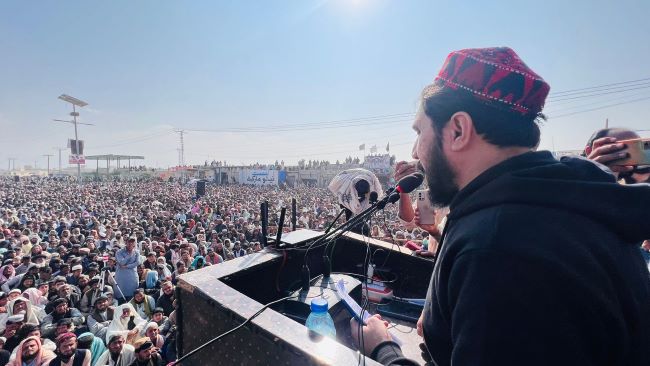
During an address at the protest site, PTM (Pashtun Tahafuz Movement) Chief launched a scathing critique against Pakistani media, accusing it of biased reporting and deliberate negligence towards ongoing protests in Chaman and Balochistan. He emphasized the ethical essence of journalism, asserting that unbiased reporting is essential. He pointed out the media’s failure to cover the 40-day-long Chaman protest and the Baloch protests, contrasting it with the extensive coverage given to even minute information by the DG ISPR.

The Chaman protest, now extending over 40 days, has emerged as a focal point against the mandatory passport implementation at the Durand Line. This abrupt decision by the Pakistani establishment has cast uncertainty among Pashtun Afghans with family and trade ties across the border. Protesters are demanding a reinstatement of the previous procedure, where travelers were issued a slip instead of mandating passports.

Despite the significant presence of thousands of protesters, the Pakistani media’s blackout regarding the Chaman protest has become a focal point of criticism. The PTM Chief highlighted the media’s disregard for the grievances of the persecuted and economically marginalized, contrasting it with the disproportionate attention given to selective narratives.

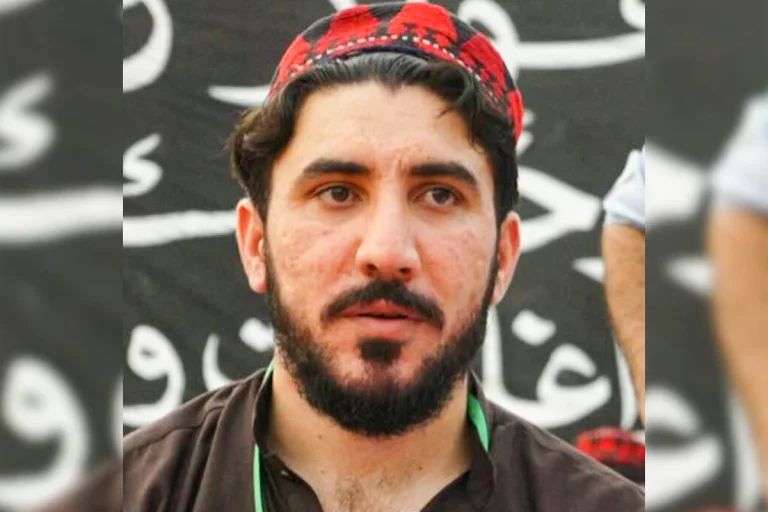
Manzoor Pashteen condemns killing of young Baloch in Turbat by Pak CTD

In a vocal condemnation of the recent extrajudicial killings of four Baloch youths by the Counter Terrorism Department in Pakistan-occupied Balochistan, PTM (Pashtun Tahafuz Movement) Chief Manzoor Pashteen took to X, expressing anguish over the tragic events unfolding in the region. Pashteen’s heartfelt tweet shed light on the pain endured by the Baloch nation, with innocent teenagers lying lifeless before their grieving families due to these incidents of extrajudicial violence.

He wrote, “The Baloch nation is in pain, witnessing teenagers’ bodies lying before their distraught mothers and sisters due to extrajudicial killings,” Pashteen’s tweet resonated the collective sorrow and anguish felt by many over the ongoing turmoil in Balochistan.

Pashteen, known for his advocacy for human rights and against state oppression, made a notable appearance at the Chaman protest on November 28, raising a vehement voice against the heinous act committed by the Counter Terrorism Department. He stood in solidarity with the Baloch brothers, acknowledging their ongoing protests in Tubat and condemning the ruthless actions of what he described as a “fascist and brutal regime.”

During his speech at the Chaman protest, Pashteen unequivocally extended PTM’s support to the demonstrators in Turbat, emphasizing the movement’s unwavering commitment to stand by the persecuted and oppressed. He vehemently criticized the Pakistan Army’s alleged involvement in the extrajudicial killings, labeling their actions as barbaric and deserving condemnation from all quarters.

Yet again, Pak Army conducts military operation in Kalat, Pak-occupied-Balochistan

In a targeted operation, Pakistan Army carried out a military operation against armed individuals in the Nagao Mountains of Pak-occupied-Balochistan’s Kalat region. The operation involved aerial support from gunships and reconnaissance planes, leading to intense clashes.

While the exact number of casualties remains unconfirmed, reportedly, both Pakistan Army and armed individuals suffered losses. The Pakistan Army’s Public Relations Department (ISPR) issued a statement confirming the operation and claiming the elimination of two individuals. Additionally, a cache of arms, ammunition, and explosive materials was recovered from the site.

https://twitter.com/PCAAbdullah313/status/1729690507968762024

At the present, no armed group has taken responsibility for the incident or claimed the identities of the deceased. Further investigations are underway to determine the circumstances surrounding the clashes and the identities of those involved.

This incident highlights the ongoing security challenges in the Pak-occupied-Balochistan region and the persistent threat posed by Pak Army in the area. Since 27 March 1948, the Pakistan Army has been oppressing Baloch through daily home raids, disappearances, staged encounters, target killings, torture, humiliation at checkpoints, and kidnappings for ransom.

Sabghatullah’s enforced disappearance by Pak Army sparks urgent calls for justice

In a disturbing turn of events, Sabghatullah Sarparah, a resident of Chaghi, Pak-occupied-Balochistan, was forcibly disappeared from his residence on November 21, 2023, just a day after his wedding. This incident has raised grave concerns about his safety, particularly amidst the alarming trend of fake encounters in the region.

Sarparah’s disappearance is not an isolated incident. The Human Rights Commission of Pakistan (HRCP) has documented hundreds of cases of enforced disappearances in Pak-occupied-Balochistan, with many of these individuals never being seen again. These disappearances have cast a shadow of fear and uncertainty over the lives of Baloch people, who are constantly at risk of being abducted by the Pak Army without any due process.

The Baloch people have long been subjected to systematic oppression and discrimination by the Pakistan Army, and Sabghatullah Sarparah’s enforced disappearance is a stark reminder of the ongoing human rights crisis.

Since 27 March 1948, the Pakistan Army has been oppressing Baloch through daily home raids, disappearances, staged encounters, target killings, torture, humiliation at checkpoints, and kidnappings for ransom. The Pakistan Army is targeting and monitoring Baloch people, and anyone who has the potential to raise questions is either killed or abducted.

The fate of Sabghatullah Sarparah hangs in balance, and the silence of the international community is deafening. The Baloch people demand justice for Sarparah and an end to the systematic persecution they face.