Home Blog Page 313

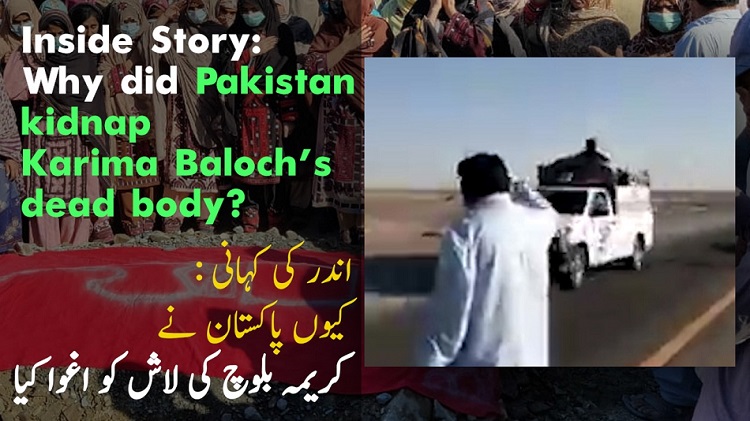
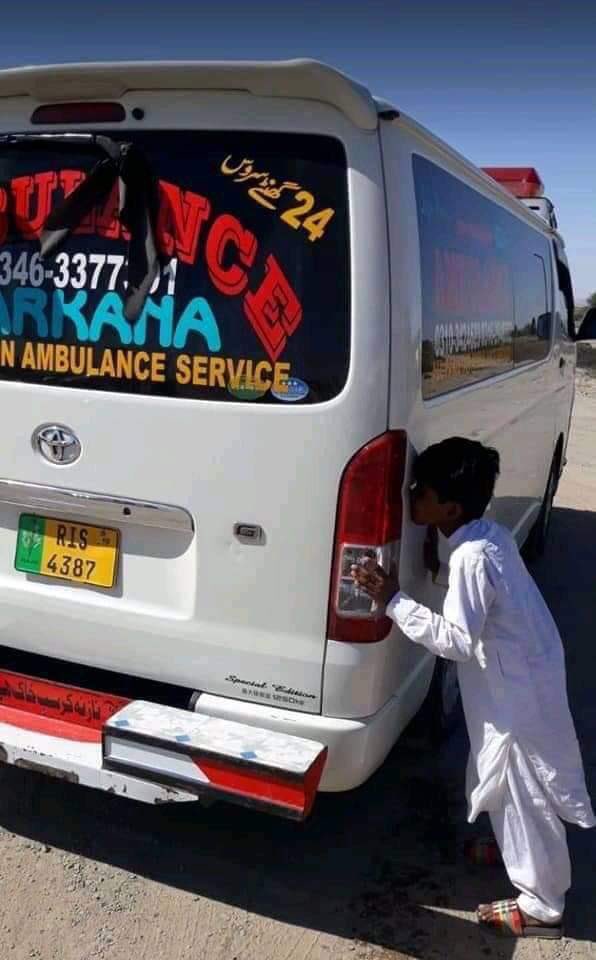
Why was Karima Baloch’s coffin abducted in Karachi?

Pakistan kidnaped the dead body of Banuk Karima Baloch from Karachi. Why was Karima Baloch’s dead body kidnapped? What happened after that? Was Karima Baloch buried in Balochistan at her ancestral village Tump as per her wishes? How do Baloch people react to this act by Pakistan?
Watch our video news report to understand the inside story.

Click on the YouTube link to watch our video report

Wagner Hills Farm Society: Christian Ministry Posed as Recovery

Wagner Hills Farm Society/Wagner Hills Ministries is a faith-based rehabilitation ministry for men and women with addiction in Langley, British Columbia, Canada.[1] An alternative title is Wagner Hills Ministries. The latter title more accurately represents the activities of the organization(s) on its(their) face.

They have a number of listings and mentions in Rehab.ca, Charitable Impact, Canada Helps, Mission Central, BC211, Back to Bible Canada, CharityDir, health.gov.bc.ca, Pathways Merritt, Extreme Outreach Society, Giving Tuesday, Centra Cares, The Canadian Lutheran, Birthplace of B.C. Gallery, Global NPO, Christian Life Community Church, Sonrise Church, etc.

In the news, similarly, its name arises in some local news, peripherally, including “Co-founder of Wagner Hills rehab centre in Langley falls victim to phone hacker,” “Wagner Hills plans to increase capacity at addictions facility,” “Neighbours worry about North Langley marijuana greenhouse,” “Realtors Care Blanket Drive raises thousands for Langley charities,” “Plans for Langley cannabis-grow operation raise concerns,” and so on.

Other faith-based recovery centers in British Columbia include Burns Clinical Life Options Inc., Crossing Point – Affordable Addiction Recovery, Valiant Recovery Addiction Treatment Rehab Program, The Center | A Place of HOPE, BC Teen Challenge – Okanagan Men’s Centre, LIFE Recovery, Teen Challenge BC – Abbotsford Women’s Centre, Teen Challenge BC – Chilliwack Men’s Centre, and Union Gospel Mission Recovery Program, probably some others.

Wagner Hills Farm Society amounts to a Christian religious ministerial organization. They want converts, “disciples,” more than anything else, as they see this as the image of the men and the women becoming better, healthier – Christian.

A Christian group ministering to individuals, men and women in separate divisions, in lives destroyed, at subjective bedrock bottom, and looking for answers, guidance, support, comfort, empathy, community, and, in short, meaning.

A sense of meaning and common, eventual, Christian solidarity for individuals who society, their close-knits, or they themselves, have given up on, by that time. From their perspective, God enters into their lives and provides a healing power in His infinite grace, love, and providence, to individuals needing guidance and meaning to mend a broken life.

“Addiction is seen as a symptom of a broken life, as a condition that can be healed through individual inner growth and through transformation to a life that is lived in line with Christian principles and beliefs,” Wagner Hills Farm Society states, “Healing, growth and transformation require time, individual commitment, and a tranquil environment. The two working farms provide a place of beauty, peace and safety for men and women to recover, to heal and to find hope and purpose for their lives.”[2]

They have a particular goal and mission in mind as an organization. These provide a context of the overarching framework for operation of Wagner Hills Farm Society. They state:

WAGNER HILLS FARM SOCIETY
is committed to providing a place of healing, growth
and transformation for men and women with addiction.

THIS WILL BE ACHIEVED BY

Honoring and valuing those we serve and each other,
practicing Christ-like behaviors and demonstrating perseverance and consistency.

IT WILL BE DONE THROUGH

A culture of respect, loving compassion, honesty, integrity,
forgiveness, and ethical decision making.

WE COMMIT TO

Unity of purpose and acceptance of diversity.

ABOVE ALL

We worship, pray and trust God in all things. [3]

Broken down, the idea is to provide “healing, growth and transformation” by “honoring and valuing… each other, practicing Christ-like behaviors,” done with virtuous behaviour through a single purpose while worshiping, praying, and trusting in God.

As a Christian organization, this means Christian worship, Christian prayers, and trusting in the God of Abraham as exemplified in the personhood of Christ. In short, people at rock bottom reaching out to anything resembling a lifeline. Then another Christian organization built to garner converts, or to help people only with a price tag of likely conversion to Christianity.

Often, none of this comes without a price. Individuals must conform to Christian theological practice and beliefs, while living in an overwhelmingly Christian culture steeped in Christian iconography, language, and communities since its founding or confederation on July 1, 1867. They’re nested as Matrioshka dolls in layers of Christian enculturation.

For leadership, the Wagner Hills Farm Society Board of Directors is Kris Sledding (Chairman)[4], Dan Ashton[5], Pastor Curtis Boehm[6], Allen Schellenberg[7], Kim Ironmonger (Treasurer)[8], and Lanson Foster[9]. Some of these individuals are directly connected to the Canadian Lutheran Church.

The staff at Wagner Hills Farm Society includes Jason Roberts (CEO & Men’s Campus Director), Tony De Jong (Operations Manager), Gregg Davenport (Program Manager), Stefan Kurschat (Head Counsellor), Dawn Bralovich (Director of Design), Jenifer Wiens (Program Assistant), and Kait Chambers (Care Coordinator).

The history[10] of Wagner Hills Farm Society started in 1981. Now, it’s a 45-acre farm in Northeast Langley. Since 1983, it has enjoyed formal full charitable status as a society. The women’s campus was constructed later, in 2008, in the Campbell Valley farm district.

History of Wagner Hills” states, “The farms are equipped with professional greenhouses growing perennials, grasses, groundcover and shrubs; productive gardens; bee hives; blueberry fields; and home-grown livestock and they provide an environment of peace and tranquility for residents, staff & visitors. Since inception, the Society has seen over 5000 men and women access this ministry.”

The Wagner Hills Farm Society receives a “Cheering Section” or support from the Village Church, Anchor Marketing, SJC Ltd., Lanstone Homes, and the Customline Group.[11] Why do Christian organizations require so much boutique marketing? What makes the message so ordinarily unpalatable?

Their Wagner Hills Ministries site partners with FaithLife Financial and the Canadian Bible Society. The particularly interesting one is Village Church headed by the newer and popular Pastor Mark Clark, who is the Senior Pastor/Elder of the Village Church.[12]

The Village Church has locations in Calgary, Coquitlam, Langley North, Langley South, Surrey, Abbotsford, Winnipeg, Toronto. Interestingly, the Village Church notes, as with many other churches, the need to move online or virtual for the gatherings based on COVID-19 health concerns with larger gatherings.

One can collect the idea of the impotence of their Christian God to protect Pastor Mark Clark’s flock in this regard. Only rational discourse and actions necessitate moving online, while modern science provides the means by which to have technology making online services possible.

Which raises a side question, why have the church buildings in the first place if one can simply move services online once a viral pandemic happens across Canada? Ironically, Pastor Mark Clark’s January 31, 2021, sermon was on “Do You Believe in Miracles?”

Not for God’s faithful and in-person church services, unfortunately, during COVID-19. Village Church is another Christian cult of personality centered on Pastor Mark Clark. It is similar to Wagner Hills Farm Society making the similar changes to their programs in the light of the pandemic.

Ultimately, there is a limitation in the power of God, even to them. All their statements point to a delusional optimism in a suspiciously missing God when they most need Him. Rational, scientific medical responses completely outweigh transcendentalist ideas here.

They, in “COVID-19 Response,” stated, “We do not act in a spirit of fear but we will use wisdom and precautionary measures to protect the health and wellness of all residents and staff.  We trust and believe God will do amazing more that we could expect in and through this time as we rely on Him to be our provider and protector.”

By “wisdom and precautionary measures,” this means facts and public health official recommendations, end of discussion. In Langley or the Township of Langley, I will give due credit, though, to some of the church leaders who showed solidarity with modern medical recommendations from the leading health authority in the province, Dr. Bonnie Henry, and Adrian Dix.

The same Township of Langley with Mayor Jack Froese. Councillor Petrina Arnason who is a former lawyer for the Law Society of Ontario. Councillor David Davis who is a Langley dairy farmer of the fourth generation.

Councillor Steve Ferguson who is a former special education teacher and school counsellor. Councillor Margaret Kunst who is a long-time business owner in the agricultural sector. Councillor Bob Long who is the former Manager of the University Press at Trinity Western University.

Councillor Kim Richter who is an Instructor of Business Management at Kwantlen Polytechnic University. Councillor Blair Whitmarsh who is a Professor at Trinity Western University (1996-) and Dean of the School of Human Kinetics and Athletics at Trinity Western University (2003-).

The controversial[13] Councillor Eric Woodward who is Co-Founder and former owner of Mail.com and DomainWorks, former President of the Fort Langley Business Improvement Association, and Founder of the Eric Woodward Foundation.[14]

On the letter, as reported in “Langley church leaders sign letter to ‘fully support’ Dr. Bonnie Henry” by Dan Ferguson, Rev. Andrew Halladay (Vicar) of St. Andrew’s Anglican Church, Rev. Kristen Steele (Pastor) of the Shepherd Valley Lutheran Church in Langley, Rev. Aneeta Saroop (Pastor) of the Spirit of Life Lutheran Church in Vancouver, Rev. Kelly Duncan (Rector) of the Parish of St. George in Fort Langley[15], Rev. David Taylor (Rector) of St. Dunstan’s Anglican Church in Aldergrove, and others, in a coalition totalling 38 signed the letter.

Fundamentally, it was a political act to remove themselves or distance themselves from the atrociously idiotic actions of their conservative Christian compatriots.

As some may recall in “Municipal Case Study: British Columbia and Permissive Tax Exemptions,” 19 churches in the Fraser Valley, at least, defied the public health orders. Lead Pastor Brent Smith of Riverside Calvary Chapel defied it.[16]

Same with James Butler of Free Grace Baptist Church and John Koopman of Chilliwack Free Reformed Church, where both cited God’s commands and Christian theology as the reason to ignore the public health order.

Thus, we have a split in the Christian communities between rejection of public health orders for the common good and acceptance of them. It’s not reported as such, but it’s shown glaringly here.

There’s a civil war between theological brands in Canada exemplified and exacerbated by the COVID-19 pandemic. Some respect the same rules for everyone and modern scientific rationalism, as given by medical recommendations.

Others deny this, thus defy the public health orders, so view themselves above the common secular law, and rules and norms of everyone else. Because they view themselves as commanded by transcendentalist ethics or God’s law, so, in a sense, superior and excluded from “common secular law, and rules and norms of everyone else.”

It’s a tense civil war amongst Christians too, where both sides lose now and in the future; there’s no way out of the failures. On the one hand, if God is all-powerful, then He can protect His faithful, so the conservative fundamentalists (the latter cited group) are correct.

On the other hand, if God isn’t omnipotent, then He can’t guard His sheep, so the liberal non-literalists (the former cited group) are correct in their actions. Yet, we see conservatives around the world who go to churches, and encourage others to go to churches in-person, who get sick and die, including dozens and dozens of pastors.

Therefore, the conservatives prove by outcomes of deaths (laity and pastors) the impotence of the Christian God to protect them, while, the liberals, prove by actions of staying indoors and respecting modern rational scientific medical recommendations the perception of the impotence of the Christian God to protect them.

Ergo, their God isn’t omnipotent, either by outcomes in response to the conservatives or in theological actions lived out by the liberals. The idempotence of God’s felt, via deaths, or God’s perceived, through actions, impotence seems natural in the light of modern science.

God comes out impotent, regardless, of the church or the Christian theology, or the individual Christian leader or believer. In this sense, the (conservative or liberal theology) Christian God is evil – letting the deaths happen, powerless – cannot stop the deaths occurring, or non-existent – because this explains either case (conservative or liberal theology in outcomes and views, respectively), with the most parsimonious in the lattermost option.

Anyhow, the Wagner Hills Farm Society support by the Village Church makes this action in the Township of Langley interesting, nonetheless. I cite the above narratives because these are all of a piece together. They come and flow within a similar integrated network of ideologies and communities here.

They have some obscure items like a Golf Tournament. They have an alumni page featuring a man named Daniel. The meat of the program is men and women addicts in recovery (discipleship).

The Wagner Hills Farm Society Men’s Campus is in Fort Langley, British Columbia, Canada, and the Women’s Campus is in South Langley, British Columbia, Canada. The Men’s Campus is located at 8061 264th Street in Langley, BC (V1M 3M3). They describe the program as follows:

Our one-year program is aimed to help men heal mentally, physically, emotionally and spiritually through a relationship with God and others. Throughout a typical week our residents participate in work, classroom teaching, group Bible study, sharing meetings, recreation, and worship. Most of these activities are required, but some are optional. We also offer prayer counseling in which residents meet one-on-one with a member of our staff. We schedule 10 meetings with each resident over the course of their year with us, and additional meetings can be scheduled on a by-request basis. In addition to these onsite activities, we also take residents to church meetings in the community every Sunday morning and evening.

Visitation and communication are based on a permission slip system with phone calls, internet, and visits. The farm is in Glen Valley. Most of the activities take place at the New Life Centre, while there are five client residences capable of housing 6 to 8 people in each.

The Women’s Campus is located at 460 216th Street in Langley, BC (V2Z 1R6). The Wagner Hills Farm Society describes the program in the following manner:

Our one-year program is aimed to help men and women heal mentally, physically, emotionally and spiritually through a relationship with God and others. Throughout a typical week our residents participate in work (with animals, in greenhouses, garden, kitchen or market), classroom teaching, group Bible study, sharing meetings, group therapy, counselling sessions, recreation, and worship. Most of these activities are required, but some are optional. We also offer prayer counselling in which residents meet one-on-one with a member of our staff. We schedule meetings with each resident over the course of their year to discuss future plans regarding education, finding a mentor,  serving within the community and aftercare. In addition to these onsite activities, we also take residents to church meetings in the community every Sunday morning and evening.

Most of the restrictions and demands of lifestyle appear much the same. However, the multi-purpose building is called the Stevenson House of Hope. They have a “EVENTS Volunteer Team” page, “Admission Application” page,  “Donate Online” page (inclusive of another on Centra Windows and Centra), “Contact Us” page, and, interestingly, a page devoted to boutique hand-crafted items called “The Market at Wagner Hills.”

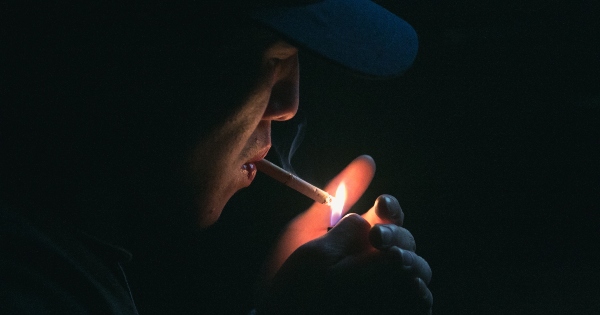
Their “FAQ’s” page answers some of the more detailed queries in a short form[17]. Their two-step program in the first part incorporates “worship services… bibles studies [sic]… and church services.” The program costs $100 (CAD) per day per resident. They do not permit “cigarettes, e-vapes, pipes, cigars, or any smoking…”

On medications, they state, “We do allow prescribed medications while you are in the program as long as they’re not addictive. Because Wagner Hills isn’t a medical facility, it is our policy to disallow anything that could cause harm to oneself or to others if it were to be abused. As such we don’t allow addictive medications even if prescribed by a doctor. These include, but are not limited to, narcotics, benzodiazepines, methadone, and suboxone.”

Even doctor visits, they must be done by submission of permission slips for the scheduling of an appointment time. Even with bail, probation, parole, or other legal issues, they help meet them where they’re situated. Those things banned include drugs, alcohol, cigarettes/pipes/cigars/e-cigs/vaporizers, weapons, drug paraphernalia, porn, and animals.

The interesting fine print is in the “Intake Guideline,” which states:

In order to maintain the highest degree of safety and respect for our residents, we have well-defined rules and guidelines. Potential clients must understand that violating any of the following guidelines may result in immediate discharge and prevention from future enrollment in the program. We reserve the right to refuse admission to the program if potential clients can not or refuse to adhere to the set rules and guidelines.

  • The use/and or possession of cigarettes, pornography and drugs, including alcohol, is strictly prohibited.
  • Threats or acts of violence against fellow residents and/or Wagner Hills employees are strictly prohibited.
  • Residents must medically be able to participate in the program both physically and mentally. The program requires one to be emotionally able to participate in counselling sessions, group sharing, and worship, and be committed to making healthy life changes.

Obviously, the presentation is fit for a Christian message within a Christian secular culture. One in which Christians dominate the current demographics of the area and Christianity has been the host colonial culture since 1867.

As such, its demeanour takes the distinctions of Genesis of man and woman seriously with the separation into Men’s Campus and Women’s Campus. It takes the Bible seriously with the bible studies as part of its program.

It takes a ministerial approach, as per the titling of a ministry and targeted objective of the creation of disciples. Its emphasis on worship as part of the program. In short, the entire approach is a faith-based collection of methodologies to move “beyond recovery to discipleship,” according to the brochure.[18] Which is all to state simply, it’s not about recovery inasmuch as it’s about, ultimately, gaining converts to Christianity.

Ultimately, their coercive and dubious aims are stipulated and made explicit in the separate website for Wagner Hills Ministries. They state the belief in God and the Bible more thoroughly and directly than in the Wagner Hill Farm Society web domain. “What we Believe”[19] states:

We believe in the Word of God as found in the Bible. This is to be the foundation for how we think, speak, and act.

God is our Creator, our Savior, and our Judge. He loves us and desires a relationship with us and wants to give us new, eternal life through Jesus Christ.

We all have intrinsic value and are worthy of respect. We all are self-aware, knowing our emotions, thoughts and actions. We all have a conscience and have a sense of right and wrong. We all have the ability and freedom to make personal choices and are responsible for those choices. Therefore, we all live with the consequences of our choices.

God intends for us to be relational. Our choices affect our relationship with God and with other people. So we are responsible for how our choices affect others as they relate to them (i.e. friends, family, etc).

Real and lasting change occurs when God changes our hearts and better choices become our lifestyle. We co-operate with God in changing our lives by obedience to His principles.

“Our Program Vision”[20] states:

At Wagner Hills we facilitate the making of disciples of Jesus Christ. This encompasses one’s whole life from the inside out, changing one’s perspective and belief system as well as lifestyle. Our vision is to raise up servants who have caught our heart in the values we hold and the ways in which we live and teach these values. We believe that men need a purpose for life and that God has given that purpose in Jesus’ commission to make disciples:

  • to teach and train all who come to go beyond recovery to know and follow Jesus in
  • a disciplined, committed life style
  • to raise up servants whose hearts are to serve in all areas of ministry
  • to train for outreach in a way that will model serving and relationships with an openness to spiritual gifts and power evangelism

The whole aim and emphasis are to convert people at the weakest points in their lives. The particularly unethical and immoral fundaments are laid bare in language seen as positive because of the valence given to the verbiage in Christian ministries and churches, and programs, in this country, particularly this municipality.

The idea of finding and bringing people into the fold who are struggling to the utmost and then “making… disciples of Jesus Christ” through the ploy of proposed recovery with worship services, bible study, and the like, is abhorrent and fundamentally vice-ridden.

A pig in a suit with a bowtie scented with inordinate amounts of cologne and walking along a path strewn in rose petals is still a pig. If you take a step back and reflect on it, then you can comprehend the despicable nature of it. Yet, it garners the social cachet of community service, social work, and Christian iconography and language. This is on the assumption that it works.

If the programs were effective, and if the money and professional resources went to real supports, then they would work towards fundamental shifts in the efforts towards evidence-based approaches, scientific methodologies, known to work better than faith-based programs.

By rejecting modern scientific counselling and therapeutic methodologies considered best practice with a preferred emphasis on bible study, worship, farm work, and ministerial activities, and coerced efforts to conform oneself to a Christian true believer, these can be considered positively framed forms of religious abuse, as in abusing people via religion.

It’s not taking sober, functional adults and making a case for the theology. It’s coercing and forcing this on individuals with no or few other options, who are desperate. The entire fiasco is infused in its media outreach with this too.

If the proposal for support or recovery comes with the basis for the construction of a new Christian personality, so as to make a disciple to evangelize, then this is taking people at the rock bottom of life and then utilizing this trauma and pain to shove religious ideology into their minds. 

The idea is “to teach and train all who come to go beyond recovery to know and follow Jesus”; is it not?

The emphasis is “to raise up servants whose hearts are to serve in all areas of ministry”; is it not?

The goal is “to train for outreach in a way that will model serving and relationships with an openness to spiritual gifts and power evangelism”; is it not?

If the idea is believing “in the Word of God as found in the Bible. This is to be the foundation for how we think, speak, and act,” then their image of Christ, the Word of God, and the Bible, is somewhat of an emotional-abuser-Messiah who only helps with the preferential option for conversion into disciples or a rose shown with the thorns hidden behind the handing hand.

It not focused on people as subjects. We’re seeing an emphasis on people as objects to round-up into disciples, as a new flock, over the course of a 1-year ‘recovery’/discipleship program. What about the fundamentals of the program? The idea of the program working for the individuals in it.

Their main foci are the testimonies of individuals who have gone through the program. Most of them of people who fell through the cracks of society. If our society and families were more functional, fewer of these individuals would be exploited for the purposes of discipleship of these programs. Testimonies are some of the weakest forms of evidence in the favour of a program, though widely considered in the reverse, colloquially.

There are a number of videos[21] – about 30 at the time of writing – with individuals who may have mental illness issues in personal history, as the first man from “Wagner Hills 2019.” The first man was sitting in a hotel and was broken down, found a Bible, and saw a list of organizations with Wagner Hills as the first on there. A desperate find for a man in desperate circumstances.

The second man had been stabbed in the Downtown of Hastings in Vancouver, or the broader Downtown Eastside of Vancouver. Well-known areas in the city with difficult life circumstances for many. The second man, with the backwards baseball cap, was calling out to God. Another desperate man looking for a way out in harrowing contexts.

The third man from the same video had been facing bankruptcy and was in bad straits with his son and daughter. He is trying to make well with his kids and finances and attributed this to God rather than his own overcoming of personal struggles.

“With God, I can finally have the appropriate relationship with my kids. I am walking around with the ultimate guidance. It is the most important thing that has ever happened to me. I feel like I am finally living a life of purpose…” the third man opined, “I feel like I’ve exchanged what I want to what I am meant for. What I am meant for is the joy God has for me. I found that here. Something about these hills. Something about the guys that come in and out. I feel like we’re farming the Spirit here.”

A further man who faced desperate personal environments, internal and external, and happened to find a lifeline and then attributed this to the divine. A fourth man claimed by the age of 12 to be a functioning alcoholic and addict, where the drugs and the other things used were worse.

“I thought my life was over by the age of 12. I was halfway on the road to East Hastings right before I got a text from Dustin saying, ‘Hey, I’ve been thinking about you. There have been a lot of people praying about you. I think you should come to Wagner Hills,’” the fourth man said. 

These four men profiled in the one video represent a series of men without meaning, in the gutter in their personal narrative, and looking for answers and hope in a moment of utter depression, anxiety, and likely suicidality. There is video after video like this one for Wagner Hills Farm Society, men and women.

All previous harsh commentary would match the commentary of the unethical and immoral foundations of the Wagner Hills Farm Society in spite of the soothing, unctuous guitar instrumentals playing in the background of so many of their videos.

Yet, we have to analyze these prospects rationally and scientifically. For example, do programs like reliance on worship, prayer, discipleship, ministry, and bible studies, help with the recovery from substance abuse?

We can look at the most widely analyzed one, Alcoholics Anonymous, which utilizes an originally Christian 12-Step Program with an emphasis on a Higher Power now. It is founded on the Big Book.

The Journal of the American Medical Association stated:

The book under review is a curious combination of organizing propaganda and religious exhortation. It is in no sense a scientific book, although it is introduced by a letter from a physician who claims to know some of the anonymous contributors who have been “cured” of addiction to alcohol and have joined together in an organization which would save other addicts by a kind of religious conversion. The book contains instructions as to how to intrigue the alcoholic addict into the acceptance of divine guidance in place of alcohol in terms strongly reminiscent of Dale Carnegie and the adherents of the Buchman (“Oxford”) movement. The one valid thing in the book is the recognition of the seriousness of addiction to alcohol. Other than this, the book has no scientific merit or interest.[22]

The only valid item is a recognition of addiction as a problem. Here’s the problem with faith-based recovery programs aside from the above concerns, they do not work and never have, by and large; thus, God is the failed hypothesis, once more.

As reported by National Public Radio in “With Sobering Science, Doctor Debunks 12-Step Recovery,” Dr. Lance Dodes, a psychiatrist, stated:

There is a large body of evidence now looking at AA success rate, and the success rate of AA is between 5 and 10 percent. Most people don’t seem to know that because it’s not widely publicized. … There are some studies that have claimed to show scientifically that AA is useful. These studies are riddled with scientific errors and they say no more than what we knew to begin with, which is that AA has probably the worst success rate in all of medicine.

It’s not only that AA has a 5 to 10 percent success rate; if it was successful and was neutral the rest of the time, we’d say OK. But it’s harmful to the 90 percent who don’t do well. And it’s harmful for several important reasons. One of them is that everyone believes that AA is the right treatment. AA is never wrong, according to AA. If you fail in AA, it’s you that’s failed…

…The reason that the 5 to 10 percent do well in AA actually doesn’t have to do with the 12 steps themselves; it has to do with the camaraderie. It’s a supportive organization with people who are on the whole kind to you, and it gives you a structure. Some people can make a lot of use of that. And to its credit, AA describes itself as a brotherhood rather than a treatment.[23]

So, the failure rate is 9 out of 10 to 19 out of 20. Probably, “The worst success rate in all of medicine.” That’s an astonishingly evidenced showing of the failure of concept of the 12-Step Programs and AA. The ‘God’ filling the gaps is in community, not in God.

People collectively are the God that they were looking for the whole time. Then when it fails, they blame this on the individual addict in recovery. When it succeeds, they can use these as the testimonies for the individuals within the program as a proof of concept to the general public (See above transcriptions or their videos online on YouTube).

You can see the videos, and the like, of Wagner Hills Farm Society. So, it’s not only unethical and immoral. The basis of many of these programs in a Higher Power or giving oneself to a Higher Power doesn’t work, factually known to fail.

Thusly, AA programs, as an analogical comparison, sets a standard of strong failure for decades while Wagner Hills Farm Society and AA set the same standard of immoral and unethical behaviour of taking advantage of the vulnerable for enforcing and coercing religion onto addicts who want to get well.

Even further, Hemant Mehta, of The Friendly Atheist, in “British Columbia Legislator Says Prayer Can Help “People With All Kinds of Disorders”” stated:

In British Columbia, however, many treatment centers only recommend AA to alcoholics. The government’s own health information website also endorses AA. That’s a problem if you’re someone who either wants secular alternatives or prefers programs that operate based on the best available scientific evidence.[24]

It seems as if religious individuals, ideologies, and institutions have set forth an integrated network of programs with extreme failure rates, unethical and immoral coercion of addicts for ministry purposes or religious evangelizing to make disciples, and then closed off the system referrals to keep addicts only within these faith-based programs.

Addicts are being abused by religious ideology here. It’s disgusting, despicable, not laudable, and damaging to the reputations of ordinary religious people, the lives of addicts, the emotional well-being of family members of addicts with seeing the revolving door, and wasting resources and time on programs without solid empirical evidence in support of them.

Ironically, Wagner Hills Ministries evades evidence-based answers, e.g., the addict is now a former addict after the program and has been for 1 month, 1 year, 5 years, 10+ years. Instead, they speak in deliberately vague evangelistic non-sense patois in “How Do We Measure Success?”:

The truest success benefits of our faith based treatment program cannot be measured by simple metrics. We believe that true spiritual change comes from a relationship with Jesus Christ. Because of this, we are witness daily to men and women transforming their lives, while mending and restoring broken relationships. We focus on rebuilding self-esteem and confidence, giving each individual an increased sense of dignity and value.

Beyond addiction, many of our residents arrive dealing with anxiety, depression, emptiness, and unfulfilled. We help them make the positive steps towards changing their lives.

In our ongoing counselling, training, work programs and an active relationship with God, a person develops deeper meaning and purpose. This helps lead them to walk a path of truth and integrity, to regain trust and respect in their lives. Many give their lives to the Lord.

This proven step by step approach increases wellness, developing a physical, psychological, social and spiritual balance. The aftercare support includes ongoing accountability, mentorship and fellowship. We promote helping others and volunteering at community events. Many of our graduates go on to living improved lives and are no longer a burden to society, they become contributing members to their community.
[25]

Here would be a simple and science-based response, “Our programs work at these rates, under these conditions, for these demographics, for these substances, for this range of conditions, and for this period of time on average,” rather than a long-winded harangue about finding and giving “their lives to the Lord.”

Yet, Wagner Hills Farm Society/Wagner Hills Ministries has endorsements, at one time or another, from prominent members of our municipal history, including Mark Warawa (former Langley Member of Parliament), Jordan Bateman (former Councilor, Township of Langley), H. Peter Fassbender (former Mayor, City of Langley), Kurt Alberts (former Mayor, Township of Langley), and Bob L. Friesen (Sales Manager, BC Christian News, The Shepherd’s Guide).[26]

Have these individuals considered stripping personal support or endorsement for these programs from their professional legacy?

While, at the same time, other secular evidenced-programs exist to provide proper care for individuals. Nonetheless, these programs exist and will provide marginal help to some and mostly dubious assistance to others.

Therefore, if individuals need help, they will have to be on their guard and proactive in finding evidence-based, secular, or evidence-based secular, alternatives in the Township of Langley and beyond.

If someone you know is or you are struggling with addiction, please see these alternatives (hyperlinks active):

Footnotes

[1] “About Wagner Hills” states:

Our program exists to provide rehabilitative care to people in addiction. It is a faith-based, non-smoking community living experience on a working farm. We use classroom learning and one-on-one mentoring to teach tools for healthy relationships which residents can then practice applying in daily life at the farm. The growth that our residents gain in these skills while in the Wagner Hills community prepares them for a successful life beyond the program. The program length is a one year commitment, with intake happening on a continual basis.

See Wagner Hills (2021a).

[2] See Ibid.

[3] See Wagner Hills Farm Society (2021b).

[4] “Board of Directors” states:

Kris Sledding is the husband to Rachel and father to Cassie and Ethan. Kris is a 12-year municipal police officer with a rich history of experience in the church community at all levels including pastoral service and board involvement. Kris has been directly involved as a board member with Wagner Hills since 2013), when he was introduced to the “Farmily” through Jason, who was just starting out in his role as Executive Director. Over the years, the experience of being proactively involved in Gods restoration of broken lives-rather then caught up in the reactive, fruitless human cycle of judicial system failure and moral emptiness that plague our society in a growing way-continues to provide Kris with a strong sense of fulfillment and purpose.

See Wagner Hills Farm Society (2021c).

[5] Dan Ashton is a self-employed mortgage and real estate broker.

[6] Pastor Curtis Boehm is part of the Lutheran Church Canada.

[7] Allen Schellenberger is part of the Lutheran Church Canada Financial Ministries.

[8] Kim Ironmonger is the Board Treasurer and is part of Northcrest Community Care.

[9] Lanson Foster is part of Lanstone Homes Ltd.

[10] See Wagner Hills Farm Society (2021d).

[11] See Wagner Hills Farm Society (2021e).

[12] “Executive Leadership, Central, Elder Team” states:

Mark grew up in Toronto and moved to Vancouver in 2004 to attend Regent College, where he received a Master of New Testament Studies. Following over ten years of ministry, Mark, along with his wife Erin and an amazing team of people, planted Village Church in January 2010, which has now grown to a vibrant multi-site church in the Greater Vancouver Area and Calgary. He is passionate about contextualizing the gospel, teaching the Bible, seeing people transformed by Jesus, planting churches, and seeing the gospel advance across Canada. Mark resides in South Surrey with his wife and their three daughters. He is honoured and excited to lead Village Church wherever God calls it to go.

See Village Church (2021).

[13] Some of the controversies have involved prominent Kwelexwelsten, Kwantlen First Nation artist Brandon Gabriel (Brandon Gabriel-Kwelexwecten), former Township of Langley Cllr. (2014-2018) and owner of Well Seasoned gourmet foods inc. (2004-) Angie Quaale, and some others, with mixed evaluations of the outcomes of each controversy from various parties within the Township of Langley and the National Historic Site Fort Langley. See Claxton (2021), Claxton (2020), and Claxton (2019).

[14] The current Board of Directors includes Barry Dashner (Chair), Catherine Cook (Director), Frank Cox (Director), Kelly Holmes (Director), Shona DeGuzman (Director), Maureen Rose (Director), Rob Rose (Director), and Eric Woodward (Secretary). Previous directors have included Tom Kirstein (former Board Chair) who is a former Mayor of White Rock and Gareth Abreo who is a former President of the Fort Langley Business Improvement Association. The Fort Langley Business Improvement Association current Board of Directors includes Lisa Smit (President), Lindsay Aplas (Vice-President), Meghan Neufeld (Treasurer), Christine Burdeniuk (Secretary), Anita Bisset (Director), and Paul Wood (Director). Although, according to some recent reportage, the Fort Langley Business Improvement Association (FLBIA) has its management taken over by the Eric Woodward Foundation. See Eric Woodward Foundation (2021) and Uytdewilligen (2020).

[15] Previous research and reportage in “Freethought for the Small Towns: Case Study” listed the churches in this locale as “Fort Langley Evangelical Free Church, Living Waters Church, Fraser Point Church – Meeting Place, St George’s Anglican Church, United Churches of Langley – St. Andrew’s Chapel, Vineyard Christian Fellowship, Fraser Point Church Offices, Jubilee Church, and Fellowship Pacific.” See Jacobsen (2020).

Fort Langley Evangelical Free Church’s staff includes Jason Lavergne (Lead Pastor), Erwin Van Ramhorst (Associate Pastor of Youth and Young Adults), Brittany Martin (Coordinator of Worship Ministries), Mary Ann Dance (Children’s Ministry Assistant), and Alana Hall (Office Administrator). See Fort Langley Evangelical Free Church (2021).

The Leadership Council is comprised of Kirsten Anonby (pastoral team), Ryan Bedwell (pastoral team), Heather Currie, Dave Dirks, Carina Drisner, Luke Knight (pastoral team), Jennifer Obrecht, Dave Solmes (pastoral team), Jonathan Withers, and Treasurer: David Knight. The Staff is comprised of Kirsten Anonby (Associate Pastor), Ryan Bedwell (Associate Pastor), Kyle Epp (Pastor), Lynn Gettel (Office Administrator), Dee-Ana Goodman (Pastor, Children’s Ministries), Luke Knight (Associate Pastor), Reuben Kramer (Pastor), Rebeca Monzo (Pator, Youth Network), Ethan Newman (Preteens Director), Harold Sawatzky (Pastor), Rachel Schock (Pastor), Carol Slusar (Children’s Ministry Assistant), Doug Smith (Pastor), Dave Solmes (Lead Pastor), Ricky Stephen (Pastor), Mike Vater (Executive Pastor), and Rob Wilson (Media Production Director). See Living Waters Church (2021a) and Living Waters Church (2021b).

Fraser Point Church – Meeting Place doesn’t appear to have immediate listing of the staff or leadership. Lead Pastor may be Tyson Kliem.

St. George’s Anglican Church’s leadership is The Reverend Kelly Duncan (Priest), The Reverend Eileen Nurse (Deacon), The Reverend Karen Saunders (Deacon), Dodi Mesenchuk (Parish Administrator), Andre Erasmus (Organist), David Jordan (People’s Warden), and Fran Hancock (Rector’s Warden). See St George’s Anglican Church (2021).

The United Churches of Langley – St. Andrew’s Chapel Congregational Leadership includes Tom Louie (Chair of the Board), Eilleen Anderson (Vice Chair of the Board), Sylvia Mountain (Past Chair of the Board), Maureen Burgess (Secretary of the Board), William Ness (Treasurer), Stacey Jordan-Knox (Chair of the Ministry & Personnel Committee), Lynda Christensen (UCW Representative, Member at Large), Kellie Warnock (Member at Large), Chandra Carlson (Pacific Mountain Region Representative), Marianne Clark (Pacific Mountain Region Representative), and Doug Perkins (Pacific Mountain Region Representative). Its Team includes Rev. M. Sophia Ducey (Co-Minister with focus on <50 year old Adults, Families, Children, Youth, and Communications), Rev. Ryan Tristin Chapman (Co-Minister with focus on >50 year old Adult Faith, Pastoral Care and Outreach), Nigel Chuah (Social Justice Program Facilitator), Linda Szentes (Music Leader – Musician), Tim Bailey (Music Leader – Choir), Joanne Sommer-Miller (Pianist), Jovana Ivanovic (Office Co-ordinator), Sherry Klassen (Finance Administrator), Deanna Feuer (Youth Facilitator), Sarah Veltman (Senior Youth Leader), and Carley Carder (Facilitator – Ministry of Children, Youth and Families). See United Churches of Langley (2021a) and United Churches of Langley (2021b).

Vineyard Christian Fellowship’s leadership includes Leili & Patti White (Lead Pastor/Elder), David Klingensmith (Elder), Mike Rempel (Elder/Board Member – Chairman), Shane Blackmon (Board Member – Treasurer), Lori Ward (Board Member – Secretary), Colin Barrett (Board Member – Director), and Barry Cox (Board Member – Director). See Vineyard Christian Fellowship (2021).

Fellowship Pacific’s Team includes David Horita (Regional Director, Krista Penner (Team Leader), Dan Cody (Team Leader), Todd Chapman, Elizabeth Faulkner, Colette Bullock, Mike Mawhorter, Allison Weber, Doug Fordham, and Jessica Powell. Its Board of Directors is comprised of Brent Chapman (President of SouthRidge Fellowship Church, Langley), Jeremy Johnson (of Village Church, Surrey), Barton Priebe (of Central Baptist Church, Victoria), Larry Lagerstrom (of Redemption Community Church, Surrey), Brian Joyce (of Chaplain, Prince George Youth Custody Center), Buffy Paul (of Village Church, Surrey), Janet Bolvin (of South Delta Baptist Church, Delta), Jeremy Norton (of Mountainview Church, Whitehorse), Kelly Nicolls (of Princeton Fellowship Baptist Church, Princeton), and Rick Burdett (of Outreach Canada). See Fellowship Pacific (2021).

[16] “Municipal Case Study: British Columbia and Permissive Tax Exemptions” states:

The male pastoral leadership (by title of “pastor” or “elder,” youth, children, and administration left to the women) comes from Elder Nathan Sawatzky, Elder Brent Muxlow, Elder Pete Jansen, Lead Pastor Brent Smith, Assistant Pastor Randy Dyck, Assistant Pastor Rob Lee, and Youth Pastor Cole Smith.

See Jacobsen (2021).

[17] See Wagner Hills Farm Society (2021f).

[18] See Wagner Hills Farm Society (2021g).

[19] See Wagner Hills Ministries (2021a).

[20] See Ibid.

[21] There are about 30 videos listed on their YouTube channel at this time: “Merry Christmas from Women’s Campus 2017,” “Jason and Tony,” “Stephanie,” “Stelle,” “Jason Roberts + Dawn Bralovich,” “Ellie,” “Teira,” “WH Men’s Campus,” “Ryan,” “WH Jason Christmas 2017 01,” “WH Giving Tuesday 2017 02,” “IMG 3899 MOV,” “Wagner Hills Farm,” “Wagner Hills Building Renovation Donation Appeal,” “A Christmas Message to Alumni 2015/16,” “Christmas Donation Appeal – Wagner Hills Farms,” “Wagner Hills Matching Donation Announcement,” “Support the Jones Family,” “Recovery Day – Wagner Hills Farm Society,” “Peter’s Testimony,” “Allan’s Story,” “Judd’s Story,” “Solid Rock Steel Supports Wagner Hills,” “Introducing ’44 for Freedom’ program,” “Meet Marty from Wagner Hills Ministries – Personal Testimony,” “Meet Justin from Wagner Hills Ministries,” “Wagner Hills – Christian Rehabilitation Center in Langley,” “Christian Rehab Recovery in Langley,” and “Testimonies for Wagner Hills Ministries – Christian Rehabilitation Center Langley.”

[22] See RationalWiki (2020, December 11).

[23] See National Public Radio (2014).

[24] See Mehta (2016).

[25] See Wagner Hills Ministries (2021c).

[26] See Wagner Hills Ministries. (2021b).

References

Claxton, M. (2019, September 4). Current Langley councillor demands apology from former councillor. Retrieved from https://www.aldergrovestar.com/news/current-langley-councillor-demands-apology-from-former-councillor/.

Claxton, M. (2020, January 23). Lawyers argue over truth of “threat” in Langley lawsuit filings. Retrieved from https://www.aldergrovestar.com/news/lawyers-argue-over-truth-of-threat-in-langley-lawsuit-filings/.

Claxton, M. (2021, January 8). Mayor, councillors win court decision and stay in office in Langley Township. Retrieved from https://www.aldergrovestar.com/news/mayor-councillors-win-court-decision-and-stay-in-office-in-langley-township/?fbclid=IwAR2IeRdIMgBTt3qoTZFGJ3Vd_J_eQe20PaUlZWyg-fOfWiAA3iFmujNxhCw.

Eric Woodward Foundation. (2021). Board of Directors. Retrieved from https://www.ericwoodwardfoundation.org/board.

Fellowship Pacific. (2021). The Team & Fellowship Pacific Board Members. Retrieved from https://www.febpacific.ca/the-team.

Ferguson, D. (2021, January 5). Langley church leaders sign letter to ‘fully support’ Dr. Bonnie Henry. Retrieved from https://www.aldergrovestar.com/news/langley-church-leaders-among-group-of-38-who-sign-letter-to-fully-support-dr-bonnie-henry-and-health-minister-adrian-dix/.

Fort Langley Evangelical Free Church. (2021). Staff. Retrieved from https://www.flefc.org/staff.

Jacobsen, S.D. (2020, May 16). Freethought for the Small Towns: Case Study. Retrieved from newsintervention.com/freethought-jacobsen/.

Jacobsen, S.D. (2021, January 26). Municipal Case Study: British Columbia and Permissive Tax Exemptions. Retrieved from https://newsintervention.com/municipal-case-study-british-columbia-and-permissive-tax-exemptions/.

Living Waters Church. (2021a). Leadership Council. Retrieved from https://www.lwchurch.ca/about/leadership-council.

Living Waters Church. (2021b). Pastoral Team. Retrieved from https://www.lwchurch.ca/team.

Mehta, M. (2016, July 14). British Columbia Legislator Says Prayer Can Help “People With All Kinds of Disorders”. Retrieved from https://friendlyatheist.patheos.com/2016/07/14/british-columbia-legislator-says-prayer-can-help-people-with-all-kinds-of-disorders/.

National Public Radio. (2014, March 23). With Sobering Science, Doctor Debunks 12-Step Recovery. Retrieved from https://www.npr.org/2014/03/23/291405829/with-sobering-science-doctor-debunks-12-step-recovery.

RationalWiki. (2020, December 11). Alcoholics Anonymous. Retrieved from https://rationalwiki.org/wiki/Alcoholics_Anonymous.

St George’s Anglican Church. (2021). Parish of St. George. Retrieved from https://stgeorgeanglican.ca.

United Churches of Langley. (2021a). Congregational Leaders. Retrieved from https://unitedchurchesoflangley.ca/about-us/pages/ministry-leaders.

Uytdewilligen, R. (2020, September 24). Eric Woodward Foundation takes over management of Fort Langley Cranberry Festival. Retrieved from https://www.aldergrovestar.com/community/eric-woodward-foundation-takes-over-management-of-fort-langley-cranberry-festival/.

Village Church. (2021a). Executive Leadership, Central, Elder Team. Retrieved from https://thisisvillagechurch.com/people/mark-clark/.

Vineyard Christian Fellowship. (2021). Our Leadership. Retrieved from https://www.langleyvineyard.com/leadership.

Wagner Hills Ministries. (2021b). Endorsements. Retrieved from https://wagnerhills.com/about/endorsements/index.php.

Wagner Hills Ministries. (2021c). How Do We Measure Success?. Retrieved from https://wagnerhills.com/about/how-do-we-measure-success/index.php.

Wagner Hills Ministries. (2021a). Mission Statement. Retrieved from https://wagnerhills.com/about/mission-statement/index.php.

Wagner Hills Farm Society. (2021a). About Wagner Hills. Retrieved from https://wagnerhills.com/about-wh/.

Wagner Hills Farm Society. (2021c). Board of Directors. Retrieved from https://wagnerhills.com/board-of-directors/.

Wagner Hills Farm Society. (2021g). Brochure Outside. Retrieved from www.wagnerhills.com/BrochureOutsidePage%20Copy.pdf.

Wagner Hills Farm Society. (2021e). Cheering Section. Retrieved from https://wagnerhills.com/cheering-section/.

Wagner Hills Farm Society. (2021h). Covid-19 Response. Retrieved from https://wagnerhills.com/covid-19-response/.

Wagner Hills Farm Society. (2021f). FAQ’s. Retrieved from https://wagnerhills.com/admission-faqs/.

Wagner Hills Farm Society. (2021d). History of Wagner Hills. Retrieved from https://wagnerhills.com/history-of-wh/.

Wagner Hills Farm Society. (2021b). Our Mission. Retrieved from https://wagnerhills.com/our-mission/.

Photo by kychan on Unsplash

Famer unrest reveals the ulterior ambition of political outfits

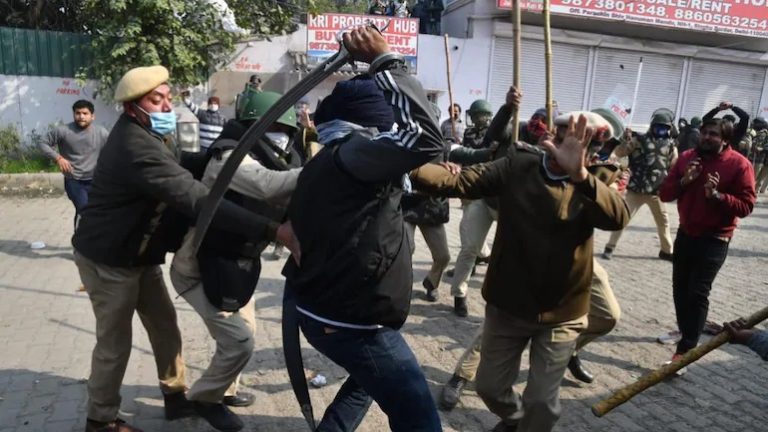
It is rather difficult to believe that farmers were incensed with the new agricultural laws enacted by the Parliament. There was a time gap between the enactment of the law and their tractor march to Delhi. A recount of the entire narrative convinces us that the real actors were not the farmers but certain people with a vested interest. The movement was preceded by a stupendous disinformation campaign to create doubts and confusion in the minds of the farmers. The intentions of the government in bringing in the agrarian reforms bill were labelled as false and anti-farmers. The gullible farmers were taken in.

We have a democratic government elected by a majority vote in the parliament. It is the manifesto that makes or unmakes the fate of a contesting party. Usually, the mainstream political parties go by their long-range political agenda that caters to the needs of the voters. India is an agricultural country and the maximum of her populations lives in villages. There is absolutely no logic in arguing that the government is enacting laws that go against the interest of the farmers, who are the village dwellers mostly.

It is unfortunate that after seven long decades of democratic dispensation, our voters would not listen and become reconciled to what their elected government and the elected ministers including the prime minister says about the new land reforms. On the other hand, they succumbed to the claptrap of a handful of loud-mouthed people who sadistically paint the elected government and its ministers in black. Why do they want to do so? The answer is simple. They have not been able to win the vote of the masses of people and have lost power. A true democrat will accept the verdict of the people without any grudge. A false and phoney democrat will fall prey to rancour and jealousy.

The Sikh for Justice named organization has claimed responsibility for unleashing mayhem on the Republic Day. The organization wants to take credit for disrupting peace and normalcy. The leaders of the farmers had given an undertaking that the tractor rally would be disciplined and will follow the route prescribed by the Delhi police. What it did was the reverse of all commitments. The tractor rally had been hijacked.

The Khalistanis, Indian Left and opposition parties led by the Congress jointly hijacked the entire movement leaving the poor and innocent farmer bewildered and guessing what was happening. The attempt of the protestors to disrespect the historic Red Fort and indulge in vandalism has been condemned by entire India and termed as an anti-national act. We know some elements instigate sectarian and ethnic violence at the behest of our enemies and they want to break India.

The villagers of nearly three score villages close to the Singhu border have warned the protesters to vacate the land where they have pitched tents saying that their free movement is obstructed. If good sense does not prevail, group clashes could be the sequel.

The entire episode explains some harsh social and political realities.  Although we have entered the 73rd year of democracy yet our stereotype mindset has not changed much. The onus of this discrepancy in our society comes to the doorsteps of our political leadership.

Political leaders have to give a proper lead to the people and provide them with an opportunity for maximum utilization of creative faculty. But the reality is that they use the mobs to bring pressure on the governing authority at various levels to accede to their agenda of vested interests. If our democracy has to succeed, there has to be a massive campaign for political education for every Indian voter about the importance of making the judicious use of his or her precious vote.

Secondly, some say that Indian democracy has become too permissive and accommodative. In other words, the political leadership in this country has become intolerably assertive and wants to manage things according to their wishes even by subverting the established rules and norms of the business. This is being done in two ways. One is to intimidate the administrative functionaries and force it to go along the dotted line. The other is to make a compromise with the situation. In the case of Indian democracy, both ways are tried though the latter one, promising least resistance, has become the order of the day.  This has given rises to endemic corruption, bribery and nepotism.

Indian Constitution is one of the few constitutions that do not stipulate any formal educational qualification for a candidate opting to fight the election and getting elected as a legislator. The permission for fighting election without any formal education was given at the time of framing the constitution when the rate of literacy in the country was hardly 30 per cent. Apart from formal education, there have to be other conditions/criteria which any candidate fighting the legislative or parliamentary election must be asked to fulfil. Mr Seshan, the former Chief Election Commissioner of India once said that 60 per cent of the members of the Parliament have a criminal record. The situation may not be better today, although the literacy level is more than double. The worst is that despite clear punitive rules governing the case of lawmakers with a criminal record, the rules are seldom enforced. Therefore, the important task before the Indian state is that a strict code of discipline has to be proposed which must be enforced in every case when candidates fill their nomination forms.

The argument that the Indian voter has matured and has a good sense of voting for the right candidate hardly stands the test of the time. Candidates campaigning for election will always make tall promises to their voters like a regular supply of drinking water and electric power to the constituency or road or link road whatsoever. But no candidate will tell them that if elected he will be trying to make them conversant with their rights and duties. We need constitutional provision that every elected candidate is bound to educate his voters on the significance of democratic dispensation, collective decision and respect for the majority vote.

In the context of farmers’ agitation, we have noted that it began first in Punjab where the farmers sat on railway lines to block rail traffic. It is rather superfluous to imagine that Punjab Chief Minister subtly wanted the farmers to move to Delhi as good riddance. Captain Amrinder Singh has fought the election on Congress ticket but he did not take dictation from the Congress High Command. Therefore, to say that he pursued the agenda of the Congress High Command cannot be substantiated. But the role he was expected to play as a nationalist and a patriot was in deficit. He knew that the Khalistanis would hijack the protesting rally and if that happened, Punjab would be face to face with a very unpleasant situation. Perhaps he miscalculated the possible turn this dangerous event would take. The result is that while the Delhi rally has almost ended in a fiasco, Punjab is bearing the brunt. The reports are that hundreds of communication towers raised by the Reliance have been pulled down and damaged by the rowdy crowds under the influence of Leftists and Khalistanis. In this matter, Punjab is going the Nandigram way in West Bengal.

The protest rally of the farmers is an eye-opener for those who fail to understand the ulterior motives of the politicians and ideologues with vested interests or with a false and fallacious ideology to keep them in the news. India must wake up and identify the anti-national elements and isolate them.

Balochistan pays tribute to Dr Mannan Baloch on his martyrdom day

Martyr Dr Mannan Baloch (former Central Secretary General Baloch National Movement) was a great personality. He struggled day and night for the sake of our motherland– Balochistan, to free her from occupying Pakistan. Dr Mannan Baloch was a bold warrior who never kneeled throughout his life. He fought enemies with a brave face and with a fearless heart. Dr Mannan looked upon nation’s pain as his own pain and struggled against the injustices and troubles which are barriers against an independent Balochistan.

Dr Mannan Baloch was a real leader of the Baloch nation who was always ready to sacrifice his life for the betterment of Balochistan. Baba Mannan Jan’s political career was so much effective and impressive that not only we (the family members) but everyone throughout Balochistan loved Baba Mannan as much as they could.

Dr Manan Baloch had faced a lot of trouble and difficulties during his life and yet he always faced these problems with a beautiful smiling face. He treated everyone with a smiling face.

Martyr Dr Manan left all his luxuries and facilities, including his government job (of a doctor) and involved himself with the struggle for freedom and independence of Balochistan.

Shaheed Baba Dr Mannan Jan was an effective leader, due to his better and effective strategies his enemies always felt insecure. That’s why, they tried to shoot him using different types of tactics, and yet they remained unsuccessful for a long time.

https://twitter.com/DAN__Baloch/status/1355185625209704448
Dr Allah Nazar Baloch pays tribute to Martyr Dr Mannan Baloch

Dr Mannan thought not only about his family, but for the whole nation.

However, the enemies of Baloch nation did manage to attack him and shoot him on head along with four other members of Baloch National Movement (BNM). Sajid (Bachuk Jan), Ashraf, Haneef, Baboo Noroz were martyred at Mastung on 30th of January 2016 early in the morning before Sunrise.

It was such a great loss for Baloch nation, but Balochistan knows his great ideology and so his ideology will always survive amongst us until this world exists.

The best way to pay tributes to such a loving leader like Dr Manan Baloch is to follow his footsteps and imbibe his ideology of an independent Balochistan from Pakistani occupation. Today I pay him my rich tributes.

https://twitter.com/AN_Baluch/status/1355237981360185352

I can proudly say that Shaheed Baba is still alive in our hearts, in our thoughts and in our expressions. We will never forget him and never leave his ideology behind. We will struggle, we will resist and we will fight against Pakistani State for an independent Balochistan.

BNM urges Balochistan to commemorate Dr Mannan’s martyrdom

Central Spokesperson of the Baloch National Movement (BNM) has directed all BNM zones to hold programs and pay homage to Dr. Mannan Baloch and his associates on their fifth martyrdom anniversary on January 30.

The BNM Spokesperson said that Dr. Mannan Baloch was an intelligent politician, Baloch intellectual and a leader who had command on world politics. It takes centuries to fill the void left by his martyrdom. Dr Mannan and other comrades were martyred by the Pakistan Army on January 30, 2016 in the house of a BNM member at Mastung in occupied Balochistan. Dr Mannan Baloch was on an organizational visit at Mastung when he was attacked by the Pakistan Army.

Dr Mannan was martyred along with well known writers Babu Nauroz, Ashraf Baloch, and his brother Haneef Baloch and Sajid Baloch in the guest house of senior BNM member Ashraf Baloch in Mastung.

“All zones should hold programs and events on Dr Mannan Baloch’s martyrdom anniversary, highlight the services and teachings of the Baloch national leader and Pakistani barbarism. In this regard, an online program will also be held at the central level,” said the BNM Spokesperson.

Balochistan: Where Even the Dead are ‘Abducted’

The news of Pakistani authorities taking away mortal remains of a deceased Baloch lady dissident living in self-exile abroad that had been brought back to her native place for burial may scandalise many, but not the people of Balochistan. Growing up seeing how innocent people who are brazenly abducted by Pakistani security forces either disappearing for good or resurfacing as battered corpses dumped by roadsides or buried in unmarked graves has inured them to tragedies of all sorts. So, being persecuted by the state and abandoned by the international community, for Balochis, there’s nothing unusual about the corpse of one of their own being ‘abducted’ by Pakistan’s security forces!

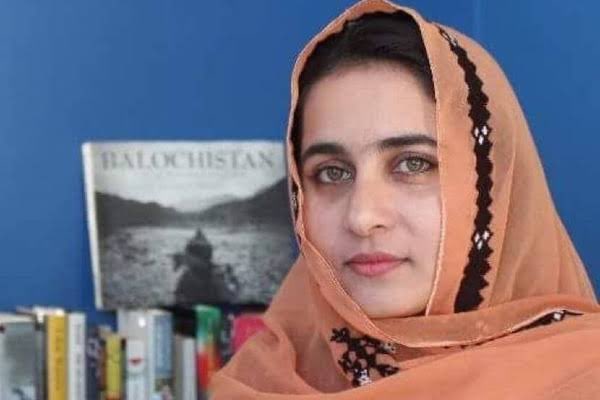
The ‘abducted’ corpse was that of Karima Baloch and this incident is the latest manifestation of Pakistan’s institutionalised persecution of Balochis. Resident of Tump in Kech district of Balochistan, 37-year-old Karmia Baloch was a vocal critic of Pakistan Army’s repulsive “abduct, kill and dump” policy in Balochistan. Though a peaceful campaigner, she was forced into self-exile in 2015, after authorities filed fabricated terrorism charges against her. After moving to Canada, Karima Baloch continued her campaign against the brutal and illegal methods being used by Pakistani security forces to intimidate Balochis.

Karima’s death aroused suspicions for more than one reason. Firstly, though she had drowned, there was no reason for this strong-willed activist to have committed suicide; nor was she so immature as to indulge in any puerile act of bravado that could result in accidental drowning. Secondly, by tweeting that it was “aware of heightened community and media interest surrounding a missing person [Karima Baloch] investigation,” Toronto Police Service has unwittingly admitted that there were reasonable grounds to suspect foul play-because if it was an accidental death or suicide, there wouldn’t have been any “heightened community and media interest” in this case.

However, Toronto Police arriving at the conclusion that it was “a non-criminal death” and that “no foul play is suspected” within just a few hours of Karima’s dead body being discovered, clearly indicates an inexplicable haste to ‘close’ the case. Moreover, since “non-criminal” death per se implies that “no foul play is suspected,” where was the need for Toronto Police to take the trouble of repeating the obvious?

Baloch icon Karima Baloch.

Karima’s name being included in BBC’s 2016 list of ‘100 most inspirational women’ clearly indicates that her voice against Pakistan Army’s oppression in Balochistan resonated across the globe. To make matters even more embarrassing for both Islamabad and Rawalpindi, Karima had in 2016, sent a message to Pakistani establishment’s latest bete noire Indian Prime Minister Narendra Modi saying, “We appeal to you that as our brother, you speak about the genocide and war crimes in Balochistan on international forums and become the voice of the sisters of Baloch. We will fight this on our own, we just want you to become the voice of our struggle.” 

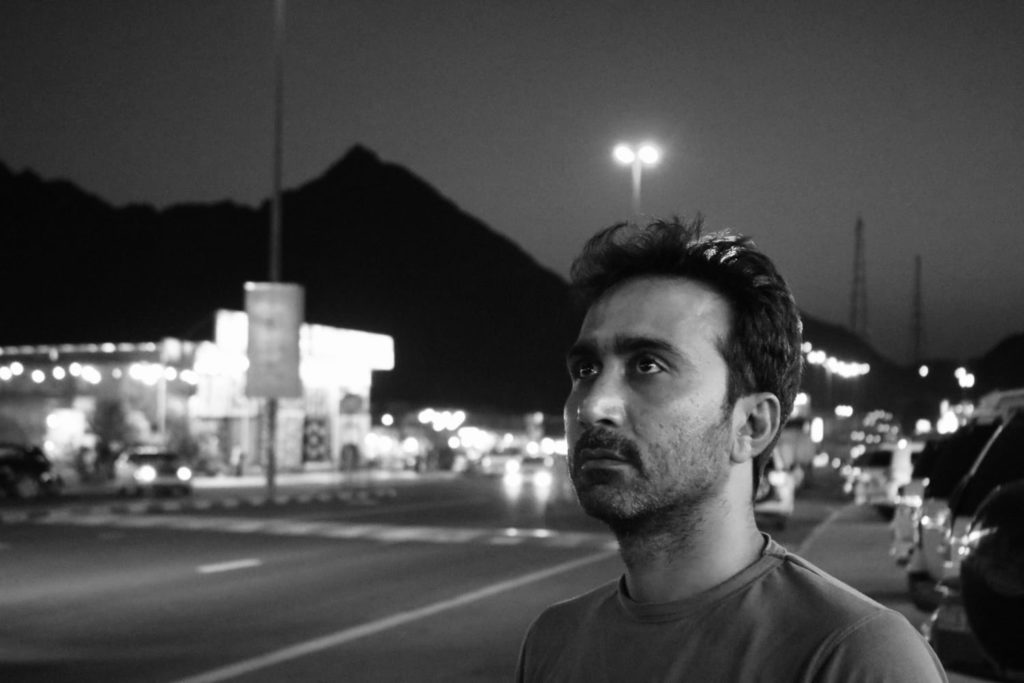
So, one doesn’t have to be Sherlock Holmes to deduce that those being pilloried by Karima Baloch would like her voice to be silenced. Ottawa would have certainly been aware of her increased vulnerability, especially after the dead body of another Balochi dissident journalist named Sajid Hussain living in self-exile in Sweden was fished out of a canal in April 2020, but surprisingly, no security was provided to Karima. So, could the overplay of words by Toronto Police to emphatically rule out foul play in Karima’s death be indicative of an attempt at concealing Ottawa’s humungous failure to protect the life of a dissident, who after fleeing her homeland to escape political persecution and possible extermination, was sanguine that she would be safe in Canada?

Sajid Hussain, Chief Editor Balochistan Times was found dead at a river side in Uppsala, Sweden On April 30. He had been missing since March 2, from Uppsala.

Changing tracks, let’s for the sake of discussion accept verdict of Toronto Police that there was no foul play in Karima’s death. So, if it was really a case of a suicide or an accident, then what explains the edgy behaviour of Pakistani authorities in not allowing relatives of Karima to receive her mortal remains at Karachi airport? Why was her body initially taken away in an ambulance duly escorted by Pakistan Army vehicles and thereafter returned to her relatives hours later? Lastly, if there was really no involvement of Pakistan’s deep state in her death, then why was curfew imposed in her home town and mobile services snapped for the duration of her funeral?

The case of Sajid Hussain and Karima Baloch have many similarities. Firstly, both victims were vocal critics of ongoing extra judicial killings and human rights violations by Pakistani security forces in Balochistan. Secondly, both were falsely framed on terrorism related charges, forcing them to flee Balochistan and seek asylum abroad. Thirdly, while in self-imposed exile, both continued exposing Pakistan Army’s excesses in Balochistan. Fourthly, both refused to be cowed down by threats and ended up dying by drowning [?]. Fifthly, both ‘drowned’ when they were alone and what’s even more surprising is that there were no eyewitnesses!

Lastly [and most importantly], while the police categorically ruled out foul play in both cases, it failed to give any convincing reasons to substantiate the suicide or accident theories! So, if either or both the deceased had decided to commit suicide, then why did they take the trouble to go into the countryside to end their lives? Next, if both were unfortunate victims of an accident, then what explains Sajid going picnicking to a canal when he had gone to Upsala for picking up keys of his new apartment in which he was due to shift shortly alongwith his wife? Similarly, how could Karima Baloch ‘accidentally’ drown in waist-deep water and that too at a place she regularly frequented, especially as this spot has security railings to prevent any accidental fall into the water?

Too many questions remain unanswered, but thanks to Toronto Police having determined that Karima Baloch’s death was “non-criminal” and that “no foul play is suspected,” one can sleep blissfully without suffering pangs of a guilt-ridden conscience!

World must speak against Pak brutalities in Balochistan

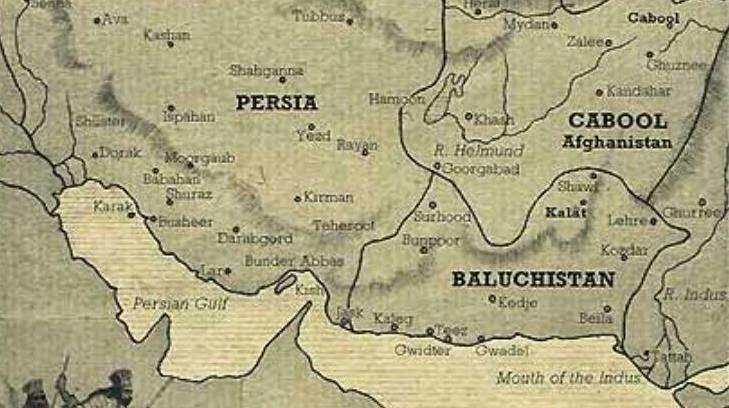
Historically, Balochistan has been an independent, sovereign and a free state for nearly three hundred years. It was also a paradise for invaders coming from outside like Asia, Persia and Arabia. All of them invaded Balochistan because of it being so resourceful. But every invader who tried to capture had to face outrageous battles by Balochistan’s brave and confident inhabitants protecting their nation from foreign powers.

One such striking example is that of Mir Mehrab Khan who sacrificed his life along with 250 rebels against the military movement launched by British on 13 November 1839. Another similar instance can be traced where Mir Naseer Khan didn’t let his quenching desire of independent Balochistan to succumb against another skirmish by Ahmed Shah Durrani during his exemplary reign among Khans of Kalat.

Generally speaking, the Khanate of Kalat was recognized as an independent and sovereign state through a treaty known as Treaty of Kalat that took place after the battle between Mir Naseer Khan and Ahmed Shah Durrani in 1758. However, in the meantime the point should be noted that after its occupation by the British in 1839, Balochistan was once again recognized by the colonizer Britishers as sovereign and independent nation through treaties in 1854 and 1876 separately.

More importantly, before the lapse of British rule in Indian subcontinent, Balochistan was accepted as an independent country on 4 August 1947 both by British and Pakistan through a Standstill Agreement. But unfortunately the agreement was breached by Pakistan and it’s leaders especially Muhammad Ali Jinnah famous among Baloch by the name of Qadoo Ahjaam.

Moreover, since Balochistan’s forced accession to Pakistan, it has been exploited for a long time. Balochistan is openly considered the hub of natural resources not only in Pakistan but in the world. It will not be wrong to say that Pakistan only needs it’s resources, not it’s people.

Balochistan has numerous natural resources including marble, limestone, gas, petrol, gold and many more. Despite being so wealthy, its difficult for it’s people to earn food even twice a day. Even children are compelled to contribute in their expenditures. As a result of this, child labor is increasing while the rate of children attending school is decreasing.

Exploitation is increasingly crossing every limit in terms of employment, education, safe drinking water, good health centers, technological facilities, infrastructure, etc. The province shows a heart breaking picture in all fields. Poverty and corruption on the one hand while insecurity and bad governance along with insecure situation of law and order on the other hand have serious repercussions.

Due to corruption, poverty among the masses has reached skyrocketing heights. The ruling party is not elected rather ‘selected’ that is protecting the interests of their lords instead of their masses. They are appointed by the establishment as their representatives. They are all used by the establishment as their instruments in crushing the Baloch demands for constituent rights. The brutalities committed by the state occupied forces do not know the name of dawn.

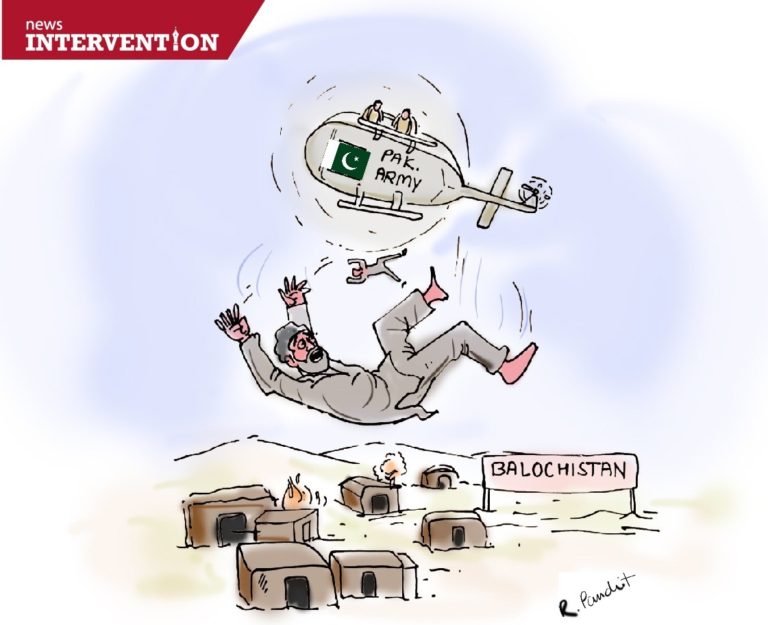
Every village in Balochistan witnesses grave brutalities by the so called Army of Pakistan. Kill and dump policy against people resisting the occupied forces still continues with a large number of operations. However, operations have intensified with an attack on the Pakistan Army by guerilla fighters. The Pak Army is armed with gunship helicopters and F-16 throwing napalm bombs.

The word military operation is not new to the Baloch as they are under siege since their forced accession to Pakistan. One such deadly operational footstep can be traced to the district of Awaran at occupied Balochistan where bombardment by 12 helicopters on 20 December 2020 on a religious place took away the lives of 10 innocent people. Their killing was however declared by the Pakistan Army capturing a camp of Guerilla fighters which is their old habit.

It is surprising that the government of Balochsitan even after knowing the real picture cannot dare to curb such operations where civilians are targeted. Balochistan’s holy land is witness to daily military operations on the one hand while helicopters, drones and jet fighters hovering all the time on Baloch skies.

In such grievous condition, Balochistan asks civilized world its moral support just to silence the occupied forces from crossing international war rules. Violation of basic human rights in Balochistan should be stopped. However, this is possible only when the world changes its mind against Pakistan. World should not overlook Baloch’s abuse by Pakistani military on a daily basis just because of their political interests. At present the world’s political interests are surely linked with Pakistan, yet the world must think about Balochistan’s geographical location and the future tie ups with Balochistan once our country attains freedom.

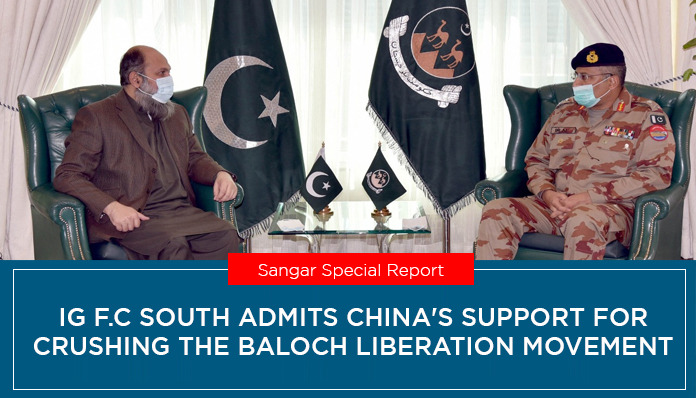
Pak Army General admits China’s support in crushing Baloch freedom movement

Ayman Bilal, a Major General in the Pakistan Army, has confessed to China’s role in crushing the Baloch independence movement in occupied Balochistan. “China has deployed me here to crush the Baloch movement and has given me a six-month task,” said Maj Gen Ayman Bilal.

Bilal added that if the threat of FATF black list is removed then they would not hesitate to go inside Iran and take action. “Iran is the biggest enemy of Pakistan which has a direct hand in the instability of Balochistan,” Maj Gen Ayman Bilal said at a special jirga meeting at the Frontier Corps (FC) Headquarters in Turbat where other important functionaries such as the local agents of FC and other intelligence people were present. Bilal is also the new IG F.C. South Balochistan.

This is the first time a serving Major General of the Pakistan Army has openly admitted to China’s role in the deployment and assistance to Pakistan Army in occupied Balochistan.

In this special jirga session of Frontier Corps, Raheema Jalal, sister of Federal Minister for Defense Production Zubeida Jalal, Sardar Aziz, head of state backed Death Squads from Pedarak, Yasir Bahram, head of state Death Squad Nagor Dasht, Hasil Kolwahi and heads of armed groups who are working on state parole from Tump, Mand, Buleda, Zamuran, Dasht and Hoshap were also present during the meeting.

Major General Ayman Bilal explained at the jirga that he had been posted in Balochistan only at the behest of China. He is also being paid a hefty salary and has only six months on the task to crush the Baloch freedom struggle.

Bilal said that he has extensive experience of working in Balochistan for the last 30 years and has worked in Quetta, Sibi, Kolwah, Dera Bugti and Awaran. “China has paid me a salary and a large sum of money and officially posted me here to protect their regional interests and to thwart Iran’s conspiracies against CPEC, as it is a kind of investment in regional interests,” Bilal explained.

Maj. Gen. Ayman Bilal also said that the end of Baloch freedom movement and the success of CPEC is very important for Pakistan and China. “We have a good amount of money for this task, so let us know how much you need because we can’t wait any longer for Iran to create unrest in Balochistan, conspire against CPEC and stab us in the stomach in the name of friendship.”

Bilal further explained that at present Iran is the biggest enemy of Pakistan and added that “…if the threat of FATF is averted today, tomorrow we will go inside Iran and teach the Baloch separatists a lesson that their generations will remember. At the moment we only have the option to take action within 25 km of the Iranian border and we will use this option on time.”

He said that fencing Gwadar was not a political issue and was not a new experience. “The world and Pakistan have already built barricades or walls to protect cities where security is out of reach. The situation in Gwadar was also out of our control, hence fencing was decided after the failure of all security options. This fencing will happen in any case, we will not allow it to become a political issue.”

Maj Gen Ayman Bilal was clear on the questions raised by the jirga participants regarding the diesel trade. He said that the illegal supply of diesel from Iran would be halted in any case. This is not a business or trade. “Behind this, Iran is directly harming us. We have seized dozens of vehicles loaded with weapons and ammunition.”

Bilal said that the diesel trade would be gradually phased out, people should arrange alternative work now, instead of smuggling Iranian oil, they should go to agriculture, farming or any other sector.

(This news report was first published in Sangar Media and is being re-published in News Intervention with due permission)

On Zara Kay: #JusticeforZaraKay in Dar es-Salaam, Tanzania

Zara Kay (YouTube, Wikinews) is the Founder of Faithless Hijabi (Facebook, Instagram, Twitter, Wikipedia). Faithless Hijabi aims for the creation of shared experiences and creating a community for ex-Muslims.[1] Since the founding of the organization in October of 2018, the organization, under the helm of Kay, has advanced rapidly.

Many resources have been provided by the organization including sections of the web domain for sharing your story[2], a blog[3], a mental health program[4], advice on setting boundaries with family as an ex-Muslim[5], life after Islam[6], a support corner[7], how to support them[8], and, as of recent, #JusticeForZaraKay[9]. Why the hashtag with “Justice” in it?

My first interactions with Kay happened around the turn or the start of the organization, around Spring of 2019. These took many months to come to transcription and publication. It became an extensive four-part introduction and interview with her.

The parts were entitled “An Interview with Zara Kay on Ethnic and Religious Background, Differential Treatments of Boys and Girls, Men and Women in the Religious Culture, and Theological Justifications (Part One),” “An Interview with Zara Kay on Faithless Hijabi, Global Violence Against Women Statistics, Leaving Fundamentalism, and Building Bridges (Part Two),” “An Interview with Zara Kay on No True Scotsman, FGM, Clitoridectomy, Infibulation, Identity Crisis, and Secular Communities (Part Three),” and “An Interview with Zara Kay on Dawkins, Liberation of Women, and Women’s Free Choices (Part Four).”

All published in In-Sight: Independent Interview-Based Journal (2369-6885). Through the interview, it was clear, early, Kay was going to be a powerful and influential voice for ex-religious people, ex-Muslim people, and, in particular, women in those communities.

The quelle surprise surprise was the bringing Kay into a police station, hence “Justice.” Her last tweet before heading into the station mentioned being checked into it. There have been growing petitions for her. Including a rapid development signatory support list, the number of signatories has grown rapidly for Kay’s case[10].

Kay was detained on purported charges on December 28, 2020. She was held in the Dar es-Salaam Oysterbay Police Station for 32 hours. It is claimed by the Council of Ex-Muslims of Britain that the charges against Zara are politically motivated.

Those charges coming from the Khoja Shia Ithnasheri Jamaat. The community, allegedly, opposed the activism, apostasy, and blasphemy, of Kay. Kay has Tanzanian ethnic background while being an Australian national. She was bailed on December 29, 2020. She has had to report to the police station every weekday between December 29 and January 11 followed by spotty reporting on January 15 and 18.

Her next report to the police station, apparently arbitrary and capricious, happened on January 22, 2021, presumably. With weeks since the original detainment in Dar es-Salaam, no court date or motion towards a resolution of this illegitimate, scurrilous, and contumelious behaviour on the part of the police authorities of Tanzania is forthcoming.

The International Coalition of Ex-Muslims, started in early 2020 and suspiciously sounding like a proposal from an article entitled “An Immodest Proposal: International Coalition of Ex-Muslims (ICEM)” (from 2019, not 2020), representative (via Ex-Muslim Somali Voices), Halima Salat, stated, “Faithless Hijabi is Zara’s organization, which has since also published a long list of signatories from all walks of life including international organizations in solidarity with what she is facing.”

I asked Salat about the post and the backlash to it, by the larger community around Kay. Salat directed attention to two posts seen as critical of the president of Tanzania, which were satirical of the government’s role vis-a-vis Covid-19.

“She shared them in May 2020 while living in London. The posts had very little interaction and no particular backlash at the time. However given that a lot of Tanzanians, specifically people from her former community had issues with her social media presence, have been wanting to actively shut her down,” Salat stated, “I have personally seen direct threats to her and her family. There have been attempts to shut down her Wikipedia page, she has been asked to leave school grounds when picking up her nieces. At the break of this story in western media, there are ongoing comments about her arrest where people have actively agreed with the government’s targeting of Zara, and calling for her to be jailed on the basis of her criticism of Islam.”

Then I asked about the similarity of this particular case with other prominent cases of ex-Muslims mistreated by the wider community and the justice system, e.g., Waleed Al-Husseini in occupied Palestinian territories (Qalqilya) and Mubarak Bala in Kaduna, Northern Nigeria, even ‘Ayaz Nizami’ in Pakistan.

Salat remarked on a refreshing fact. No blasphemy penalties exist in Tanzania. However, the risks for freethinkers and ex-Muslims are ubiquitous. Salat talked about the daily reporting to the Tanzanian police at the time.

“World-wide we see freethinkers, atheists, ex-Muslims facing persecution for their conscience, expression and beliefs. Depending on the country, it can even result in the death penalty. It has become increasingly common to see people jailed for sharing their opinion, satire, comment on social media and especially if such posts are deemed blasphemous by theocratic governments,” Salat explained.

When I asked about important ways to become involved, or effective forms of activism, Sala toted common means by which vocal ex-Muslims and activists have been targeted by the public, and how the public have been utilizing existing misdemeanour charges. These become a platform to get vocal ex-Muslims and activists in trouble with the law.

Salat stated, “In countries where blasphemy laws are not as succinct and clear on paper, the societal attitudes and individuals who hold religion sacred, have especially resorted to using state actors in making such accusation as a way to silence activists, dissenters, exmuslims, freethinkers and anyone they deem does not hold religions sacred.”

The President & CEO of Atheist Republic, Susanna McIntyre, provided some information and stated:

Zara Kay’s case has demonstrated that the ex-Muslim community, and the atheist movement more broadly, can extensively and efficiently mobilize during a moment of crisis. Ours is a large movement, and prominent figures have fundamental disagreements, but all put aside their differences when officials threatened Zara’s liberties. It has been incredibly heartening to be involved in and witness this international collaboration to secure Zara’s freedom and her safe return home, and the fight is not yet over. In the process of calling upon the United Republic of Tanzania to demonstrate their commitment to their proclaimed values of democracy and the protection of civil liberties, this tense situation has inadvertently forged a model of the achievements possible through global cooperation. Atheist Republic reiterates its appeal to the Tanzanian Government to honor the principles ensconced in their nation’s constitution and drop all charges against Zara Kay.

Furthermore, one more prominent international voice is the United States Commission for International Religious Freedom (USCIRF), which provided some answers to queries about their positions. It is bipartisan, which adds to its legitimacy.

On the social media post and the backlash against Kay for the post, USCIRF Vice Chair Anurima Bhargava considered the main concern the authorities questioning Kay about her beliefs and relationship to a religious ideology, Islam. This happened during the investigation.

“Asking such questions is problematic in and of itself, and if they base any charges or action against her on the answers to these questions, they would be committing violations of her right to freedom of belief,” Bhargava stated, “We are especially concerned about this potential since advocates report that Kay had received threats from members of the Khoja Shia Ithnasheri Jamaat, a prominent Muslim group in Tanzania, for leaving Islam and her activism supporting ex-Muslims. Religious freedom includes the right to change one’s religion or to be non-religious, and Kay must not be penalized or mistreated by either state or non-state actors for exercising this right.”

Bhargava’s recommendation was to reach out to other human rights and free speech organizations to learn more about the analysis of the situation. The Council of Ex-Muslims of Britain (CEMB) remains a potent and important organization in this regard because of its and the International Coalition of Ex-Muslims (ICEM) updates regularly coming out about the situation for Kay.

“Pew Research has found that restrictions on religion overall have increased around the world in recent years. The data around violations against humanists and free thinkers specifically is inconclusive and difficult to interpret, especially since humanists are often not accounted for in religious demographic data,” Bhargava stated.

There are broader trends of the violations of the human rights of believers and non-believers in 2020. It makes things difficult. Also, with the Covid-19 years, the comparison and tracking compared to previous years becomes difficult too.

“We have seen several high profile cases of violations against humanists in 2020, including the unlawful detention of Mubarak Bala in Nigeria, whom USCIRF Commissioner Fred Davie has adopted as part of USCIRF’s Religious Prisoners of Conscience project,” Bhargava stated.

If you wish to add your name or organization to the signatory list for Kay, please send an email to info@faithlesshijabi.org or search for CEMB’s and ICEM’s ongoing updates on the case.

Footnotes

[1] “About” states:

Faithless Hijabi was established in October 2018 and since we’ve helped hundreds of women to engage with us from all over the world. As it stands, women who leave the religion of Islam are often ostracised by their families, any form of dissent has the possibility of inciting violence.

This is a space where vulnerable and endangered women garner support. Our space is one of shared experiences, experiential guidance, and strength in unity.

The reality of the world today is that there exists many nations and cultures where women are abused and threatened with honour violence and killings when questioning their faith…
…At Faithless Hijabi we aim to ensure women are safe in questioning their faith and are protected from harm when exploring the space outside Islam.

 We’ve established a community on Discord that ensures anonymity of our members and enables women to express themselves freely while ensuring all members are protected.

 We work with women from abusive backgrounds by guiding them to the relevant organisations in their country that can support them.

 We aim to be a support system and help women grow by mentoring them to achieve financial independence

 Some of our mentorship revolve around create a nurturing environment that advocates for a balanced conversation with their families and helping them understand how to create and maintain boundaries.

 As of recently, we’ve started our podcast/video series on Life After Islam and Support Corner, for more information visit our video series page.

See Faithless Hijabi (2021a).

[2] “Sharing Your Story” states:

Send your story out into the world so that we can help each other grow!
Here are a few guidelines that you can use. We’re here to listen, only share what you’re comfortable sharing.

  • How were you raised?
  • What was your upbringing like?
  • When did you first start questioning Islam?
  • What questions did you have?
  • What triggered the questioning phase?
  • How did you react after you found your answers?
  • What do you think of the Hijab?
  • Did you wear the hijab? If so, when did you start?
  • Are you still wearing it? If not, when did you remove it and why?
  • Do your family know about you leaving Islam?
  • If yes, how did they find out and how did they react?
  • If not, what does it feel like living a double life?

See Faithless Hijabi (2021b).

[3] “Blog” states:

By sharing the stories of ExMuslims from around the globe we aim to engage our audience by igniting empathy based on stories that may be of shared experience or ones that present to us a different understanding of the current landscape.

See Faithless Hijabi (2021c).

[4] “Mental Health Program” states:

In 2014 a Freedom of Information request to UK police forces revealed that over 11,000 cases of ‘honour’ crime were recorded between 2010-14. Before accessing support, victims at risk of HBV experienced abuse for 2 years longer
(5 years vs 3 years) than those not identified as at risk of HBV.


Nearly a quarter (23%) of victims at risk of HBV were not eligible for most benefits. 68% of victims at risk of HBV were at high risk of serious harm or homicide, compared to 55% of those not identified as at risk of HBV.

We aim to create a safe space for women to come together and support one another. We have multiple programs in place, such as the video series “Support corner”, our community engagement group, and our story telling podcast on YouTube.

Currently, we are fundraising for our Mental Health Program. Our mental health program has partnered with a clinic in the UK, Cherry Tree Clinic and other independent therapists depending on locations that are trained to provide specialised therapy for apostates. Sponsoring 1 session for 1 person costs as little as £20-40 pounds, and with greater funding we can refer women for longer sessions.

This program is open to both Muslim and ExMuslims

If you’re looking to join the program to receive this benefit, please email info@faithlesshijabi.com to join our waiting list.

See Faithless Hijabi (2021d).

[5] “Setting Boundaries With Your Muslim Family, As An ExMuslim” (2021e) states:

What are boundaries?

We’ve often heard the word ‘boundaries’ being thrown around nowadays, and while many may theoretically know what that means, but how many of us really understand what it means. What are boundaries?

We can think of boundaries as a line, an imaginary line, that you set around yourself which helps how you interact with others in any relationship, it guides how you would like to be treated, and communicates what you are willing to accept.

Why is it important to set boundaries?

Personal boundaries are vital in order for us to thrive and be in healthy relationships. Having them in place allows us to communicate our needs and desires clearly and succinctly without fear of repercussions. It is also used to set limits so that others don’t take advantage of us or are allowed to hurt us. It is a way for us to practice self-care and self-respect.

With unhealthy boundaries we lose self-respect as we go against our values in order to please others. We keep giving of ourselves and yet feel like when we ask for help we are ignored. Allowing others to determine what we like, where we are going, or who we are shows that we are allowing them to control us which are a signs that we have unhealthy boundaries.

See Faithless Hijabi (2021e).

[6] “Life After Islam” states, “Life After Islam is a series dedicated to speaking with ExMuslims about their experiences, their views, advice to younger ExMuslims and just engaging in insightful conversations with our growing community of ExMuslims.” See Faithless Hijabi (2021f).

[7] “Support Corner” states:

Support Corner is weekly 30 minute series of Ghada and Zara Kay discussing most commonly asked questions by ExMuslims. And occasionally interviewing subject matter experts and other ExMuslims on specific topics. We’re by no means professionals in these topics, we only speak from experience discussing what has helped us.

See Faithless Hijabi (2021g).

[8] “Support Us” states:

Your donations will be spread across helping us run Faithless Hijabi, individual cases that we work with and events that we’ll be sponsoring in the future.
Your donations will be contributed towards:

 Funding therapy sessions: mental health remains to be stigmatised in Muslim communities, for girls that face honour and religious based abuse who require professional help but can’t afford it, Faithless Hijabi works with external partners and will sponsor 6 sessions for every case referred dependant on donations.

 Funding shelters when necessary: we often find ourselves in touch
with women who have left abusive homes and are on the run. While we connect them to other supporting organisations, we often require the funding to help girls with essentials and immediate needs.

 Our admin: more on the operations side, technology used and other forms of outreach that require funding to support.

 Volunteers: our volunteers have donated hours of their weeks to help us run this, in the future and as a last priority for funding usage.

See Faithless Hijabi (2021h).

[9] “#JusticeforZaraKay” stated:

Zara Kay, an Australian citizen and founder of Faithless Hijabi, was summoned to the Dar es-Salaam Oysterbay Police Station in Tanzania on 28 December 2020 and held in police custody for 32 hours without a clear indication of charges. 
 
Zara is a well-known ex-Muslim and women’s rights activist. Whilst in police custody, Zara was asked about the work of her organisation and why she left Islam. Zara was released on bail and is now to return to the police station with her lawyer on 5 January 2021.
 
The charges against her are:
1) Social media posts deemed to be critical of the president of Tanzania (these light satirical posts were posted in May when Zara was in London, addressing the handling of Covid-19 in Tanzania)
2) Not returning her Tanzanian passport after gaining Australian
citizenship (she never returned her Tanzanian passport as she misplaced and
never used it after gaining Australian citizenship)
3) Using a SIM-card not registered in her name (this was registered in a family member’s name). Failure to register SIM-cards legislation has been used to persecute other high-profile cases.
 
We, the undersigned, call on the Tanzanian government to immediately drop all the politically-motivated charges against Zara Kay, return her passport and allow her to leave Tanzania.  The constitution of Tanzania enshrines secularism as a state principle and recognises freedom of expression and of conscience. We also call on the Australian authorities to intervene and get Zara home to safety.


(More information available here.)

See Faithless Hijabi (2021i).

[10] “#JusticeforZaraKay” states:
A C Grayling, Philosopher, UK
Aaron Yandell, USA
Abir Ahmed Raihan, Author and Ken Fiklow Prize Awardee, Canada
Adriana S.Thiago, Communications Officer, European Network of Migrant Women, Belgium
Ahmad Nasser, ExMuslim TV, UK
Ahmedur Rashid Chowdhury, Editor in Chief and Publisher, Shuddhashar, Norway
Prof. Alan Davison, University of Technology Sydney, Australia
Albert Beale, Pacifist Activist, UK
Ali A. Rizvi, Author of The Atheist Muslim and Co-host, Secular Jihadists for a Muslim Enlightenment podcast, Canada
Ali Malik, Council of Ex-Muslims of Britain Refugee and Asylum Project Manager, UK
Ali Utlu, Human Rights Activist, Germany
Aliaa Magda Elmahdy, Women’s Rights Activist, Sweden
Alice Carr, Advocate, Progressive Atheist Inc., Australi

Alliance of Former Muslims, Ireland
Amardeo Sharma, President, The Gesellschaft zur wissenschaftlichen Untersuchung von Parawissenschaften, Germany
American Atheists
Ana González, Solicitor, UK
Andrew L. Seidel, Constitutional Attorney and Author, USA
Andrew Rawlings, Former President, Progressive Atheist Inc., Australia
Angkatan Murtad, Malaysia
Anissa Helie, Professor, Algeria/USA
Anna Zobnina, Coordinator, European Network of Migrant Women, Belgium
Annie Laurie Gaylor, Co-founder, Co-President, Freedom From Religion Foundation, USA
Anthony McIntyre, The Pensive Quill, Ireland
Arash Hampay, Refugee Rights Activist, Greece
Arif Rahman, Secular Humanist Blogger, Bangladesh/UK
Armin Navabi, Founder, Atheist Republic, Canada
Arsalan Nejati, Activist, Turkey
Arzu Toker, Internationaler Bund der Konfessionslosen und Atheisten, Germany
Ashanour Rahman Khan, Ex-Muslim Blogger, Sweden
Ashkan Rosti, Activist, Ex Musulmani d’Italia
Atheism UK 
Atheist & Agnostic Alliance of Pakistan
Atheist Iranian Community
Atheist Refugee Relief
Atheisten Österreich
Atheists for Liberty
Atheists In Kenya Society
Atika Samrah, Activist, Conseil des Exmusulmans de France, France
Avinash Patil, Executive President, Maharashtra Andhshraddha Nirmulan Samiti (MANS) And Vice President, Federation of Indian Rationalist Associations (FIRA), India
Azam Khan, Ex-Muslim Blogger, Switzerland
Barry Duke, Editor, The Freethinker, UK
Beatrix Campbell, Writer, UK
Betty Ibtissame Lachgar, Founder, M.A.L.I. (Alternative Movement of Individual Liberties, Morocco), Morocco
Bread and Roses TV, UK
Cadmeus Cain, Representative, Atheist Muslims South Africa, South Africa
Carl Russ-Mohl, Filmmaker, UK
Catherine Dunphy, Author, Canada
Cemal Knudsen Yucel, Leader, Ex-Muslims Of Norway, Norway
Central Committee of Ex-Muslims in Scandinavia
Centre for Secular Space
Chris Cooper, Representative, Atheist Muslims South Africa, South Africa
Chris Street, President, Atheism UK, UK
Christa Compas, Director, Humanistisch Verbond, The Netherlands
Cinzia Sciuto, Journalist, Italy
Community Women Against Abuse
Conseil des Exmusulmans de France
Council of Ex-Muslims of Britain
Council of Ex-Muslims of New Zealand
Council of Ex-Muslims of Singapore
Council of Ex-Muslims of Sri Lanka
Craig Michael Chatfield, UK
Dagfinn Eckhoff, Leader, Norwegian Atheists, Norway
Dan Barker, Co-President, Freedom From Religion Foundation, USA
Dario Picciau, Co-President, EveryOne Group, Italy
David P. Kramer, South Africa
David Rand, President, Libres penseurs athées, Montréal, Canada

Signatories Cont.

De Balie Centre for Arts and Politics, The Netherlands
Didarul Islam, Ex-Muslim Blogger, Greece
Djemila Benhabib, Collectif Laïcité Yallah, Belgium
Dustin Krinzer, Chairman, Atheisten Österreich, Austria
E.A. Jabbar, Yukthivadi Organisation, Kerala, India
Eddie Goldman, Journalist, USA
Eldridge Alexander, Information Security Engineer & Speaker, USA
Eric Weinstein, Host of the Portal Podcast, USA
ExMuslim Somali Voices, Netherlands
Ex-Muslims of India
Ex-Muslims of Netherlands
Ex-Muslims of North Americ
a
Ex-Muslims of Norway
Ex-Muslims of Tamil Nadu, India
Ex-Muslim Support Network of Australia
Fabian van Hal, Activist, The Netherlands
Faithless Hijabi
Fariborz Pooya, Producer, Bread and Roses TV, UK
Fauzia Ilyas, Atheist & Agnostic Alliance of Pakistan, The Netherlands
Federation of Indian Rationalist Associations (FIRA), India
Federico Galanetto, Italy
FEMEN
Freedom From Religion Foundation
Freethought Lebanon
Geoff Cooper, Author, USA
George Broadhead, Secretary, Pink Triangle Trust, UK
Gita Sahgal, Spokesperson, One Law for All and Founder, Centre for Secular Space, UK
Glenys Robinson, Co-President, EveryOne Group, Italy
Gulalai Ismail, Human Rights Activist and Founder, Aware Girls (Pakistan), USA
Haafizah Bhamjee, Representative, Atheist Muslims South Africa, South Africa
Halaleh Taheri, Executive Director, Middle Eastern Women and Society organisation-MEWSo, UK
Halima Salat, Founder,, Ex-Muslim Somai Voices, The Netherlands
Harris Sultan, Author and Ex-Muslim activist, Australia
Harrison Mumia, President, Atheists In Kenya Society, Kenya
Harsh Kapoor, South Asia Citizens Web, India
Hassan Radwan, Agnostic Muslims & Friends, UK
Helen Pluckrose, Writer, UK
Hemant Mehta, Editor, Friendly Atheist, USA
Hina Hasan, Co-Founder,  Ex-Muslims of India, India 
Houzan Mahmoud, Women’s Rights Activist, Germany
Humanist Union of Greece
Ian Bellis, USA
Ibn Warraq, Author and Researcher, USA
Imal Senevirathna, Irreligious Community of Sri Lanka, Sri Lanka
Inna Shevchenko, FEMEN, France
Internationaler Bund der Konfessionslosen und Atheisten (IBKA), Germany
Istishion Blog, Bangladesh
Izzy Diab, Community Support, Faithless Hijabi, Jordan  
Jaan Dillon, Public Officer, Faithless Hijabi, Australia
Jahid Hasan, Ex-Muslim Blogger and ICORN Scholar, Norway 
Jalil Jalili, Activist, Council of Ex-Muslims of Britain, UK
Jan Bockma, Contributing Editor, Vrij Links, The Netherlands
Jane Donnelly, Human Rights Officer, Atheist Ireland, Ireland
Jason Frye, CEO, Secular Policy Institute, USA
Javed Anand, Human Rights Defender, Journalist and Convener, Indian Muslims for Secular Democracy, India
Jay B. Kohnson USA
Jean-Pierre Sakoun, Chairman of Comité Laïcité République, France
Jenny Wenhammar, FEMEN Sweden, Sweden
James Gavitt, USA
Jill Nicholls Film-maker, UK
Jimmy Bangash, Spokesperson, Council of Ex-Muslims of Britain, UK
Jimmy Snow, YouTuber USA
Johanna AGA Browne, Melbourne Australia
Jorick-Yzaak Mallette, Canada
Julie Bindel, Journalist, Author and Feminist Campaigner, UK
Kacem El Ghazzali, Secular Essayist and Activist, Switzerland
Kareem Muhssin,  Spokesperson, Alliance of Former Muslims (Ireland), Ireland
Karen Ingala Smith, Women’s Rights Campaigner, UK
Karrar Al Asfoor, Humanist Dialogue Forum, Germany
Kat Parker, Secular Rescue Case Manager, Center for Inquiry, Australia 
Katha Pollitt, Poet and Essayist, USA
Keith Porteous Wood, President, National Secular Society, UK
Kenan Malik, Writer, UK
Khadija Khan, Journalist, UK
Kifriazrin Ahmad Kapli, Malaysia
Komal Ali, Netherlands
Lawrence M. Krauss, Physicist and Author, USA
Leo Igwe Humanist Association of Nigeria, Lagos, Nigeria
Libres penseurs athées – Atheist Freethinkers, Montréal, Canada
Lisa-Marie Taylor, Feminist Activist and CEO, FiLiA, UK
Ludovic Mohamed Zahed, Director, CALEM Institute, France
Mahaarah
Maharashtra Andhshraddha Nirmulan Samiti (MANS), India
Marea Magazine
Marek Łukaszewicz, President, Kazimierz Lyszczynski Foundation, Poland
Mariam Aliyu, Founder and Executive Director, Learning Through Skills Acquisition Initiative, Nigeria
Marieke Hoogwout, Writer and Editor, Vrij Links, The Netherlands
Marieme Helie Lucas, Founder, Secularism is a Woman’s Issue, Algeria
Markus Wollina, Co-founder LAG Säkulare
Linke Berlin, Germany
Maryam Namazie, Spokesperson, Council of Ex-Muslims of Britain and One Law for All, UK
Maryam Shariatmadari, Women’s Rights Activist
Meredith Tax, Writer and Feminist Organizer, USA
Mersedeh Ghaedi, Iran Tribunal London, UK
Michael Nugent, Chairperson, Atheist Ireland, Ireland
Milad Resaeimanesh, Spokesperson, Central Committee of Ex-Muslims in Scandinavia, Sweden
Mimzy Vidz, Youtuber, Counsellor, Lifecoach UK
Mina Ahadi, Founder, Zentralrat der Ex-Muslime in Deutschland, Germany
Miriam Therese Sofin, Ex-Muslim Women’s Rights Activist and Blogger, Germany 
Mo Jones, Cartoonist Jesus & Mo, UK
Mohamed Amara, Critic of Islam, Sweden
Monica Lanfranco, Editor, MAREA magazine, Italy
Mouvement alternatif pour les libertés individuelles Morocco
Muhammad Syed, President, Ex-Muslims of North America, USA
Muslimish
Nada Perat, Center for Civil Courage, Croatia
Nadia El Fani, Filmmaker, Tunisia/France
Nahla Mahmoud, Sudanese Atheists, UK

More Signatories

Nao Behache, Founder, Asociación de Exmusulmanes/as de España, Spain
National Secular Society
Network of Women in Black Serbia/Mreža Žena u crnom u Srbiji
Nicholas Forbes, Secretary, Faithless Hijabi, Australia
Nick Fish, President, American Atheists, USA
Nidhal Gharsi, President, INARA Association, Tunisia
Nina Sankari, Editor, Atheist Review and Vice-President, Kazimierz Lyszczynski Foundation, Poland
Norwegian Atheists
Nur – E – Emroz Alam Tonoy, Ex-Muslim Journalist, Contributor – Muktomona blog, Columnist – Dhaka Tribune, South Asia Monitor and South Asia Journal, Frankfurt, Germany
Nur Nabi Dulal, Writer, Hamburger Stiftung für politisch Verfolgte and Editor, Istishon, Germany
Obaid Omer, Podcaster, UK
One Law for All
Panayote Dimitras, Spokesperson, Humanist Union of Greece, Greece
Parisa Pouyande, Human Rights Activist, The Netherlands
Peter Tatchell, Director Peter Tatchell Foundation, UK
Pragna Patel, Director, Southall Black Sisters, UK
Progressive Atheist Inc. Australia
PZ Myers, Biologist, USA
Rahila Gupta, Writer, UK
Rana Ahmad, Founder, Atheist Refugee Relief, Germany
Ratan Kumar Samadder, Author and ICORN Scholar, Norway 
Rebecca Durand, Feminist Dissent, UK
Reginald Bien-Aime, Haitian Freethinkers, Haiti
René Hartmann, Chairman, IBKA, Germany 
Richard Dawkins, Scientist, UK
Ridvan Aydemir, Creator, Apostate Prophet, USA
Rishvin Ismath, Council of Ex-Muslims of Sri Lanka, Sri Lanka
Rivka Leah Goldstein, Kent Community Secular Alliance, USA
Rob Sellars, Manchester, UK
Roberto Malini, Co-President, EveryOne Group, Italy
Robyn E. Blumner, President and CEO, Center for Inquiry and Executive Director, Richard Dawkins Foundation for Reason & Science, USA
Rohit Balakrishnan, Author and Human Rights Activist, India
Rokaya Mohamed, Program Coordinator, Faithless Hijabi, Egypt
Rumana Hashem, Founder, Community Women Against Abuse, UK
Saadiq Samad, Ex-Muslims of Tamil Nadu, India
Saba Ismail, Activist, USA
Sadaf Alvi, Women’s Rights Activist and Columnist, Pakistan Affairs, Pakistan
Saff Khalique, Activist, UK
Safwan Mason, Council of ex-Muslims of New Zealand, New Zealand
Saif Ul Malook, Advocate, Pakistan
Salil Tripathi, Journalist, USA
Sami Abdallah, Freethought Lebanon, Germany
Samint, Artist, France
Sanal Edamaruku, President, Rationalist International, Finland
Sarah Haider, Executive Director, Ex-Muslims of North America, USA
Sarah Taylor, Researcher, Australia
Savalan Sultan, Co-Founder, Ex-Muslims of Netherlands, The Netherlands
Scott Homan, Witness Underground
Secular Policy Institute
Seth Andrews, Secular Activist, Author, Podcaster, USA
Seyyid Hanif, Ex Muslim Activist, Faithless Hijabi, Canada
Shabana Rehman, Født Fri, Norway
Shaheen Hashmat, Writer and Activist, UK
Shahin Mohammadi, Atheism Campaign, Sweden
Shakila Taranum Maan, Artist/Filmmaker, UK
Shaparak Shajarizadeh, Women’s Rights Activist, Canada
Shelley Segal, Singer-Songwriter, Australia
Shirin Shams, Founder of Women’s Revolution (of Iran), Sweden
Sikivu Hutchinson, Writer and Founder, Black Skeptics Los Angeles, USA
Sohail Ahmad, Reason on Faith, Canada
Staša Zajović, Activist, Belgrade, Serbia
Stephen Evans, Chief Executive Officer, National Secular Society, UK
Stephen Knight, Podcaster, UK
Stephen Law, Philosopher, UK
Steven Lukes, Professor of Sociology, NYU, USA
Subrata Shuvo, Atheist Blogger, Sweden
Sudesh Ghoderao, National General Secretary, Federation of Indian Rationalist Associations (FIRA), India
Sunny Hundal, Journalist, UK
Susanna McIntyre, President & CEO, Atheist Republic, USA
Taslima Nasrin, Writer, India
Teresa Giménez Barbat, Writer and ex-MEP, Spain
The Secular Party of Australia
Thomas Sheedy, President, Atheists for Liberty, USA
Thomas Westbrook, Media Producer & Conference Organizer
Ufa M. Fahmee, Freethinker and Social Activist, Maldives
Usama al-Binni, Arab Atheists Network and Manaarah, USA
Veedu Vidz, Youtuber, UK
Victoria Gugenheim, Body-Artist, UK
Wissam Charafeddine, Muslimish, USA
Women in Black Belgrade, Serbia
Yasmin Rehman, Human Rights Activist, UK
Yasmine Mohammed, Founder, Free Hearts, Free Minds, Canada
Yoeri Albrecht, General Director, De Balie Amsterdam, The Netherlands
Zehra Pala, HumaSecuLa, Turkey
Zihni Özdi, Author, Former Member of Dutch Parliament, The Netherlands
Zoheb Hasmani, Tanzania 

See Faithless Hijabi (2021i).

References

Faithless Hijabi. (2021i). #JusticeforZaraKay. Retrieved from https://www.faithlesshijabi.org/justiceforzarakay/.

Faithless Hijabi. (2021a). About. Retrieved from https://www.faithlesshijabi.org/justiceforzarakay/.

Faithless Hijabi. (2021c). Blog. Retrieved from https://www.faithlesshijabi.org/blog-page/.

Faithless Hijabi. (2021f). Life After Islam. Retrieved from https://www.faithlesshijabi.org/life-after-islam/.

Faithless Hijabi. (2021d). Mental Health Program. Retrieved from https://www.faithlesshijabi.org/mental-health-program/.

Faithless Hijabi. (2021e). Setting Boundaries With Your Muslim Family, As An ExMuslim. Retrieved from https://www.faithlesshijabi.org/setting-boundaries/.

Faithless Hijabi. (2021b). Sharing Your Story. Retrieved from https://www.faithlesshijabi.org/share-your-story/.

Faithless Hijabi. (2021g). Support Corner. Retrieved from https://www.faithlesshijabi.org/support-corner/.

Faithless Hijabi. (2021h). Support Us. Retrieved from https://www.faithlesshijabi.org/support-us/.

Photo by Harshil Gudka on Unsplash

Pak-sponsored Khalistanis attack Delhi Police in the garb of farmer’s protest

0

Pak-sponsored Khalistanis attack Delhi Police in the garb of farmer’s protest