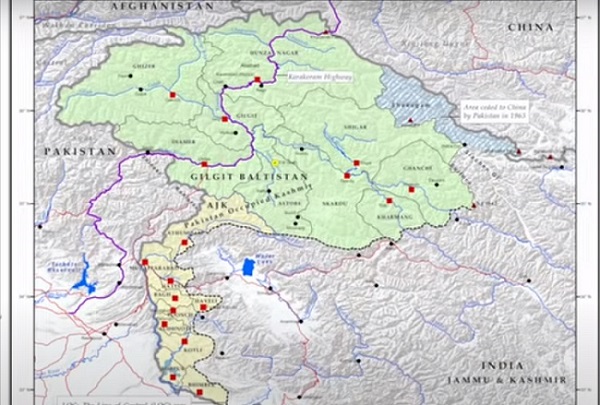
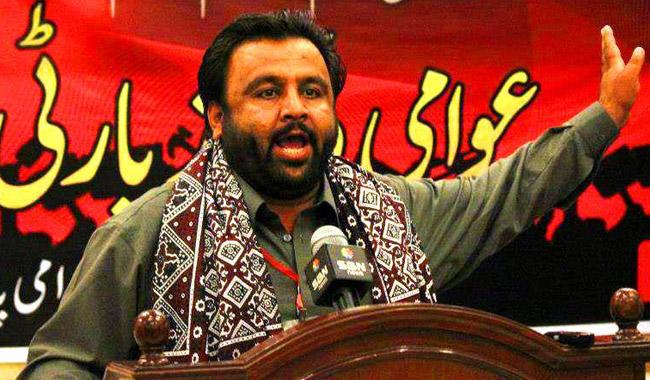
Pakistan government has been spreading the propaganda that if Gilgit-Baltistan becomes a province of Pakistan, the people of Gilgit-Baltistan will get their rights. It is worth pondering over the question as to what rights have been given to Gilgit-Baltistan or to the Pakistan-occupied Kashmir (POK) till date.
Let’s first look at the pages of history. Bengal became separate from the subcontinent as part of the existence of Pakistan in the name of Islam and Kalma. And then, as a reward to the Bengalis, it was said that these ‘black-skinned’ fish and rice-eating low-standard Bengalis have begun to show their eyes to us and so “we” will change their race.
When it comes to truth, these contractors of Islam and people who don the military uniform accuse “others” as being agents of India, and then these “others” are portrayed as enemies of Islam. History has shown that Pakistan Army raped millions of Bengalis, and today the same history is being repeated across Balochistan and in Pakistan-occupied Kashmir (POK). But revolutions can never be subdued by the tactics of colonizers.
The insidious Pakistani Biharis who played the role of front line of Pakistani establishment from the platform of Al-Badr and Al-Shams in crushing the Bengali uprising and revolution against Pakistan are still in the camps of Bangladesh. They are no longer called Pakistani Biharis or Bengalis. Nor are they called Indians. They no longer have an identity. Yes, of course, the brutal Pakistan Army have changed the generations of these Pakistani Biharis and brought them to the brink of destruction.
Today, the people of Pakistan-occupied Kashmir (POK) and Gilgit-Baltistan must think and learn from these historical facts.
Bengalis won their own country Bangladesh when they were deprived of their rights by Pakistan. But the question that needs to be asked is what will happen to the rights of the outsiders who are still calling themselves as Pakistani Biharis in the refugee camps in Bangladesh ?? When will Pakistan give rights to these Pakistani Biharis?
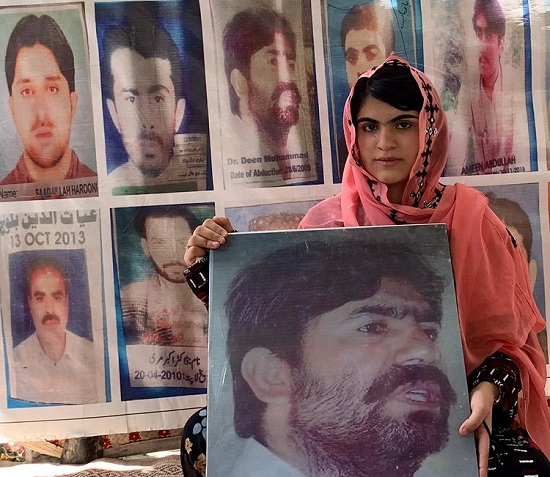
Occupied Balochistan is also known as a province of Pakistan. From the formation of Pakistan till today, Baloch have been fighting for their rights but instead of giving them rights, they are being made to ‘disappear’. Their mutilated bodies are thrown away. Their houses are burnt down. Innocent Baloch people are branded as traitors and forced to beg for life. The Baloch have no right to the natural resources of their own land. Balochistan continues to suffer from poverty and unemployment and famine, despite being rich in gold, silver, gas, copper, gypsum, chromite and coal. Balochistan has far larger reserves of natural mineral resources than Burundi or Congo.
However, the Pakistanis continue with their barbaric policy of Baloch genocide.
If becoming a province gives rights to the people, then why have the Baloch not got these rights till date? That is why the oppressed people of Kashmir and Gilgit-Baltistan must realize that there are some people who want to enjoy being in the Pakistani Parliament. These people have been bargaining interests of the nation for their own personal interests and these people are, in fact, national traitors. They are the traitors of Gilgit-Baltistan and Kashmir.
International law says that every nation has the right to maintain its identity, so why should Gilgit-Baltistan become slaves of Pakistan.
The same is true of Khyber Pakhtunkhwa. From the Babra massacre to the present day, from Bacha Khan to Manzoor Pashteen, Pashtuns have been abused and shot dead for demanding their rights. Numerous Pashtuns have been declared as traitors and branded as Afghan, American and Indian agents.
Pashtuns have been demanding their rights for seven decades. Isn’t Khyber Pakhtunkhwa a province of Pakistan? The same is true of the Pakistanis scattered in Karachi who gave up everything at the time of partition and came to Pakistan. These are the same people who made the greatest sacrifices during the creation of Pakistan. And yet they were massacred on a massive scale in the Jinnahpur plot and were called Indian agents.
The situation of Sindhis is similar. The feeling of deprivation is increasing day by day. The condition of Thar is worse than that of Ethiopia. The situation is worse in Sindh. In Sindh, those who talk about Sindh land rights are disappeared and they are killed. Isn’t Sindh a province of Pakistan? Where are the rights of Sindhis? Why Pakistan has not been able to give rights to the Sindhis till today?
Baba Jan was jailed by the Pakistanis for demanding rights for people of Gilgit-Baltistan. It’s been a decade since Baba Jan has been in jail.
All these statements of Pakistani government which claim that people of Gilgit-Baltistan will get their rights if Gilgit-Baltistan becomes a province of Pakistan, is full of lies. In order to break chains of a nation’s slavery, a few of the oppressed people have to raise their voice so that the nation can be freed.
Kashmir’s freedom is only for namesake. This freedom means nothing when all decisions are taken by the GHQ Pakistan.
If it was a matter of rights, then why were Iftikhar Karbalai and Baba Jan, who spoke for the basic legitimate rights of the people of Gilgit-Baltistan, put behind bars? Why and on what basis have they been banned?
If Pakistan wants to give rights to Gilgit-Baltistan, then first of all release Baba Jan and Iftikhar Karbalai who spoke for the people’s rights of Gilgit-Baltistan. Freedom of Baba Jan and Iftikhar Karbalai is their fundamental right. The policy of suppression in Gilgit-Baltistan will not be unacceptable.
With the
passage of the new Fundamental Rights and Freedoms Act coming out of Sudan,
there has been the formal repeal of its apostasy law, which becomes a basis for
the furtherance of religious and non-religious freedom of belief and practice
in the world. Sudan made a formal move for the respect of international human
rights.
The
USCIRF or the United States Commission on International Religious Freedom took
the decision of the “transitional government” as a positive.
Indeed, the Vice Chair of USCIRF, Tony Perkins, stated, “Sudan’s transitional government continues to live up to its commitment to justice, peace, and freedom. These new measures are important to protect the freedom of the Sudanese people to freely choose and practice their faith without punishment.”
Principles
of freedom, justice, and peace bind to international human rights in modern
formulations of ethics. The Fundamental Rights and Freedoms Act provides more
freedom of religion and freedom of belief for citizens of Sudan with startlingly
rapid or swift changes including the repeal of the apostasy law, an end to
female genital mutilation (“banning”), the end of flogging, abolition of the
guardianship law, and permission for non-Muslims to drink alcoholic beverages.
These
are stark changes demarcating a clear message and transitional point for the
modernization and secularization of significant portions of Sudanese culture.
“While the full text of the legislation has not
yet been made public, reports indicate that the apostasy law was replaced by an
article that prohibits hate speech, however the status of Sudan’s blasphemy law
remains unclear,” USCIRF reported.
Anurima
Bhargava, another Vice Chair of the USCIRF, applauded the efforts and “historic
steps” of Sudan in the protection of religious and belief freedom as well as ‘safeguarding
the rights of women and girls.’ Bhargava spoke to the need for “wide,
immediate, and effective implementation of these reforms.” The repeal of the blasphemy
law and laws regulating hate speech were encouraged for repeal as well because
of the standards set forth by international human rights.
Both
Perkins and Bhargava travelled to Sudan in February of this year to “assess
religious freedom conditions.” Based on the Sudanese progress since 2019 with
the transitional government, they have been working – the Sudanese government –
on the most egregious violations of international human rights delivered by the
former regime.
“USCIRF recommended in its 2020 Annual Report that the Department
of State maintain Sudan on its Special Watch List (SWL),”
USCIRF stated, “This was the first time since 2000 that USCIRF has
not recommended Sudan for designation as a ‘country of particular concern’
for systematic, ongoing, and egregious violations of religious freedom. In
December 2019, USCIRF released a report
entitled Apostasy, Blasphemy, and Hate Speech Laws in Africa,
which explains how overbroad or vague hate speech laws can operate as blasphemy
provisions and similarly restrict the freedom of religion or belief.”
The
United States Commission on International Religious Freedom or the USCIRF
compiled and published a report on tensions of a religious nature in the Fulani
communities in central and west Africa.
An
escalation in violence in Fulani communities has been directly connected to
religion in this area Africa, predominantly Muslim communities “with cattle
herding and livestock rearing.” The Fulani are one of the largest ethnic groups
internationally with members of the diaspora from Sudan to Senegal.
In a
bidirectional experience of violence, they have been perpetrators of violence
against civilians and civilian victims of violence in a number of countries.
“Although
the extent to which religious ideology contributes to driving this violence
remains a subject of debate, the trend of increasing violence by and against
Fulani groups is clearly aggravating religious tensions in countries such as
Nigeria and the Central African Republic, USCIRF, stated.
The
reportage is mixed with noting religion as a factor in the violence after the
fact while, at other times, noting violence coming from Fulani groups and then
this “aggravating religion tensions in countries.”
The 2020
Annual Report of the USCIRF has designated Nigeria, in particular, as a Country
of Particular Concern because of its “ongoing, systematic, and egregious
religious freedom violations.” The U.S.
State Department made the formal recommendation of placing the Central African
Republic on the Special Watch List as well.
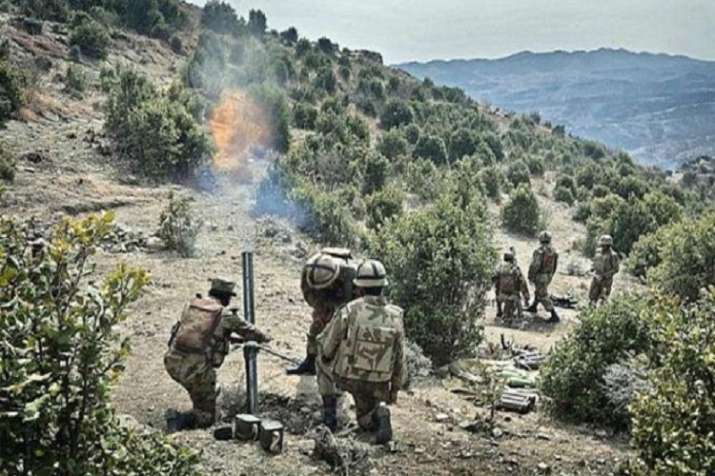
Srinagar/ October 1: The armies of India and Pakistan on Thursday exchanged heavy artillery fire along the Line of Control (LoC) in twin border districts of Jammu and Kashmir – Kupwara and Poonch – in which three soldiers were martyred while five others suffered injuries were evacuated for medical attention.
Two soldiers were also martyred and four others injured in cross border shelling in Line of Control (LoC) in Naugam sector of Kupwara district.
Kashmir-based Defense spokesperson Lieutenant Col Rajesh Kalia said that Pakistan initiated an unprovoked ceasefire violation along LoC in Naugam Sector, Kupwara on Thursday morning by firing mortars and other weapons that claimed two fatalities while fours other soldiers were also injured who were being evacuated to hospital.
“Pakistan initiated an unprovoked Ceasefire Violation along LoC in Naugam Sector, Kupwara today morning by firing mortars & other weapons. Two soldiers fatal. Four soldiers injured, being evacuated. Befitting response being given,” said Lt. Col. Rajesh Kalia.
He identified the slain soldiers as Havaldar Kuldeep of 15 Sikh Light Infantry and Rifleman Shubham, Unit 8 JAK Rifles.
Meanwhile another soldier was martyred while another suffered injuries in Krishna Ghati sector of the Poonch district of Jammu region after Pakistan resorted to indiscriminate and unprovoked ceasefire violation.
Jammu-based Defense spokesperson Lt. Col. Devender Anand said, “On 30 Sept 2020, Pakistan Army resorted to unprovoked ceasefire violation on the Line of Control (LoC) in Krishna Ghati Sector, District Poonch (J&K)”.
He said the troops deployed there gave befitting response during which two army personnel were critically injured who were subsequently moved for medical facilities, however one among the injured namely Lance Naik Karnail Singh succumbed to his injuries.
“Own troops responded strongly to the enemy fire. In the incident, Lance Naik Karnail Singh was critically injured and later succumbed to his injuries,” Lt Col. Devender Anand said. He identified the slain soldier as Lance Naik Karnail Singh.
While paying tribute to the slain soldier, Jammu-based Defense spokesperson said that Lance Naik Singh was a brave, highly motivated and a sincere soldier. He added that nation will always remain indebted to him for his supreme sacrifices and devotion to duty.
What led to massive fires in the Dash Forest on the night of September 19/20? Was this the result of Global Warming or Climate Change? Or there’s some other angle? Watch this news analysis to understand the inside story of Dash Forest Fire in Balochistan.
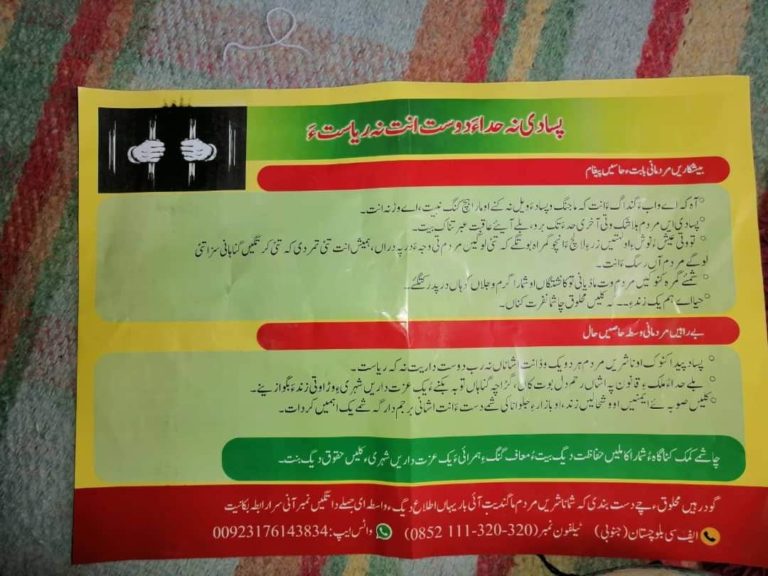
Pakistan’s distribution of pamphlets in different areas and its appeal for help from the people is a sign of its defeat, said Dr Allah Nazar Baloch, the Baloch nationalist leader in a statement on Sunday. Pakistan has been distributing pamphlets through army helicopters in and around Mand in occupied Balochistan and recently this pamphlet distribution has begun by Frontier Corps (FC) Balochistan South, wherein Pakistan is appealing for help and declaring Baloch freedom fighters as miscreants.
“This is an attempt to cover up their war crimes in Balochistan,” said Dr Allah Nazar. He added that the Baloch nation is engaged in its struggle for independence against the occupying state of Pakistan. In such a situation, such statements by the Pakistan Army and its paramilitary forces are a deception and a betrayal of the people. “They have come to realize that the people cannot be coerced into supporting their enemy by force. The whole world is aware of Pakistani atrocities and the rise of religious extremism in Balochistan. Given the situation, by declaring us freedom fighters as miscreants through pamphlets, Pakistan wants to cover up its crimes. Yet, ironically, it is promoting terrorism in Afghanistan, Kashmir and many other areas,” explained Dr Allah Nazar.
The Baloch nationalist leader Dr. Allah Nazar Baloch further said that by mentioning the expulsion of families and relatives of Baloch fighters in those pamphlets, Pakistan has also confessed to its culpability that the families were also targeted under the pretext of collective punishment and forced to leave their homes as refugees on their own land and compelled to live a life of misery.
“Frontier Corps (FC) that is associating the chaos in Balochistan with us and deeming it as being disliked by Allah, need to learn some lessons from Islamic teachings. Almighty Allah, in the battle of truth and falsehood, always supports the truth and righteousness. The way Pakistan has occupied Balochistan by force; the struggle against such occupiers is justified by our traditions, religion, Almighty Allah and the international law,” said Dr Allah Nazar Baloch.
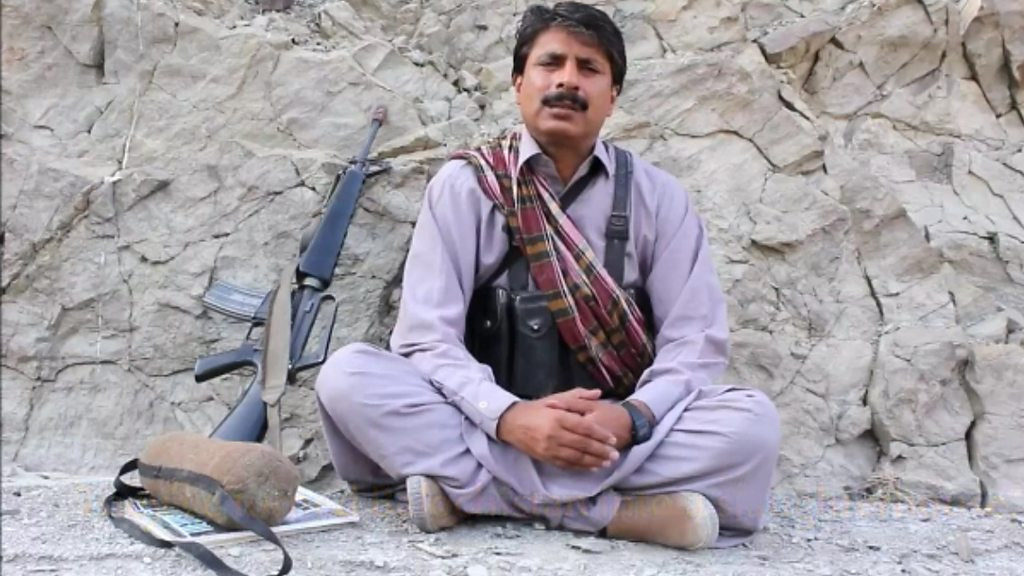
Dr Allah Nazar Baloch, Chief of Balochistan Liberation Front (BLF) and revered leader of Balochistan’s Freedom Struggle against Pakistan. (Photo: News Intervention)
Dr Allah Nazar further added that such pamphlets are a routine ploy by the occupying colonial powers. They try to justify it by covering up the atrocities inflicted upon the common people but the Baloch nation is aware of the real face of Pakistan as well as their path to salvation. This great nation cannot be led astray at any cost.
Dr Allah Nazar Baloch is a medical doctor by qualification who is leading Balochistan’s freedom struggle for the last two decades. Pakistan Army commits some of the worst forms of human rights violations across Balochistan, which includes rapes, abductions and murders. Pakistan’s state policy of “enforced disappearance” and “kill and dump” of Baloch people has meant that more than 40,000 innocent Baloch people have lost their lives in the last fifteen years. Entire Balochistan is struggling for freedom against the illegal occupation of Pakistan, which has rattled Islamabad and Rawalpindi.
Pakistan’s Commission of Inquiry on Enforced Disappearances was neither ever intended to prevent the crime nor has made any attempts to recover victims, fix responsibility of culprits and bring them to justice.
‘Enforced disappearances’ isn’t a novel tool of repression used by the Pakistan Army against Baloch patriotic political segments and general people. During 1970’s Baloch uprising, there had been a few incidents of the use of forced disappearance and custodial killing by Pakistan Army of those political activists who were thought linked, in one or other way, to Baloch National cause.
Dilip Das and Sher Ali Marri are first reported victims of enforced disappearance during 1970’s. They were arrested by Pakistan Army while traveling to Jacobabad by train from Sibi. They had gone missing after their arrest and have never been seen or traced till today. In such another incident Mir Asadullah Mengal, elder son of Sardar Attaullah Mengal, a prominent Baloch nationalist leader and first elected chief minister of occupied Balochistan, along with Ahmed Shah Kurd, a friend of him, was abducted by Pakistan Army on February 6, 1976 from Karachi and both of them have never been seen again.
However Zulfiqar Ali Bhutto, the former Prime Minister of Pakistan, has furnished an account of the incident of enforced disappearance of Mir Asadullah Mengal and his friend Ahmed Shah Kurd in a book written by him in jail when he was imprisoned after a military coup d’etat against his government in 1977. According to that account of the incident Mir Asadullah Mengal and his friend were abducted and killed by the army in an operation and were buried near Thatta.
The story about the kidnapping and killing of Asadullah Mengal in 1976 written by the then PM Zulfiqar Ali Bhutto in book which published after his hanging https://t.co/9x7CsS3dcu
Story about the kidnapping and killing of Asadullah Mengal in 1976 was written by former Pakistan PM Zulfiqar Ali Bhutto.
Mr Zulfiqar Ali Bhutto wrote in the book that when he objected the abduction and killing of the son of a prominent leader and former Chief Minister in such an illegal manner then he was advised by army to deny the arrest and custodial killing of Mir Asaduullah Mengal and his friend Mir Ahmed Shah Kurd and claim that both of them have gone to Afghanistan for getting guerrilla training. Late General Hamid Gul, a former chief of Pakistan’s military spy agency ISI, in his interview has also given the same account of the incident that was written by former Prime Minister Zulfiqar Bhutto about the abduction and extrajudicially killing of Mir Asadullah Mengal and his friend Ahmed Shah Kurd.
Enforced disappearances of Baloch patriotic political activists on a large scale in occupied Balochistan originated in the beginning of 2000. Since then there is seen an increasing intensity in the use of such an inhuman and illegal practice by Pakistan Army, intelligence agencies and Frontier Corps (a paramilitary force). Initially families and friends of victims rushed to judiciary for relief against enforced disappearances of their loved ones by law enforcement agencies but courts, either due to their bias against Baloch people or pressure from Pakistan Army and spy agencies,were unwilling or unable to help the victims to get justice.
It’s pertinent to mention here that in the beginning LEA (Law Enforcement Agencies) used to hand over some of the victims, after illegal detention and torture, to police showing them arrested in criminal cases. Though everyone in civilian administration and courts knew that cases against the victims were totally bogus showing false date and venue of their arrest but courts still used to maintain such brazenly false cases based on concocted narrative of law enforcement agencies and police. Courts of all level were, and still are, reluctant to take notice of severe physical torture against the victims they had been or are being subjected to during their forced disappearance in military dungeons. The obvious reason behind such reluctance of courts is that the perpetrators belong to military, intelligence agencies and Frontier Corps (FC).
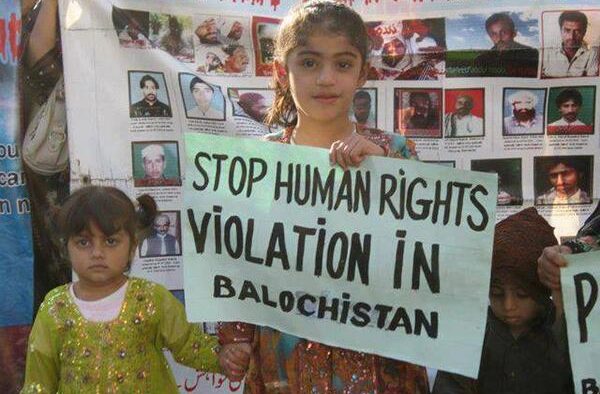
Baloch children protest against Pakistan’s gross Human Rights violations in Balochistan.
Like courts, the police was/ is also reluctant to register FIR (First Information Report) and investigate the cases of enforced and involuntary disappearances because police, a weak and corrupt civilian force, lacks the power, courage and support of so-called civilian governments and judiciary to register FIR and investigate the cases wherein the personnel of unbridled Pakistan Army and Law Enforcement Agencies are nominated.
From 2000 to 2008 there were more than one thousand cases of enforced disappearances in occupied Balochistan including cases of prominent Baloch patriotic leaders and activists Mir Abdul Nabi Bangulzai, Dr Allah Nazar Baloch, Akhtar Nadeem Baloch, Imdad Baloch, Dr Naseem Baloch, Yusuf Murad Baloch, Nawaz Jan aka Gahwar Jan Baloch, Wajah Wahid Kambar Baloch, Wajah Ghulam Muhammad Baloch the then Pesident of BNM, a pro-freedom political party, Mir Kadder Marri, and dozens of the activists affiliated with the Baloch Students Organization-Azad (BSO-Azad) and others. The above-mentioned leaders/activists were kept in military dungeons and subjected to severe physical and mental torture for long periods stretching from six months to two years or more and later were showed arrested in false cases of theft, bomb blast and treason.
Pakistan’s lower as well as apex courts failed to take notice of such afterthought cases and pass appropriate orders to prevent such unlawful arrests, detentions and torturing the victims and bring the perpetrators to justice. Instead the courts always stood by Pakistan Army and LEA (Law Enforcement Agencies) which, for all practical purposes, amounts to an encouragement to culprits continue with the commission of crime. So enjoying such impunity the perpetrators have continued to commit the crime of enforced disappearance till date.
When Justice Iftekhar Muhammad Chaudhry was Chief Justice of the Supreme Court of Pakistan, he formed a special bench for entertaining petitions regarding enforced disappearances. Aforesaid Bench tried to make the perpetrators accountable to some extent. His such daring annoyed Pakistan Army who furiously responded by suspending the constitution, arresting the Judges and imposing emergency in the country.
After the 2008 general elections as usual a weak civilian government headed by PPP’s Yusuf Reza Gelani, was formed in Islamabad who obviously lacked authority to have any sway in policy matters pertaining to army’s high handed strategy in occupied Balochistan, Waziristan and foreign affairs. Though Gelani administration, after hesitation, restored the ousted judges of apex judiciary but still both of them– civilian executive and apex judiciary absolutely failed bring the inhuman crime of enforced disappearance to an end and punish the perpetrators.
The ‘so called’ civilian government of Pakistan, after its apparent inability and failure to curb the crime of enforced disappearances and bring the culprits to justice, constituted the Commission of Inquiry on Enforced Disappearances (COIED) in March 2011 intending to buy time, mask its incompetence and powerlessness, deflect national and international criticism and pretend it is serious about addressing enforced disappearances. The reluctant Supreme Court of Pakistan also availed the creation of so-called “COIED” as an opportunity for face saving and disassociating itself from its primary duty of protecting the lives, liberty and legal rights and freedom of people including the right of free and fair trial. By transferring pending cases to COIED, the Supreme Court disposed of all petitions pertaining to enforced disappearances without any relief to the victims.
International Law describes “Enforced Disappearance” as a crime against humanity. All states are duty bound to prevent the practice of such a crime and bring the culprits responsible for the crime to justice. But the Commission of Inquiry on Enforced Disappearance (COIED) in Pakistan is performing contrary to the intent of law and justice. The platform of COIED and its procedures are being used and are instrumental to– 1-deny justice to the victims in one or other way, 2-discourage the registration, reporting and pursuing complaints of enforced disappearances by misbehaving and threatening to the helpless complainants. 3-defeat the justice by adopting complex, costly and exhausting procedures and using delaying tactics, 4-deflect the national and international criticism, 5-deceive international Human Rights bodies and thereby avoid any interference and accountability by such international entities, 6-exonerate the perpetrators of the crime by purposely creating an environment of impunity and unaccountability.
The COIED (Commission of Inquiry on Enforced Disappearances) has never showed any gesture of seriousness towards the task vested with. During long nine years of its creation the probe body never bothered to establish its branches and hold periodical hearings in the far flung armed-conflict ridden regions of occupied Balochistan. It’s meant to make the probe body inaccessible to poor families of victims who are living in remote mountainous regions lacking the means to afford expenditures of such costly litigation, travel to Islamabad, food and lodging there. Overwhelming majority of victim families aren’t only poor but also uneducated having not enough understanding of alien languages, laws, and legal procedures. That is why thousands cases of enforced disappearances in occupied Balochistan are going unreported and unfollowed.
Apart from above mentioned hurdles, there have always been complaints against the COIED’s Commissioners’ of deliberately misbehaving and harassing the complainants, mostly females, aimed to restrain them from pursuing the cases of their missing loved ones. It’s believed that COIED (Commission of Inquiry on Enforced Disappearances) commissioners harass and humiliate the complainants on behest of army and law enforcement agencies responsible for the crime.
Though it’s a primary requisite of the administration of justice to decide every case on merits but contrary to that golden rule of law the COIED has regularly been dismissing cases on procedural and technical grounds and thereby has been denying and defeating the justice. That is why a huge majority of the victim families from occupied Balochistan even don’t think of making a complaint to Pakistan’s COIED (Commission of Inquiry on Enforced Disappearances), courts or police. They deem making complaints to such state institutions a futile exercise, waste of time and money.
Another major reason for not reporting the cases of enforced disappearances in occupied Balochistan is that army and intelligence officers usually approach the victim families and threat them if they disclosed or reported the enforced disappearance of their family member then victim would be killed and dumped.
During the so called hearings before COIED (Commission of Inquiry on Enforced Disappearances) the complainants are treated like criminals while the representatives of perpetrators-army and intelligence agencies are given protocol and opportunity like members of the commission to question, reprimand, even threat and humiliate the complainants. Such insulting behavior of COIED commissioners and representatives of army and intelligence agencies is another massive hurdle in reporting and pursuing the cases.
COIED was formed and given task to trace whereabouts of missing persons and fix responsibility on individuals or organisations responsible for the enforced disappearances. But a brief glance at performance of the COIED reveals that the probe body neither intended ever to prevent enforced disappearances nor has made any sincere attempts to recover victims, fix responsibility of culprits and bring them to justice. Though on various occasions COIED has been claiming the credit of tracing whereabouts of a number of victims and getting them released but during the long nine years of its so called inquiry and investigations it has even not held a single perpetrator responsible.
The COIED has entirely failed to make a workable mechanism for the protection of victims, complainants, witnesses and their families.
Justice Javed Iqbal, the head of COIED (Commission of Inquiry on Enforced Disappearances) has many times publicly alleged that missing persons actually aren’t missing, they have either joined freedom fighters in mountains or are hiding abroad. Such is the false narrative put forth by army and intelligence agencies with mala fide intention of shading doubts about enforced disappearances and hiding their crimes. Toeing to such a false narrative of perpetrators manifests that the COIED isn’t an impartial and reliable probe body. Actually COIED has designedly been collaborating with culprits to suppress the cases of enforced disappearances and voices raising against army and intelligence agencies.
The impunity that army and intelligence agencies are enjoying in occupied Balochistan, encouraged them to expand the enforced disappearances operations in Sindh, Pakhtunkhwa, Pakistan-occupied Kashmir and Gilgit-Baltistan regions. The cases of enforced disappearances, notably of journalists, are occasionally reported even in Islamabad, the capital of Pakistan.
Not only Baloch but also Sindhi, Pashtun, Kashmiris and people of occupied Gilgit-Baltistan regions also disbelieve COIED and view it as a tool in the hands of army and intelligence agencies using to suppress the cases of enforced disappearances. On September 12, 2020 Nasrullah Baloch, the Chairman of Voice for Baloch Missing Persons blamed the COIED for further complicating the issue of enforced disappearances. Here is the link of said statement The Enforced Disappearances Commission is further complicating the issue of missing persons – Nasrullah Baloch | The Balochistan Post.
Such explicit collusion of COIED with culprits is the sole reason the probe body is being extended again and again for last nine years, despite the fact it has entirely failed in its task of providing justice to the victims, fixing the responsibility of culprits responsible for the crime and bringing the perpetrators to justice.
While enjoying full impunity the Pakistan Army and intelligence agencies are using enforced disappearance as policy to suppress the dissent of any form across the country and regions under its colonial occupation. In occupied Balochistan Pakistan Army and intelligence agencies abduct everyday dozens of civilian people including elderly men, women, children, youths and sometimes whole families and after humiliation and torture some of the victims are released while others go missing in military dungeons for an uncertain period.
It’s crystal clear from the power structure in Pakistan that Army and intelligence agencies dominate all state pillars including legislative, executive, judiciary and media. In view of Pakistan’s such a power structure there is no hope of impartial and effective inquiry in the crime of enforced disappearances, fixing the responsibility of culprits and bringing them to justice by any Commission formed by Pakistan.
Despite its undertaking to UNO’s Human Rights Council and other relevant organizations, Pakistan didn’t enact laws to declare the enforced disappearances a crime. Each of the successive governments of Pakistan have been making such false promises just to by time and spend their tenure.
Therefore it seems highly proper and timely for the UNO and International Criminal Court to commence investigations into the cases of enforced disappearances, a crime against humanity, in occupied Balochistan, trace the whereabouts of victims, fix the responsibility of perpetrators and bring the culprits to justice.
Construction of the Shri Ram Janmabhoomi Temple has started at Ayodhya. Alok Kumar, International Working President of the Vishwa Hindu Parishad (VHP) provided latest updates about Shri Ram Janmabhoomi Temple in this conversation with Vivek Sinha, Editor-in-Chief News Intervention. Alok Kumar also explained the gambit behind Halal certifications, and the devious mindset of certain individuals when they mock Hindu Gods and Goddesses in the garb of artistic liberty and freedom of expression.
Vivek Sinha: Welcome to News Intervention. All of us are keen to know about the latest updates on the construction of Shri Ram Janmabhoomi Temple at Ayodhya. Please let us know about the ongoing activities… Alok Kumar: Well as you know, all obstacles have been removed. We submitted our plans to the Ayodhya Development Authority and they have been sanctioned. We had to pay a hefty fee of Rs 2.11 crore to them, but the plans are in readiness. The soil testing has been completed. The big metal road to take heavy material has been constructed. Larsen & Toubro has set up their site office and we are now at the stage of piling for the foundations, and we hope to complete the construction within three years or a little bit more.
Vivek Sinha: Has the ongoing Coronavirus pandemic hampered the construction activities? Alok Kumar: Yeah it slowed (initially)…. but then came a stage when we decided not to wait for the Crornavirus pandemic to go away and therefore we decided to start the construction and invited the Prime Minister for it. They said that there must be only 150 guests and we agreed to that. We are building a temple made only of stone. No iron, no cement will be used and the temple would have an estimated life of more than 1000 years. So Corona slowed and obstructed, but our resolve to complete the temple construction in three years from now has overcome the obstacles.
Vivek Sinha: Will the Shri Ram Janmabhoomi Temple at Ayodhya be similar to ancient Indian temples? Is the temple architecture inspired by ancient Indian temples? Alok Kumar: Of course, yes. Sompura ji who are the architects for the Shri Ram Janmabhoomi Temple were also the architects for the reconstruction of Somnath Temple. They are a family who have been designing and constructing temples for generations so they have a lot of experience in Indian temple architecture and this would be the finest temple.
Vivek Sinha: Let us move on to a different topic, about the Halalonomics—the economics of Halal. The business of Halal is a bit controversial, yet I would like to know your views on this topic… Alok Kumar: This is not only a bit controversial, rather we have substantial objections to it. This is economic expansionism of Islam. We are for a secular economy. In England there are only 4% Muslims but every restaurant has a board that they serve only Halal meat, and for that you have to take a certification. (Swami) Ramdev ji (Patanjali) has taken that certification, Sri Sri (Ravi Shankar) has taken that certification. That (Halal) certification is given by designated Muslim organisations and they charge a hefty fee for that. So they get enriched for their religious affairs. We pay for that in the form of increased price of the goods and then from the meat they travel to food, medicines, and now a mall is coming up in Gurugram which proclaims that it is Halal certified.
So therefore it is a sort of economic domination of the principles, tenets and people of Islam over the followers of other religions. Somebody told me about a Shabad in Gurbani which ordains them not to eat Halal meat. Halal is rather a very cruel way of killing an animal. Killing an animal to a person like me is bad, but killing the animal with merciless cruelty is the worst. So I am happy that some good people in India have started a campaign to curb Halal meat and to promote Jhatka. The Indians should not yield and the serving of meat should not be restricted to serving only Halal meat including in the Indian Army.
Vivek Sinha: Is the VHP going to take an official stand on it… Alok Kumar: The VHP as an organisation has taken no stand on it yet, but then all of us are convinced that Halalonomics is bad for the religious amity. And for a secular economy we will join the fight as individuals.
Vivek Sinha: It’s argued that Hindus per se do not have any religious objections to eating Halal meat so why is it that the Hindus are objecting to Halal meat and why is Vishwa Hindu Parishad taking up an aggressive stand against Halal meat? Alok Kumar: I told you that there is a Shabad in Gurbani against it (Halal). So there are religious objections also and there are objections on the point of cruelty, and three we see it as an organised conspiracy to impose Islamic perceptions and tenets on us. And the money in certification of Halal goes to them. So I see every reason to propagate that there should be no exclusivity in food.
Vivek Sinha: Do you think that a portion of Halal certification money is being diverted towards radical Islamic fundamentalism and also for Islamic terrorism? Alok Kumar: We do seriously suspect that. Because lots of money is being collected by Islamic organisations which are approved for Halal certification. We do really suspect that the money from those sources may be directed towards Islamic propagation and terrorism.
Vivek Sinha: A few weeks back some people made derogatory comments on Maa Kali. And very often we see people making fun of Hindu Gods and Goddesses…and then taking refuge in freedom in expression. Your comments. Alok Kumar: We all have heard about Heresy Courts and the Papacy Courts, which are religious courts. And blasphemy laws still exist in Pakistan and other countries. Very recently we heard of an incident where some person had made a derogatory remark about the Prophet in Saudi Arabia and though the family of the person who was killed in the process had pardoned them yet they have been sentenced for life. The blasphemy courts routinely punish people in Pakistan on the charges of speaking against the Prophet or Islam or the Quran.
Recently there was a cartoon against a Hindu Goddess and somebody responded to it with a cartoon on Prophet Mohammed and tens of thousands of people assembled in Bengaluru and they attacked property and people, three persons were killed, the house of the MLA gutted. Can it be a one sided affair? They go on abusing the Hindu Gods and the “secularists” are telling us to be tolerant. And when somebody makes some comment on Mohammad saheb then all those lessons of tolerance go and the person is condemned for inciting hatred. The time has now come for a balanced view. And the balanced view is that I have a right to propagate my religion which includes my right to criticize Christianity and Islam and that right is limited to be within the limits of decency. Those who cross the limits of decency are criminals and should be punished.
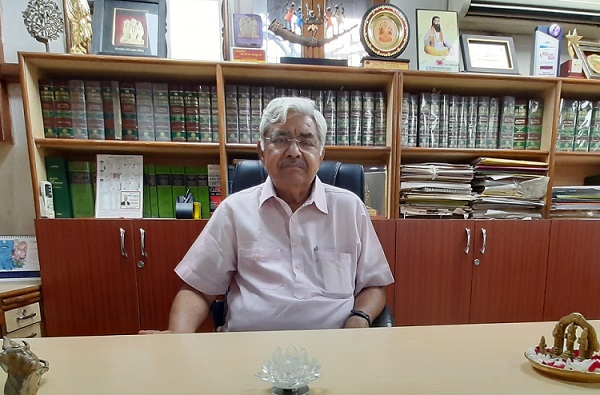
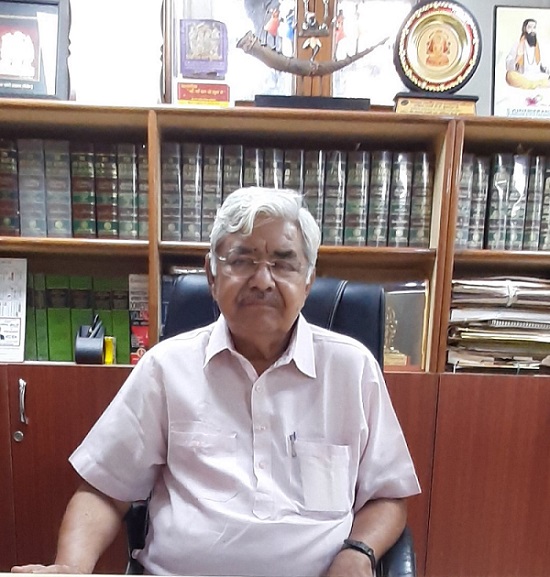
VHP President Alok Kumar is also a Senior Advocate in the Supreme Court of India. (Photo: News Intervention)
Vivek Sinha: I am reminded of a famous painter MF Husain, who painted the nudes of Hindu Goddesses, which was dubbed upon as artistic liberty and freedom of expression. Do you think the paintings come under the ambit of freedom of expression? Where can we draw this line about artistic liberty and freedom of expression? Alok Kumar: Well, this line should apply to all irrespective of which religion one does belong to. Those paintings were extremely hurtful to the Hindus and I can’t even describe the details of it. And I saw a painting that he (MF Husain) painted of his mother all dressed in sober clothes and looking nice and good. Her mother was well dressed looking down, being humble and in good taste. Do we have the same right towards our Goddesses? Why does he paint them in nudes? And in other vulgar poses? And why is it that Hindus are asked to tolerate it? I am sorry. You may call me a bigot or a communal but we will not tolerate it.
Vivek Sinha: Sure, I get your point. What is next on the agenda of VHP…. Alok Kumar: We will complete the Shri Ram Janmabhoomi Temple. It is paramount. We will put all our resources in the construction of Shri Ram Janmabhoomi Temple. After the Coronavirus pandemic eases we will go to the 400,000 villages across India, organise Ram Poojas, processions, we will go to the houses of 11 crore Hindus, collect funds for the Shri Ram Janmabhoomi Temple and in the process we will try that as the temple rises in Ayodhya a temple rises in every Hindu heart, and every Hindu is reminded that Ram went to Kewat Raj called him a friend. When Kewat referred to himself as being of the so-called “low caste”, Ram responded back and said that he does not believe in the high or low of castes or of mankind. He only knows the relationship of love and devotion. Ram also went to the hut of Shabari so we will bring this social harmony. The annihilation of caste and samrasta of Hindu society will be our priority. Like Ram went to the Ahilya’s Ashram and gave her back her garima, the respect and modesty, we will also do that to every woman in the country.
We shall work for the development of Scheduled Castes and Tribes in social and economic fields and on health issues. We have made an ambitious Setu Yojana where we shall work for taking the benefits of government schemes particularly to the Scheduled Castes and tribes, getting them new skills, establishing them in business and industry not as employees but as masters. We will focus on cow-based agriculture, no chemical fertilizers, pesticides or insecticides. In the coming years we will invest all our efforts to reenergize the Hindu society into a positive vibrant society.
Vivek Sinha: We often hear about temple ruins being found in foreign countries, Indonesia, Cambodia, Pakistan… Is the VHP planning to restore these Hindu temples found in foreign lands? Alok Kumar: Yes, at least in preserving them. And in a limited way, yes we are doing it. Some temple remains were found in Multan, Pakistan. And we went to the Pakistan High Commission and requested them to hand over the temple remains to the Indian government. So in our little way whatever efforts we can make to preserve such temples we are doing that because these temples belong to the whole mankind. When the Bamiyan Buddha Statues were demolished, it was a loss to mankind. And so I would ask everybody, particularly the Europeans, who are so keen to save the statues of those who had advocated slavery during their time, these temples are world’s heritage and they must be saved and preserved for future generations.
An interesting story doing the rounds in the Indian Capital revolves around the former Finance Minister P Chidambaram who does not lose a single opportunity to attack Prime Minister Narendra Modi. Except, every time he fails to cover his tracks and gets heavily trolled.
Chidambaram’s twitter messages criticising the government on the Farm Bill brought a large number of protests, and almost like the ghost of Julius Caesar stirred his conscience, especially in the light of his alleged role, and the alleged role of his favourite bureaucrats, Ramesh Abhishek and KP Krishnan in destructing National Spot Exchange Limited. Till the time of the Rs 5,600-crore payment hit the exchange — remember it was not a scam of the magnitude one sees almost every month — NSEL was considered the best example of what is now popular as Atmanirbhar Bharat or Digital India.
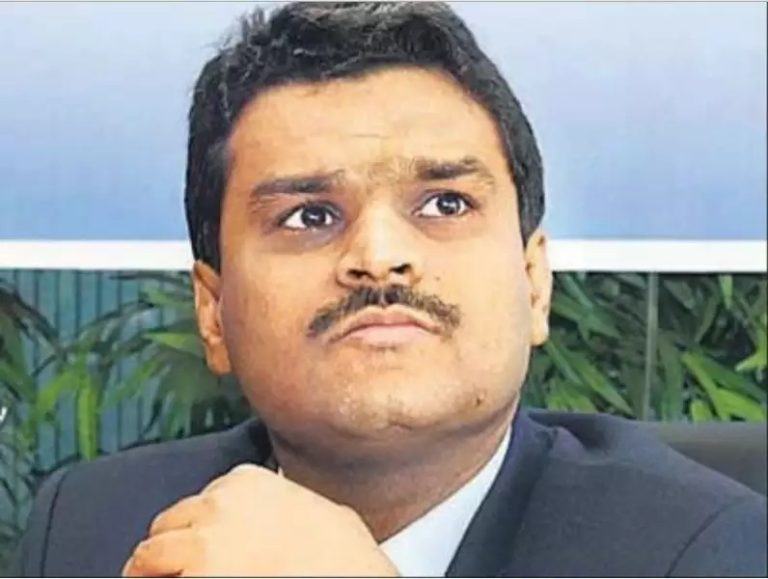
Chidambaram’s alleged role in destructing NSEL has been well documented. That the former FM and his favourite bureaucrats did not like the meteoric rise of Jignesh Shah, the promoter of NSEL, and reportedly wanted to favour the National Stock Exchange (NSE), now in the heat of a serious colocation scandal. For almost 24 hours, the twitter handle of the former FM was bombarded with comments from those who felt a genuine Made In India institution was destroyed. It was like many Caesar’s ghosts appearing to Brutus (read PC) and stirring his conscience for his past acts as well as disturbing him as he pondered his future battle. The messages highlighted works of Shah, a man who once created some of India’s finest exchanges before manipulative politicians and scheming industrialists queered his pitch. Many are now surprised as to how Shah, chairman emeritus of 63 Moons Technologies, the rechristened version of the Financial Technologies – the erstwhile parent holding firm for all the exchanges founded by him – has emerged as a Phoenix, a mythical bird with fiery plumage that lives up to 100 years.
Very few know NSEL was one of Shah’s smallest ventures.
In a landmark judgment on April 30, 2019 the Supreme Court prevented government’s move to merge NSEL with 63 Moons Technologies, and now, other courts are opening up the bank accounts and assets of 63 Moons Technologies. The big issue of corruption that once PC and his men heaped on Shah has not stuck on the sleeves of this affable visionary. Court orders are absolving him of all the charges one after another as no agency could prove even a single paisa of wrongdoing on his part, nor on the part of his companies.
Seven years have passed since NSEL got engulfed in the crisis, Shah has routinely maintained it was an “employee fraud” done in connivance with some defaulter brokers. He has said the crisis could have been solved in a month and half but for a political conspiracy hatched at that time to help his business rivals. Shah, who had to eventually exit all the exchanges and related businesses set up by him, including the flagship Multi-Commodity Exchange (MCX), is still hopeful about the resolution as also about punishment to all those who were party to the fraud. He has tremendous faith in Prime Minister Narendra Modi. He has been trying hard to work on the recovery process and refund of dues to all genuine claimants, the cash trail of Rs 5,600 crore that is missing has been established and assets worth over Rs 8,000 crore of defaulters have been attached. There is more, Rs 3,300 crore of decrees and arbitration awards have been obtained and the same for the balance amount was underway.
The 52-year-old Shah, popular as India’s Exchange Man, had successfully launched 14 exchanges across six continents, a global record. He has been hauled over the coals but he has always said he has had great faith in the judiciary. His companies were number one in commodities trading, electricity, currency, bonds and in everything they were doing.
63 Moons has filed a defamation suit, seeking Rs 10,000 crore in damages, against Chidambaram, Abhishek and Krishnan, alleging it was facing continuous “targeted and mala fide actions” in the wake of an “engineered payment default crisis” at the NSEL.
It was on July 12, 2013, the Forward Markets Commission (FMC), the then regulator of commodity exchanges, directed NSEL to give an undertaking that it would not launch any fresh forward contracts of one-day duration—for which it was given permission earlier—and settle all the existing contracts on their respective due dates. The FMC move triggered tremendous panic in the market, sellers emptying their godowns to meet their other commitments, and defaulting on their NSEL commitments, resulting in the otherwise avoidable payment crisis at NSEL on July 31, 2013.
It is important to see the crisis in its totality. For example, as sudden withdrawal of cash by depositors creates trouble in a bank, likewise the order to settle all outstanding contracts alarmed the market, leading to an otherwise avoidable payments crisis. The crisis was blown out of proportion. It was alleged that 16,000 investors had lost Rs 5,600 crore on NSEL.
One needs to remember that NSEL was not an investment vehicle, but a trading platform for buying and selling plantation and farm commodities and their products. More importantly, the Bombay High Court on August 22, 2014, observed that these so-called investors were nothing short of “bogus traders”. Let us not forget that in that very order, the court specifically observed that the then Economic Offences Wing (EOW) of the Maharashtra government “had not found any money trail leading to either NSEL or FTIL and that the entire money lay with 25 defaulters. This was again, after one year, was independently confirmed by the EOW to the then Union ministry of consumer affairs.
The recent colocation scandal at NSE has again established that the brokers — who routinely lure exchange officials — are the true culprits behind financial scandals at the markets. And when such mischievous deeds are done in the face of regulations, government officials in regulatory bodies, as also in the ministries, and even the ministers concerned, are involved behind such nefarious acts.
An Indian farmer walking through his paddy field. (Representative Photo: PTI)
The markets would have been in safe hands if NSEL had functioned. Let us not forget that for generations, millions of India’s small and marginal farmers have been living in abject poverty because of problems that exist in the country’s tightly controlled agriculture sector. If exchanges that benefit the farmers existed, the nation would not have been a massive dip in farming as an occupation. NSEL’s vision was to liberate Indian farmers from the archaic mandi structure and free them from the shackles of middlemen, the very reason why the Modi government has passed the three farm bills.
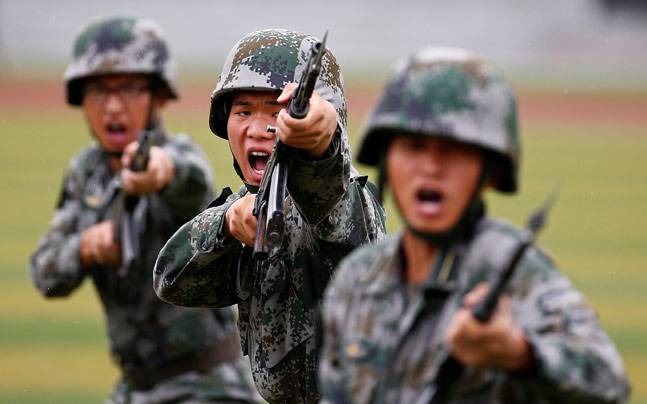
Global Times is famous (or infamous) for saying that black is white and vice-versa; and at the end, arguing that everybody should admire Red China. For the past five months, the tabloid has described the situation in Ladakh as one of India’s own making; it continues the Communist Party long tradition of telling lies (remember the Great Leap Forward and its claims of bumper harvests at a time when more than 40 million Chinese died of starvation). Today, Global Times continues to reverse the roles and change the facts.
Take the example of the joint statement and five-point consensus reached by the Indian and Chinese foreign ministers at the end of their recent meeting in Moscow. While admitting that it is “a substantial step in cooling down the current border situation, exceeding the expectations of most international observers,” Global Times squarely put the blame on India: “The successful implementation of the joint statement, however, depends on whether the Indian side can truly keep its word,” as if Delhi is not keeping its word.
It is not difficult for the tabloid to find ‘experts’ to corroborate its conclusions; one Qian Feng, director of the research department of the National Strategy Institute at Tsinghua University in Beijing told the Communist publication: “…given India’s past history of breaking consensuses reached at such meetings, some Chinese experts stressed that it’s still too early to pin high hopes on its implementation.”
However, the history of modern China is a tale of broken promises. Hardly two months after Mao solemnly announced the birth of the People’s Republic of China from the Tiananmen Square, the People’s Liberation Army (PLA) annexed Xinjiang, closing down the Indian Consulate General in Kashgar in the same stroke.
Delhi was told that the new regime would have to renegotiate all its former agreements, a position untenable in international law.
By taking over Xinjiang, Mao controlled the western borders of the Middle Kingdom, he could access trade with Central Asia and block any possibility of Soviet southward advance; for the first time, he also came in contact with the Indian frontiers, particularly the Aksai Chin area; a few years later, Beijing built a road across Indian territory linking up Xinjiang with Tibet.
The first broken promise was about the Indian Consulate in Kashgar, despite Beijing’s promises, it would never be reopened. At the same time, Beijing repeatedly told the Uyghurs that the PLA had come to help them to develop the area; the Uyghurs still do not understand how they have been ‘helped’ during all these decades.
India foolishly kept the closure of its Kashgar Consulate secret because “nothing could be done about it,” but that is another story.
Then came the invasion of the Roof of the World, called by Mao the ‘liberation’ of Tibet. A two-phase operation was meticulously planned by the Great helmsman; the first part culminated in the Battle of Chamdo in 1950, which saw the Tibetan forces being decimated; after the winter had passed, the Communist regime started the second phase, a diplomatic one; the weak Tibetan State was forced to put its thumbprint on an agreement allowing Communist China to take over the Land of Snows.
An ‘Agreement on Measures for the Peaceful Liberation of Tibet’, better known as the ‘17-Point Agreement’ was signed (‘under duress’ according to the Dalai Lama) in Beijing on May 23, 1951 by Ngabo Ngawang Jigme, the former Governor of the Eastern Province of Kham, then a prisoner of war.
The Tibetan delegates were ‘trapped’ into this (the seals of the Tibetan government had to be forged for the purpose, but never mind). The consequences for Tibet would be most momentous; not only Tibet would lose more than its independence, because here too, China would not keep its promises.
On September 9, 1951, soon after the Tibetans had signed on the dotted line, several thousand PLA troops entered Lhasa under the command of General Wang Qimei; subsequently 20,000 troops began to occupy the most strategic points on the Tibetan Plateau. India had a new neighbour.
India shares boundary with Tibet and not with China.
The next step for Beijing was to subdue the Indian government with a well-orchestrated propaganda of ‘eternal friendship’ between the two Asian giants; the Hindi-Chini-Bhai-Bhai honeymoon between Delhi and Beijing began to flourish.
In April 1954, India and China signed the so-called Panchsheel Agreement about Tibet, to which the Tibetans were not even invited to participate. India’s long border with Tibet (now China) was wishfully deemed settled in the process; Delhi thought that by signing this hasty agreement, it had ‘fixed’ the border.
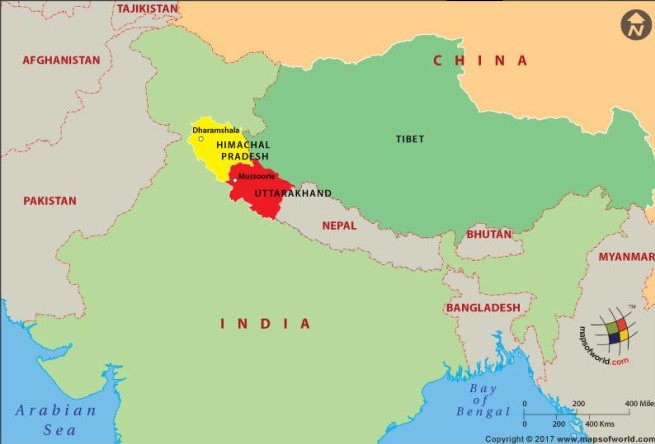
But two months later, the ink on the treaty had hardly dried, the Chinese troops walked into Indian territory; the PLA entered for the first time in Barahoti, a small flat grazing ground located in today’s Chamoli district of Uttarakhand.
It was another broken promise, the first two of the Five Principles (‘Panchsheel’) spoke of ‘Mutual respect for each other’s territorial integrity and sovereignty and Mutual non-aggression’.
In April 1958, for the first time, officials of India and China sat together to try and sort out the issue. It was a first rehearsal for the long negotiations which would take place in 1960; both led nowhere.
As a compromise in Barahoti, India agreed that Chinese ‘unarmed’ patrols could visit the place in summer till the case was solved; Beijing never kept its promise and repeatedly sent armed soldiers to Barahoti.
Sixty-two years after the negotiators agreed to be unarmed, the Chinese still cross the Tunjun-la and armed personnel walk into the desolate area.
Many more examples could be cited, i.e. the agreements of 1993, 1996 or 2005 on the borders which are often forgotten. For example, Article VII of the 2005 Guidelines said: “In reaching a boundary settlement, the two sides shall safeguard due interests of their settled populations in the border areas.” It was clearly referring to Tawang, but a few months later, Beijing started claiming again the area; to the long list of broken promises, one can add the decision for a disengagement arrived at during the recent five rounds of talks between the Corps Commanders in Ladakh. Where is the disengagement today?
Considering China’s track record in the matter, Global Timesshould be less arrogant, but it is apparently impossible.
We use cookies on our website to give you the most relevant experience by remembering your preferences and repeat visits. By clicking “Accept All”, you consent to the use of ALL the cookies. However, you may visit "Cookie Settings" to provide a controlled consent.
This website uses cookies to improve your experience while you navigate through the website. Out of these, the cookies that are categorized as necessary are stored on your browser as they are essential for the working of basic functionalities of the website. We also use third-party cookies that help us analyze and understand how you use this website. These cookies will be stored in your browser only with your consent. You also have the option to opt-out of these cookies. But opting out of some of these cookies may affect your browsing experience.
Functional cookies help to perform certain functionalities like sharing the content of the website on social media platforms, collect feedbacks, and other third-party features.
Performance cookies are used to understand and analyze the key performance indexes of the website which helps in delivering a better user experience for the visitors.
Analytical cookies are used to understand how visitors interact with the website. These cookies help provide information on metrics the number of visitors, bounce rate, traffic source, etc.
Advertisement cookies are used to provide visitors with relevant ads and marketing campaigns. These cookies track visitors across websites and collect information to provide customized ads.
Necessary cookies are absolutely essential for the website to function properly. These cookies ensure basic functionalities and security features of the website, anonymously.
Cookie
Duration
Description
cookielawinfo-checkbox-analytics
11 months
This cookie is set by GDPR Cookie Consent plugin. The cookie is used to store the user consent for the cookies in the category "Analytics".
cookielawinfo-checkbox-functional
11 months
The cookie is set by GDPR cookie consent to record the user consent for the cookies in the category "Functional".
cookielawinfo-checkbox-necessary
11 months
This cookie is set by GDPR Cookie Consent plugin. The cookies is used to store the user consent for the cookies in the category "Necessary".
cookielawinfo-checkbox-others
11 months
This cookie is set by GDPR Cookie Consent plugin. The cookie is used to store the user consent for the cookies in the category "Other.
cookielawinfo-checkbox-performance
11 months
This cookie is set by GDPR Cookie Consent plugin. The cookie is used to store the user consent for the cookies in the category "Performance".
viewed_cookie_policy
11 months
The cookie is set by the GDPR Cookie Consent plugin and is used to store whether or not user has consented to the use of cookies. It does not store any personal data.