Pastor Bob Cottrill is the Pastor at Port Kells Church in Surrey, British Columbia, Canada. Here we talk about the Christian faith.
Scott
Douglas Jacobsen: What is your family background?
Pastor Bob Cottrill: My folks were working class folks from British background. It was 100% Caucasian. I, often, think about the elementary school that I grew up in, which was about 500 kids with only a couple Japanese students or students of Japanese ancestry. The interesting thing, my sister stayed in the community, in the suburb of Toronto. When the children went through the same school a generation later. It was 80% ethnic. People from South Asia. People from Africa. It is so interesting how the face of Canada has changed. Their experience, completely different from mine. We were completely isolated from the world, this bubble. My parents and the social structures that we were involved were very closed, Christian, conservative. I would even say, perhaps, fundamentalist. In this sense, the narrative that we experienced was probably more connected to a North American narrative of the 40s and 50s, of fundamentalist, isolationist view. Our particular read of the King James Version of the Bible was the only historical one given by Jesus and the Apostles. Everyone from Catholicism through to liberal Christianity, even elements of Evangelical movement. These were all aberrant expressions, but the true Christian faith was held by our small little church. One of the really informative moments for me. It was in high school.
There
was a Christian club [Laughing]. I went to it. At the club, I met these other
students from my high school. I thought I was the only other Christian in the
high school. I met a guy on the hockey team, musicians. These were just normal
kids who were experiencing and living out Christian faith in their life, in a
real and vibrant way. We weren’t alone. I thought that we were huddled in the
basement. I went back to my church, of course, of 80 or 100 people, who held
this fundamentalist view. I thought, “Wow! Wait until they hear this, other
Christian people.” [Laughing] I was very naïve, as you can tell. They weren’t
impressed at all. When I graduated from school, I looked for an opportunity to broaden
my experience of people who were wrestling with and living out the Christian
experience. This idea of integrating the reality of God and Jesus with culture
and relationships in this world. I asked my high school counsellor, “I would
like to go to a Christian university.” He said, “That doesn’t exist in Canada.
You can’t go to the U.S. because it is too complicated.” A couple of weeks
later in Grade 12, he saw me in the halls. He said, “Hey! Are you the kid who
was asking about Christian universities?” I said, “Yes.” He said, “I got this
package of information about this place in B.C. I was about o throw it out, but
then I thought of you.”
It was a formative time for me. I got exposure to people from across the culture and around the world who came from societal and denominational different structures, but had the common idea of God at work in culture and in society. The ethos and presence of Jesus were real. It really expanded my mind. I left behind a lot of the confines that I grew up with. I am blathering on. Does this give an inkling? [Laughing]
Jacobsen:
Yes, your time at Trinity Western University. Your degree, what was it? Were
there further studies?
Cottrill: I enrolled in Business Studies. A lot of my original intent in coming to university as a young person was more social than it was educational. So, when I enrolled in Business Studies, it was a lot of interaction. I enjoyed it. I think somewhere along the way. I thought about being an accountant. It seemed like a good career. I did all my accounting studies. I graduated with a degree in Business Administration. When I first graduated, I pursued some business interests for about 3 or 4 years. My heart drew me into more traditional pastoral work. Because I think I have always been committed to community, to relationships, to understanding the experience of God and values and a deep love of that whole experience. So, inadvertently, I was drawn to that. It wasn’t intentional. Certainly, I never had that intention through early education. I graduated and worked in the business world for 4 or 5 years. I was very involved in volunteer work through church and youth work. A church leader challenged me with an opportunity. So, I enrolled in seminary. I took a full-time position at a church as a pastoral leader, eventually. I have been doing that for 30 years or more.
Jacobsen:
Same church?
Cottrill:
No, I served for 7 or 8 years as a youth pastor at one church,
providing leadership to high school students. Then I was, for 5 years, serving
as a pastor in a Mennonite church in Mission. Even though, I have no cultural
background with the Mennonite. I served as an associated pastor at a number of
larger churches overseeing public services. For the past 4 years, I have been
back here at Port Kells Church, which is a non-denominational, independent
church. It has been in the community since 1888. Interesting story, it started
in 1888 on 88th avenue, not far from where it is now. It was
Methodist settlers who came to participate in the founding of Port Kells, which
was originally meant to rival Vancouver as a seaport. I think in about the
early 1900s, after about a decade or two; they constructed a building that was
right by the corner of where 176th street meets the freeway. You
know the historic schoolhouse there. They met there and built a church there,
which they eventually disassembled and moved to the corner of Harvey Rd. and 88th
Ave.
Eventually,
in 1941, someone gave them a piece of property. They put it in rollers and
rolled it down the street.
Jacobsen:
[Laughing].
Cottrill:
That particular structure burned down years ago, but it has been
rebuilt. We are on the same property. Like many Methodists, in 1925, the
Methodists, Presbyterians, and Congregationalists rolled together to become the
United Church. The Port Kells Church was part of that, until about 1985 when,
in the face of changing politics and direction, a number of churches departed
the United Church. Port Kells Church being one of them. For a while, it was
part of a group that left the Congregational Church of Canada. That partnership
has fragmented a bit. The churches didn’t have a lot in common. Many departed
for theology. Others were traditionalists and didn’t like new things. Others
were mad about other stuff. It was hard to build a coalition. It is diminished,
but still exists. The Port Kells Church hasn’t participated in that for many years.
It is a rally independent church and holds to a historic Christian
understanding of faith. So, there we are; a little country church right in the
heart of Surrey that has been there since 1888.
Jacobsen:
When you’re there since 2016, what are you seeing in terms of some of the
differences between non-denominational church service and your example of
pastoring to youth, or in a Mennonite context?
Cottrill:
There are fewer differences among denominational churches. There
are some broad differences. Liturgical type churches, Catholic, Anglican
churches, some Presbyterian, Lutheran, churches, they would share a lot more in
common in terms of the life of the congregation than evangelical or charismatic
churches regardless of the name on the door. They would have a similar
experience of congregational life. So, our particular church experience, of our
congregation, is more connected with an Evangelical or Charismatic, or
independent, thing. If you were to move from here in B.C. from a Baptist to a
Mennonite to a Non-Denominational to an Alliance church, many of the big
flagship churches or even some of the little ones. The differences would be
more about the size and proficiency of the people leading it, as opposed to the
ethics or the intent of it. There’s been a real breaking down of a lot of
barriers. You notice the newest churches do not have a non-denominational
label. It may be in the fine print, maybe on a back page, or in one of the
dusty corners of the pastor’s mind. But, as far as the people in the pews,
there’s a real uniformity to most of the Evangelical churches or the
non-liturgical churches.
Jacobsen:
A lot of online resources exist online for modern Christians, especially young
singles and couples. So, I do note when watching some of these. There will be
the presentation. But before that, stating, “Don’t forget, this is only
supplementary to the church that you’re with, stay plugged in with your local
church and your local pastor.” Do some of your congregation take advantage of
some of these resources?
Cottrill:
That’s a good question. I don’t really know. For about 13 years, I
was part of a megachurch, as you would call here in Canada. It would get 2,000
a week in multiple services. We had a radio show. You have people coming to
take advantage of your resources. We realized along the way. The people who
attended on a weekly basis also belonged to a small church, committed to the
small church, but would chime up. It may be a thing. I’m not sure it is a
particularly healthy or helpful model. A lot of the value of having churches is
that it is a community; it is a family; it is a commitment. It is people who
walk alongside you and love you, and work together with you, even when you’re
not doing well. Even in the kind of relationship people have with an online
resource, an online church, it is, essentially, in the end, artificial. It is
like watching porn. You don’t have a relationship; they’re not going to be
there in the morning. An online church thing may be all airbrushed. They may be
incredibly talented. They may be right and smarter than your local teacher or
leader, but they are not going to be there when you are in a crisis. In the
end, I think it is an artificial relationship. A couple of years ago, I had a
medical issue. I looked online. I figured, “I am done for.” My doctor said,
“No, it’s really nothing. Go buy this over the counter thing, you’ll be good in
a couple of days.” He was right. We had the same information. But my doctor had
the information and knew my need, environment, symptoms, and was able to make
sense of that in a way that I can’t. It is not just restricted to Christian
belief but applicable to all elements of life. There is this artificial element
to information technology, which I think is leading people astray. In the same
way, I am very committed to educated in a structured environment. Essentially,
you could probably build a nuclear bomb based on information that you find in
the internet, in theory. Nobody is because there’s something about the
structure. That’s a terrible example [Laughing]. There’s something about the
structure of caring, mentoring, and personalizing and understanding people that
can’t be done online.
Jacobsen:
It sounds like taking into account human beings are living organisms and the
brain is a part of the living organism and requires an environment built around
it.
Cottrill:
I think it is more than it is a living organism.Although,
that is one way of expressing it. There is something more to being human. There
is this element of consciousness. Maybe, it is the image of God. There is this
social aspect, which is, maybe, more important than facts.
Jacobsen: Take some of the comments of some Christian educators, they will not focus on the education alone, but on a level above. The education as a means by which to inculcate virtuous ideas, and virtuous habits, to then have virtue. It is a character form of education rather than knowledge-based education.
Cottrill: As you said, holding out this idea that there’s virtue, there’s morality. There are universal values that transcend just facts and figures. It is, again, an indication of believing that there is something bigger in the universe. This is really outdated. When I went to Trinity Western University, one of their bylines was ‘Turning out fully developed students’ or something.
Jacobsen:
How vague is that?
Cottrill:
I know. There was this idea not just educated students. It was this
idea of students who maturity and development in all aspects of life, whether a
spiritual element, emotional growth, as well as academic. I think one of the
big challenges coming full circle again to what you began the question with;
the kind of relationship that you have with information technology is not real.
It is information, but it is not relational. I think the churches. I think of
even little church like mine, 100 people. It is a community; it is a family.
Together, we experience the hurts and the successes. We experience the presence
of God in the community. As part of that, it impacts us, as people.
Jacobsen:
How are you differentiating community, family, as terms?
Cottrill:
I am seeing them as descriptive terms to describe the types of
relationships that we have. We are like an extended family. As with family, we
have people who are sometimes not happy, who are introverted, who find it
difficult to participate as fully. It is people who are connected.
Jacobsen:
What are some of the difficulties in church life?
Cottrill: Difficulties in church life are people, who are people. You have people who struggle with emotional crises. You have people who struggle with mental issues. You have a lot of different views on peripheral issues. Politics is a great example. I know for a lot of Americans. Coming through the Christmas season and Thanksgiving, you will see a lot of news feeds, “How to talk politics at the Thanksgiving table?”
Jacobsen:
[Laughing].
Cottrill: We have a lot of the same things. There are a lot of ways to thoroughly address Christian issues in society. I am one person who believes how to deal with economic issues is trickle-down economics is through wealth redistribution. Others say the government should intrude. I may personal favour one or the other, but those views have integrity in and of themselves. It is the same in a dinner table chat or a church environment. Like any social structure, we have to work through those challenges. So, those are some of the challenges that we face. Also, I think a big issue for a lot of churches in the Lower Mainland is the cost of real estate. We have been in the same place in 1941 and the church structure was built well and a lot by volunteers, which has given us a leg up on a lot of folks. It is still a leg up to pay staff in the community. There are other pressures as well.
Jacobsen:
What brings individuals and families to church?
Cottrill: There are probably a couple of different reasons. I think would like you to think it is a deep need to connect with their Creator with this internal spiritual need. I’ll come back to that. Realistically, I think people want community, are lonely, have social expectations still. So, there’s some of that. But I would say that for an awful lot of folks. The things that keep them there are that many people, and I say this from my own experience, have this compelling sense, intuitive sense even; we try to rationalize and justify it, and rightfully so. The intuitive core of a lot of people – and I don’t know if I can say it is universal, but this sense of there being more to life than what we see on the surface. That communities and resources like churches explore the whole idea. It gives a framework to try and understand not just power here, and not just what we’re needing today, but why we are here. Why we exist? Why we have a consciousness going beyond instinctual reactions to what we do? It is this sense that there’s something more. We’re trying to make sense of it. Churches and Christians in particular feel that the best explanation or the explanation, perhaps, is that there is a Creator behind this; that there is a presence behind this beyond molecules, which is out there. We understand it as being a god. It is not only a presence, but a benevolent presence and a personal presence. Our expressions of worship and community and study are in trying to make sense of it, making connections, with that part of us, which calls us out. It is almost cliché now. Augustine or someone talked about this missing part of our heart. I think it is attributed to Luther along the way, a God-shaped hole. This idea that intuitively we want something more and strive for it. Communally, we work towards that. Of course, we find structure and whatever through Scripture, through mystery and tradition and understandings of theology. But I think the whole thing is driven in the first place – and we can’t make people come, in our culture at least – that we are more than just molecules. That’s, at least, what I attribute it to.
Jacobsen:
When we are having the different types of theology on the ground in pastoral
life, how does this tie into the trainings. You were at Regent College. Who
were prominent people who taught you?
Cottrill: I took courses with Dr. Alistair McGrath. Someone who I deeply admire. It sounds as if I am overwhelmed by his knowledge of things. It was really a profound thing to study under him and realize. It is not just him. It is the whole tradition of deeply understanding and wrestling with and committing yourself to understand a topic. Another professor who I had was Eugene Peterson, who is known in Evangelical circles for his translation of the Bible called The Message. It is a particular translation of the entire Bible from original languages. He passed away, recently. He was a Presbyterian, I believe, who has been uniquely influential in Evangelical circles. I found them very inspiring for different reasons. Regent seminary at UBC is a very inspiring place, actually. I didn’t graduate from there. I graduated from Trinity Western Seminary, even though I went to Regent. It is part of the ACTS consortium of seminaries, which are 3 to 5 Evangelical denominations that share some facilities, even share some classroom space and courses together on the campus of Trinity Western University. I graduated with a Master of Theological Studies in 1996.
Jacobsen:
As you’re working at Port Kells Church, which is non-denominational, and as
you’re graduating from the ACTS consortium of seminaries in 1996, what is the
orientation when you have the Evangelical ACTS consortium training, in terms of
seminary, and then translating this into a non-denominational context?
Cottrill: To a large degree, the divisions people see in the popular conception of how Christian faith and churches are divided up; it is artificial and more social constructs or ways that communities come together because I would say within the big picture called historical Christian faith or historic orthodox Christian faith. I am not talking about the Orthodox, Eastern Orthodox, Church. I am talking about those who adhere to creeds and statements of faith that have been in place since the 2nd century. In the big picture, there would not be a whole lot of difference. If I was to pick up a Baptist confession of faith or a statement of faith, and if I was to actually pick up the Catechism of the Roman Catholic Church, and discarding all of the cultural paraphernalia, and getting down to what are the key elements of faith, not argue about peripheral stuff, I don’t think you’d see a whole lot of difference.
Jacobsen:
What are the core aspects of faith or Christian religion?
Cottrill:
Since 7th century, or so, they have been defined by
about 7 or 8 key elements of faith. I don’t know if this is a test. I didn’t
study for this.
Jacobsen:
Something impressionistic to provide an idea.
Cottrill: As a non-denominational church, this is what we have tried to define, this is what places us in the stream of Christian faith. We hold to these 7 or 8 things. The others, we aren’t saying they are not important, but are sort of secondary. One is God exists (primary). He is good, personal, cares about us, and has revealed Himself to us, personally. Two is not only God exists, but the unique form in which he has revealed Himself in three different personalities. We would call this the Trinity. It is always an imperfect way of expressing. The Catholics would call it a mystery. I would call it complicated. But the fact that God has revealed Himself as God the Father, God the Son in Jesus, and the Holy Spirit. So, God exists, revealed Himself in these ways, and Jesus has specifically revealed Himself in this world to reveal Himself and connect with people and bring about forgiveness. That would the third and fourth one. Third is Jesus is, in fact, God. Fourth is coming to the world and leading the way to a life that extends beyond that. The fifth one is the Holy Spirit revealed itself in the world. The sixth would have to do with God revealing Himself through Scripture. Seventh would be that God will, at some time, wind up the affairs of this world and bring people to account. There will be a reckoning by God. When I say those 7 points, those creedal doctrines of understanding extend from the most conservative fundamentalist groups right to Catholicism, Orthodoxy, Coptic Church in Egypt, whatever. They would all hold those same 7 or 8 creedal understandings. Now, how they spin out them, the last one, for instance, of God winding things up at The End. Some fundamentalist Americans may adhere to a Dispensationalist view of 70 years, etc. I don’t quite understand it, as opposed to a different group. Those would be the distinctive, unique understandings of historic Christian faith that hundreds of millions of people have adhered to since the 7th century.
Jacobsen:
Who would be outside of that remit?
Cottrill:
I guess whoever doesn’t hold to those.
Jacobsen:
What denominations would be outside of it?
Cottrill:
When we talk about Christian denominations, we talk about people
who are within that. There are not “denominations per se, but there are
other faiths who don’t hold to that. I think a lot of groups that sprang up in
the 19th century, mid-1850s there seemed to be an explosion of
American-based ones. I don’t know if this comes out of the entrepreneurial American
spirit of right your own ticket. There came the Jehovah’s Witnesses who did not
hold to the creedal stances of Christi, of how faith in Christ brings about
relationship with God, Mormonism, Christian Science. There are some that
straddle the line who are mostly in. Depending on what day you catch them…
Jacobsen:
[Laughing].
Cottrill:
It doesn’t sound like it. This sounds like a tangent now. But
Oneness Pentecostalism, they appear to be fully in the mainstream of Christian
faith, but they have questions about how we express the identity of Christ or
in understanding of those creedal things; you must be baptised in a certain
way, in our church, to somehow become right with God. So, those people are
mostly in. But you say, “How committed are you to these basic understandings?”
I would say most of them are committed to those basic understandings. So, some
people, if you interpret it too tightly, have excluded Catholicism because they
would say, “Not only do they hold to those creedal things. They have extra
parts. I am not sure about those.” For example, Catholics would depart from
Protestants because they would give authority to apostolic tradition, which
finds its expression in the faith. In the sense, the Vatican has this authority
in speaking on faith. We just accept scripture, agree on the creedal things,
and disagree on a few extra lines on the bottom. It is splitting hairs in the
end. Because if we agree on primary things, it’s like a marriage relationship.
If you’re on the same page on most things, we can continue for even a lifetime.
If there is a disagreement, maybe, we can work it out. Perhaps, it is a little
pragmatic.
Jacobsen:
What about individual tenets?
Cottrill:
I think any of those creedal tenets. If God has revealed Himself in
Jesus, if the spiritual realm, if someone was to discard the testimony of
Scripture, if someone was to question if we can be in a right relationship with
God through Jesus, if someone was to disregard that there is a calling to
account for our actions, I think any of those things would remove people from a
historic orthodox view of Christian faith. Socially, people can function as
Christians, but practically and in a belief structure; they don’t believe it.
Then I would think that they can’t call themselves Christians or a follower of
Jesus. You hold to the historic beliefs, the ethos and values of Christ. I don’t
know why they bother calling themselves Christian.
Jacobsen:
When you’re pastoring, what is the difference between a youth pastor, a lead
pastor, etc.? How can we make distinctions between these labels being thrown
around?
Cottrill:
Right, I think they’re functional job type things, descriptions.
Pastor means shepherd or leader. Somebody who helps makes sense of the
community and to guide it. When the community gets bigger, the tendency is needing
help for the leader. It is not healthy. It is not practical for one person to
do it. It is easier to divide responsibilities. It is saying a leader with
emphasis with one particular dimension of emphasis. For instance, when I was a
youth pastor, it was that my primary responsibility was with a certain age
segment, youth leadership. When my job description was worship pastor, one of
my primary roles was to provide structure and support for the community’s
public expression of worship. I think it is just recognizing, especially in
large environments, that you will have to divide the work to get it done. Right
now, when I am in a small environment community, they call me “Pastor.”
Jacobsen:
What are some of the difficulties members of the congregation bring to you?
Cottrill:
The most difficult issues, at all, are the human condition. We
struggle with disappointment, with hurt, with loss. We have to make sense of
that. We have these hurts. We have losses. We want to know why. We want to know
how to make it through, make sense of it. Whether someone is going through a
divorce, or someone has passed away, or they are lonely, or they are
disappointed in something that has happened in their life, those are all big
challenges that. Sometimes, people struggle with faith. If all these creedal
understandings that God is real, in good, and cares about me, and wants to have
a relationship with us, why is my life so bad? Why do I live in despair? These
are hard questions. They are the things that we work together to understand, to
experience, and to make sense out of it. Specifically, when I was a youth pastor,
I remember running these mid-week and Sunday programs. Someone brought this
kid. I didn’t know the family. He came a couple of times. I said, “Can I get
your mom’s phone number and name, and to touch base? To let her know what we do
here and to answer any questions.” He said, “My mom is dead.” I said, “I am so
sorry. I am sorry to heat that. What about your dad?” He said, “My dad’s dead.”
I said, “Who do you live with? I would like to talk to her.” He said, “She is
in the hospital, pregnant with twins. She fell and broke her collar bone and is
in the hospital.” I said, “Does she live with the boyfriend or father?” He
said, “No, she doesn’t know the father or met him at a bar one time.” I said, “Well,
you’re living by yourself?” He said, “Yes, until she gets out of the hospital.”
I said, “Do you have any siblings?” He said, “One of them fell over a waterfall
and died, and the other committed suicide.”
Jacobsen:
This is awful.
Cottrill:
It sounds like you’re making this up.
Jacobsen:
It sounds too bad to be true.
Cottrill:
In fact, it is true. He came from a First Nations background, which
is a complicated, tragic, and seemingly impossible story. That was 30 years
ago. I still know him. He is a good friend of mine. I think he has gone on to
live a very fulfilled and happy life, married with a happy family, and
successful in business. Taking advantage of the resources, finding a reason to
live, believing that we were meant for something worthwhile, and in spite of
tragedy and sin, and error, there is a reason and a hope for our lives.
That’s the challenge of Christian faith.
Jacobsen:
What is “sin” to you?
Cottrill:
Traditional theological definition, I hold to it. Sin is anything
falling short of God’s standards.
Jacobsen:
What are God’s standards?
Cottrill: God is the essence of Good. He is the ultimate moral standard. Anything that falls short of that, whether death, hurt, betrayal, or any of those selfish things like pride. Any of those kinds of things that find expression in this world are sin. So, lying, for example, or hurting somebody or betraying somebody, those are sinful. They are an expression of this departure from this standard of good that somehow God holds to.
Jacobsen:
How are the Evangelical ACTS consortium training theologians at the time and
potentially now? Within the non-denominational frameworks of modern science, things
like evolutionary theory, things like Big Bang cosmology, and so on.
Cottrill:
I think that theology like, perhaps, a lot of things in life are a
lot different in academic circles than they are at street level. So, for
example, I would say, “Questions about the origins of the universe.” In theological
academic circles, I would say may prominent, even Evangelical, seminary settings
like Wheaton College in the Eastern United States, the heartland of
Evangelicalism. It would have very broad views on the origins of the universe.
They would not be confined to or even entertaining 7-day creationism. If you
were to go down to street level, the same pastors and seminary professors would
be influential in; you would find many people hold those views. It is
interesting. If you go around the world, this scientific – I don’t want to say,
“Denialism,” or this literalism is mainly confined to the U.S. and to a certain
flavour of Christian culture in the U.S. So, you have the fun park like Disney.
Jacobsen:
The Ken Ham Petersburg, Kentucky, Ark and museum.
Cottrill:
You wouldn’t find that hardly anywhere else in the world. Many
places with a long tradition. The Coptic Church in Egypt is unbroken back to
the 2nd century or the Catholic Church understanding, or the
Orthodox (Eastern), or the Anglican, or in Australia or Canada. You look across
the centuries. It is only a small sliver of culture that has, for some reason,
been really fixated on a particular idea. I think it comes out of the American experience
of from the 1850s onward strongly influenced by a few strident voices. If you
go to key seminaries or teaching focus, whether TWU Seminary or Wheaton, or
numerous other places, you wouldn’t find a fixation on scientific facts. I
think you would find people looking at the biblical text and saying, “This is
more of an explanation of why things exist and how God has revealed Himself to
us and why God has Himself to us. It is not a scientific textbook. It is not
descriptive of the geographic events. But I think it was something attributed
to C.S. Lewis, who said, ‘I take Scriptures far too seriously to take them
literally.’ That’s a thoroughly Christian thing to understand that these are
sacred texts, and not necessarily scientific descriptions of how things happen.
There happens to be historical overlaps. In the New Testament account, if you
read about certain historical figures or accounts, history does coincide with
that. But the story of the intent isn’t necessarily to teach science or even
history. It’s to teach us why we exist. So, I would say coming full circle. In the
context of Trinity Western, for example, I think that you would find that the
prevailing ethos would not be a commitment to a scientific interpretation of
the origins of the world, at least not in their theological training. I don’t
know about their science department. I don’t know how they muddle through
origins, whether multiverses, Big Bang, or otherwise. I have no idea. So, I
think it is very easy to get bogged down in a very strident, very loud tiny
sliver in the expression of American Christian faith and, somehow, think that
that is a prevailing thought over the centuries, or even over the world.
Jacobsen:
What demographics are at Port Kells Church, even impressionistic?
Cottrill: I would say that we have gone through a transition like many social structures. We tend to be set in certain social patterns that move their way through, which go into sunset and move their way through. I think we are in transition. I would suspect half of the people in the church are 60 and up. But we have intentionally had conversations about that. In the last couple of years, we have transitioned some of the activities of our community to make room for new generations. So, it is a rebalancing and emerging of newer families into our community. For example, getting down to the facts and figures, our Sunday school for children, two years ago, had two kids in it, which [Laughing] is not a good sign for the future. Whereas, we currently have 20 kids. It is an intentional focusing on that and deploying resources to say, “Yes, we are not just a club for older adults who are moving into sunset years. Our mission statement talks about being a multigenerational community. So, periodically, you have to rebalance things and say that we are open to those things. We are rebalancing. In two years, I would hope to see a broader representation of the generations in our church.
Jacobsen:
How do you plan a service? How do you implement a service?
Cottrill: Our worship service in Sunday are about an hour. An hour and a half of people’s time, what we want to do is make room for people to have community time to connect with each other, to have time to communally express their commitment, we make sure there is a teaching time, a time to explore the Scriptures together. We make sure there are elements of participation for all levels. On a practical level, what happens is that we, usually, have about 20 minutes of singing and musical participation spread across that time, I preach a typical sermon about 30 minutes, which take apart a passage of Scripture and talk about the significance of it, how this impacts our life, how we understand it, what its context is. We have an element where children participate in the service. We make sure that as we gather; we have some element of prayer. This idea that we believe God is present with us, and is interested, and responds to our communication. So, we pray together. Sometimes, it is one person. Also, this year, each time, I am taking five minutes in each service to interview a person. I ask them one of about four questions, “Tell us about yourself,” “How did your life intersect with Christian faith?”, “How did you understand Jesus? How did you become a part of this community?”, “What is a significant way God influenced your life in this community?” It gives people and opportunity to experience community. About 80 people come on a Sunday morning in our church. Also, we receive an offering each week. We have bills to pay. I am paid a salary. We have a mortgage to pay. We have someone else we pay. We pay our worship director, the person who leads the music, a custodian, and someone who coordinates “Family Ministries.” He volunteers at the schools and runs children’s programs. We pass an offering plate each week. People voluntarily contribute to the upkeep of the community in that way.
Jacobsen: How do atheist, agnostic, humanist, freethought people of Canadian society not understand, or misrepresent about, Christians and Christian community?
Cottrill:
One is, I think they tend to gravitate to the stereotypes to
strident voices, which don’t necessarily represent a deep, thoughtful
experience of Christian faith. It would be like if I engage Islam only in terms
of a terrorist who has blown themselves up. That’s the only image. If I engage
with Christians of the faith, and people who have not thought it through or who
only represent a tiny fragment of what it is, it goes both ways, too. For
example, being a Christian, if I paint a picture of an atheist, and immediately
go to the most extreme of this is a hateful, hurting person who is only
interested in tearing down everything that’s good and right, and is probably an
extreme socialist-totalitarian Stalinist, Satanist…
Jacobsen:
[Laughing] I have seen this.
Cottrill:
So often, I think people think that they are one thing. Partly, it
is that they have not experienced it. The second thing I would protest here. I
think a lot of people are looking for an identity. This goes or cuts both ways.
It cuts the Christian thing as well. I am looking to get behind something. So,
if the atheists get to me before the Christians, then I going to be a Born
Again Atheist and will sign onto it. I want to belong to something.
Jacobsen:
Is this most people?
Cottrill: A lot of the most strident, obnoxious Christians as well as the strident, obnoxious atheists are people looking for an argument. It is like, “Pick your side, I will fight you. I like the fighting. I don’t care, actually. It is not because of a deep commitment.” It is so funny. I remember being about 14 or 15 years old and being very argumentative. It was a phase in my life. I am the stereotype of the angsty teenager. I am going to get into an argument. I think for a lot of people in life. They are looking for an argument. People take them seriously. There’s a lot of very talented people looking for an argument and who are looking to use the structures of debate and information technology, and whatever else, to create tension and meaning in themselves. I am not always so sure that they are as committed as they might. It is a night like I feel above the fray in one way or another. Maybe, it is a part of discovering who you are and finding truth, which is to argue for positions and realize, “Maybe, I am not as committed to these things as I thought.” So, the misunderstandings of Christians towards secular people; people assume Christians are anti-intellectual, anti-science, anti-human rights, when, in fact, I think it has been, certainly, in the Western world, that these values have been built upon. I think there is a fad of assuming Christians are against human rights or against valuing all aspects of society, whether it’s women, gender minorities, whatever it might be. That, in fact, Christian values subjugate those people instead of looking at history in a broader sense and realizing it is Christian values that allowed those things to thrive and become a conversation in Western culture. I think there are a lot of popular myths about Western culture in general, in freedoms, in civil discourse, in commitment to intellectualism. It is like Christians aren’t a part of it, when they are a part of it. I think part of this comes from the fact that the most strident voices in engagement has been with a stratum of popularism, which doesn’t necessarily have a lot of intellectual validity. It is like take survey and thinking this is a national trend. As I said, I think it flows both ways. It is anecdotal as opposed to, a great example, in the U.S., when someone wants to get a soundbite of a prominent Christian leader. They go to Franklin Graham, who is an ‘Evangelical,’ but more represents a fundamentalist 1940s Christian Protestant faith as opposed to a 21st century Evangelical. They go to Joel Osteen.
Jacobsen:
[Laughing].
Cottrill:
Or Benny Hinn. I am not even sure if they have a seminary
education. They would, certainly, be rejected by the majority of Evangelicals
as leaders. It is really easy to stereotype. I understand why. The critique
flows both ways. Christianity in general is a kind of fluid target. In this
sense, you can’t go to the president. It is not like there is one Pope who
represents all Christians and then his word is the final deal.
Jacobsen:
Even Catholics will ignore and the Pope and Eastern Orthodox will ignore
Patriarch Bartholomew.
Cottrill:
Absolutely.
Jacobsen: This is obviously a perennial issue that will exist well past our lifetimes because dialogue is such a perennial issue.
Cottrill:
I think dialogue, education, and modelling of civil discourse. Because
when we converse, earlier, I was talking about how my growing up experience in
a very isolated environment lead me to very unhealthy and untrue expectations
of people who, for instance, were from different cultures, but when I,
actually, came into relationship with them. I realized that all of my
expectations were completely wrong or going to the doctor with the things that
I read without understanding the context and experience of it. I think it is
the same way. When people have dialogue, have civil discourse, a lot of this
other stuff gets pushed aside. It doesn’t mean that we disagree; it means that
we are disagreeing things that do not matter rather than preconceptions that
may not even be true.
Jacobsen:
So, maybe, an open mind with reaching out to change preconceived notions.
Cottrill:
I think any time that you’re in discussion. That, in and of itself,
exhibits an open mind if it is a discussion. I could preach it without having
an open mind.
Jacobsen:
[Laughing] We call this “rebuking.”
Cottrill:
Right. If we are having a discussion, hopefully, you will learn
something from me. I will learn something from you. Hopefully, it will help us
come to a new understanding of truth, the universe, God, and what is happening
in this world. Again, we talked about education, including online education,
which is one of the challenges anything [Ed. Off-tape discussion over meal.]
and is constricted, confined, and doesn’t have the room to have the whole
vista. If I was only to know you through five interviews that you’ve written; I
wouldn’t know you at all. If I were to know you through this one conversation,
then I wouldn’t you at all. If you research me through the internet, then you
wouldn’t understand me at all. However, if people have conversations and learn
about one another, then they learn about one another and a whole lot more about
life. One of the challenges, again, is the political landscape, and everything
else, in which everyone retreats to enclosed camps, as you said. Another great
example of this is the debate about climate change. It is about how people can
have access to the same facts, the same experience; yet, they come to
completely opposite conclusions, live in a closed community, where they are
bombarded with the same take on things. They don’t really evaluate what is
actually happening. When I say, “Education,” it is this idea of being exposed
to ideas and information and context, and wisdom. You know when you meet
someone. They have been around for a while. They have had the chance to wrestle
with things, look at it from a different angle, and understand that, maybe,
they are not in it to convince you. They are committed to it because they have
found some aspect of truth or hope, or future in it.
Jacobsen:
You mentioned central tenets before. What is God to you?
Cottrill:
I was thinking about this last night. Not in the context of our
conversation, “Am I convinced that God exists because of theological or
factual, or scientific, reasons?” I don’t think so. It is this intuitive sense.
I don’t know if I was born with it or whatever. Somehow, my existence, and my
life, and my being here, has a connection that’s bigger than just living for 50
or 60 or 80 years. There’s something else out there mystical, and good, and
powerful. Something that transcends our human existence. In the Christian
faith, the understanding of God is there is this presence in the universe that
is good, powerful, and benevolent. That’s God. It transcends our existence in
this dimension. I think people have pursued that philosophically and come up
with philosophical arguments for the existence of God. There are people who pursue
it in terms of the natural realm. They talk about natural theology. There are
people who experience that in Charismatic Christianity. God reveals Himself to us
in mystical ways. To me, it was this intuitive sense; I was born knowing God
exists. I think many, many people have that sense. I would like to think everybody
has that sense.
Jacobsen:
Most Canadians probably do, given the demographics.
Cottrill:
I would say, “Most Africans do.”
Jacobsen:
What do you mean by that?
Cottrill:
I would say most Africans have a commitment to the supernatural
world. They know from the time that they are born. In fact, most cultures know
that there is something greater than the flesh and blood experience. I think
only the Christian faith is a refinement, “Not only is it true. It makes sense.
God has revealed Himself in this Christian structure.” Here is the thing,
maybe, I am not right in this. I think many people who dispute that: If they
are walking by a graveyard at 2 in the morning and the moon shines through the
branches, and if they hear a wolf howl in the distance, a shiver runs down
their back. Intuitively, something is telling them. There is something more out
there. I am not trying to attribute some superstitious presence at that very
moment. But something in us tells us that there has got to be more meaning to
this world than organic material decaying in the grave; I am just on my way
home.
Jacobsen:
What about failures of intuition?
Cottrill:
Yes, that’s the tricky part. Intuition is an indication that
something is there. We don’t always understand what it is telling us. When
intuition fails, it is our interpretation of intuition. In other words, one
person has an intuition. This, perhaps, leads them into Satanism. Another
person, myself, it has lead me to this deep commitment to the Christian faith.
Clearly, one of our intuitions has failed. But I don’t think it is the
intuition itself. How do you make sense of that? I think that sometimes – and I
can’t speak for atheists or agnostics – people aren’t being complete honest, “Yes,
in my honest moments with myself, I think there might be something more to this
universe. I might disagree with Christians about what it is, but I don’t know.”
Jacobsen:
Would that be the compliment to the idea alluded to before? Christians having
moments of serious doubt as per the experience of coming across the First
Nations now-friend of yours: the mother is dead, the father is dead, one
brother committed suicide, another brother fell and died in an accident, and
his sister is pregnant with a back injury on the farm. In this sense, these
present serious reasons for further reflection and doubt to the believing
Christian as those other moments cause reasons to believe for the
non-Christian.
Cottrill:
I did get side tracked. I have such an abiding trust of God as a
presence in the universe. As to why the Christian expression of faith makes the
most sense, those are different questions along the way. I have always had a sense
of a deep abiding trust of God in the universe. I attribute it to this
intuition. I have studied, to some degree, theology, apologetics, etc., but
that’s not why I believe in God. I have just always known. I do believe most
people do know there is something out there. I do not want to speak for
everyone. Even most people who do not agree with me on the Christian view, we
do talk about there being more than a naturalism, more than scientific
evolution of social mores. There is something else that life is about. That’s
what I am about.
Jacobsen:
Thank you, Pastor Cottrill.
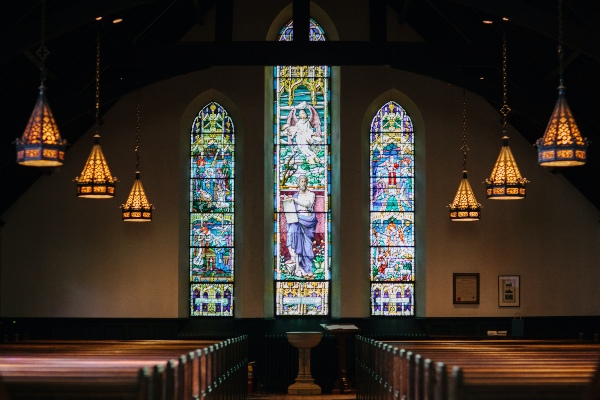
Photo by Karl Fredrickson on Unsplash