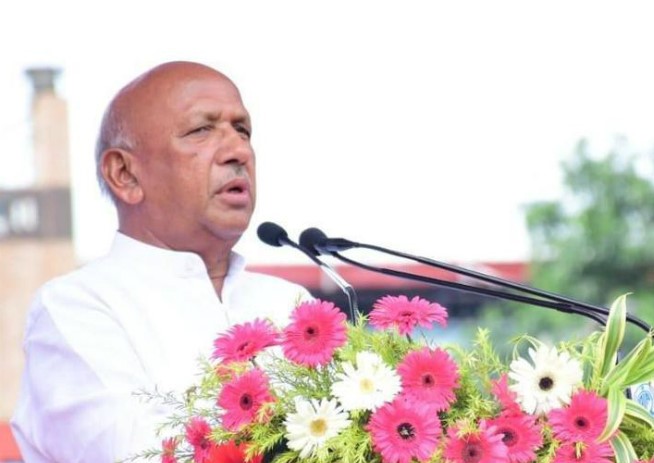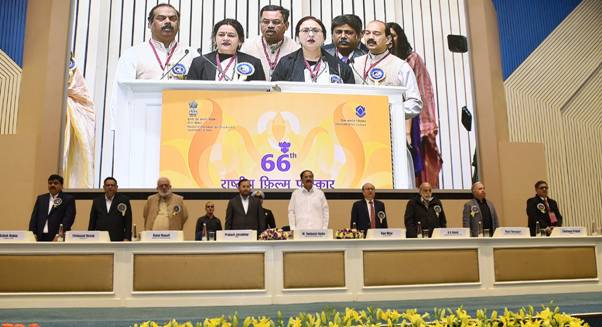
The Vice President of India, M Venkaiah Naidu today
conferred National Film Awards for the year 2018 in various categories at its
66th edition, held at New Delhi. Union Minister for Information &
Broadcasting (I&B), Prakash Javadekar; Secretary, Ministry of I&B, Ravi
Mittal; Chairperson, Feature Film Category, Rahul Rawail; Chairperson,
Non-Feature Film Category, AS Kanal; Chairperson, Best Writing on Cinema, Utpal
Borpujari and other dignitaries were also present on the occasion.
Some of the prominent winners in various categories for this
year National Film Awards includes Gujarati film Hellaroin in the Best Feature
Film category. Badhaai Ho bagged the award for Best popular film providing wholesome
entertainment, Hindi movie Padmanwas awarded Best Film on social Issues, Aditya
Dhar won Best Director Award for Uri: The Surgical Strike, Ayushman Khurana and
Vicky Kaushal jointly won Best Actor Award for their performances in Andhadhun
and Uri: The Surgical Strike, while Keerthy Suresh bagged Best Actress trophy
for her performance in Telugu movie Mahanati. Marathi movie Naal got the Indira
Gandhi Award for Best Debut Film of a Director while another Marathi movie
Paani won the award for Best Film on Environment Conservation/ Preservation.
Nargis Dutt Award for Best Feature Film on National Integration was given to
Kannada film Ondalla Eradalla and Uttarakhand was awarded the Most Film
Friendly State.
Amitabh Bachchan, could not attend today’s function due to
ill-health will be presented with the prestigious 50th Dadasaheb Phalke Award,
Indian cinema’s biggest honour in his 50th year in the Indian film industry,
later.
Speaking on the occasion, the Vice President spoke on how
Violence has no place in democracy and that Film makers must make conscious
effort to ensure that dialogues, depiction of characters and costumes reflect
India’s culture, customs, practices and traditions. He further added that
Cinema should also help in strengthening family systems and promoting
democratic values.
The Vice President while complementing the film industry
expressed how cinemas must be used for social change, “I call upon the film
fraternity to curb the depiction of violence, vulgarity and obscenity in view
of the huge impact films make on the masses, particularly youngsters. Art
speaks a universal language and helps shape social norms”.
Talking about Indian films popularity globally and how cinemas
has no geographical or religious boundaries because it speaks a universal
language and touches the raw emotions, the Vice President said “Indian films
carry an important message to audiences across the world. They convey a glimpse
of ‘Indianness’ or ‘Bharatheeyatha’ to the outside world. We need to be
effective ambassadors in the world of cultural diplomacy”.
Highlighting that Indian cinemas have gained global
popularity and that there is great demand for it, Union Minister for
Information &Broadcasting, Prakash Javadekar stated, “Our theatre and our
films is our asset, it is our soft power and we must harness to take advantage
of this. To ease the process of film shooting permissions and clearances, we
have prepared a single window system at Films Division. We are also in the
process of implementing this regionally”.
Congratulating the Award winners, Javadekar dwelt upon the
magical world of cinema and the talent that goes behind creating it, “Film is
such an art that as Vishwakarma creates a world, the filmmaker also creates a
new world and we immerse ourselves in that world”, stated the Minister.
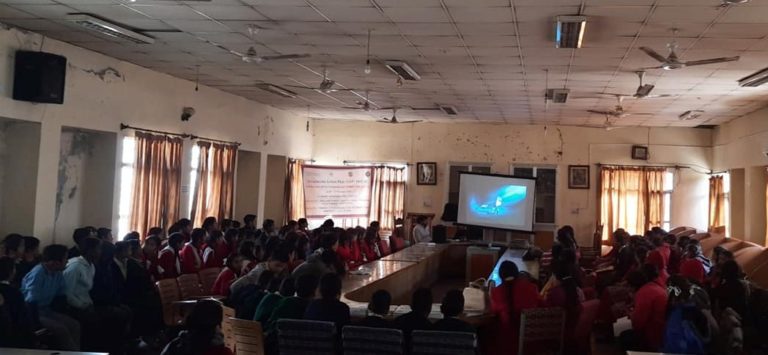
To promote informed
action by students towards environmental conservation, a two-day environment
and wildlife film festival for school children was held in Himachal Pradesh.
The film festival was jointly organized by Himachal Pradesh Council
for Science Technology and Environment (HIMCOSTE) and CMSR
Foundation. More than 30 short films and documentaries were screened during the
festival.
On the first day,
screenings were organized at Vallabh Government College in Mandi. More than 500
school students from various schools in and around Mandi participated in the
screenings. Issues of everyday concern like minimizing wastage of water, waste
segregation, discarding the use of polythene etc. were discussed in the open
forum after the screenings. Divisional
Forest Officer (DFO), Mandi, Surendra Kashyap was the Chief Guest on the
occasion. In his address he said though climate change is a natural process,
the rapidity with which climate is changing now, will be detrimental for the
planet. With increasing temperature, sea-level will rise due to which several
coastal areas will get submerged.
On the second day of
the film festival, screenings were organized at Mahavir Public School in
Sundernagar. More than 400 students and teachers from various eco-clubs
participated in the screenings in two shows. During the open forum students
shared their understanding on a wide range of contemporary environmental issues
related to conservation of bees, afforestation, use of biodegradable material,
judicious use of water, waste segregation and safe disposal. Principal of the
school Anuradha Jain, in her concluding remarks exhorted students to utilize
this information for positive action towards environment in their surroundings.
CMSR Foundation
Director Narender Yadav, who was also the resource person for the two-day
programme interacted with students and also explained various environmental
concepts in an easily comprehensible way. From Himachal Pradesh Council
for Science Technology and Environment (HIMCOSTE) Akshita Sharma and
Shweta Thakur participated in the programme. The film festival was second in
the series of three film festivals planned in Himachal Pradesh by HIMCOSTE. The
festival will conclude in Dharamshala next month.
The mindless violence over Citizenship Amendment Act (CAA) is a classic example of how a humane initiative can be made to appear monstrous and evil by skillful use of mischievous propaganda, lies and sinister planning. 95% of the protesters have not read this Act, yet they have declared Jihad. Remaining 5% who see themselves as conscience keepers of the nation have joined the chorus blinded by their hatred for PM Narendra Modi.
In simple words, CAA merely legitimizes the stay of 15 lakh odd Hindu, Sikh, Parsi, Christian, Buddhist and Jain immigrants, who escaped from Pakistan, Bangladesh and Afghanistan due to their continuous religious persecution and are staying in India as refugees. It is a one-time dispensation and its cut-off date for eligibility is December 31, 2014. The Act excludes illegal Muslim immigrants because they did not come to India due to religious persecution but in search of better economic opportunities. The protesters call CAA divisive and insist that it is going to break India on religious basis. Perhaps they would have liked over 1 crore 65 lakh illegal Muslim immigrants to be bracketed as religiously persecuted in their Islamic countries and given citizenship under this Act so that India remains united. You could not have a more bizarre situation where illiteracy of a law becomes a reason to burn the nation.
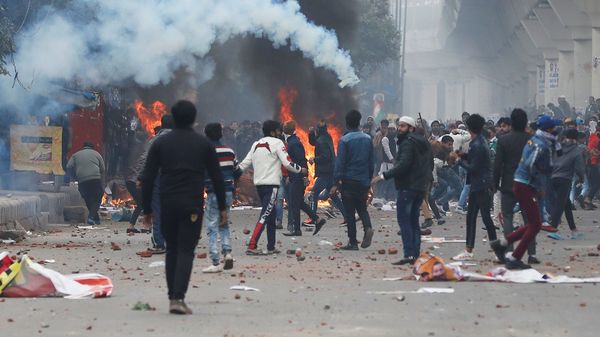
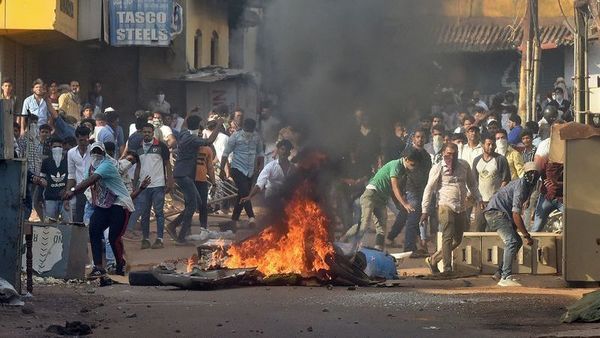
CAA protesters hurl stones on police in Mangaluru, Karnataka. (Photo: Reuters)
Kapil Sibal, the legal honcho of Congress, cannot figure out how the government will know whether Hindu immigrants were persecuted and Muslims were not. His problem is he has not witnessed the pogrom that Hindus have gone through in Bangladesh and Pakistan at regular intervals. Sikhs, Christians and Buddhists have not been far behind in suffering the same fate. Wish Sibal had listened to the horrifying account of two Christian families whom I met recently in the US. They had adopted Muslim names to survive for nearly thirty years but once Jesus tumbled out of their cupboard, life became a living hell for them. Subsequently, they escaped to the US via Mexico and are now US citizens.
Mindless Opposition to CAA
Opposition to the CAA in North East States is understandable to some
extent. People of the region have been victims of indiscriminate influx of
illegal immigrants — both Muslim and Hindus — who have adversely impacted
their demography, language, culture, property rights and electoral arithmetic.
They would naturally be apprehensive that another addition of 12 to 15 lakh
Hindu refugees to their population would further corrode their political,
social and cultural cohesiveness and eat into their economic resources.
Actually, this is more an imaginary fear than reality. Most of these refugees are abysmally poor, illiterate and are living in horrible conditions. They need help to merely survive without any uncertainty of their status. The violence unleashed by AASU (All Assam Students’ Union) etc. to get their voices heard is therefore unjustified. Look at what they have finally achieved. Four lives have been lost, hundreds of protesters are nursing injuries, public and private property worth crores of rupees lie destroyed and life has come to a standstill in many areas thereby disrupting supplies of essential commodities. Their leaders should have discussed their unease with the Prime Minister and Home Minister who would have surely found ways either to absorb the small numbers of CAA beneficiaries in the rest of the country or settle them in the North East, subject to acceptable local restrictions. They should have also realized that these beneficiaries were being offered citizenship of India and not for the states of the North East.
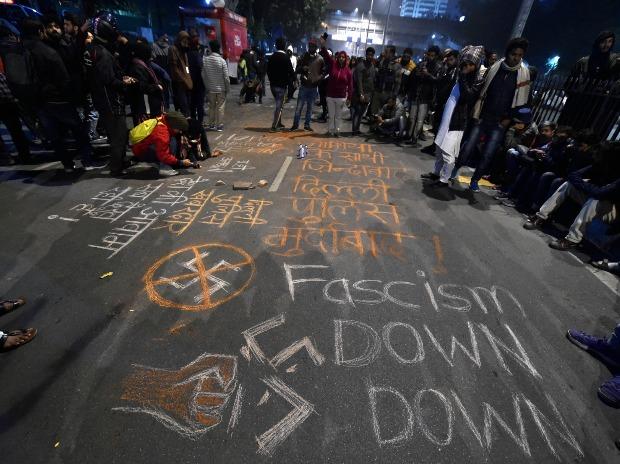
Graffiti against the Citizenship Amendment Act (CAA) on Delhi roads. (Photo: PTI)
However, the violent reaction in rest of the country is sheer madness. It has been obvious from day one that the Congress and its allies, TMC, SP, BSP and Leftists would not let the exclusion of illegal Muslims migrants from the CAA go unexploited. It was an issue ideally suited to inflame passions of Muslims to reap rich electoral dividends in future elections. Since they could not openly ask for giving citizenship to 1 crore and 65 lakh illegal Muslims in India, an ingenious campaign was set in motion to invite fire from Muslim organizations, Muslim students and clerics, saying that with CAA becoming a reality, NRC (National Register of Citizens of India) will follow next. Their statements cleverly camouflaged CAA and made it sound as NRC. After this, it became easier to enlist support of gullible Muslims who were told that 21 crore Muslims of the country will soon be asked to prove genuineness of their claim that they are Indian citizens and most of their claims will be rejected, leaving them with no choice but to live in India either as illegals or face forcible deportation to alien lands.
Vicious Campaign
This sinister propaganda was an instant hit. Muslims, duly propped up by
their cheer leaders among Hindus, have hit the roads in huge numbers. What
happened subsequently is a shame for any civilized society. Protesters littered
streets with stones and fire balls, burnt vehicles, destroyed government and
private properties, attacked policemen and paralyzed life. In a clever twist to
the plot, the police action in Jamia Millia Islamia and Aligarh Muslim Universities
were touted as an assault on students’ community, provoking students even of the
IITs and IIMs to come out of their classes to protest in solidarity for their comrade
in arms. No one had the appetite to know the circumstances in which Police
entered the campus and the action they took. No one was willing to restrain
themselves from spouting incendiary reactions till the inquiry was over. Maharashtra
Chief Minister on probation Uddhav Thackeray’s statement that police action in
Jamia Millia Islamia was similar to the massacre of Indians in Jallianwala Bagh,
Amritsar was just sickening.
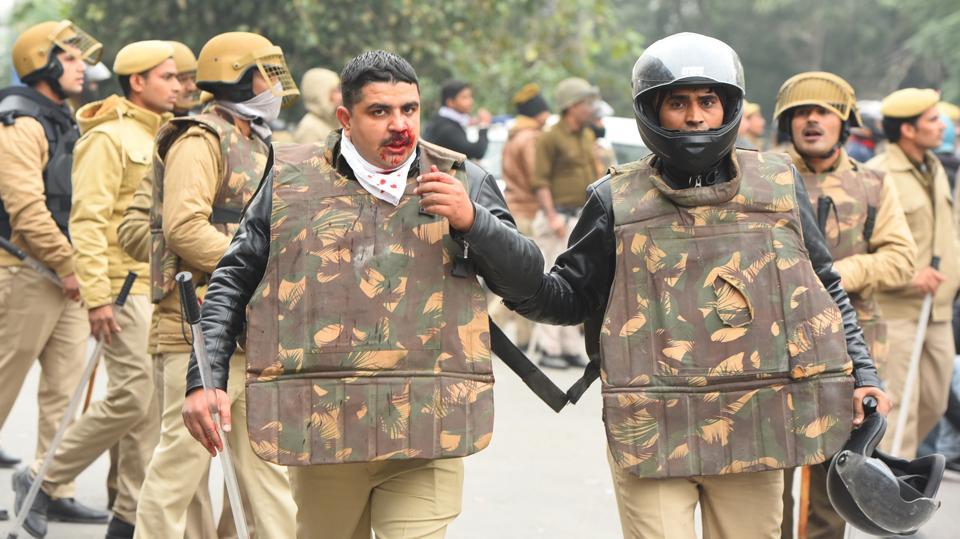
An injured policeman being taken away after he was hit by stones thrown by CAA protesters in Delhi. (Photo: HT)
The Jamia students cannot absolve themselves of the charge that they
were not responsible for riots and arson in their campuses and outside. The
politicians and activists also cannot say that they were marching peacefully
but trouble makers suddenly turned violent catching them by surprise. It is a
common knowledge that agitations are invariably hijacked by miscreants. If they
could not control the criminals, they had no business protesting. Instead, they
should have expressed dissent in writing or approached the courts for relief.
In the mayhem unleashed by protesters, no one seems to have a heart for
the persecuted Hindus, Christians, Sikhs and Parsis, Jains and Buddhists. No
one has heard a single voice from Muslims, pseudo-Hindu elites and non-BJP
political parties supporting the citizenship rights of the motely group of religiously
persecuted non-Muslims. Forget about the voice. Amarinder Singh, a Sikh Chief
Minister of Punjab, won’t accept persecuted Sikhs in his state. Mamata
Banerjee, Hindu Chief Minister of West Bengal, would allow implementation of CAA
only on her dead body. Pinarayi Vijayan, a Christian Chief Minister of Kerala, has
refused to take the persecuted Christians back in his state. Others who would
not accept these hapless non-Muslim refugees are Hindu Chief Ministers Kamal
Nath of MP, Bhupesh Baghel of Chhattisgarh and Ashok Gehlot of Rajasthan because
their party leadership doesn’t want to forego its share of Muslim votes. This
is not a season for sanity but grandstanding and false bravado.
Their defiance is indeed comical. How can these chief ministers refuse entry of CAA beneficiaries if they come looking for jobs, education etc. in their states? As citizens of India they can go anywhere to earn a living. What is their fear from these poor, neglected and abandoned lot? Unlike Rohingyas and Bangladeshi illegal migrants, they have never been involved in any crime or terror activities. And finally, how much difference will they make with their approximately 6 lakh effective votes to BJP’s electoral prospects? Hardly any.
Role of Police
The police have been the worst sufferers. They have actually nothing to do with CAA, NRC, votes or politics. Their job is only to ensure our safety. Why can’t politicians, students and Left-Liberals sort their problems out among themselves? Perhaps they cannot. So, the easiest way out for them is to flex muscles and suck the police in. As usual, police have been denounced as demons and barbaric for handling rioters and stone pelting students and insensitive for dealing with the likes of Ramchandra Guha. Jamia Milia Vice Chancellor says that police entered the university campus without permission. Is Jamia Milia outside the country where police cannot go in the hot pursuit of arsonists? Similar complaints are often heard from politicians, students, faculty members and university and college heads. There may be an informal understanding but there is no law that prevents police from entering campuses to deal with gherao of faculty members and vice-chancellors, destruction of university properties and seditious activities.
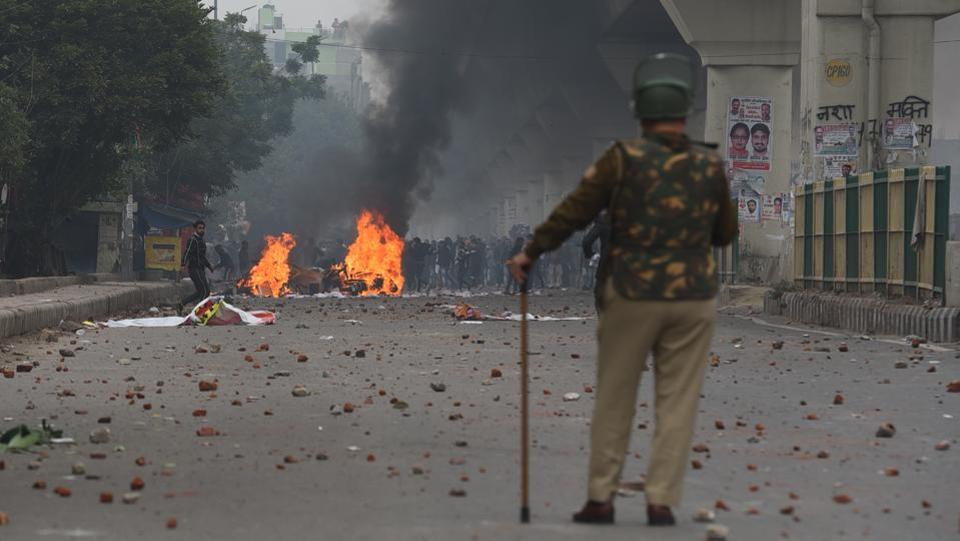
A lone policeman stands undeterred against the rioters and arsonists in Delhi. The protests were against the new citizenship act. (Photo: HT)
Salman Khurshid of Congress wanted Delhi Police to engage students in
dialogues and persuade them to return to their classes. He should know that it
the responsibility of teachers and leaders like him to drill sense in students.
The police cannot give any assurances on CAA. A retired DG (Director General) of
UP Police was fuming the other day on a television channel that police
mishandled the situation because it had no advance intelligence and made no preventive
arrests. He should have known that in a rapidly evolving agitation, advance
intelligence is a rarity. The event catches you by surprise, leaving you with no
room for planning and preventive arrests. You have to deal with it as it
surfaces promptly, and often harshly. Actually, the police seem to have been
extraordinarily circumspect in handling the rioters in Gujarat, UP, Karnataka
and Delhi, in particular. The outcome was there for everyone to see. The law
was in the rioters’ hand and police were throughout at the receiving end. It is
time the police leadership understands that a determined mob of criminals cannot
be controlled by persuasion and lathi charge. There is no need to hold fire
when rioters rule the streets.
CAA is there to stay. Hopefully, the Supreme Court will not derail the
effort of the incumbent NDA government to give a permanent home to those who
suffered continuous religious persecution and have nowhere to go. However, there
is an imminent need to educate people what CAA is all about, how NRC is
different from CAA, whether NRC for the country is coming at all and if so, in
which form. The criteria for the eligibility to Indian citizenship under the
NRC must also be widely publicized to help Muslims, in particular, understand
their folly and see through the game of unscrupulous politicians.
The Pakistan Army, which always believed that it owned the country is visibly upset today and it has good reasons for this, because what till yesterday was considered to be something unimaginable has actually started happening. The first blow to the army’s unqualified supremacy was dealt by a three-member bench headed by Pakistan’s Chief Justice Asif Saeed Khosa last month when it struck down the government order granting a three-year service extension to army chief Gen. Qamar Javed Bajwa. The second (and much bigger) shocker came just two days ago when a special court found former army chief Gen. Pervez Musharraf guilty of ‘high treason’ and sentenced him to death.
That the Pakistan Army would not allow the judiciary to
threaten its absolute
authority was a foregone conclusion and the Inter Services Public Relations
(ISPR) press release after Gen. Musharraf’s conviction says as much. In fact,
by stating that “…The due legal process seems to have been including
constitution of special court, denial of fundamental right of self defence,
undertaking individual specific proceedings and concluding the case in haste,” it
is apparent that the Pakistan Army has been so rattled by the court judgment
that it has acted rather irresponsibly by casting very serious aspersions of
judicial negligence and impropriety, which amounts to contempt of court.
Furthermore,
by mentioning that “Armed Forces of Pakistan expect that justice will be
dispensed in line with Constitution of Islamic Republic of Pakistan,” the ISPR
has on its own determined that the sentence passed by the special court is extrajudicial,
which again is outright contempt of court. What makes this statement weirder is
that the ISPR has limited the expectation–that justice will be dispensed in
line with Constitution of Islamic Republic of Pakistan– to the armed forces of
Pakistan only. Doesn’t each and every Pakistani also expect the same?
So, why
this unwarranted show of camaraderie, unless ISPR intentionally mentioned this to discreetly
convey to the judiciary that it needs to make amends to this verdict as the
army is very upset with the sentence awarded to its former chief!
The ISPR’s
press release has a hilarious side too. It presupposes that Gen Musharraf “can
surely never be a traitor” since he has been an “ex-army chief, Chairman Joint
Chief of Staff Committee and President of Pakistan, who has served the country
for over 40 years (and) fought wars for the defence of the country.” Now, if
Pakistan Army considers an officer’s rank and service profile as the barometer
of his loyalty, then why has a military court awarded life sentence to Lt. Gen.
(Retd.) Javed Iqbal Awan for having been involved in espionage
activities?
Lt. Gen. Awan’s service profile too is equally impressive.
He has been an instructor both in Pakistan Military Academy as well as Command
and Staff College and commanded the prestigious Rawalpindi-based 111 Brigade
(often referred to as the ‘coup brigade’), an infantry Division and the
Bahawalpur Corps. Besides being Colonel Commandant of Frontier Force Regiment, he
also held the prestigious appointments of Director General Military Operations (DGMO)
at General Headquarters, Rawalpindi. He has the distinction of having attended the
US Army War College course in Carlisle, Pennsylvania. He too has fought wars
for the defence of Pakistan.
So, if Musharraf’s service profile precludes his being a
“traitor,” then why hasn’t this same yardstick been applied to Lt. Gen. Awan?
With the army in full control in Pakistan, there’s just no
chance that Gen. Musharraf would ever be sent to the gallows. On the contrary,
Rawalpindi will go to any extent to ensure that the courts ultimately dismiss
the high treason case against their former chief even it amounts to interfering
with the judiciary (which is a reality that Justice Shaukat Aziz Siddiqui of
Islamabad High Court had revealed when he said that “Their (ISI) personnel
get benches formed at their will.”
Even Gen. Musharraf has himself admitted during a TV
interview that when he was placed on the exit control list, it was the army
“pressure” on the government and judiciary that enabled him to leave the
country. So there’s no reason to expect that Rawalpindi won’t bail him out yet
once again!
Postscript– In his address during the ‘Defence and
Martyr’s Day’ ceremony at GHQ Rawalpindi last year, Gen. Bajwa had said, “Democracy
cannot blossom without observing the democratic traditions in true spirit and
without the strengthening of institutions.” Just last month, during the
corps commanders conference held when Jamiat Ulema-e-Islam (JUIF) chief Maulana
Fazlur Rehman was holding a sit-in outside the Federal Capital, the army
chief once again reiterated that “Pakistan Army as organ of the state will
continue to support national institutions as and when asked as per constitution.”
So, now that the judiciary in Pakistan has refused to toe
the army’s line and is dispensing justice purely on merits of the case, what
needs to be seen is whether Gen. Bajwa will walk his moral talk about
strengthening and supporting institutional integrity!
When the Algerian Interior Minister, in a recent televised communique to the nation threatened the protesters who reject the disputed presidential elections, as, inter alia, “homosexuals” and “abnormal people,” the public were indeed outraged for what they perceived as an unforgivable insult to their dignity. But that reaction, from a different perspective, highlighted how a large swath of the population think in a negative way of homosexuals and other groups with unconventional sexual orientation. Some still uphold that homosexuals deserve no less than capital punishment as the Islamic jurisprudence clearly states. Some schools within the four Sunni schools of Islamic Jurisprudence even specify that homosexuals should be thrown from a high building. A practice carried out faithfully by ISIS within the region it had once controlled in Iraq, Syria and Libya.
The Minister of Interior, Salah Eddine Dahmoune, also made reference in his utterance to what he termed “abnormal people” which, according to the local and regional political discourse, usually refers to secular and “Westernized minds” who are regarded by the mainstream as heretics and outcasts for not endorsing Sharia Law. That statement and the peculiar language it made use of, is not an improvised angry reaction of a regime beginning to lose patience and thus resorting to casting aspersions on dissidents. Instead, it is seemingly a deliberate and conscious move as to convey a message of assurance ‘to whom it may concern’ about the side the regime is actually taking. And with other references through the statement to some influential Islamic ulema, like the Salafist scholar Abdelhamid Ben Badis, instead of Rousseau or Sartre as one might expect from a marked francophone bureaucracy, the Interior Minister steered the regime clear of the camp of La Laïcité (secularism) that once the army was one of its main pillars in the old days following the independence and specifically through the decade-long civil war of the 1990s. That reactionary attitude of the Algerian military regime came last in a series of attacks against plurality and religious freedom, such as the shutdown of an alarming number of churches, and the arrest of “41 people in recent days for waving the flag of the Amazigh community at demonstrations across the country or simply for having it in their possession,” according to a report by Amnesty International.
Algerians with their national flag during a protest earlier this year. (File Photo: Reuters)
However, the minister’s statement, if anything, reflects a deep understanding of Algerian society and its internal dynamics—that has undergone fundamental changes throughout the decades since the independence in 1962–where Islamist ideology and medieval values—which replaced Capital of Marx and the Arab nationalism of the 20th century—now form the main source from where the young population seeks its political meaning, its perception of reality and prospect of the future.
One of the main causes of the repetitive failures of popular uprisings across the MENA (Middle east North Africa) region lies not in the regimes’ ability to manipulate, plot, reorganize their cards and reinstate in place their cronies to preserve power—but essentially in the palpable lack of a mature political vision, a real philosophy of change that has always accompanied the profound and popular movements in modern history. There is an alarming absence of charismatic figures and cultivated leaders who can muster hundreds of thousands and expound in the clearest terms how they envision a future society, its political system, the main socio-political issues revolving around education, women’s status and freedom of conscience and expression, et cetera. And if we imagined ourselves in an Orwellian Farm we would say a rebellion in the absence of boars and porkers. Simply put, there is almost nothing to offer as the society has become intellectually hollowed.
Unlike the iconic figures of the 1960-70s where universities
and trade unions were proliferating eloquent orators and well-read speakers
along the left-right spectrum, both men and women—today fundamentalism and
social conservatism has dashed the individual ability to be creative and
innovative in communicating deep ideas and elaborated political messages, and
making good use of the visual art through the exhibition of political artworks,
thought-provoking posters, and deep-meaning slogans. The main slogans of the
uprisings throughout the Arab world remain extremely basic.
42 weeks into the Algerian hirak, or the movement in
Arabic, and still hasn’t yet been able to produce such outstanding figures with
whom it can exhibit itself to the outside world and have a face-to-face debate
with the ruling military junta, thus creating a vacuum to be only capitalized
on by the old guard.
Algerians have been taking to the streets qualifying Friday
(like their counterparts across the region) as the preferable day for
protesting specifically for its religious significance, and to stress
practically that the movement is in no way in favour of the jurisprudential
concept of separating the Mosque and the State if not reinforcing an already
existing formal relationship between the two—as the crowds pour directly from
Friday sermons on to the political street. If that was the goal, the regime is
all but ready to sacrifice all that remain in his old secular reservoir.
Raja Farooq Haider Khan, the
puppet prime minister of Pakistan-Occupied Kashmir (POK) recently said that, “I
may be the last prime minister of Azad Jammu and Kashmir (AJK).” AJK is the
fallacious name that has been given to such territories of the princely state
of Jammu and Kashmir that have remained under illegal occupation of Pakistan
since India’s independence.
Pakistan cleverly and
maliciously divided the occupied territories into two parts to ensure better
control. The part contiguous to Poonch and Kashmir Valley, comprising of
Muzaffarabad, Mirpur, Kotli etc, which had a population of Kashmiris, Sikhs and
others was named AJK. The much bigger part comprising of Gilgit and Baltistan,
which had a predominant Shia population having affinity with the people of
Kargil, was named Northern Areas.
AJK, as the name suggests, was projected by Pakistan as a separate state with its own President and Prime Minister running an autonomous government. In actuality the region was administered by the federal government through a draconian Ministry of Kashmir Affairs which held all financial, judicial and administrative powers. The local administration and its heads were mere puppets. It is not without reason that the AJK government was always from the party that was ruling Pakistan, such is the level of rigging that is carried out during the sham elections. Raja Farooq Haider Khan belongs to the PML(N) which was in power in Pakistan in 2016 when elections were held in this so-called Azad Jammu and Kashmir (AJK). Prime Minister Imran Khan is now waiting for an opportunity to dislodge him.
Pakistan has played a very
duplicitous and immoral game in the Northern Areas. It made out a case that
these people would have an option to decide whether they would like to go with
India or with Pakistan or remain independent. Till such time that a decision
came by, they would remain under administrative control of Pakistan. So
Northern Areas are directly controlled by Pakistan. It treats these areas like
a colony and has illegally given away huge areas in the Shaksgam Valley to
China and has also built the China-Pakistan Economic Corridor (CPEC) illegally
through this area. In recent times Pakistan has been immorally trying to
amalgamate the Northern Areas as a sixth Province of the country after renaming
it as Gilgit-Baltistan. It has not been able to do so due to massive protests
by the people and international pressure built through the diaspora.
Now, it seems that Pakistan
has opened a can of worms in this so-called Azad Jammu and Kashmir (AJK) as
well. The statement made by the puppet prime minister Raja Farooq Haider Khan gives
an indication of plans being afoot to devour this region also. Another
indicator that things are not well came in the form of a notification by the
puppet government of AJK in which the AJK Management Board has been renamed as J&K
Administrative Service. The PM has asked for immediate withdrawal of
notification and issue of apology, but the damage has already been done.
The result is widespread panic
in the region. Opposition leaders in so-called AJK have asked for clarification
from the puppet prime minister and transparency in whatever happens further. Latif Akbar, leader of the Pakistan People’s Party
that is presently in opposition has said that the statement of the prime
minister was, “poisonous for the entire Kashmiri Nation,” since it would lead
to a permanent division of the region and would amount to treachery by Pakistan
with the people of Kashmir who have made many sacrifices for the cause. Latif
also demanded that the Prime Minister convene an All Party Conference (APC) to
address the development and discuss counter measures.
The panic reaction of the
locals is quite understandable since such a move will strip the region of its
very identity, however fragile it may be. There have been protests but the same
have been brutally suppressed by the Pakistan Army. The Inter-Services
Intelligence (ISI) of the Pakistan Army continues to have an iron grip on the
affairs in the region.
PM Imran Khan has been under
pressure to act against India. Not many are satisfied with his measures and
have started raising questions. This could well be his method to remove the
heat from himself.
Strategic experts in India
have also expressed concern since the move comes across as a tit-for-tat measure
to counter India’s very righteous and constitutional reorganisation of its
state of Jammu and Kashmir into two Union Territories. Experts are of the view
that the Pakistan Army Chief, Gen. Qamar Bajwa, wishes to gain complete
legislative control of the occupied territories and then convert the Line of
Control (LOC) into a permanent border. Such a move will put restrictions on
Indian military action across the LOC since it would amount to breaching the
sovereignty of the neighbouring country. He will, however, continue with
nefarious terrorist activities and Proxy War against India as before. In other
words, Pakistan fears the possibility of getting into an open conflict with
India which may entail some strategic setbacks for the country and also loss of
face, something that it’s grappling with after the Uri Surgical strike and the
Balakot Air Strike.
India is quite clear that the
occupied territories are an unfinished agenda of the partition and they have to
be taken back at the earliest. India’s determination is reflected by the map
that the country has issued after the creation of two regional Union
Territories. The map shows POK areas with the Union Territory of Jammu and
Kashmir and Gilgit-Baltistan with the Union Territory of Ladakh. “POK is part of India and we expect one day we will
have physical jurisdiction over it,” is an emphatic statement recently made by
the Indian Union Minister for External Affairs, Dr. S. Jaishankar.
Pakistan is
already facing huge financial, political and internal security challenges. Its
beleaguered government is in no position to play dubious games in the occupied
territories. The backlash may be such that the government is unable to control.
I hope that better sense will prevail before it’s too late for them.
In a big decision with major ramifications to the Tata Group, the former ousted executive chairman of the Tata Group, Cyrus Mistry has been reinstated to the post by the National Company Law Appellate Tribunal (NCLAT) on Wednesday. The NCLAT has ruled that the appointment of N Chandrasekaran, the current chairman, was illegal.
The decision also throws questions on the company’s corporate governance standards.
However the Tatas would get four weeks to file an appeal. Mistry’s reinstatement will kick in only after four weeks.
Mistry, who took over as the sixth chairman of Tata Sons after Ratan Tata, was removed all of a sudden in October 2016.
Since then the two have been entangled in a legal battle.
On December 9, Pakistani security forces set free four Balochi women whom they had picked up from their homes in Awaran district on November 30. But the real reason behind this release wasn’t compassion or magnanimity by the government of Pakistan on the eve of International Human Rights Day 2019. It was only because Sardar Akhtar Mengal, the chief of Balochistan National Party (Mengal) that is a coalition partner of the ruling Pakistan Tehreek-e-Insaf party, had personally intervened and sent out an unambiguous warning that “We do not see the point of being a partner of this government if it refuses to address our genuine concerns.”
These four women were indeed very lucky because Balochistan is infamous for what Unrepresented Nations & Peoples Organisation (UNPO) refers to Pakistan’s “kill and dump” policy and this traumatising phrase is no exaggeration. Human Rights Commission of Pakistan (HRCP)-2013 report states that there are “credible reports of continued serious human rights violations, including (enforced) disappearances of people, arbitrary arrests, torture and extrajudicial killings.” The same things are echoed in Human Rights Watch (HRW) World Report 2019 on Pakistan, which observes that “During counter-terrorism operations, Pakistani security forces often are responsible for serious human rights violations including torture, enforced disappearances, detention without charge, and extrajudicial killings, according to Pakistan human rights defenders and defense lawyers.”
Unfortunately, human rights violations by Pakistani security forces and law enforcement agencies operating in Balochistan are neither rare aberrations nor restricted to lower echelons within the establishment. Au contraire, the 2019 HRW report notes that “counter-terrorism laws also continue to be misused as an instrument of political coercion. Authorities do not allow independent monitoring of trials in military courts and many defendants are denied the right to a fair trial.” The report presents a harrowing picture by stating that “…From the public point of view, enforced disappearances is still the biggest issue in Balochistan. Incidents of disappearance continue unabated and, in most cases, victims’ families are afraid of communicating their cases to the authorities. The fact that Dr Abdul Malik Baloch who was the Chief Minister of Balochistan from 2013 to 2015 has gone on record to say that “When the army is attacked, it will hit back,” just goes to prove how formidable and vengeful Pakistan’s deep state is!
Another insight into how well entrenched and institutionalised human rights violations are in Balochistan can be gauged from HRW’s Pakistan report 2011. In it there is a mention of 76 year old Secretary General of the Baloch Republican Party Bashir Azeem who during his “unacknowledged detention” was told by a Pakistani official that, “Even if the President or Chief Justice tells us to release you, we won’t. We can torture you, or kill you, or keep you for years at our will. It is only the Army Chief and the (ISI) Chief that we obey!” This report also notes that “These (enforced) disappearances take place in a province in which armed militants, particularly Baloch nationalist armed groups, have attacked security forces and military bases throughout the province” and this makes it evident that Pakistan Army is using the strategy of ‘enforced disappearances’ both to deter attacks and as an institutionalised form of vendetta!
Baloch women protest against the “kill and dump” policy of Pakistan Army.
One of the most disturbing instances of ‘enforced disappearance’ came to light in January 2014 when a shepherd stumbled upon a mass grave in Totak area of Khuzdar district in Balochistan, which according to media reports contained about 100 dead bodies. The judicial inquiry that probed this case not only gave the Pakistan Army and intelligence agencies a clean chit but also failed to identify the killers. The pathetic part is that instead of displaying investigative and deductive skills, the judicial inquiry admitted that it had arrived at its conclusion just because “No one has recorded any statement against the armed forces and security agencies.” No wonder Human Rights Commission of Pakistan (HRCP) Chairperson Ms. Zohra Yusuf told reporters that “The government has also not allowed the HRCP mission to visit the site, despite several written and verbal requests” and attacked the government by calling this “just another” judicial report. Eight years have gone by, but the perpetrators who murdered the Balochis whose remains were found in the mass grave have not yet been identified and the reason is not hard to guess!
A report published by BBC News in 2016 contains shocking
data of ‘kill and dump’ incidents. A few of these are:
Pakistan’s Federal Ministry
of Human Rights has confirmed that at least 936 dead bodies have been found in
Balochistan since 2011.
The Voice for Baloch
Missing Persons (VBMP) has recorded 1,200 cases of “dumped bodies,” but this
list is not exhaustive as it does not include people who have been victims of
‘enforced disappearances” and whose remains haven’t yet been found.
A political activist named Jalil
Reki, who lived in the Saryab neighbourhood of Quetta was arrested from his
residence in 2009. No one knew where he was taken but two years later, his
bullet ridden body with fractured arms and cigarette burns on his back were
found in Mand area (near the Iranian border) which is at a distance of more
than 1000 km from Quetta (from where he was arrested)!
Balochistan has been bleeding continuously for the last
seven decades but the world doesn’t seem to have either the time or inclination
to do something to ameliorate the sufferings of its oppressed people who are
hapless victims of state-sponsored terrorism. By resorting to aerial
bombardment of Balochi settlements, the Pakistan Army has declared an all-out
war against its own people while its complicity in orchestrating ‘enforced
disappearances’ and active pursuance of the ‘kill and dump’ policy is in gross
violation of human rights and international law.
The mission statement of the Office of the United Nations
High Commissioner for Human Rights (OHCHR) is “to work for the protection of
all human rights for all people” and while doing so, “give priority to
addressing the most pressing human rights violations, both acute and chronic,
particularly those that put life in imminent peril.” So, any further inaction on
the part of the international community in forcing Pakistan Army to end atrocities
on innocent civilians in Balochistan will only make the OHCHR defunct! The
whole world accepts that instances of ‘enforced disappearances’ as well as
‘kill and dump’ cases are common place in Balochistan, but yet, these
unspeakable atrocities have failed to stir the collective conscience of the
international community and this is shameful.
How many more people must die in Balochistan before the
OHCHR wakes up to this humungous human tragedy?
Postscript- In his tweet to the ‘umma’ (entire Muslim community), Prime Minister Imran Khan wrote “On international Human Rights Day, Muslims need to remember that the message of equality, justice & protection of human rights for all was given more than 1,400 years ago by our Prophet (PBUH).” Whereas this reminder is a very noble gesture, but the question everyone would like to ask PM Imran Khan is, “In Balochistan, when will the Pakistan Army start following the message of justice and protection of human rights given by the Prophet (PBUH)?
Dr. Allah Nazar Baloch, pro-independence leader of Balochistan, has condemned the kidnapping of Baloch women from Quetta and said that the occupying state of Pakistan is targeting the Baloch women after facing defeat at the hands of Baloch freedom fighters. “Pakistan is committing war crimes in broad daylight and before the eyes of the world. We do not ask our enemy to release the freedom fighters and political workers, but we have always said that the world should bind Pakistan to respect the laws of war. We have repeatedly appealed to the world to force Pakistan to abide by the laws of war, but in return, we are getting our women, children and the elderly abducted and killed by Pakistan’s armed forces,” Dr Allah Nazar Baloch said in a statement.
He further added, “The kidnapping and disappearance of women, little children and the Baloch elderly from Quetta is a clear sign of the continuation of the collective punishment policy by Pakistan through guns which shows its utter disregard for international laws of war.” Dr Allah Nazar further explained: “When we talk of any law, it should not be limited to the creation of the law, but it is the creators’ responsibility to enforce it. Similarly, when we talk of war laws or United Nations’ conventions, it is the UN’s responsibility to bind the signatories to enforce those laws. But surprisingly, the international community with regard to Pakistan, including the United Nations, is clearly oblivious of its duties, which is costing the Baloch people with their lives, livelihood and honor.” He added that under the policy of collective punishment, not only women from different areas are taken away from their homes but they also suffer the torture at secret prisons for a long time. Occasionally a few are released, and in most cases, they are kept as prisoners forever.
Seven year old Amin (son of Haji Dost Ali Bugti), Izzaton Bibi (daughter of Malha Bugti), Murad Khatoon (daughter of Nizgho Bugti), Mahnaz Bibi (daughter of Fareed Bugti), 60-year-old Haji Dost Ali (son of Malook Bugti) and 80-year-old Farid Bugti were abducted and their only crime was that they were Baloch. “Being a Baloch is a crime punishable by death and torture in Pakistani military camps according to the constitution of Pakistan. Sadly we use the term “missing person” while knowing clearly where the people really are. We have to stop using such words. Because all people with brains have no doubt that they are imprisoned in the illegal slaughterhouses of the Pakistani Army. And only those people can know what they are enduring in those dungeons,” the statement from Dr Allah Nazar reads further.
He asserted, “The kidnapping of women and children is a policy of collective punishment. Under this policy Pakistan is trying to crush the Baloch national movement forever by destroying the Baloch nation. Thousands of Baloch have gone missing in the hands of Pakistan and thousands have already been martyred. Women, children and the unarmed people are protected under every law of the world in any situation. But Pakistan is an unnatural state which is based on lies. That is why the Baloch have to fight against the brutality of Pakistan with collective force.”
Dr Allah Nazar Baloch’s statement further adds: “Pakistan neither has its own culture nor any specific identity. Also till date we have not seen any historical or any great personality in Pakistan who has supported the truth against its state policies. Ironically, whom they call a great leader was a salaried professional lawyer of the Baloch state who deceived his client and issued a decree to occupy Balochistan. It is merely wishful thinking to hope for justice from such a state. It is the responsibility of the international community to take practical steps to keep Pakistan at bay from committing obvious war crimes in Balochistan.”
The Minister for Communications, Law & Justice and
Electronics and Information Technology, Ravi Shankar Prasad has said that the
National Broadband Mission is to fulfill all aspirations of the people and
enables fast track growth of digital communication infrastructure. He was
addressing the gathering after launching the National Broadband Mission (NBM). The
Minister of State for Communications, Human Resources Development and
Electronics & Information Technology, Sanjay Shamrao Dhotre, the Secretary
(Telecom), Anshu Prakash and other senior officials were present on the
occasion. A large number of representatives from the telecom industry, officers
from various Ministries of the Government of India, various State Governments
and senior officers of the Department of Telecommunications participated in the
event.
Ravi Shankar Prasad also launched the Logo of the NBM, and a Booklet on this occasion.
The vision of the NBM is to fast track growth of digital
communications infrastructure, bridge the digital divide, facilitate digital
empowerment and inclusion and provide affordable and universal access of
broadband for all. Some of the objectives of the Mission which is structured
with strong emphasis on the three principles of universality, affordability and
quality are:
Broadband access to all villages by 2022
Facilitate universal and equitable access to
broadband services for across the country and especially in rural and remote
areas
Laying of incremental 30 lakhs route km of
Optical Fiber Cable and increase in tower density from 0.42 to 1.0 tower per
thousand of population by 2024
Significantly improve quality of services for
mobile and internet
Develop innovative implementation models for
Right of Way (RoW) and to work with States/UTs for having consistent policies
pertaining to expansion of digital infrastructure including for RoW approvals
required for laying of OFC
Develop a Broadband Readiness Index (BRI) to
measure the availability of digital communications infrastructure and conducive
policy ecosystem within a State/UT.
Creation of a digital fiber map of the Digital
Communications network and infrastructure, including Optical Fiber Cables and
Towers, across the country
Investment from stakeholders of USD 100 billion
(Rs 7 Lakh Crore) including Rs 70,000 crore from Universal Service Obligation
Fund (USOF)
Address policy and regulatory changes required
to accelerate the expansion and creation of digital infrastructure and services
Work with all stakeholders including the
concerned Ministries / Departments/ Agencies, and Ministry of Finance, for
enabling investments for the Mission
We use cookies on our website to give you the most relevant experience by remembering your preferences and repeat visits. By clicking “Accept All”, you consent to the use of ALL the cookies. However, you may visit "Cookie Settings" to provide a controlled consent.
This website uses cookies to improve your experience while you navigate through the website. Out of these, the cookies that are categorized as necessary are stored on your browser as they are essential for the working of basic functionalities of the website. We also use third-party cookies that help us analyze and understand how you use this website. These cookies will be stored in your browser only with your consent. You also have the option to opt-out of these cookies. But opting out of some of these cookies may affect your browsing experience.
Functional cookies help to perform certain functionalities like sharing the content of the website on social media platforms, collect feedbacks, and other third-party features.
Performance cookies are used to understand and analyze the key performance indexes of the website which helps in delivering a better user experience for the visitors.
Analytical cookies are used to understand how visitors interact with the website. These cookies help provide information on metrics the number of visitors, bounce rate, traffic source, etc.
Advertisement cookies are used to provide visitors with relevant ads and marketing campaigns. These cookies track visitors across websites and collect information to provide customized ads.
Necessary cookies are absolutely essential for the website to function properly. These cookies ensure basic functionalities and security features of the website, anonymously.
Cookie
Duration
Description
cookielawinfo-checkbox-analytics
11 months
This cookie is set by GDPR Cookie Consent plugin. The cookie is used to store the user consent for the cookies in the category "Analytics".
cookielawinfo-checkbox-functional
11 months
The cookie is set by GDPR cookie consent to record the user consent for the cookies in the category "Functional".
cookielawinfo-checkbox-necessary
11 months
This cookie is set by GDPR Cookie Consent plugin. The cookies is used to store the user consent for the cookies in the category "Necessary".
cookielawinfo-checkbox-others
11 months
This cookie is set by GDPR Cookie Consent plugin. The cookie is used to store the user consent for the cookies in the category "Other.
cookielawinfo-checkbox-performance
11 months
This cookie is set by GDPR Cookie Consent plugin. The cookie is used to store the user consent for the cookies in the category "Performance".
viewed_cookie_policy
11 months
The cookie is set by the GDPR Cookie Consent plugin and is used to store whether or not user has consented to the use of cookies. It does not store any personal data.