Scott Douglas Jacobsen: In brief, what is your family background?
Ensaf
Haidar: I was a Saudi
woman before I became a Canadian citizen. I was born to a conservative family
in Saudi Arabia.
Jacobsen:
What is your personal
background?
Haidar:
My name is Ensaf
Haidar, wife of prisoner of conscience Raif Badawi, imprisoned in Saudi Arabia,
mother of three children, and a Canadian citizen living in the Canadian
province of Quebec.
Jacobsen:
How did these influence your
development?
Haidar:
Certainly, memorization
of the Quran during my studies had a big impact. I even specialized in Islamic
Studies in college.
Jacobsen:
For those who may not
know, who is Raif Badawi?
Haidar:
Unfortunately, everyone
is afraid and the prisons are full of writers.
Jacobsen:
How is Canada’s
leadership helping persecuted writers in some ways and not in others?
Haidar:
I think that the
politicians in Canada are doing a wonderful job. Canada has always been strong
and open about defending human rights, not only in Saudi Arabia, but all over
the world.
Jacobsen: Why do theocracies fear writers?
Haidar: Your question reminded
me of a famous quote by an atheist Saudi writer named Abdullah al-Qasemi, who
said that the worst thing about the religious is that they tolerate the corrupt
and don’t tolerate the intellectuals.
The
pen is more powerful than bullets in the Arab and Islamic world.
Jacobsen:
How are you feeling
given the distance of the man you love?
Haidar:
There are no words in
the world that can possibly describe my feelings about Raif and what is
happening to him.
Jacobsen:
What else can be done
to save the lives and protect the rights of writers and dissidents around the
world?
Haidar:
Speak up loudly – have
the conversation everywhere, at every opportunity. Urge politicians to embrace
human rights issues.
Jacobsen: Thank you for the opportunity and your time, Ensaf.
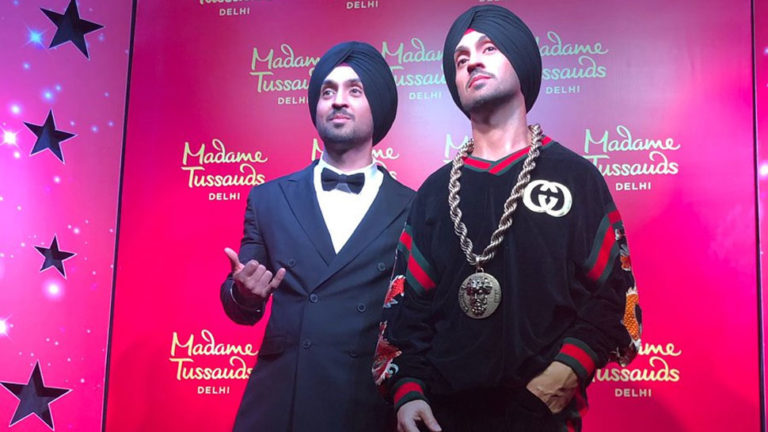
Actor and singer Diljit
Dosanjh on Thursday unveiled his wax figure at Madame Tussauds Museum in New
Delhi. The actor said it was a special moment for him as this is the first wax
statue of a personality sporting a turban, and it was a dream come true for
him.
“I never thought that I
would visit Madame Tussauds to unveil my own wax figure. Today, I got to know
how I actually look. A big thank you to the team of Madame Tussauds who have
worked so hard. It is a big moment for me and my fans that a man wearing a
turban and representing Sikh culture has a wax statue here for the first
time,” Diljit told reporters.
He recalled passing through
London’s Madame Tussauds and wondering what was inside the museum. “I saw
a long queue outside the museum and I asked my friend ‘What is inside?’. I come
from a village and I had never seen such things before. At that point of time,
I really wished to get inside the museum and today I am a part of the
family.”
The actor has joined the
likes of Asha Bhonsle, Virat Kohli, Anil Kapoor, David Beckham, Sachin
Tendulkar, Shreya Ghoshal, Sonu Nigam, Beyonce and Lady Gaga, among others to
have their figures at the museum.
As noted by linguist and prominent general atheist — in general terms with specifications based on what is exactly being denied — Noam Chomsky, the nature of the Young Earth Creationism and Evolution controversy simply remains within the sociopolitical realm, in which the controversy should, in fact, shift to that which has a large number of evidence: unlike Young Earth Creationism, which has none.
The shift of the conversation should be into Malignant Design, for which, by some metrics described by Chomsky, has much more evidence than some aspects of either theory, of which the former, Young Earth Creationism, has none and the latter, Evolution by Natural Selection, has plenty.
Malignant Design has more evidence in terms of the level of suffering in the world, whether by human machinations, e.g., conspiracy, war, bad medicine, apparently anti-vaccination now, and so on, or strictly non-conscious mechanical processes of the natural world, e.g., storms, tornadoes ripping through communities, pestilences, deadly diseases, infections, and so on.
Chomsky, in the Khaleej Times, stated, “Unlike Intelligent Design, for which the evidence is zero, malignant design has tons of empirical evidence, much more than Darwinian evolution, by some criteria: the world’s cruelty. Be that as it may, the background of the current evolution/intelligent design controversy is the widespread rejection of science, a phenomenon with deep roots in American history that has been cynically exploited for narrow political gain during the last quarter-century. Intelligent Design raises the question whether it is intelligent to disregard scientific evidence about matters of supreme importance to the nation and world — like global warming.”
The issue of the world’s suffering is tracing the motivations and consequences of the pain and misery seen throughout the world due to human actions and decision, policies, initiatives and programs, and failures to plan ahead and prepare for likely disasters, but also having appropriate scientific investigation and widespread-enough comprehension of the reasons for actions of the material world and then how certain disasters can impact human livelihood; each of these angles is important in order to, in a rational manner, deal with the problems confronting us. The reasons may be irrational, as in human motivations and fear, but the consequences and investigations of the irrationalities can be rational; with the natural world, it is simply not fooling ourselves and having specific tools in place, including the scientific method, to properly know the world to respond in a rational way to the likely consequences of natural phenomenon of the world impacting us.
Malignant design, if one is to notice the world’s suffering, akin to knowledge about mutual aid, is an important adjunct to knowledge of evolution, as a factor in evolution.
“Demonetisation” is shown within double inverted commas since the 8th November 2016 action / process followed is not Demonetisation as defined in true macro-economic parlance.
Also – and more importantly – because the RBI Act, 1934 itself does not contain this term “Demonetisation” anywhere.
Though the subject of “Demonetisation” was national news way back in November 2016, the matter has gained fresh importance since the startling revelations of the Minutes of the Meeting of RBI’s Central Board of Directors held on 8th November 2016, became public knowledge as recently as 8th March 2019 when RTI Activists did the nation a great favour by pursuing the official procurement of this vital document from RBI and publishing these Minutes for the benefit of our public. The valuable content of these Minutes provide specific details of the steps preceding the announcement of Demonetisation by the Prime Minister on 8th November 2016. It also helps gain insight into the propriety of actions taken by the Government and their compliance with the prescriptions contained in the RBI Act of 1934 and in the RBI Regulations, 1949 which are adjunct to the main Act.
As is well-known, the ultimate responsibility of managing the country’s monetary resources rests with the RBI, which is required to follow the Act and Regulations referred above. Also, the Government of India is expected to conduct itself in a manner which respects and complies with the RBI Act in all matters relating to our Country’s Monetary Policies and Practices.
We shall now dwell deep into each of the important issues concerning the actions of the Government of India in respect of “Demonetisation”. It is important for intelligent nationalists to review the actions of the Government in order to attain a proper understanding of the propriety of the Government’s actions and gauge their enduring impact and value on our economy and on the lives of our people.
Before proceeding, it is clarified that this analysis is not intended to criticise the Government or its actions. It is purely a macro-economic analysis of the actions of the Government viewed against the back drop of prescribed Legal and Administrative processes which ought to have been followed. If these aspects were not dealt with in accordance with the RBI Act, it is up to the thinking public to draw judgment on the entire exercise and voice their collective opinion resulting from a careful comprehension of the various points explained below in an unbiased and professional manner.
Several Key Documents are attached to this submission:
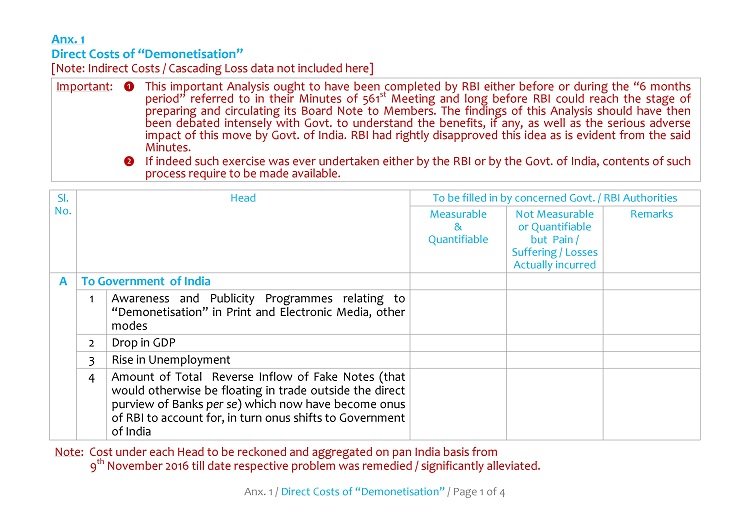
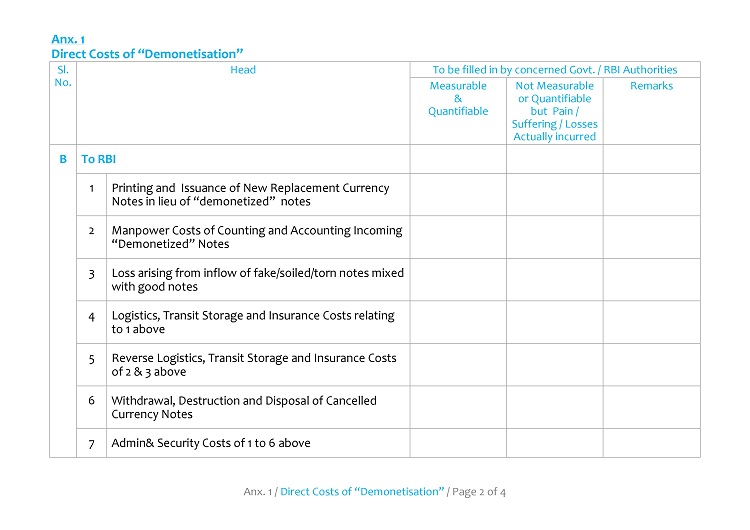
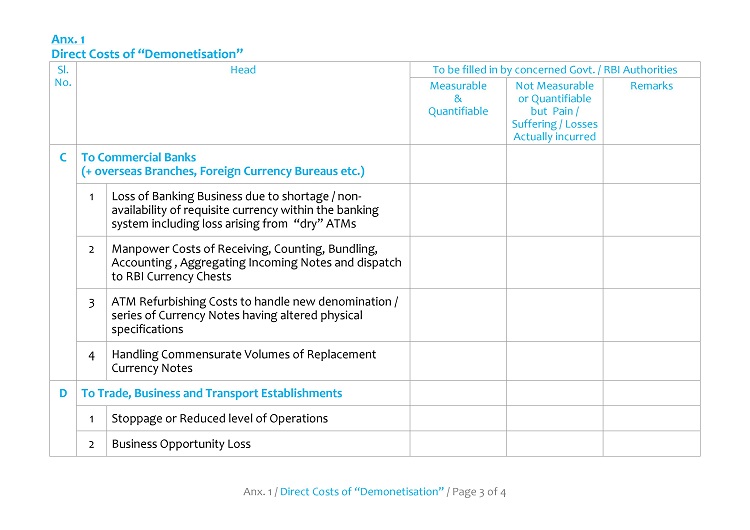
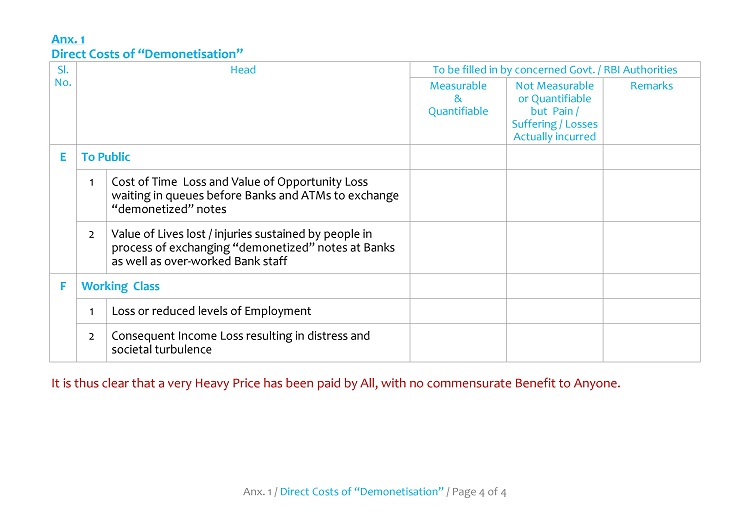
Annexure 1 is a Chart titled: “Direct Costs of Demonetisation”. Its data is to be filled in by the concerned Authorities to quantify, wherever possible, the extent of loss/physical damage caused by “Demonetisation”. Many of the events of loss/damage can be measured in monetary terms. We have catalogued the illustrative list of losses under various heads with the desire and expectation that concerned Authorities will do justice by providing the requisite data. However, many of these data can be expressed only in non-monetary terms. It is necessary to understand the aggregate damage caused to the country and its people by this action of the Government. Of course, readers are also free to contribute in this regard.
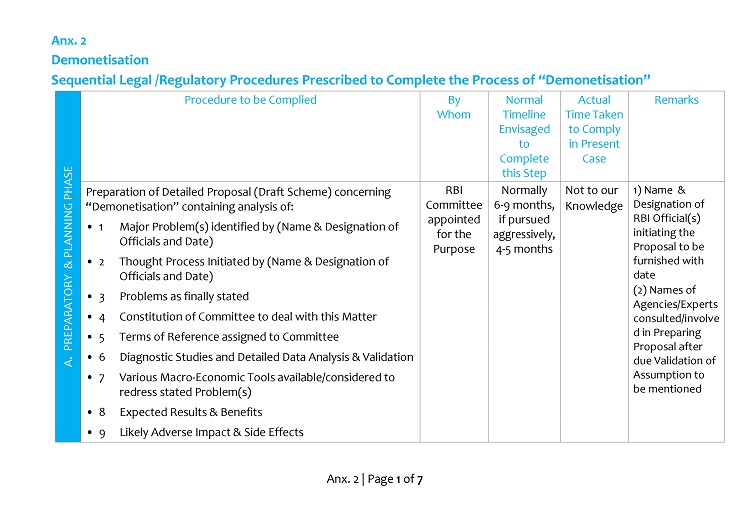
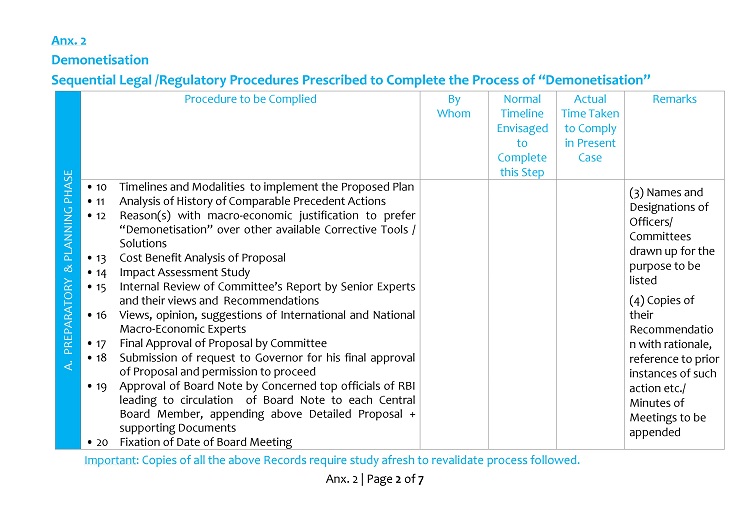
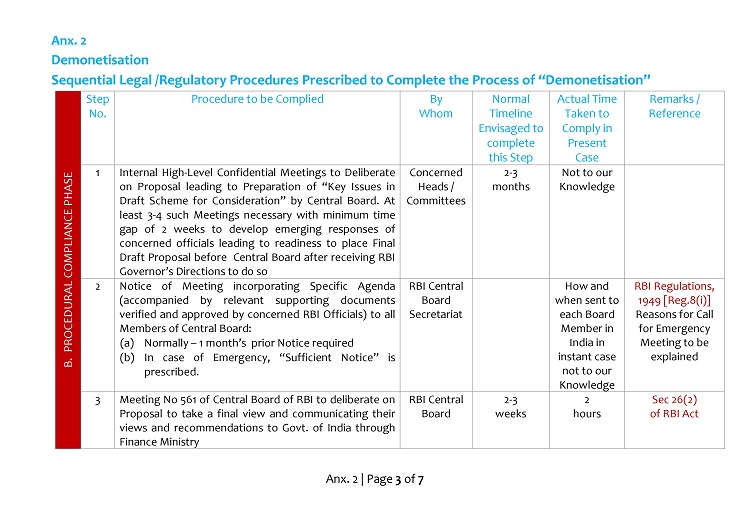
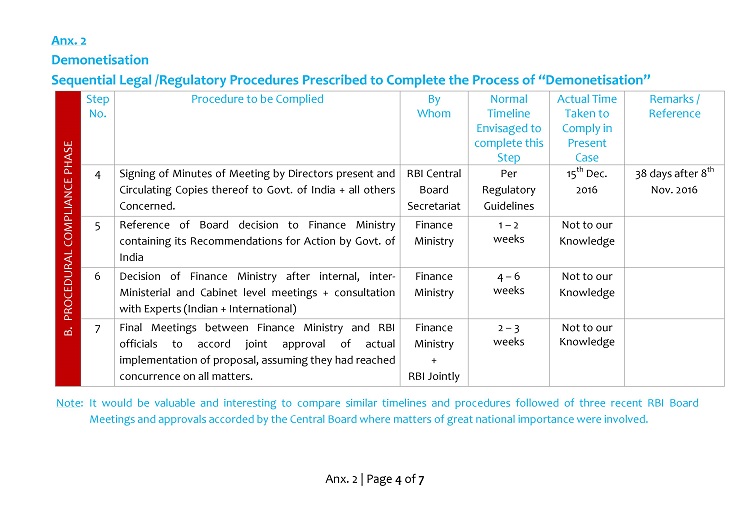
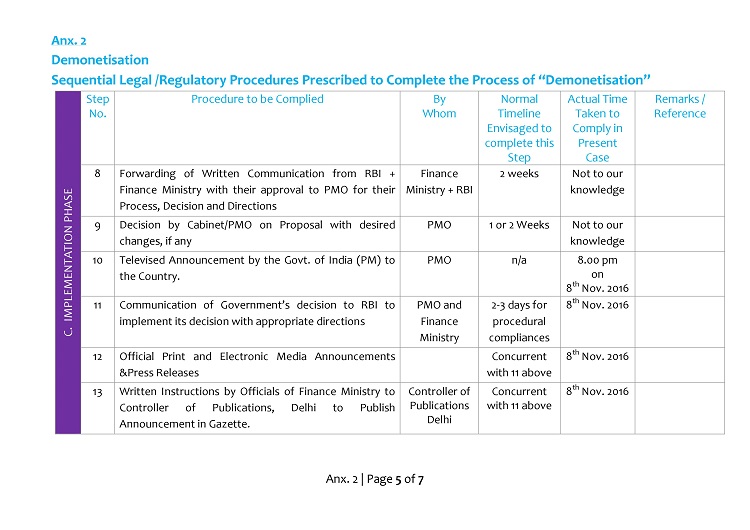
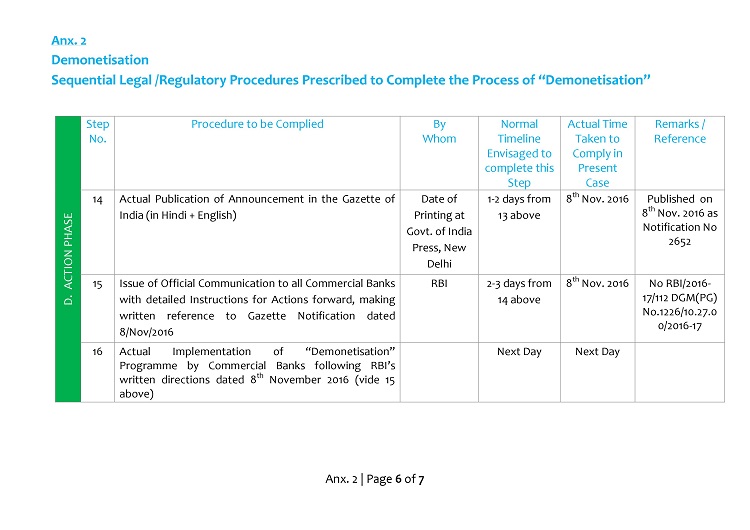
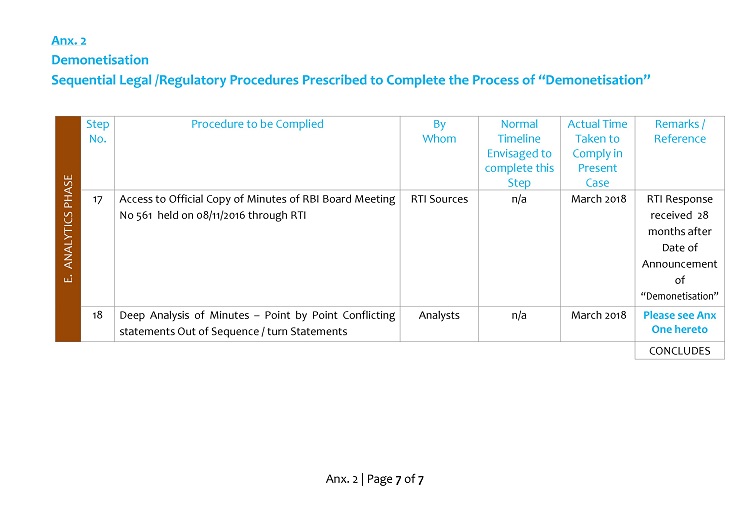
Annexure 2 is titled: “Sequential Legal Regulatory Procedures Prescribed to Complete the Process of “Demonetisation”. This contains a lucid description of various aspects of “Demonetisation” and is intended to help readers gain an in-depth knowledge of the specific legal provisions and administrative compliances which ought to have been followed both by the RBI as well as the Govt. of India during the four Main Phases of this initiative. If either of them had — fully or partially — neglected or failed to follow these legal prescriptions, in all fairness, they owe a satisfactory explanation to Parliament and to the people of India on every point which has been dealt with herein.
A purely professional assessment of the actions leading to the announcement of 8th November 2016 by the Prime Minister clearly indicates gross neglect and violation of relevant provisions of the RBI Act and related Regulations. This is an impartial assessment and is not intended to criticize or blame the actions of those concerned.
According to Section 26(2) of RBI Act, it is only based on the recommendations of the Central Board of RBI to the Central Government that “the latter may by Notification in the Gazette of India declare that with effect from the date(s) specified therein any series of bank notes of any denomination shall cease to be legal tender save at such office or agency of the Bank and to such extent as may be specified in the Notification”.
The term “office or agency” of the RBI is explained in Section 6 of the Act. However, the term “agency” of the Bank requires careful understanding as this is not specifically defined in the Act.
Regulation 8 of the RBI General Regulations 1949 specifies that one clear month’s notice shall be given of each meeting of the Central Board to every Director to his registered address. It further adds that if it should be found necessary to convene an emergency meeting, sufficient notice shall be given to every Director who is at the time in India to enable him to attend. “Sufficient” is a subjective term, hence lacks clarity of real-time necessity.
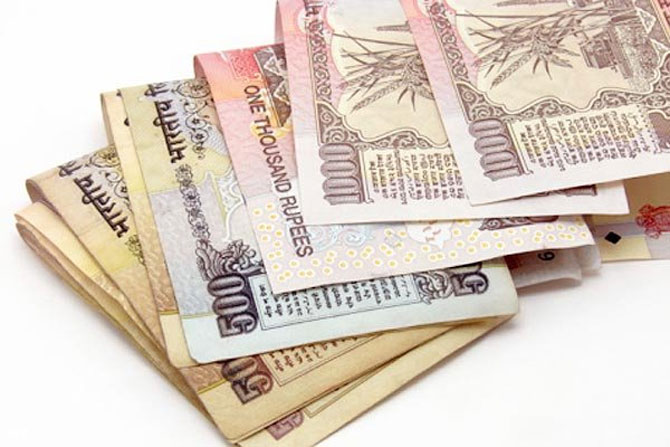
Old Rupee 500 and Rupee 1000 currency notes. These notes have ceased to be legal tender in India from the midnight of 08 November, 2016 after government’s “Demonetisation” announcement.
It is thus clear that the initiative to recommend cancelling the legal tender status to any currency notes must originate from the Reserve Bank of India which should prepare its Draft Report providing reasons and justification for such Proposal and highlighting the benefits that result from such actions. The Report should also clearly mention the expected adverse impact of such decision and possible damage to the economy and inconvenience to the public. The various sequential steps to follow are described in specific terms in Annexure 2.
Annexure 2 also gives an indication of the normal timeline to comply with each of the above steps. These datelines are juxtaposed with the actions, dates and timelines actually followed by the RBI/Govt. of India in the present case. It is for readers to draw Judgement on the practical attainability of the later dates which clearly indicate that both RBI and Govt. of India have bypassed vital procedures. It is reasonable to opine that these violations would not have been committed in the normal course either by the Central Board or by RBI.
The overwhelming point to be noted as it emerges from these records is that the entire act of “Demonetisation” is an idea of the Govt. of India which has been forced on the RBI and people of India without proper consideration of any of the aspects essential before embarking on a misadventure of such unprecedented magnitude.
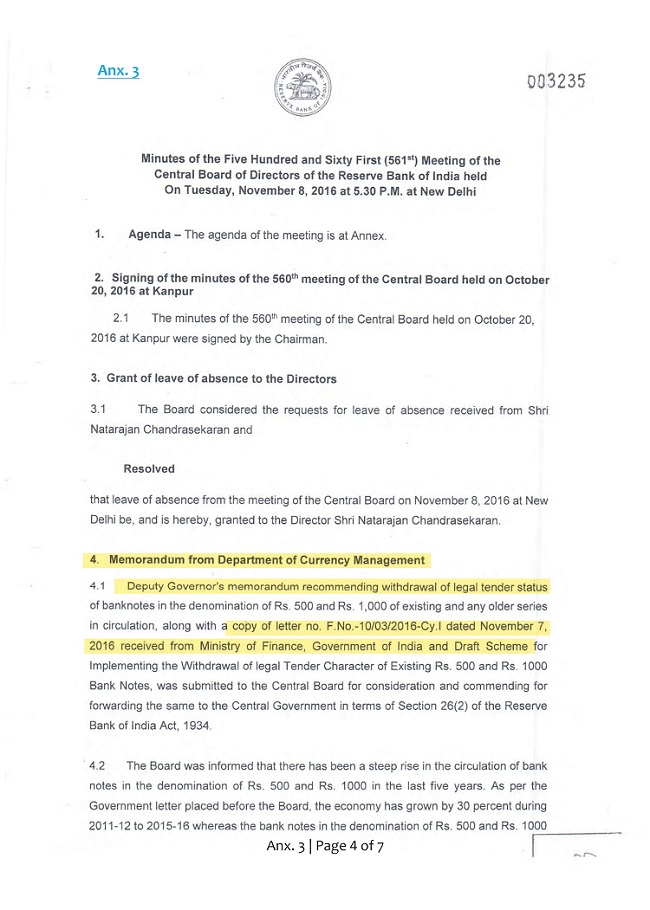
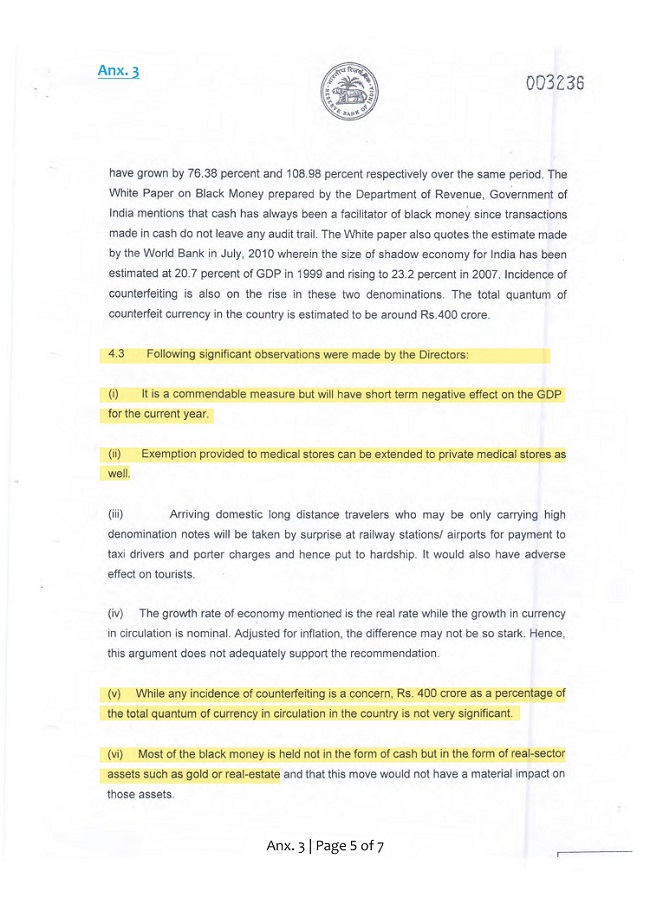
Annexure 3 is a true copy of the Minutes of the 561st Meeting of the RBI Central Board held at 5.30 pm on 8th November 2016 at New Delhi. Following points must be carefully noted:-
The meeting was held barely 2½ hours before the announcement by the Prime Minister on National Television at 8.00 pm, the same evening, declaring “Demonetisation”. It is evident that the Govt. of India compelled the RBI to hold this Meeting to fulfill the requirement of Section 26(2) of RBI Act and create the circumstance required in Section 26(2) that recommendation of “Demonetisation” should originate from RBI. It is impossible to comprehend how such a responsible institution as RBI was compelled to sacrifice its integrity and independence to blindly obey the directions of the Government. Indeed a travesty of regulatory process.
The Resolution passed at the 561st Meeting of the Central Board of RBI held on 8th November 2016 has been signed on 15th December 2016 by the then Governor of the RBI and the Chairman of the said Meeting, which reads thus, “Resolved that the proposal of the Deputy Governor recommending withdrawal of legal tender status of bank notes in the denomination of Rs. 500 and Rs. 1000 of existing and any older series in circulation is hereby considered and commended by the Central Board of Directors for forwarding the same to the Central Government.”
It is strange that the Governor of the RBI refers to the Proposal of the Deputy Governor commending this action as if it came to his knowledge for the first time on 8th November 2016, whereas he should have examined such a serious document far earlier than the said date. Section 26(2) of the RBI Act clearly states that “On recommendation of the Central Board —” it does not say on the recommendation of the Deputy Governor.
Further the Resolution is signed on 15th December 2016 which is 38 days after the Prime Minister’s announcement of “Demonetisation” on 8th November 2016. Truly speaking, this is procedurally incongruous and bad in law.
Under Para 4 of the Minutes of Meeting titled Memorandum from Department of Currency Management, at 4.1, it is recorded thus, “Deputy Governor’s Memorandum recommending withdrawal of legal tender status of banknotes in the denomination of Rs 500 and Rs. 1000 of existing and any older series in circulation, along with a copy of letter No. F.No. 10/3/2016-Cy.I dated November 7, 2016 received from Ministry of Finance, Government of India and Draft Scheme as above was submitted to the Central Board for consideration and commending for forwarding the same to the Central Government in terms of Section 26(2) of the RBI Act 1934.”
The public deserves to know why the Deputy Governor’s Memorandum was considered by the Central Board only few hours before the Prime Minister’s announcement and not weeks/months prior, which should have been the normal timeline. Also, a good explanation is required as to why the Finance Ministry’s letter dated 7th November 2016 was also pushed in to the Meeting of the Central Board on 8th November 2016, whereas this is a process which should have happened weeks / months prior as described in Annexure 2.
It is very important for the RBI Central Board Secretariat to candidly confirm and provide factual documents to substantiate the fact that in the Notice of Meeting to be held on 8th November 2016, the Agenda stated therein was supported by the various documents herein referred and duly attached for the prior knowledge and understanding of each Board Member, in preparation for the said Board Meeting. If these supporting documents are not now satisfactorily made available, there is definite reason to believe that the whole process which ought to have been followed was circumvented.
In para 4.3 of the Minutes of the Meeting, it is amusing to read at sub para (i) that “it is a commendable measure —”. These 5 words totally expose the reality of the subject viz., the whole Proposal of Demonetisation came from the Govt. of India and was not initiated by RBI as required by Section 26(2) of the RBI Act. Being an independent body, it was wholly unnecessary for RBI to praise the Govt. of India. But this proves that the process of Demonetisation originated with Govt. of India. Otherwise, if it indeed originated from the RBI itself as required by law, it would be ludicrous for the Central Board to refer to its own Proposal “as a commendable measure!” So, these 5 famous words have disclosed and affirmed the truth that the Demonetisation Proposal indeed originated from Govt of India.
At sub para (ii), the Minutes record that “Exemption provided to medical stores can be extended to private medical stores as well”. The public are entitled to know whether this exemption was contained in the Scheme prepared by the Currency Management Department or if not, who specified the grant of this relief.
At sub para (v) “the Central Board has clarified that the incidence of counterfeiting is merely Rs. 400 crores which is not very significant as a percentage of the total quantum of currency in circulation.
Therefore, the RBI Board has not construed the prevailing counterfeit currency notes as a reason to recommend “Demonetisation”.
At sub para (vi), the Minutes record that “ most of the black money is held not in the form of cash but in the form of real-sector assets such as gold and real estate and that this move (referring to “Demonetisation”) would not have a material impact on those assets”. Again, the RBI Board has clearly dissented and held that Demonetisation is unwarranted as a measure to counter black money.
However, I would like to respectfully point out that this too is a seriously flawed and myopic view inasmuch as secondary market transactions in both real estate and bullion / jewellery constantly involve the liberal use of cash while changing ownership — a process for which currency is the most fundamental pre-requisite – for both buyers and sellers. This is an undeniable ground reality pan India.
Para 4.4 states that “the Board was assured that the matter has been under discussion between the Central Government and RBI over the last six months during which most of these issues have been considered.” This requires careful understanding.
No discussion between Govt. of India and RBI especially on such a crucial matter could have ever taken place without prior knowledge, consent and approval of the Governor / Central Board, it is therefore a laughing matter that at this 561st meeting, the Board was “assured” as above. Assured by whom? requires to be clarified.
“Most of these issues have been considered”. If indeed these have been considered the views of the RBI Board mentioned in the preceding sub paras (v) & (vi) would have been sorted out at such meetings and would not find space in the present Minutes. Very difficult to understand why Para 4.4 states that “the Board has to be assured that the matter has been under discussion”. The public deserves to have complete set of copies of Minutes of all such Meetings reported to have been held, in order to understand the reality of the entire proceedings, if indeed they were held.
At Para 4.5, it is amusing to know that “the Board was assured that the Government will take mitigating measures to contain the use of cash.” One fails to understand why and how the Board of RBI required such assurances from the Government, at this Board Meeting.
Para 4.6, “The Board considered the Memorandum and after detailed deliberations —” the Board ought to have considered this Memorandum served weeks in advance, and not a few hours before announcement of “Demonetisation”.
Officially, the Resolution signed on 15th December 2016 by the Chairman of the Meeting namely the Governor of Reserve Bank Mr. Urjit Patel states that “— is hereby considered and commended by the Central Board of Directors for forwarding the same to the Central Government.” Considering Paras 18 & 19 above, which clearly reflect RBI’s disapproval of the “Demonetisation” process, how then could be that Board record its Resolution as described above in this Paragraph no. 23? In other words, how could the Board commend an action which it has itself recorded to be incorrect and unnecessary? Frankly, they are contradicting themselves by passing such a faulty Resolution.
Clearly, a great deal of further process remained at the hands of the Central Government after receiving the Minutes duly approved by the Central Board on 8th November 2016 — and signed and officially released on 15th December 2016 — before it could embark on announcing Demonetisation. Unfortunately, the entire timeline of just a few hours could never have been sufficient to make such carefully considered decisions and implement such major actions, as witnessed.
The Minutes have been signed on 15th December 2016. Legally the Government could not have taken on record this Minutes — much less acted upon them — prior to receiving and studying the same. In sharp contrast, we all know how the events unfolded rapidly on 8th November 2016.
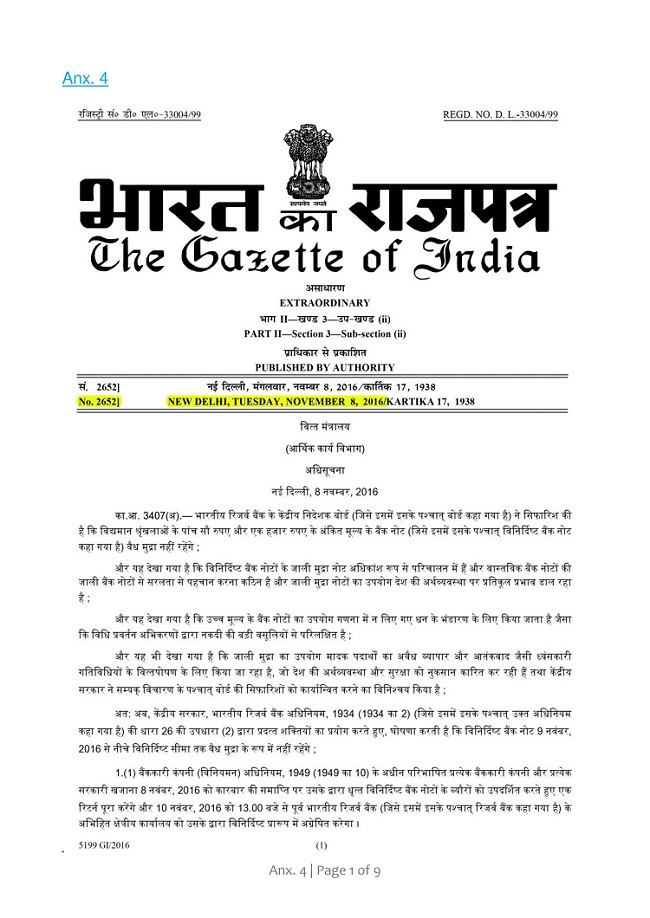
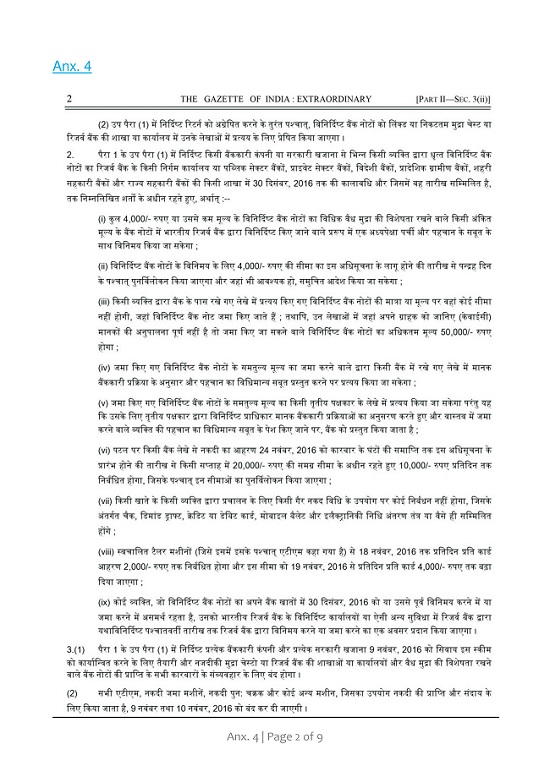
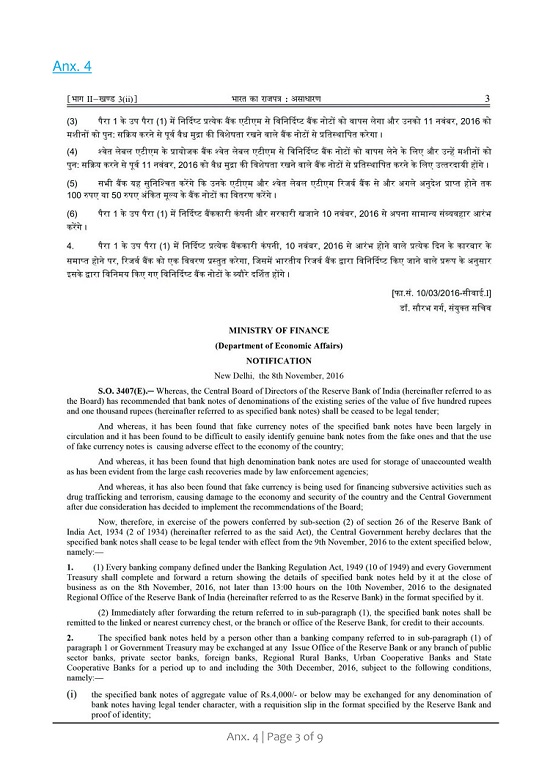
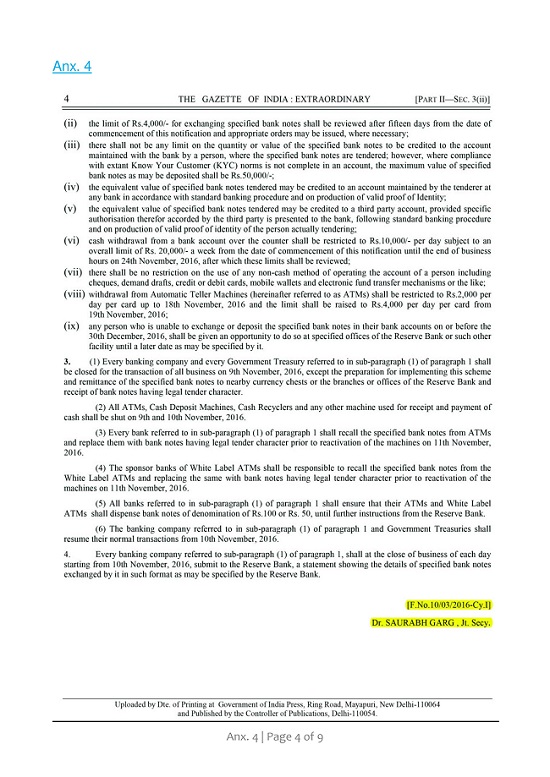
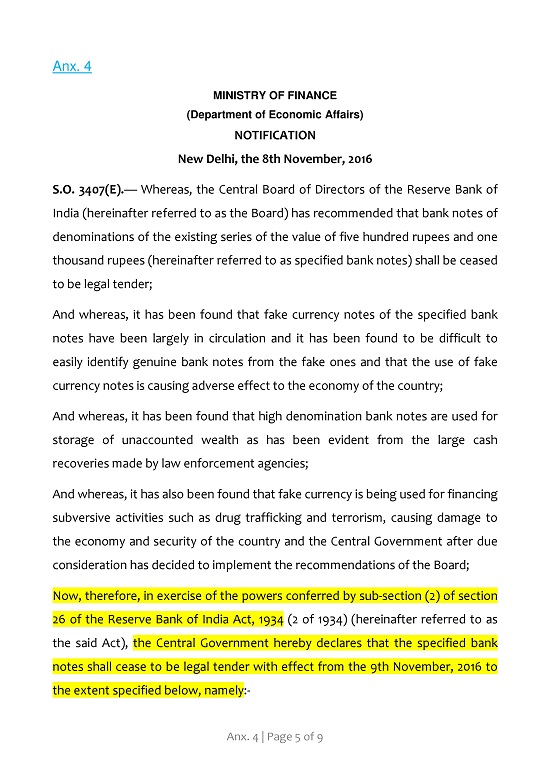
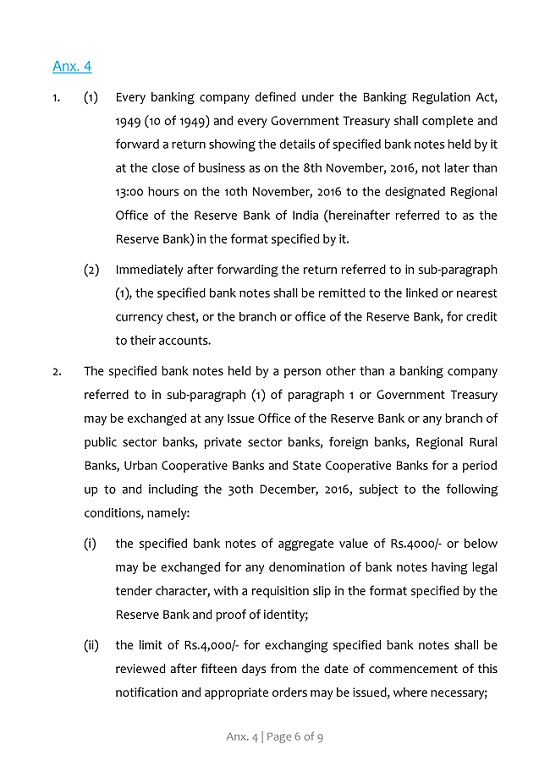
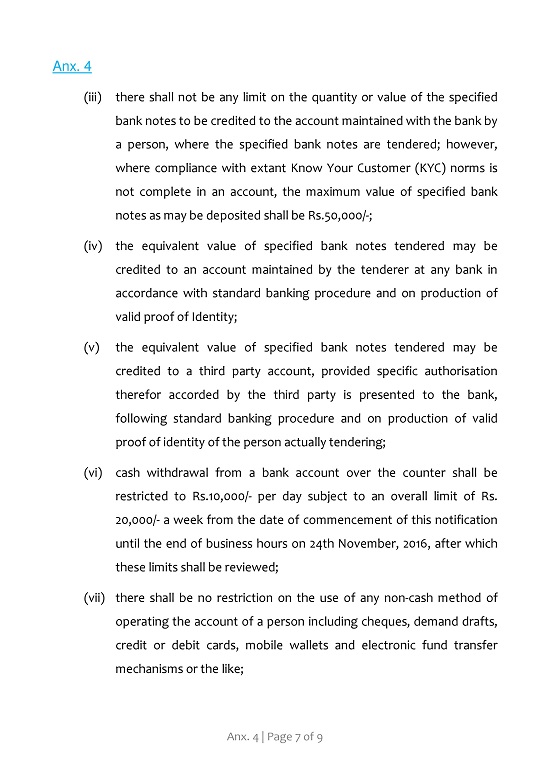
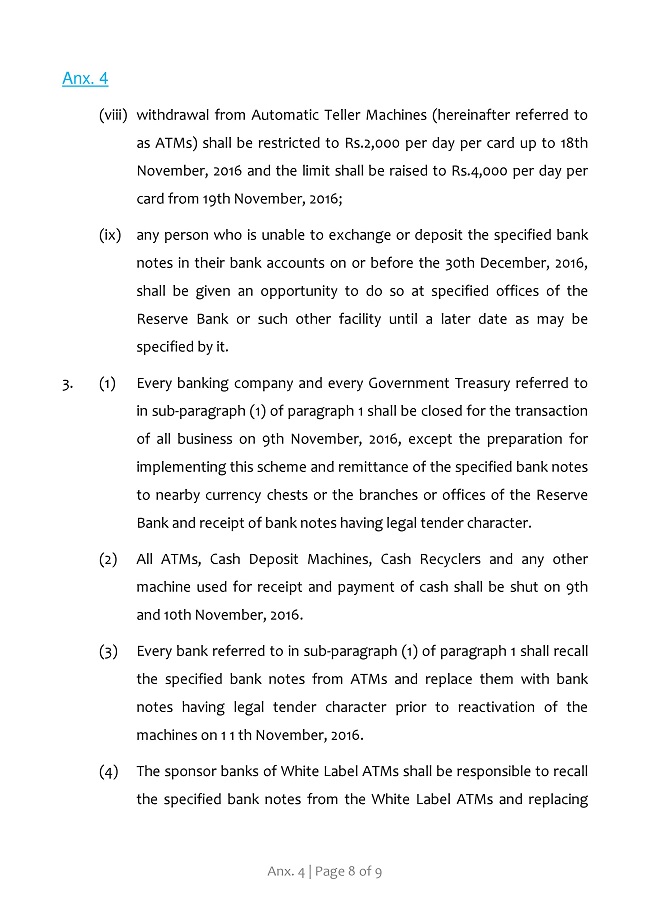
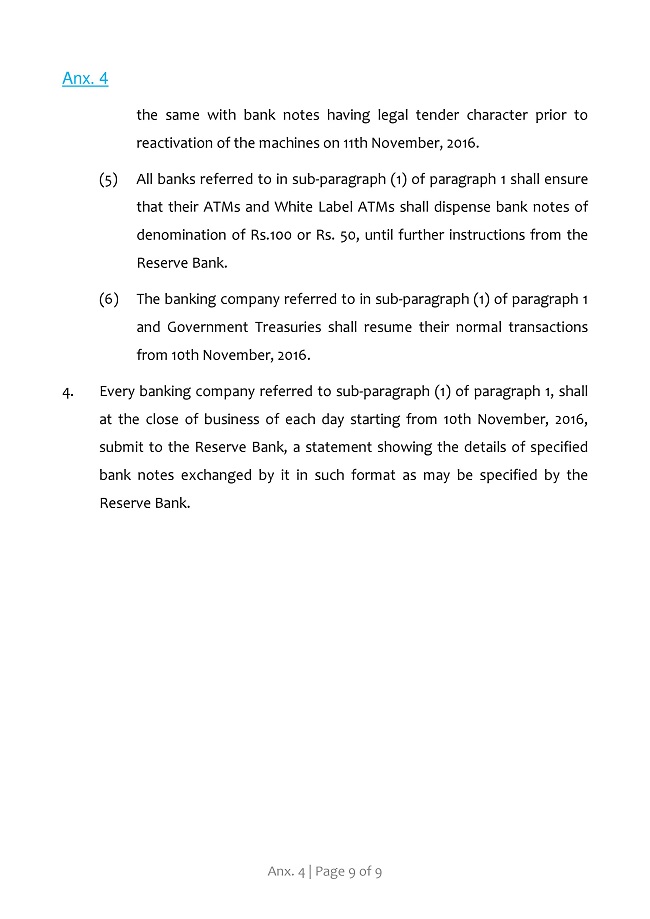
At Annexure 4, the Gazette of India N0. 2652 containing publication of Notification No. S.O. 3407(E) regarding Demonetisation is also dated 8th November 2016. If the PM’s Announcement was made at 8.00 pm, it is difficult to believe that the content of the Gazette Notification was sent by the Finance Ministry to the Controller of Publications who in turn sent written instructions to the Directorate of Printing at the Govt. of India Press for inclusion in the Gazette published and released on the same date. These reflect the super human speed of action which is not supported by real life experience.
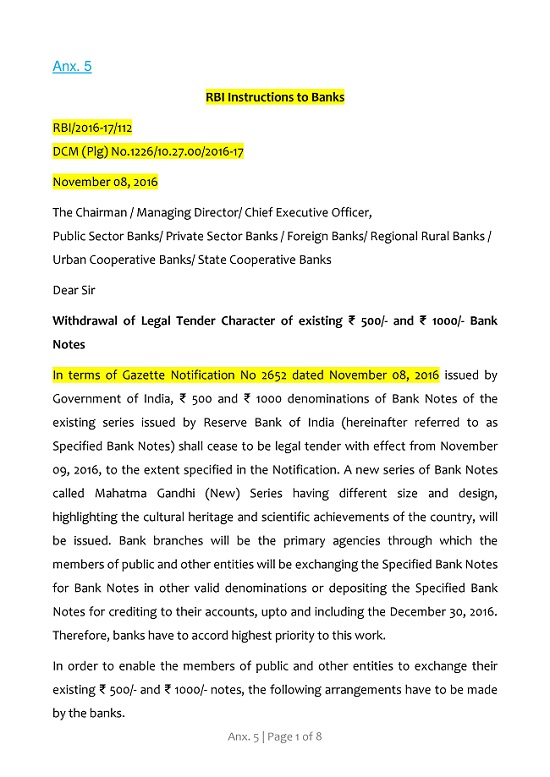
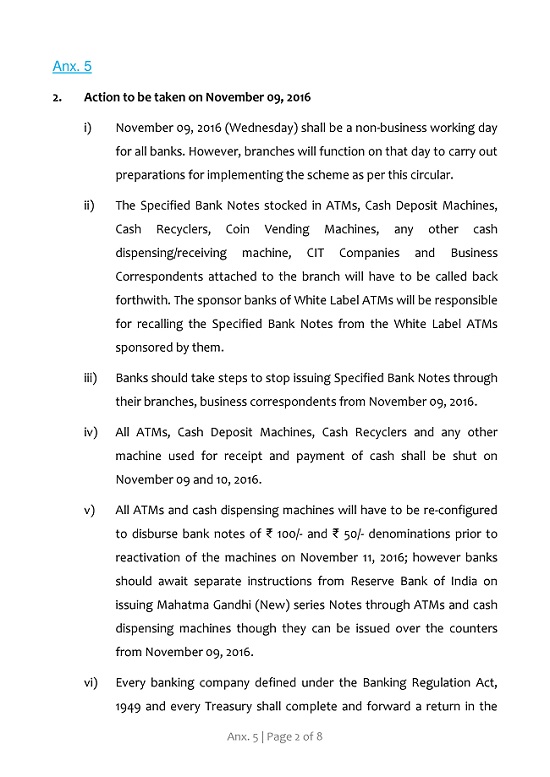
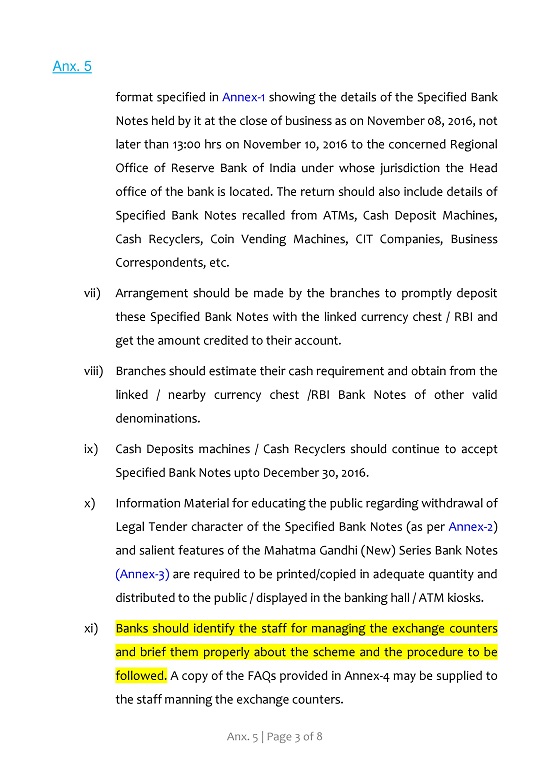
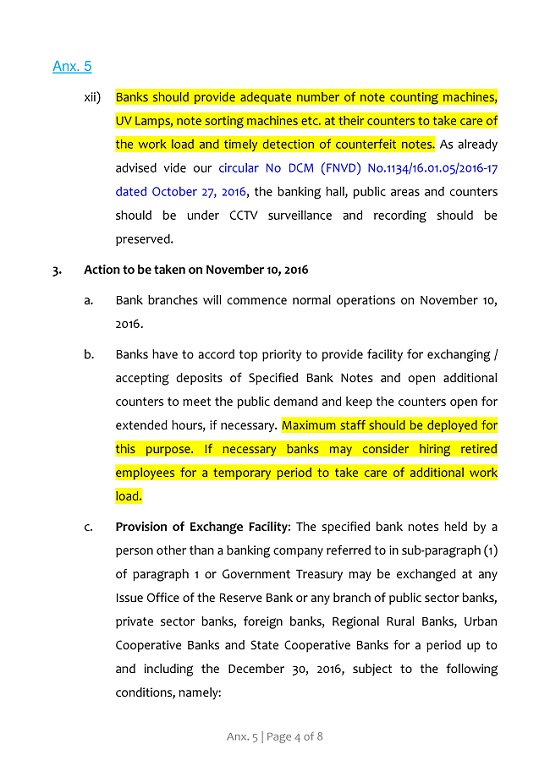
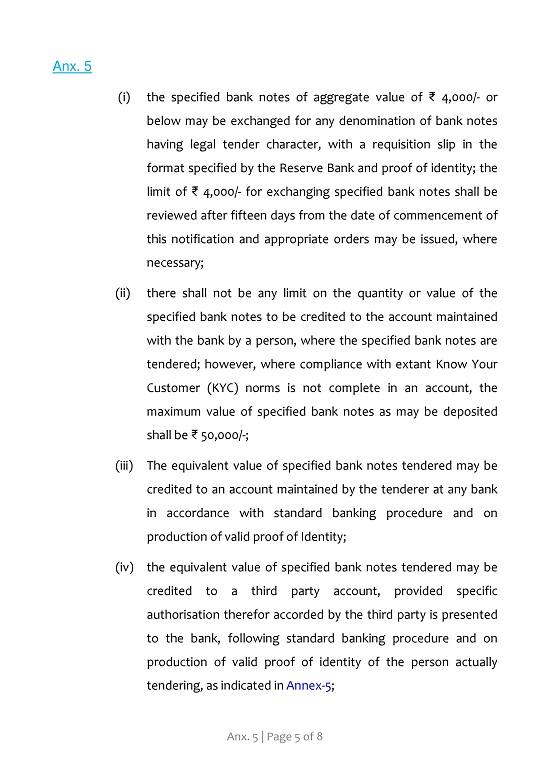
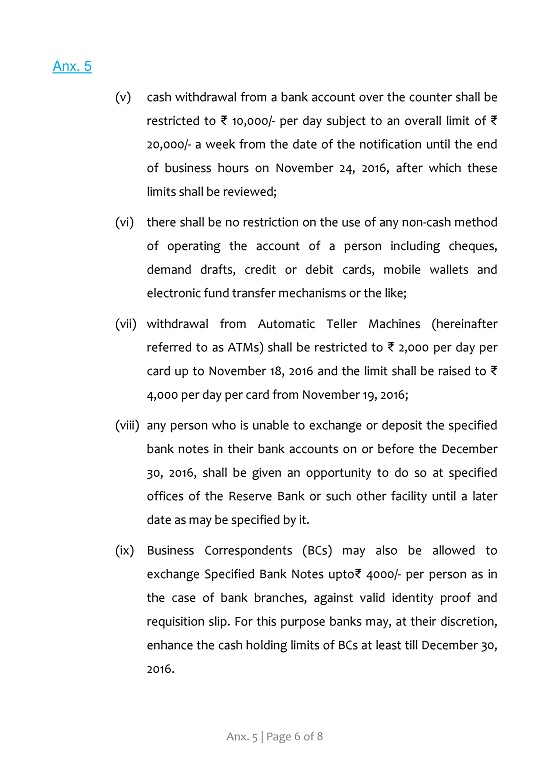
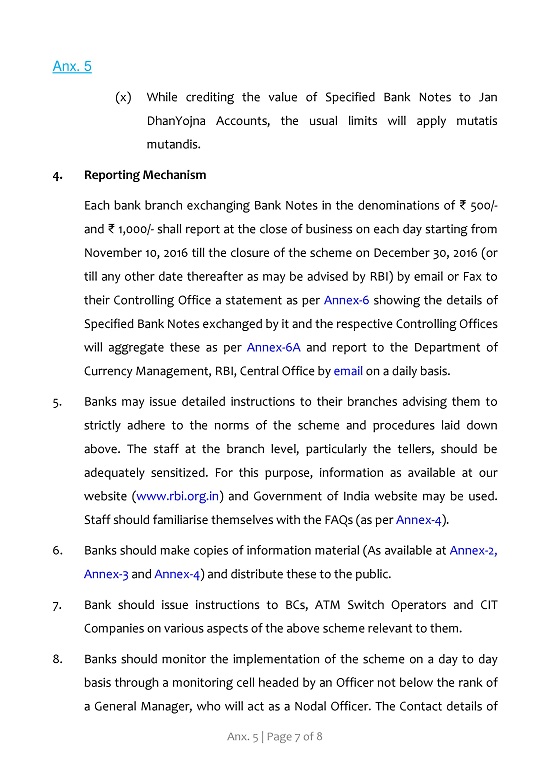
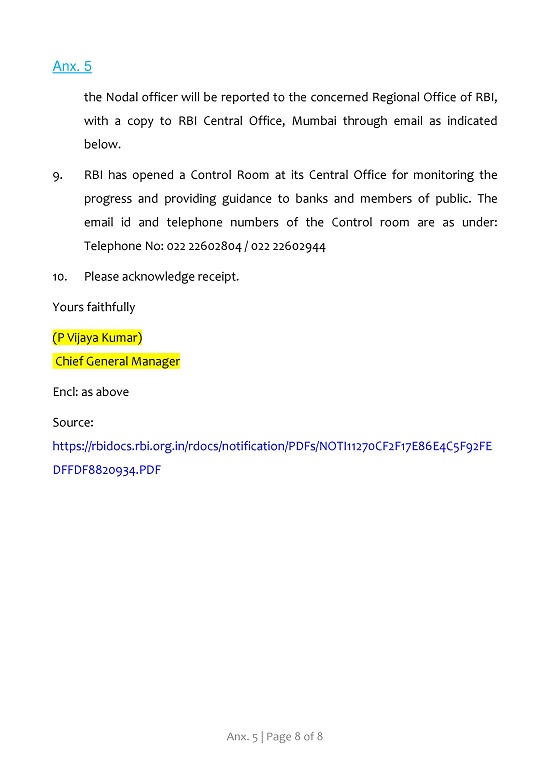
From Annexure 5, we observe that on the very same date of 8th November 2016, the RBI under the hand of its Chief General Manager has issued “Instructions” to the Heads of all Banks. In this Circular, reference is made to the Gazette Notification No. 2652 of 8th November 2016. This naturally implies that the Circular – with all the details seen therein — was prepared after the Gazette Notification was published which would have been physically seen only on 9th November 2016. Whereas, the RBI’s Circular has been issued almost simultaneously lending credence to the belief that this was prepared in advance and kept ready for issue, long before the Gazette Notification was actually published. The contents of Point No. 2: Action to be Taken on 9th December 2016, in particular instructions at Sub Para (xi) & (xii) as well at Para 3(b) clearly confirm that this Circular was prepared long before the Gazette Notification and kept ready for circulation.
The Minutes of the Meeting of RBI Central Board became available very recently hence the renewed interest on this subject. If RBI had not recommended “Demonetisation” for reasons stated in their documents, how could Government of India forced its ideas on RBI and directed it to abide by its decision to go ahead with “Demonetisation”? It is thus clear that the Government forced its will on RBI and compelled it to concur.
The primordial role of our Finance Ministry in this whole exercise is never explained anywhere though this is the apex operational Ministry for such matters.
The Minutes speak of the Memorandum on this subject being prepared by the Deputy Governor of RBI, but surprisingly his name is not mentioned in anywhere. He had to be authorized in writing in advance to do so either by the RBI Governor or by the RBI Central Board. We desire to know who mandated him to take up this serious exercise and who are the members of the Committee constituted to prepare the Memorandum along with the said Deputy Governor. The Deputy Governor could not have prepared it in isolation considering the weight of the subject and the volume of work involved.
If all proceedings had been followed for over 6 months as stated in the Minutes, then where was the need to call for an emergency meeting on 7th November 2016 instead of following the usual option of a regularly convened meeting, giving one month’s notice to all Directors ?
If indeed, the idea of the Government was to curb the use of black money, why were the erstwhile Rs. 1000 currency notes replaced by the even higher denominated Rs. 2000 currency notes, which facilitate and encourage dealing with cash and thereby support the perpetration of black money transactions? Since the storage space and logistics involved were both reduced by 50%, surely, the Reserve Bank could not have recommended the introduction of Rs. 2000 currency notes and that too, as a replacement for Rs. 1000 currency notes. Undeniably, there are highly knowledgeable and experienced officials in RBI, who would never have put forth such recommendations, and risk jeopardising their enviable reputation.
As far as Rs. 500 notes are concerned a new series has replaced the old series, therefore there is no impact one way or the other on the volume of cash in circulation and its use for unaccounted operations.
As far as counterfeiting is concerned, reports during 2017-18 by Law Enforcement Agencies in India clearly debunk the proposition of the Govt. of India that Demonetisation would deter / eliminate counterfeiting.
As far as use of currency of unaccounted transactions is concerned, the total incidence of black money operations has substantially increased since 2017 assisted by the welcome presence of the higher denomination of Rs. 2000 currency notes. Therefore “Demonetisation” has not in any way helped abate either the circulation of black money or corruption.
Specific Questions which Deserve Factual Response from RBI and Govt. of India
(I) Why did it take 28 months for RBI to provide copy of Minutes of their Central Board’s Meeting No. 561 dated 8th November 2016, to RTI Activists ?
(II) Did RBI have more to conceal than reveal regarding procedural lapses with regard to “Demonetisation”?
(III) Is RBI guilty of participative / contributory wrong doing by not recording its disapproval of Government of India’s directions concerning “Demonetisation” as they were violative of provisions of the RBI Act?
(IV) RBI’s passive stance on this crucial subject as seen from text of the Resolution passed at this Meeting but signed by the Governor as late as 15th December 2016 contains veiled admission of serious procedural lapses on their part as well as on the part of Government of India to a greater extent.
(V) Being an apex, independent body renowned for its integrity and organisational strength, it was well within the powers of the RBI Board to desist from violating the RBI Act and relevant Regulations thereunder, and instead, submit written disapproval of the Government’s proposed actions which was compulsively forced on it by Govt. of India.
(VI) RBI appears guilty of violating its own Act. What are the legal provisions for such violation?
(VII) If as stated in the Minutes, 6 months interaction between RBI and Finance Ministry/Govt. of India had indeed taken place, where was the need to state and record this in the present Minutes of Meeting No. 561?
The proceedings of all such Meetings held during these 6 months ought to be made available to lend credence to this claim.
Otherwise one would be compelled to conclude that this paragraph in the Minutes was also included at the behest of the Government, to give semblance of procedural compliance by both Govt. of India and RBI to “prepare and plan” for such a major action.
(VIII) How many days prior notice were given to the Members of RBI’s Central Board to prepare to attend the most crucial 8th November Meeting? Was the Board Note accompanied by all the supporting documents necessary to understand and prepare for the Meeting ?
(IX) Two more key documents need to be disclosed by RBI/Government:
(a) Memorandum from RBI, Department of Currency Management referred to at Para 4 of the Minutes of its 561st Meeting.
(b) The letter from Finance Ministry to RBI dated 7th November 2016 referred to therein.
(X) In its Annual Report for 2017-18, RBI has reported on 30 Aug, 2018, thus; “As much as 99.3% of the junked Rs. 500 and Rs. 1000 notes have returned to the banking system. Of the Rs. 15.41 lakh crore worth Rs. 500 and Rs. 1000 notes in circulation on November 8, 2016, when the note ban was announced, notes worth Rs. 15.31 lakh crore have been returned. This meant just Rs. 10,720 crore of the junked currency did not return to the banking system.”
This once again confirms
that the view of the Board recorded at Para 4.3 (vi) that “this move would not
have a material impact on those assets” stands reconfirmed by this statement in
its own Report.
For
hundreds of years human beings have wondered on what is going on in space.
Astronomers
have searched for new celestial bodies and tried to understand what created the
universe. Astrologers have looked at space from different perspectives in their
search for the role celestial bodies play in managing our daily lives on planet
Earth. Thousands of poems have been written about the moon. Prayers are offered
to the moon. Lunar calendars govern the lives of many of us. Unidentified
Flying Objects (UFO’s), Inter galactic movies and cartoons and everything to do
with space has always fascinated us.
Yet
it is only when Neil Armstrong landed on the moon in 1969 did modern man’s
interest in space truly get piqued. His famous line “One small step for man.
One giant step for mankind,” would probably be the most remembered quote in the
World relating to space. I remember asking my mother on Karwa Chauth in 1969 whether the moon would continue to be as holy
as before, now that man had stepped on it on 16th July 1969!
When
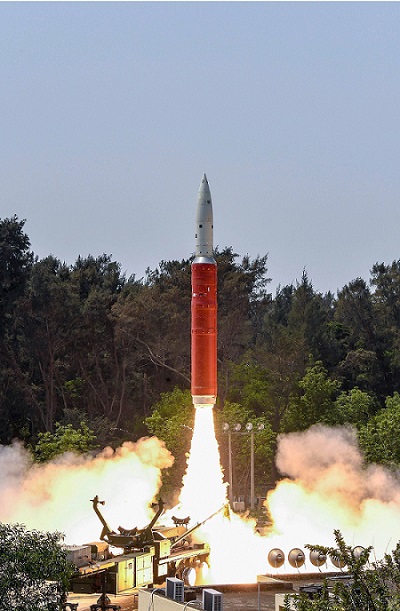
Prime Minister Narendra Modi made the announcement of India of Mission Shakti on
27th March 2019 about the successful test of A-Sat that put India in
the select club of four with United States, Russia and China, this was indeed a
giant step for India in protecting our rights and our borders in space.
This
should make every right-thinking Indian very proud. I would be surprised to
meet any Indian who does not want the best possible security or does not want
India to join her rightful place as a super power. Unless of course they are
looking at every step taken by this government through the myopic lens of the forthcoming
elections.
The
reactions from several opposition leaders were amusing and surprising. From
comparing the cost of the launch to the impact on alleviating hunger in our
country and from cynically comparing the announcement of A-Sat to that of
demonetisation, the opposition politicians and the journalists who sympathise
with these politicians did not leave any negative adjective in the book that
they could find to counter the step taken by the government. Comments like
“only 300 kilometers” to “only one satellite” demonstrated the complete
ignorance of these individuals.
Then
of course, there are a set of people who credit every positive step taken in
our country to the “first family” of India. These people could not stop talking
about India’s space programme and the Indian Institutes of Technology set up by
our first Prime Minister.
But,
let us understand why Mission Shakti is important for us.
Over the years we have learned to accept the territorial rights nations have in the international waters. Territorial sea is defined by the United Nations as 12 nautical miles or 22.2 kilometers from the baseline of a coastal state. No such definition exists in space and the United Nations has also specified that no nation can claim territorial rights on any celestial body including our moon and our planets.
Space is overseen by the United
Nations Office for Outer Space Affairs. According to the United Nations Outer
Space Treaty, signed by 102 countries, no nation can claim sovereignty over the
Moon. Early explorers like Christopher Columbus and others who followed him
over the centuries discovered new continents and established trading bases and
colonies for their countries. Therefore, there is a race to reach and establish
a presence not just on the moon but now on the Mars as well.
Very few nations have developed the
capability of building and launching satellites and India is one of these
select countries. Even fewer countries have managed to develop the capability
of putting a human being in space and India is fast developing this capability
as well.
Space is the next frontier for an ever-demanding
human race that is constantly looking for more challenges. For India, it is
critical to develop a strong capability of managing our presence in space. The
Indian Space Research Organisation is one of the premier space bodies in the
World.
It is also worth understanding why
developing rockets is important to the defence of a nation. A rocket is nothing
more that a huge “guided missile” and this technology is available to India to
fortify its borders dramatically. Mission Shakti gives us this much needed
capability of targeting rogue satellites in the future.
Space could also promise huge wealth to
the people who conquer it first. This is the reason why Elon Musk and Richard
Branson are investing large sums of money. If anyone can develop an economical
way to reach some celestial bodies and return to Earth, think of the incredible
mining opportunities that can be created. These businessmen are already talking
of creating human colonies in space and there is a queue of individuals who are
willing to take a “one-way” trip to Mars.
Exploration
of space is an expensive process fraught with very high risks. Cynical reactions
are understandable in the context of the elections but comparing the cost of
space exploration to food and housing on our planet is short sighted and
completely out of context.
NASA
lost most of its funding after a few failed launches of its Apollo programme.
President Obama reduced funding to NASA because of the fear of the fallout of a
failure. President Trump has reinvigorated NASA and has called for Astronauts
being sent back to the moon by 2024.
India
has developed a new capability to defend our rights in space and we must be
proud of this. The credit will always go to the government in power and
opposition leaders have no choice but to accept this harsh reality.
Investing
in space research is expensive. It is the future and it needs a lot of government
funding.
More
importantly, space research needs government will for its fair share of
investment. Mission Shakti, our missions to the moon and Mars, our successful
launch capabilities to low earth orbit (LEO) and to geo stationary orbit (GEO)
show our capabilities to manage our growing presence in space. Our space
scientists have the knowledge and the experience and can explore the last
frontier to our advantage.
Only
a strong government can continue to support and fund our much-needed space
programme.
Just before the Lok Sabha elections, trouble might be brewing for Odisha Chief Minister Naveen Patnaik in a two-decade old coal block allocation case.
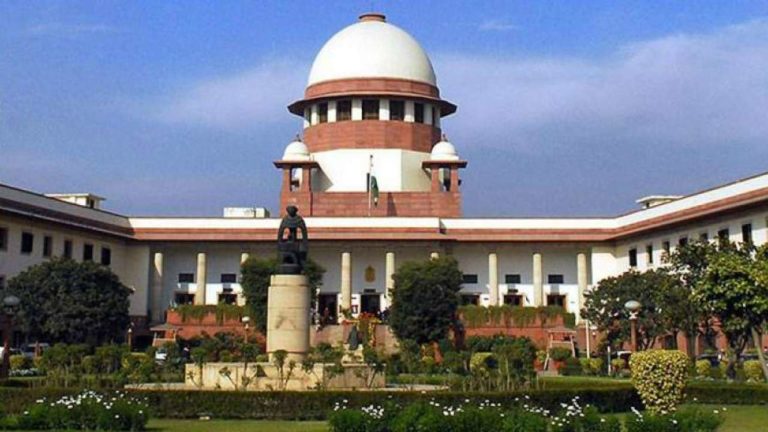
On Monday, an impleadment
application was filed in the Supreme Court seeking expediting the CBI
investigation in a coal block allocation case in which an inquiry was pending
against Odisha Chief Minister Naveen Patnaik. The case was registered five years ago. In
this connection, Patnaik was also interrogated by the Central Bureau of
Investigation (CBI) on November 25, 2017.
The CBI is investigating into
the allocation of captive coalfields between 1993 and 2010, as part of Supreme
Court-monitored probe. The case was registered on March 26, 2014, related to
forgery, criminal breach of trust and selling of coal in the open market
against the concept of captive allocation of coal mines for a specified end-use
product. The application in the court sought direction to the CBI to present
the entire file noting in the case to ascertain the reasons for the delay in finalization
of the case.
As per the petition filed by Vaibhav
Verma, MS Central collieries Co Ltd & Ors (Nagpur) was awarded the
Takli-Jena-Bellora coalfield in Maharashtra in 1998, even before its
registration. Naveen Patnaik was the then Union Minister of Mines thus making
his role questionable. The CBI has already interrogated Naveen on the issue and
thus, there’s no reason to delay the case, the plea said, adding: “Patnaik has
already been interrogated by the CBI in November.2017. That after interrogation
of Patnaik, there is no reason for delay; however as evident, again there is a
delay of almost two years since his interrogation and the CBI is yet to
complete its investigation and has failed to take any concrete steps despite
the fact that Supreme Court is monitoring the coal block cases.”
Anand Giridharadas, Aspen Fellow/Mckinsey consultant who became, subsequently, anticapitalist, was awarded the Rushdie Award for Outstanding Lifetime Achievement for Humanism in Culture.
According to Boing Boing, the award was given out by the Humanist Hub and by the Humanist Community at Harvard along with partners. Some of those partners included the Harvard College Community of Humanists, Atheists, and Agnostics (HCHAA) and the American Humanist Association.
The award was presented at the annual “social enterprise” conference via the Harvard School of Government and the business school.. Giridharadas will present the “1000 top leaders, practitioners and students” as a speech for the award.
His book entitled Winners Take All has been an important contribution, apparently, to the critique of the ultra-rich around the world and then those self-same ultra-rich using ‘philanthropy’ as simply a means by which to reputation launder.
Enter Harvard University, whose graduates constitute some of the world’s richest, most sociopathic, most generous donors to any university — the Harvard endowment was selected for study by Thomas Piketty in his Capital in the Twenty-First Century because it is the only privately held,” The article concluded, “…oligarch-scale fortune whose books are open for study. Congrats to Giridharadas, of course, but more important, bravo to the Harvard Humanists!”
Akshay Kumar’s Kesari had the
biggest opening in 2019. With 3600 screens across the country, Kesari is doing
great business at the box office. In the opening week the film had a fabulous weekend
with Rs 78.07 crore in its kitty in the first four days of its release and passed
the Monday test with flying colours. Kesari earned Rs 8.25 crore on Monday,
thus taking the total to Rs 86.32 crore. The film is expected to have made Rs 7
crore approx on Tuesday, taking its total collection to Rs 93 crore approx.
Thus easily crossing the 100 crore mark during this week.
Directed by Anurag Singh,
Kesari features Akshay as Havildar Ishar Singh, who led the 36th Sikh Regiment
of the British Indian Army in the Battle of Saragarhi, which was fought in
1897. The film tells the powerful story of 21 Sikh soldiers fighting valiantly
against 10,000 Afghan troops. Parineeti Chopra has a guest appearance, as
Havildar Ishar Singh’s wife.
Kesari is yet another hit
given by Akshay after Toilet: Ek Prem Katha, Pad Man and Gold.
Starting as a symbolic lights
out event in Sydney in 2007, Earth Hour is now the world’s largest grassroots
movement for the environment, inspiring millions of people to take action for the
planet and nature. Earth Hour 2019 is on 30th
March 2019 from 8:30pm – 9:30 pm.
Coordinated by WWF and other
volunteer organisations, Earth Hour’s greatest strength is the collective
action of people. As accelerating climate change and staggering
biodiversity loss threaten our planet, Earth Hour 2018-2020 endeavours to spark
never-before-had conversations on the loss of nature and the urgent need to
protect it.
Earth Hour 2018 saw the launch of the GIVEUPmovement. To further inspire
collective action, WWF-India is taking the GIVEUP movement forward in 2019 through
a fun activity for individuals and organizations. Titled as #BEE4THEPLANET- it is
a call to stand for the planet and buzz like a bee. This involves individuals buzzing
like a bee for as long as possible, challenging few friends and families to
take up the challenge. This is the fun part of the campaign driven through
social media.
Apart from this, participants will be
encouraged to make their GIVEUP to GIVE BACK pledge, driving the serious
message of nature conservation and a cleaner, healthier planet. As part of it people
can choose to GIVEUP from among the three themes (plastic pollution, water and
paper wastage) or anything that is detrimental to the health of the planet as a
pledge.
During Earth
Hour, people will be encouraged to switch off all non-essential lights at their
homes in support of nature on 30th March 2019 between 8:30 – 9:30pm.
The organisers feel that linking it to larger government
initiatives will ensure that the campaign is not just restricted to Earth Hour
but goes beyond it and provides a platform for other significant days in the
year like World Environment Day which will be celebrated on 5th June
2019 to promote ‘innovative solutions for
environmental challenges and sustainable consumption’.
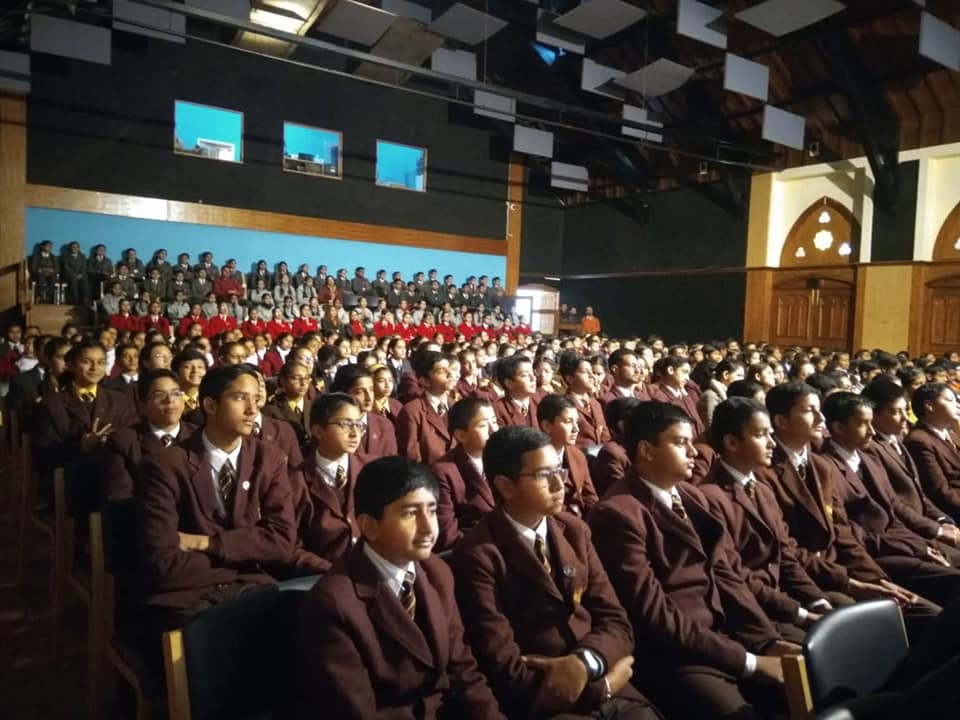
Students at the launch of #Bee4thePlanet campaign in Shimla, Himachal Pradesh by WWF, during an Environment and Wildlife Film Festival organised at Gaiety Theatre
According
to Arti Gupta, WWF State Coordinator for Himachal Pradesh, who recently launched
the #Bee4thePlanet campaign in Shimla, “It’s a wonderful opportunity for school
students and youngsters. With all the buzz, students can truly
be for the planet by GIVING UP excesses and wasteful consumption to reduce
plastic pollution, water and paper wastage. When you GIVEUP you GIVE BACK to
nature. Start the conversation in your classroom, in your school clubs – among students, teachers and staff,
encouraging them to adopt sustainable practices.” The campaign was launched in
Shimla recently during the environment and wildlife film festival organized by
Department of Science and Technology and CMSR Foundation.
Youngsters
are also being encouraged to “Pedal for the planet” and do their own cyclothons
and walkathons to build the momentum for the Earth Hour 2019.
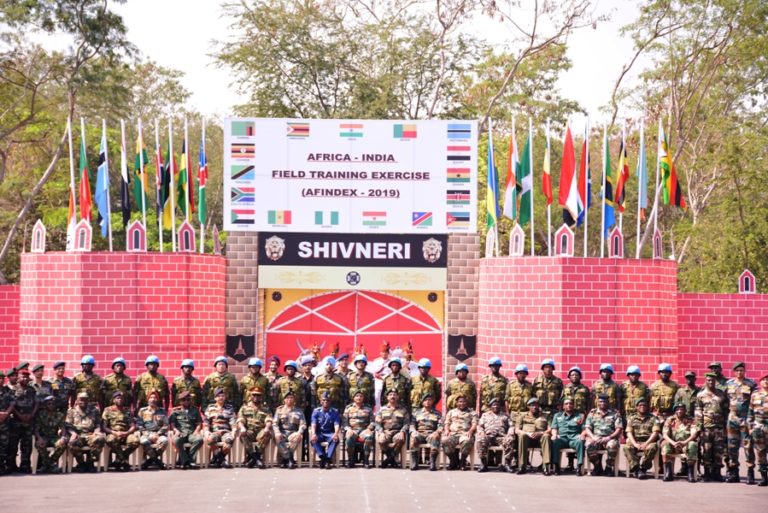
The inaugural
Africa-India Field Training Exercise-2019 for India and African nations called
AFINDEX-19 was organised from 18 March to 27 March 2019. The exercise started
with a grand opening ceremony on 18 March 2019 at Aundh Military Station, Pune.
Contingents of the 17 African Nations i.e. Benin, Botswana, Egypt, Ghana,
Kenya, Mauritius, Mozambique, Namibia, Niger, Nigeria, Senegal, South Africa,
Sudan, Tanzania, Uganda, Zambia and Zimbabwe came together for the opening
ceremony alongwith a contingent of Maratha Light Infantry representing India.
Major General Sanjeev Sharma, General Officer Commanding, Golden Katar
Division, who was the Chief Guest for the opening ceremony, reviewed the
parade, in presence of a large number of Defence Attaches and other officials
of participating nations. A fly past by a set of Advanced Light Helicopters and
Cheetah Helicopter of the Indian Army carrying the flags of United Nations,
India and the AFINDEX was the highlight of the opening ceremony. The Chief
Guest and Defence Attaches from various nations interacted with the contingents
after the completion of the parade.
The aim of
the exercise was to practice the participating nations in planning and conduct
of Humanitarian Mine Assistance and Peace Keeping Operations under Chapter VII
of United Nations Peace Keeping Operations. The exercise focussed on exchange
of best practices between the participating nations, team building and tactical
level operations in conduct of United Nations mandated tasks to include
establishment of a new mission, siting of a United Nations Headquarters for
Peace Keeping operations, siting of Military Observer sites during the peace
keeping missions, protection of civilians, nuances of standing combat
deployment, convoy protection, patrolling aspects and aspects related to
Humanitarian Mine Assistance.
We use cookies on our website to give you the most relevant experience by remembering your preferences and repeat visits. By clicking “Accept All”, you consent to the use of ALL the cookies. However, you may visit "Cookie Settings" to provide a controlled consent.
This website uses cookies to improve your experience while you navigate through the website. Out of these, the cookies that are categorized as necessary are stored on your browser as they are essential for the working of basic functionalities of the website. We also use third-party cookies that help us analyze and understand how you use this website. These cookies will be stored in your browser only with your consent. You also have the option to opt-out of these cookies. But opting out of some of these cookies may affect your browsing experience.
Functional cookies help to perform certain functionalities like sharing the content of the website on social media platforms, collect feedbacks, and other third-party features.
Performance cookies are used to understand and analyze the key performance indexes of the website which helps in delivering a better user experience for the visitors.
Analytical cookies are used to understand how visitors interact with the website. These cookies help provide information on metrics the number of visitors, bounce rate, traffic source, etc.
Advertisement cookies are used to provide visitors with relevant ads and marketing campaigns. These cookies track visitors across websites and collect information to provide customized ads.
Necessary cookies are absolutely essential for the website to function properly. These cookies ensure basic functionalities and security features of the website, anonymously.
Cookie
Duration
Description
cookielawinfo-checkbox-analytics
11 months
This cookie is set by GDPR Cookie Consent plugin. The cookie is used to store the user consent for the cookies in the category "Analytics".
cookielawinfo-checkbox-functional
11 months
The cookie is set by GDPR cookie consent to record the user consent for the cookies in the category "Functional".
cookielawinfo-checkbox-necessary
11 months
This cookie is set by GDPR Cookie Consent plugin. The cookies is used to store the user consent for the cookies in the category "Necessary".
cookielawinfo-checkbox-others
11 months
This cookie is set by GDPR Cookie Consent plugin. The cookie is used to store the user consent for the cookies in the category "Other.
cookielawinfo-checkbox-performance
11 months
This cookie is set by GDPR Cookie Consent plugin. The cookie is used to store the user consent for the cookies in the category "Performance".
viewed_cookie_policy
11 months
The cookie is set by the GDPR Cookie Consent plugin and is used to store whether or not user has consented to the use of cookies. It does not store any personal data.