Home Blog Page 67

Farmers in Khyber Pakhtunkhwa protest hydropower projects as threat to livelihoods

Farmers in Charsadda and surrounding districts of Khyber Pakhtunkhwa have voiced strong opposition to proposed hydropower projects by the Pakhtunkhwa Energy Development Organization (PEDO). The farmers say that these projects, planned to be built on irrigation canals, would severely damage their livelihoods and disrupt the region’s irrigation system.

During a recent meeting, local farmers released a statement declaring their intent to resist the hydropower projects “tooth and nail.” They warned that the initiatives would devastate the irrigation infrastructure crucial to the province’s agriculture, leading to significant losses for local growers.

The Mazdoor Kissan Party (MKP), which organized the meeting, brought together farmers from Charsadda, Mardan, Kohat, Malakand, and Bannu to discuss the potential impact of the projects. Shamas Khan, vice-president of the MKP, criticized the planned projects as “economic murder” of the province’s agricultural community. He emphasized that agriculture contributes 22 percent to Pakistan’s GDP and relies heavily on canal-based irrigation systems.

Farmers expressed concerns that the hydropower projects were being advanced without proper consultation with agricultural and irrigation departments, which would be directly affected. In response, the MKP has announced plans to stage a sit-in protest against both the provincial government and the international bank funding the projects.

Article 370 abrogation: Storm in a teacup

As the fifth ‘death anniversary’ of Articles 370 and 35 [a] of the Indian Constitution comes and goes, debate on the decision of the Government of India to abrogate these articles gets ignited once again with some endorsing and others condemning this move.    

Those who support this decision are citing the numerous positives of this path breaking decision with specific mention of how this development has enabled promulgation of various people oriented initiatives and schemes in both J&K as well as Ladakh. It has also ushered-in social justice by removal of gender biased antiquated laws.

They also mention the fact that with removal of erstwhile J&K’s ‘special status’, complete integration of India in which all citizens are equals [as envisioned in the Indian Constitution] has finally been achieved. They also maintain that by taking this momentous decision, New Delhi has wrecked Pakistan’s contrived Kashmir narrative that India was using the special status bait as an inducement to beguile the people of J&K.

However, naysayers emphatically denounce abrogation of Articles 35[a] as a “breach of trust” between the erstwhile state of J&K and the center without even elaborating, leave alone substantiating, this claim. This contention conveys an impression that accession of the former kingdom of J&K with the Union of India was conditional, which is completely untrue and grossly misleading.

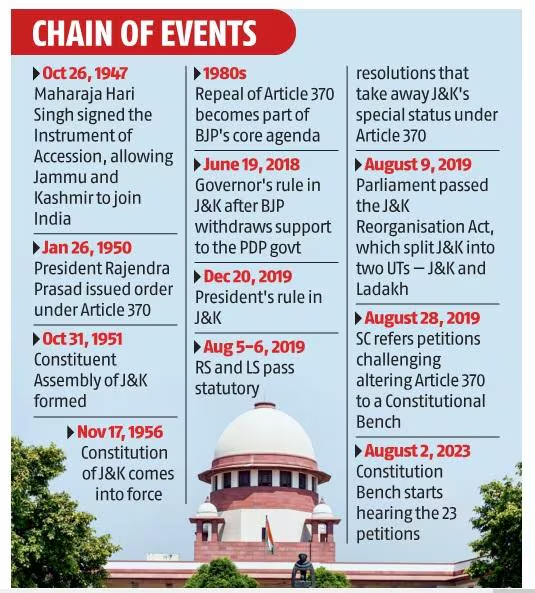
The fact of the matter is that the then ruler of J&K had signed the instrument of accession in India’s favour without any preconditions. Islamabad may complain that he was under pressure at that time due to the tribal incursion, but since this false flag operation [codenamed Operation Gulmarg] was entirely planned and executed by the Pakistan Army, why blame the Maharaja or accuse New Delhi of arm-twisting him into acceding to India?

This camp also points out that not only has abrogation of Articles 370 and 35[a] failed to end militancy in J&K, but it has also led to emergence of several other armed groups like The Resistance Front [TRF], People’s Anti-Fascist Force [PAFF], Joint Kashmir Front [JKF] and Kashmir Ghaznavi Force [KGF]. While it’s a fact that some such groups have since emerged, however, to suggest that this development is due to abrogation of Article 370 is a blatant lie and referring to these uncouth terrorists as “militants” is the height of euphemism!

Article 370’s Abrogation

There’s no denying that after the abrogation of Article 370, separatists lost their ability to orchestrate large anti-India protests at the drop of the hat. Simultaneously, terrorist activities in the Kashmir Valley have also shown a perceptible decline. Most importantly, both the UN and international community refused to entertain Pakistan’s laughable stance that abrogation of Article 370 violates UNSC resolutions on Kashmir.

All these developments forced Pakistan Army’s spy agency Inter Services Intelligence [ISI], which controls terrorism in J&K to make changes in its strategy.

So, in a desperate attempt to give the world an impression that the people of Kashmir are up in arms against Article 370 abrogation, ISI has tasked its assets in J&K to undertake terrorist attacks, the responsibility of which is immediately taken by ghost groups like TRF and PAFF. However, as these groups have been targeting members of Kashmir’s minority community and migrant workers who have nothing to do with Article 370 abrogation, it’s abundantly evident that their aim is merely to create mayhem so as to disprove New Delhi’s claim of normalcy returning to Kashmir.

Pakistan’s enduring obsession with Kashmir is evident from the fact that it has launched two full scale military operations [in 1947 and 1965] to seize this region. Despite the failure to achieve this objective, the Pakistan Army didn’t give up its Kashmir dream and in 1999, ended up not only humiliating itself yet once again in the Kargil War besides suffering the ignominy of leaving behind the mortal remains of its dead soldiers.

The Ongoing Debate

The Pakistan Army sees the Kashmir issue as the “unfinished agenda of partition” and its inability to resolve the same militarily takes the sheen off Rawalpindi’s rhetoric on the superhuman prowess of its Army. In fact, for the Pakistan Army, J&K remains a stark reminder of its helplessness in accomplishing the nation’s objective, and so to save face it is content waging a proxy war in J&K.  

So, only an imbecile would believe that terrorist activities being claimed by shadow groups are a manifestation of public opposition to abrogation of Article 370. That abrogation of Articles 370 and 35 [a] are non-issues for locals is evident from the positive feedback from both foreign and domestic tourists. Moreover, with the third G20 Tourism Working Group meeting that was held in Srinagar in May 2023 going off peacefully, to claim that there is unrest in Kashmir is nothing but a figment of imagination.

While playing politics over the Article 370 abrogation issue may be an irresistible and expedient proposition for certain politicians, but spreading disinformation just to stoke public discontent against this decision for self-serving interests is doing disservice to the people of J&K who have endured more than three decades of barefaced terrorism. The beleaguered terrorism-weary people of J&K most certainly deserve a break!

Let’s not forget that Article 370 was included as a ‘Temporary provision’ in the Indian Constitution, and with the J&K Constituent Assembly’s 1956 declaration that that “Jammu and Kashmir is and shall be an integral part of the Union of India,” Article 370 that provided ‘special status’ to J&K became redundant.

Nevertheless, this provision continued to exist and ended up creating disparity within the rights and privileges due to citizens of India, which goes against the basic tenets of democracy. So, even though very late, it’s heartening that this anomaly has finally been rectified! 

BNM protests worldwide against Pak Army crackdown on Baloch activists

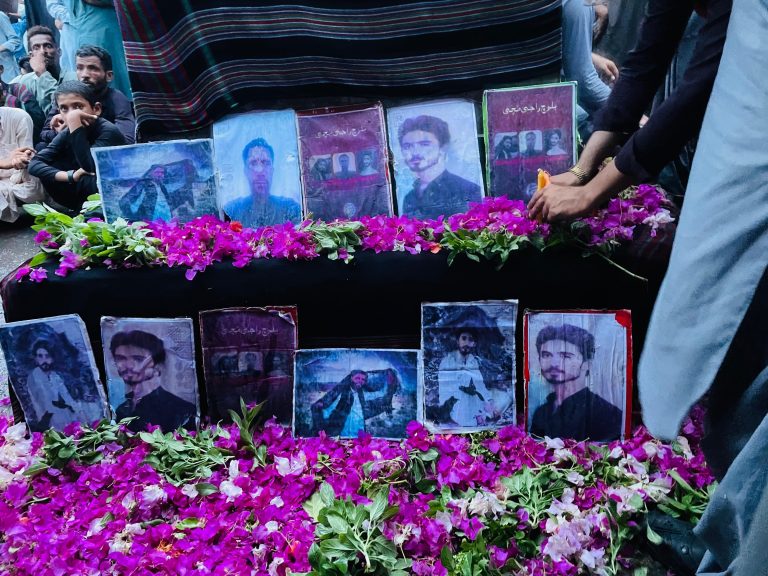
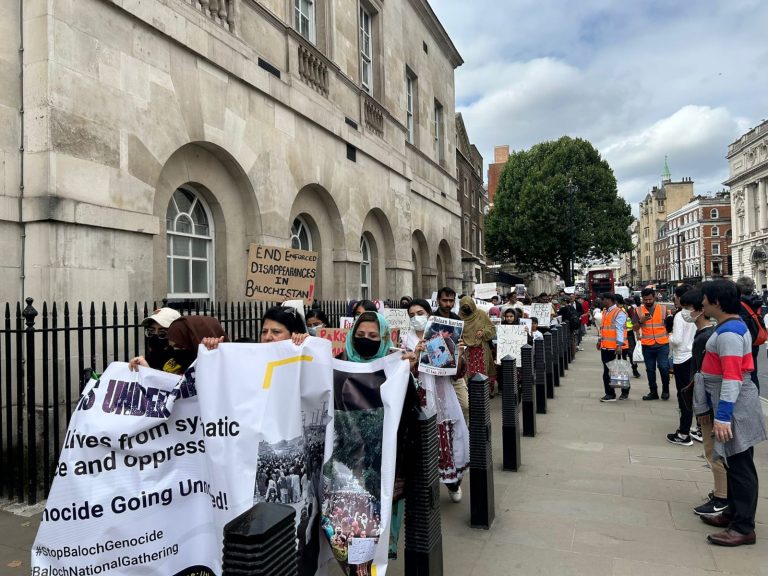
The Baloch National Movement (BNM) has organized protest demonstrations in the United Kingdom, Netherlands and South Korea to condemn Pak authorities for their suppression of a historic event in Gwadar, Pak-occupied-Balochistan. The event, known as the “Baloch National Rally / Baloch Raaji Muchi,” was marred by road closures, telephone service disruptions and internet blackouts.
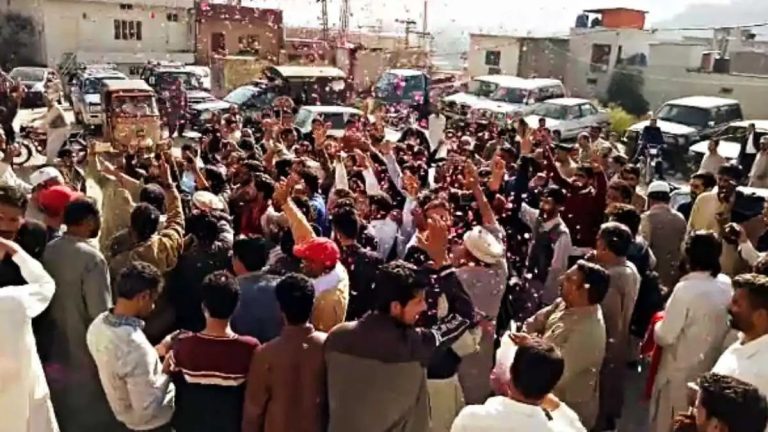
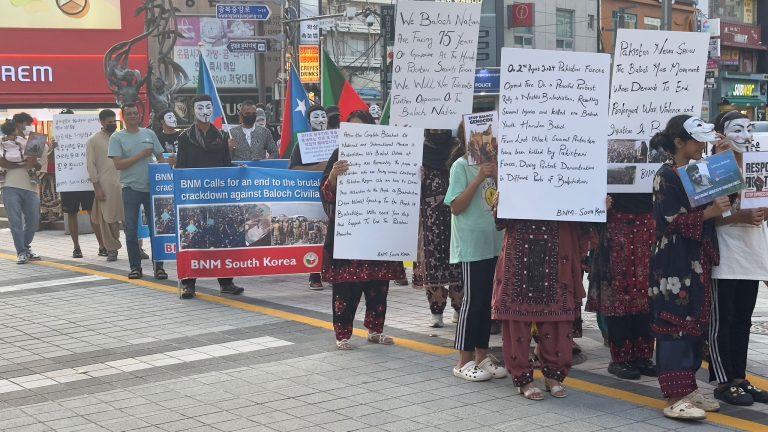
In South Korea, the BNM chapter held a demonstration at City Spot Nampo Dong, showing solidarity with Baloch protesters who face severe repression. Protesters carried banners and chanted slogans condemning the Pak Army’s crackdown on the Baloch Raaji Muchi and broader human rights violations in POB. Speakers, including Hafsa Baloch, addressed the crowd in both Korean and English, highlighting the neglect of POB’s plight amid global conflicts like those in Palestine and Ukraine.

In the UK, the BNM chapter has announced a protest against Pakistan’s violent actions aimed at disrupting the peaceful Baloch Raji Muchi. At Trafalgar Square, London, this demonstration is part of a series of global protests called by BNM Chairman Dr. Naseem Baluch, with participation from all BNM chapters.

BNM Demands Action 

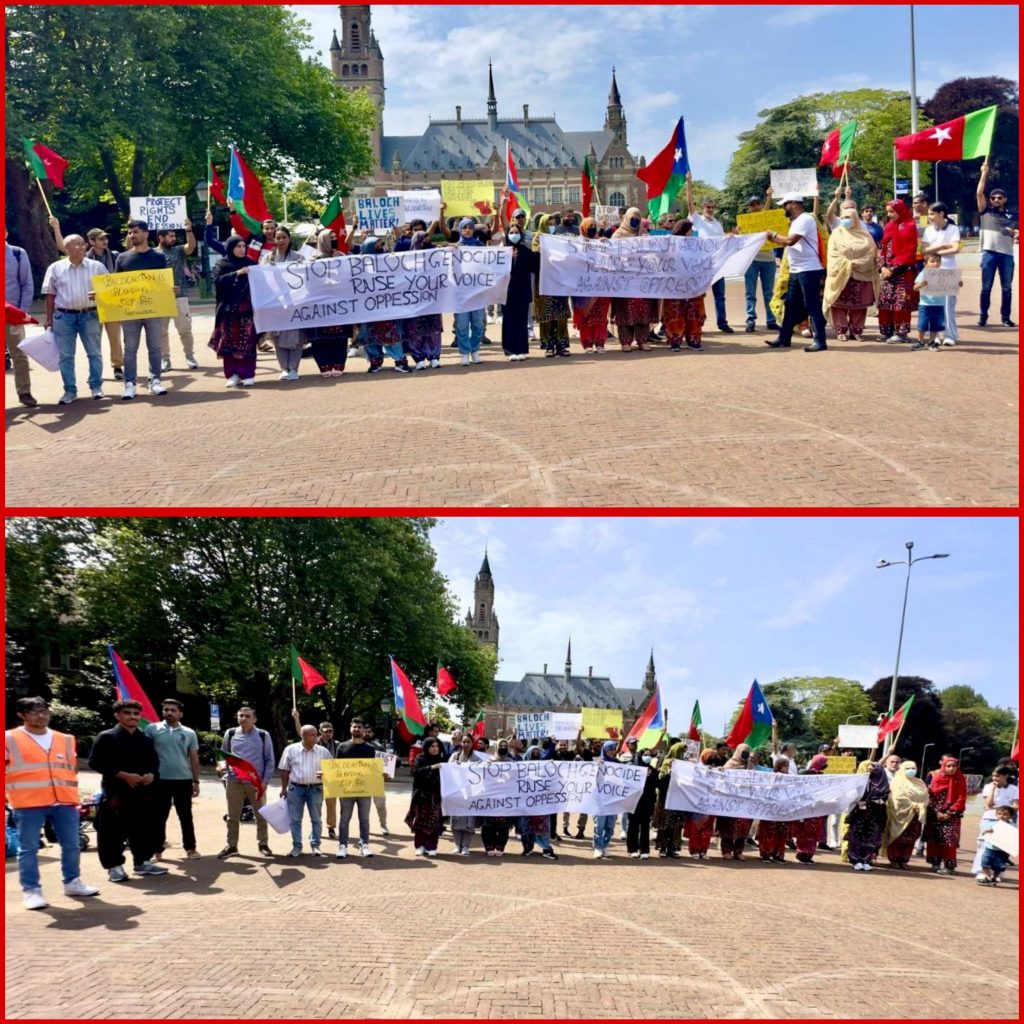
Additionally, the BNM also held a protest in front of the International Court of Justice in The Hague, Netherlands, to highlight the genocide of Baloch people. The protest, took place at Carnegieplein 2, 2517 KJ Den Haag, aims to draw international attention to the injustices and atrocities faced by the Baloch nation.

Hafsa Baloch criticized the international community’s lack of attention to the severe human rights abuses by Pakistan forces. She cited recent incidents, including a violent crackdown on a peaceful protest in Gwadar on July 28, resulting in deaths and injuries, and the shooting of protesters in Nushkai on July 2. The repression has intensified, with numerous arrests and detentions of Baloch activists.

The BNM South Korea chapter has called on global leaders and human rights organizations to intervene, urging the international community to address the ongoing violence and support the Baloch struggle for peace and dignity.

London: PM Keir Starmer vows strict action as riots rage across cities

In recent days, violent unrest has spread across several towns and cities in Britain. The violence that has been ongoing for several days across the country shows no signs of stopping. Protesters have caused chaos in many cities and engaged in violent clashes with the police. Bricks and fireworks were thrown in several places, and hotels and shops were attacked. Meanwhile, the government has warned that the violence will be dealt with strictly.

Few days ago, an attacker killed three girls with a knife at a dance class in Southport. Eight other people were injured during the incident. Violent protests have erupted since this event. It is being circulated online that the attacker was of Rwandan origin and was seeking asylum in Britain. The Southport attacker was an immigrant Muslim who entered Britain illegally. This has led to a wave of protests against immigrants. The police have arrested 17-year-old Axel Muganwa Rudakubana, who was born in Wales, in connection with the case.

PM – Rioters will regret it

British Prime Minister Keir Starmer has stated that there is no doubt that those involved in this violence will face the full force of the law. The police will arrest them. They will be taken into custody and punished. “I guarantee that you will regret being directly involved in this unrest. Those who incite violence online and then flee will also regret it. This is not a protest but organized violent thuggery. It has no place on the streets of Britain or on online platforms”.

Amid the increasing violence across the country, PM Starmer called a high-level meeting on Saturday. Following the meeting, he issued orders in support of the police, instructing them to use all appropriate measures to control the violence. The PM has given the police a free hand to bring the violence under control.

The British Prime Minister has said that those attacking the police, disrupting local businesses, and trying to spread fear and hatred within communities will face strict action. The British PM stated that the right to freedom of expression and the violent disorder we have witnessed are two very different things.

Last month, a new Labour Party government led by PM Keir Starmer was formed in Britain, and since then, there have been several incidents of violence on the streets of Britain. Strict action has been called for against those inciting violence.

Bangladesh PM Sheikh Hasina resigns & flees country; protestors storm palace

Bangladesh Prime Minister Sheikh Hasina has resigned and left the country on Monday, as more people were killed in some of the worst violence since the birth of the South Asian nation more than five decades ago.

Amid escalating nationwide violence, Bangladeshi Prime Minister has departed Dhaka in a military helicopter, local media reported on Monday.

Hasina left her official residence, Bangabhaban, at approximately 2:30 p.m. local time. Reports suggest she is heading to West Bengal, India, although this has not been officially confirmed. The helicopter also carried Sheikh Rehana, Hasina’s younger sister.

The evacuation followed a significant escalation in unrest. The protesters breached the gates of Gono Bhaban, Hasina’s official residence, around 3 p.m. Thousands of demonstrators had gathered for the Anti-Discrimination Students’ Movement’s “March to Dhaka” at Mirpur 10 roundabout before advancing towards Farmgate.

Tensions were further heightened by the involvement of Army Chief General Waker-Uz-Zaman, who was reportedly pushed back while attempting to address the situation, according to the Inter Services Public Relations (ISPR).

The protests erupted following a demand from the Anti-Discrimination Student Movement for the resignation of Prime Minister Hasina and her cabinet members. This demand was announced at a rally at Central Shaheed Minar on August 3 by Nahid Islam, a key organizer of the movement.

Sheikh Hasina Flees

Hasina had previously extended an offer to the agitating students to meet at Gono Bhaban to discuss their grievances and seek to end the violence surrounding quota reform protests. Despite her offer, the protests continued to intensify.

Today’s “March to Dhaka” was rescheduled from its initial date and has been marked by calls for nationwide participation. The anti-discrimination student movement has also initiated a non-cooperation campaign, urging citizens to withhold taxes and migrant workers to avoid remittances via banks.

The unrest has resulted in at least 93 fatalities and numerous injuries, with many sustaining bullet wounds. Violence has surged as ruling Awami League supporters clashed with anti-government protesters, further straining the situation.

The unrest is rooted in demands for reforms to the quota system, which reserves civil service positions for specific groups, including descendants of 1971 war veterans. Protests intensified after a new policy allocated government jobs to descendants of freedom fighters, leading to attacks on state television and police stations in Dhaka.

Bangladesh has announced a three-day shutdown of public and private offices, including banks, in response to the ongoing crisis. The situation remains volatile as both pro- and anti-government groups prepare for further confrontation.

POGB: Nagar district administration files new case against activist Yawar Abbas

The occupied- administration of Nagar district has filed another case against activist Yawar Abbas. District Commissioner Nagar seems to have unchecked authority, filing cases against individuals at will.

This new development follows an earlier case in which the judges dismissed the FIR filed by the District Commissioner as baseless, leading to Abbas’s release. In June, Yawar Abbas was sentenced to one month in Manawar Jail by the District Magistrate. The sentence is a response to Abbas’s social media posts, which have been critical of the Pak Army.

Official statements accuse Abbas of “inciting people” and “attempting to undermine the law and order situation” through his online activities. Notably, a recent Twitter post by Abbas compared the conditions in the POGB (Pakistan-occupied Gilgit-Baltistan) region to those in Palestine.

Abbas has been an outspoken critic of the Pakistan Army’s “green tourism companies,” which is exploiting the region’s resources. His activism has spotlighted issues such as land grabbing and the exploitation of natural resources in POGB, a region historically plagued by neglect and underdevelopment.

This case highlights the ongoing struggle in POGB, where residents have long protested poor infrastructure and ignored grievances. Despite these challenges, the administration, puppet of the Punjabi Pak Army, continues to suppress dissent rather than address the region’s underlying issues.

PoGB leader slams Pak occupied-authorities over neglect and heavy taxation

A senior leader from Pakistan-occupied Gilgit-Baltistan (PoGB) voiced serious concerns regarding the dire conditions faced by residents in the region. The leader criticized local authorities for neglecting critical infrastructure and basic services in PoGB, calling attention to the severe violence in PoGB and other regions like occupied-Kashmir and Xinjiang.

In his statement, the leader accused the authorities of exacerbating the region’s problems by failing to address longstanding grievances. He said, “There is not so much cruelty in Kashmir and Xinjiang as it is happening to us,” and announced that the CPEC (China-Pakistan Economic Corridor) Road would be closed starting today in protest.

The leader highlighted the ongoing peaceful protests by PoGB residents over the past eight months, which have not been met with any meaningful response from occupied-officials. He also pointed out smuggling activities occurring at various ports and borders, including Chaman and Afghanistan, while PoGB residents face heavy taxation with no viable options for relief.

The leader specifically addressed the ongoing protest by traders from PoGB who are involved in cross-border trade through the Sost Dry Port. He criticized the occupied-authorities for obstructing their trade activities and disregarding a court order from PoGB’s chief court that exempted them from certain taxes. “Sost Port is the only border in the country with no trace of smuggling, but they are not honoring PoGB’s chief court order, which spared us from all taxes,” he said.

Reportedly, the protests have led to a halt in border trade between Pakistan and China, with traders demanding an end to the tax collection that is unlawful. The protesters have threatened to escalate their actions, including blocking the Karakoram Highway, if their demands for fair treatment and respect for the court’s ruling are not met.

BLA strikes on Pak military outpost and burns contractor vehicle 

The Baloch Liberation Army (BLA) has launched two separate attacks targeting Pakistan military forces and a construction vehicle in the Mashkay and Zamran regions.

According to a statement from Jeeyand Baloch, the spokesperson for the BLA, the first attack occurred on the night of July 27 at approximately 9 p.m. BLA fighters targeted security checkpoints at a central Pak military camp in the Nokjo area of Mashkay.

The assault involved grenade launchers and automatic weapons, resulting in the death of one Pak Army personnel at the scene. The attack also caused further casualties and damage within the camp.

In a second incident, BLA fighters set fire to a contractor’s vehicle in the Nhung Jonki Tank area of Zamran. The contractor, who was reportedly fleeing from the fighters, abandoned the vehicle, which was then destroyed. The contractor is involved in construction projects for the occupying forces, including the installation of fencing along the Gold Smud Line.

Since 1948, Pak-occupied-Balochistan province has witnessed decades of unrest and a ruthless crackdown by Pak Army against the Baloch community. Therefore, pro-independence groups like BLA are engaged in armed struggle against the brutal occupation. 

BLF attacks Pak Army camp in Kech

Major Gwahram Baloch, spokesperson for the Baloch Liberation Front (BLF), has announced that the group’s fighters have launched an attack on a Pak military camp located in Kolwah area in Kech.

In a statement, Major Baloch reported that the assault occurred on the evening of August 3, with BLF fighters targeting the camp using heavy and advanced weaponry. The attack resulted in the death of one Pak Army soldier and left three others severely injured.

The spokesperson asserted that the BLF is employing modern warfare tactics to achieve victories on various fronts. He said that Pak forces are attacking civilian areas to distract from their defeats.

Despite their advanced weaponry, Major Baloch claimed that Pak forces are struggling against the determined resistance of the Baloch fighters, who are adept at navigating the region’s terrain and targeting their movements.

BLF has been engaged in a long-standing revolution against the Pakistan Army. Since 1948, the Pakistan Army has forcefully occupied the resource-rich region of Balochistan and, to exploit it indefinitely, has launched scathing attacks on the Baloch community.

The BLF has declared its intention to carry out further intensified attacks against the Pak forces in the future, promising to exact retribution for every act of oppression against their nation.

Dr. Naseem Baloch calls for UN intervention amid rising human tragedy in POB

Dr. Naseem Baloch, Chairman of the Baloch National Movement (BNM), has issued an urgent appeal to the heads of democratic nations. Among his three key demands is a United Nations fact-finding mission to investigate the ongoing human rights crisis in Pak-occupied-Balochistan.

In his statement, Dr. Baloch highlighted the Baloch people’s enduring suffering under Pak Army oppression. He emphasized that this crisis has its roots in the forcible annexation of Balochistan in 1948.

He said that, in POB, the Pakistan Army, intelligence agencies, and criminal groups sponsored by the military are blatantly violating human rights. Alarmingly, these violations are on the rise. The recent surge in military violence and genocide against the Baloch people in POB began around the turn of the century and has been intensifying over time.

The Pak military is indiscriminately targeting the Baloch nation with an aggressive strategy of collective punishment. Currently, thousands of Baloch people have been forcibly disappeared and imprisoned in detention centers by the Pakistan Army. These ongoing incidents of enforced disappearances have left Baloch society suffering from severe anxiety and psychological distress.

Dr. Naseem Baloch’s Plea for Help

Dr. Naseem Baloch said, “I would also like to draw your attention to the mutilated bodies that have been found throughout POB. Hundreds of unidentifiable bodies of forcibly disappeared Baloch individuals have been discovered, creating a massive human tragedy. Additionally, several mass graves have been found in various areas. The Pakistan Army has destroyed several villages, setting hundreds of houses on fire. This process of genocide continues nonstop as of this writing.”

Despite the availability of modern information sources, the severity of the Baloch issue and its human impact are being ignored globally. All international organisations, including the United Nations, are ignoring this serious humanitarian crisis. In 2011, the UN Working Group on Enforced Disappearances conducted a visit that was limited to a five-star hotel in Quetta. The commission either did not consider it necessary to meet with Baloch victims or the Pak authorities did not permit them to do so.

He further added,” The Baloch people are continuously fighting against their genocide, but the Paki establishment is harshly suppressing even minor protests. The latest series of events began on July 27, 2024, as Balochistan continues its struggle against enforced disappearances and genocide. A “Raji Machi,” or national gathering, was planned in the coastal city of Gwadar on July 28, 2024.”

People from all over Balochistan, including Karachi and Punjab, voluntarily came to participate in the rally. To foil the gathering, the Pakistan Army closed all roads, fired on innocent people, and disabled vehicles by shooting or torching them. He added.

Despite these obstacles, thousands of people managed to reach Gwadar. However, the Raji Muchi was attacked, and the city of Gwadar was bloodied. The leadership of the National Gathering was arrested, and to cover up their barbaric atrocities and heinous crimes, the authorities blocked all means of communication, including the Internet, which remains in effect.

POB Under Siege

The closure of communication channels and roads has made it difficult to know the exact situation in Gwadar, and it is impossible to provide medical treatment to the injured. The supply line for drinking water has been cut, and the road closures have led to a food crisis in Gwadar and other cities, as the Pak Army is obstructing the delivery of food items.

Dr. Naseem Baloch said, “I am proud that the recent Baloch resistance movement is being led by two fearless young women, Dr. Mahrang Baloch and Sammi Baloch. The frontline leadership of this resistance movement is also Baloch women. Sammi Baloch’s father, Deen Muhammad Baloch, is a senior leader of the “Baloch National Moment” and has been forcibly disappeared by the Pak Army for the past fifteen years. Dr. Mahrang Baloch’s father, Mir Ghaffar Langove, was forcibly disappeared twice by the Pak Army. The second time, he was tortured to death in secret detention centres, and his mutilated body was later dumped.”

It should be noted that Sammi Baloch was recently awarded the Frontline Defender for Human Rights Award, which she dedicated to the families of the forcibly disappeared Baloch missing persons. The struggle led by Baloch women is a new and unprecedented example in the region.

Dr. Baloch’s appeal includes three key actions for international actors:

  1. UN Resolution: Advocate for a UN fact-finding mission to assess the situation in POB.
  2. Condemnation: Urge international bodies to denounce the ongoing genocide, Pak Army violence, and human rights violations.
  3. Diplomatic Pressure: Apply diplomatic pressure on Pakistan to uphold human rights and end the repression.

Dr. Baloch concluded by stressing that the international response to this crisis will reflect the commitment of democratic values and principles. He called for concrete actions to address and resolve the dire situation in POB.