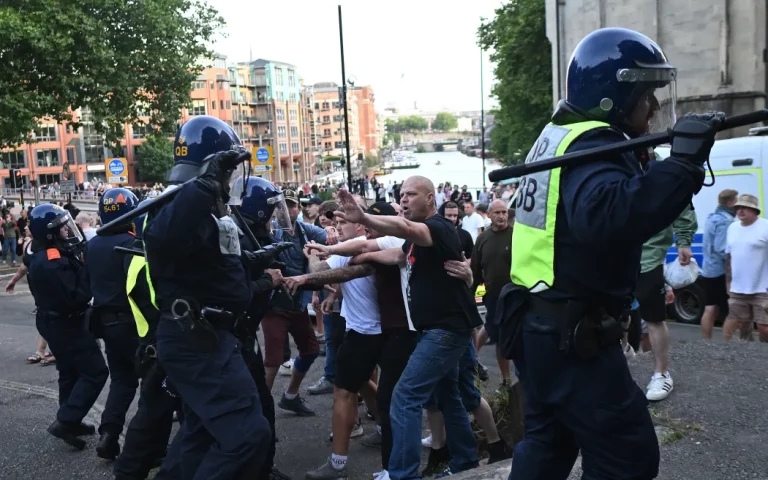
In recent days, violent unrest has spread across several towns and cities in Britain. The violence that has been ongoing for several days across the country shows no signs of stopping. Protesters have caused chaos in many cities and engaged in violent clashes with the police. Bricks and fireworks were thrown in several places, and hotels and shops were attacked. Meanwhile, the government has warned that the violence will be dealt with strictly.
Few days ago, an attacker killed three girls with a knife at a dance class in Southport. Eight other people were injured during the incident. Violent protests have erupted since this event. It is being circulated online that the attacker was of Rwandan origin and was seeking asylum in Britain. The Southport attacker was an immigrant Muslim who entered Britain illegally. This has led to a wave of protests against immigrants. The police have arrested 17-year-old Axel Muganwa Rudakubana, who was born in Wales, in connection with the case.
PM – Rioters will regret it
British Prime Minister Keir Starmer has stated that there is no doubt that those involved in this violence will face the full force of the law. The police will arrest them. They will be taken into custody and punished. “I guarantee that you will regret being directly involved in this unrest. Those who incite violence online and then flee will also regret it. This is not a protest but organized violent thuggery. It has no place on the streets of Britain or on online platforms”.
Amid the increasing violence across the country, PM Starmer called a high-level meeting on Saturday. Following the meeting, he issued orders in support of the police, instructing them to use all appropriate measures to control the violence. The PM has given the police a free hand to bring the violence under control.
The British Prime Minister has said that those attacking the police, disrupting local businesses, and trying to spread fear and hatred within communities will face strict action. The British PM stated that the right to freedom of expression and the violent disorder we have witnessed are two very different things.
Last month, a new Labour Party government led by PM Keir Starmer was formed in Britain, and since then, there have been several incidents of violence on the streets of Britain. Strict action has been called for against those inciting violence.
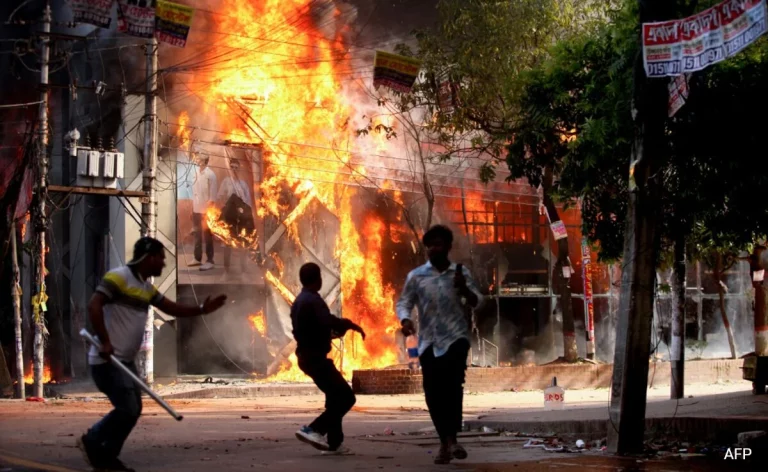
Bangladesh Prime Minister Sheikh Hasina has resigned and left the country on Monday, as more people were killed in some of the worst violence since the birth of the South Asian nation more than five decades ago.
Amid escalating nationwide violence, Bangladeshi Prime Minister has departed Dhaka in a military helicopter, local media reported on Monday.
Hasina left her official residence, Bangabhaban, at approximately 2:30 p.m. local time. Reports suggest she is heading to West Bengal, India, although this has not been officially confirmed. The helicopter also carried Sheikh Rehana, Hasina’s younger sister.
The evacuation followed a significant escalation in unrest. The protesters breached the gates of Gono Bhaban, Hasina’s official residence, around 3 p.m. Thousands of demonstrators had gathered for the Anti-Discrimination Students’ Movement’s “March to Dhaka” at Mirpur 10 roundabout before advancing towards Farmgate.
Tensions were further heightened by the involvement of Army Chief General Waker-Uz-Zaman, who was reportedly pushed back while attempting to address the situation, according to the Inter Services Public Relations (ISPR).
The protests erupted following a demand from the Anti-Discrimination Student Movement for the resignation of Prime Minister Hasina and her cabinet members. This demand was announced at a rally at Central Shaheed Minar on August 3 by Nahid Islam, a key organizer of the movement.
Sheikh Hasina Flees
Hasina had previously extended an offer to the agitating students to meet at Gono Bhaban to discuss their grievances and seek to end the violence surrounding quota reform protests. Despite her offer, the protests continued to intensify.
Today’s “March to Dhaka” was rescheduled from its initial date and has been marked by calls for nationwide participation. The anti-discrimination student movement has also initiated a non-cooperation campaign, urging citizens to withhold taxes and migrant workers to avoid remittances via banks.
The unrest has resulted in at least 93 fatalities and numerous injuries, with many sustaining bullet wounds. Violence has surged as ruling Awami League supporters clashed with anti-government protesters, further straining the situation.
The unrest is rooted in demands for reforms to the quota system, which reserves civil service positions for specific groups, including descendants of 1971 war veterans. Protests intensified after a new policy allocated government jobs to descendants of freedom fighters, leading to attacks on state television and police stations in Dhaka.
Bangladesh has announced a three-day shutdown of public and private offices, including banks, in response to the ongoing crisis. The situation remains volatile as both pro- and anti-government groups prepare for further confrontation.
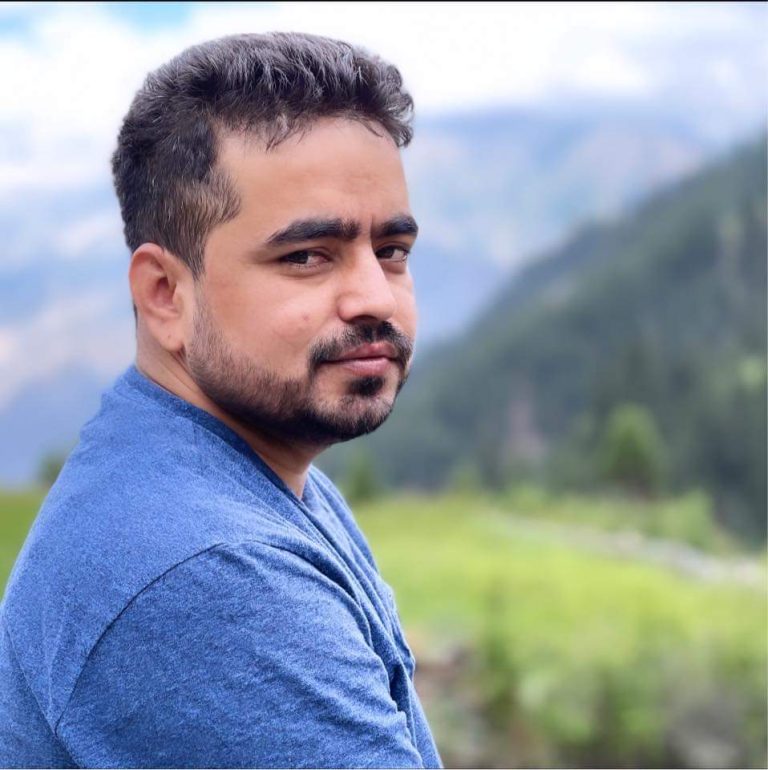
The occupied- administration of Nagar district has filed another case against activist Yawar Abbas. District Commissioner Nagar seems to have unchecked authority, filing cases against individuals at will.
This new development follows an earlier case in which the judges dismissed the FIR filed by the District Commissioner as baseless, leading to Abbas’s release. In June, Yawar Abbas was sentenced to one month in Manawar Jail by the District Magistrate. The sentence is a response to Abbas’s social media posts, which have been critical of the Pak Army.
Official statements accuse Abbas of “inciting people” and “attempting to undermine the law and order situation” through his online activities. Notably, a recent Twitter post by Abbas compared the conditions in the POGB (Pakistan-occupied Gilgit-Baltistan) region to those in Palestine.
Abbas has been an outspoken critic of the Pakistan Army’s “green tourism companies,” which is exploiting the region’s resources. His activism has spotlighted issues such as land grabbing and the exploitation of natural resources in POGB, a region historically plagued by neglect and underdevelopment.
This case highlights the ongoing struggle in POGB, where residents have long protested poor infrastructure and ignored grievances. Despite these challenges, the administration, puppet of the Punjabi Pak Army, continues to suppress dissent rather than address the region’s underlying issues.
A senior leader from Pakistan-occupied Gilgit-Baltistan (PoGB) voiced serious concerns regarding the dire conditions faced by residents in the region. The leader criticized local authorities for neglecting critical infrastructure and basic services in PoGB, calling attention to the severe violence in PoGB and other regions like occupied-Kashmir and Xinjiang.
In his statement, the leader accused the authorities of exacerbating the region’s problems by failing to address longstanding grievances. He said, “There is not so much cruelty in Kashmir and Xinjiang as it is happening to us,” and announced that the CPEC (China-Pakistan Economic Corridor) Road would be closed starting today in protest.
The leader highlighted the ongoing peaceful protests by PoGB residents over the past eight months, which have not been met with any meaningful response from occupied-officials. He also pointed out smuggling activities occurring at various ports and borders, including Chaman and Afghanistan, while PoGB residents face heavy taxation with no viable options for relief.
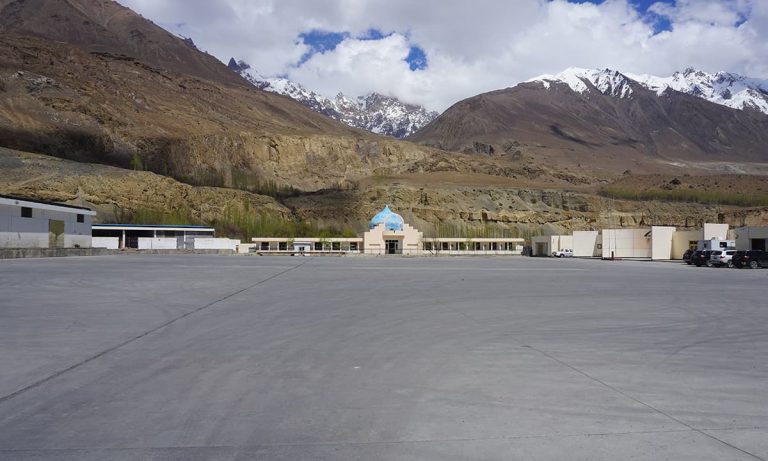
The leader specifically addressed the ongoing protest by traders from PoGB who are involved in cross-border trade through the Sost Dry Port. He criticized the occupied-authorities for obstructing their trade activities and disregarding a court order from PoGB’s chief court that exempted them from certain taxes. “Sost Port is the only border in the country with no trace of smuggling, but they are not honoring PoGB’s chief court order, which spared us from all taxes,” he said.
Reportedly, the protests have led to a halt in border trade between Pakistan and China, with traders demanding an end to the tax collection that is unlawful. The protesters have threatened to escalate their actions, including blocking the Karakoram Highway, if their demands for fair treatment and respect for the court’s ruling are not met.
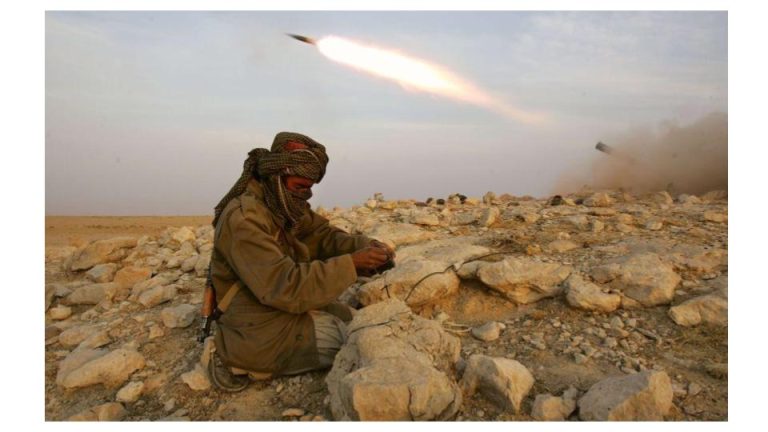
The Baloch Liberation Army (BLA) has launched two separate attacks targeting Pakistan military forces and a construction vehicle in the Mashkay and Zamran regions.
According to a statement from Jeeyand Baloch, the spokesperson for the BLA, the first attack occurred on the night of July 27 at approximately 9 p.m. BLA fighters targeted security checkpoints at a central Pak military camp in the Nokjo area of Mashkay.
The assault involved grenade launchers and automatic weapons, resulting in the death of one Pak Army personnel at the scene. The attack also caused further casualties and damage within the camp.
The Baloch Liberation Army claimed responsibility for two separate attacks in Mashkay and Zamuran. pic.twitter.com/6OMK6WJidp
In a second incident, BLA fighters set fire to a contractor’s vehicle in the Nhung Jonki Tank area of Zamran. The contractor, who was reportedly fleeing from the fighters, abandoned the vehicle, which was then destroyed. The contractor is involved in construction projects for the occupying forces, including the installation of fencing along the Gold Smud Line.
Since 1948, Pak-occupied-Balochistan province has witnessed decades of unrest and a ruthless crackdown by Pak Army against the Baloch community. Therefore, pro-independence groups like BLA are engaged in armed struggle against the brutal occupation.
Major Gwahram Baloch, spokesperson for the Baloch Liberation Front (BLF), has announced that the group’s fighters have launched an attack on a Pak military camp located in Kolwah area in Kech.
In a statement, Major Baloch reported that the assault occurred on the evening of August 3, with BLF fighters targeting the camp using heavy and advanced weaponry. The attack resulted in the death of one Pak Army soldier and left three others severely injured.
The spokesperson asserted that the BLF is employing modern warfare tactics to achieve victories on various fronts. He said that Pak forces are attacking civilian areas to distract from their defeats.
BREAKING: The #Balochistan Liberation Front (BLF) took credits for the attack on Pakistani forces in Kolwah area of #Kech, stating that the strike left one Pakistani soldier dead and three injured. https://t.co/iyZwibATx2
Despite their advanced weaponry, Major Baloch claimed that Pak forces are struggling against the determined resistance of the Baloch fighters, who are adept at navigating the region’s terrain and targeting their movements.
BLF has been engaged in a long-standing revolution against the Pakistan Army. Since 1948, the Pakistan Army has forcefully occupied the resource-rich region of Balochistan and, to exploit it indefinitely, has launched scathing attacks on the Baloch community.
The BLF has declared its intention to carry out further intensified attacks against the Pak forces in the future, promising to exact retribution for every act of oppression against their nation.
Dr. Naseem Baloch, Chairman of the Baloch National Movement (BNM), has issued an urgent appeal to the heads of democratic nations. Among his three key demands is a United Nations fact-finding mission to investigate the ongoing human rights crisis in Pak-occupied-Balochistan.
In his statement, Dr. Baloch highlighted the Baloch people’s enduring suffering under Pak Army oppression. He emphasized that this crisis has its roots in the forcible annexation of Balochistan in 1948.
He said that, in POB, the Pakistan Army, intelligence agencies, and criminal groups sponsored by the military are blatantly violating human rights. Alarmingly, these violations are on the rise. The recent surge in military violence and genocide against the Baloch people in POB began around the turn of the century and has been intensifying over time.
The Pak military is indiscriminately targeting the Baloch nation with an aggressive strategy of collective punishment. Currently, thousands of Baloch people have been forcibly disappeared and imprisoned in detention centers by the Pakistan Army. These ongoing incidents of enforced disappearances have left Baloch society suffering from severe anxiety and psychological distress.
Dr. Naseem Baloch’s Plea for Help
Dr. Naseem Baloch said, “I would also like to draw your attention to the mutilated bodies that have been found throughout POB. Hundreds of unidentifiable bodies of forcibly disappeared Baloch individuals have been discovered, creating a massive human tragedy. Additionally, several mass graves have been found in various areas. The Pakistan Army has destroyed several villages, setting hundreds of houses on fire. This process of genocide continues nonstop as of this writing.”
Despite the availability of modern information sources, the severity of the Baloch issue and its human impact are being ignored globally. All international organisations, including the United Nations, are ignoring this serious humanitarian crisis. In 2011, the UN Working Group on Enforced Disappearances conducted a visit that was limited to a five-star hotel in Quetta. The commission either did not consider it necessary to meet with Baloch victims or the Pak authorities did not permit them to do so.
He further added,” The Baloch people are continuously fighting against their genocide, but the Paki establishment is harshly suppressing even minor protests. The latest series of events began on July 27, 2024, as Balochistan continues its struggle against enforced disappearances and genocide. A “Raji Machi,” or national gathering, was planned in the coastal city of Gwadar on July 28, 2024.”
People from all over Balochistan, including Karachi and Punjab, voluntarily came to participate in the rally. To foil the gathering, the Pakistan Army closed all roads, fired on innocent people, and disabled vehicles by shooting or torching them. He added.
Despite these obstacles, thousands of people managed to reach Gwadar. However, the Raji Muchi was attacked, and the city of Gwadar was bloodied. The leadership of the National Gathering was arrested, and to cover up their barbaric atrocities and heinous crimes, the authorities blocked all means of communication, including the Internet, which remains in effect.
POB Under Siege
The closure of communication channels and roads has made it difficult to know the exact situation in Gwadar, and it is impossible to provide medical treatment to the injured. The supply line for drinking water has been cut, and the road closures have led to a food crisis in Gwadar and other cities, as the Pak Army is obstructing the delivery of food items.
Dr. Naseem Baloch said, “I am proud that the recent Baloch resistance movement is being led by two fearless young women, Dr. Mahrang Baloch and Sammi Baloch. The frontline leadership of this resistance movement is also Baloch women. Sammi Baloch’s father, Deen Muhammad Baloch, is a senior leader of the “Baloch National Moment” and has been forcibly disappeared by the Pak Army for the past fifteen years. Dr. Mahrang Baloch’s father, Mir Ghaffar Langove, was forcibly disappeared twice by the Pak Army. The second time, he was tortured to death in secret detention centres, and his mutilated body was later dumped.”
It should be noted that Sammi Baloch was recently awarded the Frontline Defender for Human Rights Award, which she dedicated to the families of the forcibly disappeared Baloch missing persons. The struggle led by Baloch women is a new and unprecedented example in the region.
Dr. Baloch’s appeal includes three key actions for international actors:
UN Resolution: Advocate for a UN fact-finding mission to assess the situation in POB.
Condemnation: Urge international bodies to denounce the ongoing genocide, Pak Army violence, and human rights violations.
Diplomatic Pressure: Apply diplomatic pressure on Pakistan to uphold human rights and end the repression.
Dr. Baloch concluded by stressing that the international response to this crisis will reflect the commitment of democratic values and principles. He called for concrete actions to address and resolve the dire situation in POB.
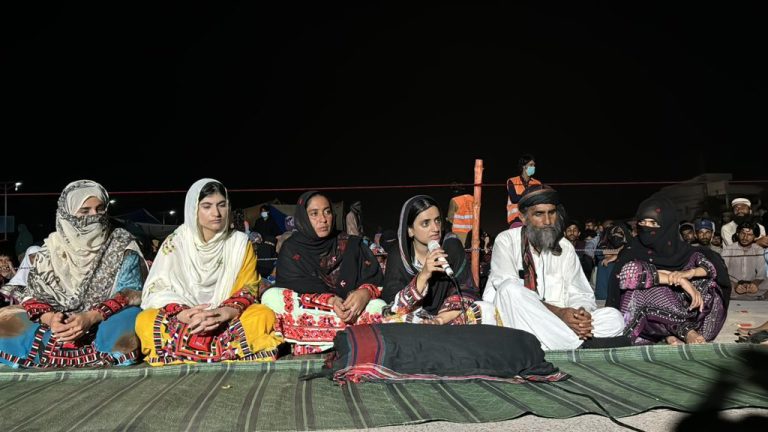
The Baloch Yakjehti Committee has issued a new statement concerning the ongoing Baloch Raaji Muchi sit-in in Gwadar, emphasizing that the Paki establishment has shown no genuine interest in negotiating. The committee says that, while negotiations are underway, the Pakistan Army is employing force across Pak-occupied-Balochistan, particularly in Makran, where plans are reportedly in place to seal the region and exacerbate suffering through violence and deprivation. The committee has denounced these actions as part of a broader strategy of intimidation and harassment.
According to the communiqué, the BYC says that the current local officials, including the Deputy Commissioner of Gwadar, lack the authority to engage in serious negotiations. The statement calls for negotiations to be led by individuals with real power to effect change.
The committee has also demanded the restoration of internet and network services in Gwadar and Makran before any further negotiations take place.
A narrative is being presented by the rulers of this country that the Baloch Yekjehti Committee is responsible for the chaos and curfew-like situation. The controlled media is aiding them in constructing this narrative. However, we are peacefully sitting in one corner of Gwadar,… pic.twitter.com/zaWeXjHZRW
The communiqué specifies that there will be no shutter-down or wheel-jam strikes in POB without a direct call from the committee. It also highlights the recent actions of the Pak military and intelligence agencies in Gwadar, which have used force to close shops, markets, and roads, causing significant hardship for residents. The committee urges the public to support local shopkeepers and assist in reopening businesses and markets. Shopkeepers are being asked to resume their operations immediately.
Protests continue in various regions, including Gwadar, Quetta, Panjgur, Nushki, Karachi, and Turbat. The communiqué confirms that in these areas, there will be no additional shutter-down or wheel-jam strikes, only ongoing sit-ins.
Furthermore, the BYC has instructed to closely monitor the activities of Army intelligence officials who are infiltrating protests disguised as ordinary citizens to incite violence. The BYC has been advised to maintain a public-friendly approach during protests and sit-ins, ensuring that these events remain peaceful and do not cause undue inconvenience.
The statement concludes by reaffirming that the central sit-in organized by the BYC will continue in Gwadar, and any negotiations will be held exclusively at this location.
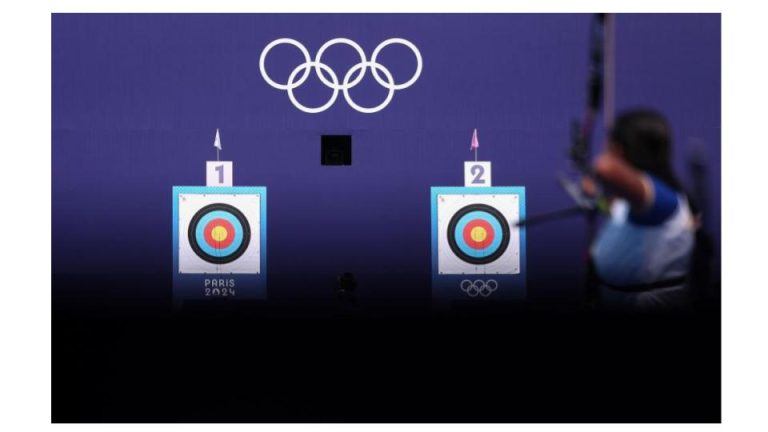
The Olympic Games are being held in Paris from July 26, 2024, to August 11, 2024. During this period, around 10,500 athletes from around the world are competing for Olympic medals in 329 events. The Paralympic Games will also take place in Paris from August 28 to September 8, where 4,400 athletes will compete for medals in 549 events. While 184 countries are sending their athletes to the Paralympics, 206 countries are participating in the Olympic Games this time.
Indian athletes are showcasing their remarkable talent at the Paris 2024 Olympic Games. So far, India has won three bronze medals at the Paris Olympics. Swapnil Kusale has won a bronze medal for the country in the 50-meter (men’s) rifle category. Manu Bhaker made history by winning India’s first medal at the Paris Olympics, raising the hopes of Indians even higher. A total of 117 Indian athletes, including five reserves, are in the race for medals at the Paris Olympics 2024, which runs from July 26 to August 11. Manu Bhaker and Sarabjot Singh also claimed a bronze medal in the 10-meter air pistol mixed team event at the Paris Olympics 2024.
History Of The Olympic Games
The history of the Olympic Games is very old. The ancient Olympic Games were held 1200 years ago among warrior-athletes. In ancient times, sports developed through competitions among warriors during periods of peace. Initially, running, boxing, wrestling, and chariot racing were part of military training. The warriors who performed the best in these activities would showcase their prowess in competitive sports.
In ancient times, the Olympic Games were held in Athens, the capital of Greece, in 1896. The name “Olympics” comes from being held on Mount Olympia. Athletes from states and cities participated in the Olympics. The popularity of these games was such that even wars between cities and states were suspended during the Olympic Games.
In the Olympic Games, the world’s best athletes represent their respective countries, and those who make it to the podium are awarded gold, silver, and bronze medals in that order. The Olympic flag features five rings in blue, yellow, black, green, and red. These five rings symbolize the interconnectedness of the five continents: Africa, the Americas, Asia, Europe, and Oceania. The flag was designed by Pierre de Coubertin in 1913.
The Olympic Games are the world’s largest sporting competition, where the best athletes from around the globe participate and represent their countries. The Olympics are held every four years, and this period is known as an Olympiad. The International Olympic Committee (IOC) oversees the Olympic Games.According to information, the Olympic Games were first held in 1896 in Athens, the capital of Greece. Since then, the games have been held every four years, except for 1916, 1940, and 1944, when they were not held due to World War I and World War II.
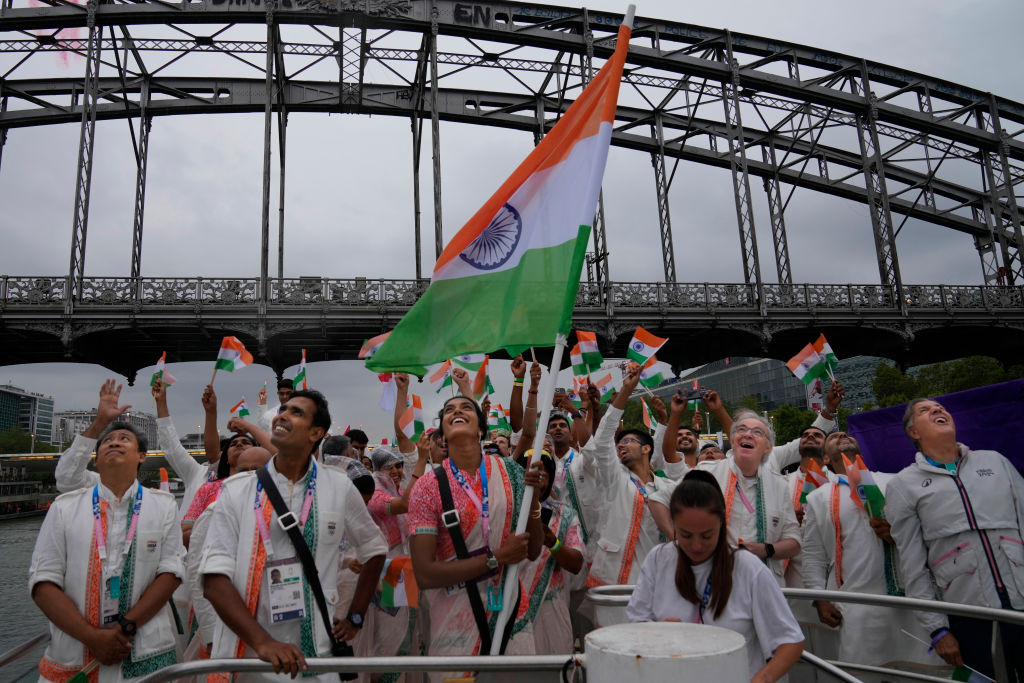
FRANCE – JULY 26: Members of Team India wave their national flags on a boat on the River Seine during the opening ceremony of the Paris 2024 Olympic Games on July 26, 2024 in Paris, France.
India’s Olympic Journey
India first participated in the Olympic Games in 1900, with the sole athlete Norman Pritchard winning two medals in athletics—both silver—making India the first Asian country to win an Olympic medal. The country sent its first team to the Summer Olympics in 1920 and has participated in every Summer Games since. India has also taken part in several Winter Olympic Games starting in 1964. Indian athletes have won a total of 38 medals, all in the Summer Games. For a period, the Indian men’s field hockey team dominated Olympic competition, winning eleven medals in twelve Olympics between 1928 and 1980. This streak included eight gold medals, six of which were won consecutively from 1928 to 1956.
Since its debut at the Paris Olympics in 1900 with just one participant, India’s Olympic journey has undergone significant changes. A historic moment came in the 1920 Antwerp Games when India sent its first official team, marking a century of remarkable achievements.
At the Paris 1924 Olympics, India made its debut in tennis, with five players participating in singles and doubles events. Following this, the Indian men’s hockey team delivered a remarkable performance at the Amsterdam 1928 Olympics, winning their first Olympic gold medal under the leadership of the legendary Dhyan Chand. Notably, the hockey team scored 29 goals and did not concede a single goal throughout the tournament, setting a high standard on the international stage.
In the 1930s and 1940s, under the leadership of the great player Dhyan Chand, the Indian men’s hockey team rose to prominence, achieving an unprecedented three consecutive gold medals at the Amsterdam 1928, Los Angeles 1932, and Berlin 1936 Olympics. This solidified India’s reputation as a leading hockey powerhouse in the world.
India’s Olympic journey post-independence began with the London 1948 Games, where the nation fielded its largest contingent yet—86 athletes across nine sports. The Indian hockey team continued its dominance, securing its fourth Olympic gold and introducing a new star, Balbir Singh Senior.
The Olympic Legacy
At the Helsinki 1952 Olympics, wrestler K.D. Jadhav made history by winning India’s first individual Olympic medal, a bronze. In Mexico City 1968, the hockey team won a bronze medal, marking a deviation from their usual top-two finishes. India repeated this achievement at the Munich 1972 Olympics.In Atlanta 1996, tennis star Leander Paes won a long-awaited bronze medal in men’s singles, while four years later in 2000, weightlifter Karnam Malleswari made history as the first Indian woman to win an Olympic medal with her bronze.
The Beijing 2008 Olympics was a memorable moment for India when shooter Abhinav Bindrawon the country’s first individual gold medal in the 10-meter air rifle event, setting a new standard in Indian Olympic history. Boxer Vijender Singh and wrestler Sushil Kumar also won bronze medals, marking India’s first multi-medal performance since 1952.
At the 2012 London Olympics, Saina Nehwal won India’s first Olympic medal in badminton. Sushil Kumar won his second Olympic medal, and Gagan Narang, Vijay Kumar, Mary Kom, and Yogeshwar Dutt contributed to India’s total of six medals, which was the highest at that time.
At the Rio 2016 Olympics, P.V. Sindhu and Sakshi Malik were India’s only medalists, marking the first time that all medals won by India were secured by female athletes.
The Tokyo 2020 Olympics proved historic for India, with a total of seven medals won. The men’s hockey team ended a 41-year medal drought with a bronze medal, while the women’s team achieved its best-ever fourth place. Neeraj Chopra won India’s first track-and-field gold medal in javelin throw, bringing a spectacular end to the campaign.
In the Paris Olympics 2024, India has sent its largest-ever contingent of 117 athletes across 16 different sports, including 70 men and 47 women. These athletes will compete in 69 events and have the opportunity to win a total of 95 medals, with three bronze medals already secured. Supported by a substantial funding of over ₹470 crores from the government, Indian athletes are striving to make a lasting impression on the global stage with their best performances.
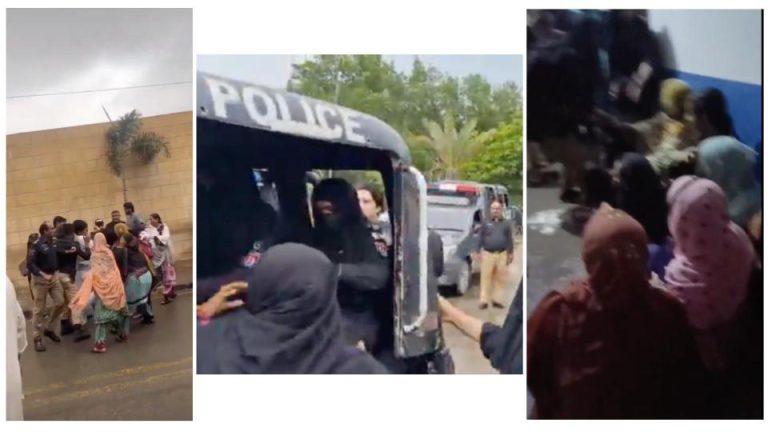
A police raid on a Baloch Raaji Muchi organized by the Baloch Yakjehti Committee (BYC) in Karachi has resulted in the detention of around 50 male protesters, including 13 women. The police operation, aimed at dispersing those demanding the release of detained colleagues, has been marked by severe violence and arrests, with the occupied-authorities targeting Baloch women who were staging a sit-in at the Karachi Press Club.
The protest was held in response to ongoing violence and arrests of Baloch Raaji Muchi participants in Gwadar and other parts of Pak-occupied-Balochistan. The crackdown against peaceful Baloch protesters in both POB and Karachi represents a serious infringement on their fundamental rights. Despite their peaceful intentions, the protesters have been met with aggressive tactics and mass arrests.
ایک طرف حکومت بلوچ یکجہتی کمیٹی کے ساتھ مذاکرات کا ڈھونگ رچا رہی ہے دوسری جانب کراچی، دالبندین اور کوئٹہ سے متعدد لوگ گرفتار اور لاپتہ کیے گئے ہیں۔
ہم حکومت کو ایک مرتبہ پھر یہ واضع کرنا چاہتے ہیں کہ اگر مظاہرین کو ہراساں کیا گیا یا گرفتار کرنے کا سلسلہ جاری رہا تو پورے بلوچستان… pic.twitter.com/iatMZ2fLre
— Baloch Yakjehti Committee (@BalochYakjehtiC) August 2, 2024
Among those arrested in Karachi are renowned human rights activist Professor Nida Kirmani, several Baloch women, and Fozia Baloch, an organizer and leader of the BYC, all of whom have been transferred to the police station.
The BYC condemned the actions of the Pak Army for this blatant violation of the right to peaceful assembly and free expression. Reportedly, bogus cases are being filed against the detained Baloch protesters in Karachi, and some of the arrested women are being forcibly transferred to undisclosed locations. This latest episode of brutality highlights the ongoing repression faced by the Baloch community.
We use cookies on our website to give you the most relevant experience by remembering your preferences and repeat visits. By clicking “Accept All”, you consent to the use of ALL the cookies. However, you may visit "Cookie Settings" to provide a controlled consent.
This website uses cookies to improve your experience while you navigate through the website. Out of these, the cookies that are categorized as necessary are stored on your browser as they are essential for the working of basic functionalities of the website. We also use third-party cookies that help us analyze and understand how you use this website. These cookies will be stored in your browser only with your consent. You also have the option to opt-out of these cookies. But opting out of some of these cookies may affect your browsing experience.
Functional cookies help to perform certain functionalities like sharing the content of the website on social media platforms, collect feedbacks, and other third-party features.
Performance cookies are used to understand and analyze the key performance indexes of the website which helps in delivering a better user experience for the visitors.
Analytical cookies are used to understand how visitors interact with the website. These cookies help provide information on metrics the number of visitors, bounce rate, traffic source, etc.
Advertisement cookies are used to provide visitors with relevant ads and marketing campaigns. These cookies track visitors across websites and collect information to provide customized ads.
Necessary cookies are absolutely essential for the website to function properly. These cookies ensure basic functionalities and security features of the website, anonymously.
Cookie
Duration
Description
cookielawinfo-checkbox-analytics
11 months
This cookie is set by GDPR Cookie Consent plugin. The cookie is used to store the user consent for the cookies in the category "Analytics".
cookielawinfo-checkbox-functional
11 months
The cookie is set by GDPR cookie consent to record the user consent for the cookies in the category "Functional".
cookielawinfo-checkbox-necessary
11 months
This cookie is set by GDPR Cookie Consent plugin. The cookies is used to store the user consent for the cookies in the category "Necessary".
cookielawinfo-checkbox-others
11 months
This cookie is set by GDPR Cookie Consent plugin. The cookie is used to store the user consent for the cookies in the category "Other.
cookielawinfo-checkbox-performance
11 months
This cookie is set by GDPR Cookie Consent plugin. The cookie is used to store the user consent for the cookies in the category "Performance".
viewed_cookie_policy
11 months
The cookie is set by the GDPR Cookie Consent plugin and is used to store whether or not user has consented to the use of cookies. It does not store any personal data.