Home Blog Page 74

Radical Islamists abduct, rape and convert another minor Hindu girl in Sindh

In a troubling trend of incidents targeting religious minorities, a 14-year-old Muskan Kumari have reportedly been abducted from Dholi Chowk, Ghouspur in Pakistan’s Sindh province. This has reignited concerns over forced conversions and the safety of minority communities.

Earlier, on July 4, a 10-year-old Jamuna Kohli, daughter of a Hindu laborer, was also kidnapped from her home in Goth Bhatiyani, near Khipro in Sanghar District.

These cases follow a distressing pattern seen in the region. Young girls, often between 12 and 15 years old, are reportedly kidnapped, forcibly converted to Islam, and married to their abductors or other Muslim men.

When families report these abductions, they often face counter-accusations of harassment from the kidnappers, who claim the marriages are consensual. The victims’ families say that the girls are subjected to threats and intimidation while in captivity, leading many to testify in favor of their abductors when brought before authorities.

The vulnerability of minority communities in Pakistan, particularly Hindu girls, to abduction, rape and forced conversion is heart wrenching. The cases highlight the ongoing challenges faced by religious minorities in Pakistan, particularly the Hindu community who are called “kafirs” in Sindh.

Rising death count forces Bangladesh Student Group to suspend protests for 2 days

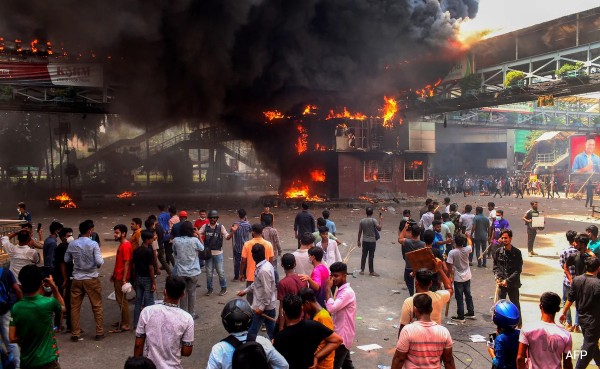
The violent protests occurring in Bangladesh have been suspended for 48 hours. The Bangladeshi student group leading the protests, which have turned into deadly violence, made this announcement. The group’s leader said they do not want reforms at the cost of bloodshed in the country. 

The protest, which started against the political quota for entry into government jobs, has now turned violent, resulting in the deaths of approximately 163 people. The Bangladeshi student leader called for a 48-hour halt to the protests on Monday after the Supreme Court’s decision to abolish most of the quotas in government jobs. Over 160 people have died due to the unrest across the country.

Supreme Court’s Order

The Supreme Court has directed that 93% of government jobs should be open to candidates based on merit. The Supreme Court instructed the government to reduce the job quota for families of freedom fighters from 30% to 5%. They stated that the remaining 2% of jobs are still subject to quotas, which are for so-called backward groups and the disabled. The court urged the protesting students to return to their classes and also asked the government to issue an order regarding the quotas.

In June, the High Court reinstated the job reservations that were removed by Prime Minister Sheikh Hasina’s government in 2018. Following this, reports of protests started emerging from various parts of the country, and students took to the streets.

The protests against reservations in government jobs in Bangladesh appeared to have calmed down on Monday after several days. The general public has been given some respite from the curfew. However, communication services have not yet been restored. The protesting students have given the government 48 hours to consider their new demands. On Sunday, the Supreme Court issued an order suspending the High Court’s order of 30% reservation.

Protest in Karachi demands recovery of missing 9 year old Priya Kumari

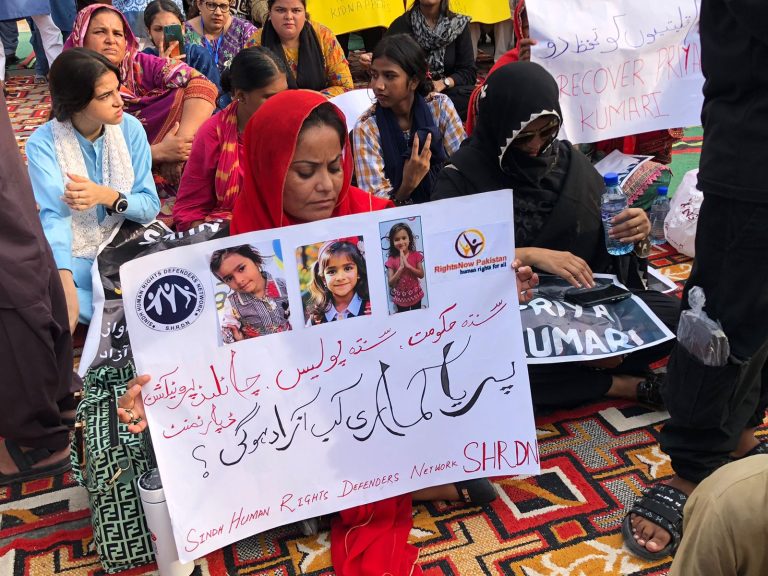
A protest took place at Teen Talwar in Karachi on Friday, demanding the recovery of nine-year-old Priya Kumari, who disappeared from Sukkur, Sindh, three years ago.

The protest saw participation from women and children holding placards with messages calling for Priya’s return. Social media videos showed police using force and making arrests to disperse the demonstrators.

Priya Kumari’s parents, Raj Kumar and Raveena Kumari, attended the protest, pleading for their daughter’s swift recovery.

Later, Sindh Interior Minister Zia-ul-Hassan Lanjhar arrived to negotiate with the protestors and met with Priya’s parents. The minister informed them that a Joint Investigative Team (JIT) has been formed to locate Priya, assuring them that she is alive and will be found soon.

Disappearance of Priya Kumari

Priya Kumari went missing from Sukkur on August 19, 2021. Her father, Raj Kumar, recounted the events of that day: “Ashura, and I had set up a water stall at my grocery store in the town of Singrar, about 45 k.m. from Sukkur. My nine-year-old daughter Priya was there, serving water to mourners. I left her at the stall to attend to some work at home, but when I returned, she was gone.”

Raj Kumar said they contacted neighbors and relatives, but there was no trace of Priya. Three days after her disappearance, they filed a kidnapping case at the Singrar police station. Despite nearly three years passing, Priya has not been found.

Over the past three years, there have been multiple protests against Priya’s disappearance in various cities across Sindh, including Sukkur, Hyderabad, and Karachi. Social media campaigns have also been launched to raise awareness about her case.

Additionally, Sindhi citizens living in countries like the USA and Canada have raised their voices for Priya’s recovery on various international forums.

BLF launches multiple attacks on Pak Army across Balochistan

The Balochistan Liberation Front (BLF) has launched a series of attacks on Pak military personnel in the Panjgur, Kokkoh, and Turbat regions. According to Major Gwahram Baloch, the spokesperson for the BLF, the freedom fighters targeted military outposts and convoys in four separate incidents, resulting in the deaths of six personnel and injuries to five others.

In a statement issued to the media, Major Baloch detailed the attacks. He reported that on the afternoon of the most recent incident, BLF fighters ambushed a convoy of four motorcycles belonging to the Pak Army in the Kolwah Rodkan area of Kech, killing one personnel on the spot and injuring another.

On the evening of July 20, at approximately 5 p.m., BLF snipers attacked a Pak military post in Kirk Dal Gachak, Panjgur, killing one soldier. A subsequent assault with modern automatic weapons killed another soldier and wounded one more.

Further attacks occurred on Sunday night. At 8:50 p.m., BLF fighters attacked a military outpost in Pul Abad, Turbat, with automatic weapons, killing one soldier and injuring two others. At 9 p.m, another outpost in Malant, Turbat, was targeted, resulting in the deaths of two soldiers and injuries to one.

Multiple Strikes on Pak Forces

Following these attacks, the Pak military reportedly launched retaliatory operations in the area, targeting the general population to obscure their losses.

The spokesperson emphasized that the BLF is a people’s army dedicated to achieving Pak-occupied-Balochistan’s independence with the support of its citizens. The BLF has successfully confronted the Pak military on multiple fronts and vows to continue its struggle until freedom is achieved.

Independence groups like the BLF have been engaged in a long-standing revolution against the Pakistan Army. Since 1948, the Pakistan Army has forcefully occupied the resource-rich region of Balochistan and, to exploit it indefinitely, has launched scathing attacks on the Baloch community. The BLF has declared its intention to carry out further intensified attacks against the Pak forces in the future, promising to exact retribution for every act of oppression against their nation.

Indian Army thwarts Pak-backed terrorist infiltration attempt in J&K

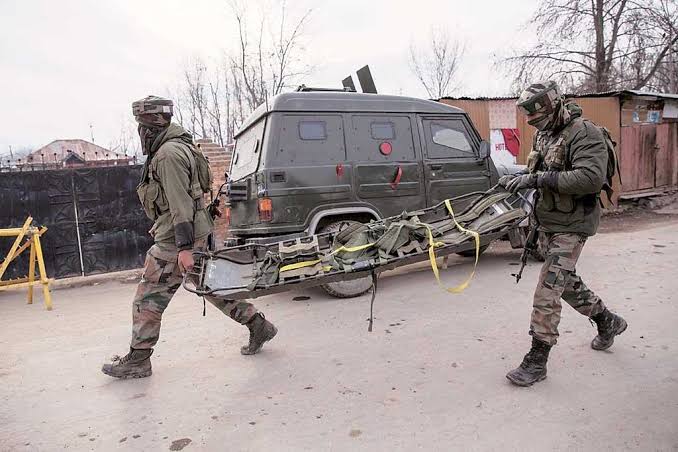
In the early hours of this morning, the Indian Army successfully foiled an infiltration attempt in the Krishna Ghati sector of Jammu and Kashmir. The incident occurred around 3 a.m. when terrorists launched an attack, resulting in an exchange of fire that left one soldier injured.

This marks the second terror-related incident in the Jammu region within 24 hours, specifically in the Poonch-Rajouri area. The White Knight Corps, the Indian Army’s XVI Corps, reported on social media platform X.

The injured soldier has been evacuated and is currently receiving medical treatment at a hospital.

This infiltration attempt comes amidst a series of terror attacks in the region, predominantly in Jammu. Over the past 32 months, 48 army soldiers have lost their lives in counter-terrorist operations in the area.

In response to the escalating situation, Army Chief General Upendra Dwivedi visited the Union Territory on Saturday to discuss measures to counter the recent surge in terrorist activities in an area that was relatively peaceful until a few years ago.

The Army has intensified its efforts to combat the threat, deploying additional troops and Para Special Forces commandos to the region. Security forces have identified the involvement of Pakistani terrorists in these attacks and are developing strategies to locate and neutralize them.

This incident follows a string of recent attacks, including one on an army camp in Rajouri and another on the residence of a Village Defence Guard. Last week, four soldiers, including a captain, were killed in Doda district, shortly after five soldiers lost their lives in an ambush in Kathua.

Khyber-Pakhtunkhwa: Pak Army kills another Pashtun in Tirah valley

Hamid Khan, a native of Tirah Valley in Khyber District, was killed by the Pak military for taking a few of his goats to a nearby mountain. This incident highlights the ongoing violence against Pashtuns, who are frequently targeted without cause. Reportedly, Hamid, son of Yasin Malik Deen, was shot and killed by gunfire from Punjabi Pak Army checkpoint on the Tera Adam Kheil and Malik Deen Kheil border.

In protest, his body was placed in front of the brigade headquarters. Earlier, a young boy named Zia ur Rehman was also killed by the Punjabi Pak Army in Khadi village, North Waziristan. Since the Punjabi Pakistan Army occupied Khyber Pakhtunkhwa in 1947, the Pashtun community face genocide, with fears that the situation could worsen.

The killing of Hamid Khan is part of a broader pattern of violence affecting various ethnic groups in Pakistan. Alongside the rise of terrorism, there is an ongoing genocide of Baloch, Pashtuns, Sindhis, and Kashmiris. The Pashtun community continues to suffer from arbitrary violence, reflecting the broader tensions and unrest in the region.

Pak Army threaten transporters ahead of Baloch National Gathering

Pak establishment has threatened transport companies, warning them not to provide buses for the Baloch National Gathering scheduled for July 28 in Gwadar. Additionally, the Kech district administration has also banned the collection of donations for the event.

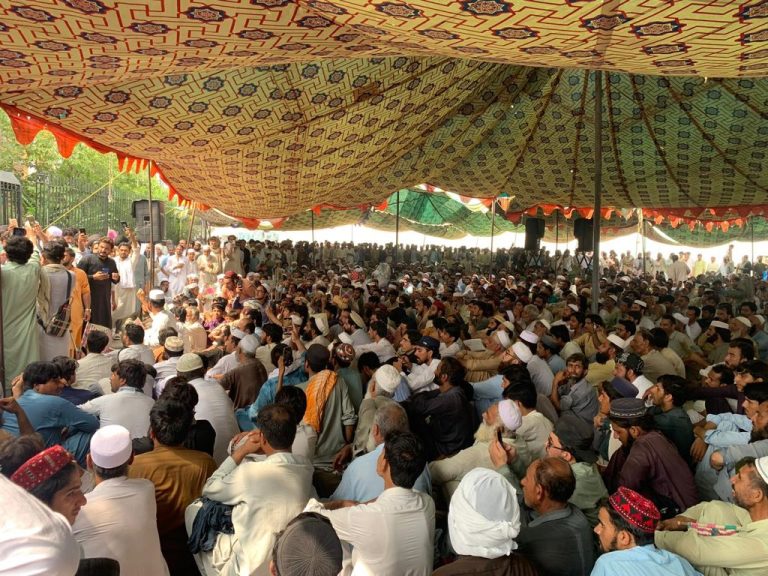
Announced earlier this month, the Baloch National Gathering, known as the Baloch Raaji Muchi, aims to unite the Baloch people against Army oppression, including enforced disappearances, torture, targeted killings, and economic exploitation. The Baloch Yakjehti Committee (BYC) has been actively organizing corner meetings across Pak-occupied-Balochistan to raise awareness about the upcoming gathering.

For over seven decades, POB has faced severe oppression and exploitation, akin to an imperial colony. Despite being the rightful inheritors of this land for thousands of years, the Baloch people live like refugees in their own homeland. Enforced disappearances, extrajudicial killings, forced displacements, and military operations are common, leaving the Baloch community in constant fear and insecurity.

Gwadar, the centerpiece of the China-Pakistan Economic Corridor (CPEC), struggles with basic amenities such as clean drinking water and reliable electricity, which is available for only four to six hours a day. Fishermen are being deprived of their traditional livelihoods, and residents face daily harassment and checkpoints, turning Gwadar into a heavily militarized zone.

Baloch Raaji Muchi

The Baloch people question the nature of this development, which has brought them suffering and turned their lives into a nightmare. The so-called megaprojects appear to benefit everyone except the local population, whose resources are being exploited while their quality of life deteriorates.

The Army values Pak-occupied-Balochistan’s land and resources more than its people. The CPEC and other megaprojects have coincided with an increase in violence and repression against the Baloch. The entire region has been transformed into a prison under the pretext of security, exacerbating the hardships faced by the Baloch community.

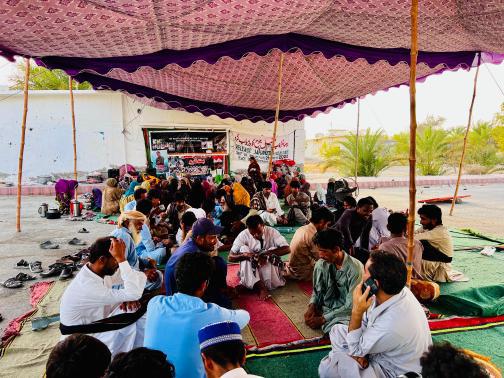
Chaman residents win back old border system after 273 days of protests

After 9 months sit-in protest, the demands of Chaman’s residents have been met, leading to the restoration of the old border system. This significant development comes amid ongoing discontent over new border regulations imposed by the Punjabi Pak establishment.

Inayat Kasi, who played a key role as a mediator between the protest leaders and the government, announced from the protest stage that cross-border movement using identity cards and passports would resume immediately. He confirmed that the demands of the protesters had been accepted, leading to the reimplementation of the previous border system.

Notably, lakhs of Pashtuns had been protesting at the Chaman border for over nine months. Their protest was driven by the Pak establishment’s imposition of a new one-document regime, which replaced the previously functional Tazkira system with mandatory passports for trade across the Durand Line. This major crossing in Pak-occupied Balochistan is vital for local traders who previously used Tazkira (a paper slip permission) for border crossing. Additionally, familial ties between communities on both sides of the border have been disrupted by the new regulations.

The protest highlighted the lack of measures taken to address these issues, with a significant portion of the Pakistan-controlled media neglecting the massive demonstration, seemingly waiting for it to subside. The situation escalated when the Pak Army and Frontier Corps (FC) forces launched crackdowns on peaceful Pashtun protesters. On June 6, these actions resulted in the deaths of many Pashtuns and the arrest and disappearance of dozens more.

With the successful conclusion of negotiations, protest leaders have announced the end of the sit-in, and border business activities are set to resume as before. The resolution marks a critical moment in addressing the grievances of the local Pashtun community and restoring their traditional cross-border practices.

J&K: Indian Army thwarts major Pak-backed terrorist attack in Rajouri

The Indian Army successfully repulsed a major attack early this morning in Jammu and Kashmir’s Rajouri district. Reportedly, a soldier sustained injuries during the predawn assault on an army camp. Following the attack, security forces launched a comprehensive search operation to locate and neutralize the terrorists involved.

This incident occurs amidst a surge of terror attacks in the Jammu region, escalating security concerns. The attack came less than 24 hours after Army Chief General Upendra Dwivedi’s visit to Jammu, where he discussed strategies to address the recent rise in terrorist activities in a region that had been relatively free of such violence until a few years ago.

A heavily armed group of terrorists targeted the army camp and also attacked the residence of Shaurya Chakra Awardee Parshotam Kumar in Gunda village. Kumar, a village Defense Guard recognized for his bravery in neutralizing two terrorists last August, was recently awarded the Shaurya Chakra by President Droupadi Murmu.

Another assault

Despite a robust counterattack by the army forcing the terrorists to flee, this marks yet another bold assault on military positions in the area. On Friday, a temporary army camp set up in a school in Doda district was hit with heavy gunfire and grenades. Last week, four soldiers, including a captain, were killed in the same area, following an earlier ambush in Kathua that resulted in the deaths of five soldiers.

In response to the escalating threat, the Army has deployed additional troops, including special forces commandos, to the Jammu region to combat the terrorists. Over the past 32 months, 48 army soldiers have been killed in terrorist attacks in Jammu, with terrorists frequently escaping without casualties.

The increase in attacks has prompted a recent cabinet committee meeting chaired by the Prime Minister, who has directed the army to utilize the full spectrum of its anti-terrorism capabilities to eliminate the threat from the region. Despite extensive cordon and search operations by security forces, the frequency of these attacks continues to challenge the region’s stability.

Pashtun protesters attack & vandalize Pakistani consulate in Germany

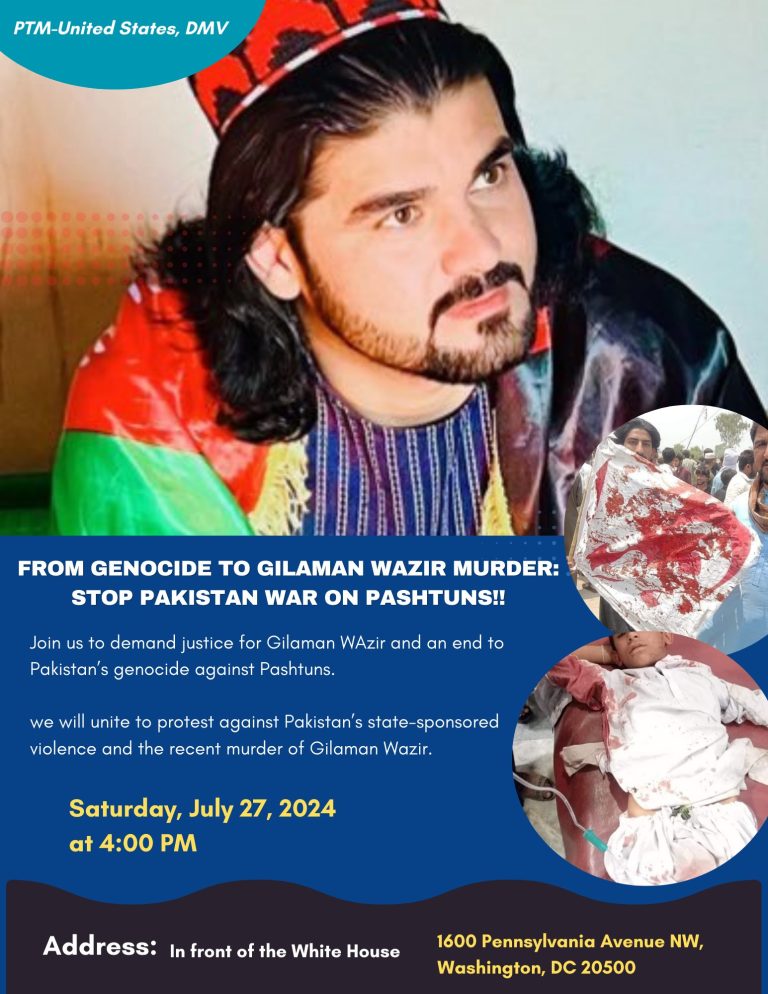
A group of Pashtun protesters attacked the Pakistani consulate in Frankfurt, Germany, on Sunday, throwing stones and temporarily replacing the Pakistani flag with an Afghan flag following the death of prominent Pashto poet and key figure in the Pashtun Tahafuz Movement (PTM) Gilaman Wazir. Wazir, whose real name was Hazrat Naeem, was attacked and repeatedly stabbed by Pak Army on July 7 in Islamabad and he succumbed to his injuries after 5 days.

Video footage circulating on social media shows a small number of demonstrators, some wearing Afghan flags, entering the consulate grounds. The protesters were seen throwing stones at the building and vandalizing the premises. They removed the Pakistani flag from outside the building and replaced it with Afghanistan’s flag. Some Pakistani media outlets reported attempts to burn the Pakistani flag, though this has not been independently verified.

On Sunday, PTM Germany held a large protest in Germany against the policies of the Pakistan Army, including its acts of terror, the genocide of Pashtuns, and the military attack on peaceful protests in Bannu.

It is no longer possible for the state to continue under such policies. On October 11, there will be a major judicial meeting of the Pashtuns to address decades of exploitation since 1947, when the region came under the control of the Pak Army. The Pashtuns have been exploited by the Army for its own agenda, only to later be labeled as terrorists and targeted.

PTM Germany

The rampant militarization of the region has led to numerous abductions, enforced disappearances, and extrajudicial killings of innocent Pashtun youths, many of whom are reportedly unconnected to any activist activities. Pashtuns around the world have expressed their frustration with the Pak Army’s brutality, and PTM’s movement in Germany is one such example.

In response to the attack, Pakistan’s Foreign Ministry issued a statement, demanding that Germany take action against what it called a “gang of extremists.” The ministry expressed concern over the safety of consulate staff and criticized German authorities for failing to protect the diplomatic premises as required under the Vienna Convention.

The Foreign Ministry called for the arrest and prosecution of those involved in the attack and demanded that German officials be held accountable for security lapses.

There was no immediate reaction from the German government to the attack and its denunciation by Pakistan. Taliban authorities in Afghanistan did not comment on the incident either.