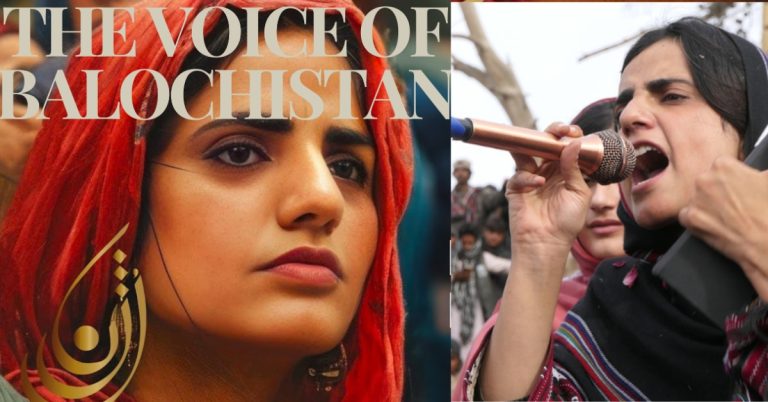
In the resource-rich regions of Pak-occupied Balochistan, where any basic sense of human rights and calls for justice are muffled by the oppressive Pakistan Army, one courageous woman has stood as a beacon of hope and emerged to take on the powerful establishment in Pakistan. The “lioness of Balochistan”, Dr. Mahrang Baloch, has earned the reputation of being resilient and defiant in the face of hardship.
Dr. Mahrang Baloch is a surgeon turned human rights activist. She hails from a Muslim Baloch family. Her journey from a physician to a crusader for justice is an outcome of her tragedy. In 2009, her father, Abdul Gaffar Baloch, a labourer and political activist, was forcibly abducted by the Pak Army, while he was going to a hospital in Karachi. She was only sixteen at the time. Later, in 2011, her father’s tortured body was found. Tragedy struck again when her brother, Nasir Baloch, too was abducted in 2017.
“It was the moment I decided to protest for everyone. And I removed my veil and showed my face to everyone”, Mahrang Baloch told the Guardian in 2021.
Since then, Dr. Mahrang has been at the forefront of the Baloch resistance movement, fearlessly confronting the entrenched forces of oppression. Despite facing intimidation, harassment, and baseless charges, she remains undeterred in her quest for justice.
Mahrang hasn’t raised her voice of resistance just for her community but has also stood up with oppressed groups, including the Hazara, Sindhi, Muhajir, Pashtun, Shia, Hindu and Christians of Pakistan.
Mahrang Baloch is the formidable leader of the Baloch Yakjehti Committee (BYC). The BYC is dedicated to advocating for the rights of the Baloch people, particularly against enforced disappearances and extrajudicial killings. Through peaceful protests and advocacy, the BYC seeks to draw attention to the plight of the Baloch population and challenge the oppressive policies of the Pak establishment. Under Mahrang Baloch’s leadership, the BYC continues to serve as a powerful voice for justice and accountability in Pak-occupied Balochistan.
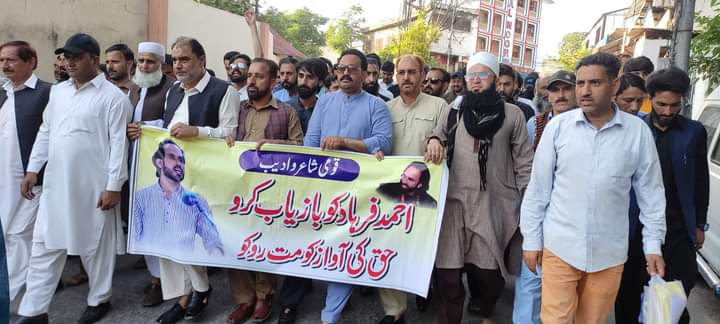
In November 2023, the extrajudicial killing of 24-year-old Balach Mola Bakhsh, another victim of enforced disappearance by the Counter-Terrorism Department (CTD), ignited a new chapter in the Baloch struggle for justice. Dr. Mahrang and her fellow activists embarked on a powerful movement called: The Baloch Long March from Turbat to Islamabad, staging sit-ins and protests across the country. Despite facing brutal crackdowns and vilification campaigns, they refuse to be silenced.
In the male-dominated Pak-occupied- Balochistan, where it is unusual for Balochis to rally behind a woman leader, Mahrang is special.
She has made relentless efforts to garner global support for the Pak-occupied Balochistan’s cause. On April 29, 2024, she held meetings with UN officials, aiming to draw international attention to the dire human rights situation in Pak-occupied Balochistan, Mahrang engaged with United Nations officials and presented detailed accounts of human rights abuses, including enforced disappearances and extrajudicial killings. She highlighted the perilous conditions faced by Baloch protesters during demonstrations and sit-ins, and she underscored the urgent need for international intervention to address these systemic injustices.
On 25 January 2024, thousands of people gathered in Quetta near Balochistan University to celebrate the return of participants in the Turbat long march, which was led by the indomitable Mahrang Baloch. It was a historic show of bravery and dedication to their cause. The march, which covered 1,600 k.m. and ended in Islamabad, represented a passionate demonstration against the systemic injustices that the Baloch people have to live with.
Recently she spoke at a discussion organized by the Norway chapter of Pen International in Oslo, Norway. Addressing activists from around the world, she highlighted the grave human rights violations in Balochistan, particularly enforced disappearances and extrajudicial killings. Sharing personal experiences and challenges faced by Pak-occupied- Balochistan’s people, she called for international intervention and solidarity.
Dr. Mahrang is at the forefront of these movements against the Pak-occupied- Balochistan’s age-old story of discrimination and exploitation by the Islamabad-Rawalpindi regime. This can be gauged from the fact that Balochistan is a resource-rich province and the poorest in the region. Over 41% of its residents are still living below the poverty line. Pak “establishment” along with Chinese interests has been continuously exploiting the Baloch resources mainly through the infamous CPEC corridor in Gwadar.
Pak-occupied Balochistan has seen constant deprivation. As if the situation was not dire enough, for decades, the Baloch community has witnessed forced disappearances and kidnappings by Pak Army personnel.
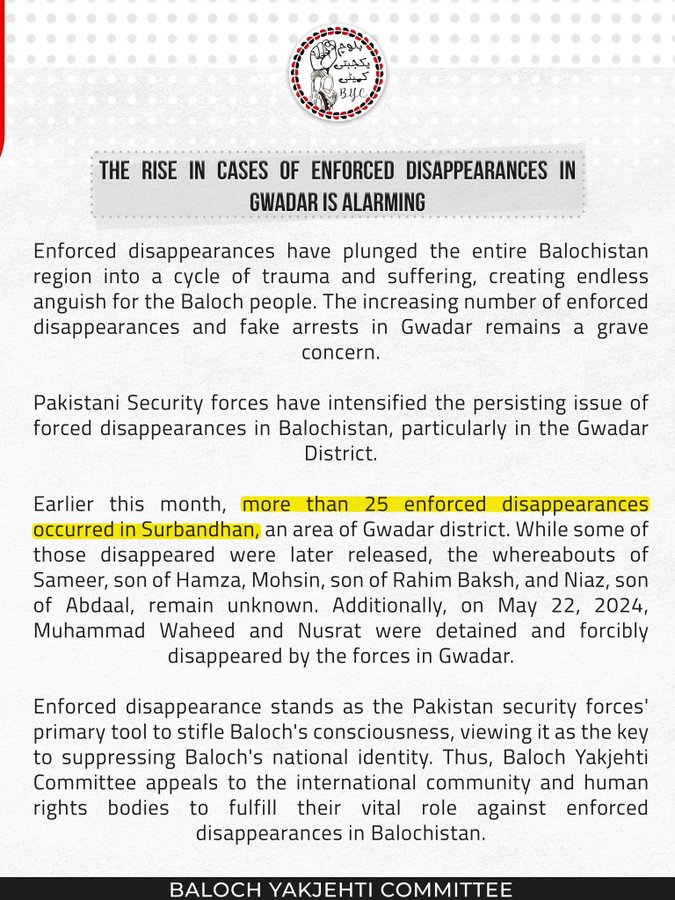
Balochistan has a long history of enforced abductions leading to mysterious disappearances. Earlier, social activists, intellectuals or those looked upon as opposing the Pakistan establishment were picked, however, now it has come up to this that every Baloch faces the danger of being picked up with ease. It is a known fact that the Pakistan Army has, for a long, supported criminals in the creation of what the locals call “death squads.”
PAANK, the Baloch National Movement’s Human Rights Department, has released its findings stating that 38 Baloch individuals forcibly disappeared after extrajudicial detentions by the Army in April 2024 alone. Imagine the staggering figure for the past 75 years of forceful occupation of Balochistan by the Pak Army.
Hereof, a trained surgeon and fiery orator, Mahrang Baloch has become a symbol of resistance against the Pak establishment. She is being compared to the brave Baloch daughter Karima Baloch who was assassinated by the Pakistani ISI in Canada for exposing barbarism and the atrocities committed by Pakistan. Her courage inspires countless others to stand up against the oppressive tactics of the Pak Army and demand a future where justice prevails.