Home Blog Page 100

Mashkel protesters’ Long March against Pak Army’s oppression in PoB

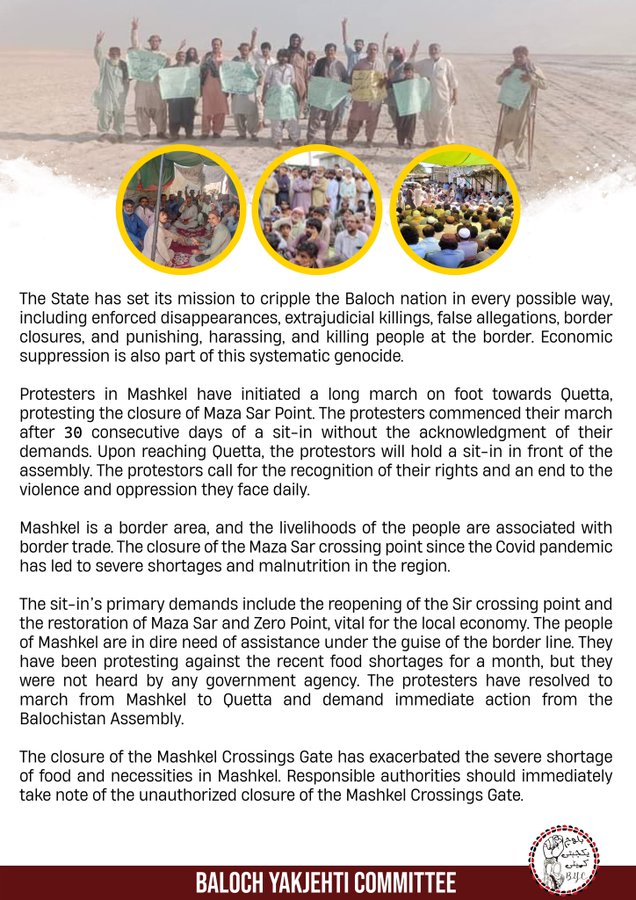
Hundreds of protesters from the town of Mashkel have embarked on a grueling long march towards the provincial capital Quetta, against the Pak Army’s systemic economic strangulation and oppression of the Baloch people.

The Mashkel protesters, comprising men, women and children began their march on foot after a 30-day sit-in protest in their town failed to draw any response from authorities regarding the crippling closure of the vital Maza Sar border crossing point with Afghanistan.

Upon reaching Quetta after the nearly 200 k.m. trek, the marchers have vowed to stage an indefinite sit-in outside the Pak-occupied-Balochistan Provincial Assembly, demanding immediate action to ease the humanitarian crisis unfolding in the border town.

The Army has unleashed systemic genocide on Baloch people through enforced disappearances, extrajudicial killings, false imprisonments and economic suffocation. Mashkel’s very survival is at stake due to the border closure.

The remote town of Mashkel lies in a region straddling the Afghanistan-Pakistan border, with its economic lifeline dependent on cross-border trade and movement. However, the closure of the Maza Sar crossing point since the COVID-19 pandemic has paralyzed this vital trade artery, leading to acute shortages of food, medicines and other essentials.

Children are going hungry, our sick cannot access medical care due to this illegal border blockade by Pak Army. They have been rendered prisoners on their own land.

The marchers have demanded the immediate reopening of not just the Maza Sar crossing, but also other key border points like Sir and Zero Point, stating that their very livelihoods have been destroyed by Islamabad’s collective punishment policies against occupied-Balochistan.

The powerful visuals of the Mashkel Caravan, comprising people of all ages braving the scorching desert terrain, have sparked an outpouring of support and solidarity protests.

However, Pak authorities have responded with a brutal crackdown, imposing internet shutdowns, mass arrests of activists and enforced disappearances to quell the dissenting voices.

The Army wants to economically bleed the Baloch land, starve the population into submission for daring to demand the basic rights over their own resources and lands. But this march is a resounding rejection of that oppression.
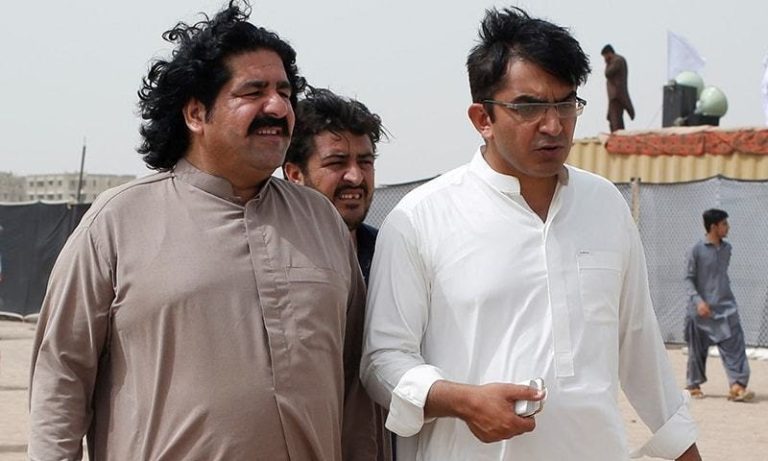
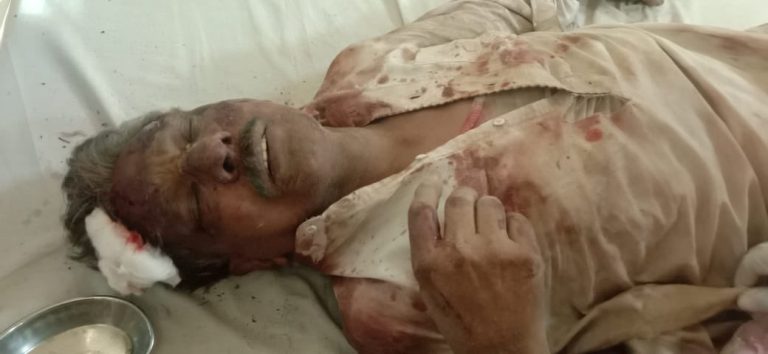
Pashtuns commemorate and honour the martyrs of Kala Qamar massacre

Pashtuns across Pakistan, along with other human rights activists, commemorated the victims of the Kala Qamar massacre and paid tribute to them on Sunday (May 26).

In North Waziristan, the Pashtun Tahafuz Movement (PTM) held a public meeting to honor the martyrs. The organization’s leader, Manzoor Pashteen, was present during the meeting.

The massacre took place on May 26, 2019, when the Pakistan Army opened fire on peaceful PTM protesters at the Khar Qamar check post in North Waziristan. The brutal act resulted in the deaths of 15 individuals and left 45 others injured.

The Pakistan Army attempted to blame the PTM, claiming that the protesters had attacked the army, leading to the firing. However, these claims were unfounded, and no evidence was provided to support them. Following the incident, several PTM activists, including Members of the National Assembly Ali Wazir and Mohsin Dawar, were arrested.

Videos from the incident showed that the activists were unarmed and protesting against the brutal torture of an elderly woman by the Pakistan Army on May 25, 2019, as well as the ongoing subversion and human rights violations against Pashtuns.

At the time of the massacre, the PTM had been established for almost a year, with its leaders and activists facing false charges of treason and other accusations. The Pakistan Army used brutal force in an attempt to curb the movement. However, the resilience of the PTM has made it a strong force against Pakistani oppression.

The Khar Qamar massacre serves as a stark reminder of the high price paid for raising one’s voice against the Pakistan Army’s oppression and human rights violations.

Christians escape lynching by Tehreek-e-Labbaik extremists in Pakistan

In less than a year of the Jaranwala horror, the Christian community in Pakistan is once again reeling under the threat to their very existence in the Islamic Republic. The latest ordeal was witnessed in Sargodha, where a Christian man was nearly lynched, his belongings were looted and his shoe factory was set ablaze, all because he was accused of blasphemy.

Even more concerning is the role of authorities in Pakistan, which has not only become a mute spectator during such incidents but also try to sweep the issue under the carpet, a Pakistani norm which was evident in Jaranwala also.

Pak media hesitant to name TLP

Pakistani media by and large projected it as an attack by an agitated mob against blasphemy, ignoring the fact that the mob largely comprised the extremists of Tehreek-e-Labbaik (TLP).

The police are now busy arresting perpetrators, 44 have been identified. But how Pakistan’s law and order works is no hidden fact. The point here is that Nazir Masih’s house, factory, and entire Mujahid colony, where he lived, were vandalised in front of the police but no action was taken and so this FIR and all follow-up investigation is just a pretence of law enforcement.

The ordeal didn’t end here, after nearly killing Masih, the TLP extremists then turned towards the ambulance he was taken to the hospital in. They attacked it with bricks and vandalised it to prevent Masih from being taken to the hospital.

Blasphemy: Pakistani law, policing by mob

Notably, the Blasphemy law in Pakistan provisions the death sentence for the accused. Surprisingly, no accused has been legally sentenced so far; however, scores of them are lynched by the radicalised mob.

This clearly tells that Pakistan is hell for minorities. A large section of society, the dominant political force and authorities all are guided by Islamic fundamentalism which advocates for the purge of religious minorities and considers it a sacred duty to Islamise them.

Chagai residents block road to protest against Pak Army’s oppression

The residents of Chagai also known as Chaghi have voiced their frustration by blocking the road leading to Nokundi Bab-e-Umar against the oppressive tactics of the Pak Army.

https://twitter.com/Fatima_bal0ch/status/1793369240571113549

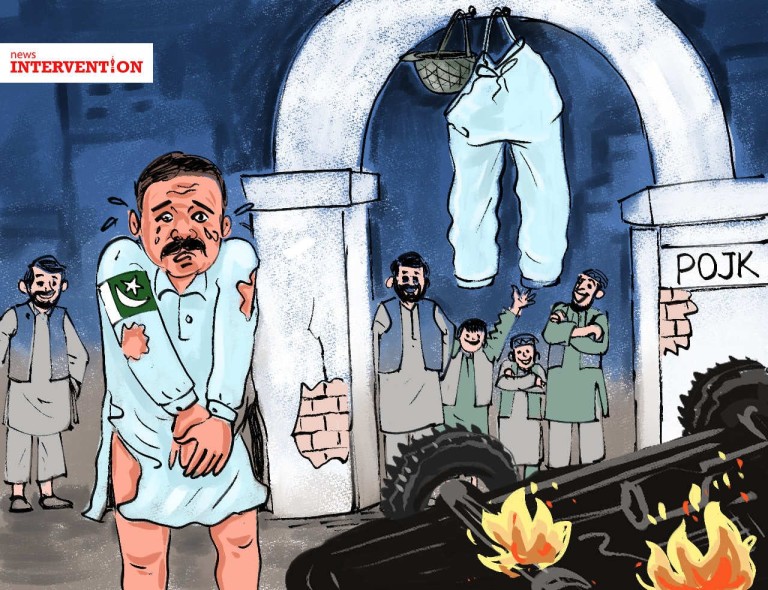
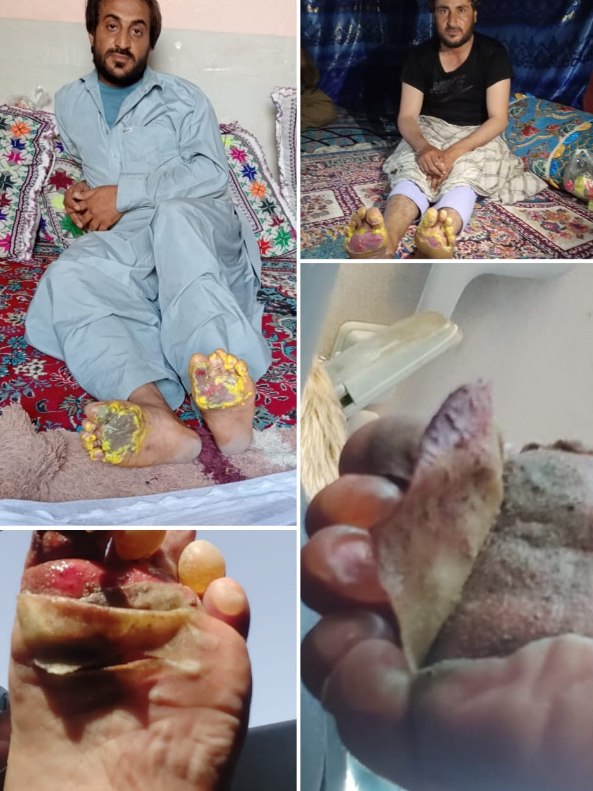
Reportedly, the previous day, the Pak Army callously sabotaged their vehicles by pouring sand into the engines of two local individuals’ vehicles, causing them excruciating pain as they walked barefoot on scorching hot sand.

Residents said that such incidents have occurred before, where drivers’ vehicles’ engines were disabled, and water bottles were also snatched from the drivers, leading to the drivers dying of thirst.

They further said that they appeal to human rights organizations to take note of the forces’ actions. Meanwhile, an announcement was made by the Baloch Yakjehti Committee to hold a protest rally in Dalbandin.

In an inhumane and disgraceful act, the Pak Army has tortured and abandoned Baloch drivers and labourers in the desert.

Leaders from the Baloch National Party and other nationalist groups participated, calling the puppet authority representatives “traders” who have been “sold out” and no longer defend the rights of the Baloch people.

The protesters said that Baloch people are being exploited. Instead of hiring local youth for the Rekodiq and Saindak projects, people from Punjab are being recruited. “If any Baloch tries to work across the border, they are not spared. Their shoes are removed and they are forced to stand barefoot on scorching sand,” another protester said.

It should be noted that in April 2024, nearly 200 batteries were removed from the radiators of vehicles by the Pak Army officials in the deserted border area, leaving drivers helpless and stranded. Reportedly, many drivers died due to thirst.

Since 1948, when Pakistan forcibly occupied Balochistan, the region has been subjected to the exploitation of its resources and systematic oppression of its people by the Pak Army. Pak Army is depriving the people of their basic rights. It is important for the international community to support the Baloch nation and raise its voice for their rights.