Home Blog Page 248

Pak Army continues its oppressive military operation in Balochistan

The Pak Army stormed Kirkdal in Malar area of Awaran district of occupied Balochistan and surrounded the neighbourhood early in the morning. The Army is oppressively checking  the people one by one.

Peoples’ mobiles and identity cards were forcibly taken away while their names and telephone numbers were being denied. Earlier, forces also raided all the villages of Cheri Malar, Sri Malar, Kanri, Sham Malar and Sahkal Malar. The villagers had their phones taken away by the camp blockers.The Pak Army time and again conduct military operations. Whenever, they conduct military operations human rights are brazenly flaunted, raiding houses, setting up random check posts in different areas and forcibly kidnapping the locals.

Pak Army manages to broker peace deal in POGB

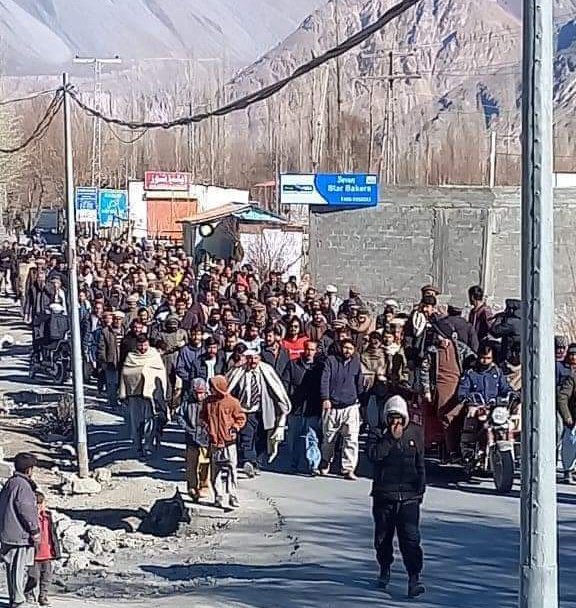
The largest public protest in the history of Gilgit-Baltistan against Pak atrocities has been postponed for a month after a meeting  was held between the GB Chief Minister Khalid Khurshid and Anjuman Tajran Baltistan where the state establishment asked for a months time to review their demands. The local people have been raising their voices for issues related to daily life, including cuts in wheat subsidy, increase in electricity bills, enforcement of illegal taxes, teachers’ strike at Toramuk Truck Road, shortage of lady doctors and other issues as well.

Prior to the protests in different areas, the Public Action Committee Gilgit-Baltistan had conducted meetings and small level public awareness series in the first phase, which continued for two months. The strike continued and in every district a sea of people came out against land grabbing, cuts in wheat subsidy, and non-provision of other basic human amenities on the highways in bitter cold.

A member of the action committee said that they are ready to wait for sometime to see the action of the state officials and if there is no response then they would be forced to take another step in their protest.

Pashtun protest against Paki regimes continues in Waziristan

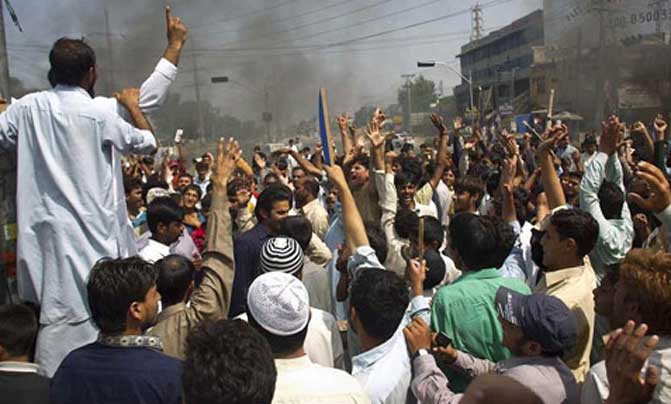
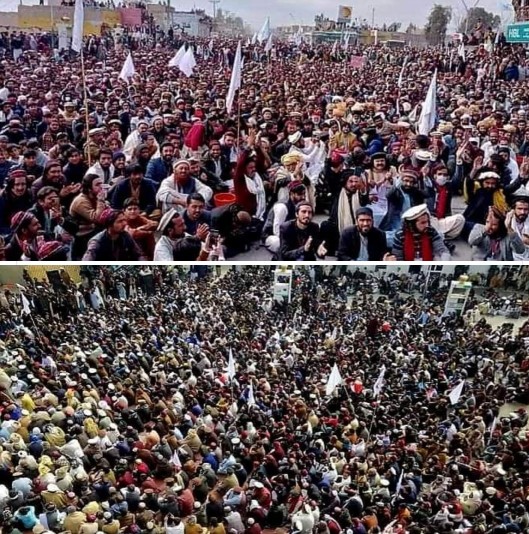
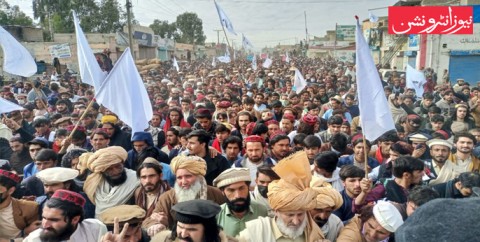
The sit-in of local people continued for the fourth day in Wana against the deteriorating law and order situation in south Waziristan, Khyber Pakhtunkhwa in which a large number of people participated despite the cold weather. Local leaders of all the political parties of Wana formed a coalition named Olsi Pasun, which means public awareness, and have been protesting for the past four days.Among the demands of the protestors, the establishment of law and order and the determination of the powers of the police top the list.

The participants of the sit-in are also demanding the release of a recently arrested local tribal leader, Jamshed Wazir, along with member of the National Assembly Ali Wazir. Negotiations between the protest leaders and the authorities on Sunday ended without any results. The District Deputy Commissioner of  Khyber Pakhtunkhwa, has been in touch with the protesters from time to time, but without the involvement and assurance of the military establishment, the protesters are not ready to end the sit-in and demand that the arrested tribal leaders should be released.

Senior local journalist Dilawar Wazir said that the Aman Paswan sit-in is a demand from the state to take indiscriminate action against all types of terrorists and to eliminate vehicles with black glasses, robberies and drug dealers in the area. The leaders of the sit-in are also demanding that armed organizations should be banned and police checkpoints should be established in all the markets of lower Waziristan on an emergency basis and police stations should be restored, otherwise their sit-in will continue.

66 Baloch women killed in 2022: Aurat foundation

According to the Aurat Foundation (Islamabad) annual data report, 66 Baloch women were killed in incidents of violence against women in Balochistan in the year 2022.

The survey report of the organization stated that there has been a significant increase in incidents of violence against women in Balochistan. In 2021 the number of Baloch women killed was 57 while  the number took a leap to 66 in 2022. Nineteen women were killed in the name of honor, while in 2021, 28 women were killed for the same reason. In 2022, three women committed suicide owing to domestic conditions. Human rights activists have cited lack of justice as a main reason behind the increasing violence in Balochistan and said that the perpetrators of such incidents should be punished so that these kind of atrocities can come to an end.

Activists working for womens’ rights demanded strict implementation of the law against perpetrators  committing violence against women in Balochistan.

Pashtuns protest against Paki atrocities in Wana

In the Wana area of South Waziristan the sit-in of tribals and political parties against the unrest and target killing continued for the third day. The protesters demanded that incidents of extortion, murder and kidnapping in Wana has to come to an end and said that there has to be immediate restoration of peace in the region.

The Pashtun leaders accuse the Pakistan Army for creating unrest in the tribals areas and that they are behind the killings, forceful abduction, etc. The protest comes as terrorism is again rearing its head in the country, especially in Khyber Pakhtunkhwa and Balochistan. Pashtunistan is the geographical region in Pakistan and Afghanistan inhabited by the Pashtuns. Some of the worst killings of Pashtuns have been carried out by the Pakistan Army.

Taliban and China join hands to extract oil in Afghanistan

The Taliban government, which is in full control of Afghanistan, has signed an oil extraction agreement with the Chinese company CPEIC in Kabul on Thursday. The Chinese Ambassador to Afghanistan was also present on this occasion.

Taliban’s Acting Minister of Minerals and Petroleum, Shahabuddin Dilawar stated that the deal would cover an area of 4,500 sq. k.m. in the three northern provinces of Saripol, Jawzjan, and Faryab (Amu Darya basin in northern Afghanistan). This is the Taliban government’s first major contract with an international company after assuming power in 2021.

China has not formally recognized the Taliban administration but has significant interests in a country that is vital to its Belt and Road infrastructure at the heart of the region.

Under the agreement, the Taliban government will share 20 percent of the investment and the Chinese company will invest a total of $540 million over three years.Zabihullah Mujahid, the spokesman of the Taliban-run administration tweeted that the Chinese company will invest 150 million dollars annually in Afghanistan under the agreement.He added that the Taliban-led administration would have a 20 percent stake in the project, which could be increased to 75 percent.

Chinese Ambassador to Kabul Wang Yu said during the signing ceremony that China respects the free choice and religious beliefs of the Afghan people. He said that his country never interferes in the affairs of Afghanistan.

Afghanistan is in desperate need to boost its economy and since the Taliban’s return to power, international funding has remained largely frozen.

2023:Pivotal year in global geo-politics,year of opportunity for India

There has always been a sense of déjà vu when we relate the immediate past and future within a short international time-space matrix. After all what can change in one year? However, ever since Covid 19, which acted as a catalyst for disruption in all domains especially geo-political, economic, social and security, there lurks a permanent sense of foreboding of what the near future will throw up. The world is now decidedly ‘flat’ (global impact of events) as presciently stated by Thomas L Freidman in his seminal book ‘The World is Flat’ as early as 2005, talking about globalisation and the world in the 21st century. 2022 was a turbulent year, and 2023 promises to be different, uncertain and unpredictable with events that could change the world as we know it. For India it could be an ‘year of opportunity’.

What did the World say about 2022 and Expectations for 2023?

In what is now a decade-old annual tradition, Ipsos [i] recently asked more than 24,000 citizens of 36 countries (including India) to reflect on the year gone by and the year ahead. 2022 was a challenging year marked with continued COVID-19 pandemic, ongoing international conflicts including the very visible and dominant Ukraine war, economic woes, and an increasingly urgent climate emergency. Interestingly, there is a marked difference between how people feel 2022 has treated them and their family, and how it has impacted their country as a whole. On average across all 36 countries, over half (56%) describe 2022 as a bad year for themselves and their family, and even more (73%) say it has been a bad year for their country. 2022 stats were better than 2021 and 2022.

2023, is starting its business with instability, uncertainty and unpredictability. Pessimism surrounds most expectations specially the economic situation, which in turn impacts most other social and geo-political parameters ranging from unemployment, social unrest, inflation and rising prices amidst food and energy scarcity, exacerbated diplomatic and political relations both inter and intra nation. The security environment including use of nuclear weapons is a real and present danger, made more likely with the Ukraine war turning global and multi-dimensional. US-China relations already frosty is fast racing towards a cold war template. Sudden and traumatic natural disasters, and adverse climate change effects are causing enough anxieties for nations, institutions and individuals to take note and demand an international action plan. Interestingly even asteroid collisions and visits from aliens make the list specially from India! The Ukraine war which has already transformed into an attrition, multi-domain war with increasing involvement of many nations, could have catastrophic impact geo-politically, economically and socially; and it is not likely to end soon!

Global power equations are in a flux, within an increasingly fragmented international system with multilateralism being questioned. Rising geopolitical tensions and global economic volatility, and the combination of Covid effects and Ukraine war, are keeping the world in an unstable state. Dealing with these challenges will consume most nations’ energies in the coming year, but will hit the global South especially hard. A global recession is a high probability. Interestingly, evolving and metamorphosing high-end and disruptive-tech generates a global tech race (which could have disastrous consequences if unchecked like AI, robotics, big data encryption, hyper-sonics, automation, anti-satellites systems and space domain) demanding better civil-military fusion which China has mastered, and India has miles to go.

USA-China Competition and Confrontation: USA has given every indication with execution, that it intends the Ukraine war to be the final showdown to downsize Russian power and influence forever. Experts largely accept that the run up to the war was planned and executed with the aim of baiting Russia into an unequal war. Whatever the outcome of the war which in all probability will continue in attrition mode in 2023, the image, status and power of Russia will certainly be impacted adversely. In addition, with Biden announcing his ‘strategy of containment’ against China, and a confident Emperor Xi who consolidated power further during 20th Congress ready to accept the gauntlet thrown: the geo-political and security outlook looks menacing. Expect further deterioration of relations between them, forcing nations to hedge their relationships, being wary of getting caught in the highly probable new ‘cold war’. With credibility of USA at an all-time low, and Chinese belligerence unleashing hitherto hidden fangs, nations are preferring to play the wait and watch game, except for the known allies like UK, Pakistan and North Korea. Military competition will intensify leading to confrontation and Taiwan will remain a dangerous flashpoint in relations. The border impasse along the India-China border will likely get exacerbated and widened, with an anxious and impatient Xi in a hurry to achieve his ‘dream’, racing against economic, demographic and geo-political headwinds. USA-China tensions could well pose the most serious security challenge in 2023 along with the repercussions of the Ukraine war. The manner in which China manages the rampaging Covid pandemic comes a close second. The Economist in the essay series on ‘The World Ahead 2023[ii]’ also lists high food and fuel prices, the fight against inflation and the transition to renewable energy as challenges. The ‘West led by USA’ will contain China and Russia by forging and strengthening alliances and agreements (QUAD, AUKUS). Concurrently both Russia and China would re-invigorate their overtures to gain more allies or neutral nations. China’s use of geo-economic strategies by its Belt and Road initiative will accelerate. Newer alignments are also indicated by growing China-Middle East (specially Saudi Arabia) ties and Xi’s Africa outreach. Nations would prefer ‘issue-based alignments’ and join coalitions which allows them to face the pulls and pressures of big power rivalries.

Risk-Management Talk:Ian Bremmer, head of political risk firm Euro Asia Group, reiterates that geo-politics will no longer be dictated by single global orders, however, security order would still be led by US, economic leadership depends on Chinese trajectory, digital order will continue to be driven by big tech companies, while climate by multiple stakeholders.[iii] Fresh challenges will be mounted on democracies, sharper rise in economic inequities within and without nations, will impact nations policies. Right wing political movements will continue gathering steam; and will certainly test the international community’s ability to take collective action against global challenges.

UN in 2023: A muscular response to multiple and major security and social threats has been found wanting due innumerable reasons including total lack of cooperation within the UNSC. This will continue. Unfortunately thanks to Ukraine, the lesser world will lose out on any attention or proactive actions like Mali, Afghanistan, Congo, Sudan, Syria leaving regional groupings to intervene as best as they can (affected neighbours unfortunately promote their own agendas rather than resolving the crisis). Big powers for the sake of the future must initiate robust dialogue and steps to make UN more effective in 2023. Unsurprisingly, the UNGA facing the chaotic myriad issues has got virtually paralysed and quiet.

A Year of Opportunity for India amidst the Challenges

Promising Opportunities: 2023 is undoubtedly a year of opportunity for India, as if the stars are aligned for India’s decisive leap onto the global ‘high table’ where the two superpowers USA and China sit along with a select few regional powers and allies. Economic conditions are relatively more vibrant and robust than the rest, and India is projected to be among the world’s fastest growing major economies, with the World Bank recently upgrading the country’s 2023 GDP growth forecast from 6.5 percent to 6.9 percent.[iv] Add to it, demographic dividends, increasingly acknowledged soft power coupled with chairmanship of G 20 (currently the most potent multilateral global institution), and SCO (growing impactful organisation specially in Asia). We have been there before! but have failed to exploit it.

India External Outreach: India must immediately carry out trade and economic reforms based on national interest, which will transform our economy, with an international environment eagerly awaiting change. India needs to vigorously enter into free trade agreements (FTAs) with multiple nations, and has fortunately completed bilateral agreements with Australia and  UAE, and extended overtures to GCC (Gulf Cooperation Council) and Israel, and should further reach out to EU and UK. Immediate neighbourhood demands immediate focus and real time attention always; and has been India’s weak link along with economic reforms. All SAARC nations are undergoing turmoil be it a new government in Nepal, unstable Myanmar, economically endangered Sri Lanka (and Pakistan apart from her habitual shenanigans) and sudden turbulence in Bangladesh. Maldives has always been rocky and changing equations with India. Afghanistan is the veritable lull before the storm which will erupt in 2023, and India as a friend and neighbour must make a difference using her position as Chair of G 20. This reaching out needs to be handled deftly against our ‘over sensitive’ neighbours. Our much touted ‘Look East’ now ‘Act East’ policy will have to be actioned with urgency on ground, with no more delays and empty gestures.

Internal Challenges: Some of the major security challenges listed below, will continue to remain and could diffuse Indian focus towards the opportunities presented.

  • Cross border Terrorism spreading to the hinterland.
  • Economic support to insurgents and anti-nationals from inimical nations.
  • Left Wing Extremism (LWE) in certain areas.
  • Insurgency in the North Eastern States.
  • Drugs and narcotics trafficking.
  • Cyber security which has emerged as a major national challenge (a la AIIMS).
  • Fissiparous polity.
  • Societal challenges like inequity, unemployment, urban-rural divide, communal tensions.

G 20 and SCO Presidency

Chairing of G 20 and SCO at a critical phase of global affairs, places India in a unique position, opening an opportunity for India. She can use (and enhance) her international goodwill and credibility, and talk to all sides involved in confrontation be it the Ukraine war, or crisis situations which normally UNO should address. India’s aim would be to soften entrenched positions. The critical challenges confronting humanity today are global in character, not confined by national boundaries, and require collective action. Solving these challenges demands multilateral initiatives which has recently taken a big hit. Pathetic collective global response to Covid, Ukraine war (ironically the guardian nations are deeply involved in the war), resurgence of nuclear arming and brinkmanship, climate change challenges, disruptive technologies like AI, robotics, hyper-velocity, space and satellite systems, has further widened the fault lines in multilateralism. India must revive multilateralism, and revamp failing global institutions (at least start the process).  The Global South expects India to establish their prominence/visibiity or at least parity in international geo-politics. Accolades for India’s crisis management ability has become frequent as of late. International Monetary Fund (IMF) managing director Kristalina Georgieva recently referred to India as a “bright spot” on the dark global horizon and credited the country’s post-Covid-19 pandemic growth momentum to structural reforms.

India inherits the responsibility of steering collective action for restoring global economic and financial stability in the aftermath of the pandemic and the Russia-Ukraine war. The food and fuel crises triggered by the conflict are only worsening. India’s presidency will have to prioritise the formulation of a robust strategy for a resilient recovery of economic growth and recalibrate the action plan for achieving the 2030 Sustainable Development Goals (SDGs). Other priorities could be global health, alternate energy transition, digital transformation and most importantly climate change initiatives (use influence to address COP27 initiatives).

Priorities Identified by India: India accordingly has identified several priorities for its G20 presidency,[v] which are inclusive, equitable and sustainable growth; LiFE (lifestyle for environment); women’s empowerment; digital public infrastructure and tech-enabled development in health, agriculture, education, commerce, skill-mapping, culture and tourism; climate financing; circular economy; global food security; energy security; green hydrogen; disaster risk reduction and resilience; developmental cooperation; fight against economic crimes; and multilateral reforms.[vi]

Conclusion: 2023 is likely to be a pivotal year to crystallise the dawn of a new geo-political and economic environment. It does not require great analytical ability to forecast a period of instability, uncertainty with unpredictability, both in man-made and natural crisis situations. Collective and cooperative global action led by the major powers is the order of the day, who unfortunately are themselves at the helm in causing the crisis. Multi-lateralism and world institutions must be revived and made effective and relevant, starting with the UN. For India, 2023 is a year of opportunity, and could well be a game-changer and catalyst, to reach her seat at the high table of global management. Only time will tell!

(This article was previously published by bharatshakti.in)


[i]Ipsos Group’ – an acronym of ‘Institut Public de Sondage d’Opinion Secteur’, is a multinational market research and consulting firm with headquarters in Paris, France’. Conducts an annual survey on 36 countries both developed and developing.

[ii] https://www.economist.com/the-world-ahead-2023

[iii] https://www.eurasiagroup.net/media/in-state-of-the-world-speech-ian-bremmer-discusses-russias-historic-mistake-us-china-decoupling-and-where-we-are-headed-in-2023

[iv] ‘India Better Positioned to Navigate Global Headwinds Than Other Major Emerging Economies: New World Bank Report’, World Ban press release dated 05 Dec 2022, available at https://www.worldbank.org/en/news/press-release/2022/12/05/india-better-positioned-to-navigate-global-headwinds-than-other-major-emerging-economies-new-world-bank-report#:~:text=The%20World%20Bank%20has%20revised,the%202022%2D23%20financial%20year. Accessed on 29 Dec 22.

[v] ‘G20 in 2023: Priorities for India’s Presidency’ by Renita D’Souza, Shruti Jain, Preeti Lourdes John, ORF, available at https://www.orfonline.org/research/g20-in-2023-priorities-for-indias-presidency/#_edn1. Accessed on 25 Dec 2022.

[vi]India to assume G20 Presidency for one year from December 2022; host over 200 meetings and MEA lists priorities,” Business Insider, September 14, 2022.

Pak Army chief Asim Munir is strengthening grip over Pakistan  

In his public first address during the commissioning parade at Pakistan Naval Academy, Gen Munir said“Pakistan is passing through one of her most critical junctures and this requires development of national consensus by all stakeholders to sail through the confronted challenges of economy and terrorism”. His worries regarding Pakistan’s failing economy as well as escalating terrorism are well founded, especially the latter as defeating terrorism is the constitutional responsibility of the army.

Economy and defence are undoubtedly interrelated, but however well-intentioned it may be, for an army chief to give a public call for “development of national consensus by all stakeholders”, is tantamount to transgression into political and legislative arenas. So, could this be a premeditated move on Gen Munir’s part to send a clear message  that he has no intention whatsoever of honouring his predecessor Gen Qamar Javed Bajwa’s public assurance that Pakistan army had resolved to keep away from politics?

Rawalpindi seems to have an obsession for delving into Pakistan’s economic affairs. In 2019, the then army chief Gen Bajwa held private meetings with business moguls purportedly to find ways to boost Pakistan’s economy. He also became a member of the newly created National Development Council for setting the country’s long-term economic policy, and while reporting this, Arab News aptly captioned the article, “New council puts Pakistan army chief in economic driving seat”, [Emphasis added], that said it all!

So, it’s not at all surprising that Gen Munir has decreed that economic issues will very much continue to remain under the army’s jurisdiction and Rawalpindi would not hesitate to intervene on fiscal matters. However, while Rawalpindi keeps expressing serious concerns about the country’s rapidly worsening economic conditions, its own defence expenditure remains inordinately bloated.  

A recent report published in The Express Tribune mentions that in the period from July to November 2022, cash-strapped Pakistan incurred an unbelievable expenditure of PKR [Pakistani Rupee] 2.2 trillion on debt servicing and defence, which is 107 per cent of the federal government’s net income.

Payment of interest on debt and expenditure on defence are unavoidable.  Yet, while adjustments in the case of debt servicing is difficult, there’s always a scope of substantial expenditure reduction on defence through prioritisation based on realistic assessment.  

However, despite Pakistan’s rapidly worsening financial situation, Rawalpindi has spent PKR 517 billion [which is 28 per cent more than the expenditure during the same period last year], and this princely amount excludes military pensions and expenses on the armed forces development programme.

Since the Pakistan Army was in ceasefire with the Indian Army and TTP, this extraordinary spike in defence expenditure during the current fiscal is curious. So, the message of the Pakistan Army chief is clear- while everyone in Pakistan should tighten their purse strings, this ‘advice’ doesn’t apply to Rawalpindi!   

On the issue of terrorism, Gen Munir has indirectly implied that it is burgeoning due to lack of “national consensus”, and not because of Rawalpindi’s inexplicable apathy. Coming at a time when there’s a massive public outcry against unabated terrorist activities in Pakistan, the army chief’s call is really confusing as the people of Pakistan have always wholeheartedly supported military action against terrorists.

On the other hand, it’s Rawalpindi that needs to explain its highly questionable actions. For instance, despite TTP’s extremely dismal history of honouring ceasefire agreements, why did Rawalpindi still enter into a ceasefire with this terrorist group and thus gave it time to refit and reorganise? Why did it unconditionally agree to release 100 jailed TTP fighters? When TTP continued to target security forces and kill civilians, why didn’t the Pakistan army abrogate the ceasefire?

Most importantly, when residents of Khyber Pakhtunkhwa [KP] went on a more than one-month long anti-TTP protest during July-August this year, and this issue was even raised in the National Assembly, why did Pakistan Army’s media wing Inter Services Public Relations [ISPR] outrightly reject reports of large scale TTP presence in KP terming the same “grossly exaggerated and misleading”?

Furthermore, once ISPR acknowledged that “Presence of [a] small number of armed men on [a] few mountain tops between Swat and Dir has been observed [which are] located far away from population”, why didn’t the army drive out these terrorists?

By failing to do so, isn’t Rawalpindi guilty of abdicating its constitutional responsibility of ensuring security of its own countrymen? Isn’t it also true that news of Pakistan army holding dialogue with TTP was kept under wraps [even from legislatures], and came into public domain only after the then Prime Minister Imran Khan mentioned the same during a TV interview?

Pakistan’s economy is in tatters but this has had no effect on Pakistan army’s old habit of lavish expenditure in equipping itself to ward off a non-existent enemy. The people of Pakistan want  terrorism to end, but Rawalpindi believes in covertly mediating with terrorists, ‘buying’ peace by accepting ludicrous demands like unconditional release of convicted fighters and watering down the gravity of terrorist threats.

So, when Rawalpindi’s own outlook on economy and terrorism remains at a complete variance with public aspirations, isn’t it ironic that Gen Munir is exhorting others to “develop national consensus” on these issues?

Pakistan’s ‘war on terrorism’ is only to fool the world  

Déjà vu

In the first corps commanders’ conference chaired by Pakistan Army Chief Gen Asif Munir which concluded recently, it was “resolved to fight against terrorists without any distinction and eliminate this menace as per the aspirations of the people of Pakistan”. The army’s decision to take the bull of terrorism by its horns was long overdue and hence should have served as a soothing balm for the country’s terrorism public.

 However, the public isn’t enthused and the reason isn’t hard to find. The assurance that Rawalpindi would “fight against terrorists without any distinction”, reminded the people of a similar promise which was made by the army eight years ago but was never fulfilled.

A poor track record

On 15 June 2014, the Pakistan Army launched ‘Operation Zarb-e-Azb’, anddescribed it as “a comprehensive operation against foreign and local terrorists who are hiding in sanctuaries in North Waziristan Agency”. This announcement was very well received by the people who thought that the Pakistan Army would walk it’s talk, and by acting against all terrorist groups across the board, finally end this menace.

A few days after Operation Zarb-e-Azb commenced, Director General [DG] of the Pakistan Army’s media wing Inter Services Public Relations [ISPR] told the media that “We are going after terrorists of all hue and colour”. Since ISPR had already made it amply clear that Zarb-e-Azb was “a comprehensive operation against foreign and local terrorists”[Emphasis added]. To the uninitiated, the DGISPR’s reiteration of the army acting against “terrorists of all hue and colour” may have appeared superfluous and hence, unnecessary.

Pakistan watchers, on the other hand, are well aware that since the Pakistan Army’s sincerity in its ‘war against terror’ has always been suspect, Rawalpindi perforce has to go overboard for concealing its duplicity on this issue. Furthermore, since the situation on ground belied ISPR’s claim that terrorists in North Waziristan had been surrounded and hence would have to either surrender, or face extinction, ISPR went into an overdrive to salvage Pakistan army’s professional reputation.

Soon after ‘Zarb-e-Azb’ commenced, it had become amply clear that certain dreaded terrorist groups having a large presence in North Waziristan were able to safely move out of this area-lock, stock and barrel, despite the Pakistan army’s claim of having blocked all escape routes. Since ‘the ones who got away’ were terrorist groups having links with Rawalpindi [like the Haqqani network], it was evident that they had been either tipped-off in advance or surreptitiously allowed a safe passage by the Pakistan Army. This inference is substantiated by the fact that even though the Pakistan Army claimed killing around 3,500 terrorists during ‘Operation Zarb-e-Azb’, not even one amongst the dead belonged to the Haqqani network!

Rawalpindi’s bluff called

Islamabad consistently denied providing safe sanctuary to Afghan Taliban leaders fighting US led coalition forces in Afghanistan. However, in 2016, the then Pakistani prime minister’s adviser on foreign affairs Sartaj Aziz admitted that “We have some influence on them [Afghan Taliban] because their leadership is in Pakistan, and they get some medical facilities, their families are here.”

However, it was only in 2018 that the then US President Donald Trump publicly called Rawalpindi’s bluff by tweeting, “The United States has foolishly given Pakistan more than 33 billion dollars in aid over the last 15 years, and they have given us nothing but lies and deceit, thinking of our leaders as fools. They give safe haven to the terrorists we hunt in Afghanistan, with little help…”  [Emphasis added].

Subdued expectations

Fast forward to the present and we find that the Pakistan Army, which has now pledged “to fight against terrorists without any distinction”, hadmeekly accepted the ceasefire offered by the Tehreek-e-Taliban Pakistan [TTP] and even released some of its dreaded fighters convicted for killing Pakistani soldiers and civilians. Not only this, it was also negotiating a peace deal with this very terrorist group which had the blood of 134 innocent Army Public School Peshawar school children killed in the 2014 massacre on its hands as well as the murder of hundreds of security force personnel and civilians.

With passage of time, people in Pakistan are realising that Rawalpindi is the main culprit in spawning the scourge of terrorism in the country.  In this regard, former Pakistani President and ex-Army Chief Gen Pervez Musharraf’s admission that “We poisoned Pakistani civil society for 10 years when we fought the Soviets in Afghanistan in the 1980s. It was jihad and we brought in militants from all over the world, with the West and Pakistan together in the lead role,” validates their assessment.

So, it’s obvious that public expectation that the Pakistan Army will earnestly address the spectrum of terrorism without any exception and deliver on its promise to “eliminate this menace as per the aspirations of the people of Pakistan” is extremely low. So, while ISPR may continue to blame “external forces” for trying to tarnish the image of the Pakistan army, the fact of the matter is that Rawalpindi has no one but itself to blame for its plummeting domestic popularity.

Let’s only hope that Rawalpindi doesn’t let down the people of Pakistan yet once again!