
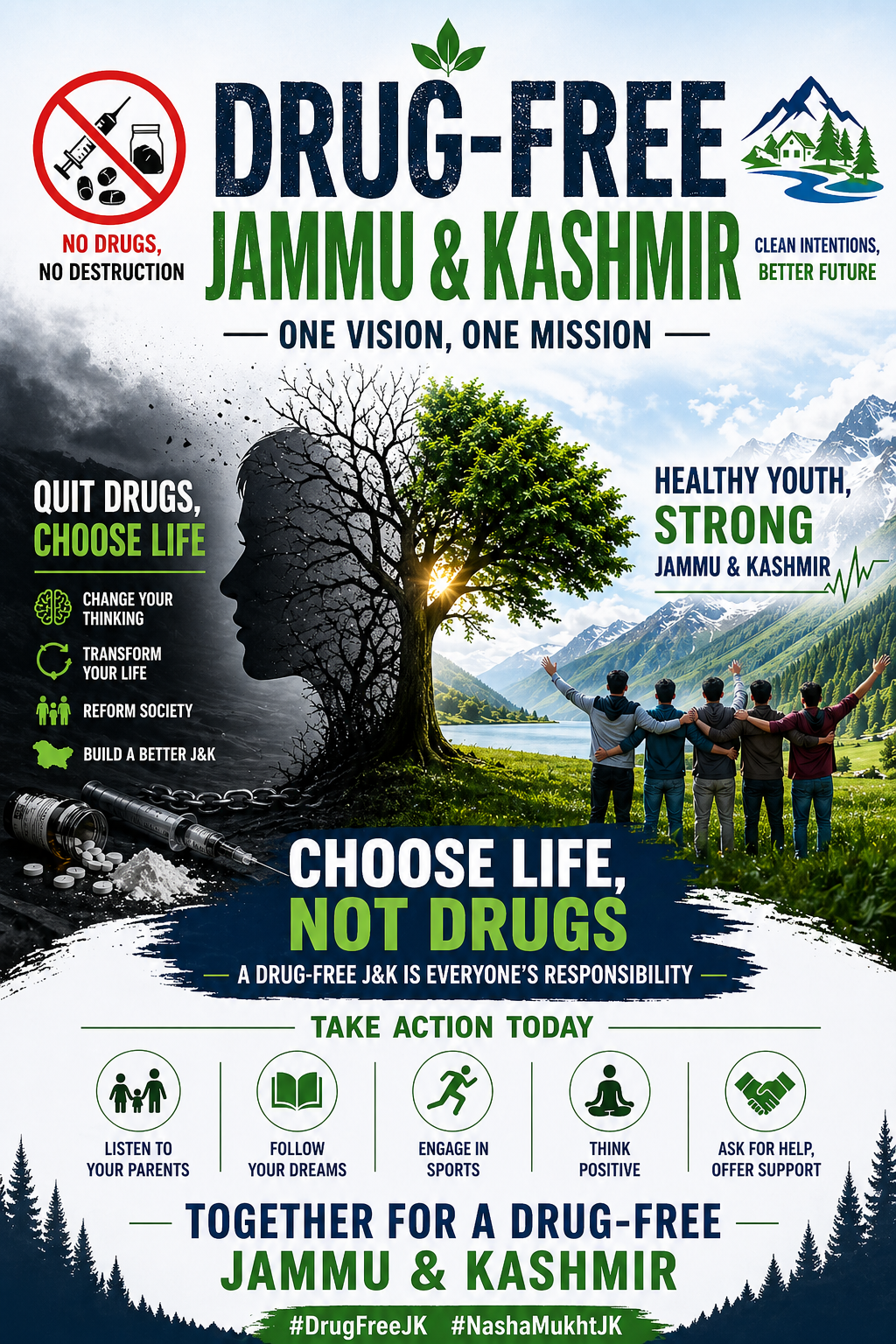
The problem of drugs in Jammu and Kashmir is very serious. It is not just a crime or a bad habit.
It is a danger to the health of people, safety of society, future of our youth, and peace of the entire region.
Many young boys and even girls in Jammu and Kashmir are falling into drug addiction. Some take drugs because of stress, unemployment, or bad company.
Others are tempted by dealers who make it look fashionable or a way to escape problems. Many families do not even know that their children are using drugs until it becomes too late. Drug addiction destroys the body and mind.
It damages the heart, brain, liver, and weakens a person’s thinking. Addicted people lose interest in studies, work, or relationships. They fight with families, steal money for drugs, and sometimes get involved in crime.
Drug addiction also spreads diseases when people share needles. Families suffer emotionally and financially. In Jammu and Kashmir, where family bonds are strong, addiction brings shame, sadness, and helplessness.
It also affects the entire society because addicted youth cannot contribute to development, peace, or progress. Another big problem is that drugs are also being used to harm the region from outside.
Pakistan-based smugglers and terror groups are pushing drugs into Jammu and Kashmir to destroy young minds and to earn money for terror activities.
They use drones, secret routes, and local networks to spread heroin, charas, and other harmful substances. This is called narco-terrorism. Their aim is to weaken the youth, break social harmony, and disturb peace in Jammu and Kashmir.
But there is also hope. The government, Indian Army, Jammu and Kashmir Police, Anti Narcotics Task Force, schools, and many social groups are fighting back.
They are trying to stop the supply of drugs, spread awareness, treat addicted people, and save the future of our youth.
The Anti Narcotics Task Force is a special team of Jammu and Kashmir Police that catches drug smugglers, blocks drug supply, and finds out which gangs are supplying drugs from outside and inside the region.
They have arrested many peddlers, seized large quantities of heroin, and broken many drug networks. The Indian Army is also doing an important job.
Army troops guard the borders and stop smugglers from bringing drugs into Jammu and Kashmir. They have caught large drug consignments and noticed how drones from across the border are used to drop drugs.
The Army also conducts awareness camps, sports events, and youth programs to keep young people active and away from drugs. The Government of India has started the Nasha Mukt Bharat Abhiyaan, which means Drug-Free India Campaign.
Under this campaign, schools, colleges, and social groups organize workshops, rallies, street plays, and counselling sessions. They teach youth about the dangers of drugs and guide them towards good habits, sports, and skill development.
The Government of Jammu and Kashmir also has its own mission called Nasha Mukt Jammu Kashmir Abhiyaan.
This mission encourages teachers, parents, religious leaders, health workers, and community members to work together to protect young people. They conduct village meetings, school programs, and treatment camps.
Officials are also opening de-addiction centers in hospitals where addicted youth receive medical treatment, psychological counselling, and training to restart a normal life.
But the strongest and most long-term solution is education. Education does not only mean studying books. It means teaching children about right and wrong, healthy living, emotional strength, and decision-making. When students know how drugs destroy life, they are less likely to try them.
When teachers and parents talk openly about addiction, children feel safe to ask questions and share problems. When schools include life skill lessons, mental health support, and sports activities, young people find purpose, confidence, and happiness.
They do not feel the need to escape into drugs. Education also helps society understand that addiction is not always a crime.
It is often a disease, and people need help to recover. When society supports recovering addicts instead of judging them, they have a better chance of starting a new life. Education helps remove stigma and builds kindness, care, and unity.
We must also understand that only police action or army security cannot completely solve this problem.
If there is demand, someone somewhere will supply drugs. That is why we must stop demand through awareness, discipline, emotional support, and hope. Young people must feel that they have opportunities, dreams, and a purpose in life.
When youth feel strong and hopeful, they reject drugs naturally. Yes, there are challenges.
Education and awareness take time. Some schools and families still avoid talking about addiction. Some people feel ashamed to seek help. But slowly, attitudes are changing. More families are coming forward for treatment.
More children are saying no to drugs. More communities are joining awareness drives. This change must grow. Jammu and Kashmir is going through an important time in history. Roads, bridges, tourism, farming, business, and technology are improving. But the real future depends on the mental and physical health of its youth.
If young people are healthy, educated, strong, and drug-free, Jammu and Kashmir will rise as a model of peace and progress. If they fall into addiction, no development will be meaningful.
The fight against drugs is not only a police duty. It is a duty of every teacher, every parent, every religious leader, every soldier, every doctor, and every youth.
Together, with firm action, kind support, and strong education, we can protect our children from drugs and protect Jammu and Kashmir’s future.