
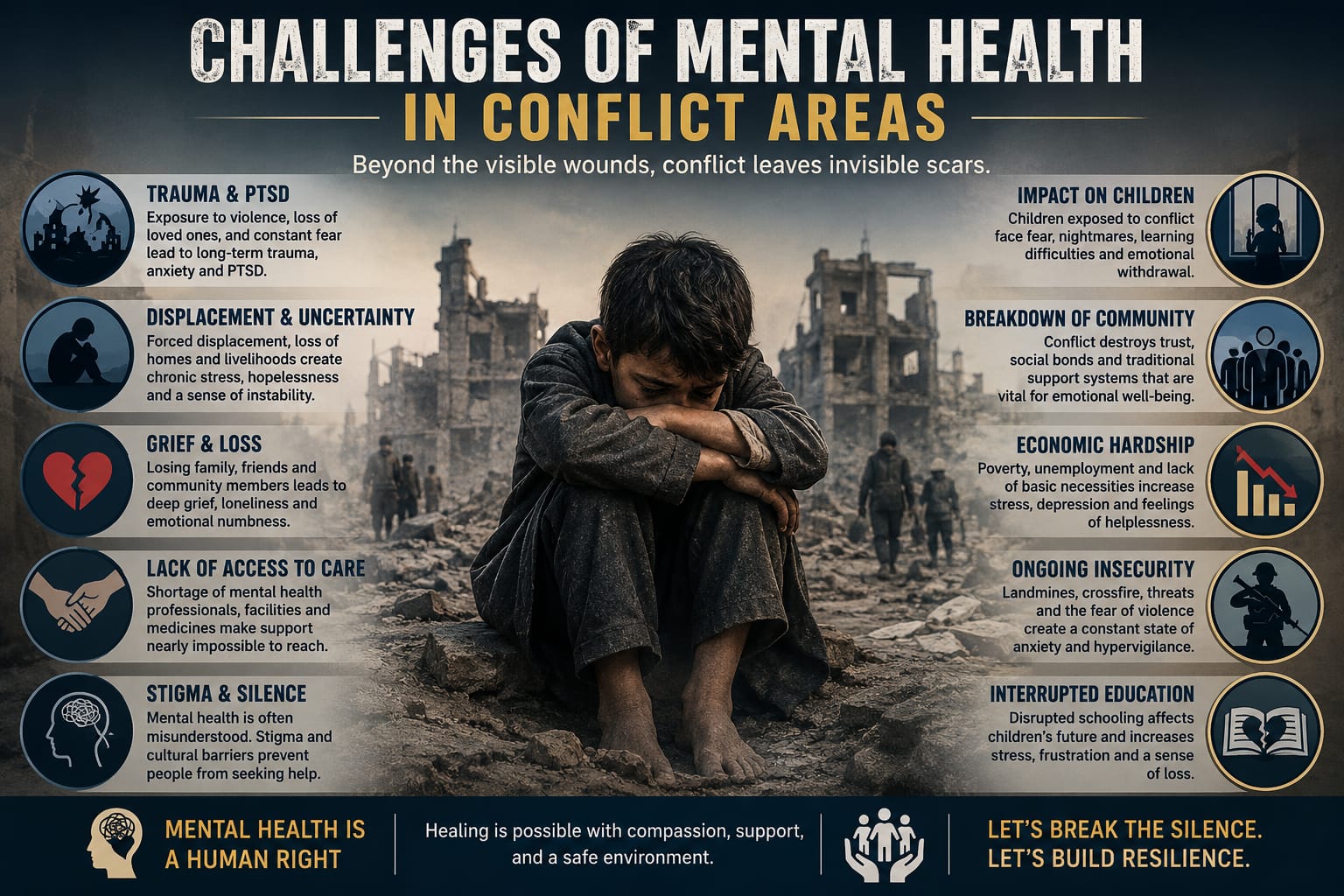
Mental health is one of the least discussed yet most serious consequences of conflict. While the world often measures conflict through casualties, damaged infrastructure and economic losses, the invisible wounds carried by people can endure for generations.
Fear, uncertainty, repeated exposure to violence, displacement, loss of loved ones and disruption of normal life profoundly affect the psychological well-being of individuals and communities.
These effects are felt not only by civilians but also by members of the armed forces, police personnel, healthcare workers and others who operate in high-risk environments.
Jammu and Kashmir has experienced decades of security challenges arising from terrorism, cross-border infiltration and periods of civil unrest. Families have lived through uncertainty, school closures, disruptions to livelihoods and the emotional burden of prolonged insecurity.
Children who grow up in such environments often face anxiety, emotional distress and difficulties concentrating on education. Women frequently shoulder additional responsibilities while coping with loss, trauma and economic hardship.
Security personnel, who spend extended periods in demanding operational conditions, also face immense psychological pressure. Mental health, therefore, should be understood as a shared national concern rather than the challenge of any single community.
The World Health Organization estimates that around one in five people living in conflict-affected areas may experience a mental health condition such as depression, anxiety or post-traumatic stress disorder at any given time.
This figure is significantly higher than in populations not affected by conflict, highlighting the urgent need for accessible psychological support and community-based care.
Research from different conflict regions consistently demonstrates that the longer insecurity continues, the deeper its psychological impact becomes, particularly on children and adolescents.
Mental health challenges in conflict zones do not emerge solely from direct exposure to violence.
They are also shaped by persistent uncertainty, unemployment, disrupted education, social isolation and the breakdown of community networks. A child who cannot attend school regularly because of security concerns may lose confidence and hope for the future.
A young person struggling to find employment may become more vulnerable to depression or exploitation.
Families living under continuous stress often find it difficult to provide the emotional stability that children require during their formative years.
Another major challenge is stigma. Across many societies, including parts of India, people continue to associate mental illness with weakness or social embarrassment.
Individuals suffering from anxiety, depression or trauma frequently hesitate to seek professional help because they fear being judged by family members or society.
This silence often delays treatment and allows psychological conditions to become more severe. Breaking this stigma requires sustained public awareness, education and community engagement.
The Government of India has taken significant steps to strengthen mental healthcare. The Mental Healthcare Act, 2017 recognised mental healthcare as a legal right and established a framework for accessible and non-discriminatory treatment.
The District Mental Health Programme has expanded services across the country, while the Tele-MANAS initiative has improved access to psychological counseling through a nationwide helpline.
Since its launch, Tele-MANAS has reached all States and Union Territories through dozens of centers and has responded to millions of calls, demonstrating both the growing demand for mental health support and the government’s commitment to expanding services.
However, conflict-affected regions require interventions that go beyond conventional healthcare systems. Mental health professionals must work alongside teachers, social workers, religious leaders, local administrations and community organizations. Schools should become centers of emotional resilience where children learn healthy coping mechanisms, conflict resolution and stress management.
Community-based counseling programmes can encourage individuals to seek help before problems become severe. Mobile counseling teams and telemedicine can extend services to remote villages where specialized professionals are scarce.
The role of families cannot be overstated. Emotional support within the household often determines whether an individual successfully recovers from trauma.
Parents should be encouraged to recognize early signs of emotional distress among children, including withdrawal from social interaction, changes in sleep patterns, declining academic performance and persistent anxiety. Timely intervention can prevent long-term psychological difficulties and improve overall well-being.
Members of the armed forces and police deserve equal attention in discussions on mental health. They operate in physically demanding and emotionally challenging conditions while carrying the responsibility of protecting national security. Long deployments away from families, exposure to danger and the pressures of operational readiness can affect psychological health.
Over the years, the Indian Armed Forces have expanded counseling services, peer-support mechanisms and stress-management programmes to strengthen the mental resilience of personnel. Such initiatives should continue to evolve with greater emphasis on early intervention and confidential access to professional care.
Media also has a significant responsibility. Sensational reporting of violent incidents may unintentionally increase public anxiety and fear. Responsible journalism should report facts accurately while avoiding unnecessary sensationalism.
At the same time, media can contribute positively by highlighting stories of resilience, rehabilitation, successful counseling initiatives and community solidarity. Balanced reporting encourages hope rather than despair and helps reduce the stigma associated with seeking mental healthcare.
Technology presents both opportunities and challenges.
Telemedicine has transformed access to psychological counselling, especially in remote areas where specialists are unavailable.
At the same time, the rapid spread of misinformation, graphic content and unverified rumours through social media can intensify fear and emotional distress during crises.
Strengthening digital literacy and encouraging responsible online behaviour are therefore essential components of mental health promotion.
Educational institutions should integrate emotional well-being into their curricula. Students should be taught that seeking psychological support is a sign of strength rather than weakness.
Teachers should receive basic training to identify students who may require professional assistance.
Universities can establish counseling centers that provide confidential support to young adults facing academic stress, social pressures and emotional challenges.
Civil society organizations, charitable institutions and community volunteers can complement government efforts by conducting awareness campaigns, organizing counseling camps and supporting families affected by conflict.
Religious and community leaders also have an important role in promoting compassion, reducing stigma and encouraging individuals to seek professional help whenever necessary.
Mental health should also be viewed as an important pillar of national security. Communities that are emotionally resilient are better equipped to resist fear, misinformation and extremist propaganda.
Psychological well-being contributes to social stability, economic productivity and stronger democratic institutions. Investing in mental health is therefore not merely a healthcare expenditure but an investment in national resilience.
Jammu and Kashmir has repeatedly demonstrated remarkable resilience despite decades of adversity. Communities have continued to educate their children, rebuild livelihoods and preserve their cultural traditions even during difficult times.
This resilience should now be strengthened through a comprehensive mental health strategy that combines modern healthcare, community participation, educational reform and technological innovation. Such an approach would not only reduce suffering but also empower future generations to contribute positively to society.
As India continues its journey towards inclusive development and lasting peace, mental health must become an integral part of public policy, particularly in regions affected by conflict.
Roads, schools and hospitals are essential for development, but so are hope, emotional resilience and psychological well-being. A nation truly becomes stronger when it protects not only the physical security of its citizens but also their mental and emotional health.
By recognising mental health as a national priority, India can build communities that are more compassionate, resilient and prepared to face future challenges with confidence and unity.