Home Blog Page 105

India, Iran sign 10-year pact for operation of Indain company at Chabahar port terminal

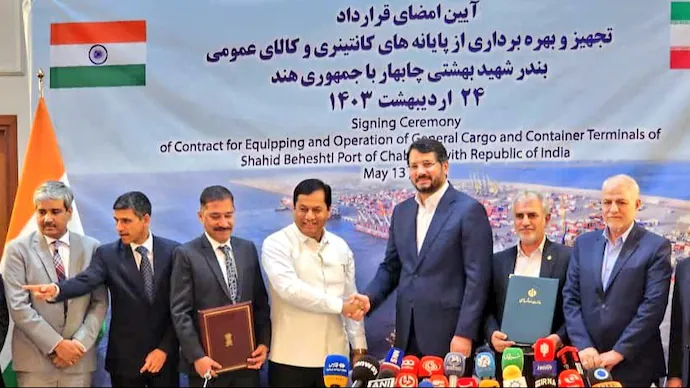
India and Iran on Monday signed a key 10-year contract that will allow an Indian company to take over operations at Shahid Beheshti terminal of the strategic Chabahar port in Iran, in a move aimed at boosting regional maritime trade connectivity. 

The agreement was signed between India Ports Global Limited (IPGL) and Iran’s Ports and Maritime Organization (PMO) in the presence of India’s Ports, Shipping and Waterways Minister Sarbananda Sonowal, who is on a visit to Tehran.

As per the pact, IPGL’s subsidiary India Ports Global Chabahar Free Zone (IPGCFZ) will operate the Chabahar terminal for 10 years. India plans to invest $120 million in equipping the terminal, while also offering a $250 million credit line for developing associated infrastructure.

This marks the first time an Indian company will operate a terminal at an overseas port, a strategic move that will boost trade ties between India, Iran and Afghanistan while allowing greater access to landlocked Central Asian nations.

“This agreement aims to enhance regional connectivity and facilitate trade, particularly between India, Iran and Afghanistan”, an official statement said.

Sonowal termed it a foundation for “India’s long-term involvement at Chabahar” with a “multiplier effect” on the port’s viability. He highlighted Chabahar’s potential as a hub for the International North-South Transport Corridor for linking India with Central Asia.

The U.S. had previously granted a sanctions exemption for Chabahar to facilitate Afghanistan’s trade and development. However, the State Department indicated the latest deal may not have a similar carve-out.

While calling sanctions on Iran “in place”, a spokesperson said any entity doing business with Iran risked potential sanctions exposure, without directly commenting on the Chabahar pact.

Iran has termed Chabahar a key maritime enabler for boosting trade connectivity to Central Asia, bypassing Pakistan. The port has handled over 8 million tons of cargo since India began operations there in 2019.

POJK: Pak Army fires indiscriminately on Kashmiris; 3 killed, over 30 injured

The situation in Muzaffarabad has escalated dramatically as Pak Army began firing live rounds at protesters, killing 3 Kashmiris on Monday. More than 30 people have also been injured.

The unrest in Muzaffarabad intensified as protesters set Ranger vehicles on fire. In response, Rangers opened fire on the crowd, leaving at least 30 people injured and resulting in the deaths of three protesters. The atmosphere in the city has become highly volatile, with fears of further violence looming.

This came after Pakistan announced a multi-million dollar grant to provide urgent economic relief to the Kashmiris on Monday. The incident clearly shows that while Pakistan government seemed kneeling down in front of the demands of POJK Joint Awami Action Committee, the real controller of Pakistan, the Pak Army took revenge on people for their loss.

Adding to the tension, four helicopters carrying Pakistan Army commandos arrived in Muzaffarabad. Local sources confirm that Special Services Group (SSG) personnel were on the scene, further heightening the sense of urgency and danger.

The situation remains fluid, with ongoing reports of clashes and a heavy military presence in the city. The protests, which began as a peaceful demonstration for basic rights, have now turned into a deadly confrontation, marking a significant escalation in the region’s unrest.

Meanwhile, the Kashmiris living in Britain also started to protest against Pakistani establishment outside its assembly in London.

Multiple processions head to Muzaffarabad demanding basic rights in Pak-occupied J&K

After the initial hurdles due to Pakistani FC forces’ crackdown on peaceful civilians protesting for basic rights, multiple processions from across Pakistan-occupied Jammu and Kashmir (POJK) are converging towards Muzaffarabad.

The processions are reaching Muzaffarabad from various regions, including Kotli, Poonch, Dadyal, Rawalkot, Mirpur, Tattapani, Bagh, and Hajira.

As protesters marching towards Muzaffarabad reached Rawlakot on May 12, the Pakistani Establishment extended an invitation to the POJK Joint Awami Action Committee leadership for a dialogue. The dialogue, which took place in Rawlakot, saw representation from the Establishment, including the GOC Murree, some Pakistan Army Officers stationed in Pakistani Occupied Jammu Kashmir (POJK), and the Chief Secretary of Pakistani Occupied Jammu Kashmir.

Despite the dialogue, the POJK AAC’s demands were not accepted by the Establishment, resulting in the failure of the negotiations. Consequently, the committee decided to persist with their Long March.

As the protesters arrived in Dhirkot, they took a moment to rest before setting off once again towards Muzaffarabad today, continuing their journey and their pursuit of their demands.

Additionally, a procession from Bagh is also on its way to reach Muzaffarabad, where the marchers have shown great resilience and remained undeterred by bad weather and rains.

https://twitter.com/SamRaja21700228/status/1789774374972661863?t=zaUHDTbBKigsdkEzu6mMjw&s=19

In an address to the public, Awami Action Committee leader Shaukat Mir emphasized that the movement is about rights, attributing credit to the people of Poonch who initiated the demand in the early days. He stressed that the fight for rights should continue and that the rights of the people remain paramount and cannot be compromised for personal gains.

Baloch students launch nationwide boycott against enforced disappearances by Pak Army

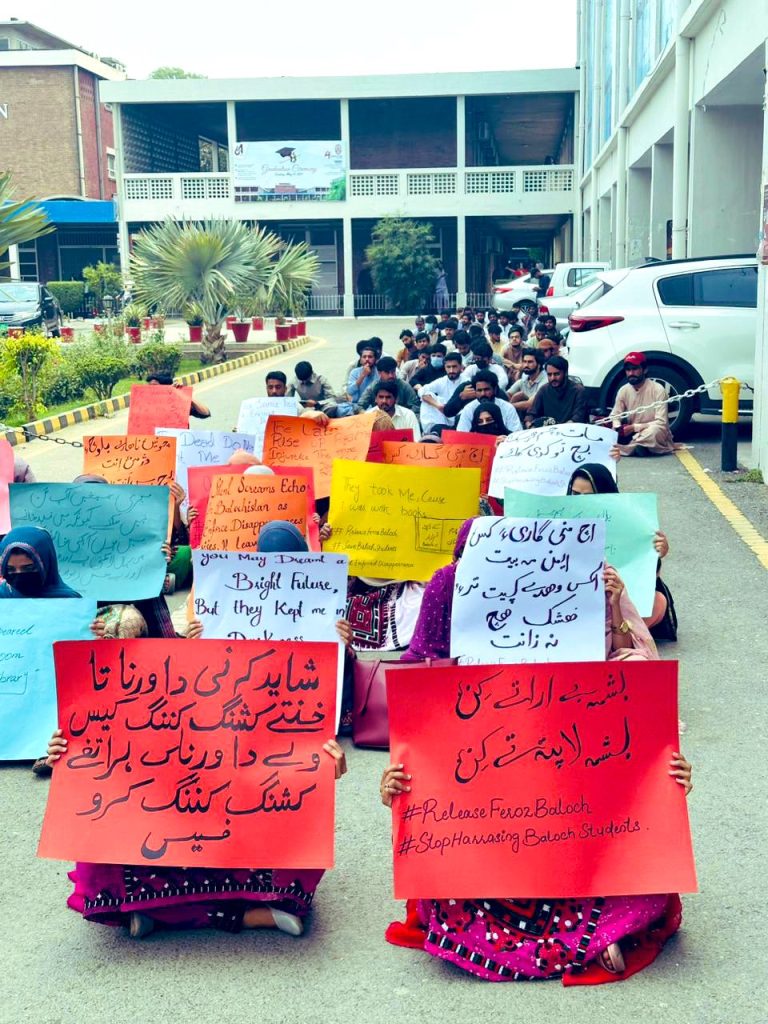
Baloch student councils across Pakistan have commenced a week-long boycott of classes to protest the enforced disappearances, racial profiling, and harassment faced by Baloch students, particularly in universities of Punjab province. The student bodies, joined by human rights activists, have initiated a nationwide campaign highlighting the plight of missing Baloch students through press conferences, demonstrations, statements and an online mobilization drive.

The campaign kicked off this week with pamphlet distributions to raise public awareness. In Islamabad on Saturday, hundreds of Baloch students met at a major protest spotlighting the case of Feroz Baloch, a student missing for nearly two years. The demonstration culminated at the Islamabad Press Club.

In Lahore, Baloch students boycotted classes and held a rally on the university campus, supported by peers from other communities. The Baloch Students’ Council Punjab is spearheading protests in major cities demanding an end to enforced disappearances, racial profiling and the safe return of Feroz Baloch and Ahmed Khan Baloch, another missing student.

In the initial phase, Baloch students and female students took to the streets, distributing pamphlets at educational institutions and public places in Punjab. The pamphlets highlighted the daily harassment, racial profiling, and enforced disappearances faced by Baloch students in Islamabad and Punjab.

In the second phase of the campaign, members of the Baloch student councils escalated their efforts by boycotting classes and holding silent rallies across universities in Punjab. This collective action aims to record their protest and amplify their demands for the safe release of Feroz Baloch and other forcibly disappeared Baloch students.

The students have expressed deep concerns over the Pak Army’s harassment they face while pursuing education in Punjab. Several Baloch students have been targeted for enforced disappearance from various educational institutions. 

Pakistan has forcefully occupied Balochistan since 1948, exploiting its resources while oppressing its people. The escalating protests by Baloch students have brought the issue of enforced disappearances into the spotlight, where mounting cases of enforced disappearances in Pakistan are being reported every day, week, month and year. Thousands have gone missing over the years by Pak Army, with their dead bodies occasionally resurfacing under mysterious circumstances.

Baloch protesters in Gwadar rally against Pak Army’s plans to fence off Gwadar city

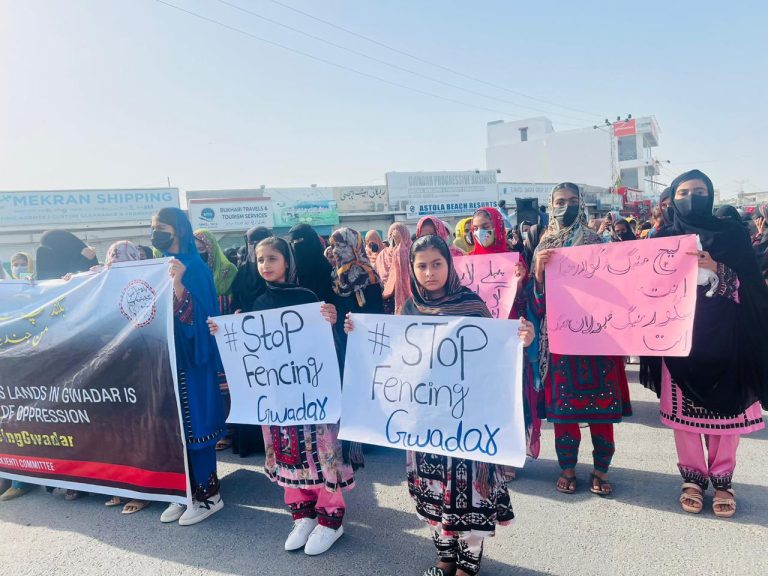
Hundreds of protesters, including women, children and elders, took to the streets in the coastal city of Gwadar on Sunday to rally against Army’s plans to erect a fence encircling the city.

The protest was organized by the Baloch Yakjehti Committee, with participants from various areas marching while carrying banners and placards opposing the fencing, as well as condemning enforced disappearances and the genocide of the Baloch people.

The rally met at Shahda-e-Jiuni Chowk, where speakers from the Committee addressed the protesters. Sabghat Ullah Baloch, a senior leader, questioned the need for fencing off Gwadar in the name of security for locals.

“At one time, people used to come here from Punjab with sacks of money to buy land from Baloch owners, but their dreams were dashed. The Baloch still live on this land, and their aspiration of keeping it will never be defeated,” he said.

He said that rather than posing a threat, the Baloch have co-existed peacefully with all communities in Gwadar, which he hailed as a site where “mosques and temples stand side-by-side.”

They warned that attempts to “grab” Baloch lands by fencing them off will not succeed. The Army is fencing the city to safeguard its and Chinese interests and the China-Pakistan Economic Corridor rather than securing the local population.

They said that erecting a fence in Gwadar will not make the lives of those who are victims of enforced disappearances secure. The recent floods in Gwadar destroyed the livelihood of fishermen, rendering them homeless. People have lost their shelters, their homes have been submerged, leaving them in utter misery. The fence is being erected to secure Gwadar for the Chinese and the China-Pakistan Economic Corridor, ignoring the locals and putting them at further risk.

Shah Ji said in the name of protecting foreigners, Gwadar has already been divided into two parts. From the airport to Gwadar port, the city has become a center of facilities for non-locals. And now the city is being fenced in the name of security. What kind of law is this that you imprison our homes for your own security? Will the Army, which eats up billions in security budgets, now be protected by imprisoning our homes behind fences?

Earlier, Baloch student and nationalist groups have strongly condemned the construction of barriers by Pak forces on agricultural lands in Gwadar, as it is an attempt to displace local farmers from their ancestral lands.

BLA attacks Pak Army post in Kolwa, kills 3 soldiers

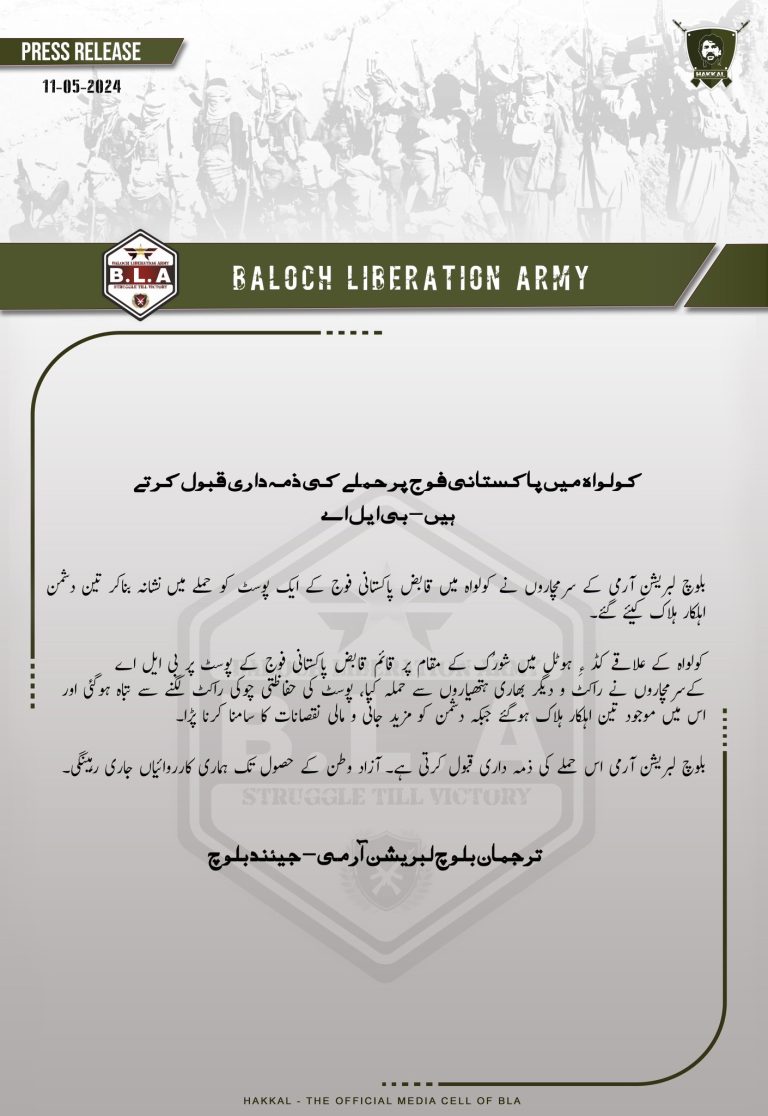
The Baloch Liberation Army (BLA) has claimed responsibility for a rocket attack on a Pak military outpost in Kolwa area of Pak-occupied-Balochistan province, stating that three soldiers were killed in the assault.

In a statement issued, BLA spokesperson Jeeyand Baloch said their fighters targeted the outpost located at Shoruk near a hotel in Kolwa region using rockets and heavy weapons on Saturday.

“The security bunker of the post was destroyed by the rocket attack, killing three personnel inside,” the spokesperson said, adding that the Pak forces suffered further human and material losses in the strike.

Jeeyand asserted that the BLA takes full responsibility for carrying out this attack. “Our operations will continue until an independent homeland is achieved,” he warned.

This action is the result of forceful occupation and neglect of the resource-rich region of Balochistan, which led Baloch revolutionary groups like the BLA to rise and demand independence from Pak Army rule. Since 1948, Pak Army has committed numerous atrocities and suppressed the Baloch community.

Pak Army has resorted to various oppressive tactics. These include enforced disappearances, extrajudicial killings, and the abduction of students. Additionally, reports suggest Pakistan’s support for death squads, further exacerbating the situation.

Kashmir votes in first major poll after abrogation of Article 370

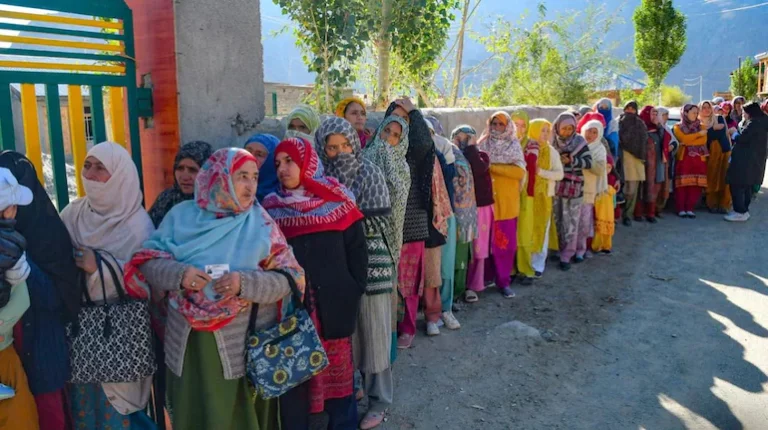
Monday’s polling for the Lok Sabha elections in Srinagar constituency is being viewed as a key test of public opinion on the abrogation of Article 370 and reorganization of Jammu and Kashmir into two union territories in 2019.

The election marks the first major democratic exercise in the region since the BJP government’s move to revoke the former state’s special constitutional status and bifurcate it into the union territories of Jammu and Kashmir and Ladakh.

Major Kashmiri parties like the National Conference and People’s Democratic Party have framed the polls as a “referendum” on the Center’s decisions related to J&K. Party leaders including Farooq Abdullah, Mehbooba Mufti and Omar Abdullah have asserted that “roads, electricity and water” are not the main issues, urging voters to use the election to voice their stance on the loss of statehood and stripping of semi-autonomous powers.

The Election Commission has even sought clarification from PDP’s Srinagar candidate Waheed-ur-Rehman Para over his characterization of the vote as a referendum.

Significantly, the poll comes amid vastly changed political dynamics in the erstwhile state. A crackdown has led to the elimination of many militant commanders, arrests of Pak-backed separatist leaders like Yasin Malik, and banning of several organizations. The era of violent protests, stone-pelting and shutdowns has waned.

Separatists, who traditionally enforced poll boycotts through threats and violence, have remained largely subdued this year. No boycott calls or protests have marred the campaigning so far.

All eyes will now be on the voter turnout figures from Srinagar, which could prove a bellwether for participation levels in the Muslim-majority Kashmir valley. Turnouts plunged to single digits through the 1990s due to militancy but had improved somewhat in recent elections before 2019.

Taliban nixes Pakistan Army delegation’s visit to Kandahar

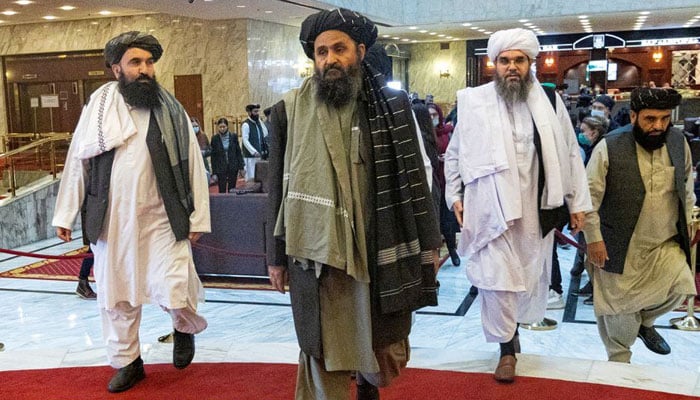
Afghan Taliban officials claimed that a planned trip by a Pakistan Army delegation to Kandahar on Sunday was cancelled in apparent protest over reported cross-border strikes by Pakistan targeting terrorist hideouts in Afghanistan.

There was no word from the Pakistani side either on the reported airstrikes or the visit of its delegation to Kandahar.

The foreign office had no knowledge of both developments, while the military’s media wing didn’t respond until the filing of this report.

However, reports suggest that the Pakistan Army delegation, comprising mid-level officials, was to travel to Kandahar on Sunday as part of efforts by both sides to resolve the issue of the banned Tehreek-e-Taliban Pakistan (TTP).

Delegation was to meet Governor of Kandahar

The delegation was to meet Mullah Shirin Akhund, the Governor of Kandahar, and the deputy head of Afghanistan’s intelligence agency. Shirin is also considered close to Taliban supreme leader Haibatullah Akhundzada. He was one of the key members of the Taliban team that helped broker talks between Pakistan and the TTP.

Mullah Shirin is a key interlocutor of the Afghan Taliban trying to defuse tensions with Pakistan over the TTP. He travelled to Islamabad earlier this year to address Pakistan’s concerns.The planned trip was believed to be a follow-up to those efforts to find a solution to the TTP problem.

The visit, however, was cancelled by the Afghan Taliban. There were reports, and some Afghan journalists claimed that Pakistan carried out fresh airstrikes in the Paktika province of Afghanistan on Friday, killing certain TTP terrorists.

Pakistan never confirmed those attacks, although it publicly acknowledged carrying out several cross-border attacks on March 18.

An Afghan media outlet claimed it obtained information that the Taliban had cancelled a scheduled trip of a Pakistan Army delegation to Kandahar in response to reported recent air and missile strikes by Pakistan in Paktika province.

Cancellation attributed to weather condition

Originally, the delegation was to travel from Rawalpindi to Kandahar on Sunday, the Afghan International report said. The cancellation by the Taliban was officially attributed to “weather conditions,” although it is widely believed that the real reason was the airstrikes on Paktika that occurred on Thursday. The specifics of the attack and any casualties remain undisclosed.

Previously, an Afghanistan media house had accessed a document indicating that Pakistan had detailed the aircraft, flight times, and arrival information to the Taliban’s Ministry of Foreign Affairs through an official letter sent to Kabul.

As of now, the Taliban has not issued an official statement regarding the Pakistan Air Force’s attacks on Paktika or the reasons behind the cancellation of the Pakistani delegation’s trip.

Surge in enforced disappearances by Pak Army across PoB

Amid escalating concerns over human rights violations in Pak-occupied-Balochistan, reports have emerged of a recent spike of enforced disappearances across three districts. More than a dozen individuals have been illegally detained by the brutal Pak Army and forcibly disappeared, with their whereabouts remaining unknown.

In the Surbandar area of Gwadar district, six individuals – Sameer, Bilal, Dur Muhammad, Ameer Aslam, Nizam Qayyum, and Aman – have been subjected to enforced disappearance.

The situation is equally alarming in Dera Bugti district, where six more individuals – Zahoor, Dilawar, Ahmad Ali, Nawaz Ali, Khaliq Gul, and Jalal Bugti – have been forcibly disappeared. Additionally, the disappearance of Zahid Hussain from Chitkan Panjgur has added to the mounting concerns over the systematic violation of fundamental human rights in the region.

Pakistan’s military and intelligence agencies are solely complicit in the enforced disappearances of Baloch citizens. Families have led numerous protests demanding the recovery of their missing loved ones. However, since Pakistan has forcefully occupied Balochistan since 1948, it is exploiting its resources while oppressing Baloch community.

POJK residents overpower Pak forces trying to thwart May 11 protest; roar ‘Azaadi’ slogans

Pakistan occupied Jammu and Kashmir (POJK) witnessed a tumultuous turn of events on May 11 as tensions between the Pak FC forces and protestors reached a boiling point.

The FC forces initiated a crackdown on protestors, resorting to tactics such as gunfire, tear gas shelling, and stone pelting, leaving dozens injured.

According to reports, in Mirpur, FC personnel disguised in civilian attire aggravated the situation, inciting the mob towards violent actions. As a result of the clashes, more than 60 Kashmiri protestors. Additionally, around 50 FC personnel were injured during the confrontation.

In few instances, the FC forces were beaten and chased while they trie to flee from the clutches of agitated protestors, who turned violent after Pak lawlessness.

The situation became out if control as people started confronting Pak forces with some picture emerging of Pakistan FC forces caught and made to leave their uniform which social media took as a reminiscent of 1971. Additionally an FC personal was thrown from the cliff.

In solidarity with the people of POJK, a rally was taken out by the Awami Action Committe of Pal occupied Gilgit-Baltistan (POGB) from Palace Hotel to Ittehad Chowk in Gilgit city. They protested the arrest of the leaders of POJK Awami Action Committe.

Meanwhile, the processions from across POJK started moving towards Muzaffarabad on May 11 but faced road blocks as many roads towards Muzaffarabad were blocked by GC forces.

Slogans of “Hum leke rahenge azaadi, him chheen ke lenge azaadi” were raised across POJK.

Awami Action Committe Chairman warns Pak forces

The Awami Action Committe chairman Shaukat Nawaz Mir vehemently condemned the Pak brutality and warned that any further arrest would lead to a direct confrontation.

Notably, these protests started by the J&K Joint Awami Action Committee a year ago, demanding the subsidised wheat, electric power, royalty on the power generated from Kashmiri resources, among others.

What are the protests actually for?

The Awami Action Committee had issued a Charter of Demands highlighting its course of action and demands.
In the course of one year, POJK saw women’s protest, children protest, complete shutdown, school students’ protest but Pakistan remained unmoved by the ordeal of protestors, who were out on road in chilling winters.
Due to high inflation, the prices of wheat flour have gone up unprecedentedly. Kashmiris are demanding subsidised wheat as provisioned for the disputed land under the UN Charter.

This must be understood here that POJK is not the fifth state of Pakistan and hence Pak denies to treat the people as its citizen. However, it earns massively from the region, without giving Kashmiris their due share. The region generates 4900 megawatts of electricity and 13 billion units, suffice enough to fulfill the need of entire Pakistan. But that electricity is transmitted to Pakistan and then again sold to POJK at a hefty price which is above Rs. 16 per unit.

To even worse, the Pak authorities do load shedding for over 15 hours a day. To protest against it the protestors have boycotted the electricity bill. Every month they collect the bills and burn them publicly, sometimes take out its death procession, sometimes make paper boats using them to register their symbolic protests.

The chaos and violence was unpredicted because the protest has been peaceful since one year. It is the Pak forces that took the region under seize and Muzaffarabad as hostage. The oppression and military control over the already downtrodden population led to violent resistance.