
Sixty year old dies while protesting in Pak-occupied Gilgit-Baltistan for basic rights
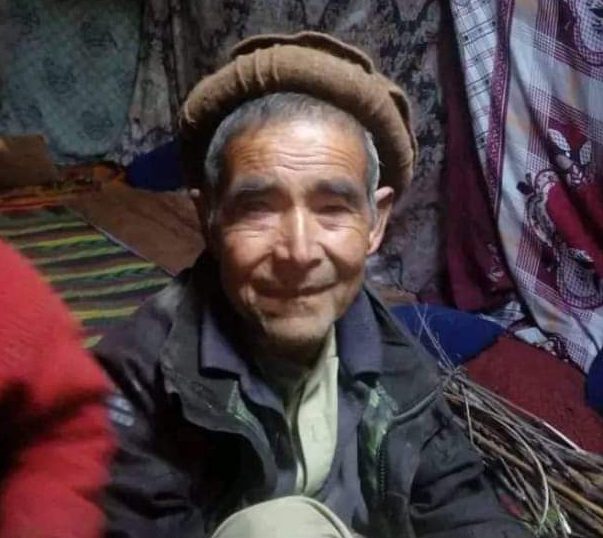
In a heart-wrenching turn of events, a sixty-year-old man participating in the sit-in at Etihad Chowk in Gilgit, Pakistan occupied Gilgit-Baltistan (POGB), has lost his life while protesting for the wheat subsidy and other demands. Hailing from the Yasin district, the elderly man joined the Etihad Chowk sit-in four days ago, braving the bone-chilling winter conditions.
The unfortunate incident occurred when the protester, dedicated to the cause, succumbed to a cardiac arrest, shedding light on the arduous circumstances faced by those advocating for their rights in the region.
The incident adds poignancy to the arguments put forth by the people of POGB, asserting that they are under the rule of a colonial regime. Amidst freezing temperatures, hundreds of thousands of people across POGB continue their protests, demanding their basic rights. However, the occupying government seems to downplay the gravity of the situation, anticipating that the protests will naturally dissipate.
The sacrifice of individual protestors, like the elderly man, not only deepens the sorrow within the community but also fuels anger and determination among the protestors. Such sacrifices serve to intensify the resolve of the people, making them more resolute and aggressive in their pursuit of justice and rights, vowing to persist until their aspirations are fulfilled.
As the news of the elderly protester’s demise reverberates through the region, it becomes a poignant symbol of the ongoing struggle for basic rights in Pakistan occupied Gilgit-Baltistan, marking a solemn moment in the fight against perceived injustice and neglect by the occupying authorities.
Sindhi students pay a heavy price at Karachi university for protesting against fee hike
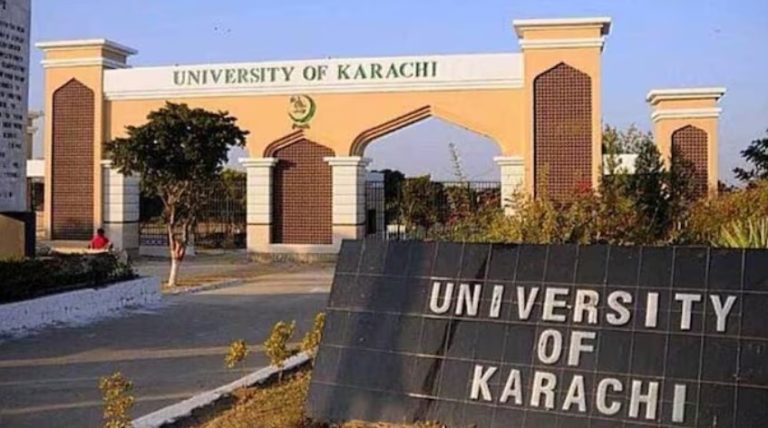
In a concerning turn of events, some of the Sindhi students at Karachi University have been expelled for staging a hunger strike in protest against the university policies. The University of Karachi, instead of addressing the students’ concerns, chose to issue expulsion letters, raising questions about discrimination against Sindhi background individuals in Pakistan.
The expulsion comes after students protested against an abrupt fee hike and other grievances such as the implementation of the KSP-POLICY, discriminatory practices, and cultural heritage concerns. The administration’s alleged indifference to these issues fuelled the protests, pushing students to resort to a hunger strike as a final effort to draw attention to their demands.
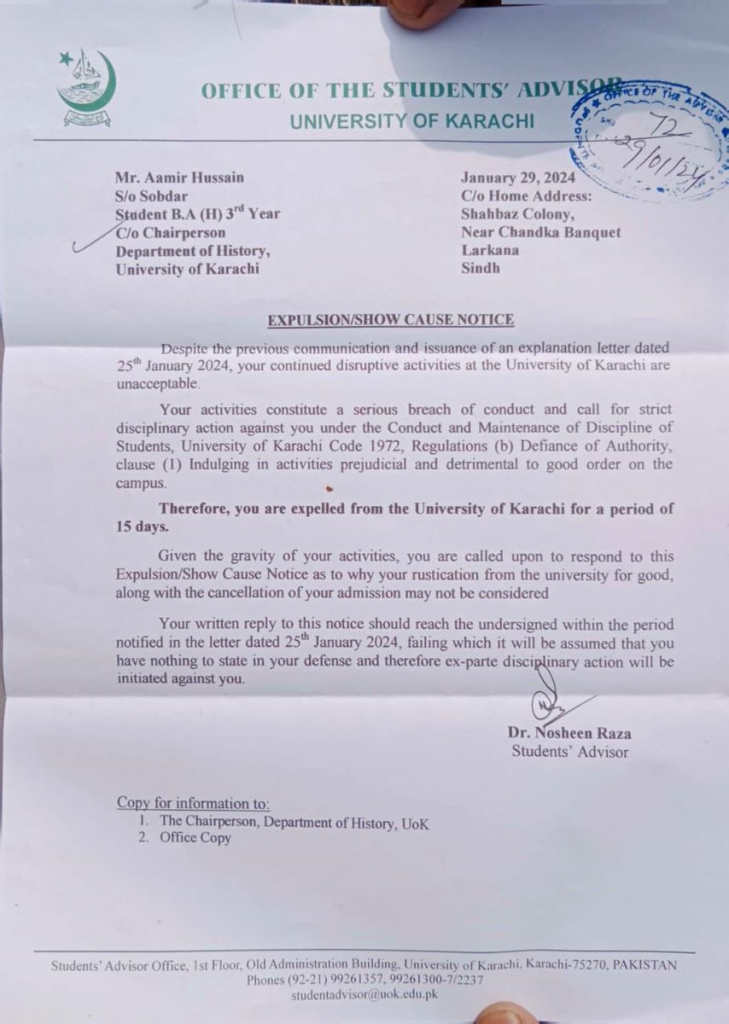
Earlier developments saw some students being arrested, underscoring the university’s uncompromising stance on dissent. The entire situation highlights a lack of space for dialogue and discussion within the university. Instead of heeding the rightful demands of the students, the administration chose a path of suppression, first through arrests and now through expulsions.
The Jeay Sindh Freedom Movement (JSFM) has also condemned the decision of the university. JSFM took to X, formerly twitter, warning the university that if the decision of expulsion of the students is not taken back, they would start the protest.
This episode at Karachi University sheds light on the broader issue of discrimination and repression faced by Sindhi-background individuals, with concerns mounting over the state of academic freedom and the right to dissent in Pakistani universities.
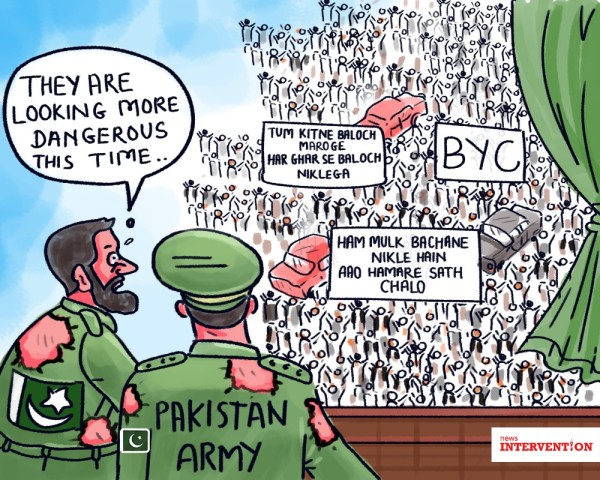
Dr Sabiha Baloch addresses crowd at the national gathering of Baloch Yakjehti Committee
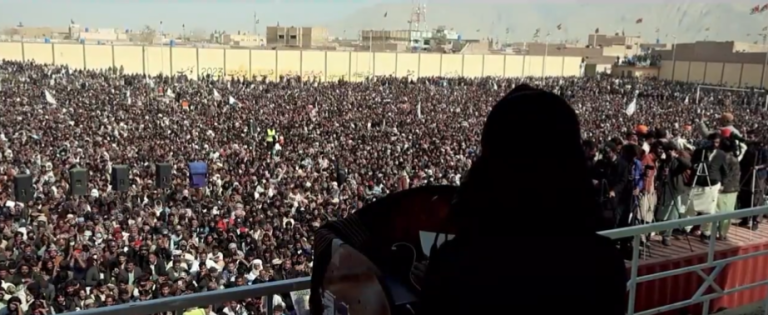
Dr. Sabiha Baloch addressed the crowd at Shahwani Stadium Shawal disseminating information about the history of the Baloch Yakjehti Committee (BYC) and the march against genocide from Shahwani Stadium Shawal on January 27, 2024.
In her speech, she stated that the public meeting of the Baloch Yakjehti Committee has emerged as a milestone in the Baloch genocide movement. The Baloch people from Karachi to DG Khan and from Barkhan to Turbat have united and come together to prove that they will no longer silently bear the loss of their loved ones.
Despite the criticism and threats, people from every corner and almost every village of Pak-occupied Balochistan have stepped out to become part of a collective consciousness. This social consciousness encourages the Baloch people in the face of oppression to raise their slogan of resistance for the sake of their national identity and survival.
BYC’s movement on Baloch genocide has gained momentum for a very long, the Baloch people are unified and committed to exposing and opposing the grave injustices committed by the Pak Army. These public gatherings and demonstrations are increasing the strength of the Baloch genocide movement and the atrocities that the Baloch community faces from the oppressive Pak Army since forcefully occupying Balochistan on March 27, 1948.
Occupying Pak-occupied Gilgit-Baltistan government hoodwinks protestors ;forms 6 member committee
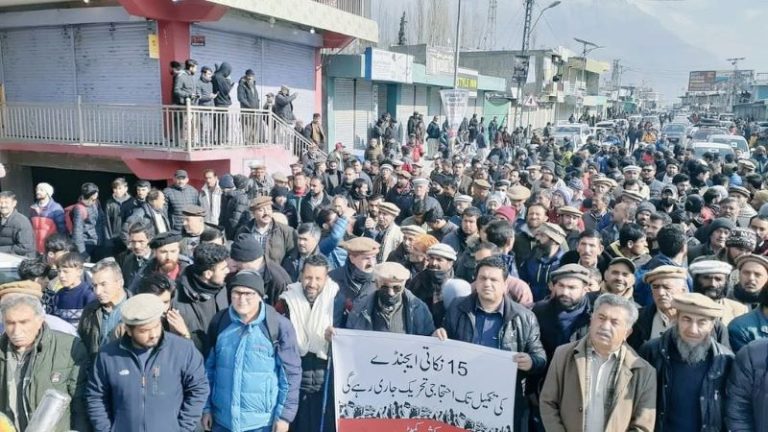
In the picturesque region of Pakistan occupied Gilgit-Baltistan (POGB), the political landscape is charged with tension as protests spearheaded by the Awami Action Committee show no signs of abating. The occupying government has initiated a deceptive response, in the form of a 6-member committee, to engage with various stakeholders and find a comprehensive solution to the burgeoning public discontent.
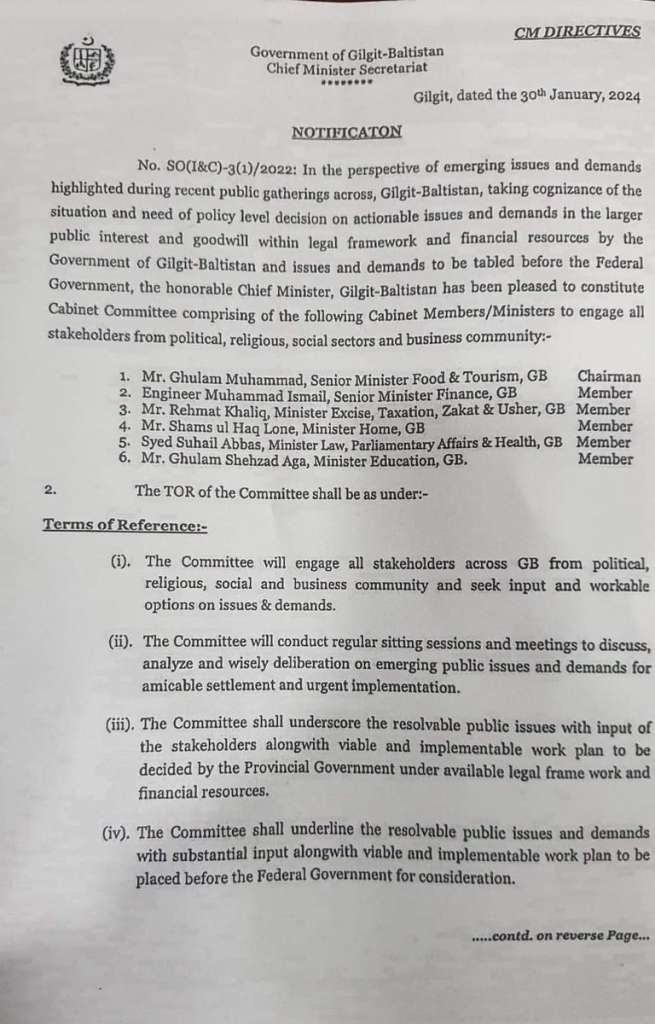
Objectives of the Committee
The newly formed committee, is tasked with engaging representatives from political, religious, social, and business communities across the region. The primary goals include seeking input and workable options on the issues and demands raised by the protestors. Regular sessions and meetings will be conducted to analyse and deliberate on emerging public issues with the aim of finding amicable and urgent solutions.
Moreover, the committee is mandated to underscore resolvable public issues, collaboratively decide on a work plan within the existing legal framework and financial constraints of the occupying government. But interestingly, this is the only bone of contention as protestors have realised that existing legal framework is there to exploit the POGB and hence any negotiation under the existing framework would eventually lead to nothing but dissent. As stated by Awami Action Committee leader Ehsan Advocate recently, the main problem is the imposition of assembly through the colonial order. Accordingly, the only intention of the Pakistani establishment to impose the Assembly was to continue the exploitation of the region, which they always did, without being answerable to the people of POGB directly. The whole intention was to keep the struggle and fight of the people up to themselves.
Clash of Agendas: Protestors Demand Autonomy
While the committee’s formation might look as a step towards addressing public concerns, the protestors affiliated with the Awami Action Committee, being aware of the consequences of such committees, remain resolute in their demands for autonomy. The occupying government’s formation of the committee is a deceptive effort to somehow deflate the protest. And hence, their Charter of Demands, consisting of 15 points, calls for the detachment of Pakistan from significant stakes in Pakistan occupied Gilgit-Baltistan (POGB).
Furthermore, the protestors had firmly asserted that without the fulfilment of their 15-point Charter of Demands, they will not disband and will continue the protest. And at the core of their demands is the call for autonomy, a proposition that challenges the very political status of POGB which led to its subjugation at the hands of the regime in Islamabad.
Explosion in Sibi (POB) kills four and injures dozen
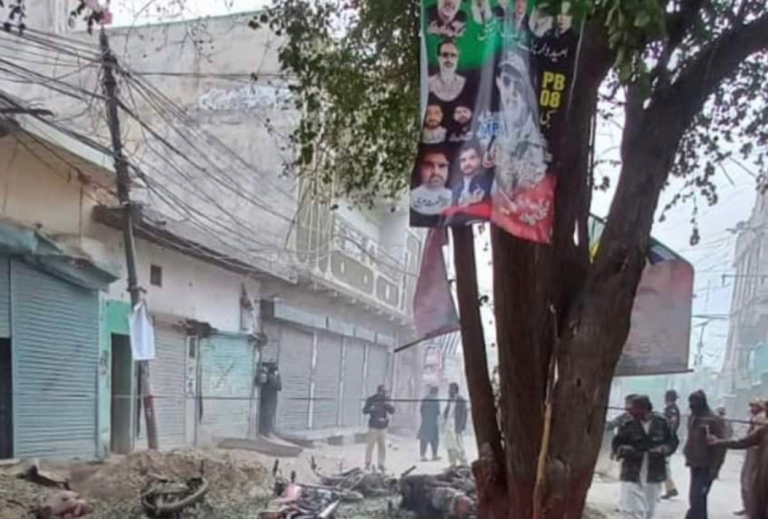
Recently, an explosion took place near a PTI rally in the Sibi district of Pak-occupied Balochistan on Tuesday that resulted in the death of at least four individuals and injuring dozens.
The blast took place near Faisal Bank on Iqbal road, at an election rally of Pakistan Tehreek-e-Insaf (PTI) and soon after the explosion the Pak Army cordoned off the area and launched an investigation.
The victims of the explosion have been shifted to Civil Hospital in Sibi. Zakaullah Gujjar, the Station House Officer told the media that the injured victims of the explosion are in critical condition and the death toll could rise.
The deceased are identified as Hammad Khan, son of Sarwar Khan, Abdul Waasay, son of Abdul Basti, Muhammad Rafiq, son of Hussain Bakhsh and one individual identity remains unknown.
The explosion at the PTI rally in Sibi has been noted by the Election Commission, which has instructed the Chief Secretary and the Inspector General of Pak-occupied Balochistan to provide a report on the event. But no group or individual has so far taken responsibility for the bombing.
Pak-occupied Balochistan has been in shambles since the Pak Army captured it on March 27, 1948, and since then Baloch people have been subjected to systematic assaults like home invasions, torture, enforced disappearances, kidnappings for ransom and target killings by the Pak Army.

POGB leader accuses Pak Army and Chinese businessmen of diving the region
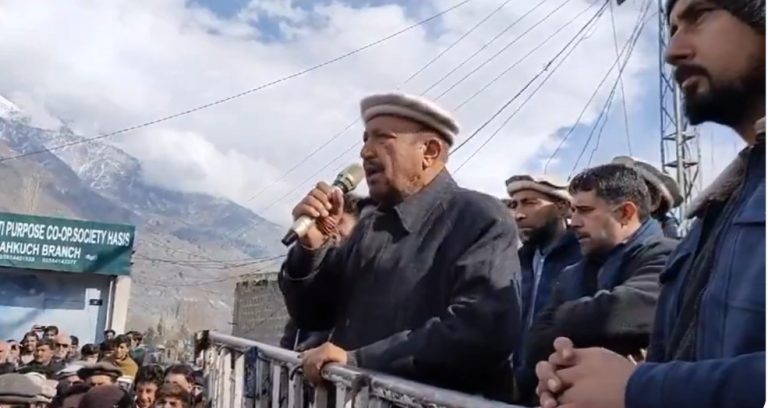
In a significant development, the caravan of Anjuman Tajran led by Nawaz Khan Naji from Ghakuch , Ghizar and Awami Action Committee Punial joined the ongoing protest at Gilgit Ittehad Chowk. The caravan is one amongst many, coming from across the POGB. These convoys including thousands of people are converging into Gilgit to mark the biggest protest demonstration for their rights. The protest in POGB is taking the shape of a movement as the protest is unprecedented and historically the biggest protest in more than 75 years.
A day earlier, Nawab Khan Naji addressed the crowd during a protest in Ghakuch and emphasized the broader goal beyond wheat prices, stating, “We have to work so that not only wheat but the agricultural lands, mountains, and seas come under our rightful control.” He denounced the Pakistani establishment, alleging, “This is not only a matter of wheat; these mountains have been divided by the Pak Army generals and Chinese businessmen among themselves.”
Nawab Khan Naji criticized the leasing practices in POGB, asserting, “Any lease provided in POGB is either given to retired Pakistan Army generals or Chinese businessmen.” Affirming their commitment to the cause, he declared, “POGB will snatch their mountains from the Pakistan Army and Chinese businessmen.”
Nawab Khan Nazi’s statement falls in line with the Charter of Demands put forward by the Awami Action Committee. The committee has made it clear that they would not succumb to the latest notification and would continue their struggle until all the POGB’s rights are given.
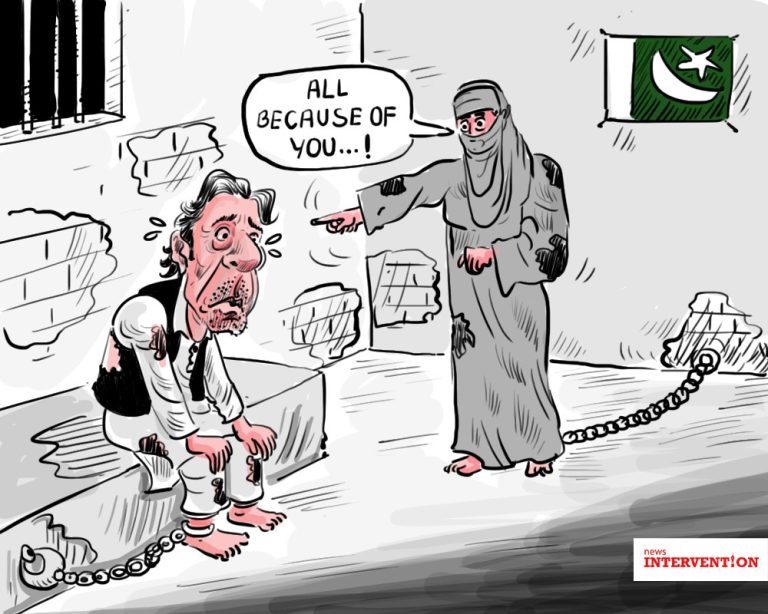
Islamabad: Imran Khan & Shah Mahmood Qureshi receive 10-year jail sentences in Cipher case
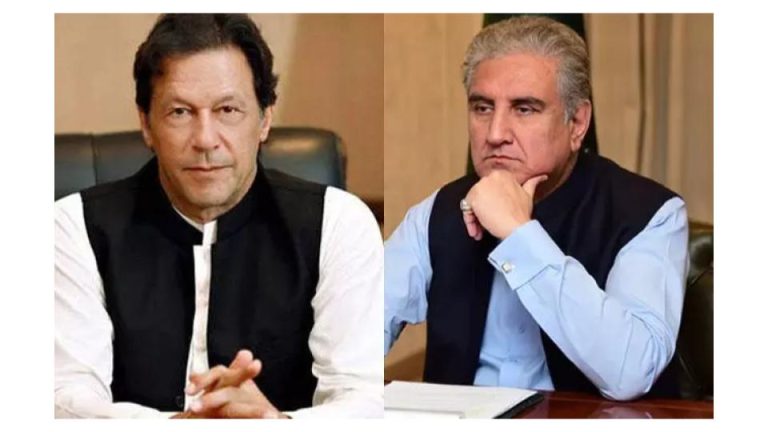
In a significant development, a Pakistani court has sentenced former Prime Minister Imran Khan and his former foreign minister Shah Mahmood Qureshi to 10 years in prison in cipher case. The charges stem from a violation of the Official Secrets Act, with both leaders found guilty of making a diplomatic cable public during Khan’s tenure.
Imran Khan received his sentence within the confines of Adiala Jail, where he is placed since his August arrest.
The verdict was pronounced by special court judge Abual Hasnat Muhammad Zulqarnain. However, Imran Khan retains the option to appeal against the decision in a higher court, indicating potential legal maneuvers in the ongoing case.
The case revolves around allegations that Imran Khan disclosed the contents of a confidential cable between the Pakistani ambassador to Washington and the Ministry of foreign affairs in Islamabad.
Pakistan Tehreek-e-Insaf
Imran Khan’s political party, Pakistan Tehreek-e-Insaf (PTI), labeled the case a “sham” and announced plans to challenge the decision. PTI expressed unwavering confidence in Khan and Qureshi.
Throughout the trial, Khan’s party, the Pakistan Tehreek-e-Insaf (PTI), expressed grave concerns that the former prime minister could face the death penalty for treason charges. Khan himself has consistently asserted his innocence, emphasizing that he never revealed the cable’s full contents. Meanwhile, Qureshi stands accused of manipulating the diplomatic cable’s contents for political gain.
The cipher case is just one of more than 150 cases Imran Khan faces, with charges ranging from contempt of court to terrorism. Imran Khan is specifically accused of revealing a classified cable during a public rally, asserting it as evidence of a US conspiracy against him.
Cipher case
The special court restarted the cipher trial last month after the Islamabad High Court nullified previous proceedings. Imran Khan and Qureshi were indicted for a second time in December, both maintaining their innocence.
In response to the verdict, Imran Khan denounced the trial as a “fixed match,” suggesting external influences in the legal proceedings. He underscored the Islamabad High Court’s twice-nullified status of the cipher case and reiterated his claim of innocence.
On X, Imran Khan said, “This is not a trial but a fixed match whose outcome was predetermined by the characters and planners of the London Plan and their seals. That is why I already know the decision of this case.”
He added, “Remember that Cipher is a case which has been declared null and void twice by the Islamabad High Court and ordered to be re-tried because both times the case was tried to be run in violation of the constitution and the law. Then the Supreme Court has also given me bail in this case because the whole building of this case has been built on lies, bullying, conspiracy and deceit.”
In a bid to overturn a previous ruling, Pakistan’s caretaker government filed a petition with the Supreme Court earlier this month. The petition challenged the Islamabad High Court’s (IHC) decision, which declared the government’s notification regarding PTI leader Imran Khan’s jail trial in the cipher case as invalid. The government argued that the IHC failed to properly assess the case’s facts and lacked the authority to invalidate the special court established for Khan’s trial.