Home Blog Page 175

World Sindhi Congress holds International Conference of Sindh for Sindhi rights & issues

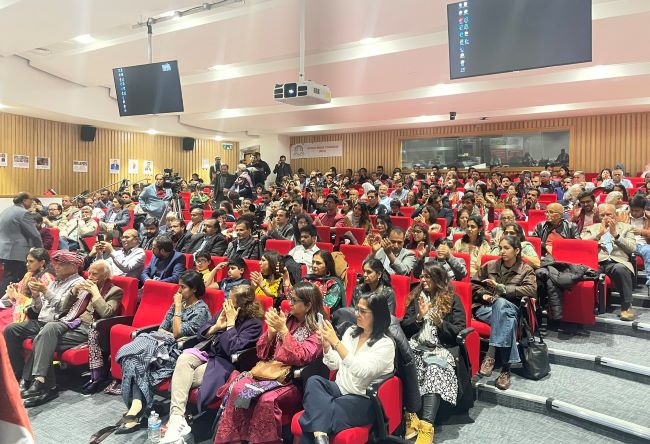
World Sindhi Congress organised an international conference in London which saw participants from Sindhi Community from across the world.

On 30 October the World Sindhi Congress organized the 35th International Conference on Sindh at the University of Westminster in London. The event focused on the issues related to the Sindhi communities around the world, with special focus of Sindh. During the conference the precarious conditions of Sindhis in Pakistan was also highlighted.

The event was attended by various dignitaries and stakeholders that are working for the cause of Sindhis and Sindhudesh. This included Rabina Sheikh, who serves as the Chairman of the World Sindhi Congress, as well as prominent figures like Lakhu Lohanu, Hidayat Bhutto, Sagheer Sheikh, Hajan Kalhoro, Maqbool Halepoto (Chairman of SANA), Sain Imdad Oodhu (Managing Director of Voice of Sindh London), Hasan Dost Baloch (Leader of BNM), Qamber Baloch (Leader of BHRC), Sohail Abro (Chairman of Jeay Sindh Freedom Movement), Narayan Bablani (Leader of Indian Sindhi Businessmen and Heritage Foundation), and the distinguished senior journalist Veengas, among others. The gathering also included writers, intellectuals, professors, journalists, international human rights organizations, and leaders, workers, and families associated with Sindhi and Baloch parties and forums, who came from various parts of the world to take part in the event.  

World Sindhi Congress has been vocal for the rights and issues of Sindhis. With the organization of Sindhi conference at global level and bringing all the important stakeholders to one platform, WSC has actually strengthened the fight for the cause of Sindhis.

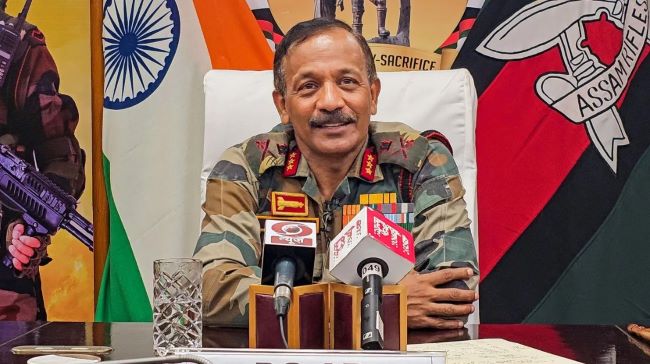
Selectively leaked videos for vested interest pose challenge in Manipur: DG Assam Rifles

It is almost 181 days, or roughly six months since the violence has grappled the border state of Manipur. Having less chance of immediate cessation of hostilities, the DG Assam Rifles seems optimistic about the gradual and successful return to normalcy. Along with this, he also raised red flags regarding the selectively leaked videos and heavily weaponised Manipur.

Selectively leaked video incite communities

DG Assam Rifles P.C. Nair, while talking to a news channel said, “I think it will take some time for it to revert to what it was earlier. During such periods, selectively leaked videos or motivated narratives tend to go viral, with individuals manipulating them for personal gain. These represent vested interests from which people must be safeguarded.”

According to him, these selectively leaked videos incite a community towards the other and vice versa. While saying this, he also mentioned the accusations of bias that have been put on Assam Rifles by both the communities Kuki and Meiteis from time-to-time. He opined, “There were instances when people of a community were going en masse to attack the other after being fed with a certain narrative. And here, we stopped them. So obviously, when emotions are running high and they are prevented from doing what they want to, stories get cooked up,” Lt Gen Nair added.”

Apparently, his statements indicates that, for some vested interests, the communities are often fed with half-baked information leading them incited to violence. This has further worsened the situation and the security forces that stop them were labelled as biased out of emotions.

Heavy weaponisation of communities, one of the biggest challenge

Additionally, he pointed out the mindset of the people and heavy weaponisation as one of the most significant problems. According to him, both the communities are heavily weaponised.

Considerably, this is not the first time that he has openly talked about the communities being heavily weaponised. On August 29, when the conflict once again escalated, 8 people including 2 security personnel lost their lives in merely 72 hours. At that time also DG Nair had emphasised that one of the biggest challenges was the “large number of weapons” within both the communities. He had said, “The society has become weaponised. Unless these weapons come back in whatever way they can, this challenge will be the biggest. Today, there’s so much against each other, it’s so corrupted. This needs to be stalled.” Also, he referred to the clashes in Manipur as unprecedented. He highlighted that the situation is new not only to the forces but also to Manipur.

Missing weapons coming back

Nonetheless, in his recent interview with a media channel, DG Assam Rifles also talked about the missing weapons. He said, “The number of weapons that went missing from various police stations are close to 5,000, of which about 1,600 weapons are back today — a positive development, though it will take time before we get all the missing weapons back.”

In response to inquiries regarding the “assurance from the state government” concerning the relocation of Assam Rifles from buffer areas and their substitution with paramilitary forces, Lt Gen Nair stated, “Why would there be a need for such strategies? We maintain a presence in a wide range of areas, including the plains, hills, and the intermediary buffer zones. Our dedicated officers and personnel diligently perform their duties with the utmost professionalism. Our foremost objective is to restore normalcy, and we are steadfast in our commitment to achieving that goal.”

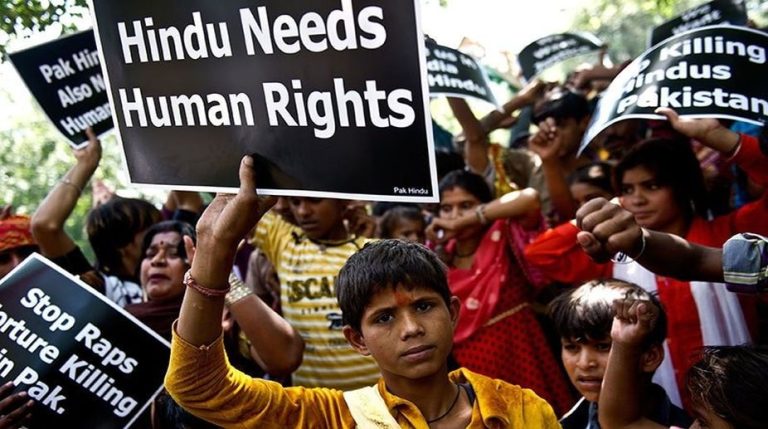
Hindu village and temple set on fire by a radical Islamist in Sindh

In Sindh, Pakistan, a distressing incident has unfolded, where a Hindu Kachhi community has been subjected to a tragic act of violence and hatred. This episode involved a Muslim landlord from Nasarpur, who not only demolished homes and temple but also set fire to the entire Hindu village, where these residents had lived for over four decades. This act of aggression didn’t end there; it also included the theft of motorbikes owned by the villagers, adding to their hardships.

The Hindu community, especially in Sindh, has a long history of facing persistent persecution and discrimination since the partition. The Hindu Kachhi community, in particular, is a vulnerable group, often struggling with poverty and landlessness. As of now, they continue to live under the constant threat of the landlord and his associates.

This deeply disturbing incident of homes and temple demolished is a stark reminder of the escalating violence against minority communities in Pakistan. It underscores the urgent need for attention and action to protect and support these marginalized groups, ensuring that they can live in peace and security, free from the fear of persecution and discrimination.

Balochistan: BLF attack kills six Pak Army soldiers

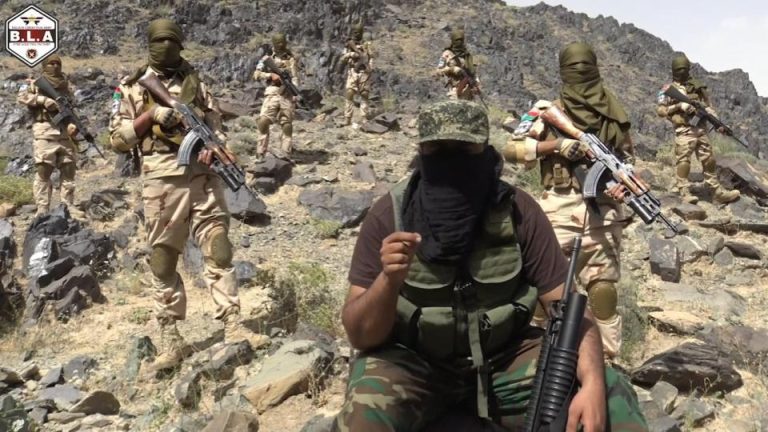
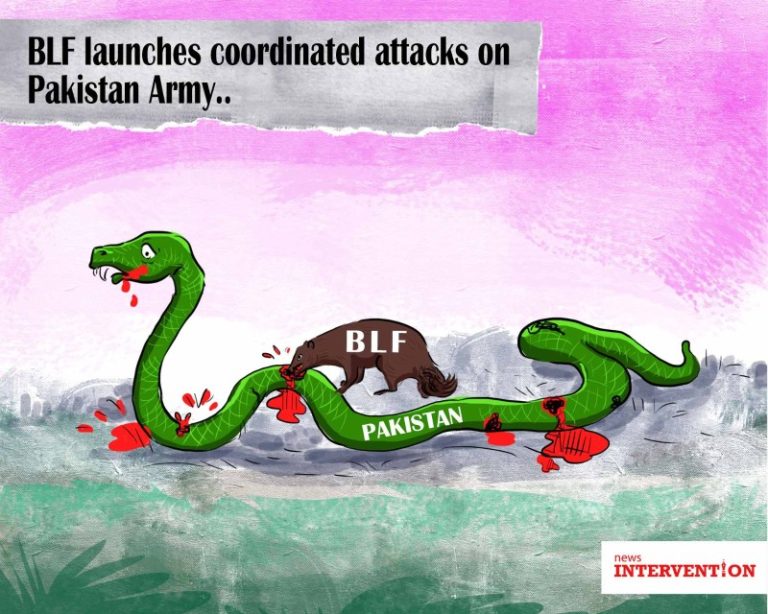
Recently, in the act of valour, the Balochistan Liberation Front (BLF) carried out an attack on the Pakistan Army in Jaho, resulting in the deaths of six Army personnel, including a Deputy Subedar. The attack also led to the capture of weapons, and rocket was also fired at a nearby checkpoint during the attack.

The attack was executed on a unit of the Pakistan Army stationed in the Baderang Nonrada area of Jaho. The BLF planned the operation strategically, coordinating it with a Combat Reaper Team (CRT) from the nearby Pakistan Army battalion headquarters in Koharo.

Execution

Two different groups collaborated to execute this attack. One group closely monitored the movements of the Army battalion headquarters in Koharo and informed the BLF fighters about their activities. The BLF members then positioned themselves near the Army’s path in Baderang. When the Army came within striking distance, the BLF launched a sudden and intense attack, resulting in the deaths of six personnel before the Pak Army could respond.

The Paki ‘establishment’ have confirmed and identified the two slain officials as Deputy Subedar Asif Irfan Resident of District Okara Punjab, and 25 years old Soldier Irfan Ali Resident of District Sargodha Punjab. However, the Public Relations Department of the Pakistan Army is concealing the deaths of their other officials. There was no resistance from the Pakistan Army during this attack. The Baloch freedom fighters did not give them a chance to fire a single shot and took away their weapons after the attack.

Confirmation

However, the nearby checkpoint fired back at the Baloch fighters, forcing them to stay behind the walls of the checkpoint. After the attack, all Sarmachars successfully managed to evaluate the area safely. The Pakistan Army has confirmed the attack, but as always, they have lied that only two Baloch fighters were martyred in this attack.

The claim made by the ISPR is a complete lie. This proves that the Paki ‘establishment’ is trying to hide their defeat and embarrassment. BLF had already warned in its previous statements about these attacks. Their operations have resulted in the abandonment of several Army posts and checkpoints. Despite Paki ‘establishments’ superior numbers and resources, they are being defeated on every front in Pak-occupied-Balochistan. The Army primarily targets unarmed civilians and attempts to create disturbances in Baloch society by forming alliances with criminal groups.

BLF calls to the Baloch nation to support the organisation with patience and resilience so that together they can successfully remove the Army from their land. As long as this Army remains occupiers, the Baloch nation will remain in trouble. For decades, BLF has carried on an armed struggle against the Pakistan Army and ‘establishment’, as they have illegally occupied Balochistan. Since 27 March 1948, Pakistan Army has been oppressing Baloch through daily home raids, disappearances, staged encounters, target killings, torture, humiliation at checkpoints, and kidnappings for ransom. The Pakistan Army is targeting and monitoring Baloch people, and anyone who has a potential to raise questions is either killed or abducted. 

Will 2023 see a ‘Hot’ winter in Kashmir?

0

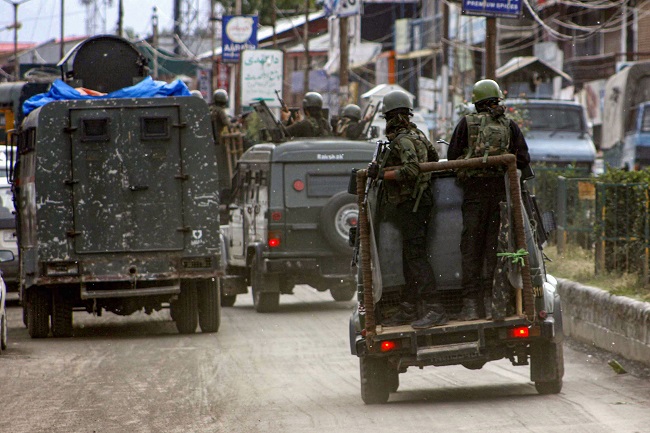
Every year, prior to onset of winters, Kashmir Valley witnesses a flurry of activities. While the civil administration works overtime to complete stocking of essential items ranging from foodstuff, fuel, medicines to other items of daily use before roads get blocked due to snowfall, the locals too make necessary provisions to cater for the severe winters.

However, feverish activity during this period isn’t restricted to the hinterland and inhabited areas only. This is also the time when Pakistan Army’s spy agency Inter Services Intelligence [ISI] which is overseeing Rawalpindi’s proxy war in J&K also undertakes a massive ‘stocking’ exercise, albeit of an entirely different kind.

It is always the ISI’s endeavour to push-in maximum number of terrorists as well as adequate quantities of arms and ammunition into J&K before the mountain passes along the Line of Control [LoC] are rendered impassable due to snow accumulation. To sustain the proxy war, it’s necessary for ISI to ensure that the strength of terrorists and their stocks of arms and ammunition don’t deplete drastically due to ‘wastage’ as a result of encounters with Indian security forces.

Hence it’s not at all surprising that just during the last 30 days, four infiltration attempts have been thwarted by joint teams of the Indian army and J&K police in which at least 10 terrorists were been neutralised. However, two things do stand out-one, there’s an exponential increase in the number of foreign terrorists vis a vis locals, and two, renewed focus on inducting weapons that can be easily concealed.

The number of foreign terrorists in J&K has gone up exponentially. According to a report, out of a total of 46 terrorists killed in J&K during the current year, 37 were Pakistanis, which means that three out of every four terrorist killed was a Pakistani national. This indicates that despite the continuing efforts of Islamabad and its J&K based proxies like All Parties Hurriyat Conference [APHC], the locals have realised that they are being used as ‘expendable’ pawns by Pakistan.

The total number of pistols and hand grenades recovered from terrorists killed while infiltrating during the current year isn’t available. However, news reports about a haul of six pistols and four hand grenades on October 22 from the encounter site after an infiltration attempt in Uri sector was defeated in which two terrorists killed, is revealing. Since pistols are accurate only at extremely short range [50 m for Type 54 pistol being used by terrorists in J&K], it’s of no particular use in encounters.

Similarly, the hand grenade used by terrorists [Pakistan Ordnance Factory manufactured ARGES 84 P2A1] is manually flung and so its range is limited to the strength of the user, which is usually less than 100 feet. This grenade has 5,000 steel pellets [of 2-2.3 mm diameter each] which are effective within a radius of 20m from point of burst, and its limited range restricts it utility during encounters.

However, since both pistols and hand grenades are very easy to conceal and can be effectively used with one hand only, they are invaluable for use by ‘hybrid’ terrorists for attacking ‘soft’ targets and creating mayhem in crowded places. With locals wearing the traditional phiran [long cloak or robe] with hands tucked inside the same instead of being put through the sleeves in winters, a pistol or hand grenade can not only be effortlessly concealed but also used with matching ease.

Concerted and sustained action against the well entrenched terrorism support system is one of the main reasons behind the low recruitment of locals into terrorist ranks in Kashmir Valley. Piqued by the targeting the jugular of the ecosystem nurturing and sustaining terrorism, the ISI has shed all the pretense of trying to portray terrorism in Kashmir as a ‘freedom struggle’ and instead, is now openly playing the communal card by instructing its proxies to target minority community members.

Just recently, J&K Police DGP Dilbagh Singh remarked that terrorism “which had struck like a calamity on the entire J&K has been almost been finished and whatever remnants are left will be eliminated soon.” While there are no doubts that terrorism in J&K has been effectively brought under control through a proactive and comprehensive counter-terrorism strategy, yet it may be a bit early to predict the imminent end of terrorism in J&K.

The harsh reality is that what we are facing in J&K isn’t mere militancy or terrorism- it’s a full-blown proxy war being waged by an inimical neighbour. And since it enjoys state sponsorship as well as the unconditional blessings of Pakistan’s all-powerful army, while the international community chooses to remain silent spectators, it’s not so easy to eliminate this menace. Hence, while there’s no need to unduly worry or lose hope, complacency would be suicidal!

“The militancy, which had struck like a calamity on the entire Jammu and Kashmir, has been almost finished and whatever remnants are left will be eliminated soon.

Read more at:
https://economictimes.indiatimes.com/news/defence/only-10-local-youths-joined-militancy-in-2023-jk-dgp/articleshow/104675900.cms?utm_source=contentofinterest&utm_medium=text&utm_campaign=cppst

30 Sep- Kumkadi area of the Machil sector in the north Kashmir district 2XAK

16 Sep -Hathlanga forward region within the Uri sector of Baramulla District in North Kashmir, 3 killed [2 rec, 1 under fire from Pak post]

22 Oct Uri sector 2 Killed two AK series rifles, six pistols, four Chinese grenades,

Read more at:
https://economictimes.indiatimes.com/news/defence/infiltration-bid-foiled-in-jks-uri-sector-2-militants-killed/articleshow/104632278.cms?utm_source=contentofinterest&utm_medium=text&utm_campaign=cppst

26 Oct -Machil sector of Kupwara district. 5 killed

Pakistan’s Kashmir treachery revisited

0

Brief Background

To formalise the transfer of power from Her Majesty’s Government to the newly created dominions of India and Pakistan, the British parliament passed the Indian Independence Act of 1947. As the British decided that the princely states in undivided India should be given a choice to decide on joining either of the two dominions, a standstill agreement was incorporated.

This agreement was meant to ensure that “all the administrative arrangements that existed between the British crown and the princely state would continue unaltered between the signatory dominions [India and Pakistan] and the state, until new arrangements were made.”    

The Maharaja of J&K expressed his willingness to enter into standstill agreement with both India and Pakistan. While Pakistan immediately accepted his request, it was conveyed by New Delhi to the Maharaja that he or an authorised minister should be sent to discuss this issue, which did not happen. So, the princely state of J&K had a standstill arrangement with only Pakistan.

Eyeing Kashmir

While India made no overtures to influence the Maharaja of J&K to accede to India, Pakistan tried everything in the book to do so. Starting with the prompt acceptance of the standstill agreement to show bonhomie with the princely J&K state, Pakistani President Muhammad Ali Jinnah even sent his private secretary Khurshid Hasan Khurshid to persuade the Maharaja of J&K to accede to Pakistan. Having reportedly boasted that “Kashmir is a blank cheque in my pocket,” accession of J&K with Pakistan must have become an obsession for Jinnah.

According to Mehr Chand Mahajan who became the prime minister of J&K in mid October 1947, Khurshid conveyed Jinnah’s message to the Maharaja of J&K that the latter “… was an independent sovereign, that he alone had the power to give accession; that he need consult nobody, that he should not care for the National Conference or Sheikh Abdullah … that he need not delegate any of his powers to the people of the State and that Pakistan would not touch a hair of his head or take away an iota of his power if he acceded to Pakistan.

But the Maharaja wasn’t convinced. Jinnah however didn’t give up hope and in beginning October 1947, he once again sent Khurshid to try and persuade the Maharaja of J&K to accede to Pakistan, who refused to yield. In order to exert pressure on the Maharaja, Pakistan started impeding movement of essential supplies and fuel guaranteed by the standstill agreement as well as fomented communal violence, but the Maharaja didn’t relent.

So when it became apparent to Jinnah that J&K’s accession to Pakistan was out of question, a decision was taken to invade and annex this princely state, standstill agreement notwithstanding! 

Operation Gulmarg

The Pakistan Army’s plan to seize J&K was codenamed ‘Operation Gulmarg’ and envisaged the use of an orchestrated ‘tribal invasion’ to avoid international censure for waging unprovoked aggression. Accordingly, tribals armed and administered by the Pakistan Army, were led by Army regulars who also disguised themselves as tribals. The invasion commenced on October 22 [and the J&K state forces were unable to match this better led and numerically superior force. By October 26, the ‘tribals’ had reached Baramulla which is just about 50 km short of  J&K’s capital city Srinagar.

Liberation or Pillage?

Just like Pakistan’s military operation was disguised as a tribal invasion, its stated objective touted as ‘liberation’ too was an equally shameful farce. Had this really been the aim, then Brigadier [later Maj Gen] Mohammad Akbar Khan who was the overall commander of the invading force would have definitely told his officers and men commanding groups of tribal fighters not to physically harm Kashmiris or loot their property. Moreover, he would have pressed his forces to reach Srinagar  at the earliest and accomplish the task of ‘liberating’ J&K rather than wasting time in pillaging – but he did neither!

What actually happened proved beyond doubt that Pakistan was only interested in J&K territory and not its people. Speaking at the UN on February 5, 1948, J&K leader Sheikh Muhammad Abdullah highlighted Pakistani atrocities and revealed that “…the raiders came to our land, massacred thousands of people — mostly Hindus and Sikhs, but Muslims, too — abducted thousands of girls, Hindus, Sikhs and Muslims alike, looted our property and almost reached the gates of our summer capital, Srinagar…” [Emphasis added].

The carnage committed by Pakistan Army led tribals has also been documented in great detail by several authors and writers with impeccable credentials, and Rawalpindi can’t absolve itself of the unsoldierly conduct exhibited by its rank and file. While Brig Khan has heaped praises on the tribals in his book on this war, he conveniently feigned ignorance about the two day long rampage of Baramulla by mentioning “The uncouth raiders delayed [themselves] in Baramulla for two [whole] days.” However, by describing them as “uncouth,” he has said it all!

Saving Kashmir

It was on October 26, 1947, that the Maharaja of Jammu and Kashmir [J&K] signed the instrument of accession in favour of India, and the very next day Indian army troops landed in Srinagar. Without wasting any time got down to the task of pushing back the invaders and fierce battles ensued. Though outnumbered and unfamiliar with the terrain, Indian army through its exemplary grit and unparalleled valour succeeded in not only stem the advance of intrudes but also forced them to retreat.

The areas of operations were hazardous and diverse- from the dizzy and barren heights of Zojila Pass, to the rugged mountainous areas of Kashmir Valley and the thick forested Poonch-Rajouri belt to the South of the Pir Panjal mountain range. The intruders were routed and it is estimated that Pakistani intruders suffered 6,000 fatalities and 14,000 non-fatal casualties. But success came at a heavy cost- while 1,104 members of the Indian army gave the supreme sacrifice, 3,154 were wounded in action.

Operations of the Indian army to drive out the Pakistan Army and tribals from the entire J&K were progressing well when the UN sponsored ceasefire came into force. Resultantly, despite being in a militarily advantageous position, the Indian army had to cease operations. This is how Pakistan managed to retain some territory of Jammu and Kashmir that is today referred to as Pakistan occupied J&K [PoJK].

Karma Strikes Back

While barbarity was expected from tribals, complicity of Pakistan Army’s rank and file in savagery directed against unarmed and innocent minority communities [whether by omission or commission] is unpardonable. The most disconcerting part is the fact that this rabidly communal mindset gained such widespread acceptance within the Pakistan in a matter of just over nine weeks of its creation.

But Karma came to haunt the Pakistan Army under whose charge innocent Kashmiris were subjected to unspeakable atrocities and became victims of a horrific bloodbath. Its brazen attempt to annex J&K failed and became a source of enduring embarrassment for Rawalpindi. Due to Pakistan Army’s despicable actions and the adverse sentiments it created, Pakistan feared that a plebiscite in J&K would go against it and as such never pursued this issue vigorously.

Epilogue

Pakistan has continued to reap the grim harvest of its communal mindset and barbarity of 1947-48. 24 years later, this very perverse trait prompted the Pakistan Army’s ‘Operation Searchlight’ to undertake ethnic cleansing of Bengalis in what was then East Pakistan, which led to the creation of Bangladesh. Even today, while some residents of PoJK are today protesting against its illegal occupation by Pakistan, there are others who are openly demanding its merger with India.

It seems that finally the wheel has come full circle!

Qatari news agency criticises Pakistani ‘establishment’ for it’s silence on Israeli attacks on Gaza

Al Jazeera, the renowned Arabic media outlet, has highlighted the significant “Gaza March” held in Islamabad, organized jointly by the Jamaat-e-Islami and the Tehreek-e-Bidar-e-Ummat Mustafavi (TBMU), as Pakistan’s largest rally in support of Palestine. This demonstration comes as the Pakistani government faces criticism for its perceived silence on the ongoing Israeli attacks in Gaza.

Al Jazeera’s report underscores the overwhelming public participation in the rally, stating that the “turnout is exceptionally high.” It goes on to assert that “since the beginning of Israel’s war on Gaza, this is the largest pro-Palestinian rally in Pakistan.”

The report goes on to describe the widespread unity and support for the Palestinian people as women and children, along with people from all walks of life, gathered to express their solidarity.

Additionally, protests are taking place in other major cities across Pakistan. The Al Jazeera report underscores that the Pakistani government has not been as vocal in supporting the Palestinian cause and opposing Israeli aggression as many expected.

Rise in casualties in Palestine

The rally saw the international community’s frustration with Israel’s bombing campaign in Gaza and its failure to prevent civilian casualties. Since the Hamas offensive on October 7, the number of casualties in Palestine has risen to 8,005, with 20,242 wounded. In the West Bank, there have been 112 Palestinian fatalities and 1,900 injuries.

On the other hand, Israeli casualties stand at 1,405 deaths and 5,431 injuries. Pro-Palestinian demonstrations are taking place worldwide, with demands to halt Israeli bombings in Gaza. Melbourne has witnessed protests this morning, and cities across the world, including Beirut, Berlin, Munich, Madrid, San Antonio, Albany, Newark, Watertown, Denver, Aron, Orlando, Toronto, and Ottawa, saw demonstrations on Sunday.

This international response reflects global concern for the situation in Gaza and a call for a cease-fire and a peaceful resolution to the ongoing conflict.

Lt. Gov. Manoj Sinha flags off ‘Run for Unity’ program on Rashtriya Ekta Divas in Srinagar

In a high-spirited event in Jammu and Kashmir, the Lieutenant Governor of the UT, Manoj Sinha flagged off “Run for Unity” program on the birth anniversary of Sardar Vallabhbhai Patel. Sinha attended the event in Bakshi stadium, Srinagar.

Before the flag off, Lt. Governor, Manoj Sinha administered the “Rastriya Ekta Divas” oath to the dignitaries and among others were present at the event. It is worth remembering that each year October 31 is celebrated as “Rashtriya Ekta Divas” (National Unity Day) to commemorate the first Home Minister of Independent India and the revered freedom fighter, Sardar Vallabhbhai Patel. The day is remembered as National Unity Day to acknowledge his role in integrating the presidencies, states and princely states into India as a Union of States.

The event was celebrated across the nation as the Ministry of Education, Government of India, has directed all government schools across the nation to organise a “Run for Unity” event and oath taking ceremony. In line with that, all Chief Education Officers (CEOs) in J&K were notified by the project director of J&K Samagra Shiksha to organize the events in all the government schools as per the guidelines.