Home Blog Page 184

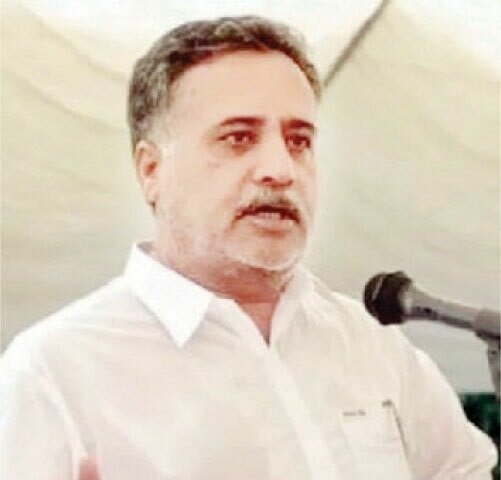
Pakistan abducts PTM activist for speaking up for the Afghan refugee crisis

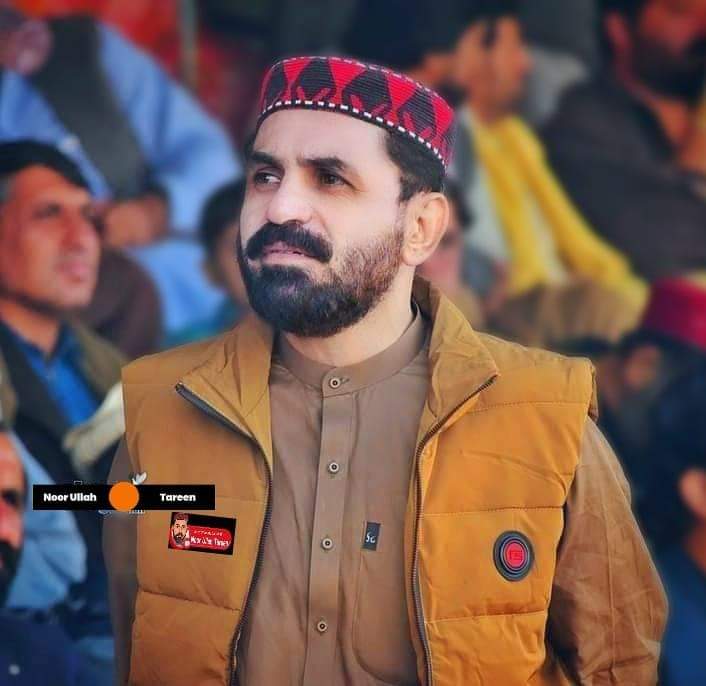
The crackdown on the Pashtun Tahafuz Movement (PTM) is continuing in Pakistan. In a recent development, Karachi Police has picked Sindh Coordinator of PTM, Noorullah Tareen. Noorullah was abducted from his house in Karachi on 5 October.  

His abduction is in line with the policy of Pakistan, according to which, any activist who raises voice for the persecuted and against the establishment will be hounded, abducted and even killed in many cases. Noorullah Tareen has recently been vocal against the ongoing Afghan refugees repatriation efforts by Pakistan.

Provincial leadership of PTM Karachi has decided to put a strong resistance if he is not presented in the court by Monday.

Crackdown on Afghan refugees and role of PTM Sindh

On 11 September, the Paki establishment initiated a sudden arrest drive against Afghan refugees. Almost 250 Afghan migrants were arrested by Karachi Police including women and children. Pakistan declared that it would be repatriating the undocumented Afghan refugees. Soon it became clear that under the garb of repatriating undocumented Afghan refugees, Pakistan was harassing and selectively targeting them. One of the reasons regarding this was the TTP attack that happened days before the arrests. The Pakistan Army was completely thrashed and humiliated by the TTP terrorist whom it patronised. Frustrated Pak Army launched an assault on the Afghan refugees because of their national identity.

During this hard phase of Afghan migrants, PTM stood beside them. PTM raised the issues of Afghan refugees and held protests. Since, Karachi was the epicenter of the arrests, Noorullah Tareen assumed greater responsibility.  On September 14, PTM provincial committee under Noorullah visited the Afghan colony and assured protection and support. Later, a team of sixty lawyers was set up to provide legal assistance to Afghan refugees and Pashtuns.

Since then, Sindh unit of PTM has been working proactively for the cause of Afghan refugees. Infact, after the Taliban took over Afghanistan in 2021, a significant number of Afghan population sneaked out of the country, some documented and others undocumented. Their only goal was to keep themselves alive. So, if they go to Afghanistan, they will face severe consequences. Therefore, undocumented Afghan refugees are facing a humanitarian crisis and hence need humanitarian support.

Abduction nearing deadline

Since Pakistan has made it clear that they will repatriate every undocumented Afghan migrant before 31 October, it knows that PTM is fighting for their cause. And hence, the abduction of Noorullah Tareen is an illegal action taken by the Pakistan government and establishment to weaken the fight of human rights.

It is the real face of Pakistan. PTM which is a non-violent and human rights advocating organization is dealt with brutality by the Pakistan Army and its puppet establishment.

Shia killer Haibat Khan eliminated in Pashtunistan

Terrorist Haibat Khan involved in countless Shia killings was killed in a joint operation conducted by the Pakistan Police and Counter-Terrorism Department (CTD) at Dera Ismail Khan on October 7. Haibat Khan was a member of Sunni extremist groups Sipah-e-Sahaba (SSP) and Lashkar-e-Jhangvi (LeJ) and had played a key role in a number of targeted attacks on Shias. Khan was also involved in several other terrorist attacks in the South Asian region.

According to the Central Police Office, Haibat Khan was wanted in 10 cases, including murder, terrorism, and possession of illegal weapons. Police also said that a bounty of 60 million rupees had been placed on his head.

The joint operation of Pakistan Police and CTD was carried out in Dera Ismail Khan, at Khyber-Pakhtunkhwa (a part of Pashtunistan, which at present lies within Pakistan). Police said that they received intelligence inputs that Haibat Khan was hiding in the area. Soon a team of police and CTD officers raided the house where Haibat Khan was hiding, and a gun battle ensued. Haibat Khan was killed in the exchange of gunfire.

Massive protests in POJK against Pakistan’s atrocities

On the call by the Awami Action Committee (AAC) of Jammu and Kashmir, Kashmiris observed complete shutdown and protest in POJK on October 5. Protests spanned across Poonch, Muzaffarabad, and Mirpur, with the participation of thousands of individuals. The call for the protest aimed to pressurize the occupying POJK government to address key demands including free electricity. Simultaneously the protest was also in response to the crackdown on activists by the  administration.

It’s worth noting that for two consecutive months, 78% of Kashmiris did not pay their electricity bills as part of a boycott, which is expected to continue until their demands are met. The protesters have outlined a list of demands, which include the provision of free electricity, the reinstatement of subsidies, and the withdrawal of unnecessary government perks enjoyed by the ruling elite.

Power Shortages in Kashmir

Out of the 3,000 megawatts of electricity that is generated in POJK, the region itself requires only 400 megawatts, making it a net surplus producer of electricity. Despite that, the region is facing extreme power cuts and high prices. And that is happening because the region and its resources are being exploited by Pakistan for its own benefit, depriving Pakistan Occupied Jammu and Kashmir (POJK) of their rights and justified claims. The protesters are, hence, demanding free electricity and the elimination of power shortages and that the benefits of the surplus electricity to be passed on to the Kashmiri population.

Various labor and socialist organizations, both from Pakistan and around the world, have expressed their solidarity with the Kashmiri people’s struggle for their rights. Notable organizations joining the cause include the Pakistan Trade Union Defence Campaign, Labour Party Pakistan, Workers’ International Network, and others.

Upcoming Demonstrations

As per the action plan laid out by the Awami Action Committee, women and children are scheduled to hold rallies on October 10, and student organizations plan to organize protests on October 17.

This recent wave of protests in Kashmir, involving the working class, the underprivileged, and the youth, is emblematic of a broader struggle against colonial rule, class oppression, and national subjugation in the entire region. The success of this movement is seen as vital for the marginalized and working-class Kashmiris, who continue to rally for their rights and demand socio-economic reforms in the region.

POJK: Complete shutdown on Oct 5, 2023 against Pakistani occupation

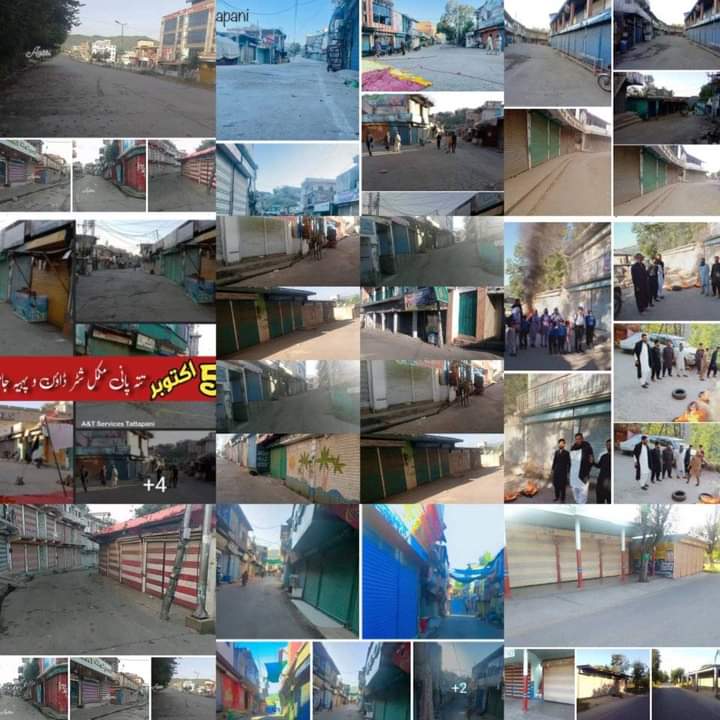
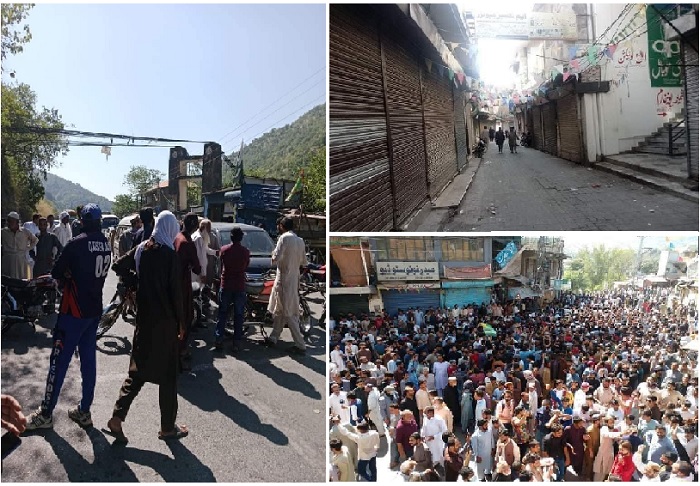
Kashmiris across ten districts of Pakistan-occupied Jammu Kashmir (POJK) marked October 5, 2023 by observing shutter down and chakka-jaam (total shutdown) against Pakistani misrule and illegal occupation. Alongside this massive bandh the protest rallies were also taken out at every district in the region.

The protests are being held after the Joint Public Action Committee issued a charter of demands comprising of free electricity, resumption of subsidies on wheat flour, elimination of taxes and end of the privileges for Pakistani elite. Since months, people of POJK have been agitated and have been protesting over these issues and have taken complete shutter down protests. However, it is the first protest after a communique regarding the series of protests was issued by Joint Public Action Committee.

The effects of the strike are visible in the entire region, especially, Muzaffarabad, Rawalkot and Neelam Valley. People of POJK have followed the call proactively and almost all the districts are completely shut. The only presence that is on the streets is lakhs of protestors across POJK, who are agitating against the exploitation and oppression of the occupying government.

Chakka-jaam (total shutdown) and Protests

In Kotli, one of the various protest rallies saw women at the front. In Muzaffarabad, various protest rallies were organized amidst the chakka- jaam (complete shutdown) and shutter down protest, in which the protestors raised slogans against Pakistani establishment. Later, all the protest rallies in the district marched towards Gilani Chowk and raised their concerns in a unified voice.

Similarly, in Rawalakot, the protestors in large numbers raised black flags as a symbol of resistance to the occupying government. The protestors demanded free electricity and subsidized wheat flour along with other basic amenities that they are deprived from.

The same kind of pictures are visible in the entire region of POJK. This overwhelming protest under the aegis of Awami Action Committee is one of the most impactful and expansive protest in the history of POJK.

Meanwhile, people in Mirpur district also observed complete shutdown and participated in protest rallies. During one such rally, the protestors echoed “Resources ours Control yours.. Unacceptable Unacceptable”

The masses in POJK are fed up of the exploitative tactics and policies of the occupying Pakistani establishment, which works under the influence of Pakistan. People in POJK neither get wheat flour nor electricity. Above all, the electricity tariffs have also been increased dramatically by the government leading to more crisis. This has aroused resentment among Kashmiris and so they have decided to resist the occupying Pakistani establishment.

Crackdown on Protests

Feared by the awakened voices of POJK, now the Pakistan’s puppet POJK government has initiated crackdown on the peaceful protestors. The regime that facilitates terrorists has for long used its coercive powers against the right seeking innocent individual. Unfortunately, similar thing is happening again in POJK. However, the puppet government and Pakistan, both should understand that this is just the beginning. As this was the first protest that was called by the Awami Action Committee. Just after five days, on 10th of October, another protest with participation of women and children will be held. Later on October 17th, various student organisations will hold similar type of rallies.

The committee through its communique has precisely elucidated that involvement of Pakistan Army will be perceived as external threat and any baseless cases protestors or crackdown on demonstrations will eventually lead to further expansion of movement and afresh jail bharo (fill the jails) movement.   

POJK Assembly disqualifies PTI member for rigging elections

A party member from the Pakistan Tehreek-e-Insaf (PTI) has been disqualified due to his involvement in electoral rigging in POJK Assembly Constituency LA-35 Jammu 2. Chaudhry Maqbool Gujjar, a PTI assembly member, has been stripped of his position. The POJK Election Tribunal has ruled on the electoral misconduct of Chaudhry Maqbool Gujjar, who was running against Chaudhry Ismaeel, the Pakistan Muslim League-Nawaz (PML-N) candidate. The Tribunal has declared Gujjar ineligible based on proven electoral rigging in the elections.

The POJK Election Tribunal canceled the notification of Chaudhry Maqbool Gujjar’s victory and, following his challenge, ordered a re-poll in POJK Assembly Constituency LA-35 Jammu 2. The Election Tribunal’s decision came after Chaudhry Ismaeel raised objections, claiming that the returning officer had tampered with the election results.

Upon investigating Chaudhry Ismaeel’s complaint, the POJK Election Tribunal found discrepancies at polling stations and ordered a re-election. The counter files of eight polling stations were found to be empty, which is a violation of Section 60 of the Election Act. This decision by the Election Tribunal raises suspicions about the involvement of officials in electoral misconduct.

Pak-occupied Kashmir organizations join hands, hold protests in Islamabad

Jammu and Kashmir (Pakistan-occupied) Joint Public Action Committee organized a protest on October 3rd in front of the Rawalpindi Press Club in Islamabad. The demonstration was organized to protest against the lockdown imposed by the occupying government of POJK (Pakistan-occupied Jammu Kashmir). The demonstration was held to express solidarity with Kashmiri detainees.

The Jammu and Kashmir (Pak-occupied) Public Action Committee in Rawalpindi included both men and women in its ranks. Participants recorded their first peaceful protest in Rawalpindi thus expanding the ambit of protests from occupied Jammu and Kashmir to Pakistani cities. This protest demonstration comes in the wake of a ten hour meeting of the Joint Public Action Committee which released a communique detailing Kashmir’s intent to take on Pakistani atrocities. The communique called for a series of protests ranging from the general masses to student organisations. It also categorically warned the occupying government of Pakistan against taking any suppressive actions.

Nonetheless, people of POJK have now united to raise voice for their rights from the occupying government of Pakistan. They are in no mood to compromise with the occupying Paki regime on no less than the basic amenities including affordable wheat flour and electricity along with the peace and stability in the region.

Dr. Naseem Baloch calls for crusade against Pashtun recruitment into Pakistan Army

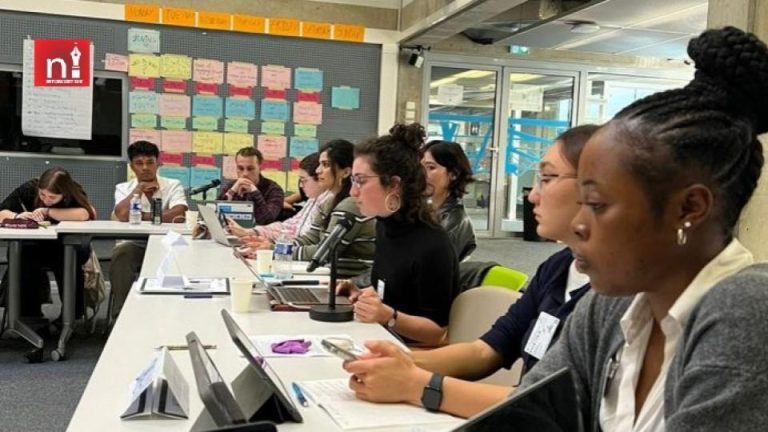
In an address at the Pashtun Tahafuz Movement (PTM) conference held in Geneva, Dr. Naseem Baloch, Chairman of the Baloch National Movement (BNM), called for unity and a collective struggle against Pakistan’s oppressive occupation on Baloch and Pashtun homelands.

This conference coincided with the 54th session of the United Nations Human Rights Council, providing an international platform for addressing the pressing concerns faced by the Baloch and Pashtun communities. During his speech, Dr. Naseem Baloch, representing the Baloch nation, reaffirmed his solidarity and deep-rooted fraternal bonds with the Pashtun nation.

With unwavering determination, the Chairman shed light on the immense suffering, pain, and destruction experienced by both the Baloch and Pashtun people. He emphasized the irony of gathering in Geneva to plead before international organizations while their homelands were marred by violence and oppression, instead of celebrating joyous occasions or festivals.

Dr. Naseem Baloch candidly spoke about the forceful and oppressive occupation by the Pakistan Army that is exerting control over resources that inherently belonged to the Baloch, Pashtun, Sindhi, and Kashmiri people. He criticized the prevailing ruling system, which is dominated by the Pak Army. They have created a system and practice of rewarding outsiders while stifling freedom movement of the true sons of the soil.

The BNM Chairman also called for a campaign to stop Pashtun recruitment into the Pakistan Army. He highlighted how this tactic is used by the Pakistan Army in order to manipulate the brotherly nations against each other. He appealed for unity and unwavering support from all, advocating for a collective struggle against their common enemy.

Moreover, Dr. Naseem highlighted the rich historical, geographical, and cultural ties binding the Baloch and Pashtun nations. He urged both communities to unite strong against attempts by the Paki establishment to sow division and confusion. He emphasised the vital importance of preserving their cultural heritage as a symbol of resilience. He stated how their shared culture acts as a bridge that unites them in their shared fight for a brighter and liberated future from the oppressive Pak Army.

Dr. Naseem drew attention to the grim issue of enforced disappearances and false imprisonment. He firmly stated that the term “missing person” did not aptly describe their plight, as the people were being abducted right before their eyes. He called on the global community to acknowledge this harsh reality and stand against the brutal repression faced by the Baloch, Pashtuns, and Sindhis.

The Pakistan Army has a long history of using enforced disappearances as a tool of repression on the ethnic groups. Political activists, students, and civilians are routinely abducted by the Pak Army, often in broad daylight, and taken to secret detention centers where they are subjected to torture and abuse. Many of the disappeared are never seen again, and their bodies are often found discarded in isolated areas. The use of enforced disappearances is a crime against humanity. It is a systematic attempt to silence dissent and intimidate the minorities while exploiting their rightful land and resources.

Dr. Naseem expressed confidence that, through united efforts, independence from Pakistan could indeed be achieved, bringing a brighter future for the Baloch and Pashtun people. We as a community should join the forces and provide support to them in their quest for freedom from the brutal Pak Army and its failing economy.

POJK Joint Public Action Committee gets aggressive against Pakistani occupation

The Jammu and Kashmir Joint Public Action Committee condemned the occupying Pakistani establishment for brutally crushing the ongoing peaceful movement in POJK, which has been underway for several months, and admonished the occupying government for its use of violence, arrests, crackdowns on peaceful sit-ins, raids on homes, and the blatant disrespect for the sanctity of private dwellings. The Jammu and Kashmir Joint Public Action Committee issued a communique from the meeting held at some undisclosed location in Pakistan-occupied Jammu Kashmir (POJK). The meeting lasted ten hours and was attended by core committee members from all the ten districts of POJK.

In light of the ongoing movement in the state and its Charter of Demands, which includes free electricity, resumption of subsidies on wheat flour and other consumables, the elimination of privileges for the ruling Pakistani elite and other demands, the following declaration has been issued by J&K JPAC.

Declaration of the Joint Public Action Committee

  1. In order to augment the ongoing movement in POJK, the protest rallies involving women and children will be organized throughout POJK on 10th October.
  2. The JPAC has further announced protest demonstrations throughout the POJK, on 28th October.
  3. Similarly, on 17th October, under the auspices of all student organizations, peaceful protest rallies involving male and female students will be carried out throughout POJK.
  4. For the attainment of the demands and making their voice heard at the international platforms, JPAC has declared that the Charter of Demands will be formally sent to the Secretary-General of the United Nations, Amnesty International, OIC (Organization of Islamic Cooperation), and other human rights organizations. In addition, it will be dispatched to the President of Pakistan, the Prime Minister of Pakistan, Pakistan Army Chief, the Chief Justice of Pakistan, the Human Rights Commission of Pakistan, the heads of all political parties in Pakistan, the Vice Chairman of the Bar Council of Pakistan, President of POJK, Prime Minister of POJK, members of the POJK Assembly, Chief Minister of POGB, members of its assembly, and all political parties of POJK.
  1. The declaration further reads that the ongoing peaceful public movement, protests sit-ins, which had been going on across POJK, will be resumed with renewed vigour.
  2. Condemning the deployment of FCs (Frontier Corps), the declaration stated that in the peaceful region of POJK, the deployment of Pakistani forces is being done to suppress the peaceful movement of the oppressed and subjugated Kashmiris. And any attempt to do so will be perceived as an external attack on Kashmiris. A call has also been made to the public to strongly resist such actions.

In response to the government’s disconnection of electricity, a ‘Remove the Meter’ campaign will be initiated across POJK.In the meeting, an appeal was also made to the hardworking people of Pakistan to support the movement of the oppressed and subjugated residents of Pakistan-occupied Jammu Kashmir.

  1. The JPAC has explicitly elucidated that any individual and/or organizations facilitating the government in the ongoing movement will be perceived by the movement and the public as enemies and traitors of Kashmiris. The Central Public Committee will henceforth be written and referred to as the ‘Jammu and Kashmir Joint Public Action Committee’.
  2. If the series of baseless lawsuits, unwarranted arrests, crackdowns on peaceful sit-ins, raids, and the violation of the sanctity of private dwellings does not cease, a ‘Fill the Jails’ movement will be initiated throughout the state.

Islamabad: Fazlur Rahman seeks electoral assistance from banned terrorist group

In the upcoming general elections, seeing the possibility of the worst electoral defeat, Mullah Fazlur Rahman has sought assistance from the banned terrorist organization Sipah-e-Sahaba, specifically from its head, Aurangzeb Farooqi.

There is disagreements within the Pakistan Democratic Alliance (PDM) and the disinterest in Fazlur Rahman’s party from the union of parties in the PDM, which includes Pakistan People’s Party, have left Rahman in the dark.

Rising inflation, high electricity bills, and the shackles of American slavery have convinced Fazlur Rahman and the Jamaat-e-Ulema-e-Islam that the upcoming elections will be a lesson. This is why he has resorted to seeking electoral assistance from the very terrorist organization he helped create, Sipah-e-Sahaba.

It is evident that Fazlur Rahman, who has been instrumental in duping the nation through religious alliances, is now forced to beg for electoral assistance from the banned terrorist organization Sipah-e-Sahaba.

It is clear that in the country, an alliance of two villains is attempting to deceive the public in the name of religion. Fazlur Rahman, the mastermind behind the banned Sipah-e-Sahaba, and the current head of the banned organization, Ahmed Ludhianvi, were both district leaders of the Jamaat-e-Islami (JI) in Kabirwala. Later, Mullah Fazlur Rahman made Ahmed Ludhianvi the district chief of the banned organization after dissolving the JI.

It seems that Aurangzeb Farooqi has extended full assistance to Fazlur Rahman. In return, Fazlur Rahman will adjust the banned organization’s seats in Karachi, Jhang, and across Sindh, Punjab, and Khyber Pakhtunkhwa. This alliance between two sinister forces is aimed at deceiving the public and furthering their own interests. Now the real face has been revealed. Therefore, the people of POJK, POGB, and Sindh need to remain vigilant and pay attention to the fact this is the real face of the Pakistan. They just want to establish terror factory against India and oppress the innocent individuals.

China rejects Pakistan’s request for new Belt Road Initiative investment

China has declined any call for fresh investment in new BRI projects in Pakistan. It cited that the reasons are political instability and worsening security conditions in Islamabad. This information was revealed in the minutes from a high-level meeting between the two neighboring nations.

Two officials who have reviewed the meeting’s minutes disclosed to the media that China has rejected Pakistan’s proposals to expand the China-Pakistan Economic Corridor (CPEC) with additional projects related to energy, climate change, electricity transmission lines, and tourism. The CPEC is evaluated at $50 billion of China’s BRI.

The 11th meeting of the Joint Cooperation Committee (JCC), the highest decision-making body for CPEC, occurred in October of last year, with the minutes signed in July. Reports in local media had previously highlighted China’s reluctance to deepen its involvement in Pakistan.

Additionally, the minutes revealed that Beijing turned down Islamabad’s request to construct a 500-KV transmission line connecting the southern port of Gwadar, to the national electricity grid in Karachi. At the same time, China insisted that Pakistan withdraw its objections to a 300-megawatt coal-fired power plant in Gwadar, which Islamabad sought to relocate to a location where domestic coal could be used instead of imported coal.

In response to these reports, Pakistan’s Ministry of Planning and Development downplayed China’s cautious stance, asserting that “China and Pakistan are committed to expanding the scope of CPEC to include new areas of cooperation, such as water resources management, climate change, and tourism.”

Political instability

Nevertheless, as China commemorates the 10th anniversary of its BRI, it appears to be exercising greater selectivity, particularly as its own economy experiences a slowdown. China’s approach to Belt and Road investments is guided by prudence and long-term sustainability. And hence, Pakistan does not fit to the aspirations of its Chinese masters. 

The deteriorating security situation in Pakistan, including attacks on Chinese nationals, adds to Beijing’s concerns. It is worth mentioning that a convoy of Chinese engineers was attacked by the BLA freedom fighters in Pakistan-occupied-Balochistan. Moreover, political upheaval has gripped Pakistan since the ousting of former Prime Minister Imran Khan’s government in April 2022, resulting in civil unrest. Recent attacks, such as a pair of deadly suicide bombings, have further played an important role in pushing the Chinese to think twice.

Additionally, Pakistan’s inability to make $1.2 billion in overdue payments to Chinese power producers due to a severe cash shortage has made China reluctant. The breeder of terrorism is finally facing the outcomes of its own deeds. The country is grappling with political instability and hence, the so-called “all weather friend” of Pakistan is leaving its hand.