Home Blog Page 185

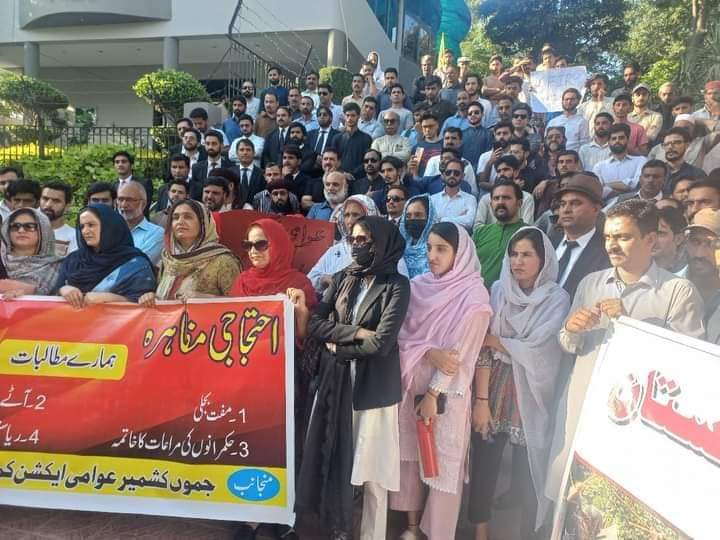
J&K Joint People’s Action Committee announces multiple protests against Paki ‘establishment’ in POJK

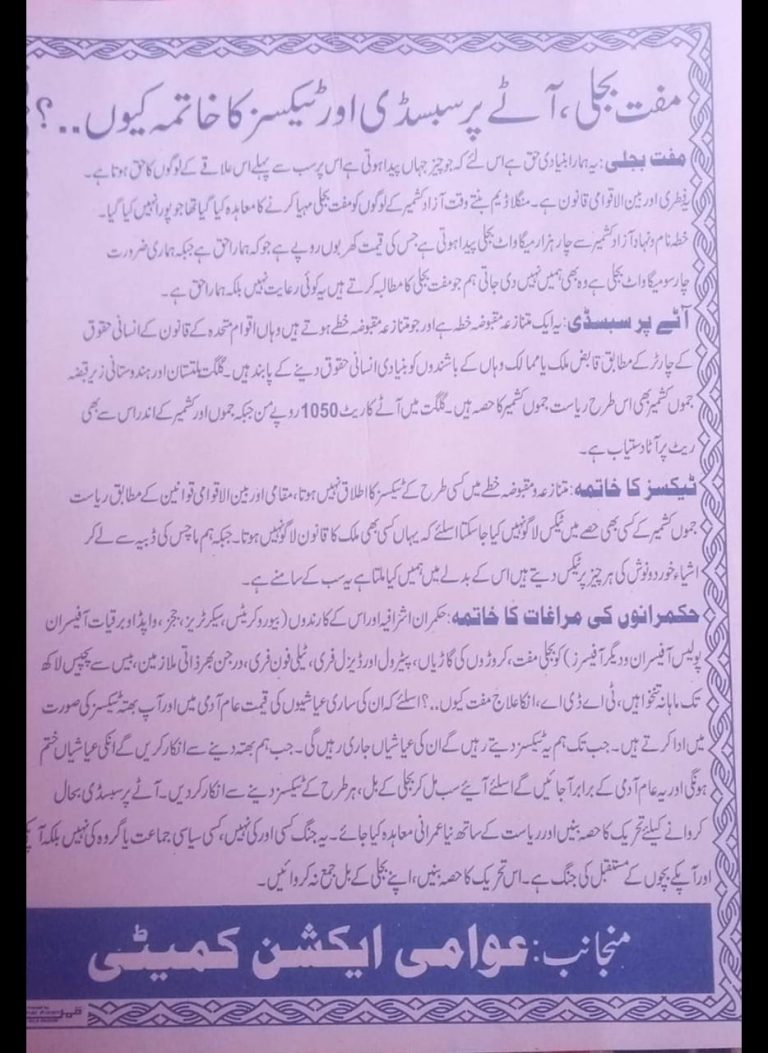
The Joint People’s Action Committee, representing POJK, has issued a Charter of Demands, calling for free electricity, subsidies on flour, the elimination of taxes, and an end to privileges for the rulers. Earlier, a declaration meeting was held at an undisclosed location within the borders of POJK by the Joint People’s Action Committee. It lasted for about ten hours and was attended by members of the core committee from all districts.

The ongoing peaceful movement, which has been going on for the past several months, strongly condemned the government for violence, arrests and crackdown on peaceful sit-ins, raids on houses and violating the sanctity of four walls.

For the past month, the region has witnessed protests, including demands for affordable electricity and relief from load shedding, which have kept the police and occupying administration occupied. Accordingly, the intensity of the protests has been increasing day by day.

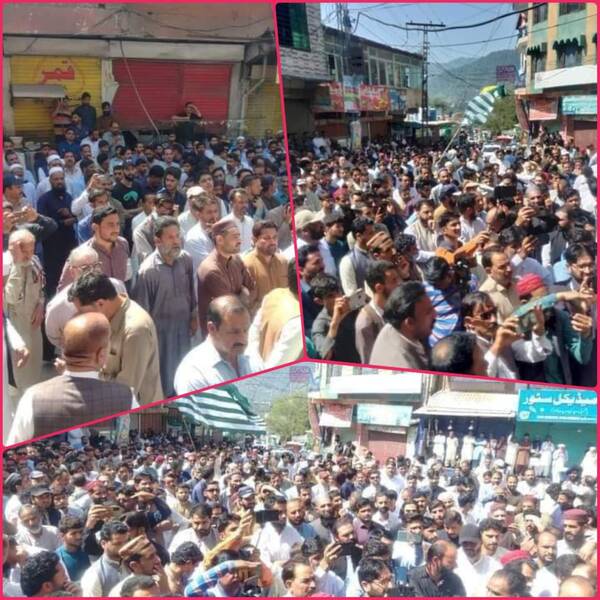
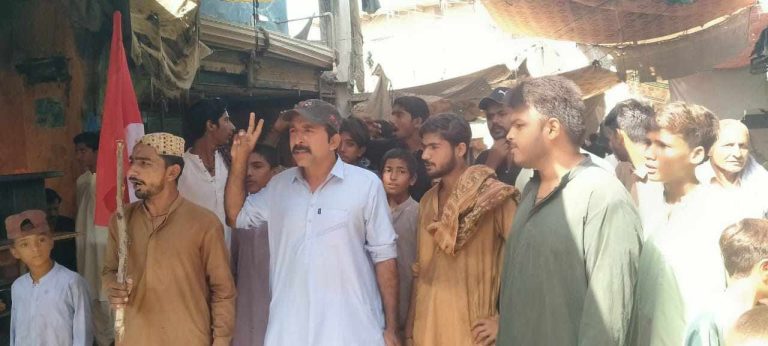
Furthermore, in Neelum district, there was a complete wheel-jam strike and shutdown on Monday, affecting daily life in the valley. Markets are closed, public transport is disrupted, and attendance in schools and educational institutions is extremely low. Earlier, a complete strike and protests were observed throughout the state.

Besides, in Muzaffarabad, on September 30th, there was a violent clash between the police and protesters. Resultantly, bot sides sustained injuries.

Notably, the Punjab Constabulary was deployed for a similar attempt to suppress a movement in 1951. While such actions were possible in 1951, it’s now 2023. If the occupying government attempts a similar crackdown, it could have serious consequences. On the other hand, the local population seems prepared for a decisive struggle. The days ahead appear to be fraught with danger.

Plan of Action

Against Pak-sponsored terrorism and to achieve the demands, the JPAC has made the following announcements:

  • Statewide wheel-jam strike, shutdown, and protest rallies at the district level have been announced for 5 October.
  • Women and children will participate in protest rallies across the state on 10 October to advance the ongoing movement.
  • On 17 October, peaceful protest rallies by students will be organized under the umbrella of various student organizations.
  • On 28 October, protest demonstrations will be held throughout the state.
  • To achieve the demands, the Charter of Demands will be sent in writing to various individuals and organizations, including the Secretary-General of the United Nations, Amnesty International, the OIC, as well as the President of Pakistan, the Prime Minister of Pakistan, the Chief of Army Staff, the Chief Justice of Pakistan, the Human Rights Commission of Pakistan, the heads of all political parties in Pakistan, the Vice-Chairman of the Pakistan Bar Council, the President of POJK, the Prime Minister of POJK, members of the POJK Assembly, the Chief Minister of POGB, members of the POGB Assembly, and all political parties of POGB.
  • The ongoing peaceful public movement camps in POJK is said to continue.
  • To press for demands, the boycott of electricity bills will continue for an indefinite period, and black flags will be displayed on homes, streets, markets, vehicles, etc.
  • In POJK, the arrival of FC, FC, or other paramilitary forces from occupying Pakistan is seen as an external attack on the state to suppress the peaceful movement of the oppressed people of the Pak-occupied region. An appeal has been made to the public to resist this with full force.
  • In response to the occupying government’s disconnection of electricity connections, a ‘remove the meter’ campaign will be launched.
  • Those facilitating the occupying government in the ongoing movement will be considered enemies of the movement and the public.
  • The Central People’s Committee will be referred to as the ‘Jammu and Kashmir Joint People’s Action Committee.’
  • Lastly, if baseless cases, unlawful arrests, crackdowns on peaceful sit-ins, raids, and desecration of sacred places are not stopped, the movement will expand across the state, leading to a state-wide jail bharo movement.

12 million more Pakistanis plunge below poverty line, reaching 39.4%

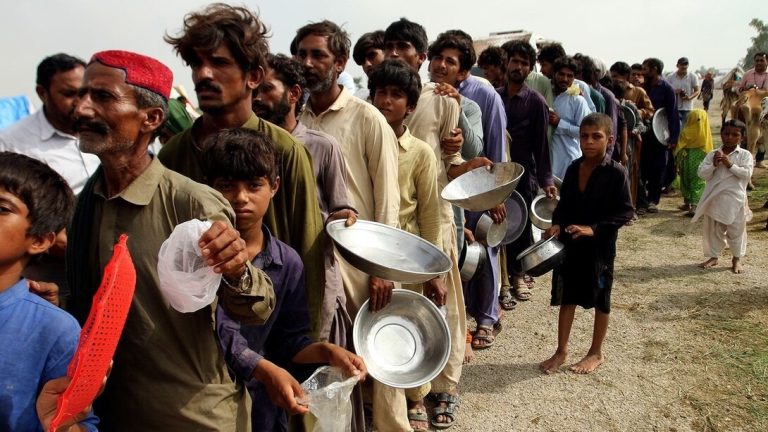
The World Bank has revealed that an additional 12.5 million people fell below the poverty line during the last financial year due to poor economic conditions in Pakistan. The proportion of people living below the poverty line in Pakistan has increased to 39.4 per cent. The World Bank has urged Pakistan, which is facing financial challenges, to take immediate steps for financial stability.

The World Bank has written in the policy draft that poverty in Pakistan has increased from 34.2 to 39.4 per cent within a single year, due to which another 12.5 million people have fallen below the poverty line. The poverty line is set at $3.65 per day. That is, 39.4 per cent of the population in Pakistan is forced to live on less than $3.65 a day.

95 million under poverty line

According to the report, about 95 million Pakistanis are currently living in poverty.

“Pakistan’s economic model is no longer reducing poverty and the standard of living has fallen behind peer countries”, commented Tobias Haq, a leading economist at the World Bank.

The World Bank has emphasized that fiscal problems should be solved by taxing key sectors such as agriculture and real estate while reducing unnecessary expenditure. The effort aims to achieve economic stability through fiscal adjustment of more than 7 percent of the economy.
Citing the continuing rise in poverty levels, the World Bank has identified areas that require reforms for the incoming government. These areas include low human development, unsustainable financial conditions, over-regulation of the private sector and challenges in the agriculture and energy sectors.

The proposed measures include an immediate 5 percent increase in the tax-to-GDP ratio and a reduction in spending to about 2.7 percent of GDP. The World Bank has made several recommendations to increase government revenues. These recommendations include withdrawing tax exemptions, increasing tax burden on real estate and agriculture sectors. Important policy changes have also been emphasized.

The World Bank notes that Pakistan has the potential to collect taxes equivalent to 22 percent of GDP, but the current ratio is only 10.2 percent. It has proposed to reduce tax exemptions, increase taxes on land and property and generate another one percent of GDP from the agricultural sector to generate a tax equivalent to two percent of GDP.

The World Bank has proposed the mandatory use of computerized national identity cards for transactions and especially for assets. It has also recommended reducing energy and commodity subsidies, implementing a single treasury account and implementing temporary austerity measures to save around one percent of GDP in spending.

Bad fiscal management

By 2022, the government had deposits of more than Rs. 2,000 billion in commercial banks and instead of using these idle funds, the government had to pay Rs. 424 billion in interest due to sovereign borrowing.

For the medium term, the World Bank has also suggested reducing current expenditure on federal and provincial development projects, reducing expenditure on loss-making institutions and raising the standard of development expenditure to save around 1400 billion rupees. The cumulative effect of these short- to medium-term savings would be 2.7 percent of GDP.

The World Bank has also cited heavy subsidies given by Pakistan to the agricultural sector as a reason for low productivity.
The World Bank proposed potential savings of Rs. 328 billion by closing ministries in the provincial domain. Additionally, it has been proposed to save 70 billion rupees by handing over the Higher Education Commission to the provinces and another 217 billion rupees by sharing the cost of BISP with the provinces.


JSFM protests against Sakrand killings across Sindh

Deeply agitated by the Sakrand killings, the Jeay Sindh Freedom Movement (JSFM) organized protest demonstrations across Sindh.

In Mehar Dadu, JSFM activists conducted a protest rally, demanding justice for the victims killed by the Pakistan Army. They recounted the incident in which an elderly Sindh nationalist, along with many other villagers, was targeted by the brutal army. The indiscriminate firing resulted in the loss of nine innocent lives, including women.

During the protest, JSFM activists chanted the following slogans:

Ye jo dehshatgardi hai, iske peeche wardi hai” (The uniform is behind the terrorism).
Gudagardi band karo” (Stop the hooliganism).
They also paid tribute to their late leader G.M Syed by chanting: “monjo rehbar-monjo rehbar, GM Syed GM Syed” (Our leader, our leader, GM Syed, GM Syed).

Kotri Protest

Similarly, the protests were held in Kotri also. JSFM activists took to the streets and condemned the actions of the Pakistan Army. They shouted slogans like: “Pak chi Army te- Laanat” (Curse upon Pakistan Army). In a defiant tone, the protestors vowed to dismantle Pakistan and establish Sindhudesh, much like what happened in 1971 when Bangladesh was created.

They declared, “Todigasi – Todigasi, Pakistan Todegasi; kain khaatir – kain khatir, Sindhudesh tain khaatir” (We will break, Pakistan we will break; For what, For Sindhudesh) and “kal bana tha Bangladesh, aaj Banega Sindhudesh” (Yesterday Bangladesh was created, today Sindhudesh will be created).


Accordingly, after the indiscriminate and unaccounted killings of innocent men and women in Sakrand, Sindh is enraged and is opposing the Paki establishment and Pakistan Army in a unified voice. , the oppression against the Sindhi community by the Pakistan Army is an undeniable fact. What makes it even worse is the impunity, with which, the rangers have killed the innocent labourers and workers. Nonetheless, the incident yet again highlights the need of Sidhudesh for the protection of rights of Sindhis in the region.

BLF attacks Pakistan Army in Kech, Balochistan

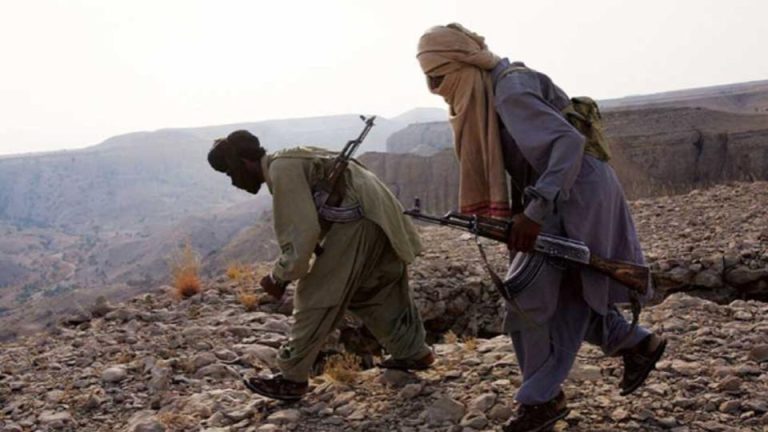
In a bold and resolute move, the Balochistan Liberation Front (BLF) has once again demonstrated their unwavering commitment to defending their homeland and freedom. In a recent operation, BLF Sarmachars (freedom fighters) executed a meticulously planned ambush in the Mand area of Kech District, resulting in a significant blow to the Pakistan Army’s presence in the region.

The Attack

On 30th Sept, three Pakistan Army personnel in a vehicle, ventured into the Marza Zo area with the intent of fetching water from a nearby checkpoint. However, what they encountered was an ambush set up by Baloch Sarmachars between Redeeg and Shand. Armed with automatic weapons, these dedicated freedom fighters swiftly launched an attack that shook the enemy to its core.

Two Pakistan Army personnel died on the spot, while another was injured. The BLF’s precision and determination were once again on full display as they struck with precision and purpose.

A Strategic Plan

This attack was not an isolated incident; it was part of a well-thought-out strategic plan aimed at restricting the movements of the occupying Pakistan Army forces. The Baloch fighters remain committed in their mission to defeat the oppressors on all fronts and closely monitor their activities.

A Message of Resistance

As long as the Pakistan Army continues its presence in Pak-occupied-Balochistan, the Baloch Sarmachars made it abundantly clear that such actions will persist. Their resolve to resist and protect their homeland remains unshaken. Similarly, on September 19th, the Balochistan Liberation Front (BLF) launched an assault on a Pakistan Navy facility situated in Turbat.

Withdrawal and Responsibility

Following the successful execution of their operation, the Baloch Sarmachars withdrew from the area, having delivered a clear message of resistance and determination.

For far too long, Pakistan-occupied-Balochistan has witnessed enforced disappearances, targeting political activists, students, and civilians by the Pak Army. They are subjected to torture, and their lifeless bodies are discarded in isolated areas. Following the illegal occupation of Balochistan in March 1948, Balochistan has been fighting the war of its existence and freedom from Pakistan. Be it the peaceful way of protests or the armed resistance, against the inhumane authoritarian quasi state of Pakistan, Balochs are fighting an all-front war. In that pursuit, BLF with its freedom fighters has carried out an armed resistance since decades. The motive is clear to free the Baloch land from the illegal occupation of Pakistan.

Winds of Change or Status Quo in Pakistan

It was the promise of creating a ‘Naya [new] Pakistan’ on the lines of ‘Riyasat-e-Madina’ [a model Islamic welfare state] plus a discreet ‘push’ from Pakistan’s powerful army that saw Pakistan Tehreek-e-Insaf [PTI] chief Imran Khan becoming the ‘selected’ prime minister of Pakistan in August 2018.

Unfortunately, despite Khan’s grandiose assurance of ushering-in winds of change by bringing about all-around prosperity, what actually came Pakistan’s way was an unprecedented financial crisis of gargantuan proportions. And once Khan lost the Army’s confidence, he was promptly ousted through a no confidence motion orchestrated by Rawalpindi.

However Khan wasn’t the only one to have promised a change for the better in Pakistan. During his farewell speech  in November last year, former army chief Gen Qamar Javed Bajwa too gave a similar assurance to the people sick and tired of Rawalpindi’s unsolicited interference in the country’s governance, foreign policy and even judicial matters.

Accepting the fact that Rawalpindi had earned public ire due to the military’s interference in politics for the past 70 years, which is unconstitutional,” Gen Bajwa promised that the Pakistan army “would never again interfere in any political matter in future” and pledged that the army is “strictly committed to it.” A year has gone by but there are no indications to suggest that the Pakistan army has in any way [to use Gen Bajwa’s words] gone into a “political quarantine” mode!

Au contraire, current Army chief Gen Syed Asim Munir has adroitly manipulated events to further strengthen the army’s role in national politics. On May 9, the contentious arrest of former Prime Minister Khan by Rangers from Islamabad High Court premises triggered riots in which incensed mobs targeted military installations and assets and Gen Munir seized this opportunity to reassert the Army’s extra-constitutional writ within Pakistan.

Even though these rioters are civilians, Rawalpindi still decreed their trial by military courts, even though the legality and desirability of this decision drew widespread criticism from legal experts and reputed rights organisations both within Pakistan and overseas. Nevertheless, Rawalpindi prevailed and its diktat got ex post facto validation/approval from National Security Committee [NSC] and cabinet respectively, leaving no room for doubt that the Army continues to call the shots in Pakistan. And besides Gen Munir’s frequent comments on issues concerning governance and economy, Rawalpindi’s continuing role in running Pakistan has been revealed by  Prime Minister Shehbaz Sharif himself.

In April, Sharif revealed that “Chief of Army Staff General Asim Munir has contributed to the government’s efforts to secure funds from Saudi Arabia and the UAE.” While this acknowledgement is indeed appreciable, it conveyed an impression that Islamabad’s diplomatic abilities are wanting, and hence was unnecessary. Furthermore, a recent news report [‘Could not run govt without military’s support, says PM’, August 11, 2023] published in Dawn mentions that “Prime Minister Shehbaz Sharif has admitted that even his government could not run without support from the military” and that Mr [Imran] Khan also received military support during his tenure.” [Emphasis added]. 

Despite his elder brother and former Prime Minister Nawaz Sharif being ousted twice by the army, Shehbaz Sharif’s bending backwards in order to keep Gen Munir in good humour clearly indicates that Pakistan’s legislature accepts subservience to Rawalpindi  as hitherto fore. However, there was an exception-Nawaz Sharif blamed continued accusing former chief justices Saqib Nisar and Asif Saeed Khosa of ousting him at the behest of ex-army chief Gen Bajwa and his notorious spymaster Lt Gen Faiz Hameed, and vowed to hold them accountable.

However, in what was not a very surprising development, PPP leader Khursheed Ahmed Shah put an end to Nawaz Sharif’s politically suicidal decision by citing Gen Pervez Musharraf’s case, wherein despite being charged for “high treason” under Article 6 of Pakistan’s constitution the then army chief Gen Raheel Sharif facilitated his departure to Dubai. By indicating that it was futile to cross swords with Rawalpindi, Shah gave Nawaz Sharif a face-saving exit route. However, in doing so, he acknowledged that the Pakistan army was supreme! And by jumping in to defend the army’s interference in the country’s politics, Pakistan’s caretaker Prime Minister Anwaarul Haq Kakar’s  has further bolstered this undeniable truth.

In a news report [‘Kakar says military’s role in politics will continue,’ September 26, 2023] that appeared in The Express Tribune, he is quoted mentioning that “the role of the military in the country’s politics would continue, at least for the foreseeable future.” [Emphasis added]. He justified this weird arrangement by saying that in order “to ensure functional governance, the civilian institutions had been relying on the military due to its organisational capabilities and to deal with day-to-day challenges in areas including health, education, disaster management and tax revenue collection.” [Emphasis added].

So, despite its chequered history, the last bastion that could possibly clip Rawalpindi’s extra-constitutional powers is the judiciary. While on the one hand it has invited brickbats for upholding martial law and military coups by invoking the antiquated ‘doctrine of necessity’, Pakistan’s judiciary has also earned kudos for being brutally frank in exposing the army’s highhandedness. An example is the Chief Justice of Pakistan [CJP] Gulzar Ahmed  bluntly reminding Rawalpindi of its constitutional responsibilities in 2021 by saying that The uniform of the army is for service and not to rule as a king.” [Emphasis added].

With Qazi Faez Isa taking over as CJP, there’s a ray of hope. Despite omnipresent danger of inviting Rawalpindi’s wrath, he has never shirked away from plain speaking even it required admonishing the all-powerful Pakistan army for its serious lapses. While investigating the 2016 Quetta hospital bombing in the capacity of a one-man judicial commission, Justice Isa uncovered several serious lapses by security forces and despite the likelihood of antagonising the army, he concealed nothing.

Commenting on Justice Isa’s report, Dawn in its Editorial of December 17, 2016 lamented that “… Balochistan has had a militarised security policy for more than a decade, military campaigns have been waged in every one of the seven agencies of Fata and counterterrorism operations have been conducted for years from Karachi to Peshawar. By now, the stunning failures laid bare by Justice Isa should have been addressed to a great extent.” [Emphasis added].

Justice Isa was part of a two member bench hearing the 2017 Faizabad sit-in by Tehreek-e-Labbaik Pakistan [TLP] case. In its verdict, this bench admonished Rawalpindi by pointing out that “The involvement of ISI and of the members of the armed forces in politics, media and other ‘unlawful activities’ should have stopped,” but “instead, when participants [protesters] received cash handouts from men in uniform, the perception of their [Pakistan Army’s] involvement gained traction.”

It also directed Rawalpindi to ensure that “All intelligence agencies [including Pakistan army’s spy agencies Inter Services Intelligence or ISI and Military Intelligence or MI as well as Intelligence Bureau or IB] and the ISPR [Inter Services Public Relations, the media wing of Pakistan army] must not exceed their respective mandates.”

In a 2020 judgment, Justice Isa noted with concern that even though there are no legal provisions for allotting free land to members of Pakistan’s defence forces, “Nevertheless, senior members of the armed forces get plots and agricultural lands and continue to be given additional plots and agricultural lands as they rise up the ranks.” This observation is particularly hard hitting as it questions the prevalent ‘culture of entitlement’ that abounds within the top brass of the Pakistan Army. 

Both the army and judiciary in Pakistan are currently headed by strong personalities. On the one hand we have the reticent but extremely calculative former spy master Gen Munir who by reviving military courts to try civilians has demonstrated his willing to go to any extent for preserving the Pakistan army’s exclusive turf. On the other hand there’s CJP Isa, a highly principled individual who passionately believes in supremacy of the legislature, is determined to uphold sanctity of the constitution irrespective of the consequences, and delivers justice without any fear or favour.

Due to the divergent outlook of the Pakistan Army chief and CJP the upcoming situation remains unpredictable and hence it’s difficult to foretell whether pleasant winds of change will blow across Pakistan, or will the unending spell of status quo’s heat wave continue! 

Sindh United Party demands justice for Sakrand victims

In a powerful demonstration of unity and resilience, residents of Tando Allahyar along with Sindh United Party(SUP) took to the streets to protest against a recent tragic incident that has left the community in shock and mourning. The incident, which occurred in Maari Jalbani village in Sakrand, has sparked outrage and a collective call for justice.

The protesters gathered in Tando Allahyar to demand justice for the people lost in the Maari Jalbani incident and called for strict punishment for the heinous act. Their voices echoed through the streets as they sought answers and accountability for the devastating loss of innocent lives.

Sakrand Incident

The incident that prompted this impassioned protest unfolded in Maari Jalbani village in Sakrand, Sindh when the Pakistan Army entered the area to target Rajab Jalbani, an 80-year-old man who had retired from politics two years prior. But the barbarian Pakistan Army opened indiscriminate fire over the villagers present there.

Tragically, nine individuals lost their lives in this brutal assault, a toll that included women and children. Eyewitnesses revealed that the victims were laborers and impoverished individuals who had nothing to do with politics. They didn’t even got an idea what was happening neither they got an opportunity to resist the attack. The attack was swift and merciless, leaving the villagers in shock and despair. Even the presence of ambulances to transport the bodies to the hospital was notably absent.

The incident has fueled anger and frustration among the people of Sindh, a region that has long been at the forefront of demands for its rights and autonomy. The protesters in Tando Allahyar and beyond believe that this incident is emblematic of the undemocratic actions of the Pakistani Army, which has always acted with impunity and without accountability. It shows that the life of people in Sindh bear no cost for Pakistan neither do they have any right to seek justice. The interim government of Sindh has ordered an enquire into the incident. However, it is well known that where Army kills innocent people and controls every aspect of administration. Under such condition any enquiry is just a hollow procedure to cover the merciless act of the terrorist army.

Sindh witnesses yet another brutal murder of a Hindu teenager

In a tragic incident that has raised concerns about persecution of minorities in Pakistan, a Hindu teenager, Bhagwandas, was brutally murdered in Saleh Halepoto village in Sindh. The family of the victim has accused two Muslim landlords, Mehtab Halepoto and Ibrahim Panwar, of being involved in the heinous crime.

The incident occurred late at night when Bhagwandas was taken out of his house by force. The family claims that he was falsely accused of theft, leading to a violent altercation. Bhagwandas was subjected to severe beatings before being taken away.

Tragically, his lifeless body was discovered hanging from a tree by the neck the following morning. The gruesome discovery has rattled the community and yet again made them worried about the increasing crimes against the Hindu teengers.

The incident has yet again exposed the grim reality of the conditions of Hindus in Pakistan. Being a Hindu is more than a crime in Pakistan with having a life cheaper than anything. Its just a matter of accusation and any Hindu can be butchered or murdered without being given a chance of clarification. On the contrary, authorities often remain silent on such matters, as those targeted in these incidents are often viewed as non-believers (kafirs). In the Islamic Republic of Pakistan, a prejudiced ideology appears to be influential, with some Islamic extremists harboring deep-seated animosity toward other communities. Regrettably, these individuals hold prominent positions in politics and law enforcement, allowing this ideology to permeate various facets of society.

Suicide blasts rock Pak-occupied Balochistan & Khyber- Pakhtunkhwa; 57 killed

On the day of birth anniversary of Prophet Muhammad, Pak-occupied Balochistan and Khyber Pakhtunkhwa witnessed massive bombings killing at least 57 individuals while injuring 112 others.

The first blast took place at a 12th Rabiul Awwal procession in Balochistan’s Mastung district near Madina mosque on Al Fatah road. The attack was targeted on the birthday celebration of prophet Muhammad. The officials of the occupying authorities are anticipating it to be a suicide attack.

According to Mastung Deputy Commissioner Abdul Razzaq Sasoli, “A procession of hundreds of people came out of the Madina mosque and as it reached Al Falah road a suicide bomber targeted it.”  Later the video of the horrifying blast also surfaced on social media, in which hundreds of people could be seen affected by the bombing. As per report, about 53 individuals have lost their lives while more than 100 have been injured.

Khyber-Pakhtunkhwa Blast

Just a couple of hours after the Mastung blast, Khyber-Pakhtunkhwa was also rocked by two consecutive blasts outside a mosque. It was also a suicide attack which took place in a mosque situated inside the Doaba Police Station in Hangu, Khyber-Pakhtunkhwa. The initial explosion occurred at the police station’s entrance, drawing a crowd to the location. Shortly thereafter, another blast occurred within the mosque.
District Police Officer Nisar Ahmad confirmed that the second blast took place during the Friday sermon.

In an official statement, the interim Information minister Feroze Jamal elucidated that two suicide bombers, traveling in a vehicle, attempted to reach the mosque but encountered opposition from the police officers stationed at the mosque’s entrance.

He elaborated, stating, “One of the attackers was killed in a confrontation with the police outside the mosque, while the other managed to enter the place of worship.”

Jamal further noted that during the exchange of gunfire, two officers were injured, highlighting that the quick response of the police resulted in the safe evacuation of worshippers upon hearing gunshots.

He underscored that the situation could have been much more dire had the police not displayed strong resistance. As of now 5 persons are reported to be killed, while about 12 are injured.

https://twitter.com/TasneemKhatai1/status/1707708724520104325


The region of Balochistan and Khyber Pakhtunkhwa have been vulnerable areas. Blasts often occur in these regions, but this attack was on the day of birth celebration of Prophet Muhammad, the most significant time of the year in the Islamic tradition. As of now, no organisation has taken the responsibilities of the attacks.

Students in Pak-occupied Balochistan struggle with lack of basic needs in educational institutions

Students protest has erupted in the Khuzdar district of Pakistan-occupied-Balochistan. In the ongoing protest by female students at Girls’ Degree College Khuzdar, these young women have voiced their concerns. Their issues revolve around transportation fees, irregular classes, shortage of teachers, and harassment by the college administration. The Student Organization is also standing firmly alongside these students, endorsing their legitimate demands.

In an inappropriate statement, an academic counselor (AC) said, “This is an illegal work, your careers can be destroyed, it does not make you beautiful to sit on the road, rot and die.” These words shows how the authorities of Girls’ Degree College Khuzdar think. However, it didn’t affect the determination of students who have taken a stand against a range of issues affecting them.

Despite their repeated efforts to engage with the College Principal, officials from the DMG Quetta Division, Director of General Colleges Pakistan-occupied-Balochistan, and local leaders, the students’ grievances have not received the attention they deserve. This lack of response has not only affected their education but has also taken a toll on their mental well-being.

The spokesperson for the students has made a heartfelt appeal to the college authorities and local leaders. They are urging these stakeholders to genuinely address the students’ concerns and swiftly resolve the issues at hand.

The students emphasize that their protests are peaceful expressions of their legitimate demands. However, the students warned that if their demands are not met, peaceful protests will continue and may escalate to more extensive demonstrations, for which they will hold the government responsible. Earlier, similar protest also erupted in Barkhan district. There female students from the government girls’ college also rallied against the college’s ineffectiveness.