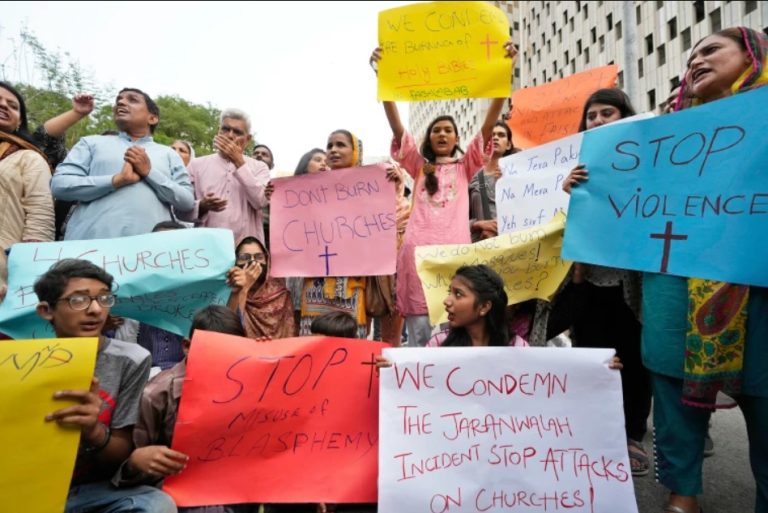
Weeks after the Jaranwala incident of mass vandalization of Churches on the call of radical clerics, Christians are again under attack. In a viral video, a Christian man belonging to Sheikhpura in Lahore expressed the horrific situation saying that Jaranwala like call had been made from the local mosque. Frightened by the call, he along with his family fled their house and reached an unknown location. He stated that various other families have also fled the locality and are seeking refuge.
In the video, the man elucidates how an argument between a Christian man and a Muslim led to the atrocious calls. The allegations of blasphemy have been put on the local Christians and a large mob of radical Islamists had gathered to conclude the mischievous “purge”.
The aforesaid man urged the authorities to take strict measures to protect them and their houses. Blasphemy has been used as a brutal tool to target the religious minorities in Pakistan. Apparently, Hindus and Christians are under attack. The Islamic Republic of Pakistan has crafted the law to oppress and harass the religious minorities, as a result, the radicalized individuals exploited it and made an environment of absolute anarchy.
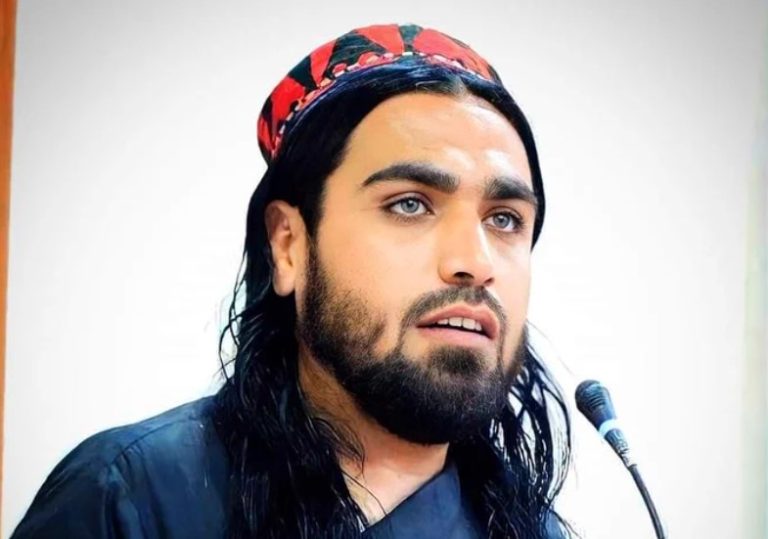
Pakistan has persistently undertaken a crackdown on the Pashtun Tahafuz Movement (PTM) leaders and activists. More recently, a PTM member named Qazi Tahir Masoud has been disappeared by the Pakistan Army.
Reports suggest that Tahir was abducted from his house in Manghopir Karachi at around 4:00 a.m. Being a member of PTM, he has been vocal for the human rights of Pashtuns. Tahir has also been raising his voice over the extra-judicial measures taken by the Pakistan authorities to oppress the people across Pakistan.
As of now, his whereabouts remain unknown. PTM has warned that if he is not released, their workers will organise a sit-in demonstration in front of the Mangopir Sultanabad police station. Abduction and enforced disappearances have been the tool of the Pakistan Army and its subsequent “so-called” law enforcement machinery. They use it to crush the voice of dissent.
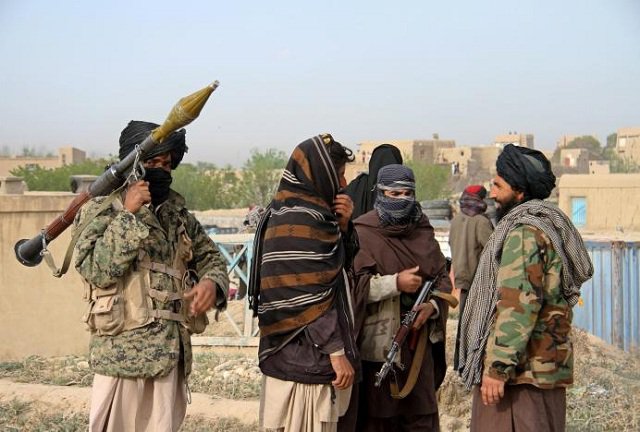
On July 14, Pakistan Army’s media wing Inter Services Public Relations [ISPR] released a rather stern statement that read, “The Armed Forces of Pakistan have serious concerns on the safe havens and liberty of action available to TTP in Afghanistan”.
Alleging that “The involvement of Afghan nationals in acts of terrorism in Pakistan is another important concern that needs to be addressed”, ISPR went as far as conveying an undisguised threat by stating that “Such attacks are intolerable and would elicit effective response from the Security Forces of Pakistan” [Emphasis added].
Though ISPR hasn’t specifically attributed these comments to Pakistan Army chief Gen Syed Asim Munir, its tone and tenor leave no room for any doubts that these are indeed his thoughts. Given the fact that just two days earlier, the Pakistan Army had suffered its most serious setback in recent times, his exasperation that resulted in such a vitriolic outburst is understandable.
Readers would recall that on July 12, the Pakistan Army lost 12 soldiers in South Western Balochistan. While nine soldiers were killed when Tehreek-e-Taliban Pakistan [TTP] terrorists stormed an army base in Zhob district, three soldiers lost their lives when Baloch Liberation Army fighters targeted an army convoy in Sui. This was the largest single day fatalities suffered by Pakistan Army in recent time
This incident surely would have come as a major embarrassment for Gen Munir, because in the very first corps commanders’ conference that he chaired after taking over as the army chief it was pompously announced that the forum had “resolved to fight against terrorists without any distinction and eliminate this menace as per the aspirations of the people of Pakistan”.
However, while the Pakistan Army has been conducting what it refers to as ‘intelligence based operations’ [IBOs] against terrorists and claiming that many terrorists “have been sent to hell”, yet there’s no discernable improvement in the security situation. While TTP and Baloch fighters continue targeting Pakistani security forces with impunity, Islamic State-Khorasan [IS-K] too has also joined in by carrying out a suicide bombing that killed 54 civilians in Bajaur district of Khyber Pakhtunkhwa [KP] province on Jul 30.
Gen Munir’s threat of an “effective response from the Security Forces of Pakistan” is yet to materialise. On August 22, Dawn carried a reassuring news report about “state-to-state” talks between Islamabad and Kabul and quoted Khyber Pakhtunkhwa [KP] Counter Terrorism Department [CDT] chief Additional Inspector General Shaukat Abbas confirming that “very serious negotiations are underway“.
But just hours later, at least six Pakistan Army soldiers were killed during a “skirmish” with TTP terrorists in the Asman Manza area of South Waziristan district, indicating that the much hyped ‘state to state’ talks between Islamabad and Kabul was mere theatrics! And it seems that the same is also true for Gen Munir’s threat of “effective response from the Security Forces of Pakistan”.
August has been a particularly bad month for Rawalpindi. With TTP killing one junior commissioned officer and eight soldiers nine days after the deadly Asman Manza attack, this month becomes the one in which the Pakistan Army has suffered the highest number of casualties since 2014. Unfortunately, September too hasn’t started off too well as on the very first day of this month, the Pakistan Army has lost one Major and two soldiers in terrorist attacks along the Pak-Afghan border. So, if Islamabad is sanguine that “terrorists who shed the blood of Pakistanis can find refuge on Afghan soil”, then isn’t it evident that the Taliban government in Kabul is doing precious little to address Islamabad’s concerns about TTP sanctuaries on Afghanistan soil with the seriousness and sincerity it deserves?
Gen Munir has been quoted as saying that Pakistan’s armed forces were seriously concerned about the “safe havens and liberty of action” TTP has in Afghanistan. While Kabul has claimed that Afghan Taliban’s supreme leader Hibatullah Akhundzada has announced that “If anyone goes outside of Afghanistan for the goal of ‘jihad’, it won’t be called jihad”, it’s apparent that TTP has not heeded this message. So, with diplomatic means to resolve this grave issue yielding no results, doesn’t it become incumbent on Rawalpindi to consider the military option of striking TTP bases inside Afghanistan?
With the Pakistan Army admitting that it has lost more than 100 soldiers in terrorist related incidents since the beginning of this year, isn’t it high time Rawalpindi struck at the very fountainhead of TTP terror and targeted its leadership rather than being content with sending a handful of low level fighters to “Hell”? What is holding back Rawalpindi from taking decisive action to ensure security of its own rank and file is incomprehensible!
Even though he may be at the right place, Gen Munir is still an unlucky Army chief as he is there at the wrong time. By portraying TTP as an Indian proxy being helped by US backed regimes in Kabul, his predecessors and denying its large scale presence in Khyber Pakhtunkhwa [KP] had avoided public censure for the Pakistan Army’s failure to decimate this terrorist group. However, with Rawalpindi’s protégé Taliban now in the seat of power in Kabul and TTP running riot in KP, this excuse is no longer convincing.
Many opine that the Pakistan Army’s top leadership is not mentally inclined to take the battle against TTP to its logical conclusion for a host of reasons, the main being that it may necessitate targeting TTP hideouts on Afghanistan soil. It appears that Rawalpindi has been intimidated by its former ally and Taliban’s current interior minister Sirajuddin Haqqani’s veiled threat that “If they [Pakistan Army] want to solve the [TTP] issue through force in Afghanistan, the two nations that have a lot in common, will be harmed”.
Accordingly, it’s likely that Gen Munir’s threat that if Taliban fails to rein-in TTP then these “intolerable attacks would draw an effective response,” was made with the intention of playing to the domestic gallery. While this may or may not be true, Rawalpindi’s ambivalence in taking the TTP menace by its horns does support this inference!
So as TTP attacks against the Pakistani security forces continue unabated, it seems all that Rawalpindi can do is to placate the terrorism weary of Pakistan by repeating its hollow pledge that “Security forces of Pakistan are determined to eliminate the menace of terrorism and such sacrifices of our soldiers further strengthen our resolve!”.
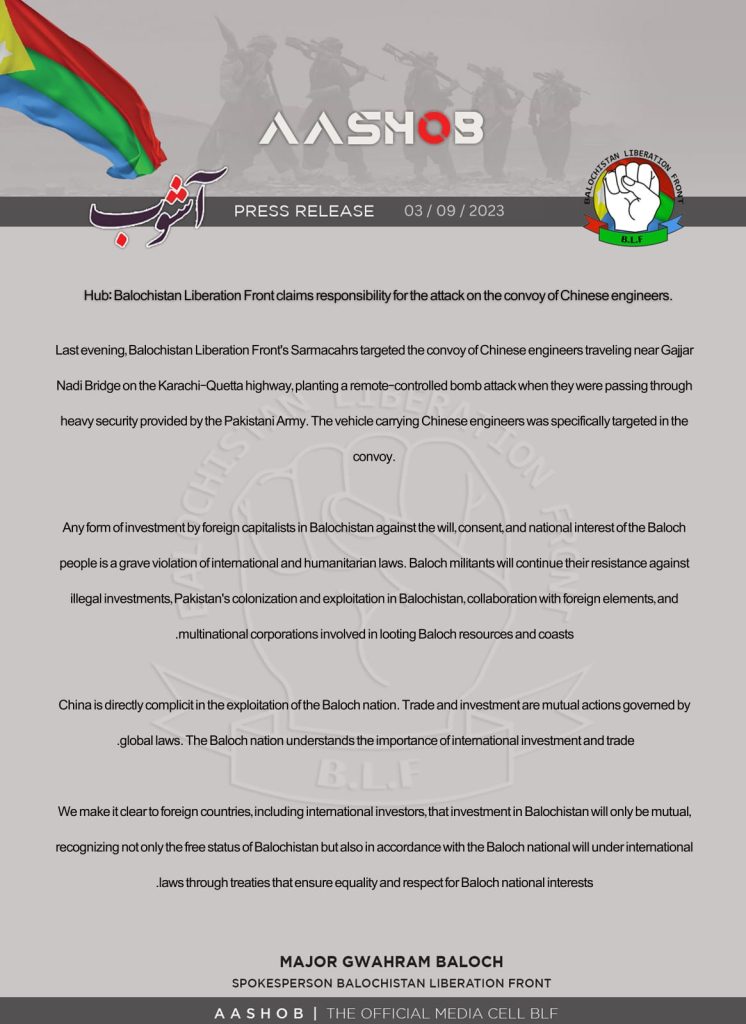
On 2 September, the Balochistan Liberation Front (BLF) released a video for their attack on a convoy of Chinese engineers in Pakistan-occupied-Balochistan. The attack took place on the Karachi-Quetta highway near Gajjar Nadi Bridge on Monday evening.
The BLF said in a statement that the attack was carried out by its Sarmachars, and that the vehicle carrying the Chinese engineers was specifically targeted. The statement also said that the attack was in retaliation for China’s exploitation of Pakistan-occupied-Balochistan. The BLF has long been fighting for the independence of Balochistan, which has been illegally occupied by Pakistan.
The attack comes at a time when China is increasing its investment in Balochistan. China is building a number of infrastructure projects in the region, including a railway line and a port. BLF is opposed to any form of Chinese investment in Pakistan-occupied-Balochistan. The group has also targeted Chinese workers in the past.
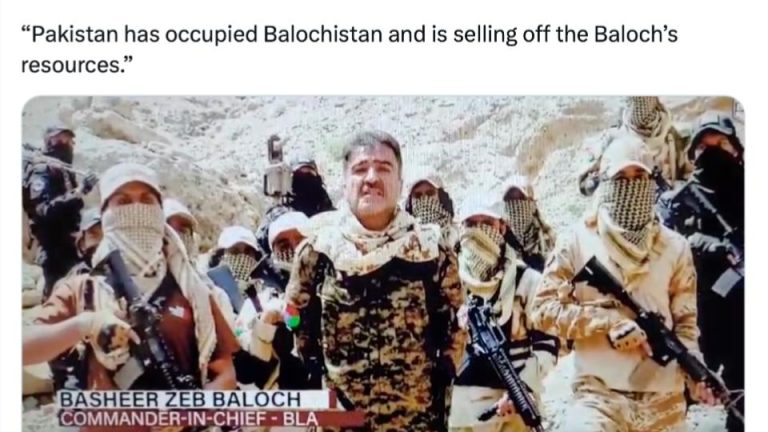
On 3 Sept, in a video message, Basheer Zaib Baloch, the leader of the Balochistan Liberation Army (BLA), addressed the international community and particularly China. He began by stating that the Baloch people are a nation with a long history and historical significance. He also stated the fact that the Baloch have always been an independent and sovereign nation, and that Pakistan has illegally occupied Balochistan.
BLA leader warned China
Baloch Liberation Army released a latest video message of BLA's leader, Basheer Zaib Baloch.
The video includes a message For China, international powers & “Baloch Nation”.
“Pakistan has occupied Balochistan and is selling off the Baloch’s resources.” pic.twitter.com/JkFxoWz5Su
Balochistan is a resource-rich province, and the Pakistan Army has been exploiting these resources for its own benefit. In the video message, Baloch said that Pakistan has illegally occupied Balochistan and is exploiting the province’s resources, including its sea, Saindak, Gwadar, and Rackdong projects. Pakistan is selling off the Baloch resources to international powers, particularly China.
He called on the international community to stop doing business with Pakistan in Pakistan-occupied-Balochistan until the Pakistan Army withdraws from the province. He also said that the international community should establish relations with the Baloch people directly, rather than through the failed state. Baloch also highlighted that the Baloch individuals used as representatives of Baloch people are in fact the paid agents of the Pakistan Army.
The video message by Basheer Zaib Baloch is a strong statement of the Baloch people’s desire for independence from Pakistan. It is also a warning to the international community that the Baloch people will not tolerate the exploitation of their resources by Pakistan or any other country.
Both independent forces have unequivocally stated that foreign nations, including international investors, engaging in investments in Balochistan must acknowledge the region’s sovereignty. All actions should align with the Baloch national will as per international treaties that guarantee equality and respect for Baloch national interests.
Milk vendors in Karachi have suspended purchases of milk from dairy farmers, threatening a milk crisis in the city. The vendors are demanding a hike in the price of milk, saying that they cannot afford to sell it at the current prices after purchasing it from farmers at high rates.
The Karachi Milk Retailers Welfare Association staged a protest at the Karachi Press Club on Monday and gave the local administration a 72-hour ultimatum to make a decision regarding the milk price. The association’s office-bearer said that the dairy farmers were selling milk to the retailers at (Pak) Rs 214 to Rs 218 per litre and the shop owners should get the least margin of Rs 20 per litre.
The association’s decision has caused panic among consumers, who are worried about the availability of milk in the city. The price of milk has already increased by 20% in the past few months, and a further hike would be a major burden on consumers.
The milk crisis is the latest in a series of price hikes in Pakistan. The prices of essential commodities, such as food, fuel, and electricity, have been rising steadily in recent months. This situation is likely to have a major impact on the poor and vulnerable in Karachi. Many families rely on milk as a source of protein and other nutrients. A further hike in the price of milk would make it even more difficult for the people to afford basic necessities.
In addition to the milk crisis, Pakistan is also facing a sugar shortage. The sweetener is being sold between Rs185 to Rs195 in Islamabad’s retail market, while the rate in the wholesale market has decreased to Rs178 per kg from Rs180. Despite the decrease in the wholesale market price of sugar, the retailers are selling the same at their desired rate.
In a statement, Rauf Ibrahim – Chairman Wholesale Grocers Association – said that the sugar mafia and hoarders created an ‘artificial shortage’ of sweetener and reduced its supply into the market.
Pakistan is under tremendous pressure to resolve the milk crisis and other price hikes. However, it remains to be seen whether they will be able to take effective measures to address the issue.
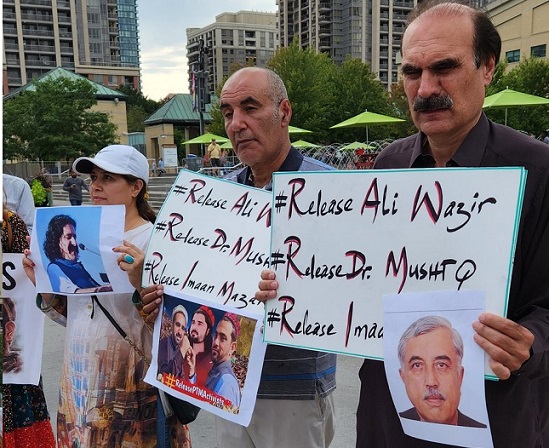
Pashtun Council Canada (PCC) held a protest demonstration for the release of arrested Pashtun Tahafuz Movement (PTM) activists including Imaan Mazari, Ali Wazir.
On September 3, the activists of Pashtun Council Canada gathered at Celebration Square, City Centre Mississauga, in Canada. They protested against the illegal arrest of PTM workers and an illegitimate crackdown over the PTM activists following the August 18 jalsa in Islamabad.
Pakistan Army and its oppressive policies has made the Pashtun land and people vulnerable. The Pashtuns have been exploited and thrown to the reign of terror by the Pakistan Army. Despite that, Pashtuns have largely been non-violent in their protests. However, Pakistan Army in turn, always tried to crush those protests with force. It is now that Pashtuns have reached Islamabad and challenged the authoritarian regime of Pakistan to refrain from subverting Pashtuns.
Hence, Pashtuns and other human rights activists across the globe are raising voice for the Pashtun cause.
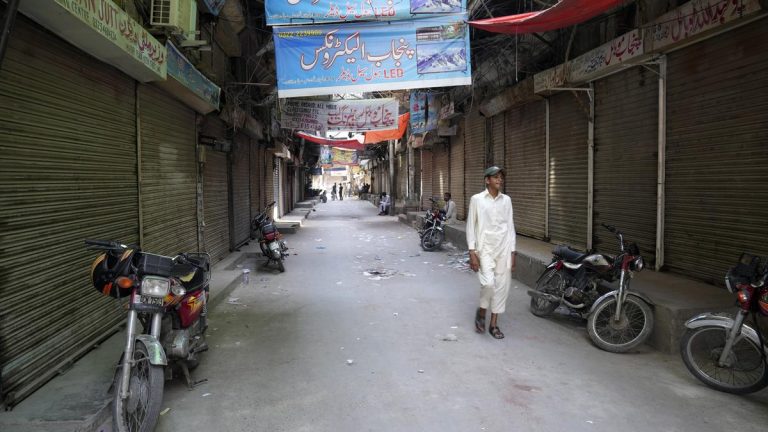
Pakistan’s business community observed a shutter down strike on Saturday across the country to protest against the inflated electricity bills and rising inflation.
It was largely endorsed by trade and business communitie, market associations, lawyers associations and transporters. The strike brought commercial activities to a halt in major cities across the country, including Karachi, Lahore, Peshawar, and Islamabad. Public transport was also largely off the roads.
The policies of the ‘establishment’ are making it difficult for businesses to operate and for people to make ends meet.
Growing Discontent
The strike is the latest sign of growing discontent with the way the country has been handling the economy. In recent months, there have been a series of protests against rising prices and power outages.In Karachi, the Tajir Action Committee (TAC) on Friday gave the government 72 hours to reduce the bills and withdraw the hike in petrol prices or else they would go for a prolonged 10 days strike.The call for strike was supported by The Karachi Chamber of Commerce and Industry (KCCI).
The Pakistan Army under the guise of the government has responded to the protests by saying that it is taking steps to address the economic challenges.The strike is likely to put further pressure on them to take action to address the economic problems.
Meanwhile, social media platforms were flooded with the significant number of visuals related to the shutdown. Be it Islamabad, Karachi, Peshawar or Pakistan Occupied Gilgit-Baltistan (POGB), the effect of shutdown was seen everywhere. The call for shutdown and the subsequent support it got across Pakistan, itself shows that people are now fed up of this military-politico complex which finds its base in territorial aggression, resource exploitation and power lust. People are now becoming vocal and demanding their rights proactively.
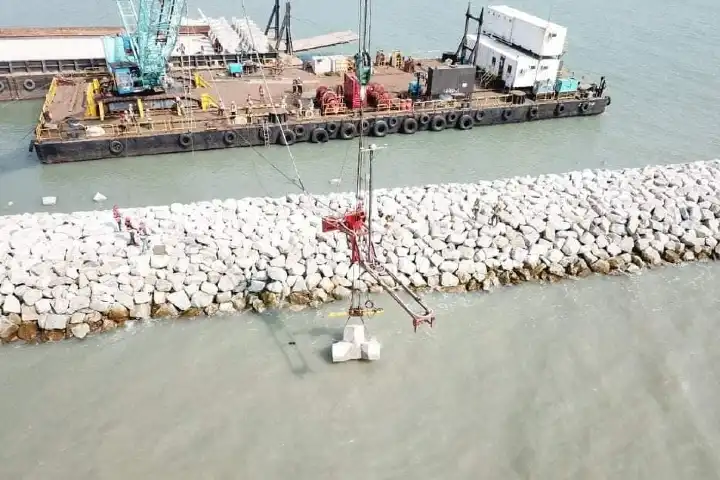
The Matarbari deep sea port, which is currently under construction in Bangladesh, will be a game changer for the region as it would open up connectivity with India’s northeast, especially Tripura, along with landlocked Nepal and Bhutan. For Japan, India’s northeast has been in focus for some time. Japan has shown an urgency build an integrated and scaled up supply chain in the region as it plans to boost its presence and increase investments.
At present, only about 350 Japanese companies operate in Bangladesh but once the region is integrated, trade and economy can zoom.
The port located at Cox’s Bazar, is primarily being developed by Japan International Cooperation Agency under the Bay of Bengal Industrial Growth Hubs.
“Japan wants better connectivity between India’s northeast and Bangladesh to leverage and build on each other’s strengths,” Takashi Suzuki, Chief Director General (South Asia), Japan External Trade Organisation (JETRO) told India Narrative earlier.
During his trip to India, Japanese Prime Minister Fumio Kishida too highlighted the importance of strengthening connectivity in the Northeast region, rich in resources but is relatively untapped, for developing robust global supply chains.
National Maritime Foundation (NMF) in a study noted that connectivity will open avenues for collaborative endeavours among nations while encouraging partnerships across multiple sectors including infrastructure, tourism, cultural integration, and of course, logistics, and trade. “The establishment of a seamless regional trade network lays the foundation for shared prosperity and sustainable development, ultimately benefiting all participating nations,” it said.
Once the deep sea port becomes operational, a large number of items that are currently being traded through Haldia port could be routed through Matarbari, thus easing the load on one port. Importantly, Matarbari will be able to handle larger cargos as well.
The project also allows India to balance China which is aggressively enhancing its influence through the multi trillion Belt and Road Initiative. “Matarbari port is strategic. It will boost connectivity but notably it gives both India and Japan a big opportunity to balance China’s growing influence,” an analyst said.
According to Maritime Gateway, Japan’s engagement in Bangladesh for connectivity development goes hand-in-hand with India’s endeavour which is undertaking upgradation of Mongla Port, road and power transmission networks, railway lines, inland waterways, among others, in the neighbouring country.
Last year, trans-shipment of cargo movements began between Kolkata to the northeast through Bangladesh’s Mongla port marking a new era in connectivity for New Delhi and Dhaka.
Benefits to Nepal and Bhutan
Nepal and Bhutan, the two landlocked countries in the region, are dependent on India and Bangladesh for port access. Therefore, the Matarbari port will not only bring significant economic advantages to Bangladesh “but also holds significant potential for neighbouring landlocked countries such as Nepal and Bhutan,” NMF said.
These countries would experience substantial benefits through the reduction of regional transshipment costs for their goods and Bangladesh hopes to be able to do just that, it said.
South Asian countries are among the least connected and integrated in the world today.
“The eastern sub-region is poised to become an economic growth pole for South Asia. An important component of this development potential is for countries to invest in connectivity – rail, inland waterways, and roads,” Junaid Ahmad, Vice President of Operations, Multilateral Investment Guarantee Agency of the World Bank who earlier served as country director for India had noted.
(This article was first published in India Narrative)
Prime Minister Narendra Modi’s decision to travel to Indonesia just ahead of next week’s significant G20 Leaders’ Summit in New Delhi sends a strong message on the value India attaches to engagement with the countries of the Southeast Asian region and its vision for the wider Indo-Pacific under the current geopolitical scenario.
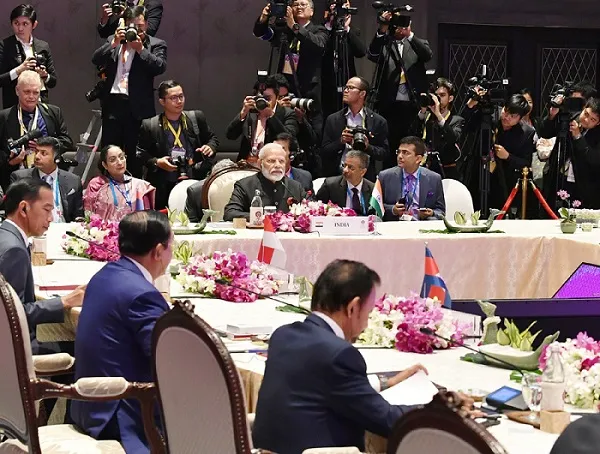
PM Modi will be travelling to Jakarta on a two-day visit starting September 6 to attend the 20th ASEAN-India Summit and 18th East Asia Summit being hosted by Indonesia as current Chair of Association of Southeast Asian Nations (ASEAN).
India, which currently holds the Presidency of the G20 – a premier global forum for international economic cooperation – will be hosting the leaders’ summit of the grouping in New Delhi on September 9-10 which will be attended by several top leaders of the world, including the US President Joe Biden.
The ASEAN-India Summit will be the first since the elevation of India-ASEAN relations to a Comprehensive Strategic Partnership in 2022 and will review the progress of India-ASEAN relations and chart the future direction of cooperation.
Hosted by Indonesian President Joko Widodo, the East Asia Summit would provide an opportunity for the leaders of ASEAN countries and its eight dialogue partners, including India, to exchange views on issues of regional and global significance.
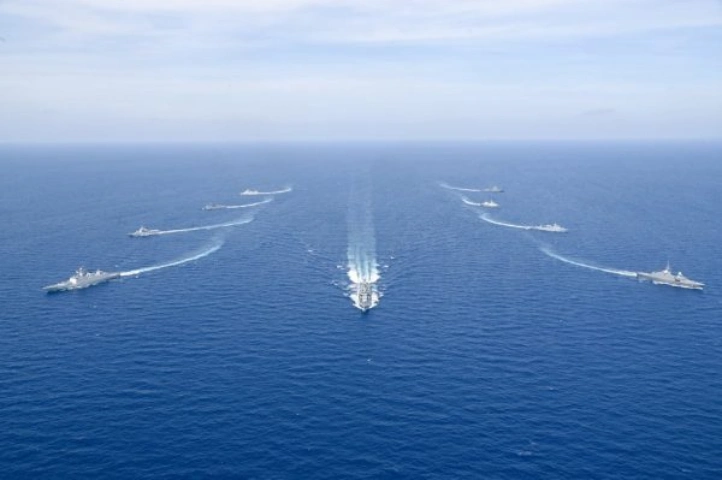
The inaugural ASEAN India Maritime Exercise (AIME-2023) was successfully held in the South China Sea in May 2023 (Image courtesy: Indian Navy)
Acknowledging that the international and regional landscape is undergoing “profound changes with rising instability and uncertainty”, China on Friday announced that the country’s Premier Li Qiang will attend the 26th China-ASEAN Summit, the 26th ASEAN Plus Three (APT) Summit and the 18th East Asia Summit to be held in Jakarta.
India believes that a strong and unified ASEAN plays an important role in the emerging dynamic of the Indo-Pacific and firmly supports ASEAN centrality and the ASEAN outlook on the region.
ASEAN countries remain an important pillar of India’s Act East policy and key partner of its Indo-Pacific Vision underlined by PM Modi’s Security and Growth for All in the Region (SAGAR) initiative.
The Ministry of External Affairs (MEA) has maintained that India’s engagement with the ASEAN has been driven by three goals – enhancing connectivity (physical, digital and people-to-people business) between India and ASEAN; strengthening the ASEAN organisation; and, expanding practical cooperation in the maritime domain.
New Delhi has also welcomed Indonesia’s efforts in mainstreaming of ASEAN’s Outlook on Indo-Pacific (AOIP) and its planned implementation through the ASEAN Indo-Pacific Forum.
“AOIP’s convergence with the Indo-Pacific Oceans Initiative, or IPOI, provides a strong basis for our cooperation in this regard,” remarked External Affairs Minister S Jaishankar at the opening session of the ASEAN Post Ministerial Conference with India in Jakarta in July.
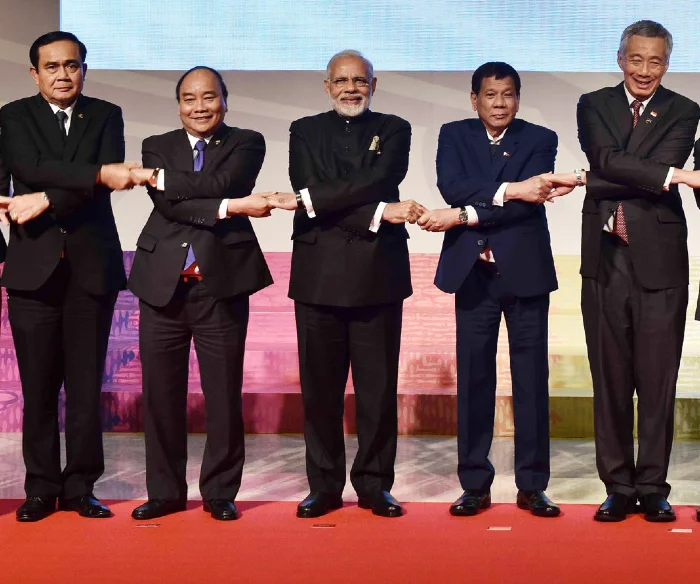
A file photo of Prime Minister Narendra Modi with ASEAN leaders during the 2017 East Asia Summit (Image courtesy: PIB)
“As comprehensive strategic partners, we look forward to working with ASEAN in further expanding our partnership to include newer areas while strengthening existing corporations. And I refer here especially to cyber, financial and maritime security domains,” he added.
Enhancing maritime cooperation has also been one of the priorities of Indonesia’s ASEAN Chairmanship in 2023 as it launched last month the ASEAN Maritime Outlook (AMO) – a strategic document which will be a compass for ASEAN in determining the direction of maritime cooperation in the future.
As highlighted in the AOIP, Southeast Asia lies at the centre of and serves as the conduit linking the Asia-Pacific and Indian Ocean regions, which are among the most dynamic regions in the world and hubs of economic growth. The importance of the region’s sea lines of communications (SLOC) is underlined by the fact that 60 percent of maritime trade passes through Asia, with the South China Sea carrying an estimated one-third of global shipping.
Concerned about China’s strategic expansion into the South China Sea, several countries of the region are now spotlighting the importance of sustaining defence engagement with India and like-minded partner countries.
Without mentioning China during his address to the Joint Sitting of the US Congress in Washington this June, PM Modi said that “dark clouds of coercion and confrontation” are casting their shadow in the Indo Pacific and the stability of the region has become one of the central concerns of India-US partnership.
“We share a vision of a free, open and inclusive Indo Pacific, connected by secure seas, defined by international law, free from domination, and anchored in ASEAN centrality. A region where all nations, small and large, are free and fearless in their choices, where progress is not suffocated by impossible burdens of debt, where connectivity is not leveraged for strategic purposes, where all nations are lifted by the high tide of shared prosperity,” he said.
(This article was first published in India Narrative)
We use cookies on our website to give you the most relevant experience by remembering your preferences and repeat visits. By clicking “Accept All”, you consent to the use of ALL the cookies. However, you may visit "Cookie Settings" to provide a controlled consent.
This website uses cookies to improve your experience while you navigate through the website. Out of these, the cookies that are categorized as necessary are stored on your browser as they are essential for the working of basic functionalities of the website. We also use third-party cookies that help us analyze and understand how you use this website. These cookies will be stored in your browser only with your consent. You also have the option to opt-out of these cookies. But opting out of some of these cookies may affect your browsing experience.
Functional cookies help to perform certain functionalities like sharing the content of the website on social media platforms, collect feedbacks, and other third-party features.
Performance cookies are used to understand and analyze the key performance indexes of the website which helps in delivering a better user experience for the visitors.
Analytical cookies are used to understand how visitors interact with the website. These cookies help provide information on metrics the number of visitors, bounce rate, traffic source, etc.
Advertisement cookies are used to provide visitors with relevant ads and marketing campaigns. These cookies track visitors across websites and collect information to provide customized ads.
Necessary cookies are absolutely essential for the website to function properly. These cookies ensure basic functionalities and security features of the website, anonymously.
Cookie
Duration
Description
cookielawinfo-checkbox-analytics
11 months
This cookie is set by GDPR Cookie Consent plugin. The cookie is used to store the user consent for the cookies in the category "Analytics".
cookielawinfo-checkbox-functional
11 months
The cookie is set by GDPR cookie consent to record the user consent for the cookies in the category "Functional".
cookielawinfo-checkbox-necessary
11 months
This cookie is set by GDPR Cookie Consent plugin. The cookies is used to store the user consent for the cookies in the category "Necessary".
cookielawinfo-checkbox-others
11 months
This cookie is set by GDPR Cookie Consent plugin. The cookie is used to store the user consent for the cookies in the category "Other.
cookielawinfo-checkbox-performance
11 months
This cookie is set by GDPR Cookie Consent plugin. The cookie is used to store the user consent for the cookies in the category "Performance".
viewed_cookie_policy
11 months
The cookie is set by the GDPR Cookie Consent plugin and is used to store whether or not user has consented to the use of cookies. It does not store any personal data.