Home Blog Page 214

Protests by teachers in Peshawar and Karachi marred by Pak police brutality, arrests

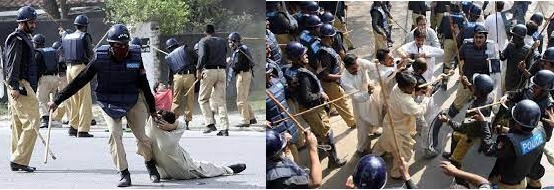
LAHORE: Protesting teachers in Peshawar and Karachi were lathi-charged, teargas shelled, and water cannons used by the police. Many teachers have been arrested, and cases have been registered in both cities.

On Thursday, the police lathi-charged and fired teargas shells at protesting teachers on GT Road in Peshawar. These teachers were protesting in front of the Directorate of Education on GT Road for the demand of scale upgradation.

During the protest, the police started baton-charging the protesters and shelling them with tear gas, due to which the teachers dispersed. The police have arrested several teachers and registered a case.

The protesters said that peaceful protest is not allowed, which is a violation of the constitution and law. Instead of accepting the demands of the teachers and solving the problems, they are being subjected to coercion and violence.

Meanwhile, on Wednesday, the Karachi Police foiled an attempt by the teachers to go to the Chief Minister’s House to protest. Dozens of teachers were arrested with water cannons and batons.

All Sindh Primary Teachers Association Karachi Division protested in front of the press club against non-payment of allowance and non-permanent employment. Later, the protesters entered the red zone and advanced towards the Chief Minister’s House, where the police tried to stop them, but the protesters continued to advance.

The police used water cannons and lathicharge to stop the teachers from proceeding. Meanwhile, dozens of teachers were detained.

Later, the teachers made another attempt to go towards the Chief Minister’s House, but the police foiled the attempt by baton charging the protestors.

The teachers’ organisation claimed that more than 150 protesters were in police custody. The teachers said that the long-standing demands of primary teachers in Sindh should be accepted. “We are being treated unfairly. The police resorted to violence, while we came to get our legitimate demands met”. The teachers said that they were assured to approve the demands in 2021, which have not been implemented yet.Teachers are being forced to retire.

The association demanded that all teachers be made permanent and that senior teachers be given grade 17 and a service structure. “The teachers said that we would continue to protest until our demands were accepted” said one of the protesting teachers. On this occasion, the protestors also demanded the release of the arrested teachers.

Multiple attacks by BLF on Pak Army across Balochistan

Balochistan Liberation Front (BLF) carried out four attacks on the occupying Pakistan Army and a construction company’s vehicles in three different locations of Turbat, Tump and Buleda.

On July 15, BLF freedom fighters targeted a checkpoint of the Pakistan Army in Sangani Sar, Turbat. In a first, BLF personnel threw hand grenade on the checkpost. From the other side they opened fire in which one enemy personnel of the occupying forces was killed. The camp also incurred serious financial losses.

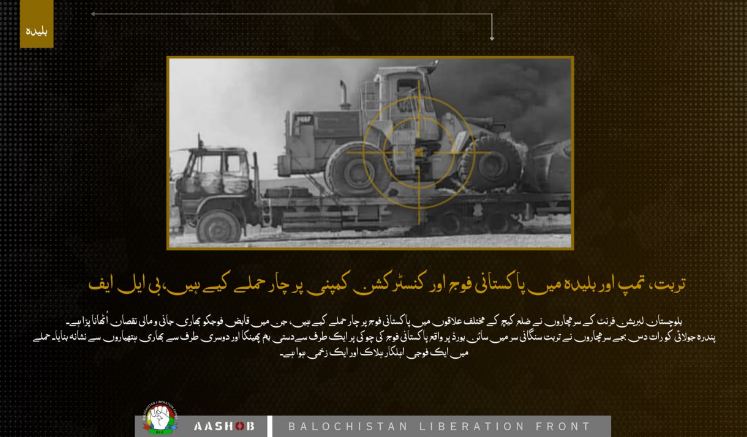
In a separate incident on the same day, armed BLF freedom fighters intercepted a loaded bulldozer on the truck which belonged to a construction company. The truck was on its way from Turbat to Zamran when it was thwarted by BLF operatives at Bulaida and set on fire. The truck driver and crew, being of Baloch origin, were left with a warning. In his statement, Major Gwahram Baloch, the spokesperson of BLF has warned the companies to stay away from the exploitative projects in Balochistan.

Apart from these attacks, an attack was also carried out by BLF on July 14. Two different groups of BLF operatives launched two different attacks on Phulabad area of Tump. In the first attack at 3 PM, sarmaachars threw grenade at the occupying Pak Army post while in the second attack at 9 p.m., another group fired six rounds of A-1.  The attacks caused heavy losses and resulted in significant casualties.

Since its formation in 1964, BLF has contributed to the Balochistan liberation cause in both Iran and Pakistan. As of now it is firmly proceeding towards its goal of freedom of Balochistan from Pakistan who annexed the sovereign state of Balochistan in 1948.

Pak forces thrash students protesting at BUET in Balochistan

The student of the Balochistan University of Engineering and Technology (BUET), Khuzdar are being physically assaulted by the Pak FC forces.

A couple of days ago, the students of the University announced boycott of the examination demanding a reduction in fees, restoration of scholarships, lifting of restrictions on study circles and the removal of unnecessary surveillance cameras in the campus. After the student voice became profound, the University management called the Frontier Corps to disperse the protesting students. It is reported that the forces incorporated coercive measures to curb the protest. Some of the students were arrested and are still in the Police custody. Calling the armed forces to deal brutally with the protest of students depicts the sorry state of human rights violation in Balochistan.

Later at night, the negotiations were carried out between the protesting students and the university which ended without yielding a solution. The Grand Student Alliance has accused the university administration of assigning the responsibility of the examination to the comptroller, who has a history of intimidating the students.

Since then, the students are on a sit-in protest. On 16 July, the Grand Student Alliance announced to convert their sit-in protest into a token hunger strike, witnessing the ignorance of BUET administration.

Now, once again, the forces have been called to the campus to deal with the protesting students. In a series of various videos surfacing on the social media, it is apparent that the protestors are being thrashed by the cops on the call of University administration. Amidst the continuing conflict, various student organizations have extended solidarity with the Grand Student Alliance.  

Pakistan’s interference sparks political crisis in POGB

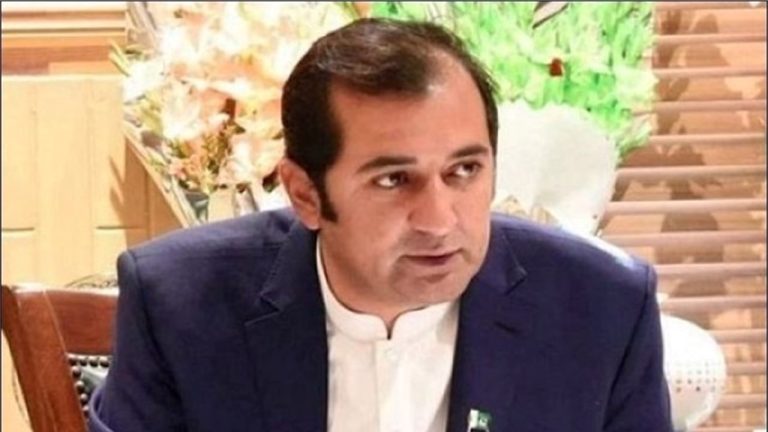
On July 4, 2023, Khalid Khurshid, the Chief Minister of the elected government of Pakistan Tehreek-e-Insaf in Pak-occupied Gilgit-Baltistan, was disqualified by the Chief Court of Gilgit-Baltistan due to a fake degree case. Consequently, the Pakistan Tehreek-e-Insaf government was dissolved in Pakistan-occupied- Gilgit-Baltistan. What makes this situation intriguing is that despite multiple attempts by opposition parties, such as the People’s Party and the Muslim League, to topple the government through democratic no-confidence measures, it was ultimately dissolved by a court decision, both in Gilgit-Baltistan and Pakistan-occupied Jammu and Kashmir. Adding to the surprise is the fact that upon the disqualification of Gilgit-Baltistan Chief Minister Khalid Khurshid, who was favored by Tehreek-e-Insaf Chairman Imran Khan, the leaders of Tehreek-e-Insaf Pakistan in Gilgit-Baltistan swiftly distanced themselves from the party, displaying their indifference. These turn of events raises questions about the underlying reasons.

In Gilgit-Baltistan, three factions of Tehreek-e-Insaf have emerged. One is known as the ‘like-minded group’, another as the ‘Forward Block’, and the third comprises supporters of Khalid Khurshid, who not only faced disqualification by the court but also is barred from contesting elections for the next two and a half years. The court decision has resulted in the scattering of the Pakistan Tehreek-e-Insaf government in Gilgit-Baltistan. Despite this, Khalid Khurshid remains the sole person in Gilgit-Baltistan who stands by Imran Khan. This explains why Imran Khan has retained Khalid Khurshid as the president of Gilgit-Baltistan Tehreek-e-Insaf, despite his disqualification. However, other leaders and ministers of Imran Khan’s party have either joined the new government by aligning themselves with the ‘Khairabad’ group or have chosen to remain silent, expressing their indifference towards the party.

After parting ways with Tehreek-e-Insaf, Haji Gulbar Khan, the leader of the Forward Block, has been elected as the new Leader of the House in Gilgit-Baltistan with the support of PDM (Pakistan Democratic Movement). Interestingly, Raja Azam Khan, a former minister of the Tehreek-e-Insaf government, positioned himself as the unanimous candidate of the like-minded group, but he, along with MWM (Majlis-e-Wahdat-e-Muslimeen), Islami Tehreek, and other like-minded colleagues, boycotted the election for the Leader of the House in Gilgit-Baltistan today. This group of like-minded individuals who have separated from the opposition parties, MWM, Islami Tehreek, and especially PTI, boycotted the elections. Furthermore, the establishment has faced accusations of coercing its members into joining the Forward Block, thereby exacerbating another political crisis.

The election for the Leader of the House in Gilgit-Baltistan has faced significant criticism. However, despite this, when Haji Gulbar Sahib, the newly elected Leader of the Gilgit-Baltistan Assembly, addressed the assembly, nationalist leader and Balavaristan National Front Chairman Nawaz Khan Naji, who is also a member of the Gilgit-Baltistan Assembly, congratulated him. Naji stated, ‘Congratulations to you, Mr. Chief Minister, because you have become the Chief Minister in the same manner as previous Chief Ministers of the Gilgit-Baltistan Assembly. This practice has been ongoing since 1947, so it is nothing new.’

He further said that this is an oppressed assembly. A lie is told in this assembly by saying that it is a powerful house. “Apart from congratulating the Chief Minister, I also offer conditional congratulations to all my friends. Let them sit comfortably in the evening and think that whatever has happened to them during this month, if it is in accordance with conscience, then bless you; otherwise, it is a reprehensible act. This is something to be ashamed of and self-condemned.” Islamabad’s interference in Gilgit-Baltistan has gone too far and may have dire consequences.”

It is important to note that a few days ago, the Gilgit-Baltistan Assembly was sealed by the police following a court order to halt the election of the Leader of the House. Assembly members and the Speaker of the Gilgit-Baltistan Assembly were prevented from entering the premises. Senator Raza Rabbani of Pakistan, while addressing the National Assembly, remarked that “The way the police sealed the Gilgit-Baltistan Assembly was the darkest day in parliamentary history.” These are signs of danger to your democracy.”

The primary reason for the disrespect shown towards the Gilgit-Baltistan Assembly lies in the Gilgit-Baltistan Order 2018. This order does not grant any authority or role to the members of the Gilgit-Baltistan Assembly. Additionally, the order cannot be challenged in the Pakistan-occupied-Gilgit-Baltistan Supreme Appellate Court or the Chief Court of Gilgit-Baltistan. Essentially, it is a presidential decree that concentrates power in the Prime Minister of Pakistan and the Federal Minister for Kashmir Affairs, granting them more authority in the region than a king. Consequently, in this unconstitutional region, the government belongs to the federal party that holds power in the Federation of Pakistan or receives their complete support. As a result, governments in Pakistan-occupied-Gilgit-Baltistan can be formed overnight, and it doesn’t take long for them to be toppled. The loyalty of the people also revolves around the parties that rule at the federal level. Once a government ends, the people’s loyalty completely shifts. The detachment of all Tehreek-e-Insaf leaders and minister advisors in Gilgit-Baltistan from the party today is not a new phenomenon, as the past is filled with similar examples.

“Let’s reflect on the tragic history of Gilgit-Baltistan: In 745 AD, the forces of Tibet and China engaged in a fierce battle for control over the crucial strategic routes in the valleys of Gilgit. In this bloody conflict, the Chinese emerged victorious, leading to the collapse of the Bilor state. Our people subsequently rallied behind the triumphant army. Another significant example is seen when the Sikhs of Punjab launched an attack after 1840, and despite their defeat, our people supported them. Similarly, the Dogras of Jammu and British India extended their support to our people when they faced defeat. Following the Gilgit-Baltistan War of Independence, the people united under the leadership of Sardar Muhammad Alam, a unity that endures to this day. This long-standing pattern reveals a colonial system dominated by psychological influences”.

Now it remains to be seen what role the youth of Pakistan-occupied-Gilgit-Baltistan will play in advancing the collective national interests of the region following the announced boycott of the elections for the Leader of the House by the Islamic Movement, MWM, and the Gilgit-Baltistan like-minded group. Will they strive for peace, development, and meaningful change, transcending divisions based on sectarianism, regionalism, and color? Or will they merely engage in the chanting of slogans like La La Musa, Raiwand, Zaman Park, or Big Brother? Only time will answer this question.

Pakistan has terrorised locals across Gilgit-Baltistan and stifled their demands for political, social and fundamental rights.

Pak-occupied Balochistan plagued by financial irregularities, over 32 billion rupees fudged

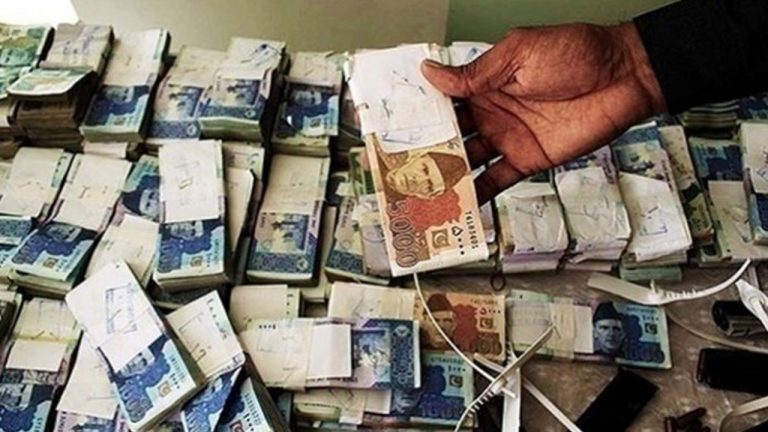
Financial irregularities exceeding 32 billion and 63 crore rupees have been revealed in Pak-occupied Balochistan during the fiscal year 2021-22. An audit report released in this regard highlights that the Balochistan government was unable to utilize 11.67% of the budget, amounting to 53 billion and 44 crore rupees. Furthermore, only 29% of the budget was allocated for development projects by the provincial government.

The audit report reveals that out of the PSDP (Public Sector Development Program) worth 239 billion rupees, only 68.7 billion rupees were spent. Financial irregularities exceeding 3 billion and 39 crore rupees occurred within the Board of Revenue Balochistan. Additionally, there were illegal expenses totaling 2099.7 million rupees, with records of more than 33.7 million rupees not being submitted. Irregularities amounting to over 2 billion and 17 crore rupees were also identified in the Department of Industries.

According to the report, financial irregularities exceeding 1 billion and 78 crores were found in the Planning and Development Department of Balochistan, while irregularities exceeding 1 billion and 87 crores were recorded in the Communication and Construction Department.

The audit report further reveals financial irregularities exceeding 3 billion and 89 crore rupees in the Health Department of Balochistan, and over 4 billion rupees in the Department of Mines and Minerals. Moreover, illegal expenses of more than 2 billion and 45 crore rupees were incurred in the Public Health Engineering Department.

Other findings include irregularities exceeding 1 billion and 38 crore rupees in the Balochistan Police Department, irregularities amounting to 263.3 million rupees in the Agriculture Department, and recommended recovery of 209 million rupees. Furthermore, irregularities exceeding 959.2 million rupees were identified in the Higher Education Department.

The report also states that irregularities exceeding 480.8 million rupees were found in the Finance Department, illegal expenses of over 213.2 million rupees were made in the Food Department, and irregularities of 194.5 million rupees were identified in the Livestock Department.

In addition, the audit report highlights irregularities amounting to 312.6 million rupees in the Irrigation Department, financial irregularities of 70.9 million rupees in the S&GAD Department (Services & General Administration Department), and instances where schemes were not implemented in the Finance, Excise and Taxation, and Transport Authority departments.

The report further reveals that out of the 28 sectors in the PSDP, 24 sectors received an allocation of less than one percent. Government departments failed to submit records of an amount totaling 62 crore rupees, and fraud and embezzlement exceeding 25 million rupees took place.

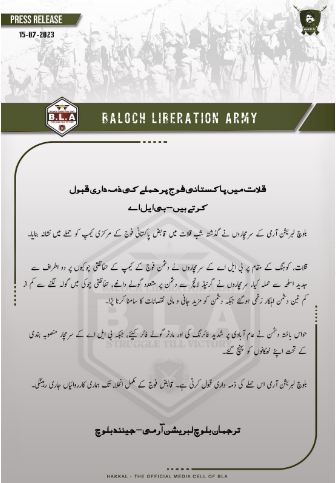
BLA attacks Pak Army’s main camp in Kalat, injures 3 soldiers

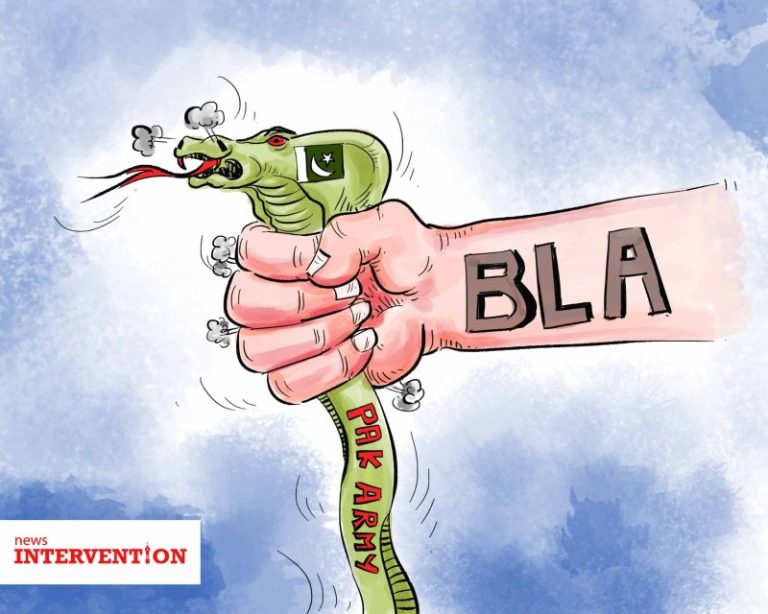
The Baloch Liberation Army (BLA) has targeted the main military camp of Pakistan Army, inflicting heavy losses.

According to BLA spokesperson Jeeyand Baloch, the freedom fighters launched an attack on the camp in Kalat. The freedom fighters targeted the security post from two different directions resulting in chaos in the camp. Further, they hurled grenades at the enemy positions injuring at least three personnel. As a result of the attack, the Pakistan Army suffered heavy damages.

After concluding the attack, BLA personnel returned back to their location. However, the Pakistan Army men started firing indiscriminately on the civilians. As usual, the BLA has stated that until the liberation of Balochistan, it will continue to target the occupying Pakistan forces. To fight against these ongoing atrocities, organizations like the BLA have resorted to armed struggle, as the illegal occupation of Balochistan in March 1948 by the Pakistan Army initiated a period of severe exploitation in the region. Baloch nationals have persistently faced profiling and disappearances, while the resources of Balochistan have been exclusively exploited by the occupying forces and government.

Revival of Kashmir’s Pashmina textile after the abrogation of Article 370

The never witnessed momentum in the development of Jammu and Kashmir, after the scrapping of Article 370, is taking Kashmir out of noisy and smoky environment towards prosperity and peace. As a consequence, the opening of the floodgates of opportunity has allowed traditional businesses to diversify across the world. And now this growth story is transcending the oceans, depicting a complete different and beautiful picture of Kashmir.

On Thursday, a well-known businessman Najtaba Kadri , became the first Kashmiri to deliver a speech at the House of Lords in the UK. He is the founder of Me&K label luxury brand based in Kashmir. He was invited by the King’s College, London to present his views on the two-hour roundtable, which was hosted by the House of Lords. The roundtable meeting focused on the impact of trade facilitation policies on women, challenges in designing trade policies and gender inclusivity.

During his speech, Kadri stated that women are playing a significant role in the Pashmina Industry, especially in the higly skilled work of hand spinning and embroidery. Along with that, Kadri also said, “In today’s world, there is a growing demand for slow and sustainable fashion. Kashmir’s pashmina  and other traditional textiles exemplify sustainability, and have stood the test of time for centuries.”

Aligning with the topic of discussion, he also emphasized the gender inclusivity in the Pashmina industry. He said, “Around 80 per cent of wages paid in the manufacturing of hand spun go to female workers in Kashmir. Kashmiri Pashmina is a way to empower women and increase their financial independence.”

The End Of Decade Old Plight Of Kashmir

Kadri urged the UK government to make the imports of Kashmiri Pashmina with a GI mark, duty-free. He elucidated how in the last 33 years, the companies had been hesitant to send their employees to Kashmir, which became a curse of disadvantages for the region’s trade.

But the things have now changed since Article 370 is abrogated, the merchandise exports of Kashmir soared by 30.76 per cent to $246.07 million in FY22. Along with that, the nerve of Kashmir’s economy is tourism which is a in a way, a supportive industry for Kashmiri Pashmina. According to reports, in 2022, 1.9 crore people visited Jammu & Kashmir, while this year 80.4 lakh people have visited J&K so far till May.

During the event, All-Party Parliamentary Group (APPG), the co-organizer of the roundtable with King’s college has expressed interest in organizing a meeting in Kashmir in the near future. APPG based in UK, is an organization working with an objective of fostering trade and investment between India and UK.

Pak Army abducts five Balochs from Balochistan

Five Baloch nationals have been forcibly abducted by the Pakistan Army from Balochistan in just two days.

Three Balochs namely, Dinnar, Dad Baksh and Zabad were forcibly abducted by the Pakistan Army on the night of 13 July. All the three victims were attending a wedding ceremony when the personnel of Pak Army intruded and took them away. As of now they have been forcibly disappeared and their whereabouts are unknown.

A day after, two other individuals have also been illegally abducted by the Pak Army. On the 14th of July, Azam, son of Allah Dad and Zahoor Ahmad, son of Jam Khan belonging to Awaran and Bolan respectively were forcefully abducted by Pak Army from Quetta.

Azam and Zahoor

The cases of enforced disappearances are increasing rapidly in Balochistan. The voice of dissent is mercilessly suppressed by the military machinery. After Balochistan gained independence from British on 11th August 1947, it was illegally occupied by Pakistan in March 1948. Since then, Pakistan has used Balochistan as a colony but in more inhumane way than the British. As a result, people across Balochistan have been demanding an end to Pakistan’s colonialism in Balochistan and in order to suppress these freedom demanding voices, Pakistan has incorporated various barbaric tactics including mass killings, enforced disappearance, and unlawful detention in torture cells, among others. As of now, hundreds of innocent Baloch nationals have been either illegally detained or have been killed extra-judicially.

Pak Army opens fire on two JSFM members in Sindh

Two Sindh nationalist workers have been attacked by the Pakistan Army at Karachi Mori in Sindh.

Reportedly, Sajjad Chana and his nephew Zahid Chana were travelling on their bike, when the Pakistan Army from the vehicle behind, opened fire on them. In a rampage, Sajjad Chana suffered fatal shots on his arm and leg. Later, the Army vehicle rammed their motorcycle, causing more brutal injuries. This was the second instance when Sajjad is being targeted by the Pak Army.

Both the nationalists belong to Jeay Sindh Freedom Movement (JSFM) and are actively fighting against the atrocities of Pakistan over the Sindh. The undisciplined way of operations by Pak Army shows that they are no better than a terrorist organisation which attacks innocent civilians.

JSFM Chairman urges revitalisation of the national movement in Sindh

Jeay Sindh Freedom Movement (JSFM) Chairman, Sohail Abro has issued a statement calling for a revitalization of the nationalist struggle for the freedom of Sindh.

According to the statement, there is a pressing need for the revitalization of the national movement amidst the given circumstances, both in terms of leadership and organization. The recent state operation has prompted intellectual figure Syed Amin Jai to emphasize the significance of Sindudesh’s demands, organizational structuring, advocacy, and engagement with friendly nations. To address the concerns, political activist Pir Ali Shah Wari has taken the initiative to unite parliamentary politicians in Pakistan. He has urged them to prioritize national interests over personal gains. However, amidst these efforts, it is crucial to avoid discrediting the ideology of Sindhudesh, which stands for the preservation of Sindhi culture and rights and for the struggle of their freedom from Pakistan.

A Need For Strong Global Presence

In this pursuit, it is imperative to establish a strong presence on the international stage, aligning personal interests with global interests to garner trust and support. Such endeavors will invigorate the national workers’ morale, dispelling the prevailing sense of silence and despair. As the movement gains traction, the inherent drive for progress and advancement will naturally emerge, fostered by knowledge, literature, science, and other realms of human intellectual development. It is important to recognize that stagnation occurs when the pursuit of knowledge, literature, science, and experimentation ceases.

Amidst the current circumstances where the national movement has been overshadowed by state apprehensions, it is essential to break free from the shackles of fear, for it is inherent in human nature to evolve and progress. Progress can be achieved by fostering intellectual development in various fields, including knowledge, literature, science, and experimentation.As a result, a new revolutionary organization has emerged, empowered to dispel the sense of despair and silence and challenge the state’s oppressive fears. This young leadership represents an ideological revolutionary movement that forms the foundation of Sindudesh, safeguarding the Sindhi identity and striving for its preservation.