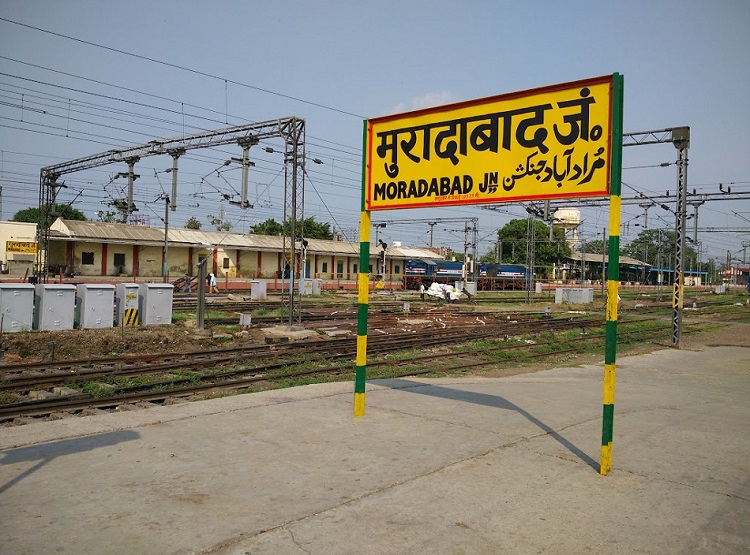
Uttar Pradesh chief minister Yogi Adityanath’s recent announcement to release the long forgotten report on 1980 Moradabad riots has sparked debate about a crucial chapter in the state’s history. These riots were UP’s first large-scale communal violence since India’s independence. Despite the turbulence caused by partition, Uttar Pradesh had remained mostly peaceful until the awful events in Moradabad. With the government’s decision to release the report, let us delve into the specifics and comprehend the significance of this historic occurrence.
Background
Moradabad riots began with conflicts between Muslims and Hindus in a West Uttar Pradesh neighbourhood. It was a time when V P Singh, a first-time chief minister, was leading Congress-led administration in the state. Meanwhile, Prime Minister Indira Gandhi was preoccupied with the developing Punjab conflict and the emerging tensions in Assam. Both the state and central governments struggled to properly contain the violence, which continued to spread across various parts of Uttar Pradesh and lasted for months.
The Tragic Beginnings and Escalation
The riots broke out on August 13, 1980, coinciding with Eid-ul-Fitr, near an Idgah located between Hindu and Muslim neighbourhoods. The incident began with rumours of a ‘stray animal’ near the Idgah, which led to clashes between Muslim devotees and police. As tensions rose, the police and the Provincial Armed Constabulary (PAC) opened fire, killing numerous people.
The Commission and the Hidden Report
In response to the turmoil, the V P Singh government appointed a commission to investigate the riots, led by recently retired Justice Mathura Prasad Saxena. In November 1983, the commission issued its findings. Unfortunately, the report remains classified till date. Yogi Adityanath’s decision to table it in the Uttar Pradesh Assembly is part of a special initiative to reveal previously concealed findings of this report into the public domain. This long-awaited report offers insight on the events, reasons, and consequences of the riots in Moradabad.
Widespread Impact and Political Ramifications
The Moradabad riots had far-reaching ramifications, spreading to Sambhal, Aligarh, Bareilly, Allahabad (now Prayagraj), and rural Moradabad. These sporadic events persisted for the rest of the year. The official death toll, as announced in the Assembly by UP Home Minister Swarup Kumari Bakshi, was 289, comprising both confirmed and assumed dead, including District Magistrate DP Singh. Prime Minister Indira Gandhi first said a “foreign hand” was behind the violence, implying a plot to destabilise the country. She then retracted her statement after visiting the impacted communities.
Controversies and Political Blame Game
Various tales evolved regarding the rioters’ instigators. Yogendra Makwana, Union Minister of State for Home Affairs, blamed the disturbance on the newly founded Bharatiya Janata Party (BJP) and Rashtriya Swayamsevak Sangh (RSS). V P Singh testified in front of the UP Assembly that intelligence personnel had warned about potential trouble owing to the gathering of Muslims at the Idgah. Amid mounting criticism, VP Singh tendered his resignation but was ultimately persuaded to continue serving as chief minister.
The release of the long-awaited Saxena report on the 1980 Moradabad riots is expected to be an important turning point in Uttar Pradesh’s history.
Homes of Pakistani Hindu migrants have been demolished in Jaisalmer, Rajasthan on orders of IAS Tina Dabi. These migrant Hindu families who had fled Pakistan under inhumane conditions are now forced to live in the open during scorching summer heat of Rajasthan. This is the second incident in less than a month where the residential colonies of Hindu migrants from Pakistan have been mercilessly demolished by the Rajasthan government. The first was in Jodhpur, where two residential colonies of Pakistani Hindu migrants were torn down.
Scattered hopes
On May 16, the district administration of Jaisalmer demolished 28 housing structures and shelters at the Amar Sagar area belonging to Hindu migrants displaced from Pakistan. Terming the temporary settlement as ‘encroachment,’ the administration set their homes ablaze. The migrants are staging a dharna outside the district collectorate, but instances of forcefully dragging a woman were witnessed. The migrants, however, said that they wouldn’t budge from the dharna site until they were resettled elsewhere.
The administration under the 2016 batch topper IAS Tina Dabi defended their move. Tina Dabi said that the action was taken after complaints were received from the Amar Sagar Sarpanch and various local residents. They claim that the migrants have occupied the land that allegedly belonged to the state government’s urban improvement trust (UIT). She added that prior notice was also served to the refugees, but they refused to vacate. Dabi stated that the state government has not yet provided any guidelines regarding the resettlement of migrants who have not been granted Indian citizenship.
How is India any different?
It was 2019 when the Indian government passed the Citizenship Amendment Act. Have they implemented it? No. The path that was provided to gain Indian citizenship for certain religious minority groups from neighbouring countries, namely Afghanistan, Bangladesh, and Pakistan, is still unclear. “Religious persecution in their home countries,” which was the basis of the CAA, has been deeply undermined.
Hindus in Pakistan who somehow came to India after escaping the terror and repression of the Pakistani government are facing the same deplorable condition in India. How is India any different for them? There is neither empathy nor a law to protect these migrants. Who should we blame? The government that is delaying its implementation or the administration that fulfilled the official duty but failed in ethical service.
We need to assess the seriousness of the situation and provide formal citizenship to the displaced residents. The government’s and administration’s apathetic approach is causing enough harm, and we cannot afford to add to it.
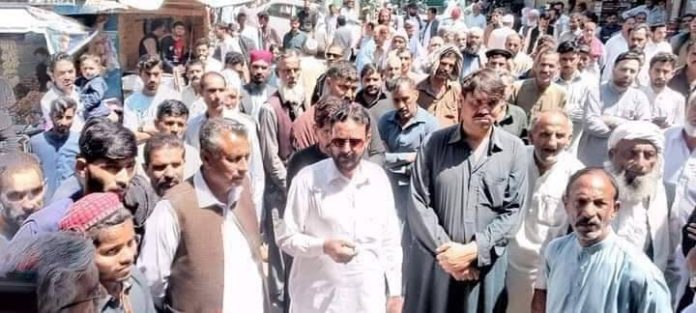
Intense protests by citizens of Hujra city erupted for subsidy restoration. During the protests, citizens expressed strong grievances against the Pakistani government and the unrecognized autonomous administration. Amidst the protests, resounding slogans echoed against skyrocketing inflation, demanding the government to ensure the provision of subsidized flour, as promised on international forums.
Protesters pointed out the stark contrast across the Line of Control, where the Indian government has been providing its residents with affordable food and basic necessities. Meanwhile, under Pakistan’s forceful rule, the region of occupied Jammu and Kashmir is grappling with surging inflation.
Addressing the protesters, organizers issued an ultimatum to the Pakistani government, demanding tangible measures to ensure the provision of subsidized flour. A year ago, a widespread movement was launched to combat inflation and reinstate subsidies in Pakistani-occupied Kashmir. The protests subsided after the government’s assurances, but they said that despite the passage of a year, those promises remain unfulfilled. They further said that if the situation persists, a significant mobilization is anticipated once again.
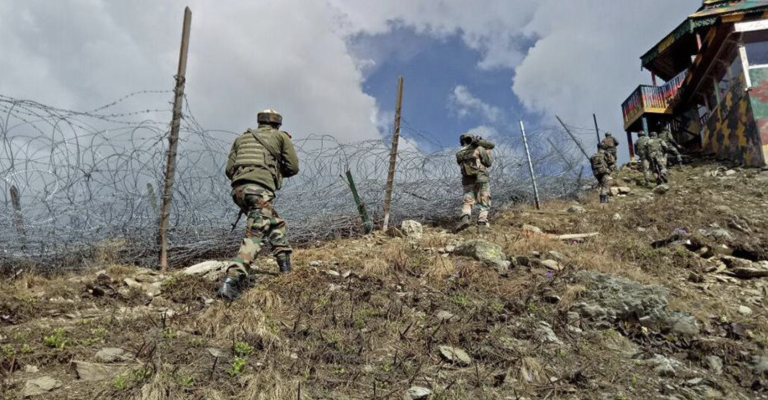
An unidentified woman hailing from Pakistan-occupied Jammu and Kashmir (POJK) was shot dead by Indian security forces on Monday after she crossed the Line of Control in Baramulla district.
As per officials, she crossed the LOC in Kamalkote area and was inching closer to the border fence when she was challenged by the forces to stop. Disregarding the orders, woman persisted in moving closer to the restricted zone.
Faced with the woman’s non-compliance, the security forces were left with no choice but to open fire, resulting in her tragic death. Meanwhile, in a separate incident, Indian security forces thwarted another infiltration attempt in the Rajouri district of Jammu & Kashmir.
Infiltration attempts have increased in recent weeks, but Indian security forces’ alertness has successfully foiled these endeavours. Their vigilance remains crucial in safeguarding the region and preventing unauthorized crossings.
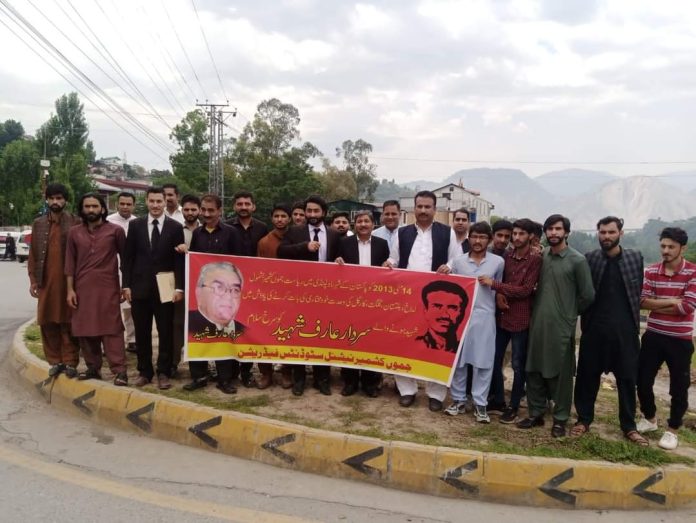
A protest was organized in Muzaffarabad, the main city of Pakistan occupied Jammu and Kashmir, on the occasion of the death anniversary of Shaheed Arif Shahid, head of the Jammu Kashmir Al-Parties National Alliance. In the month of May, Kashmiri nationalists living around the world record their protest. On May 13, 2013, Kashmiri leader Sardar Arif Shahid was shot dead in the Pakistani city of Rawalpindi.According to his colleagues, orders to kill Sardar Arif Shaheed Shaheed were given by Pakistani state institutions. Sardar Arif Shahid was considered the bravest freedom fighter leader of Pakistan occupied Kashmir. He continuously raised his voice against Pakistani occupation and atrocities and it is thus that Pakistan killed him.
With former Pakistan Army chief Gen Qamar Javed Bajwa announcing that the Army’s “institutional resolve to remain apolitical will remain steadfast”, one had expected Rawalpindi to walk Gen Bajwa’s talk. Unfortunately, this doesn’t seem to be the case since Khan has consistently accused the Army of not only sabotaging his party’s political activities but even orchestrating his assassination. So, suspicions that this move was the result of Rawalpindi’s behind-the-scenes manipulations was but natural.
However, in its news report on Imran Khan’s arrest by the National Accountability Bureau [NAB], Geo News has stated that “government sources have confirmed that the country’s military forces have nothing to do with the arrest of the political leader.” While there may well be no ulterior motive on Rawalpindi’s part on this issue, but considering the timing and unusual manner in which the former Pakistani prime minister was arrested, serious suspicions to the contrary do arise.
ISPR’s Overreaction
For one, Khan’s arrest came just a day after Pakistan Army’s media wing Inter Services Public Relations [ISPR] issued a strongly worded statement dismissing the PTI chief’s allegation that a two star General serving in Pakistan Army’s spy agency Inter-Services Intelligence [ISI] was devising his assassination. Rawalpindi’s angst is understandable and dismissing Khan’s allegation for being “highly irresponsible and baseless” would have been a good enough rebuttal.
However, ISPR went overboard by going into a verbal overdrive. Mentioning that “This has been a consistent pattern for last one year wherein military and intelligence agencies officials are targeted with insinuations and sensational propaganda for the furtherance of political objectives,” it went on to issue a veiled threat by saying “The institution [army] reserves the right to take legal course of action against patently false and malafide statements and propaganda.”
Crafting an Elaborate Trap
The next issue that raises red flags is the manner in which Khan was arrested. The PTI chief was undergoing a biometric process within Islamabad High Court [IHC] premises in connection with hearing of a corruption case when Pakistan Rangers entered after breaking open a glass window and took him into custody on the basis of an arrest warrant issued by National Accountability Bureau [NAB].
Since Pakistan Rangers is commanded by Pakistan Army officers and operates under the command of Pakistan Army, it’s uncouth behaviour in the court premises obviously raises suspicions of Army involvement.
NAB Judge Zafar Iqbal’s justification that non-inclusion of bail provision in Khan’s arrest warrant was because the PTI chief had failed to appear in court despite repeated summons is reasonable. However, Khan’s lawyer has claimed that he had already informed the NAB court that the PTI chief couldn’t be present on the due date since he was to appear for a hearing in IHC, and had requested for an extension. Under these circumstances, the NAB’s direction to execute Khan’s arrest warrant has only further muddied the already murky waters.
By pouncing upon Khan and literally ‘abducting’ him while he was in the process of appearing before another court is downright revolting, and seriously raises doubts regarding the NAB’s sincerity and impartiality while dispensing justice in Khan’s case. And while on the issue of NAB’s credentials, the focus automatically shifts to the NAB chairman retired Lt Gen Nazir Ahmad Butt.
According to Maj Adil Raja, a former Pakistan Army officer living in self-imposed exile in the UK, Pakistan Army Chief Gen Asim Munir had served under NAB chairman Lt Gen Butt in the same unit and hence both are extremely close to each other. Interestingly, Lt Gen Butt was selected as NAB chairman just two months ago, and it’s rumoured that Gen Munir’s proximity with his erstwhile commanding officer had tipped the scales in Lt Gen Butt’s favour.
But things don’t end here.
Gen Munir too is believed to have been selected as the Army chief by Prime Minister Shehbaz Sharif since he bears a personal grudge against Khan. Readers would recall that in 2019, Lt Gen Munir who had just completed eight months as Director General ISI was unceremoniously removed from this prestigious post by Khan to make way for the PTI chief’s close confidante Lt Gen Faiz Hameed.
Since Gen Munir was due to retire two days before superannuation of the then Army chief Gen Qamar Javed Bajwa, his being promoted as Army chief was virtually ruled out. But with Pakistani President Arif Alvi’s approval of Lt Gen Asim Munir as new Army chief just two days before his retirement, Sharif got a Khan-baiter to occupy Pakistan’s most powerful chair!
These patently motivated developments gave rise to suspicions regarding the existence of an anti-Khan troika comprising Sharif, Gen Munir and retired Lt Gen Butt, the highly questionable manner in which Khan has been hounded only buttresses this apprehension.
Lastly, use of Pakistan Rangers instead of the local police to arrest the PTI chief makes the entire episode all the more quirky. While Rangers serve as a law enforcement force, it is used on occasions where major use of force is anticipated, and so its employment for arresting Khan, and that too by breaking into IHC was definitely ‘overkill’!
Why Imran?
Whereas some may dismiss it, but there’s a distinct possibility that Pakistan’s legislature and military has ganged-up against the PTI chief, and the reasons are not too hard to find. It’s no secret that Khan’s stupendous popularity amongst the masses is a credible threat to the PDM government and the widespread violent protests against his arrest validate this apprehension. So, Khan is obviously a serious political threat in being to the ruling dispensation that can only be countered by his disqualification or political emasculation though trumped up corruption charges.
For Rawalpindi, Khan is a protégé turned rogue. ‘Selected’ by Gen Bajwa and his coterie to serve as its obedient minion, Khan turned the tables on Pakistan Army by his assertiveness, and questioning Pakistan’s all-powerful military became the proverbial last straw that broke Rawalpindi’s back.
Khan’s incessant diatribe against the army has greatly diminished Rawalpindi’s ‘Holy Cow’ image and military installations and houses of senior Army officers being ransacked by irate mobs clearly indicate his remarkable ability to change the age-old and stereotype public perceptions of the country’s armed forces. The targeting of military installations and residence of Generals by his supporters clearly indicate that his claims of the Army trying to suppress PTI and ISI attempting to assassinate him have found traction amongst the masses.
For an Army determined to preserve its turf against all odds, Khan is a serious threat that needs to be neutralised. Consequently, Rawalpindi has no other option but to prevent the PTI chief from spewing vitriol against the Army and to achieve this, it can go to any extent. So, though macabre and outlandish, the possibility of the Army taking over the country, forcing Khan into exile or even silencing him for good cannot be completely ruled out.
International Impact
While Khan may be quite popular at home, he unfortunately hasn’t been able to endear himself to the international community. Au contraire, by his anti-US rhetoric and assertive stance while dealing with Beijing on CPEC related issues, both these countries would be definitely more comfortable if Khan is out of the scene. So, there are bright chances that Washington and Beijing may tacitly approve discreet political or military maneuvering that keeps Khan away from power!
Prognosis
Given the incalculable imponderables that influence Pakistani politics, to accurately predict the shape of things to come is well-nigh impossible. However, with Rawalpindi showing no signs of manipulating the various state organs, it would be safe to assume that Pakistan is unlikely to witness any path-breaking development.
Rawalpindi knows very well that the masses can easily be swayed by hyper-nationalistic appeals and, so, the threat of its marginalisation can effectively be offset by suggesting that the recent targeting of military assets were not due to public anger but engineered by India through its spy agency RAW. And this has already started!
The global geopolitical situation is in constant flux, with eroding globalisation, conflicting ideologies, shifting alliances, multi-domain global asymmetries, mainly economic within and between nations, and rising right-wing popularity for control. There is a surge in nuclear and military armament and modernisation, which could result in an expansive nuclear club, a race for disruptive and hi-technologies which can change the landscape of war, leading to a battle between the West led by the USA and her global allies, and the protagonist peer competitor China and ally Russia. The global South and a few others like India, nations in South America, Africa, and South East Asia (SEA nations – Brunei, Darussalam, Cambodia, Indonesia, Laos, Malaysia, Myanmar, Philippines, Singapore, Thailand, Timor-Leste and Vietnam), are trying desperately to stay neutral and not get caught in the crossfire; but will be forced to take sides or get singed.
China probably rightly feels that “her time has come’” to proclaim her ideology as the most effective and pragmatic and dominate Asia first and the World next. More and more nations are getting wary of both poles. However, the Chinese surge in belligerent actions, coupled with rising multi-domain capacities and capabilities, which under normal circumstances would seem a natural progression of her rising comprehensive national power (CNP), is now seen with alarm and apprehension globally, especially by her immediate and regional neighbours in South and East Asia, and Indo-Pacific region. While many support Chinese economic policies like China’s Global Development Initiative (GDI) and BRI, most nations are wary of her role as a security provider in Asia.
The West and China are creating and consolidating their strategic space, compelling the Rest of the World to protect their national interest by building their CNP (internal, external, and soft power), as they need to be more precise about the intentions of either power bloc. One offshoot of this worldwide development is a surge in military spending and modernisation.
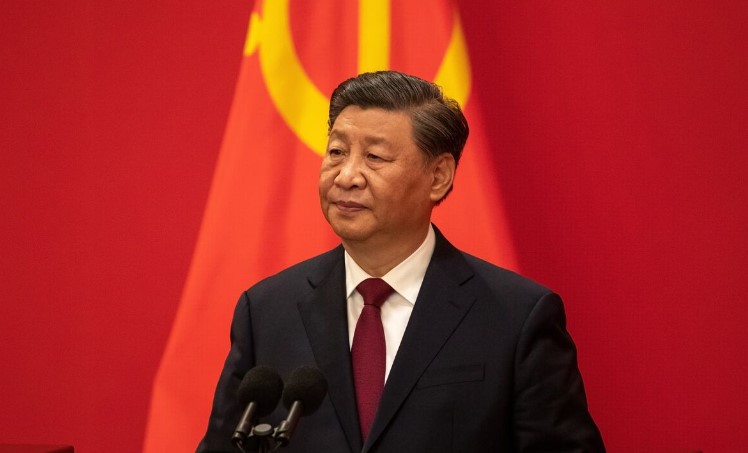
Under President Xi Jinping, China’s defence and security domain, both kinetic and non-kinetic, has shown immense growth. Xi has categorically tasked his military to ‘prepare for war’. China is in a hurry to achieve her strategic and national goals before her CNP plateaus (some say that is happening faster than predicted), especially her dramatic decline in demographic youth power.
The Ukraine war is a proxy war between the two power centres, bringing EU and NATO closer internally and externally and growing capacities to defend European landmass and leverage their CNP globally. The Ukraine war has decisively turned global attention, especially of bigger powers towards Asia and the Indo-Pacific, with a high probability of a new global great game for supremacy in Asia.
China’s Global Security Initiative (GSI), Defence Budget and its Impact on the Indo-Pacific Region
What does GSI mean to China
The GSI was launched by President Xi Jinping in UNGA in April 2022, calling on countries to adapt to the profoundly changing international landscape in the spirit of solidarity and address the complex and intertwined security challenges with a win-win mindset. While the general policies on foreign affairs and security are similar, as stated earlier, it is a new package and the latest expression of China’s international discourse that seeks to challenge the Western-led global governance system and especially to de-legitimise the US role in Asia and advocate an exclusivist approach to Asian security governance. It mainly talks of:
Concept of Indivisible Security: With growing threats posed by unilateralism, hegemony and power politics, and increasing deficits in peace, security, trust and governance, humanity faces increasingly intractable problems and security threats. Thus, China feels that the principle of “global indivisible security”, which means that no country can strengthen its security at the expense of others, should be the norm and institutionalised.
Asian Security Model: Implementing the above concept in Asia with a “common, comprehensive, cooperative and sustainable” security and building an Asian security model of mutual respect, openness, and integration”.
Opposing Sanctions: This would oppose the use of unilateral sanctions and long-arm jurisdiction, appearing to refer to Western sanctions.
Tackling New Cold War: The West’s Indo-Pacific strategy to divide the region, create a ‘new Cold War’, and use military alliances to assemble an ‘Asian version of NATO’. This view is bolstered by the formation of QUAD (USA, Australia, India, Japan); the resurgence of the ‘Five Eyes Intelligence Alliance’ involving Australia, New Zealand, Canada, USA, and the UK; and the military alliance AUKUS (USA, UK, Australia) as a precursor to cementing an “Asian NATO”.
China’s Defence Budget Through Chinese Eyes
*Source: Graphic-Global Times
On 2nd April, China announced a draft budget for 2023 which shows the country’s annual defence budget rise to 1.5537 trillion yuan ($224.79 billion), an increase of 7.2 per cent, remaining single-digit for the eighth consecutive year. From the Chinese perspective (Global Times), the figure marks a reasonable and restrained boost amid military spending sprees by many other countries around the world in light of global security tensions, the need to modernise its national defence to protect its sovereignty, territorial integrity and development interests facing external threats and instabilities.
There are contrarian signals emanating. Firstly, the external signs with the Ukraine war, the visit of Nancy Pelosi, the US overt anti-China geo-political and economic moves supported by the West and adverse global reaction against China forced Xi to give a call to get ‘ready for war’ during the Two Sessions, justifying its military modernisation.
However, China’s hegemonistic actions in Asia (India, South and East China Sea) indicate concrete steps towards Asian dominance, providing the rationale for defensive and offensive multi-domain manoeuvres. China aims to achieve the centenary goals of the People’s Liberation Army (PLA) by 2027, realise the modernisation of national defence and the armed forces by 2035, and fully build the armed forces into world-class forces by the mid-21st century and its security implications in a contested Indo-Pacific region does not help assuage frayed feathers of SEA countries.
Chinese Perceptions of Adversary Military Spend
The US, as usual, tops the list with an $817 billion budget for the Pentagon, more than three times that of China. Japan by a record-breaking 26.3 per cent higher than the previous year, and India by 13 per cent. EU and NATO have already substantially boosted defence spending. China’s defence spending as a share of GDP has remained stable for many years and is lower than the world average.
Focus on South East Asia
Foreign Minister Wang Yi has been vigorously broadcasting the benefits of GSI (Global Security Initiative) globally, especially in Asia. Regarding SEA countries, the region was in the spotlight with Wang Yi’s speech at the ASEAN Secretariat on 11 July 2022. Wang mentioned that the GSI is part of an effort to advance regional peace and stability for advancing ASEAN-China relations by supporting ASEAN centrality, cooperation on development, science, technology, innovation, and people-to-people ties. Specifically, Wang indicated that China would work with ASEAN countries to implement GSI cooperation in priority fields such as counterterrorism, joint maritime search and rescue, disaster management, and countering transnational crime, thereby strengthening security ties with ASEAN. Progress in non-traditional security areas, such as climate and cyber, and managing “differences and disputes” on the South China Sea would be enhanced. GSI remains vague, its future is unclear, and traction is far from guaranteed. Seasoned ASEAN officials rightly point out that while China has proposed a dizzying array of repackaged frameworks to Southeast Asian countries in recent years, only a few have eventually gained ground beyond Beijing’s hyping of initial rhetorical support. Unfortunately, the belligerent actions at sea in the South and East China region are contrary to assurances, making most ASEAN nations wary and unsure of China.
ASEAN Response
Undoubtedly, China is the most important economic partner for virtually every country in Southeast Asia, including US treaty allies. Initiatives like GSI are just part of China’s growing regional security role and its evolving efforts to knit together its expanding array of activities into proposals that can gain traction within the region and position itself more favourably relative to other perceived competitors. GSI does highlight the “Asia for Asians” vision relative to “outside” alternatives but is already facing pushback from countries such as Singapore Prime Minister Lee Hsien Loong cautioned that it was “neither realistic nor wise” to exclude actors from outside of Asia, including the United States.
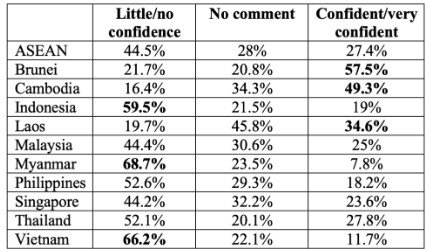
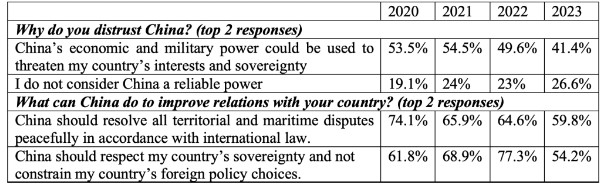
According to the State of Southeast Asia Survey 2023, the region’s overall reaction to the GSI is ambivalent and cautious as they fear that the GSI will increase US-China tensions and intensify pressure on regional states to take sides (see table 2 below). SEA states are aware of the vast gulf between rhetoric and reality when it comes to Beijing’s management of differences, including on the disputes in the South China Sea. China, under Xi, has followed a vigorous moralistic and nationalistic posturing and foreign policy, coupled with his more serious salami-slicing tactics both at land and sea. Without exception, all SEA nations have begun a surge in military expenditure to protect their national interests and lessen their dependence on the West and China.
The US Perspective, Actions and Ground Reality in SEA
Forcing states to choose between Washington and Beijing would be a strategic mistake. SEA is undoubtedly gaining strategic importance, especially given the US-China standoff and inadequate US policy moves and actions. Ukraine war awakened the Biden administration, which stepped up its game by filling up long-pending ambassadorial posts, clarifying its approach in key strategy documents, and boosting cooperation through initiatives such as the elevated Comprehensive Strategic Partnership between the US and ASEAN.
President Biden visited the region four times and even hosted the US-ASEAN Special Summit at the White House, bringing together nearly all ASEAN leaders. (Myanmar was not invited, and then Philippine President Rodrigo Duterte did not attend due to impending Presidential elections). The summit signalled that the US would invest further and still wields significant influence, despite China’s growing political, economic, and military clout.
However, US power status has taken a hit in recent times. Despite US rhetoric of ‘Centrality of ASEAN’ and promising deeper bonds, perceived close security ties with the USA are no longer desperately desired, as it signals hostility towards China. One notable success is the promulgation of the ‘Indo-Pacific Economic Framework for Prosperity (IPEF)’, a policy that pledges to cooperate with a number of countries on advancing sustainable, competitive, and fair economic growth, which seven out of the 10 ASEAN countries have signed up (minus Cambodia, Laos, and Myanmar).
The new US National Defence Strategy states “will invigorate multilateral approaches to security challenges in the region, to include by promoting the role of ASEAN in addressing regional security issues.” However, Chinese presence and economic clout cannot be wished away. It is no secret that SEA is increasingly uncomfortable with US-China competition and how it might impact the region’s security and stability. As already stated, the US has fanned the flames of competition by resurrecting QUAD and forming AUKUS, mainly when both aim to push China back from the Indo-Pacific region, including SEA.
Taiwan Manoeuvres: Barometer to SEA Nations
Historical research provides a perspective of the history of Formosa, now Taiwan, that “Taiwan has always been at the periphery, and most of the time outside the periphery of the Chinese empire“. Since its founding in 1949, Beijing’s People’s Republic of China (PRC) government has never had any sovereignty over Taiwan. It has always been ruled independently: first, by the regime of Chiang Kai-shek, who wanted to “recover the mainland”, but since the early 1990s, Taiwan has been a vibrant democracy that wants to be accepted as a full and equal member in the international family of nations.
Taiwan is the “reddest of red lines” for China, and it views it as an inalienable and integral part. US-China relations have followed a sine curve, and the US stand on Taiwan has been ambiguous at best. In his short Presidency, President Biden has categorically stated that the “USA would help Taiwan if it were ever attacked by China” (retracted by his advisors after every such assertion). The complex issue is outside the purview of this article, but suffice it to say that the USA is now firm in building up a formidable Taiwan military with commensurate hardware inside the island to enable Taiwan to sustain herself till the USA and her allies come to her aid physically (staggering military aid through FMS route provided by Trump and Biden administration alone; around US $42 billion, not counting the direct commercial sales). The necessity of stockpiling weapon systems is that Taiwan has no land connectivity, unlike Ukraine. The arms race ……. continues globally, including in SEA.
Complex Geo-Political and Security Environment in SE
China has laid claim and tried to control large tracts of the South China Sea for centuries, but aggressive overt manoeuvres have increased disproportionately since the past decade. The security environment of SEA has seen both continuity and profound changes. Chinese capabilities and capacities of prosecuting multi-domain confrontation and conflict have increased manifold; priority and intentions towards SEA could change for the worse precipitously. This insecurity provides an open invitation for the big powers to intervene.
Unfortunately, ASEAN does not think or act unitarily in security matters but focuses on its security agenda. Their perception of threats varies, as do their spending and acquisition patterns. China looms large during decision-making and military spending, especially the six states contesting territorial claims in the South China Sea (Brunei, Taiwan, Indonesia, Malaysia, Philippines, and Vietnam). The emphasis is on advanced long-range weapons, drones (UAVs), and creating effective anti-access/area denial systems/weapons that provide a credible deterrence. The increase in military spending has been so dramatic that the term ‘arms race’ has been used, implying a rapid excessive and destabilizing action-reaction pattern leading to regional military build-up and the potential of future large-scale armed conflict.
Military spending, percent of GDP, 2021 – Country rankings
The average for 2021 based on nine countries was 2.07 per cent. The highest value was in Burma (Myanmar): 3.33 per cent, and the lowest was in Indonesia: 0.7 per cent. The indicator is available from 1960 to 2021.
Below is a chart for all countries where data are available:
Growing insecurity has led South East Asian states to increase their military spending and arms acquisitions, mainly through imports. The increases are facilitated by economic growth. Military spending for the region increased by 33 per cent between 2009 and 2018, and arms acquisitions in the last decade were about twice those of the previous decade, significantly more than other regions’ global statistics .
Between 2002-2007, Southeast Asia’s military expenditure was less than $30 billion per annum, but it breached the $30 billion mark from 2008 to 2014; from 2015, SEA countries spent about $41 billion or more, touching $44.3 billion in 2020. The surge started around 2013 when China’s aggressive intent in the South China Sea became overt, and expenditures jumped from $34 billion to $38 billion and have been growing since.
Similarly, East Asian nations Japan (“record” defence expenditure of US $51.7 billion for 2023, emphasising “the most severe and complex security environment since World War II”), South Korea (US $48 billion in 2021, increase of 5.4 per cent), Australia (around A$42.75 billion, 2.19 per cent of the country’s GDP with plans to increase to 2.38 per cent of GDP by 2023-24) – all have enhanced military spend mainly due to muscular Chinese actions and policies.
India’s Role and Actions
India has strong historical links with SEA, and geographically and geo-politically, SEA is too close for comfort, given India’s regional power aspirations and status, maritime goals and strategic compulsions in Indo-Pacific (specially IOR). Our unresolved borders with China, perpetual strategic competition and confrontation, and present relations need to expand India’s strategic space to manoeuvre India to continuously upgrade and expand her CNP, focusing on building strong linkages and inter-dependencies with SEA by renewing focus on our ‘Act East’ policy. We can play honest broker in case of tensions in SEA and East Asia.
Interestingly, despite the current geopolitical winds, China hopes and aspires for good relations with India and has been calling for the same. India is in a good strategic space with the West led by the USA, the competitor led by China and Russia, the third pole of the Global South, and all the Rest wanting India on their side. India should continue promoting multilateralism under ‘Vasudhaiva Kutumbakam (The World Is One Family)’, restructuring the economic order for equitable, sustainable development, and taking a diplomatic leadership role towards cementing the Asian Century.
Conclusion
The world is focussing on Ukraine and the resultant churning geo-political balance, but the ‘centrality of Asia’ beckons, in which SEA is a pivotal region. The current turbulent security environment could exacerbate the differences between China and ASEAN. China and ASEAN nations need to sit down and resolve their differences and continue talking rather than precipitate a confrontationist phase. The USA needs to play an honest superpower to ensure stability in Asia. India needs to keep enhancing its CNP and multi-domain capabilities and concurrently take a leadership role in ensuring the “centrality of Asia” and the coming of the “Century of Asia”.
The Pakistani version of Game of Thrones is at a crescendo, with the spectacular arrest of Imran Khan, the former prime minister of the country, from the premises of the Islamabad High Court (IHC), where he had gone to appear for one of the hundreds of cases, ranging from sedition to corruption, that have been pressed against him by the incumbent coalition government of the country.
The difference between the original Game of Thrones and this Pakistani version is that while the former was a fantasy, the latter is very real and much more diabolic. The protagonists have let loose their political machinations due to their lust for power and the people are suffering terrible deprivation. Pakistan today is a certified failed state where the poor are literally starving, law and order is at its nadir and militant overlords are taking over the reins of the country.
Imran Khan holds the ignominy of being the first premier of Pakistan to be ousted from power after losing a no-confidence vote. He was replaced by a motley coalition of parties in the form of the Pakistan Democratic Movement (PDM). The main constituents of the PDM are the Pakistan Muslim League (Nawaz) and the Pakistan People Party (PPP). Both have ruled over the country at some point in time and both have been victims of the high handedness of the Pakistan Army, yet, they chose to “sleep with the devil” and took assistance of this very army to oust Imran Khan.
The Shahbaz Sharif led government was shaky from the word go and has not gained much in terms of stability with the passage of time. It is no surprise, therefore, that the streets of the country are dominated by the supporters of Imran Khan.
Buoyed by the support, Imran Khan launched an acerbic attack on his opponents. He alleged that his ouster was part of a US-led conspiracy that targeted him because of his independent foreign policy decisions on Russia, China, and Afghanistan. He openly blamed former Army Chief General Qamar Bajwa for his ouster. “This man pushed Pakistan into crisis. . . Bajwa ruined Pakistan’s political and economic gains”, Khan said. The diatribe did not end here, he soon took on the current Army Chief and, in recent days, has been insinuating that Major General Faisal Naseer and the notorious spy agency of Pakistan Army, the Inter Services Intelligence (ISI), are trying to assassinate him.
The Pakistan Army has slammed Imran Khan for making “highly irresponsible and baseless” allegations. “This has been a consistent pattern for last one year wherein military and intelligence agencies officials are targeted with insinuations and sensational propaganda for the furtherance of political objectives,” said the Inter-Services Public Relations (ISPR) of the Pakistan Army.
With elections in Pakistan due in October this year, Khan’s growing popularity has set alarm bells ringing in both the Army as well as Government circles. They have responded by pressing numerous charges against him with the intention of putting him behind bars.
Attempts by the Police to arrest Khan from his residence at Zaman Park in Lahore were unsuccessful. In what seems to be an act of desperation, he has now been picked up from the court by the Rangers, a paramilitary force of Pakistan. It is being said that the arrest had been made by the National Accountability Bureau for causing losses to the national treasury by giving undue favours to a real estate firm called Bahria Town. However, unlike India, where the paramilitary comes under the Home Ministry, the Rangers of Pakistan come under the Pakistan Army. Therefore, the arrest had been made by the Pakistan Army.
The IHC has reserved its verdict on the legality of Imran’s arrest with Chief Justice Aamer Farooq saying that if the PTI chief was arrested illegally, “he will have to be released”. “Come to court and tell us why Imran has been arrested and in which case,” Justice Farooq said while threatening to summon the prime minister if a satisfactory answer is not given. On being summoned, the Police Inspector General of Islamabad denied any knowledge of the arrest and said that he got to know of it from the media.
The President of Pakistan, Arif-ur-Rehman Alvi has also come out openly in support of Imran Khan and admonished the Government. “I am deeply saddened by today’s events. Unhealthy revenge politics. Poor priorities of the Government of a country that should focus on the economic misery of the people. Are we destroying the political landscape? Am I concerned about the safety & dignity of @ImranKhanPTI like that of all politicians?,” he said in a Tweet.
Obviously, the Army has taken things in its own hands, with the support of the Government. But the people are agitated and the Judiciary remains unconvinced about the constitutional legality of the action taken. The battle lines are clearly drawn.
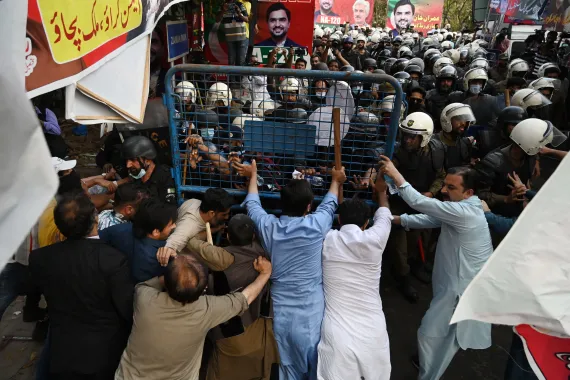
Before being arrested, Imran Khan exhorted his supporters to abjure violence. Despite his appeal, his supporters launched violent protests across the country with reports of agitated crowds attacking government property in important cities like Lahore, Peshawar and Karachi among many others.
In an unprecedented development, protestors attacked military establishments also. Reports, supported by videos, of protestors vandalising the house of Army Corps Commander in Lahore and even the Army Headquarter in Rawalpindi are doing the rounds.
Surprisingly, the Army has not reacted to this vandalising of its property and assets, indicating the possibility of a big divide on the Khan question within the establishment itself. It is well known that the Army Chief, General Syed Asim Munir is wholly against Imran Khan. The possibility of a revolt within is gaining credence by rumours of the Chairman of Joint Chief of Staff Committee (CJSC) General Sahir Shamshad Mirza taking over the reins of the Pakistan Army doing the rounds.
Undoubtedly, there is a civil war like situation in Pakistan though the civilians are without weapons and the Pakistan Army still holds the power to crush them ruthlessly. The evolving situation throws up a number of possibilities.
First, Imran is riding a sympathy wave even as no prediction can be made about his future. It cannot be said with any surety whether he will live to see the elections or be wasted away like Zulfikar Ali Bhutto. Presently, his whereabouts are not known.
Second, the inept government of Pakistan has joined with some elements of the Army and carried out an act that could be a big political miscalculation. Whether it will be able to ride through is a big question.
Thirdly, if the Government falls, the Army leadership could attempt to revive its image by imposing martial law. The Pakistan Army is known to put aside internal dissensions when the question of its survival comes up. This self-interest may well become dominant in the present context too.
A certainty that emerges is that the people of Pakistan are fed up with the current situation and are looking for change. They also seem to have lost the traditional respect and regard that they held for the Army and are questioning its position in the affairs of the country.
It is well known that the Pakistani elite, comprising the feudal and political families, the business magnates, bureaucracy and judiciary, has been responsible for the endemic governance deficit in the country marked with corruption and nepotism. This elite cannot go against the super elite which comprises of Army Generals (retired and serving) and the militant warlords who are possibly stronger than the Generals. The battle for resurrection, therefore, is lost before it can even begin.
The economic situation of the country is such that even the best and most committed economic pundits will find it difficult to turn it around, what to speak of the ham-handed politicians. The dismal situation is quite evident from the economic parameters – hardly $4 billion in foreign exchange reserves; a trade deficit of $50 billion and the Pakistani rupee in free-fall. The skyrocketing prices of fuel, gas, electricity, food, and medicines are putting tremendous strain even on upper and middle class families, what to talk of the poor and marginalised. How can the country survive?
India shares with the world a concern about the nightmare that a failed Pakistan entails. There is every possibility of the Army directing a misadventure towards India in order to save its teetering image. India therefore needs to watch the proceedings closely and remain ready for any and every eventuality.
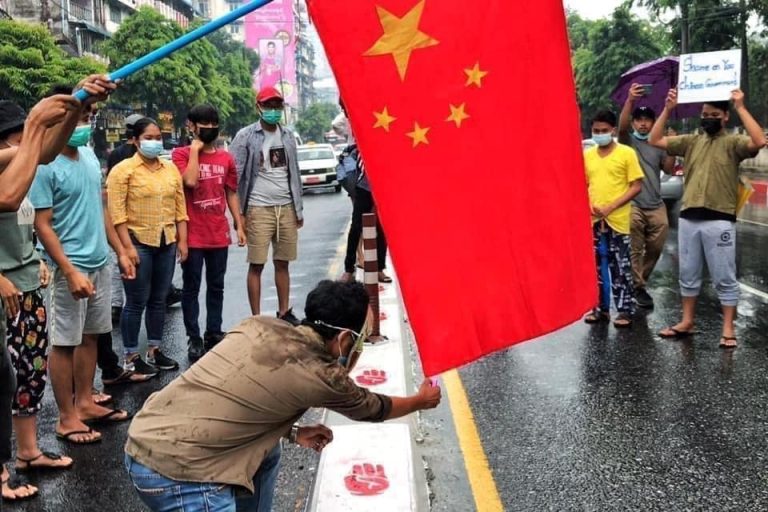
Protests erupted in Myanmar after China’s Foreign Minister Qin Gang met with the country’s military dictators and reaffirmed China’s commitment to work with the Junta regime as he made a stop in Myanmar en route to India . The angry protestors protested against China and burning of Chinese flags took place. China has strategic geopolitical and economic interests in Myanmar.China is a major arms supplier to Myanmar’s military. It also is Myanmar’s biggest trading partner and has invested billions of dollars in Myanmar’s mines, oil and gas pipelines and other infrastructure.
We use cookies on our website to give you the most relevant experience by remembering your preferences and repeat visits. By clicking “Accept All”, you consent to the use of ALL the cookies. However, you may visit "Cookie Settings" to provide a controlled consent.
This website uses cookies to improve your experience while you navigate through the website. Out of these, the cookies that are categorized as necessary are stored on your browser as they are essential for the working of basic functionalities of the website. We also use third-party cookies that help us analyze and understand how you use this website. These cookies will be stored in your browser only with your consent. You also have the option to opt-out of these cookies. But opting out of some of these cookies may affect your browsing experience.
Functional cookies help to perform certain functionalities like sharing the content of the website on social media platforms, collect feedbacks, and other third-party features.
Performance cookies are used to understand and analyze the key performance indexes of the website which helps in delivering a better user experience for the visitors.
Analytical cookies are used to understand how visitors interact with the website. These cookies help provide information on metrics the number of visitors, bounce rate, traffic source, etc.
Advertisement cookies are used to provide visitors with relevant ads and marketing campaigns. These cookies track visitors across websites and collect information to provide customized ads.
Necessary cookies are absolutely essential for the website to function properly. These cookies ensure basic functionalities and security features of the website, anonymously.
Cookie
Duration
Description
cookielawinfo-checkbox-analytics
11 months
This cookie is set by GDPR Cookie Consent plugin. The cookie is used to store the user consent for the cookies in the category "Analytics".
cookielawinfo-checkbox-functional
11 months
The cookie is set by GDPR cookie consent to record the user consent for the cookies in the category "Functional".
cookielawinfo-checkbox-necessary
11 months
This cookie is set by GDPR Cookie Consent plugin. The cookies is used to store the user consent for the cookies in the category "Necessary".
cookielawinfo-checkbox-others
11 months
This cookie is set by GDPR Cookie Consent plugin. The cookie is used to store the user consent for the cookies in the category "Other.
cookielawinfo-checkbox-performance
11 months
This cookie is set by GDPR Cookie Consent plugin. The cookie is used to store the user consent for the cookies in the category "Performance".
viewed_cookie_policy
11 months
The cookie is set by the GDPR Cookie Consent plugin and is used to store whether or not user has consented to the use of cookies. It does not store any personal data.