
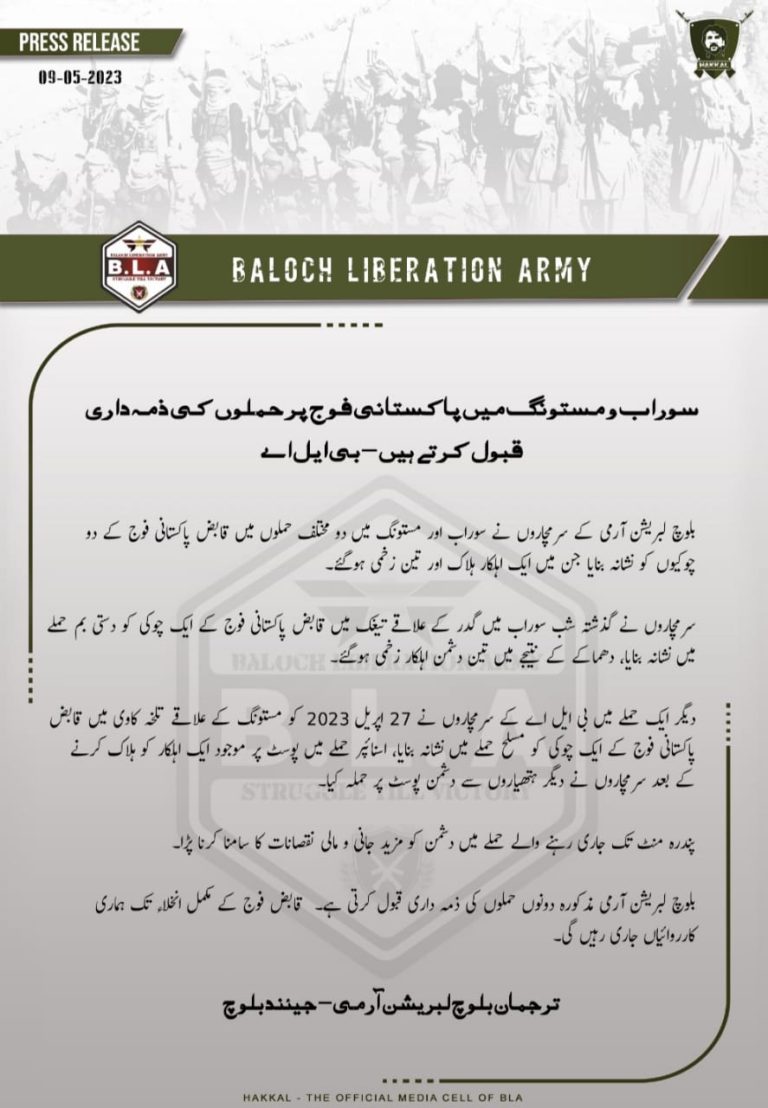
Freedom fighters (sarmachaars) of the Baloch Liberation Army (BLA) attacked two tyrant Pakistani Army’s posts, one in Surab and the other in Mastung.The attacks have resulted in the death of one Pak soldier and three others have been injured. Hakkal BLA’a official media released the statement of these attacks. Pakistan had forcibly occupied Balochistan in 1948 and has been committing atrocities on Baloch people since the last seven decades. Baloch Liberation Army (BLA) considers the defence and liberation of Baloch nation it’s utmost responsibility.
Poonch terror attack exposes Pakistan’s duplicity
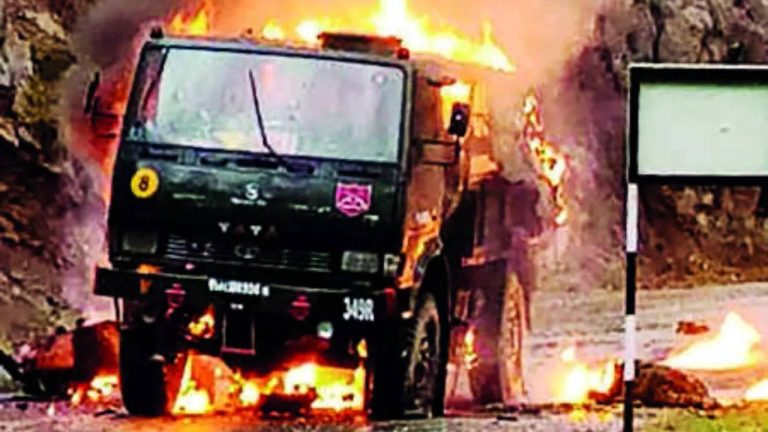
The recent attack on an Indian army vehicle by Pakistan backed terrorists in the Poonch area of J&K that claimed five lives is an extremely tragic incident that serves as a grim reminder of the fact that despite facing a host of extremely menacing domestic threats ranging from political instability to financial meltdown and burgeoning terrorism, Pakistan Army’s proxy war against India through state sponsored terrorism continues unabated.
The fact that Pakistan remained ‘grey-listed’ by international terror funding watchdog Financial Action Task Force [FATF] for four years leaves no room for doubt regarding its complicity in abetting and sponsoring terrorism. In fact, in 2019, the then Pakistani Prime Minister Imran Khan himself admitted that “when you talk about militant groups, we still have about 30,000-40,000 armed people who have been trained and fought in some part of Afghanistan or Kashmir” [emphasis added].
Khan’s revelation throws up some very pertinent questions such as- what makes terrorists of all colour and hue converge onto Pakistan? Why did Al Qaeda founder Osama Bin Laden choose to settle down in Pakistan? How come nearly 150 terror entities and individuals blacklisted by the UN Al Qaeda Sanctions Committee are either based in Pakistan, have links in the country or operate from the Pakistan-Afghanistan border areas?
The international community’s failure to seriously introspect on the potential dangers of Khan’s damning revelation and the fact that Pakistan hosts the largest number of UN designated terrorists, though deplorable, is still welcome. This is because it unambiguously exposes the harsh reality that despite waxing eloquent on creating a united front to unitedly tackle the scourge of terrorism, countries only take meaningful action on this issue when they are directly threatened.
Pakistan tries to conceal its use of terrorism as an instrument of foreign policy by playing the terror ‘victim’ card, but there is a mountain of evidence that exposes Rawalpindi’s enduring role in fuelling terrorism in J&K. What’s most surprising is that the Pakistan Army has no qualms whatsoever in directly associating itself with separatist activities in Kashmir and on this issue, former Pakistan Army chief Gen Qamar Javed Bajwa’s post Article 370 abrogation statement comes to mind.
Readers would recall that a day after New Delhi abrogated Article 370, the then Pakistan Army chief Gen Bajwa announced that “Pakistan Army firmly stands by the Kashmiris in their just struggle to the very end. We are prepared and shall go to any extent to fulfil our obligations…” [emphasis added]. This statement merits thorough deliberation as it clearly establishes Rawalpindi’s role in propelling proxy war in J&K. Let me explain.
When the government of Pakistan officially acknowledges providing political, moral and diplomatic support to separatists in J&K, isn’t Pakistan Army’s support to this lobby axiomatic? Hence, where’s the need for the Army to reaffirm this commitment? Secondly, what exactly does Rawalpindi’s assertion that the Pakistan Army is “prepared and shall go to any extent to fulfil our obligations” imply? [emphasis added].
Since the Pakistan Army doesn’t have any political or diplomatic outreach and as such what does Rawalpindi’s assurance actually mean?
The only conceivable “obligations” that the Pakistan Army could possibly have is provision of military related assistance to terrorists fighting in J&K in terms of training, supply of weapons and in providing safe sanctuaries. This Rawalpindi is duty-bound to do, because [to borrow United Jihad Council chief and Hizbul Mujahideen supremo Syed Salahuddin’s words], terrorists in J&K are actually “fighting Pakistan’s war in Kashmir”! [emphasis added].
What is important is that by saying that “We will continue to provide political, moral and diplomatic support to our Kashmiri brothers,” Pakistan Army’s present Chief Gen Asim Munir has indicated that Rawalpindi will continue supporting terrorist groups in J&K as hitherto fore. So, it would really be naïve to expect that Pakistan will discontinue its proxy war in J&K or hope that the international community will compel Islamabad to cease keeping snakes in the backyard to bite its neighbours.
The harsh reality is that while the ongoing proxy war being fuelled by Rawalpindi in J&K is here to stay, Rawalpindi is simultaneously making preparations on a war footing to open another such ‘front’ in Punjab by supporting Sikh separatists seeking ‘Khalistan’. Since the writing on the wall is clear, to expect Rawalpindi [which calls the shots in Pakistan] to have a change of heart is an unpardonable delusion.
New Delhi has no other option but to adopt a tough approach, and shedding its characteristic trepidation arising out of its ‘what will the others say’ syndrome, formulate a proactive no-holds-barred strategy that dissuades Pakistan from sponsoring proxy wars against India. To those who oppose strong action against Pakistan’s perfidy on the grounds that it will invite retaliation leading to loss of lives and limbs need to answer just one question- isn’t this happening even now when we’re doing more of talking rather than acting?
J&K: Candlelight march against the murder of 8 Shia teachers in Pakistan
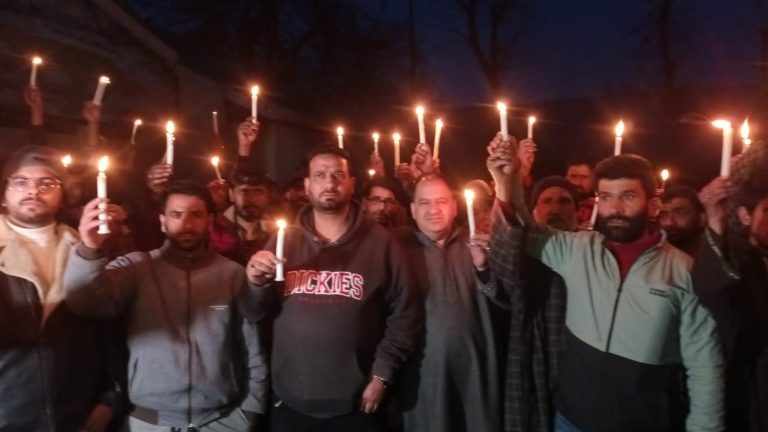
A late-night candlelight march was conducted in Srinagar on Friday to protest the recent targeted killing of seven Shia school teachers in Pakistan. The furious protestors at Srinagar’s Alamgari Bazar, Zadibal area put the blame on the Pakistan government for the killings and said that the country has been umable to stop these targeted killings.During a press conference held on Friday, Jamiat Ulema Isna Asharia Kargil (JUAIK) Ladakh condemned the attack on Shia minorities in Pakistan and urged authorities to take action against perpetrators.
Unidentified gunmen had shot the teachers in the staffroom of Government High School Tari Mangal.In another incident in the Parachinar region of Upper Kurram, a school teacher was killed while he was travelling in a car on Shalozan Road.
Mahal Baloch: Suicide bomber or a scapegoat ?
Background
In March 2017, Chinese Communist Party’s flagship newspaper Global Times reported that the then Pakistani Ambassador to China Masood Khalid had during a news conference stated that “Pakistan has deployed more than 15,000 troops to protect the CPEC, and the country’s navy has raised a contingent for the protection of Gwadar Port.”
However, despite creating a ‘Special Security Division’ [SSD] comprising 9,000 Pakistan Army soldiers and 6,000 paramilitary forces personnel exclusively for the security of the CPEC project and Chinese nationals working on it, the Pakistan Army hasn’t been able to prevent armed Baloch groups from attacking Chinese nationals working on this ambitious project.
Nor has the Pakistan Army’s perverse stratagem of using enforced disappearances and its notorious ‘kill and dump’ policy helped in preventing Baloch nationalists from targeting Chinese workers engaged in exploiting Balochistan’s natural resources. Just two years and two months after SSD was created, a small group of Baloch separatists carried out a suicide attack on Zaver Pearl-Continental Hotel in the strategic port city of Gwadar.
Luckily, no Chinese nationals were killed or injured in this attack. However, this incident became a cause of grave concern for Beijing since it had developed this five star hotel as part of the CPEC project which is extensively used by Chinese nationals. So, it justifiably demanded Islamabad to do more for ensuring safety of Chinese citizens, and Rawalpindi immediately obliged.
Within days of the Pearl Continental Hotel attack, Director General [DG] of Pakistan Army’s media wing Inter Services Public Relations [ISPR] announced that in addition to SSD, an additional force of an equal size would be created to protect the CPEC project. Unfortunately, despite massive troop deployment and barbaric retribution practices, the Pakistan Army has failed to curb attacks by determined Baloch nationalists.
Worsening Security Situation
It was on April 26 last year, when for the first time in Balochistan’s long history of resisting Pakistani occupation and brazen exploitation of this region’s natural resources, a female turned herself into a human bomb and targeted a bus in Karachi, killing three Chinese nationals. While security of its citizens rightly became a matter of serious concern for Beijing after this attack, Rawalpindi’s abysmal failure to ensure the same caused great embarrassment to Islamabad.
So, there was much jubilation within the security community when in just two weeks after the Pearl Continental Hotel attack, Pakistan police claimed to have arrested a ‘would-be’ female suicide bomber from the South Balochistan. Alleging that she was a member of Baloch Liberation Army [BLA], the police alleged that she had admitted planning to blow herself up near a convoy of Chinese nationals along the CPEC route.
While this was surely a reassuring development, three issues put a big question mark on the credibility of the police claims.
Firstly, the police stated that the apprehended woman had confessed that she “wanted to target a convoy of Chinese nationals” and this may be true. However, considering that Chinese nationals working on CPEC projects are being protected by the 30,000 strong SSD, chances of a successful suicide attack and that too on a “convoy of Chinese nationals,” [Emphasis added] are extremely remote, especially when it’s a female suicide bomber who’s acting alone.
Secondly, though the police have claimed recovering explosives and detonators from this potential suicide bomber, it has failed to produce any other evidence to support its accusation. Thirdly [and most importantly], it’s the timing of this apprehension that raises serious doubts regarding authenticity of police claims.
In its news report, Al Jazeera mentions that the so called suicide bombers arrest “came hours before Pakistan’s Prime Minister Shehbaz Sharif, in a telephone conversation with his Chinese counterpart Li Keqiang, conveyed his condolences over the April killings and promised maximum security for thousands of Chinese working in Pakistan.” So, either this woman suicide bomber’s arrest is an incredible coincidence, or just a ploy to humour Beijing!
Lastly, since nothing more has been heard about this woman thereafter, there are all the reasons to take the CTD’s claim of this woman being a suicide bomber with a fistful of salt!
Dancing to ‘Big Brother’s’ Tune
While China and Pakistan may glibly boast about being ‘Iron-clad brothers’, but there can be no two views that the former is certainly the proverbial ‘big’ brother who calls the shots- an inference validated by the 2021 Dasu Dam incident. Readers would recall that on July 14, 2021, a bus carrying Chinese technicians working at the Dasu Dam Project met with an accident in the Upper Kohistan district of Khyber Pakhtunkhwa in which 12 Chinese workers died while several others were injured.
Speaking on this incident in Pakistan’s National Assembly, Adviser to the Prime Minister on Parliamentary Affairs invoked the terrorist angle by referring to it as a “cowardly attack”. However, just hours later, the Foreign Office [FO] contradicted his assessment by saying that the bus “plunged into a ravine after a mechanical failure resulting in leakage of gas that caused a blast.” [Emphasis added]. However, Beijing refused to accept the FO’s view and insisted that it was a terrorist attack and the reason for the same isn’t hard to find.
Had it been an accident due to human error or mechanical failure, Beijing would be required to pay compensation to families of the deceased and those injured. However, if it was a terrorist attack, then the onus of compensating the dead and injured falls on Islamabad since the Pakistan Army is responsible for ensuring safety of Chinese nationals. No wonder ‘Big Brother’ Beijing insisted that the Dasu incident be classified as a terrorist attack and Islamabad had no other choice but to oblige.
So, when Pakistan’s Foreign Minister Shah Mehmood Qureshi contradicted the assessment of his own FO by declaring that the Dasu incident was an act of terrorism, it was obvious that Beijing had prevailed. To give his ludicrous assertion a semblance of authenticity, Qureshi claimed that this incident was executed by Tehreek-e-Taliban [TTP] with active support of Indian and Afghan intelligence agencies. But with no evidence to substantiate his assertion, his claim found no takers.
With Islamabad finally agreeing to pay a whopping USD 11.6 million to China as compensation for death and injuries suffered by its citizens in the Dasu incident, Islamabad must have realised that ‘iron-clad’ friendship is an expensive proposition!
Scapegoating Continues
In January this year, China’s new Foreign Minister Qin Gang made the first phone call to his Pakistani counterpart and explicitly told Bilawal Bhutto Zardari that “the Chinese side is highly concerned about the safety of Chinese citizens in Pakistan and hopes that the Pakistani side will continue to take strong security measures.” It doesn’t rocket science to discern that this polite sounding request was actually a stern warning.
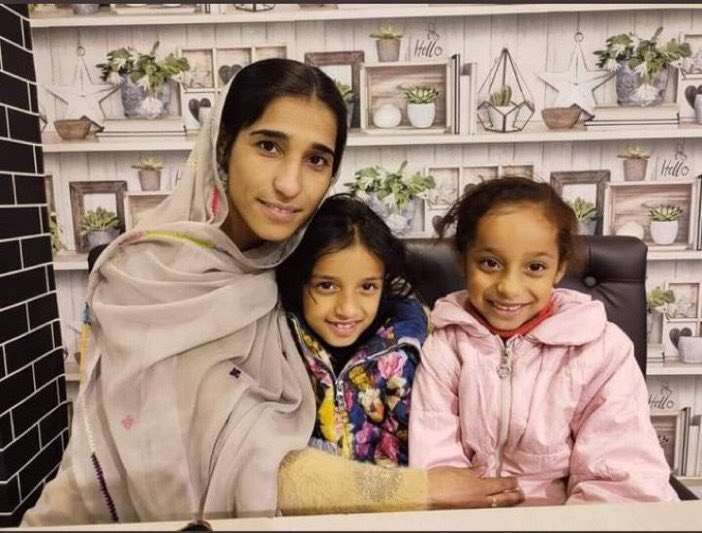
Once again, Islamabad suddenly struck gold within a matter of just nine days when it supposedly apprehended another 27-year-old female suicide bomber named Mahal Baloch, a single mother of two, belonging to Gumazi area in Kech district of Balochistan. The police maintain that she’s “a suicide bomber and affiliated with the Baloch Liberation Front (BLF) and was arrested near Satellite Town Ladies Park in Quetta”, and claim to have recovered a suicide vest packed with four kilograms of explosive from her.
However, several dependable witnesses have confirmed that Mahal was whisked away from her home after a late night raid by members of the Counter Terrorism Department [CTD] and the police claim of her being arrested in Quetta is a fabrication. Based on reliable inputs from multiple sources, Amnesty International [AI] has determined that “On 17 February at 11pm, the home of Mahal Baloch was raided by 12 security agents. The agents had not provided a warrant or any sort of legal documentation ahead of or during the raid” [emphasis added].
What makes Mahal’s arrest all the more suspicious is that she’s been produced before courts four times and on each occasion, the police have asked for a custody extension. While failure of CTD to provide clinching evidence to substantiate its claim of Mahal being a suicide bomber even after having kept her in custody for more than two-and a half months is inexplicable, the decision to telecast her purported confessional videos raises serious doubts regarding the genuineness of CTD’s claim.
Mainstreaming Human Rights Violations in Balochistan
Mahal represents one of the thousands of Balochis being brutalised by Pakistani security forces in the garb of counter-terrorism operations. Surprisingly, the international community doesn’t seem to have either time or the inclination to speak up for the tormented people of Balochistan, and this is what has emboldened the Pakistan Army to let loose a reign of terror in this region.
Perhaps this is why in 2019, while replying to a question regarding enforced disappearances in Balochistan, DGISPR had the gall to say, “We don’t want anyone to be missing, but war is ruthless. Everything is fair in love and war” [emphasis added]. That Pakistan Army’s barefaced attempt to mainstream human rights violations in Balochistan hasn’t irked the international community and rights groups is regrettable.
Postscript: What makes this case all the more intriguing is that while the authorities have allowed extensive televising of Mahal Baloch’s purported confessional statement and thereby encouraged her ‘media trial’, Human Rights Commission of Pakistan [HRCP] despite being the country’s apex independent human rights body, has inexplicably denied access to her.
Something is surely amiss!
Indian army eliminates 4 Pakistan backed terrorists in Kashmir
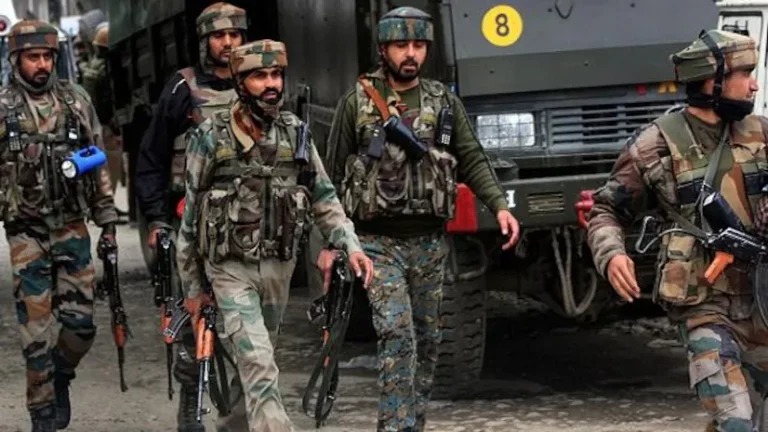
In a span of 24 hours the Indian army (Northern Command) has successfully launched a strike against Pakistan backed terrorist groups in Jammu and Kashmir’s Baramulla and Machal. The army eliminated four terrorists.Police said incriminating materials, arms and ammunition, including an AK 47 rifle and one pistol were recovered.
Hindu girl forcefully converted to Islam after abduction in Sindh

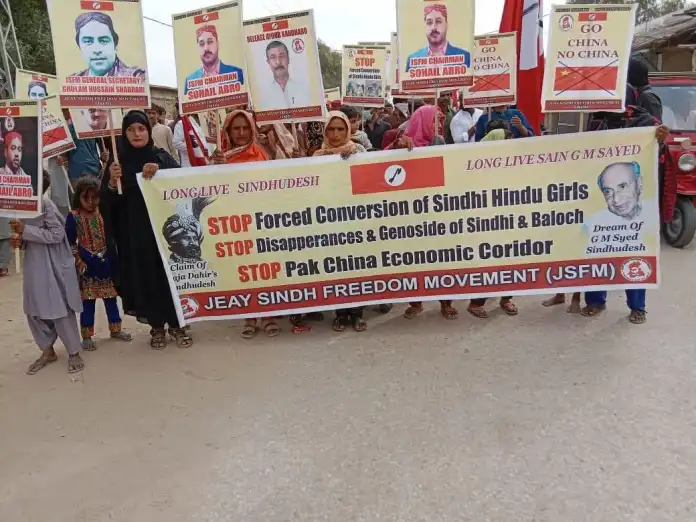
Another Sindhi Hindu girl Pars, daughter of Morji Maheshwari, resident of Ghulam Shah Lane Lyari, was kidnapped 15 days ago. The girl was forcibly taken, married and converted into Islam.This incident is just the latest in a string of similar kidnappings and forced conversions of Hindu girls in Pakistan, highlighting the continuing persecution of religious minorities in the country. Young girls are abducted, converted into Islam and forced to marry or are kept as sex slaves or raped.These incidents are happening on a daily basis across Sindh at the behest of Pakistan Army. Recently Sindhis took out protest rallies and shouted slogans against forceful abduction of Hindu girls and loot of natural resources in the name of CPEC (China Pakistan Economic Corridor). Sindhi protesters carried large banners that read “Stop Forced Conversion of Sindhi Hindu Girls”, “Stop Disappearance & Genocide of Sindhi and Baloch”, “No China Go China”, “Sindhis reject CPEC corridor”. All Sindhi protesters carried national flag of Sindhudesh.
BLA freedom fighters kill 3 Pak soldiers in Balochistan
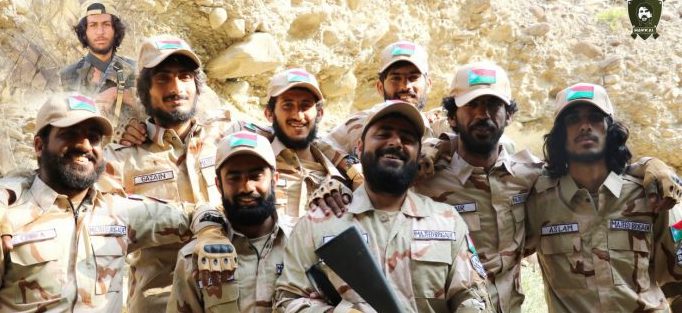
In a BLA press release, Jeeyand Baloch, spokesman for the Baloch Liberation Army has stated that BLA freedom fighters of the Baloch Liberation Army eliminated three personnel of occupying Pakistani military and destroyed a communications tower in three separate attacks carried out in Noshki, Panjgur and Mach.
He said that at night BLA fighters targeted an outpost of Pakistani military on a main highway in Noshki. In the hand grenade attack, an enemy personnel was killed and two were critically injured.After the attack, the Noshki police tried to intercept BLA fighters, however with good planning BLA fighters successfully reached their desired destination.
BLA has warned the local police and Levies forces in Balochistan to refrain from becoming an hurdle in front of Baloch liberation movement, and stop harassing the Baloch public. If such forces fail to pay heed then they will have to bear strong consequences.
The communiqué further states that in a separate attack in Panjgur, BLA fighters targeted a vehicle of Pakistani occupying military with an IED near custom area of Washbodh. This attack eliminated two enemy personnel, injured at least three Pakistani personnel and destroyed the enemy vehicle.
In the third attack, BLA fighters destroyed a communications tower in Mach, Bolan.
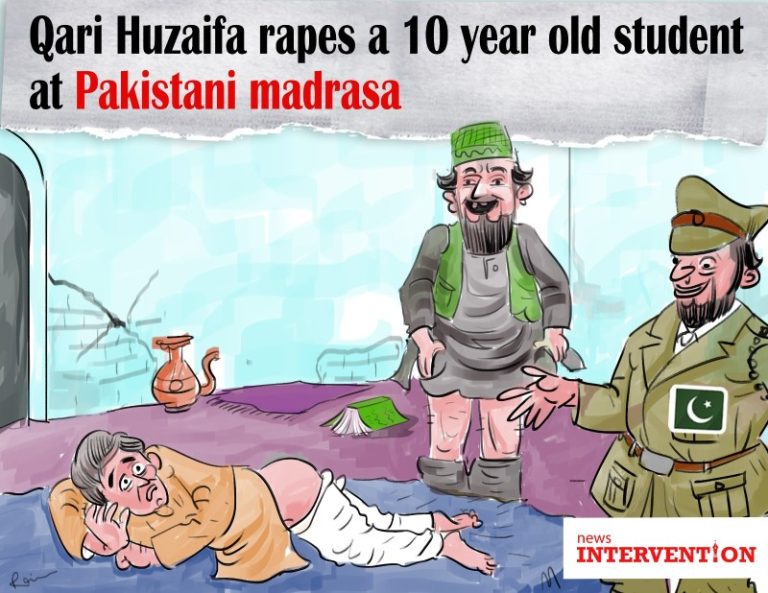
Qari Huzaifa rapes a 10 year old student at Pakistani madrasa

Qari Huzaifa and his partner have raped a 10-year-old student at Khanewal’s Jamiat al-Habib madrasa in Pakistan’s Panjab province, and in order to hide this heinous crime all talk against this sexual assault has been dubbed as an “attack on Islam” and a “plot against madrassas”.
The religious community of the madrasa is worth analyzing, especially in the context of this incident. When the rape at Jamiat al-Habib madarasa was reported, the victim was quickly branded as a concealed atheist or Qadiani by members of the religious community at the Khanewal madrasa. Instances of sexual intercourse in schools and colleges were cited as justification in response to this horrific rape against a ten year old boy. The Islamic religious community demanded that people who talk about the Khanewal rape incident should first speak out against sexual relationships that takes place in schools and universities, otherwise, they will be labeled as hypocrites.
Incidents of rape by clerics at madrasas are particularly concerning because the rape accused at madrasas are offered all kinds of help by religious elite, they are fully supported, and after a while, these rape accused are seen giving religious lectures elsewhere. The increasing trend of rape in madrasas is dangerous, and people should never send their children to residential madrasas until the Islamic religious community stops shielding these rape accused.
There are now schools where students can learn to read and memorize the Quran. Instead of the madrasas, children can be educated in such institutions until Islamist leaders openly come out against the rape accused in madrasas.
Interestingly, in order to avoid such issues, nowadays several parents invite Islamic clerics and qaris to their homes to teach Quran to children but these pervert maulvis do not hold themselves back. Even at a child’s home these qaris and maulvi’s find some way to have sexual relations with children.
Several Muslims say that these clerics, maulvis and qaris must be completely prohibited from entering the home in the name of teaching the Quran in order to protect children from these sexual predators. Of course, not all clerics and maulvis are same, but nobody knows when a cleric’s or maulvi’s sexual desires will surface and they sexually assault a gullible child. The reason for sexual perverseness in mullahs is sexual suffocation. They are suffocating because, owing to the issue of eye protection, they cannot look at women, and yet they desire to be in the company of women. The result is intense sexual suffocation, and if this suffocation does not find a proper route, they start fantasizing about women and/or force themselves on any available girl/young boys. They begin to perceive every youngster as a toy to be enjoyed which leads to rapes, like the unfortunate incident at Khanewal’s Jamiat al-Habib madrasa in Pakistan.
Pakistanis torture Ahmadiyya on allegations of insulting the Prophet
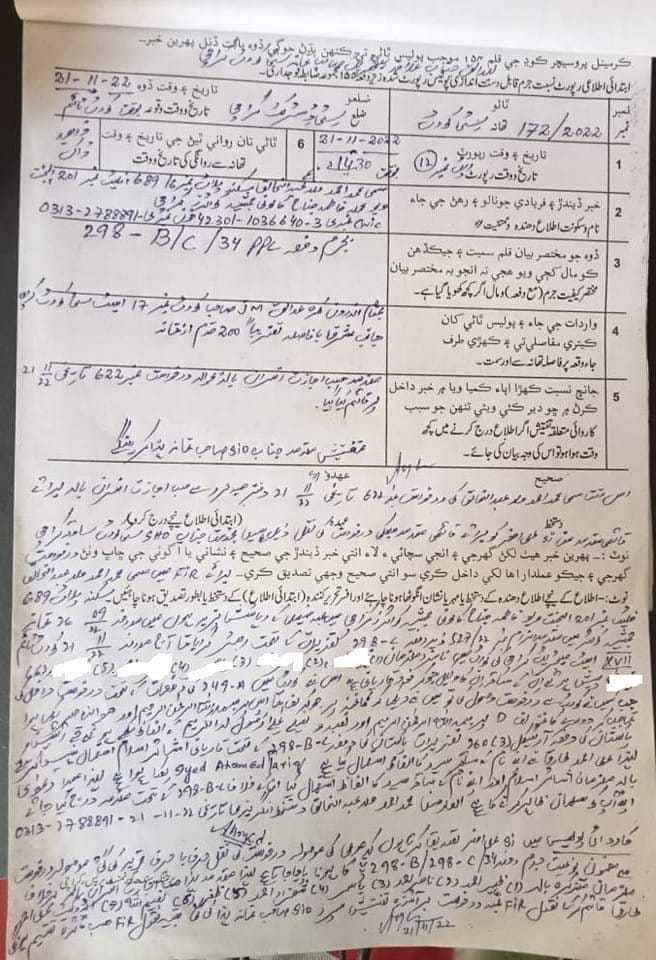
In Pakistan, an Ahmadi (one who belongs to the Ahmadiyya Muslim community) has been accused of “blasphemy” just for associating himself with the Prophet of Islam on a hereditary basis. Human rights activist Senge Sering from Pakistan-occupied Gilgit-Baltistan (POGB), currently residing in the United States, says “…if non-Muslims consider Islam as a religion that promotes racial discrimination and bigotry, then Muslims should not be displeased by it. This is entirely a personal and individual act.” Ahmadis in Pakistan have often come under religious religious persecution and discrimination. Pakistan is not only a hell for Ahmadiyyas but also for other minorities. Physical assault like beating and torture on the Ahmadiyyas and other minorities has become a routine practice in Pakistan and their government institutions.