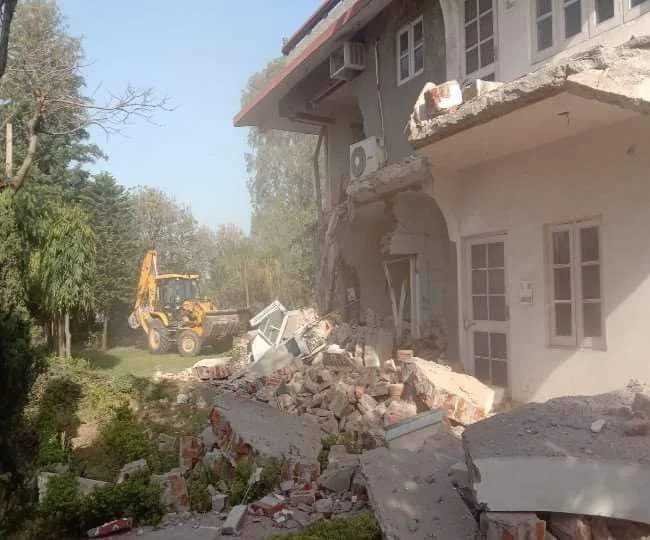
After UP, J&K has come into focus for bulldozing operations. There is a weird story behind the grabbing of state lands and erecting residential or commercial structures on them. It is not only a matter of illegal land grab and its weird aftermath; it is a schematic intrigue forged by the top ruling or non-ruling valley-based political leadership supported discreetly by the state bureaucracy with sinister objectives. Proverbially speaking, it is the tip of the iceberg and the time demands that its bottom should be exposed.
Land grabbing or encroachment of state land is not unprecedented wrongdoing nor is it limited to J&K only. But what we are trying to unravel is a long-drawn game plan aimed at subverting secularism and democracy to perpetuate the precedence of Muslim majoritarianism in J&K which may ultimately end up in the emergence of a theocratic state in theory and practice.
The Machiavellian enterprise of transferring thousands of canals of state land —barren or grassland— nearby the capital cities, to the members of one particular community against a cost next to nothing, with covert or overt involvement of the devious bureaucracy, is a definitive exposé of the Kashmir leadership aiming at converting Kashmir into an Islamic theocratic State.
Knowing that democracy means numbers as long as our sham democracy is concerned, it is obvious that the concentration of a religion-fixated community wants to attain the first pre-requisite of political empowerment through the instrument of majority vote.
Two objectives were behind the dubious Roshni Act. Amusingly, the essence of the Roshni Act was injected into the socio-political construct of J&K by both NC and PDP. Working in tandem, both agreed to make the Congress-ruled administration its cat’s paw. Thus, Ghulam Nabi Azad of Congress, expecting the two mainstream parties of Kashmir to lend support to his government, agreed to carry the cross. After going through some revisions, the notorious Roshni Act was passed by the legislative assembly. This is how an anti-national move that would strike at the roots of democratic secular dispensation in the State was legalized.
Armed with a strong instrument of legislative approval, the government unhesitatingly began to unfold its objective of working out the preliminaries of a theocracy to replace the fragile secularist dispensation. The modality for executing the plan was what is known in Islamic jurisprudence as “takiya” or concealment. How the plan of Islamization would be implemented, who would be the prime actors, what was the time frame, etc., all related details were kept as highly guarded secrets. Secrecy is the hallmark of Islamic jurisprudence and that is why democracy does not suit the Islamic mindset. It has not succeeded anywhere in the Islamic world.
The concealment theory referred to above, unfolded first in 1990, when the NC leadership resigned from the government. It was a masterstroke to legitimize all the perfidy that followed the outspread of insurgency in Kashmir Valley. To disown any responsibility, the NC top leader took a speedy flight to London to be out of the picture as the sponsored terrorists unleashed mayhem, killing and chaos that ultimately forced the hapless Hindu minority to flee the land of their ancestors. The leader who had been voted to power through a democratic process, played golf in London while his voters saw the sword of death and devastation hanging on their heads. The plan of ethnic cleansing of Kashmir was in full progress.
The planning was foolproof. After the NC leader hid in London, his ministers were no more in power, but still ran to Jammu, grabbed government quarters, and established liaison with the insurgent commanders to guide and advise how the ethnic cleansing and Islamization of Kashmir had to be pursued. At the same time, they impressed upon the Commissioner and others in the Jammu administration to provide them with full security.
Farooq knew that after he resigned, Governor’s rule would be imposed in J&K. That happened to the satisfaction of NC as well as PDP and other dissenting groups because now they had the buffer between them and the administration in New Delhi. They brought slander against the governor saying it was on his behest that the Hindus departed from the valley. The entire Muslim population of Kashmir orchestrated the same narrative which continues down to the present day. In doing so, they do not mean to malign Governor, the late Jagmohan. They meant to shift the onus to the buffer between them and New Delhi.
In this way, the first step of denuding the Valley of the presence of Hindus and paving the path for Islamization became a success. Since the Congress or BJP government in New Delhi did not react to the heinous crime of subjecting the valley to ethnic cleansing and genocide of the Hindus, the operators of the Islamization agenda got emboldened and embarked on the second stage of solidifying the theocratic character of Kashmir.
The second vicious step was of building up concentrated Islamic locales in the peripheries of Jammu city. The objective is to equalize or even upset the demographic complexion of the city. Muslim-dominated localities like Sidhra, By Pass, Sabzi Mandi, Sanjwan, Gujar Nagar, etc., were either built or reinforced. Mostly, members of the affluent sections of the valley majority came to inhabit these locales where the government immediately provided civic facilities to make their stay in new locales comfortable and hassle-free.
The third and crucial step was to plan the establishment of vast inhabitation in Jammu of a good number of the valley’s majority community members plus the affluent Muslims from the far-flung areas like Bhaderwah, Doda, Kishtwar, Rajouri, Poonch, Surankot, Ramnagar etc. To achieve this goal, the valley-based leadership drew up the collective plan of grabbing thousands of canals of state land in the proximity of Jammu city and planting the Muslim population there. Avoiding direct responsibility, they let the Azad government (Congress) carry the cross. The Roshni Act was passed which opened the way for bringing up the tail-end of the masterplan.
Two important guiding outlines were strictly observed in distributing the loot called Roshni Act. One was that no non-Muslim would be allowed to claim or bid for land under Roshni Act, and secondly, the land would be given away to the bidders (only Muslims) against almost no price. Thus, land worth billions of rupees were given away for peanuts. It was indirectly a gift for those Muslims who had opted for the Islamization of J&K by agreeing to inhabit the new sites.
Who then were the recipients of the largesse of the Kashmir government? Chief Ministers or their wards, former or sitting ministers, MLAs, top Muslim bureaucrats, political leaders of all hues, industrialists, business magnates, political bigwigs, mafia runners, influential segments of administrative departments and affluent Muslims from any part of the State.
They grabbed large chunks of land almost free of cost, and established localities as detailed below:
1.Khatinka Talab- 90% Muslim
2. Gujjar Nagar 90–95% Muslim
3. Bathinda-80–85% Muslim
4.Sunjawan-90% Muslim
5. Sidhra-80–90% Muslim
6. Karbala-80% (Mostly Shia Muslims)
7. New Plot-50–60% (Mostly Shia)
8. Malik Market-70–80% Muslim
9. Channa Rama-65–75% Muslim
10.Raika (Near Sidra) 95–100% Muslim
11. Agoda (Near Sidra) – 75% Muslim
12. Baxalta- 79–85% Muslim
13.Prem Nagar (Near Gujjar Nagar) 50–60% Muslim
14.Shahabad Colony (Near Baghe Bahu)-85% Muslim
15. Bashir Gujjar Basti (Near Blachernae) – 90–99% Muslim
It is in these localities — where revenue records show the lands belong to the state and were illegally grabbed by the occupants — the bulldozer has to come to play its role.
The question is this: Will the bulldozer be able to visit all these localities or not? The final take from this sordid story is that the Kashmir political rulers established nearly two dozen Muslim-dominated localities in Jammu but it is not prepared to allow the displaced Pandits to return and resettle in Kashmir. That makes us believe we are living in a sham of secular democracy which in practice is the Islamized state of J&K.
‘The war in Ukraine in 2023, will see prolonged, grinding attrition operations along a line of control that neither side accepts’
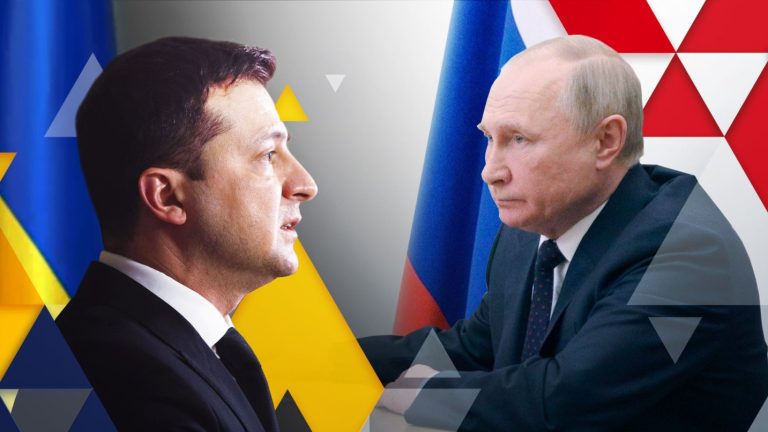
Total multi-domain war in the times of no war General Mark Milley, Chairman of the US Joint Chiefs of Staff during Nov 22, sent shock waves through Western capitals when he declared that the war in Ukraine is unwinnable by purely military means[i]. He further suggested, “now that Ukraine is in a position of strength, and winter acting as an obstacle to both sides, it would be appropriate to consider peace talks with Russia”. He referred to World War I, when the adversaries’ refusal to negotiate led to millions of additional deaths, and stopped short of saying, that the world could well be heading for WW III under a nuclear backdrop. His remarks caused consternation not only in Kyiv but also in NATO, and many of its Western backers, including Poland, the Baltics, North America, and the United Kingdom, which have endorsed Ukraine’s pursuit of complete military victory. Many EU leaders like the Estonian Prime Minister Kaja Kallas have categorically stated that the only path to peace is to push Russia out of Ukraine, which in essence implies defeating Russia militarily[ii]. Their rhetoric and wishes do not end there, they demand the trial of Russia’s political and military leadership for war crimes, reparation of damages and NATO membership to Ukraine. Frankly, even to a geo-political novice, these terms and conditions would be unacceptable to Russia. President Zelensky’s ten-point peace plan restates the same, making even talks forget about reaching a deal a non-starter.
Geo-political implications We are looking at a long war of attrition, which would increasingly cause geo-political upheavals and conditions not in the control of even the most dominant player, the USA. Naturally, it would imply that the West and NATO led by USA would continue to support Ukraine in all domains; military, economic, diplomatic, information warfare (global perception management), intelligence sharing and psychological. All the while testing red lines which could abruptly explode, increasing the danger of escalation both in terms of span of conflict (nuclear conflagration), and inadvertently drawing in nations on both sides specially NATO. The war has already had a very deep and adverse impact on the global economy specially for the Global South, as also providing opportunities to non-conformist authoritarian/autocratic nations to secure their national interests at the cost of other nations and a stable security environment; Chinese adventurism, over-reacting USA raising fears of another cold war, energy crisis, right wing expansionism, decline of globalisation and multi-lateralism with rise in ‘my nation first’. It has compelled nations specially the smaller and poorer ones to adopt a policy of strategic/principled neutrality, to ensure they do not get singed to machinations of either side of the conflict. The West essentially would like to degrade Russia’s comprehensive national power (CNP) to such an extent that she no longer can impose her will in Europe and globally; for this Russia has to lose and President Putin has to go. Consequences have been colossal and tragic so far; over six million Ukrainian refugees and counting; over one million deaths on both sides[iii], destruction of essential infrastructure of Ukraine, freefalling Ukraine economy and a unified, stronger Europe robustly ganged up against Russia, whilst concurrently weaning itself off Russian energy and materials (ideal conditions for escalation).
Ukraine and the West are winning the information war The outside world has been kept in the dark regarding the Russian perspective; why they started a calamitous war and how Russia is faring against the sanctions, and in the war. What emanates is also the western net and media inputs imagining the Russian thoughts. This article is focussed on the Russian perspective without being judgemental; difficult to access worthwhile material emanating from Russia as even the global tech and IT giants have corroborated in waging a ‘mother of all information and psychological wars’ highlighting and pushing their narrative, and as of now are winning in this vital information domain.
Crossing of Russia’s Red Lines: Existential anxieties There is enough recorded evidence available, and supported by most strategic and defence experts that Ukraine joining NATO, has always been ‘The Mother of Red Lines’ for Russia. The Russian leaders, the military and public view this as existential, jeopardising their rightful place in the comity of nations. How can one forget that for many centuries and till two odd decades ago, Russia (albeit as USSR, but essentially Russia) was a global power with the largest nuclear arsenal. It would be reasonable to suggest that any leader other than Putin would have invaded Ukraine; before it is too late and a fait accompli NATO member.
Broad Russian public support and Russian resilience Contrary to Western media tirade, Russia is stronger than many would have predicted, and importantly her economy, leader and army have all weathered the storm. Putin has not lost his mystique and confidence, at least in his media interactions and speeches. Undoubtedly, Russia lacks the broad and deep support that Ukraine has received from its partners and allies, The Russian military would be dispirited by repeated defeats, but it has survived, learnt lessons, consolidated its defensive positions by shortening its front line and logistic tail. Its economy has by all counts withstood the storm though it will progressively weaken; currently down by just 3% , significantly less than some had predicted, and its financial system has proved sustainable and macro-economically stable. History has proved that economic pressures and sanctions have rarely ended a war. Russia’s war machine remains funded and equipped, and is suffering the same inadequacies which the West and Ukraine is facing; albeit with lesser avenues for procurement sensitive and key weaponry and munitions.
In today’s world of hyper nationalism, it is hardly surprising that the majority of Russians continue to support the Russian government and are not ready to accept defeat (grudgingly accepted by West). The common man has accepted Putin’s grave warning that Western sanctions were imposed to crush the Russian people. Many regard Crimea and its stronghold of Sevastopol worth fighting for, and Putin remains the guarantor of Russian sovereignty and stability. To many oligarchs and even most ordinary Russians, the possibility of a defeat and Putin’s removal is a nightmare scenario, which they fear may precipitate implosion of Russia. Hence, the outcome of the war is existential to most Russians. Putin has over the years written and declared “We always considered the Ukrainian people as brotherly, and I still think so,” and “What’s going on is certainly a tragedy, but it’s not a result of our policy.” Like in all totalitarian regimes, supporting numbers could change and reverse direction rapidly against Putin, as causalities rise and defeat seems more probable. Putin is fully aware of the consequences of a defeat to Russia and to him personally.
The ongoing winter and spring will be a crucial test for the Russian army’s ability to endure, but military experts do not predict its collapse. Many more defeats and retreats would be needed to change this assessment. The Ukrainians are already warning of a spring offensive when the freshly mobilised troops are available; what could be Putins operational objective is currently a matter of speculation. The new Russian military commander Gerasimov would have a strategic objective (Kyiv, strengthen the land corridor to Crimea, consolidate the Eastern and Southern fronts, establish credible governance structures), and be ready to slug it out against Ukrainian counter offensives.
Current US and NATO Approach will only fortify Russia to fight on Western leaders including President Biden and allies have made no secret of their intentions of permanently defanging Russia. Apart from conditions stated earlier, they have implemented numerous unprincipled hypocritical steps prior and during the war, frozen over 300 billion Russian reserves; all of which only cement their intentions. Russians with access to the Western media on the internet do not accept that Russia is a “terrorist state” or an “imperialist nation.” Russian elites and many ordinary Russians believe that it is in their best interests to rally around the flag. Most importantly, the obvious intention of fighting to the last Ukrainian, only confirms the Russian populations belief that it will continue till Russia is defeated.
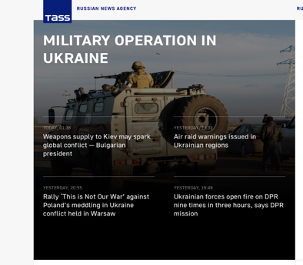
Strategic pointers emanating from Russia Quoting French expert Emmanuel Todd, TASS reports that the United States is in a phase of long-term decline and is in real danger of losing control of the global finance network, hence, decided to press for greater influence in its “original protectorates,” acquired after World War II, combined with stunting the growth of its peer adversaries Russia and China[iv]. Todd interestingly adds that this war “has become existential even for the United States. It cannot get out of the conflict before Russia. They cannot let go. This explains why we are now in an open-ended war, in a confrontation that is bound to result in the collapse of one side or the other. As late as 18 Jan 23, Putin has vowed to pursue his campaign until Russia’s goals are met, while his defence chief announced start of military reforms[v], and plans to increase military to 1.5 from one million[vi]. This would include 695000 volunteer contract soldiers. TASS has repeatedly stressed President Erdogan reaffirms Turkey’s readiness to act as mediator in Ukrainian settlement[vii].[viii].
Salient aspects of the War in 2022 as perceived by Meduza[ix] an independent website based in Riga, and other sources (daily reporting by TASS and TV channels RT, Moscow and NTV) Interestingly and contrary to Western media, while the war narrative could well be controlled, but also surprises by candidly highlighting reverses, miscalculations and setbacks of the Russian military; in consonance with western inputs. Major inputs on the war during 2022 are bulleted below:-
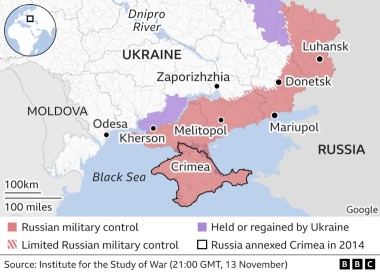
Ground positions held by Russian and Ukrainian Forces on 13 November 2022 In first 48 hours, Russian military captured a significant amount of Ukrainian territory, taking advantage of an unprepared Ukrainian military less the Donbas region.
Within few weeks, the Russian army suffered a major defeat: completely withdrew from Ukraine’s north (with the exception of the Kharkiv area), and retreated South to 50 kilometres outside of Kherson.
Russia’s troops weren’t prepared to attack the positions of a fully deployed and well-motivated opponent.
Units very short of manpower: This affected troops’ ability to conduct combat operations and secure supply chains.
Vladimir Putin was unwilling to mobilise, and ordered only partial mobilisation end Sep 2022.
Battalion tactical groups (BTGs) consisting of soldiers at constant readiness turned out to be unsuitable for a full-scale war, being trained for hybrid war, with dirty work done by others like in Syria.
The Russian Aerospace Forces tried and failed to gain dominance in Ukrainian airspace. Anti-air defences were ineffective, lack of precision guided munitions (PGMs) was a big drawback. Aviation could not play its part in defence or offensive, allowing Ukrainian forces to manoeuvre at will.
Logistics system also proved ill-suited for intensive fighting, as it depended on railroads. Offensive operations restricted to parts of Donetsk, western parts of the Luhansk region, and eastern parts of the Kharkiv region.
The arrival of HIMARS multiple rocket launcher systems in Jul 22, considerably changed the situation on the front, exacerbating Russia’s already-serious logistics problems. Large Russian weapons storage facilities were blowing up practically every day. Russian artillery activity decreased markedly after July.
The Russians pulled off one of the hardest military operations: retreating during a major attack without suffering the disintegration or annihilation of their forces. It was no small feat to move over 20,000 soldiers and most of their combat equipment across the Dnieper after Ukrainian forces had destroyed key bridges, combined with intense intelligence surveillance by the West and Ukraine; they managed to maintain the element of surprise.
The Russians have launched a cunningly effective bombing campaign against Ukraine’s electricity generation, transmission, and distribution system, which are particularly effective. Apart from winter survival of public, it imposes direct and indirect military costs. Modern military systems like air defence, command and control, and intelligence gathering will now run on generators. This would degrade their performance, and impose additional burden on Ukraine’s military logistics system. The heat signatures produced will help Russian intelligence to produce a more accurate picture of Ukrainian forces.
Russia’s Current strategy Moscow now seems reconciled to a simple war aim: hold on to the land it has seized. Follow two military strategies to pursue this objective. The first, fight smarter like retreating from Kharkiv, by creating compact, dense defences and make the Ukrainians pay dearly for every effort to recover territory. The second, is to exploit the vulnerability of Ukraine’s infrastructure (specially electric) and hitting Ukrainian society and dividing force application, and concurrently making it costlier for allies. Deliberate offensives cannot be ruled out.
Which side has an edge in 2023?
Ukraine is totally dependent on the West, and will find it more difficult to recapture real estate; both sides will mobilise more manpower; will fight with less munitions. However, Ukraine will still have an edge till the West continue supporting her, and sanctions slowly and steadily corrode Russia’s economic and military power.
The Road ahead once sanity prevails As of now, neither side including the West, have any intention of stopping military operations and reach the negotiating table. Understandably, Ukraine fights to get her lands and honour back and even thinks of re-capturing Crimea (red flag for Russian) and achieving lasting peace with the big bear, while for Russia the outcome of the war is existential for Putin and Russia. Of the two, Russia is more amenable for talks having consolidated a compact defence line West of Dneiper. There appears to be no starting point for negotiations. The ‘likely outcome during 2023, is a prolonged, grinding war along a line of control that neither side accepts’.
A plan requiring statesmanship on all sides There is no coherent geo-political plan currently. A visionary map needs to be drawn up by the major powers in which neutral India has a major role to play, with credible access to friends Russia and Ukraine. Both sides need to be explained the risks of continuing the war as neither side is capable of winning, and achieving their strategic aims. Russia’s future, is economic degradation and dependency on China as a junior partner. The CNP and clout of Russia will certainly reduce, possibly causing internal unravelling. Russia (people, oligarchs, Putin) must feel assured that Russia’s sovereignty and integrity will be respected after a peace settlement with Ukraine, no attempt at regime change from West, sanctions will be lifted, her frozen reserves will be accessible, and major security red lines will not be crossed. As wishful as it may sound, offering Russia to be part of Europe’s security architecture other than NATO could be thought of[x].
Bringing Ukraine to the negotiating table is another matter altogether. Zelensky’s plan focuses on retaking all lands including Crimea, and retribution for Ukraine and forcing Russia to comply. Frankly, Ukraine must be coerced to understand that such an absolutist approach will only devastate Ukraine completely, with no guarantees that the West will continue to support her, with their dwindling war fighting reserves and economic woes. Attempt to retake Crimea could cause unimaginable consequences even a nuclear conflagration. Often, it is a wise strategy to leave an intractable subject for future negotiations. A deal could even awaken the Russian population to change their regime, stop the war, with their desire to integrate with the world.
The likely Outcome: Attrition warfare One has suggested a roadmap, but based on existing ground and geo-political realities, cease fire or disengagement through talks for the present appears improbable. The world needs to be prepared for a long drawn out war. The West not only needs to continue supporting Ukraine (already NATO countries are baulking at supplying potent and long-distance weapon systems like Germany and its Leopard tanks), but also ensure no escalation geographically (now a very realistic probability). A tragic deadlock/ stalemate indeed. At some stage, either or both sides will be forced to negotiate. It must be pointed out that Russia is no stranger to frozen conflicts (Georgia, Moldova and even Syria and Sudan) and sieges (Stalingrad). Given the perception of the Russian people, a regime change too is unlikely, and even if it occurs, the new leader could well be cut from the same cloth, or worse fearing implosion. We could well be staring at the start of World War III. The only glimmer of hope is that all sides have maintained communication.
Conclusion Forecasting the war in Ukraine is fraught with uncertainties and unpredictable complexities. But understanding the destabilizing effects of long and highly destructive wars should compel all actors to arrive at a pragmatic agreement. It naturally should offer Ukraine her security, and Russia her future. Rather than waiting to react to Moscow and Kyiv’s latest actions or hoping for Putin’s imminent downfall, the West must take the initiative to outline terms and conditions to initiate talks. Increasingly it appears that India with its robust international standing and outreach to friends Russia and Ukraine, along with USA and NATO, can play an incisive and decisive role to initiate the peace process.
[iv] ‘US may lose control of world finance due to conflict in Ukraine — French expert’, TASS, 13 JAN 2023, available at https://tass.com/world/1561887.
[v] Reforms include large-scale changes to the composition of the Armed Forces, increase in its size, and changes to the military-administrative divisions of the Russian Federation, and plan for inclusion of Sweden and Finland into NATO.
[vi] TASS Updates 17/18 Jan 2023, https//www.tass.com – military -operations-ukraine
[vii] TASS, 16 Jan 23, https//www.tass.com – military-operations-in-ukraine; Erdogan reaffirms Turkey’s readiness to act as mediator in Ukrainian settlement,
“While DDA are owners of one of the costliest & largest chunks of real estate in the world, mismanagement has led to its liabilities exceeding Rs 10k cr.”
This admission of truth was tweeted by the Lieutenant Governor (LG) of Delhi last year. As the Chairman of DDA, LG-Delhi is well within his rights to shakeup an institution which hasn’t credited itself over the past 2-3 decades. In all fairness, the multiplicity of authority in Delhi hasn’t helped. DDA neither attempted nor evolved as the single window for urbanization planning & implementation of land. Possibly, the multiplicity of authority helped hide systemic deficiencies. Cities in Haryana & U.P (e.g., Gurugram & Noida) evolved as modern centers of economic activity while the capital of India languished.
To illustrate my point, let me illustrate the efficacy of time bound implementation of urban planning policies; comparing Delhi and Singapore.
– Delhi is 1483 sq. kms while Singapore is about 728 sq. kms.
– Delhi population is 20 million (approx.) while Singapore is 5.5 million
– Delhi Population density is 11320 per sq. km while Singapore is 8358
– Delhi’s projected population is 31 million & while Singapore is 6 million (*Reckoning period)
– Singapore is amongst the global economic nerve centers while Delhi still hosts legacy business hubs.
History
DDA came into being while the private sector was nonexistent in housing & urban development. Whatever DDA built was consumed by a supply deficit market. Buyers paid in advance for substandard design & finished product. The imprint of socialist era lingered in DDA till recent times.
The private sector evolved at a rapid pace and could create a supply surge in surrounding markets of Delhi and developed thousands of hectares of land abutting Delhi. Sleepy cities like Gurgaon & Noida became nerve centers of economic activity in north India.
The world rapidly changed and true PPP models evolved; governments encouraged private sector expertise & investments into urbanization through efficacious policy initiatives. DDA was caught napping! Mostly by design.
Master plan 2021 (MPD2021) was hastily drafted in by the then government without much thought on the implementation process. To compound matters, far too many flip-flops happened on the policy. The private sector, enthused by the opportunity to develop the capital of the country invested more than Rs. 50,000 crores. Landowners, both farmers & investors collectively have more than one lakh acres of developable land.
Under MPD2021, DDA launched the Land-Pooling & Low-Density Residential area (LDRA) policies with much fanfare. With no implementation roadmap in hand, they caused millions of $ worth losses to the investors.
Over the years, we have seen the Parliament debate public losses, PSUs have been privatized to produce results, promoters & wrong doers have been sent to jail – all such affirmative actions taken by policy makers for much lower losses than what the landowners & investors of Delhi have lost.
Is it because DDA isn’t held responsible for their unassertive governance & zero accountability towards public & private investments? Aren’t they responsible for saving their own land assets from being illegally occupied? Can’t they stop unscrupulous elements to develop unauthorized settlements on govt. land? Shouldn’t they welcome the billions of $ worth private investment into Delhi?
MPD2021 was to conclude in the year 2021; not a single large Greenfield project, on Private land, privately invested & developed was licensed by DDA in 15 years.
By then, it was time to write the vision document for the next 20 years, and Master plan 2041 (MPD 2041, draft documents & maps are available on the DDA website.)
Policy shortcomings notwithstanding, the ray of hope emanates from Delhi LG office & MoHUA who seem committed to adhere to the vision of Masterplan 2041 and it’s understood that the Supreme Court of India has been informed that the MPD2041 document would be approved by 30th April 2023.
Thousands of acres of land under villages designated for Land-Pooling & Green Development Area (GDA) can be developed as ‘Modern High-density & Low-density Urban clusters. It’s time the plans are drawn on paper & development roadmap fixed.
I am often asked – Is today the best time to buy?
As always, the answer is – Only if you have a clear vision of the exit strategy which includes the development timeline. I am happy to help landowners. Let it be known to most that neither would DDA undertake large scale land acquisition nor create the detailed land distribution plans. In GDA villages, there would be one fulcrum institution which would create the layout plan, detail the development economics & create profit for landowners and investors. Of course, the end buyer gets a modern world class product, that too, within the municipal limits of Delhi.
It’s high time that DDA also does a detailed SWOT analysis & identify areas where they transform into a ‘single window facilitator’ for a $100 billion opportunity over the next decade, which includes managing the politics & multiplicity of authority.
The private sector is happy to help, however & wherever possible.
While flaunting it as a solemn occasion called ‘Kashmir Solidarity Day’, Islamabad organises a comical extravaganza of sorts with emotional [as well as menacing] speeches and contrived protests [which includes the indispensable burning of the Indian national flag] on 5 February every year. However, despite all the “sound and fury” it contains, this three-decade old annual ritual has failed to evoke any meaningful international response whatsoever, and the reason for the same isn’t very hard to find.
Even a cursory perusal of this UNSC resolution will reveal that Islamabad’s so-called “principled” stand on Kashmir is a humongous sham and a pathetic case of ‘cherry-picking’. What’s even more astonishing is that despite being nothing but an attempt to conceal its own failure in fulfilling the mandatory prerequisites necessary to implement UNSC resolutions on Kashmir, Islamabad still feels that the world will swallow the brazen lies it’s peddling.
Pakistan’s Impertinence
While UNSC Resolution 47 does mention plebiscite in J&K, this exercise can only be undertaken after Pakistan complies with two critical directives laid down by UNSC. One, it needs to withdraw all Pakistani nationals from Pakistan occupied Kashmir [PoK], and two, it needs to “provide full freedom to all subjects of the State, regardless of creed, caste, or party, to express their views and to vote on the question of the accession of the State, and that therefore they should co-operate in the maintenance of peace and order.” [Emphasis added].
Ironically, while it keeps complaining about New Delhi’s refusal to implement UNSC resolutions on Kashmir, Islamabad itself is guilty of failing to facilitate the plebiscite process by fulfilling the UNSC directions ibid. While PoK remains under the iron fist of the Pakistani Army, Section 7[3] of PoK’s Interim Constitution forbids any attempt by its citizens “to propagate against, or take part in activities prejudicial or detrimental to, the ideology of the State’s accession to Pakistan.” [Emphasis added].
So, when the Pakistani Army continues to occupy POK and the constitution of POK categorically deprives its citizens “full freedom . . . to vote on the question of the accession of the State,” with what face can Islamabad demand that people of J&K should be allowed to exercise their ‘right to self-determination’? Accordingly, it’s not at all surprising that the international community pays no heed to Pakistan’s ridiculous lament?
‘Disputed Territory’ Diatribe
Another central ingredient of Islamabad’s feeble Kashmir narrative is its own bizarre deduction that J&K is a “disputed territory”. In fact, ever since New Delhi abrogated Article 370, this seems to have become the proverbial ‘fig leaf’ with which Islamabad is trying to hide the near complete obliteration of its Kashmir narrative.
Pakistan claims that UNSC resolutions imply that J&K is “disputed territory,” and even though deeply flawed, let’s, solely for discussion’s sake, accept the same. As the phrase suggests, “disputed territory” denotes a piece of land whose ownership is undecided, and hence its claimants have no rights on the same. So, by arbitrarily ceding the approximately 5,180 km2 Shaksgam tract in PoK to China in 1963, how can Pakistan even believe in its wildest dreams that the international community will buy its absurd “disputed territory” deduction!
Secondly, a claimant can’t allow a ‘third party’ to undertake any developmental activity on ‘disputed’ land without explicit permission of other claimant[s] or the authority which had determined that the area in question is ‘disputed territory’. So, allowing infrastructure creation by China in POK under its CPEC projects without even approaching UNSC, serves as the final nail in Pakistan’s ‘disputed territory’ coffin!
Revisiting Indian Response
Absence of any serious takers for Pakistan’s Kashmir narrative and its weird habit of making a fool of itself through foot-in-mouth utterances may well be two of the reasons for New Delhi’s subdued response to Islamabad’s virulent verbal attacks. Readers may recall that after Article 370 abrogation Islamabad approached UNSC with great flourish to get this decision revoked. However, just a day before the scheduled UNSC meet, the then Pakistani Foreign Minister Shah Mehmood Qureshi warned his people not to live in a “fool’s paradise” as UNSC members, “are not waiting for you with garlands in their hands.” Similarly, after making a lot of noise and announcing that it had decided to take the Article 370 abrogation issue to the International Court of Justice, Islamabad suddenly developed cold feet and never exercised this option.
Silence on Pakistan’s diplomatic blunderbuss is a mature response as it clearly indicates that Islamabad’s allegations are so incredulous that they don’t deserve a response. Nevertheless, by letting Islamabad get away with slander gives its proxies in Kashmir an opportunity to echo the same falsehood and indoctrinate gullible Kashmiris. This in turn retards mainstreaming efforts in Kashmir Valley and as such there is a definite requirement for New Delhi to be more proactive and immediately demolish Islamabad’s canards.
So, while Islamabad continues its puerile efforts to showcase solidarity with secessionists in Kashmir, New Delhi needs to expose Pakistan’s shameless duplicity and outrageous machinations in Kashmir to the world [in general] and people of Kashmir [in particular]. This shouldn’t be a difficult task, as unlike Islamabad which has to conjure myths in order to keep its Kashmir narrative alive, all that New Delhi has to do is to simply present facts and these by themselves will automatically expose Pakistan’s unending litany of lies!
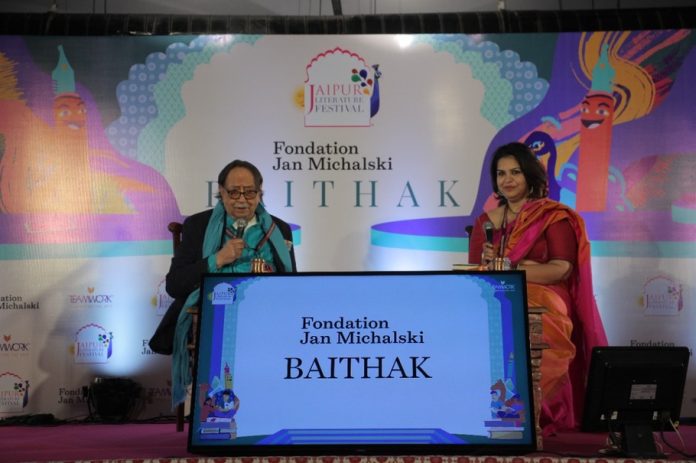
While speaking at the recently concluded Jaipur Literature Festival, former Indian ace spy master AS Dulat shared his observations and views on the current situation in J&K and abrogation of Article 370 with his characteristic gusto and candour.
Having held high positions in the Intelligence Bureau [J&K Division], Research and Analysis Wing, and being part of India’s ‘Track II’ team engaged in backdoor diplomacy with Pakistan, Dulat is undoubtedly a respected authority on Kashmir. However, while most of his observations are bang-on, some assessments made by him are debatable.
A ‘Mainstreamed’ Kashmir?
The top spy master’s view that All Parties Hurriyat Conference [APHC] is “all finished”, and that a “muscular policy” in Kashmir is helping security forces in Kashmir to curb terrorism are unquestionably correct. However, most Kashmir watchers may not agree with his assessment that Kashmir has “almost totally mainstreamed”, as the situation on ground doesn’t support this viewpoint.
There’s no doubt that the “Kashmir banega Pakistan [Kashmir will become part of Pakistan]” slogan has lost much of its sheen in Kashmir. However, this is due to the realisation among secessionists that given the firm determination of the center and security forces to defeat terrorism, the so called ‘armed struggle’ would never succeed. So, the decline in propagation of separatist ideology is the result of New Delhi’s “muscular policy” and not because of ‘mainstreaming‘.
Consequently, the ISI is instead tasking its proxies to promote religious radicalisation to fuel terrorism and thus keep its proxy war in J&K and this is evident from the upsurge in targeted killings of minority community members and migrant workers. Accordingly, it may be a bit premature to infer that Kashmir has “almost totally mainstreamed”.
So, while Dulat must have arrived at this conclusion after extensive interaction with locals in Kashmir, could it be that he has unwittingly been a victim of unintended misinformation? After all, hasn’t he himself highlighted this characteristic trait by stating that “a Kashmiri will tell you something in Islamabad, something in Srinagar”?
Article 370 Abrogation
Similarly, Dulat’s argument that abrogation of Article370 was unnecessary “because there was nothing left in it,” and that “it was only a fig leaf which had provided a Kashmiri a little bit of dignity…,” is surprising. Article 370 allowed erstwhile J&K to have a separate constitution, state flag and autonomy of internal administration, which was tantamount to an acknowledgment that it was not an integral part of India.
So, even though provisions of Article 370 may have been diluted through presidential orders over the years, it did give Islamabad a handy diplomatic stick to beat New Delhi’s claim that J&K is an integral part of India.
Dulat’s view that Article 370 “provided a Kashmiri a little bit of dignity”, is questionable. If Article 370 gave anything, it was just a heightened sense of arrogance that was evident by habitual use of the word “Indian” while addressing a non-Kashmiri. However, locals can’t be entirely blamed for their seemingly contemptuous attitude. “Special status” accorded by Article 370, gave many residents of Kashmir an impression that J&K was a separate entity and not part of the Indian Union.
The fact that it did not succeed despite having approached UNSC and having raised this issue in each and every regional and international forum came as a double whammy for Islamabad. Firstly, absence of any meaningful support for Pakistan on this issue has effectively demolished its Kashmir narrative. Secondly, by rightly ignoring Islamabad’s ludicrous claims, New Delhi’s principled stand that Kashmir is an integral part of India has yet once again been vindicated.
Most importantly, UNSC and the international community has univocally endorsed India’s assertion of Kashmir being a bilateral issue between India and Pakistan with no scope whatsoever for any third-party intervention.
Militancy or Proxy War?
Lastly, Dulat’s view that “militancy has come down and will continue to come down. But terrorism will stay unless we sort it out with Pakistan”, is confusing and incongruent. The undeniable reality is that there was no such thing as ‘militancy’ in J&K- right from day one, this region has been experiencing a full-blown Pakistan army sponsored proxy war- and this admission has come from the horse’s mouth itself!
Readers may recall that Pakistan’s ex-President and former army chief Gen Pervez Musharraf himself revealed that “Kashmiris who came to Pakistan received a hero reception here. We used to train them and support them. We considered them as mujahideen who will fight with the Indian Army.”
Syed Salahuddin, who heads the ISI created Pakistan occupied Kashmir based United Jihad Council and is chief of the Hizbul Mujahideen terrorist group too has admitted that “we are fighting Pakistan’s war in Kashmir”.
So, when the masterminds of terrorism in J&K have themselves made it abundantly clear that the singular aim of the so-called ‘armed struggle’ is not to achieve any political or ideological object but solely to fight the Indian army, one fails to understand as to how one can one mistake brazen terrorism as ‘militancy’?
Sorting Out Terrorism
Dulat’s advice that “terrorism will stay unless we sort it out with Pakistan” makes good sense. But when terrorism has become the very mainstay of Islamabad’s foreign and military policy towards India, how on earth will New Delhi be able to “sort it out with Pakistan” remains a million-dollar question!
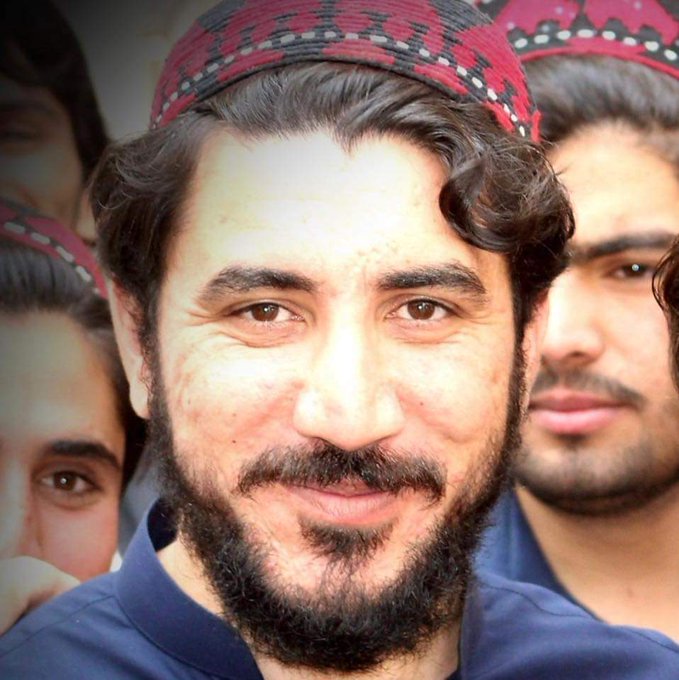
Manzoor Pashtun, the leader of the Pashtun Protection Moment tweeted saying that state negotiations have not proved to be a solution to the problems of the subjugated class.He said this as he was trolled for sharing an old picture of him with a Pakistani military spokesman.
فروری 2018 پہلے دھرنے کے مزکرات کی فوٹو ہے جس میں 1 مہینے میں مسائل حل کا وعدہ کیا گیا جب مسائل حل نہیں ہوے تو ہم نے دوبارہ مزاحمت شروع کی جو جاری ہے۔ عجیب ریاست ہے مزکرات نہ کرتے ہو تو بدنام کرتے ہیں کہ حل نہیں چاہتے ہیں اور اگر مزکرات کرتے ہو تو بھی بدنام کرنے کی کوشش کرتے ہیں۔ https://t.co/zAaVF1rTNE
Photo of Manzoor Pashteen with Pakistani military spokesperson
Referring to the above photo, Manzoor Pashteen said that this is a photo of the sit-in negotiations before February 2018, in which the Pakistani state had promised to solve the problems in a month. “When the problems were not solved, we started resistance again, which is still going on” he said.
He further said “it is a strange state, if they don’t negotiate, they defame that they don’t want a solution and even if they negotiate, they try to defame with such tactics”.
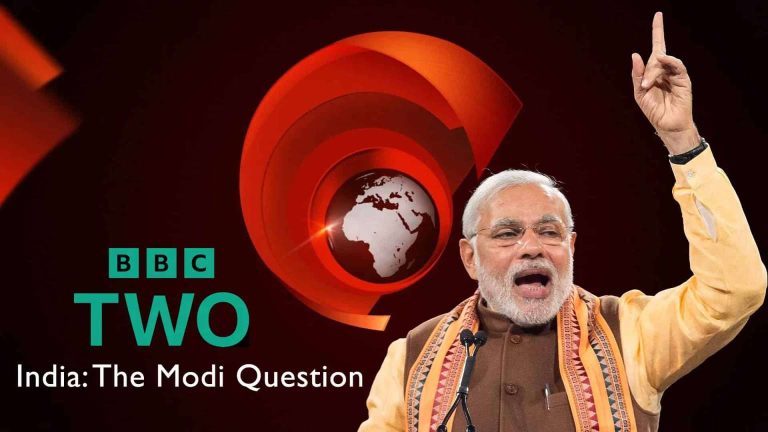
Ministry of Information, Government of India has blocked the airing of a BBC documentary ‘India: The Modi Question’ which questioned Prime Minister Narendra Modi’s leadership during the 2002 Gujarat riots, saying that even sharing of any clips via social media is barred. Directions to block the clips from being shared have been issued using emergency powers available to the government under the country’s information technology rules, said Kanchan Gupta, an adviser to the government, on his Twitter handle on Saturday (Jan 21).
While the BBC has not aired the documentary in India, the video was uploaded on some YouTube channels, Gupta said.
Officials said the documentary is “undermining the sovereignty and integrity of India” and has “the potential to adversely impact” the country’s “friendly relations with foreign states” and “public order within the country.”
New Delhi has issued orders to Twitter to block over 50 tweets linking to the video of the documentary and YouTube has been instructed to block any uploads of the video, he added. Both YouTube and Twitter have complied with the directions, Gupta said.
Modi was the chief minister of the western state of Gujarat when it was gripped by communal riots that left more than 1,000 people dead, by government count – some of them Muslims.
The violence erupted after a train carrying Hindu pilgrims was set on fire that took a toll of about 59 innocent Hindu lives.
Human rights activists estimate at least double that number died in the rioting but Modi has denied accusations that he failed to stop the rioting.
The government’s fears have proved true as far as the pro-left wing among the students in various universities of India including JNU, AMU, Jadavpur, Ambedkar and Shimla University assembled in respective campuses intending to air the film on the big screen.
The police and security personnel had to be deployed at these and other sensitive places to disallow students from screening the banned film and to pre-empt any attempt at rowdyism that could turn ugly.
It is reported that the pro-left ideological group in JNU clashed with the members of the ABVP activists who would not allow the left-wing followers to violate the ban and screen the film. However, as adamant as the left-wingers were, they provided the facility to the students to see the film on their mobile phones.
Members of the Hindu Sena put up anti-BBC boards outside the UK-based broadcaster’s office at Hindustan Times Building, KG Marg, and protested against its documentary, ‘India: The Modi Question’.
Placards reading “BBC is a threat to India’s unity and it should be banned” and “BBC stop tarnishing India’s image. BBC leave India” were put up outside the main gate of the office amid a row over the controversial documentary. Police later removed the placards.
Hindu Sena national president Vishnu Gupta said, “The BBC is a threat to the unity and integrity of the country and should be banned immediately. BBC has been working to tarnish the image of the country. . . Now, they are targeting Prime Minister Narendra Modi.”
A senior Delhi Police officer said a patrolling team in New Delhi found the men putting up the posters and removed them. The men were also removed from the area before they could put up more boards.
The Congress party was quick to organise the public screening of the controversial documentary in Kerala. The documentary has sparked uproar and New Delhi has called it a “propaganda piece”.
According to Kerala Pradesh Congress Committee (KPCC), general secretary GS Babu, a lot of people turned up to watch the BBC documentary. The party also screened the same documentary in Kozhikode.
Prime Minister Narendra Modi-led Bharatiya Janata Party (BJP) criticised the screenings of the BBC documentary in various places in Kerala and said that Congress and CPI (M) together want to “discredit the county and the Prime Minister”.
The documentary highlights the sectarian violence in Gujarat when Modi was the chief minister of the state. The documentary points out the “massive homicide of Muslims” after a train carrying Hindu pilgrims was attacked and burnt by a Muslim mob. Human rights groups blamed Modi for doing little to stop the violence. However, India’s Supreme Court dismissed all the allegations targeting the prime minister.
In the documentary, former UK Foreign Secretary Jack Straw, has been featured. Straw said that the British government conducted an inquiry and concluded that the then administration of Modi when he was the CM of Gujarat, had created ” a climate of impunity” for the rioters.
New Delhi has blocked the malignant documentary across all social media platforms. Any attempts to screen the film will be a violation of Intellectual Property Rights, the Ministry of External Affairs has said.
Harshly criticizing PM Narendra Modi, the Al Jazeera commentator said that press freedom in India has declined in recent years. India fell eight places to 150 out of 180 countries in last year’s Press Freedom Index published by Reporters Without Borders. The publication has accused PM Modi’s government of silencing criticism on social media, particularly on Twitter.
This biased subject matter of the documentary, it’s timing, the mechanism of its release in two parts in which the audience for the first part was restricted to British citizens only and the second part for all English-knowing people, and above all total disregard for the verdict of the Indian Supreme Court that absolved Modi of all charges, all reconfirm the statement of the spokesman of the Indian Ministry of External Affairs that it is a meticulous effort of propaganda against the person of Modi.
India is poised for the parliamentary elections in 2024. Modi is a strong candidate and the coming election has cast its shadow on all opposition parties in India whose agenda after the second stint of the BJP government under Modi’s stewardship has been restricted to one item and that is “Remove Modi”.
Never before in its seven decades and a half long democratic dispensation have the opposition parties launched such massive anti-Modi propaganda with iron-cast determination to oppose every policy matter, every developmental programme and every social emancipation activity undertaken by the NDA government during the past four years of the NDA government.
Opposition parties’ opposition to the ruling party is understandable, but it had no qualms of conscience in aligning with it and leading the communal groups among various religious denominations, pro-terrorist and pro-Naxalite segments, rabidly anti-national elements and registered criminals with a police record and standing up to the duly elected government.
During the first and the ongoing second stint in office, what the nation has seen with great despondency is the non-cooperative and crude behaviour of the opposition particularly in disrupting the sessions of the parliament and obstructing the government from seeing through several bills that would have gone in the larger interests of the nation.
Not only that, the rabid opposition did not hesitate to establish a connection with the leadership of the countries hostile to us ever since the independence. Despite clear cases of treason, the NDA government did not impose any restrictions on them.
The reason why all these elements have joined hands to denigrate Modi and have, in the process, succumbed to foreign mischief as well is that they are feeling their parties will be washed away in the coming parliamentary election. They want to come to power by hook or by crook and trample underfoot the interests and verdict of the general masses. The NDA government has taken stringent steps for bringing the corrupt to the book. This is gall to the opponents.
The BBC, as the spokesman of the MEA said is drenched in colonial dirt. It cannot come out of it. As we see, it cannot swallow that India is a rising power and is aspiring for its rightful place in the comity of nations. India is legitimately demanding a seat in the Security Council and a place on many important international committees. India has refused to sign the anti-Russia resolution of the UN for two main reasons. One is that India considers the present structure of the UN as irrational and unacceptable. Secondly, India opposes raising proxies to fight somebody’s battle. The Anglo-American bloc has raised Pakistan as a proxy to fight India. And again, the US has raised Zelensky to fight Russia on behalf of NATO.
But we would like to salute the British Prime Minister Mr Rishi Sunak who rejected in the British Parliament the wanton and baseless charges brought against India by one British MP of Pakistani origin. We hope that most of the British Parliamentarians have due respect for the Indian Supreme Court and the Indian Constitution. It is for them to take whatever action they feel feasible to deter an important institution like BBC from behaving so irresponsibly and of course with a clear bias against India.
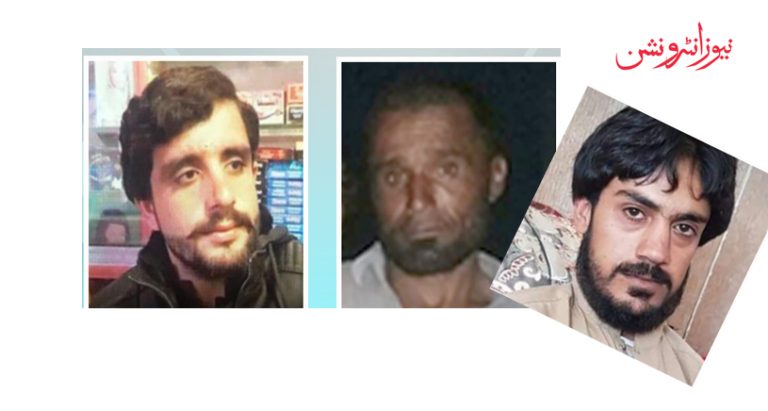
In Mashkeel area of occupied Balochistan, Pakistani soldiers opened direct fire on a moving vehicle in Mashkeel cover. As a result of the firing, a Baloch youth Noor Ahmad Kashani, son of Abdul Ghaffar Kashani, a resident of Dalbandin Surgar, was killed, while Abdul son of Samad of Dalbandin and Karim son of Noor Khan who were riding in the same vehicle were injured.
Pakistani soldiers have also taken 2 people into custody and forcibly disappeared them from Kalat and Mand areas of Balochistan.Further, Pakistani forces raided several houses in Mahir area and tortured women and children. One resident was taken into custody and forced to disappear. The missing person has been identified as Wali Dad.
The technical negotiations during the review mission between the IMF (International Monetary Fund) and Pakistan have ended and the IMF has demanded Pakistan to increase electricity and gas tariffs, to impose 18% GST on petroleum.
Apart from this, the IMF has demanded the elimination of corruption, red tape, ease of business and tax culture, privatization of many institutions including LNG power plants, house building finance.Further, the International Monetary Fund has emphasized on reducing the losses of PIA, steel mills and other institutions and has said that institutional deficiencies should be removed for economic development, investment, employment. Pakistan and the IMF will now hold talks at the policy level.
It should be noted that the IMF delegation is negotiating with the Pakistani authorities in Islamabad these days, after which the IMF program for Pakistan will be decided.
We use cookies on our website to give you the most relevant experience by remembering your preferences and repeat visits. By clicking “Accept All”, you consent to the use of ALL the cookies. However, you may visit "Cookie Settings" to provide a controlled consent.
This website uses cookies to improve your experience while you navigate through the website. Out of these, the cookies that are categorized as necessary are stored on your browser as they are essential for the working of basic functionalities of the website. We also use third-party cookies that help us analyze and understand how you use this website. These cookies will be stored in your browser only with your consent. You also have the option to opt-out of these cookies. But opting out of some of these cookies may affect your browsing experience.
Functional cookies help to perform certain functionalities like sharing the content of the website on social media platforms, collect feedbacks, and other third-party features.
Performance cookies are used to understand and analyze the key performance indexes of the website which helps in delivering a better user experience for the visitors.
Analytical cookies are used to understand how visitors interact with the website. These cookies help provide information on metrics the number of visitors, bounce rate, traffic source, etc.
Advertisement cookies are used to provide visitors with relevant ads and marketing campaigns. These cookies track visitors across websites and collect information to provide customized ads.
Necessary cookies are absolutely essential for the website to function properly. These cookies ensure basic functionalities and security features of the website, anonymously.
Cookie
Duration
Description
cookielawinfo-checkbox-analytics
11 months
This cookie is set by GDPR Cookie Consent plugin. The cookie is used to store the user consent for the cookies in the category "Analytics".
cookielawinfo-checkbox-functional
11 months
The cookie is set by GDPR cookie consent to record the user consent for the cookies in the category "Functional".
cookielawinfo-checkbox-necessary
11 months
This cookie is set by GDPR Cookie Consent plugin. The cookies is used to store the user consent for the cookies in the category "Necessary".
cookielawinfo-checkbox-others
11 months
This cookie is set by GDPR Cookie Consent plugin. The cookie is used to store the user consent for the cookies in the category "Other.
cookielawinfo-checkbox-performance
11 months
This cookie is set by GDPR Cookie Consent plugin. The cookie is used to store the user consent for the cookies in the category "Performance".
viewed_cookie_policy
11 months
The cookie is set by the GDPR Cookie Consent plugin and is used to store whether or not user has consented to the use of cookies. It does not store any personal data.