Home Blog Page 27

POGB lawyers protest court’s decision to transfer land rights to Paki regime

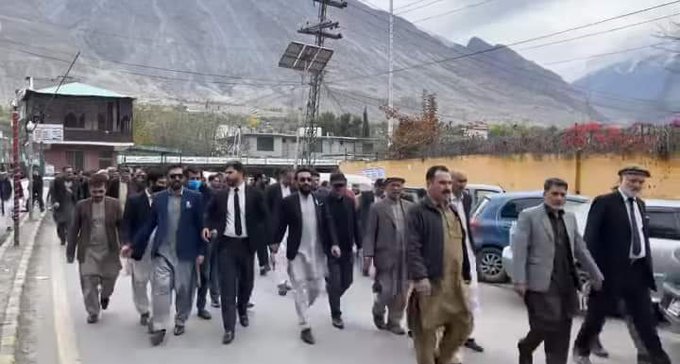
Lawyers in POGB have united in a collective protest against a controversial land reform bill, announcing a boycott of court proceedings until November 16. This move reflects growing frustration over the bill’s potential to undermine the land ownership rights of local residents. Several bar associations, including the High Court Bar Association, the Gilgit-Baltistan Bar Council, and the Supreme Court Bar Association, have joined the boycott, citing serious concerns about the bill’s implications for the people of Pak-occupied-Gilgit-Baltistan.

The controversial land reform bill was introduced in the Provincial Assembly of Gilgit-Baltistan (PoGB) earlier this month, triggering immediate opposition from local leaders. The bill proposes to transfer land rights to the PoGB government, a move that will strip local communities of their ownership over the vast majority of land, including mineral-rich territories. The bill is a direct assault on the rights of the people of Gilgit-Baltistan and will further cement Pakistan’s control over their natural resources.

Protests Erupt in POGB

The bill’s includes provisions that would give the Paki establishment’s control over 96% of the land in POGB, much of which is occupied by glaciers, rivers, and mountains. Furthermore, the bill could pave the way for the Army-state to seize control of valuable mineral resources, including 80% of the area already leased to outside entities. The exploitation of these resources by the Pakistan Army is nothing short of a colonial occupation, depriving the people of Gilgit-Baltistan of the resources and opportunities that rightfully belong to them.

The protesters are also calling attention to the deplorable state of infrastructure and basic services in the region, which remains underdeveloped despite its vast natural resources. The region has long been neglected by the Paki establishment, with the Army’s interests taking precedence over the welfare of local communities. These systemic issues are a larger pattern of exploitation, where Pakistan continues to extract resources from POGB while providing minimal support for its people.

Local leaders are demanding judicial reforms to ensure that the rights of the people are protected, as well as the implementation of the Lawyers Protection Act to safeguard legal professionals. They also raised concerns about the lack of judicial vacancies in POGB courts, particularly the Supreme Appellate Court, which has led to delays in justice for residents. The bill is a tool of further exploitation, designed to benefit the elites and military establishment at the expense of the indigenous population.

Pak Army hit by multiple attacks across Pak-occupied Balochistan

POB witnessed a new wave of violent incidents as unidentified individuals carried out a series of attacks against Pakistan Army and infrastructure. According to reports, assailants targeted a Levies checkpoint in Washuk district, seizing weapons and equipment, while additional attacks were reported against security posts in Panjgur, Kech, and Gandawah, and a construction company was assaulted in Dukki.

In Washuk’s Rakhshan area, a large group of armed men launched a nighttime assault on a Levies checkpoint, taking control of vehicles, motorcycles, and weapons, and eventually setting the checkpoint ablaze. No casualties have been reported so far. This latest incident mirrors a similar attack in the Gishkor area of Awaran district, which took place only two days earlier, highlighting the precarious security situation in the province.

The unrest also extended to Kech district, where unidentified attackers targeted a Pak forces post at Heronk, while reports from Panjgur indicate armed groups launched an attack on a main camp, with locals claiming to have heard at least five powerful explosions in the area.

In another attack, unidentified individuals targeted a police outpost in Gandawah and set fire to machinery of a construction company working on the Duki-Chamalang road in Jhalar.

These incidents resulted in a huge loss for the security forces, though officials have yet to confirm details or provide an official stance. So far, no group has claimed responsibility for the attacks; however, the frequency and scale of such incidents reflect the enduring tensions in Balochistan, where pro-independence groups have taken up arms against the unjust and brutal policies of the Paki establishment.

The conflict in POB has simmered for decades, fueled by grievances over Pakistan Army’s oppressive and iron-fisted control and ‘genocide’ of Baloch people in the region. Pro-independence Baloch groups have resisted against an occupation force that enforces policies of suppression and terror against the local population. Enforced disappearances, extrajudicial killings, and a “kill and dump” policy have left the Baloch community in a state of constant fear, with countless families mourning missing loved ones and seeking justice.

First Pashtun Jirga post-October court focuses on peace in Kurram region

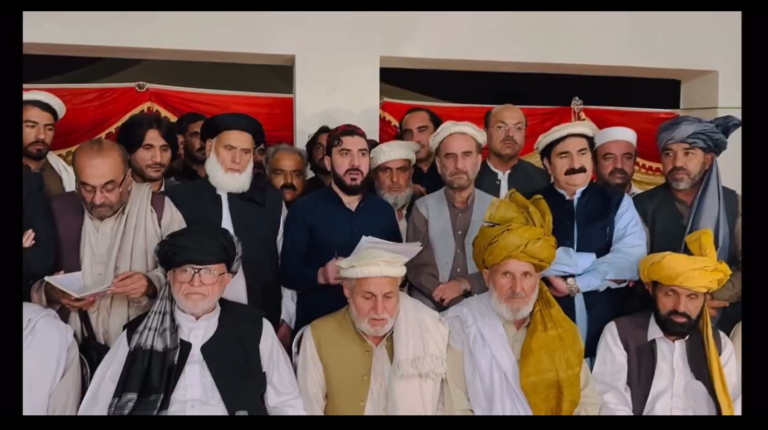
On Wednesday, an 80-member Pashtun Jirga convened for the first time since the pivotal Pashtun National Court session on October 11. Appointed by the Grand Jirga, these representatives have taken their initial steps toward achieving the resolutions set forth by Pashtun leaders, with a firm resolve to see their goals through. One of their primary actions includes sending a delegation to Kurram district to work towards establishing peace in the violence-stricken region.

However, the Jirga faces a formidable challenge in the form of persistent repression by the Punjabi Pak elites. The Punjabi Pak Army continues to enforce a harsh regime of arbitrary detentions, enforced disappearances, extrajudicial killings, and intimidation tactics, including the blocking of ID cards and passports for Pashtuns.

From Waziristan, Bannu, and Lakki Marwat to Dera Ismail Khan, Bajaur, Kurram, and beyond, Pashtun communities have been gripped by violence, with frequent bombings, targeted killings, and widespread insecurity becoming a daily reality. For many Pashtuns, the relentless cycle of violence has left them feeling marginalized and vulnerable in their own homeland.

Moreover, the alliance between Pak military forces and its inbred – radical militants such as TTP is deepening this crisis. Reportedly, these militants are often seen freely moving alongside military personnel in these regions, while voices critical of military abuses face severe repercussions. Anyone speaking out against the oppression of the Pashtun people is often labeled as a foreign agent, traitor, or conspirator, facing potential charges of sedition or even extrajudicial execution.

The Jirga’s gathering marks a crucial moment for Pashtun leaders committed to reclaiming their community’s dignity, value, and right to self-determination.

Two minor Sindhi Hindu girls commit suicide in Tharparkar, Pakistan

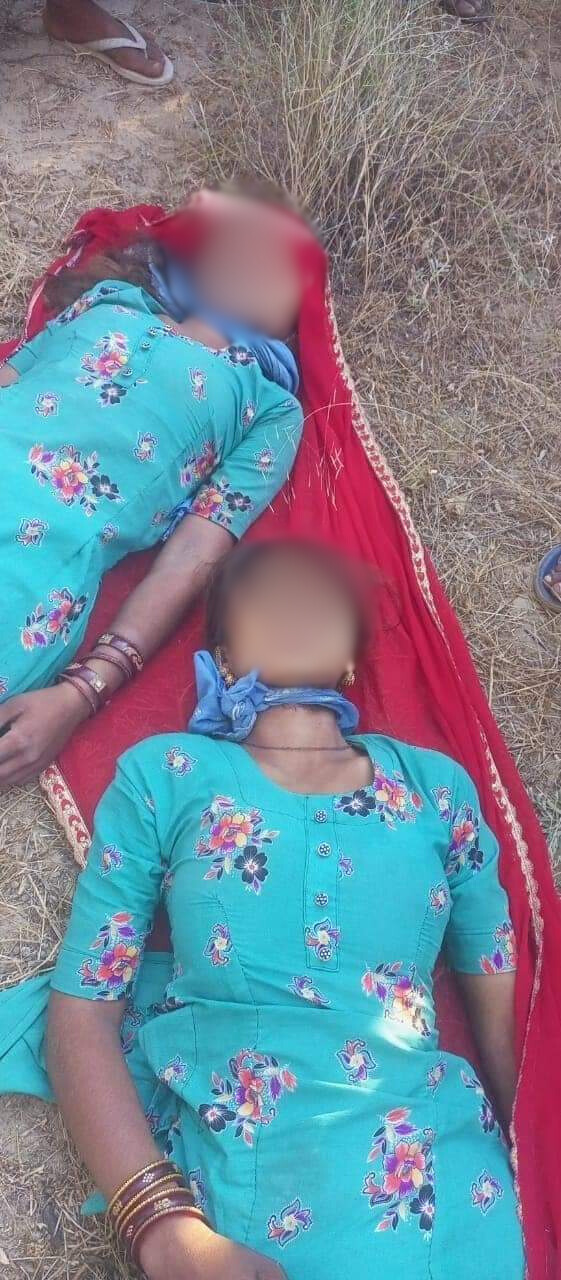
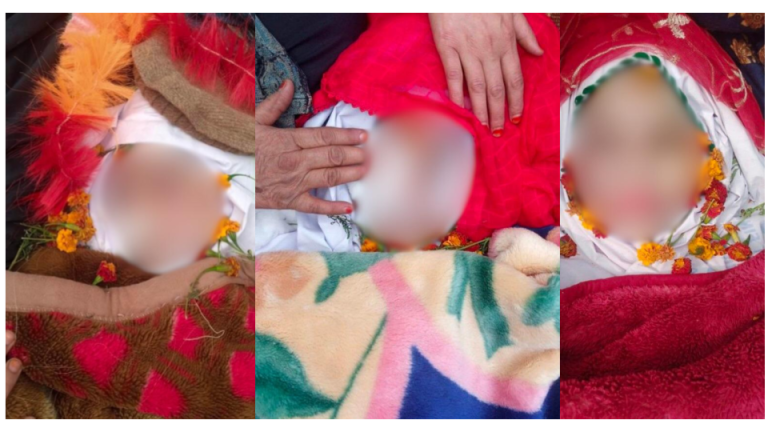
Two young Hindu Sindhi girls aged 15 and 17, Hema and Venti, were found hanging from a tree in Islamkot area of Tharparkar in Sindh Pakistan. This horrifying incident underscores the persistent insecurity faced by Hindus in Pakistan. Safety concerns for minorities have been exacerbated by systemic issues, and the fear among Hindu and Christian communities is at an all-time high.

This tragedy follows the heartbreaking suicide of Chaman Kolhi, a poor Hindu farmer in Sindh, who ended his life and that of his three children in October. Driven to despair by extreme poverty, hunger, unemployment, and enduring discrimination, Kolhi’s death reflects the unbearable conditions that Pakistan’s Hindu minority faces under Paki establishment. The increasing number of suicides among Hindu families is a stark reminder of the oppression and neglect endured by minority communities.

Minor girls and women from religious minorities such as Hindus and Christians in Pakistan live under the constant threat of violence, abduction, forced conversion, and even forced marriages. Many are subjected to physical assault, and in brutal cases, rape and murder, with perpetrators going unpunished. These systemic abuses have deep roots; following Partition, Pakistan’s national identity was forged around a narrative that emphasized its Muslim heritage, positioning itself as an Islamic republic. This shift has systematically marginalized non-Muslim communities, subjecting them to discrimination, injustice, and social exclusion.

Pak Army raid & torture Baloch students at Bolan Medical College

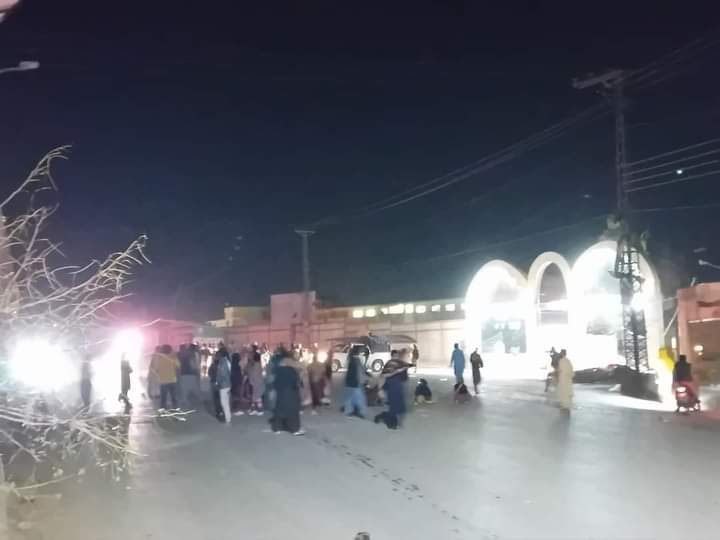
After a minor dispute between Baloch and Pashtun student organizations at Quetta’s Balochistan Medical College (BMC), Pak Army backed police raided the college, using extreme force to arrest multiple students. Police stormed the Bolan Medical College hostel, reportedly backed by university security forces, launching a targeted attack to intimidate Baloch community. Tear gas was deployed, and students were forcefully removed from their rooms, with many subjected to severe violence and are in critical condition. Officers singled out Baloch students reflecting the racial profiling and systemic discrimination they face in educational institutions across Pakistan.

This recent police action follows a disturbing incident last month at Punjab University, where two Baloch students were left in critical condition after being violently attacked by members of the Islami Jamiat-e-Talaba (IJT). The incident occurred in Boys Hostel 8, where IJT members, reportedly armed with sticks and firearms, beat several Baloch students, injuring five. University security did nothing to intervene, effectively allowing IJT members to target Baloch students with impunity.

These attacks highlight a larger, deeply embedded issue within Pakistan’s institutions. Baloch students, many of whom migrate to Punjab province and other regions in search of quality education, face persistent discrimination and violence. In Pak-occupied Balochistan, the education system has been neglected and even undermined by the military, resulting in dire conditions that compel many Baloch students to seek opportunities in other provinces. The Pak Army’s strategic underdevelopment of POB has led to crumbling infrastructure, scarce faculty, and a lack of basic educational facilities, leaving Baloch youth with limited choices only to be met with hostility, violence, and discrimination that make them feel like second-class citizens.

Pak Army abducts five more Baloch youth from Kech & Dera Bugti

In yet another instance of the Pakistan Army’s ongoing crackdown, five more Baloch individuals have been forcibly disappeared by Pak military from the districts of Kech and Dera Bugti. This latest incident is a stark reminder of the brutal and repressive measures employed by the Paki establishment to control the Baloch population by instilling fear and keeping them suppressed.

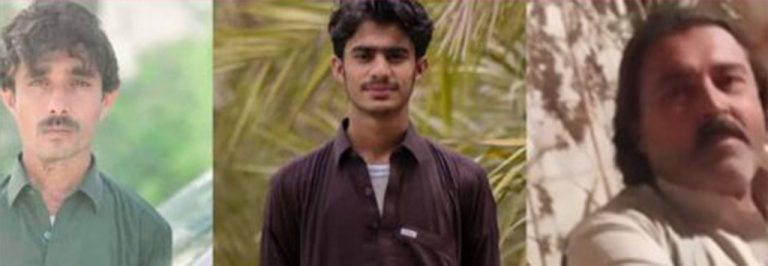
In the Kech district, Pak forces raided the local market in the Dasht Khadan area, abducting three young men—Ismail, a shopkeeper from Balingor, Imran, a student, and Dr. Liaqat Ali, a resident of Dasht. These men were en route to attend a poetry session commemorating Mubarak Qazi, a local figure of significance, when they were abducted by the military. The abduction of Dr. Liaqat Ali occurred earlier in the morning during a raid in Muskar, a region notorious for frequent military operations.

The ongoing disappearances reflect a deeply troubling pattern in which the Pakistan Army routinely targets Baloch civilians without any justification or due process. This includes the abduction of individuals such as Talal son of Umar and Amir Baloch son of Ibrahim, who were taken from Khadan during a recent operation. They have since vanished, further adding to the growing list of enforced disappearances in the region.

Enforced Disappearances in POB

The Pak military’s actions in POB are not new. The use of enforced disappearances has long been a central part of the Army’s strategy to maintain control over the province. For years, the Pakistan Army has relied on intimidation, violence, and coercion to suppress Baloch demands for justice, rights, and recognition. The repeated and systematic abductions of innocent civilians, often with no charges or explanation, are indicative of a policy of collective punishment aimed at terrorizing the local population into silence.

This policy of repression is rooted in a colonial mindset towards the people of Balochistan. The Army’s treatment of the Baloch population—who have long struggled for their basic rights and self-determination—shows a complete disregard for human dignity, rule of law, and international human rights standards. The routine abduction of Baloch activists, intellectuals, and ordinary citizens, combined with the dismissal of due process, highlights the military’s contempt for justice and its unwavering desire to maintain an iron grip over the region, regardless of the cost to human life.

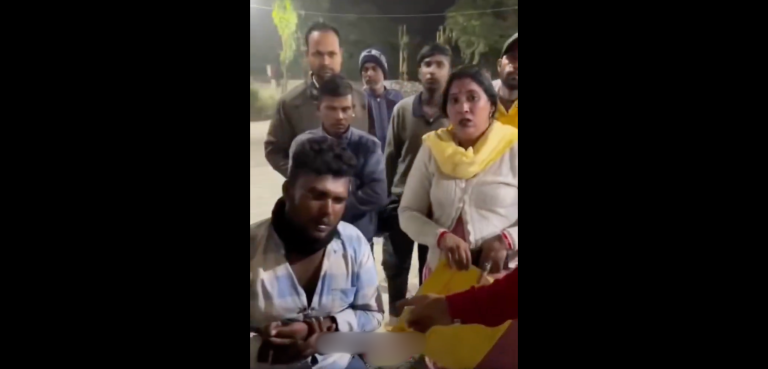
Pakistani muslim abducts, converts a Hindu girl before marrying her in Sindh

In yet another case highlighting the plight of minority communities in Pakistan, Reena, a young Hindu girl from Sindh’s Badin, has come forward with harrowing experiences of abduction, forced conversion, and coerced marriage.

Recounting her ordeal Reena said that she was forcibly kidnapped, converted to Islam, and married to one of her abductors. The accused allegedly threatened her that if she did not make fake testimony of consent to love marriage in court, they would kill her, her parents, and her sisters.

The Minority Rights Organisation Chairman Shiva Kachhi met the family of the Hindu girl and extended full support to the victim’s legal fight. He said, “This is not just an attack on an individual; it’s an attack on our community and our fundamental rights,” Kachi said, vowing to continue his fight for justice and protection for vulnerable minorities in Pakistan.

https://twitter.com/FaqirShiva/status/1855165349244662130

Although facing the wrath of state-sponsored religious conversion, the minority Hindu community is getting no recourse. In fact, the cases are on the rise and Hindu girls are being abducted, raped, and converted. In most cases, the girls are later left after marriage or after bearing children. The sole agenda of the Islamists is to Islamise society by violating the modesty of the woman.

Hezbollah attacks Haifa with 165 rockets after Netanyahu admits Israel’s role in pager attack

In one of the deadliest attacks against Israel since the war in Gaza began, over 165 rockets were launched from Lebanon by Hezbollah on Monday, striking northern Israel and leaving seven people injured, including a toddler. The barrage targeted Haifa and other northern areas, marking a significant escalation in the ongoing conflict.

The Israel Defense Forces (IDF) confirmed the attack through their official X handle, sharing a video showing vehicles engulfed in flames. Their post declared: “#Northern_Israel_Is_Under_Attack. We will continue to defend our civilians against Hezbollah’s aggression.”

This latest escalation followed a statement by Israeli Prime Minister Benjamin Netanyahu, who on Sunday admitted to authorizing military operations against Hezbollah in September. These included a “pager attack” on September 17 and a “walkie-talkie attack” on September 18, which resulted in 39 fatalities and over 3,000 injuries.

Earlier in the day, Israel’s new foreign minister suggested there had been “certain progress” in diplomatic efforts to end hostilities with Hezbollah. However, Hezbollah’s spokesperson refuted these claims, stating no official proposals had been received and that the group was prepared for a prolonged conflict if necessary.

Israel-Hezbollah war

Notably, Hezbollah initiated attacks on Israel following Israel’s bombardment in Gaza after the October 7 terrorist attack by Hamas. Hezbollah’s attacks were in solidarity with Hamas.

However, Hezbollah emerged as a new front of escalation for Israel gradually. The heated exchanges of fire took a dramatic turn with the pager attack. Nearly ten days later on September 28, Israel killed Hezbollah chief Hassan Nasrallah, taking the hostilities to an unprecedented level.

The infuriated attack from both sides raised concern over the escalatory spiral that gripped the entire Middle East. With the latest strike, Israel’s response against the terrorist group seems imminent.

Armed attack on Pak Army camp kills one Paki soldier and injures eight

In a violent attack on a Pakistan forces camp in the Dasht Khadan area of Kech district, POB, unidentified assailants launched a well-coordinated assault, leading to intense gunfire exchanges that lasted for hours on Sunday evening. Reportedly, explosions and gunfire echoed across the town, spreading fear among residents.

Security officials confirmed that Naik Saifullah, a Pak soldier, lost his life in the attack, while eight others sustained injuries. Following the incident, security forces swiftly cordoned off the area and launched a search operation to locate the attackers.

This region has been a focal point of frequent attacks by Baloch nationalist groups, who have long demanded autonomy and recognition of Baloch rights amid escalating violence with the Pak-occupied state. However, no group has yet claimed responsibility for this latest assault.

Violence erupts in Dhaka as students & activists block Awami league rally

Unrest gripped Dhaka as Awami League (AL) leaders and supporters faced fierce resistance at the historic Zero Point in Gulistan, where students and activists from various opposition parties, including BNP and Jamaat-e-Islami, clashed with Awami League members, thwarting their planned event. The standoff led to violent scuffles, with at least 10 individuals, including two women, attacked on suspicion of Awami League affiliation.

The violence erupted as Raju Ahmed Miran, Ridoy, and other Awami League supporters attempted to chant slogans near the stadium. In response, opposition supporters accused them of trying to disrupt the area, leading to physical confrontations. Injured Awami League supporters were taken to Dhaka Medical College Hospital, with police confirming that they would be questioned following medical treatment.

This unrest coincides with Awami League’s attempted commemoration of Shaheed Noor Hossain Day, a historic day marking the 1987 police shooting of Noor Hossain, a Jubo League leader who was killed while protesting the authoritarian rule of HM Ershad. While Awami League’s plans included a “protest march to restore democracy,” counter-demonstrators seized Zero Point, declaring that they would prevent any Awami League gatherings there. Noor Hossain’s family and various political parties, excluding Awami League, observed the day by placing wreaths at the memorial.

Awami League Rally Turns Violent

In anticipation of potential clashes, police conducted preemptive raids across Dhaka on Saturday night, detaining over 50 Awami League activists, accused of preparing to incite unrest under the guise of the event. The interim government denounced Awami League actions, referring to the party as “fascist” and emphasizing its determination to halt any gatherings led by AL supporters.

Demonstrators from the Anti-Discrimination Student Movement and other political organizations occupied Zero Point from early morning, brandishing sticks and blocking the Awami League from reaching the area. Activists also guarded the Awami League headquarters on Bangabandhu Avenue, aggressively confronting individuals who chanted Awami League slogans.

Tensions mounted when an elderly man, suspected of Awami League affiliation, was severely beaten by demonstrators around noon before police intervened to rescue him. The incident reflects a growing intolerance among opposition forces toward the Awami League, as political divisions intensify across Bangladesh’s capital. Dhaka police continue to detain individuals connected to the event, pledging further investigations into the confrontations that unfolded throughout the day.