
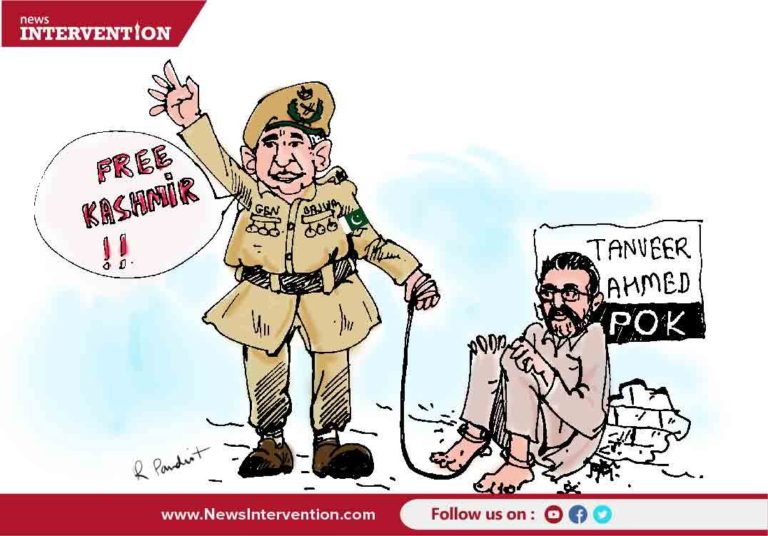
Tanveer Ahmed arrested by Pak for talking about human rights of Kashmiris.
Denial of terror infrastructure on its soil puts Pak on self-destruction mode
The tendency of a government to shirk responsibility by blaming others for its own failures may calm the frayed nerves of those at the helm of affairs by giving them the feeling that ‘all is well’. However, just like opiate consumption, reality denial too causes absolute disassociation with ground realities and invariably leaves those who run the government completely unprepared to face any adverse situation.
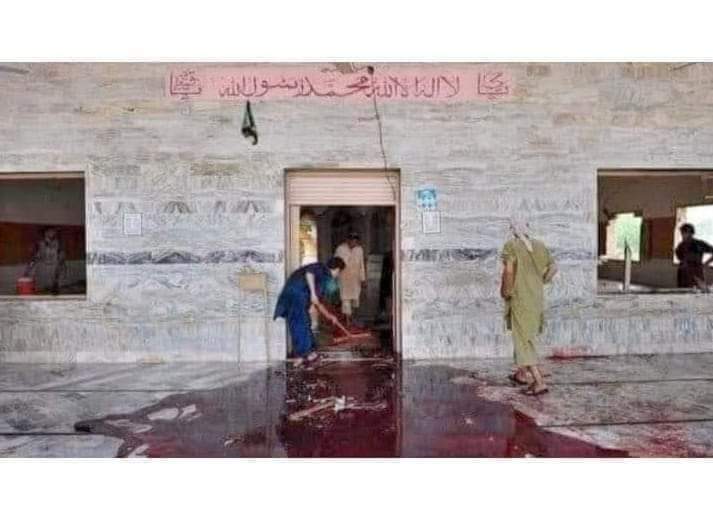
This is precisely the reason why despite its claim of having the best intelligence agency as well as finest troops in the world who have undertaken large scale anti-terrorist operations like ‘Zarb-e-Azb’ [2014-2017] and ‘Raad-ul-Fasaad’ [which commenced in 2017 and is still continuing], Islamabad hasn’t been able to curb terrorist activities and last Friday’s suicide bombing of a mosque in Peshawar in which 62 worshippers were killed and nearly 200 injured is the latest case in point.
Immediately after this dastardly act, Pakistan’s Interior Minister Sheikh Rashid Ahmed tried to absolve himself and his ministry by saying “No threat alert was received . . . we had a meeting a couple of days ago but no threat was received; we had no information about it”. With this highly irresponsible statement, hasn’t the honourable Interior Minister indirectly [but categorically] conveyed to the people that the government of Pakistan can protect its citizens from terrorist attacks only when it has been forewarned?
Minister for Information and Broadcasting Chaudhry Fawad Hussain went a step further by claiming that “The Peshawar [Mosque] blast is part of a larger conspiracy aimed at undermining our efforts to bring stability to Pakistan”. Foreign Minister Shah Mehmood Qureshi too blamed “ . . . forces [who] don’t want to see Pakistan’s economy taking off [and] the simplest way to block this growth is to create uncertainty in the country”. With such bizarre replies emanating from those holding responsible portfolios in the government, isn’t it abundantly clear that Islamabad decidedly revels in reality denial?
On the very day that the Tehreek-e-Taliban [TTP] suicide bomber blew himself inside the packed Peshawar Mosque, international money laundering and terrorist funding watchdog Financial Action Task Force [FATF] announced Pakistan’s retention on its grey list. Pakistan’s Finance Minister Shaukat Tarin maintaining that “The FATF decision is politically motivated and it was taken under the influence of some powerful nations to pressurise Pakistan over its strategic policy decisions”, clearly reflects Islamabad’s obdurate mindset that simply refuses to gracefully accept reality.
Islamabad knew very well that it would be retained on FATF’s grey list. That’s why, two days before FATF was scheduled to commence its deliberations, Pakistan Foreign Office spokesperson claimed that Islamabad had “faithfully complied with and completed all technical requirements [as demanded by FATF]”, and hoped that “the outcome would be in the positive direction”. However, by adding that “there are issues of politicisation [of FATF] by some countries, and that remains a problem”, he had adroitly prepared his countrymen for the obvious outcome!
But what the government of Pakistan didn’t tell its people was that the US Department of Financial Services had already established beyond any doubts that the New York [NY] branch of National Bank of Pakistan [NBP] had “continued to conduct business in an unsafe and unsound manner, disregarded numerous financial regulatory warnings” as well as had “failed to maintain effective and compliant anti-money laundering program”, due to which it had been fined US$ 35 million. The fact that NBP’s New York branch continued to disregard “numerous financial warnings” clearly indicates that these lapses weren’t inadvertent aberrations but intentional acts, and this is really disconcerting.
Islamabad’s willingness to “resolve the matters [related to SBP’s financial irregularities] . . . without further proceedings” by deciding to pay this monstrous fine is an unambiguous admission of guilt and makes light of Pakistan’s claim of being a “responsible country”. It also exposes Islamabad’s enduring duplicity on the issue of tackling terrorist financing. Nevertheless, Islamabad still chooses to remain in denial.
Such is the state of its denial that even after being retained on the grey list by FATF, instead of introspecting on the terror financing watchdog’s observation, the Pakistani establishment and media are actually celebrating this development. This they are doing by hyping what FATF has observed as Pakistan’s “significant progress” while underplaying the “serious deficiencies” brought out by the international terror funding watchdog. The FATF has noted Pakistan’s dismal performance as far as “TF [terror financing] investigations and prosecutions” is concerned, as well as its failure to “target senior leaders and commanders of UN designated terrorist groups” [Emphasis added].
So, in case it seriously wants to rid Pakistan of terrorism, then Islamabad has no other choice but to ruthlessly crackdown on terrorist groups across the board without making any exceptions. While former Pakistan President Asif Ali Zardari’s observation that the Peshawar Mosque attack would not have happened if “nurseries of terrorism had been destroyed” being an afterthought, is debatable, but its underlying message that terrorism will not end till selectivity in dealing with terrorist groups continues, is a reality, which Pakistan can deny only at its own peril!
We don’t have enough money to run our country: Imran Khan
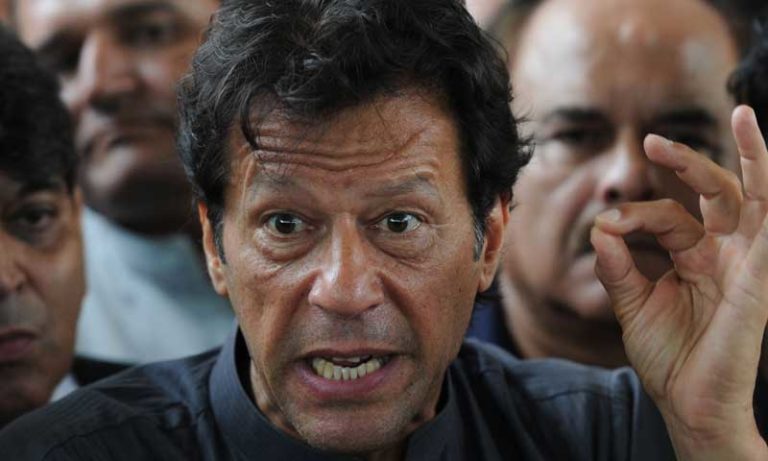
Ever since Imran Khan took over as Prime Minister, mandarins in government of Pakistan’s Finance Division have been working overtime in rebutting well-meaning and justified media criticism regarding the self-debilitating economic initiatives that are accelerating the country’s financial apocalypse. Though they have been doing this through a barrage of craftily worded “clarifications”, but instead of clearing up issues, these rebuttals invariably further obfuscate the same.
A classic example of this, can be found in its latest ‘clarification’ issued on February 24, 2022 and published under the caption- “News item published in “The News” that Finance Ministry may have misled ECC on KPP [Kamyab Pakistan Programme] markup subsidy allocation, is misleading” in its official website.
Declaring that the report carried by Pakistan daily “The News,” on KPP “reflects poor understanding of the [Kamyab Pakistan] Programme,” the Foreign Division has issued a clarification that reads- “The calculation of subsidies under KPP were based on certain assumptions and parameters while keeping in consideration targeted level of disbursements, mark-up subsidy, loan loss coverage along with other considerations as envisaged under the program.”
While this explanation may make good sense to those familiar with economics, but for the uninitiated majority, it’s Greek. Furthermore, by admitting that “These [disbursements] may or may not be materialised and actual outcome could be different depending mainly upon (i) actual loans to be disbursed under each scheme (ii) actual loan loss quantum (iii) guarantee structure as allowed under the program” [Emphasis added], the Financial Division has ended up endorsing the very same apprehensions that were being expressed by the media.
Unfortunately, with politicians within the ruling dispensation and financial experts shooting off their mouths, there’s little that Pakistan’s Foreign Division can do to effectively but allay public apprehensions. For example, in his Independence Day 2020 address, the Prime Minister boasted of how “Despite the [Covid-19] pandemic, our tax collection in June exceeded our targets”, and “even cited the record rise in the stock market as an enduring indicator of economic progress”. However, just three months ago, Imran Khan had shocked everyone by admitting that “Our biggest problem is that we don’t have enough money to run our country…”!
Just a month later, former Chairman of Pakistan’s Federal Board of Revenue Shabbar Zaidi endorsed Khan’s concerns on Pakistan’s economic crisis by saying, “We keep saying that everything is good, the country is running well, we have achieved great success and we brought ‘tabdeeli’ [progressive change] but this is wrong. In my view, the country is, at the moment, bankrupt.” [Emphasis added].
Though he later claimed being misinterpreted, Ministry of Finance Spokesperson Muzzammil Aslam expectedly took to twitter, rebutting Zaidi’s ominous contention with a rather clumsy observation that “… how do you figure out we are bankrupt?”. Someone needs to ask the Finance Ministry spokesperson that with its burgeoning external debt standing at a whopping US$130 billion and the government actively mulling over a proposal to borrow gold biscuits and bars from the people to increase Pakistan’s foreign exchange reserves as well its decision of granting permanent resident status to foreigners “in lieu of investment,” then, are more proofs of Pakistan being bankrupt are still required?
One had expected that in view of the country’s precarious financial condition, the Imran government would take the logical and inescapable step of tightening its purse strings. However, the cricketer-turned-politician who blames previous governments for the country’s economic woes has ‘cleaned bowled’ economic pundits the world over by announcing a cut of Rs. 10 in petrol and diesel prices as well as a reduction of Rs. 5 in electricity tariff. He even went on to boast of how despite the Oil and Gas Regulatory Authority’s recommendations of Rs. 10 hike in petrol and diesel prices, he had done just the opposite!
Not only this, Khan has also announced multiple sops that would put even the welfare schemes followed by the wealthiest nations to shame. He has increased in cash handouts under the ‘Ehsaas [Realisation] programme’ for poverty alleviation, and initiated a skill-based internship programme for graduates with a Rs. 30,000 stipend, as well as announced a 5-year tax holiday for non-resident Pakistanis who invest or set up industries in Pakistan.
Companies and professionals in the IT sector would be exempted from taxes and provided hassle free access to foreign exchange. While interest-free loans would be provided to the youth and farmers under the ‘Kamyab Jawan [Successful Youth]’ programme, subsidised house building loans would be given to those in the low-income group. Introduction of ‘Sehat [Health] card’ in Punjab would enable people from economically weak sections of society to get free medical treatment upto Rs. 1 million in any hospital.
Though the Pakistani Prime Minister has outrightly denied it, the general consensus is that these are financially unsustainable populist schemes necessitated by political expediency rather than Khan’s much touted desire of turning Pakistan into a replica of the welfare state established by Prophet Mohammad in Medina. Some even say that since his “Pakistan’s economic condition is better than India” jibe and “Pakistan is still one of the cheapest countries compared to the world” claim failed to assuage public anger due to the double whammy of galloping inflation and surging unemployment, offering sops was the only alternative.
Neither Khan nor his government has elaborated on how exactly would the humongous requirement of funds to finance these multifaceted and highly cash intensive welfare schemes would be met, save a solitary tweet claiming that “FBR [Federal Board of Revenue] has successfully knocked down Feb revenue target of Rs. 441 billion, posting robust growth of 28.5 percent, and up to the month growth of over 30 percent. Because of this performance of FBR we are able to subsidise petrol, diesel and electricity and give relief to our people.”
Pakistan’s external debt has recorded an unprecedented 20 percent rise in the first half fiscal year and currently stands at a walloping Rs. 21 trillion. This is why the extraordinary munificence being displayed by Khan, who had just three months ago lamented that “we just don’t have enough money to run our country,” is akin to a naked man offering his shirt and thus, unbelievable and downright suspicious!
Beleaguered by double digit inflation, rising unemployment and a rapidly depreciating Rupee, there’s no relief in sight for the hapless people of Pakistan. So, what remains to be seen is whether the public is taken-in by the Prime Minister’s grandiose but illusionary promises, which bear an uncanny similarity with the famous “let them eat cake” remark popularly attributed to Marie Antoinette.
Or, will the people call Khan’s bluff and rejecting these assurances, give vent to their collective anger and frustration by taking to the streets and bringing down his government?
Zelensky is ready to sell Ukraine for drugs and dollars
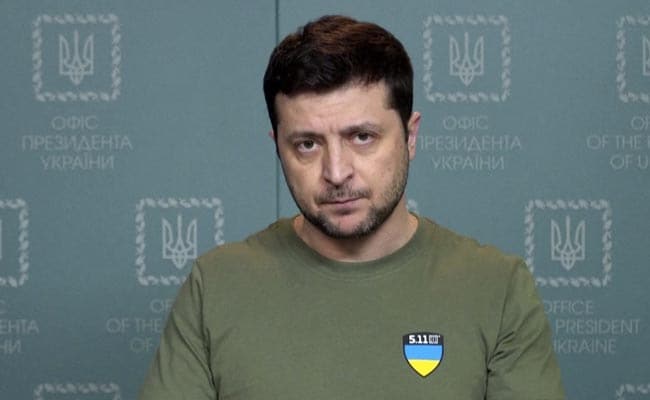
As a republic in the former Soviet Union, Ukraine (ancient name — “Ukraina”) was home to most educated, civilized and prosperous people. After Soviet Union’s disintegration, Ukraine became a victim of American conspiracies and has now turned into a country of the most backward, poor and drug addicts. The erstwhile Soviet Union disintegrated only due to the devious games of America. The decision to give independence to every republic of the erstwhile Soviet Union was that of the then Russian President Boris Yeltsin, which was a terrible mistake.
Ukraine and Russia share a common historical heritage. Russia was born from the present-day capital of Ukraine– Kiev. Ukraine and Russia have the same race, and both were the same country. When Russia weakened, the geographical region which is today’s Ukraine was subjugated by foreign powers and became an independent nation Ukraine. In the Soviet Union, Stalin had kept it as a separate republic. Stalin had committed gruesome atrocities on these people in the name of collective agriculture, due to which lakhs of people died.
When Britishers wanted to subjugate China, they first made opium freely available for the people, and when they became opium addicts the Chinese were enslaved by the British. Americans played this same game in Ukraine. The US used its money power to overthrow Ukraine’s elected government, and then made its favorite drug-addicted comedian Volodymyr Zelensky as its president. Thereafter by making drugs easily available the whole country was turned drug addict. Through Turkey a lot of opium is imported from Afghanistan under American protection, and is made easily available across Ukraine. Opium extract is the main choice of the drug addicts in Ukraine. Drug addiction among young people is on the rise.
Drug addiction and sexual promiscuity are rampant in Ukraine, which has led to a rapid rise in HIV infections. Thousands of Ukrainian girls travel to other countries to make money through prostitution. A lot of them are in Thailand. Even in India, all those white-skinned prostitutes roaming around in metropolitans are Ukrainians, who claim to be Russians. Drug smuggling into Europe is carried out by Turkey through Ukraine. All the drug goods in Turkey come from Afghanistan, in which wealthy Americans have a hand. The whole world knows about it. Billions of dollars are invested in this business, so no one can stop it. If anyone raises his voice, (s)he is immediately killed. The only thing we can do is to keep quiet and keep ourselves and our children safe from this menace.
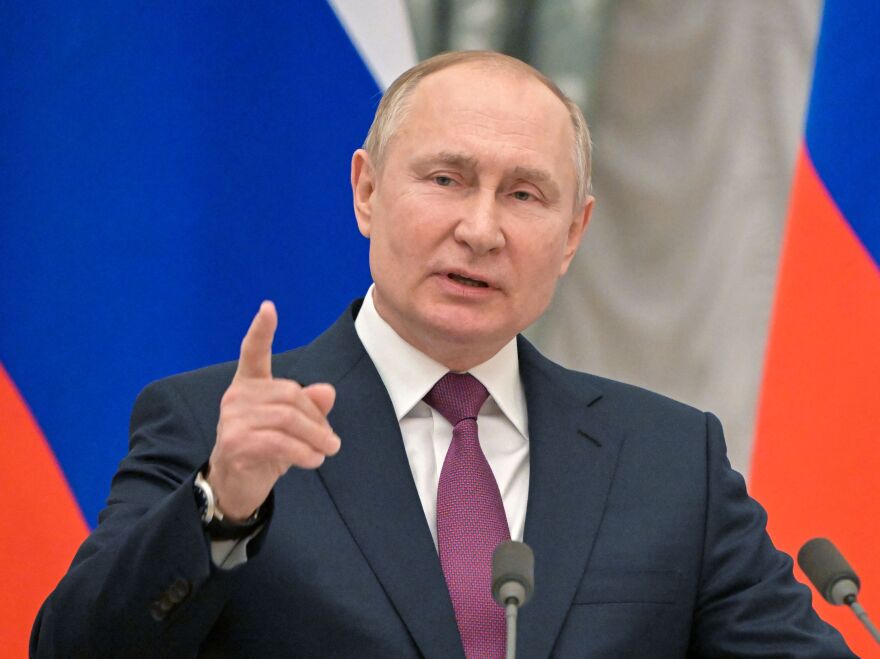
Ukrainians have been turned into drug addicts. Ukraine gets billions of dollars in aid which is only misused. Now the situation has turned such that Ukraine is only interested in consuming drugs and begging from NATO (North Atlantic Treaty Organization) and the European Union. NATO and the European Union no longer want a useless country like Ukraine to be their member. And NATO is using this useless country against Russia. The aim of America and NATO countries is to destroy Russia. For this purpose, they have made Zelensky and Ukraine a scapegoat. Volodymyr Zelensky is a fool and a drug addict who has destroyed his country in the greed of becoming a member of the European Union and NATO.
Inviting NATO against Russia and massacre of Russians in Ukraine has forced Russia to wage war against Ukraine. If Ukraine had declared that it would not join NATO, neither there would have been this war nor much of this needless destruction. In his greed for power Zelensky is provoking this war. He doesn’t even have basic common sense.
NATO countries have only been supporting the massacre of Russians in Donbas. NATO’s making noise of human rights is mere posturing. Distressed by the continuous massacre of Russians, Russia was compelled to wage this war. Russia’s fault is that it delayed it by eight years. Russia should have started this war eight years ago.
Much has already been written about the current US President Joe Biden that he is not a good man. His party is no good either. Zelensky is ready to sell his own country for drugs and dollars. The massive support in United Nations to pass American resolution has been obtained through coercion and ‘dollars’. The Russian side has been suppressed by censorship and sanctions. India’s mainstream media has been completely clueless about the real underlying issues in this Ukraine Russia war.
New born Hamro Party sweeps Darjeeling civic polls
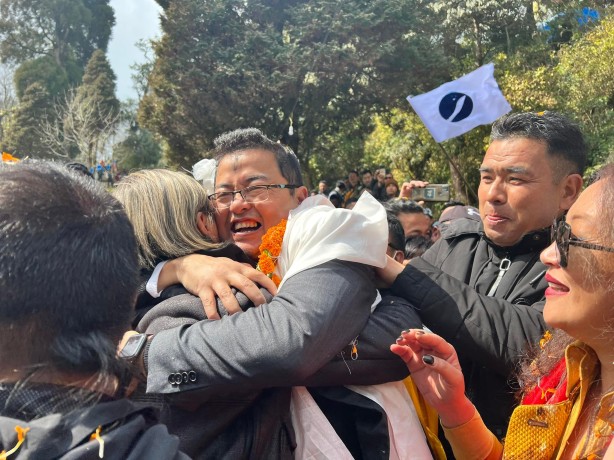
Darjeeling’s civic poll results have surprised the political pundits. The newbie political entrant Hamro Party (Our Party), a three month old local party won 18 of 32 seats in the Darjeeling Municipality. Results of the civic polls in Darjeeling were announced on 2 March 2022 at the Darjeeling Government College. Hamro Party is now all set to form the board of commissioners and take over the administration of the Darjeeling Municipality.
Anit Thapa’s Bharatiya Gorkha Prajatantrik Morcha (BGPM) came second in the race winning nine seats followed by TMC who won two and Bimal Gurung’s Gorkha Janmukti Morch (GJM) won three seats in Darjeeling’s civic body. The GNLF-BJP alliance that had been victorious in the last Bengal Assembly elections failed to capture even one ward this time in Darjeeling.
Interestingly, Ajoy Edwards president of the winning Hamro Party and probable candidate to be the Darjeeling Municipality Chairman lost in his own ward by five votes. However, in an interview later Edwards said that “The chair was never the goal, the message was. To that reason, I also accept my defeat in Ward 22 with humility.” He further said, “I learned many things about Darjeeling during this campaign— I’m more convinced than ever that we’re a good and decent people, that democracy matters and that what our hills have always stood for is worth fighting for.”
Ajoy Edwards further explained that though the state government cannot be taken as an “enemy” as the Darjeeling Municipality comes under the purview of the Bengal Municipal Act, however, the citizens of Darjeeling will now no longer be puppets in the hands of anyone and it will now be an “era of diplomacy, diplomacy and diplomacy”. He spelt out some of their short term development projects like ‘garbage management’, opening of diagnostic centres, apart from solving the issues of water scarcity, traffic jam and bringing revenue back to the Darjeeling Municipality.
Ironically the Darjeeling municipality in the 1970s was known to be one of the richest municipalities in the state. Over the years it has been deprived of funds from the state government and also whatever little comes is inept to deal with day to day civic problems. The party won the hearts of the citizens of Darjeeling and they are now ready for a new beginning in the hills.
Soon after the results were announced chief minister Mamata Banerjee announced that she “welcomes the Darjeeling civic election results” and said that the state is interested in conducting the Gorkhaland Territorial Administration elections soon and the Panchayat elections too. The last Panchayat elections were held in 2000 in the hills. The hills unlike the rest of Bengal have been given a two tier panchayat rule. Three-tier Panchayat system in Darjeeling district exists only in the Siliguri sub Division.
This region, which is North Bengal, Terai and the Doors areas, and it’s Nepali speaking community have been demanding a separate state of “Gorkhaland” outside the state of West Bengal but within the Indian ambit for a long time. The territory is one of the most juggled territories. Perhaps, it was the proximity of this region to Kolkata that after India’s independence the region was made a part of Bengal though “having no history with the state and later now became a district under it”.
The people thus have been part of the rise and fall of the demand for a separate state and this movement reached it’s peak in the 1980s and again in 2007. These movements have been a manifestation of relative deprivation of the people of the hills, lack of basic needs like water, poor health facilities, unemployment among the youth, degeneration of the tea gardens, absence of “need based policies”, unfulfilled assurances that were promised to the people of the hills. Most of the policies of the state government so far have been appeasement policies.
The question of identity of the Indian Nepalis and a political space for the legitimization of that identity is central to the Gorkhaland movement. Until and unless there is a resolution, or questions of the identity and rightful representation of indigenous hill population are not rightly addressed the agitation even though sporadic in nature will continue and the tranquility and harmony of the hills will be at stake for years to come.
What does Imran Khan want to talk to Modi?
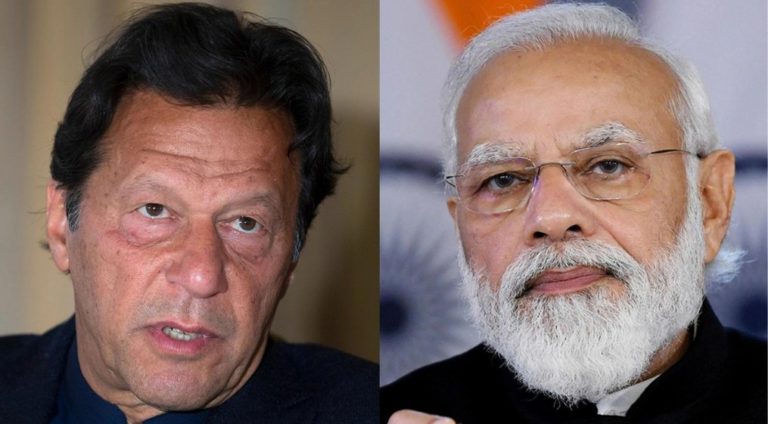
An interview with Imran Khan before his departure for Moscow was released by the media soon after his arrival in Moscow. He was on a two-day visit at President Putin’s invitation. Pakistani newspaper the Dawn of 24 February wrote that Khan would like a televised debate with his Indian counterpart on India–Pakistan relations. Russian foreign minister Lavrov had visited Pakistan nine years ago and a Pakistani Prime Minister would be visiting Moscow after twenty three years.
Seasoned and serious leaders when intending to talk on sensitive issues do not talk publicly. That is a deskbook rule of international diplomacy. However, sometimes an issue is talked about by them publicly if it is of global significance and concerns a wide spectrum of international community. For example, the Coronavirus when at its peak did call for timely interaction among the top leaders. Even then it remained accessible to a restricted audience.
By deviating from the accepted norms, and asking for a televised debate with the head of the government of a neighbouring country against which Pakistan has been nursing ill-will, animosity and hatred ever since its creation sounds bizarre. What does Imran Khan want to talk to Modi?
For the PTI government headed by Imran Khan, Kashmir is made the sum and substance of Pakistan’s foreign policy — “the jugular vein”. Pakistan’s Kashmir policy is chartered by the Pakistan Army and ISI both drawing strength from the home-bred jihadist militant organizations. PTI or any government in Pakistan survives as long as it has the goodwill of the army. Therefore, PTI has to play the card that stimulates maximum sensitivity and euphoria among the jihadists. Kashmir issue bandaged in religious padding serves Imran’s political purpose.
Therefore, Imran Khan has the compulsion to build Hitler, Mussolini, Genghis Khan et al out of Modi. He has the compulsion to raise the hoax of a tyrant, an extremist Hindutva ideologue, a far right-wing dictator for Modi, the Indian leader to whom the vast Indian majority vote has sent to power for the second time and now eyeing the third stint in 2024 as well. Hence, what Imran Khan is unwittingly pursuing with all his intentions and compulsions is an ideological war camouflaged as the clash of religions. He has the compulsion of painting Modi as the biggest threat to the survival of the Muslim community in India despite constitutional and administrative guarantees for safety and security, and he (together with the Saudis) has the compulsion of giving a clean chit to China for demonizing two crore Uyghur Sunni Muslims of Xinjiang.
For the last two years, Imran Khan has added a defining clause to its hate-India canard, viz. “persecution of the Muslims of Kashmir and India by Modi government”. This compound lament has become integral to the prayer of Pakistani diehard anti-India and anti-Hindu jihadists in mosques, at shrines, in homes, offices, public places, at graveyards while offering fateha to the dead or on occasions of celebrating a feast in remembrance of a saint or Sufi.
Victimhood is a facet of taqiyya meaning the ‘covert strategy’ in Islamic jurisprudence. The intensity, with which Pakistan has woven the Kashmir mesh into Pakistan’s religious-political narrative, makes its factual refutation difficult and hideous for a large democracy that had allowed the separatists to stay back and live as Indians while successfully slicing traditional India into three.
What does Imran Khan intend to talk to PM Modi in a televised debate? This is an interesting question. Imran complains that India does not respond to his overtures since he thinks outstanding issues can be resolved by dialogue. Here lies the dichotomy which Modi is not going to buy while his predecessors did. Modi’s standpoint is that talks and terror do not go together. The world knows that at one time Pakistan feigned ignorance about the whereabouts of Osama bin Laden as the ‘martyr’ (in the words of Imran Khan) hid in the backyard of the GHQ for years at end and finally the US Marines finished him.
Finding that India was tenaciously holding on to its stance of “talks and terror not going together”, and that the world largely found sense in Modi’s argument, Pak Prime Minister offered ceasefire along the LoC in February 2021. He wanted to sell his “good boy role” to his detractors and above all the FATF, which showed no inclination of removing Pakistan from its grey list.
Is it Imran Khan’s sincere conviction that a ceasefire along LoC would serve to put a halt to the clandestine infiltration of jihadists? No, not at all. The ceasefire agreement does not contain any clue to Pakistan putting a halt to clandestine infiltration across Kashmir. It has not been stopped and thousand of jihadists have assembled in camps close to the LoC on the PoK side. Pakistan offered a ceasefire because it knew it had raised the jihadist training centres in the deep forests along the borderline in J&K, streamlined anti-India and anti-Hindu brainwashing campaign among the Kashmiri youth and provided them enticement for enrolling in various jihadist organizations’ branches in Kashmir.
He wants to tell his beneficiary (meaning China) that he is soft and resilient towards India with whom his country’s relations are strained ever since Pakistan launched a proxy war against India on 22 October 1947 to wrest the J&K State from the Maharajas control. This is another facet of victimhood syndrome.
Pakistan wants to blur the vision of the world and hence a televised debate. But one is to ask, when Pakistan sponsored, abetted and guided the invasion of tribal lashkars on J&K in 1947, the then Pakistan PM did not even inform or consult his cabinet colleagues leaving aside the people and the international community. What is more, Pakistan has been denying all these seven decades and half that she has anything to do with the Kashmir issue as it is the “insurgency of Kashmiri people against India”.
If Pakistan has nothing to do with the Kashmir issue, then why ask for a televised debate? Whom does he want to convince? Of course, the Kashmiris, who, in the process, have been hunting with the hound and running with the hare. They are enjoying the best of both worlds out of victimhood syndrome. One more facet of victimhood syndrome very well suiting Kashmir valley separatist leaders is “money from India and guns from Pakistan”.
Imran Khan has manufactured all possible canards and falsehoods to carry the product called taqiyya to the world market and find customers. He is projecting Modi as the enemy of the Muslims. He is presenting Indian and Kashmiri Muslims as persecuted and oppressed. They understand he is invoking taqiyya, not for any general good of the community but self-aggrandizement only. It is not important whether the world accepts what he says. It is important to keep track of what his people say about his method of taqiyya.
Pak Army Major abducted Hafeez Baloch: BSC
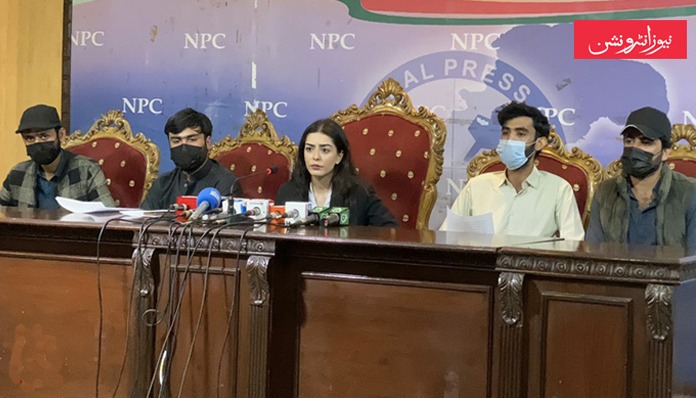
Research scholar Hafeez Baloch was abducted after months of being threatened and harassed by a Pakistan Army Officer, claimed Baloch Students’ Council (BSC)- Islamabad. According to the BSC-Islamabad, Hafeez Baloch was abducted by the Pak Army after being threatened and harassed for several months by Murtaza, a Major in the Pakistan Army.
Hafeez Baloch belonged to the Khuzdar district of Balochistan. He was an M.Phil student at Quaid-e-Azam University in Islamabad.
The Baloch Students’ Council -Islamabad said that Hafeez Baloch was constantly receiving threats and was being summoned to meet Major Murtaza, however, due to some personal engagements he couldn’t meet the Major.
Major Murtaza allegedly travelled all the way to the Quaid-e-Azam university in Islamabad to intimidate and harass Hafeez Baloch, said the students of Quaid-e-Azam University. They further explained that Major Murtaza also scanned the profiles of Baloch students who were studying at the institution under the pretext of conducting research.
According to local sources, Hafeez Baloch was forcibly abducted by the Pakistani forces while teaching at a private academy in Khuzdar on 8 February, 2022. Speaking to a press conference, the students of the academy said that a protest against the illegal abduction of Hafeez Baloch was recorded by the Baloch Students Council Islamabad on 13 February 2022 in front of the Islamabad Press Club. Three peace walks were already held inside the Quaid-e-Azam University and a three-day protest camp was also set up. Despite all the struggles, neither the university administration or the government officials gave any information regarding the illegal abduction of Hafeez Baloch.
FATF’s soft-pedalling is emboldening Pakistan
Pakistani Prime Minister Imran Khan’s admission that “when you talk about militant groups, we still have about 30,000-40,000-armed people who have been trained and fought in some part of Afghanistan or Kashmir”, once again proves that Pakistan remains the most favoured sanctuary for terrorist groups involved in cross border terrorism. Accordingly, Pakistan was grey listed by the international money laundering and terrorism financing watchdog Financial Action Task Force [FATF] in June 2018. It comes as no surprise that Pakistan continues to remain in the FATF grey list for more than two and a half years.
However, rather than take corrective measures to curb terror financing, Islamabad has [as is its wont], been blaming New Delhi for its grey listing by FATF without furnishing any credible evidence to substantiate this bizarre allegation, which expectedly haven’t cut any ice with the international community. Yet, Islamabad is still happy since this preposterous assertion has found traction with its citizens indoctrinated into believing that India is an existential enemy responsible for all problems plaguing Pakistan. As such allegations work wonders when it comes to diverting public attention from the government’s own failings, they are used frequently.
While Pakistan has been maintaining that it has been working assiduously to comply with FATF action plans, its performance on this account is far from satisfactory. Last year, when it was retained on FATF’s grey list for not fully complying with two action plans, ministers and government officials assured the people that Pakistan would be able to resolve the outstanding issues in no time and thus certainly exit FATF’s grey list in its next meeting scheduled in February this year. However, certain developments since the last FATF plenary concluded do not present a very optimistic picture.
For one, while Islamabad hurriedly convicted and jailed senior members of Lashkar-e-Taiba [LeT], a designated terrorist group proscribed by UNSC just before the 2021 FATF meeting, curiously, three key LeT operatives were acquitted soon after Pakistan’s continuation in FATF’s grey list was confirmed. Secondly, with a Pakistani court issuing an arrest warrant against Jaish-e-Mohammad [JeM] chief and a UNSC designated terrorist Masood Azhar, Pakistan Army’s brazen attempt to protect this ‘strategic asset’ by falsely claiming that he wasn’t present in Pakistan has badly backfired!
Just a few days ago, US Federal Reserve Board [FSB] and the New York’s Department of Financial Services [NYDFS] imposed a whopping $ 55 million penalty on the New York branch of National Bank of Pakistan [NBP] for blatantly violating international anti-money laundering laws that could be easily exploited by terrorist groups. Islamabad’s willingness to “resolve the matters described herein [in the ‘Consent Order’] without further proceedings”, is a univocal acceptance of its intentional complicity in facilitating money laundering activities.
The strange thing here is that this isn’t the first time that a Pakistani bank in the US has been accused of violating anti-money laundering rules. In 2017, Pakistan’s the New York branch of Habib Bank, which is Pakistan’s largest bank was fined $ 225 million for several major lapses such as having:
- “Facilitated billions of dollars in transactions with a Saudi private bank, the Al Rajhi Bank, with reported links to Al-Qaida, without adequate anti-money laundering and counter terrorist financing controls”.
- “Allowed for at least 13,000 transactions that potentially omitted information adequate to properly screen for prohibited transactions with sanctioned countries”.
- “Improperly used a ‘good guy’ list- a list of customers who supposedly presented a low risk of illicit transaction- to permit transactions by an identified terrorist, an international arms dealer, an Iranian oil tanker, and other potentially sanctioned persons and entities”.
Despite struggling desperately to keep its economy afloat, Pakistan, has readily been giving its consent to “resolve the matters [related to noncompliance of anti-money laundering laws] … without further proceedings”, and paying million of dollars as fines rather than contesting the charges levelled against it. This clearly indicates that the lapses on its part weren’t unintentional or oversight but very much premeditated and the fact that the same illegal actions occurred twice in just a matter of five years and clearly reveals a complete lack of commitment and abject irresponsibility on Pakistan’s part in curbing terror financing.
However, Islamabad doesn’t consider it necessary to make amends, knowing fully well that it won’t be put into the dock or held answerable for sponsoring and nurturing terrorist groups that furthers Pakistan Army’s ‘shadow war’ against its neighbours. Au contraire, patronising terrorist groups has turned out to be a very profitable business proposition for Islamabad.
That Rawalpindi hosted the UNSC proscribed Taliban which was fighting US-led coalition forces in Afghanistan for two decades is no secret. Yet, instead of being taken to task for violating UNSC mandate and aiding America’s enemy number 1, Islamabad ended up receiving billions of dollars in aid from Washington. This is evident from former U.S. President Donald Trump’s 2018 tweet- “The United States has foolishly given Pakistan more than 33 billion dollars in aid over the last 15 years, and they have given us nothing but lies & deceit, thinking of our leaders as fools. They give safe haven to the terrorists we hunt in Afghanistan . . . .”!
It’s also abundantly clear that the Pakistani military establishment had provided Al-Qaida founder and 9/11 mastermind Osama Bin Laden a safe sanctuary in an Abbottabad compound since being just a stone’s throw away from Pakistan Military Academy, this location was safe from prying eyes. Since Islamabad consistently claims that Pakistan Army’s premier spy agency ISI is the best in the world, it’s difficult to digest the lame excuse of being unaware of Laden’s presence in Abbottabad. Yet, the international community let Pakistan get away with such barefaced falsehood and doing so, indirectly encouraging Islamabad to nurture and harbour terrorists.
Therefore, both FATF and the international community needs to be far more stringent while dealing with Pakistan because measures like imposing fines on Pakistani banks for not implementing anti-terrorism funding don’t seem to be working. Needless to say, terrorism has today acquired the status of a global pandemic due to international apathy and thus, any soft-pedalling while dealing with errant countries like Pakistan will only make the world a far more dangerous place!
India must work towards unified Pashtun homeland
It has been almost six months since Taliban came back to power in Afghanistan. The regime is stabilizing itself steadily and with patience. It’s initial appeal to world powers for formal recognition did not receive favourable response. The past history of Taliban regime was a hindrance. But soon the world powers will voluntarily announce the recognition of the Islamic Emirate of Afghanistan (IEA).
The history of past two decades of fighting and the dramatic end of the war in August last year has changed the oft-repeated notion of the “graveyard of big powers” about Afghanistan. The Afghans had never seen the miserable exodus of its people in thousands following the fall of Kabul nor had they witnessed economic and financial crisis overtaking the country in such a frightening manner.
Economic crisis forced Kabul regime to appeal to the world community for succour to wriggle out of impending disaster. At the same time, the Taliban mounted pressure on the US to order release of its assets in foreign banks. Both developments show that the Taliban understand the importance and reality of inter-dependence of states in modern times. Inter-dependence also means conforming to fundamental norms and criteria of bilateral and multilateral relationship generally enshrined in the charter of commitments made. Understandably, no regime can live in isolation.
Taliban regime in Kabul will be accepted by the world fraternity sooner than later. Indications are already visible. The US is mulling the de-freezing of 50 per cent of Afghan assets of nearly US$ 7.0 billion which is about US$3.5 billion. There are some technical hitches in how to utilise the available funds for the welfare of the Afghan people.
Pakistan has played a distrustful role in the Afghan conundrum. From the very beginning it focussed on two objectives. One was to see that India’s footprints are no more to be seen in Afghanistan and the second was to gain strategic depth westward. Although Pakistan pretentiously said that strategic depth westward meant reducing the impact of Indian pressure on the eastern border yet it actually meant exploiting and exposing the warrior Afghan nation to the dynamics of Islamization as a joint bulwark against India.
But what has been unfolding in Afghanistan after the Taliban takeover needs to be analysed objectively. India had maintained contacts with the Taliban even when the Afghan-American strife was at its peak and later when secret talks began in Doha. Yes, at one stage the Americans, misled by Pakistani interlocutors, did bypass India. They created an impression that India’s role was not very significant in resolving the Afghan crisis. But the astute Indian foreign office refused to be intimidated.
India knows very well that the Haqqani network alone does not matter in her broad-based dealings with Afghanistan. The Afghans know, and for that matter even Pakistanis know that India is on firm ground in Afghanistan for the simple reason that India owes a historical debt of gratitude to Afghan nation. During the great Indian struggle against the colonial rule, Afghanistan gave protection to so many of our freedom fighters and saved them from being arrested by the British rulers. When our supreme soldier of freedom struggle Subhash Chandra Bose escaped from India to avoid arrest, he went to a safe haven in Afghanistan. We Indians are ethnically, historically and morally bound to Afghan nation.
Superseding the adamant outlook of many world powers, India air lifted tons of essential medicines to Kabul to replenish the depleting medical stores in hospitals. Humanism and the aching heart for the needy were the motivation for India to take the bold step. This was followed by India’s announcement of a gift of 50,000 metric tons of wheat for the famished Afghan populace. Pakistan brought in politics and soured bilateral relations as the pretext for refusing to allow passage of Indian truckloads of wheat through Pakistan to Kabul. Afghan foreign minister had to remonstrate with his Pakistani counterpart on disallowing passage of humanitarian assistance to the beleaguered Afghans.
Expression of warm thanks to Indian government by the Taliban leadership must have served a bolt from the blue to the fanatical Pakistani policy planners. It has certainly dashed to the ground their hopes of Taliban giving them overt or covert support on Kashmir issue.
But the crucial factors that will inject fresh blood into the friendship veins of the two countries are firstly India’s subtle diplomatic manoeuvres of convincing big powers that the Taliban regime has to be given recognition as a step contributing to the peace and security in the region. Secondly, India must make a categorical statement that she will in all circumstances uphold indivisibility of the Pashtun homeland. India can go a step further and propose to the international community to draw a development package for the Pashtun homeland. If peace and security are to be secured in the region and in Asia, development of Pashtunistan is the key. India should be the first to announce a hefty financial contribution to the development package under contemplation.
India need not wait for the formal recognition of Taliban regime by world powers for resumption of trade relations with Afghanistan. The connectivity through the Iranian seaport of Chahbahar needs to be streamlined. New Delhi must mount attention on removing bottlenecks in Indo-Iranian Chahbahar deal if any. It has to remain the India-Iran-Central Asia link and of vital importance. The rail link from Chabahar to Kabul and then to Afghan-Turkmenistan border is of great significance to India, Iran, Afghanistan and Turkmenistan. Connectivity enhancement in these sectors will also contain the dangerously increasing influence of China in the region through its Belt & Road initiative. If the US $3 trillion worth mineral resources of Afghanistan are to change the destiny of the entire Afghan nation (Pashtuns, Tajiks, Hazaras, Uzbeks and all other constituent groups) then the rail and road connectivity through Helmand basin should become most urgent priority of the international community and funding agencies.
BJP won initial battles in Punjab through deft moves
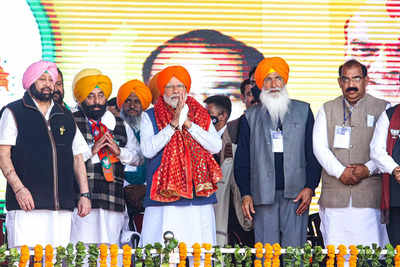
On 16 June 2021, the Bharatiya Janata Party (BJP) office in Delhi became the venue for a unique function; six Sikh personalities from Punjab joined the party in the presence of Union Minister Gajendra Singh Shekhawat, General Secretary in-Charge Punjab, Dushyant Gautam and State Unit President Ashwani Sharma. Those who joined included the author of this piece, Colonel Jaibans Singh, a well known media personality; Harinder Singh Kahlon, former President of AISSF; Kuldeep Singh Kahlon, former AISSF leader; Jaswinder Singh Dhillon, former Vice-Chancellor of Guru Kashi University; Jagmohan Singh Saini, a lawyer by profession and President of Farmers’ Intellectual Front (Patiala) and Nirmal Singh, a Mohali-based lawyer. The joining was facilitated by a senior BJP leader and national spokesperson of the party, Iqbal Singh Lalpura.
New people joining or leaving political parties is a normal ongoing process. However, this was a joining with a difference since it heralded the first major move by the BJP to reach out to the Sikh community in Punjab post its break-up with the Shiromani Akali Dal (Badal).
At that point in time, the BJP was also reeling under the onslaught of the farm agitation and was being looked upon as an anti-Sikh, anti-Punjab, anti-Farmer party due to the massive disinformation campaign launched by the Farmer Unions and the political rivals of the party, mainly the Congress and the SAD(B). On 12 October, 2020, Punjab BJP President Ashwani Sharma was attacked by a violent mob in Hoshiarpur. On 27 March 2021 BJP MLA from Abohar, Arun Narang, was attacked by a mob of so-called farmers, his clothes were torn, his face was inked and he was thrashed mercilessly. In other instances, many BJP leaders were surrounded by violent mobs and tons of garbage was thrown outside their houses.
In deciding to induct the six Sikhs who were described as “prominent Sikh faces of Punjab” by the media, the party heralded its policy of reaching out to the Sikh community. Those inducted were not active politicians but were looked upon as “opinion makers, achievers and influencers” who would send a message of the party’s policy direction in the state.
These “prominent personalities” were well aware of the environment but convinced that only the BJP could check the downward slide of Punjab. They took a dynamic decision at a time when sentiment of the Sikh community of Punjab was very much against the BJP. They were ready to take on the brickbats that did come their way from the society and even their family members, but they held onto their decision.
Despite the challenges, the joining came as a game-changer for the BJP in Punjab. It galvanised the outreach efforts leading to more and more Sikhs joining the party. The next batch in August, 2021, saw Amanjot Kaur Ramuwalia daughter of former Union Minister Balwant Singh Ramuwalia of the SAD and many leaders of the SAD joining the BJP.
On 19 November 2021, the auspicious day of Prakash Purab (birth anniversary) of Guru Nanak Dev, Prime Minister Narendra Modi announced the decision of his party and his government to repeal the three farm laws. In taking this dynamic decision, Prime Minister Narendra Modi upheld the highest traditions of democracy and exhibited his respect and love for the farmers.
While declaring the decision during the course of his address to the nation on the occasion of Gurpurab, the Prime Minister was humbleness personified in admitting that “Tapasiya Mein Kuch Kaami Reh Gayi.” This apart, a few days earlier, on 17 November, the union government also reopened the Kartarpur Corridor that had been closed due to COVID restrictions. The two decisions were of great consequence in bringing the BJP closer to the Sikh community in Punjab. The trust deficit continued, but not to the degree seen earlier.
The Punjab unit of the BJP worked hard to create the necessary infrastructure required to fight the forthcoming state assembly elections in all 117 constituencies of the state. The general impression of the party being irrelevant in the political spectrum of Punjab did not deter it from its goal. Unrelenting support from the centre did a lot to build the morale of the party.
With new faces, especially Sikhs, coming in, the capacity of the party to hold its own in television media debates increased tremendously. The effect on the party cadre was electrifying and a feeling of confidence started emerging. Many within the Sikh community of Punjab, especially those belonging to the white collared segment, realised that the BJP was the only option available for taking Punjab out of the morass that it was mired in. This led to a spate of joining; among those who joined were senior retired officers of the rank of DGP and Army Chief. Soon the political class also gravitated towards the party and joined after leaving its parent organisations.
The political environment in Punjab witnessed an unprecedented twist due to the “political Hara-kiri” committed by the ruling Congress party by ousting Chief Minister Captain Amarinder Singh. The senior leadership of BJP was already in talks of an alliance with the SAD (Sanyutk). The break-up in the Congress gave to the BJP another option of allying with the like-minded political dispensation for Punjab floated by Captain Amarinder Singh in the form of a political party called the Punjab Lok congress (PLC).
Thus, despite having created with herculean effort, the requisite wherewithal to fight the elections in all 117 constituencies on its own, the BJP decided to go in for a strategic alliance with PLC and SAD (S). Distribution of seats on the basis of winnability led to a seamless coordination between the three partners. A significant point in the alliance was that the BJP retained a senior and dominant position with 65 seats; PLC got 37 and SAD (S) 15. Thus, the BJP, in a single move, catapulted from a junior alliance partner in Punjab to a senior partner.
The distribution of seats within the BJP was also a path-breaking exercise. Nearly 30 seats out of the 65 that the party was to contest went to members of the Sikh community. Thus, the myth perpetrated by the opposition that the BJP in Punjab was essentially a Hindu-centric party was broken forever.
The beginning of election campaigning witnessed a negative media response to the BJP with most opinion polls predicted a complete drubbing of the alliance in the electoral battle. This did not deter the alliance from continuing with its campaign with all honesty and dedication.
A vibrant information structure was created with the active assistance of a very dedicated and proficient core team that came from the centre. It resulted in enhanced presence in the print as well as the social media to augment the already dominant presence in television news debates. The information campaign was built on a well conceived agenda based structure. More and more leaders, both local and national, came in to take the message to the people.
Within a few days, political analysts started commenting that the earlier prediction of miniscule seats for the BJP+ alliance merits revision. The new analysis predicted for the alliance a very big leap in electoral presence. The build-up received further traction by the three rallies in Punjab addressed by Prime Minister Narendra Modi that had a momentous positive impact on the morale of the cadre.
The BJP has, within the span of a single election campaign, managed to elevate itself from the level of a junior partner in a debilitating alliance to a strong party with a pan-Punjab presence. While there is all hope of a positive result in the counting scheduled for March 10, the ground reality is that the BJP has already won the battle even as the war continues.
It is quite evident that Punjab is poised to regain its old glory as the most vibrant state of the country economically, socially and culturally and that the BJP will get the opportunity to, most humbly, move the region onto the desired path of progress.