Home Blog Page 297

Why Pakistan’s objections on Art 370 abrogation went unheard ?

“You can fool some of the people all of the time, and all of the people some of the time, but you cannot fool all of the people all of the time.”
― Abraham Lincoln

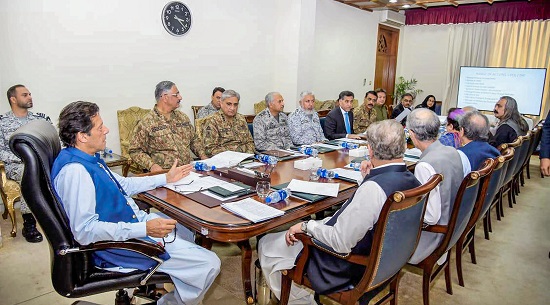
The puerile manner in which Islamabad has responded to the abrogation of Article 370 of the Indian Constitution clearly indicates that it’s been finally ‘checkmated’ by New Delhi on the Kashmir issue. Whereas Pakistan Prime Minister [PM] Imran Khan may be of the view that this action is “illegal” as it “violates” UNSC resolutions, but his perceptions are unfortunately completely removed from reality–a fact validated by Islamabad’s abysmal failure to seek revocation of Article 370 despite trying every conceivable trick in the book and much more!

Khan’s desperation is evident from the fact that instead of substantiating his allegations with legally tenable arguments, he chose to level insinuations that sounded more like the tongue in cheek lines from BBC’s famous comedy show, ‘Yes, Prime Minister’. Some examples he wants the world to believe that by scrapping Article 370, New Delhi has:

  • “Gone against [India’s] Constitution, they have gone against a verdict of their Supreme Court as well as against that of Jammu and Kashmir [J&K] High Court.”
  • “Gone against 17 UN Security Council resolutions [UNSC],” as well as “UN General Assembly [UNGA] resolution.”
  • “Gone against Shimla Agreement.”

A few questions to PM Khan:

  • How does the decision to abrogate Article 370 taken by the democratically elected government of India violate India’s Constitution?
  • Which verdict of India’s Supreme and J&K High Court been violated by the decision to abrogate Article 370?
  • If this decision has indeed violated UNSC and UNGA resolutions, then why hasn’t the UN asked New Delhi to restore status quo ante on this issue?
  • Which clause in the Shimla Agreement debars New Delhi from amending the Indian Constitution?

One doesn’t have to be a ‘legal eagle’ or constitutional expert to figure out that every government has the right to amend the country’s constitution by following the stipulated procedures. So, will Pakistan’s PM explain as to how does abrogation of Article 370 by New Delhi become a “unilateral” issue? Secondly, since inclusion of Article 370 in India’s Constitution was the independent decision of Indian government and had nothing whatsoever to do with UN, to insinuate that its abrogation violates UNSC and UNGA resolutions is downright hilarious! Lastly, since amending the country’s Constitution is an internal matter, how does Article 370 abrogation violate the Shimla Agreement?

Khan has also alleged that by abrogating Article 370 “They [GoI] want to change the demography,” and that “Changing the demography of a region is against Geneva Convention. This is considered war crime. They have violated Indian and international laws to impose their ideology.” To enable people to comprehend what he means, Khan needs to provide credible evidence to substantiate his ‘demographic change’ charge. In addition, he needs to explain that if Article 370 abrogation is not only a violation of Geneva Conventions, but also a war crime, then why hasn’t Islamabad filed a case against New Delhi in the International Court of Justice [ICJ]? Since he has declared himself to be the “ambassador of Kashmir,” why isn’t he taking legal recourse to undo what he feels is New Delhi’s gross injustice to the people of Kashmir?

The fact of the matter is that Imran Khan is both upset and embarrassed since his never ending rhetoric on Article 370 abrogation being some earth-shattering diabolical occurrence that deserved immediate reversal hasn’t found any worthwhile support from the international community. However, no one but Khan himself is to blame for ending up with egg on his face, because he obdurately refused to see the writing on the wall by disregarding clear indications that Pakistan’s claims lacked merit. Some examples:

  • Just a few days after Article 370 abrogation, UN spokesman Stephane Dujarric stated that while the UN Secretary General was closely monitoring the situation “with concern and makes an appeal for maximum restraint,” he simultaneously “recalls the 1972 Agreement on bilateral relations between India and Pakistan, also known as the Shimla Agreement, which states that the final status of Jammu and Kashmir is to be settled by peaceful means, in accordance with the Charter of the United Nations.” Wasn’t this a clear hint that the UN had no intention of intervening in the Article 370 abrogation issue?
  • After Article 370 abrogation, Pakistan Foreign Minister Shah Mehmood Qureshi wrote a letter to UN Secretary General seeking UN intervention on this issue. Pakistan’s then envoy to UN, Maleeha Lodhi met UN Secretary General’s ‘Chef de Cabinet’ Maria Luiza Ribeiro Viotti as well Polish Ambassador Joanna Wronecka, [who was serving as President of UNSC for the month of August] and requested UN’s indulgence on this issue. However, when asked about Qureshi’s letter, Wronecka’s curt reply was “No comments”- could there be a more direct indication the UN found no merit in Pakistan FM’s request for UN intervention?   

Khan and Qureshi claim having a very strong case but have been let down by the international community. However, both knew all along, that emptions apart, Islamabad’s anti-Article 370 abrogation blitzkrieg, while “full of sound and fury,” is devoid of any substance. Why else would Khan on his return from the 2019 UNGA meet make the pessimistic remark that “Pakistan will stand by Kashmiris even if the world doesn’t”? Similarly, if Qureshi was so confident that Pakistan’s demand for revocation of the Article 370 abrogation decision had merit, then why did he forewarn his countrymen that “You [people] should not live-in [a] fool’s paradise” because “Nobody will be standing there [at UNSC] with garlands in hands”? So, who are these two fooling?

One positive fallout of Article 370 abrogation is that the people of Kashmir have realised three very important things. One, that instead of serving the people of J&K as was being claimed by those with vested interests who were benefiting from its convoluted provisions, Article 370, in actuality, was discriminatory towards women and minorities. In addition, since directions of Supreme Court weren’t valid in J&K due to this provision, it impeded progress as the benefits of several public welfare initiatives like right to information and education weren’t available to the people of J&K.

Two, abrogation of Article 370 has fully exposed how Pakistan’s Kashmir narrative has been built on a bundle of lies and once again indisputably established that J&K is an integral part of India. Lastly, everyone knows that the Kashmir issue can only be resolved through Indo-Pak dialogue and so, Islamabad’s refusal to engage with New Delhi unless Article 370 abrogation is revoked is a clear giveaway that Islamabad is more concerned about refurbishing its tarnished image rather than seeking speedy resolution of the Kashmir issue.

Tailpiece: In 2019, Khan lowered his own standing within the international community by misusing the UN General Assembly’s podium to instigate the people of Kashmir through provocative and fallacious innuendoes. He talked about people of J&K being “caged like animals in homes” and even went on to make an extremely suggestive allusion by saying,“but what will happen when 8 million Kashmiris come out of a lockdown [lifting of precautionary curbs, imposed consequent to Article 370 abrogation] …? I fear there will be a bloodbath.” That Khan’s much hyped and toxic prognosis about “a bloodbath” in post-Article 370 J&K hasn’t come to pass is an explicit indication that disillusionment of Kashmiris with Islamabad’s duplicity on Kashmir is near complete!
Art 370 & Art 35A benefited only the political elite of Kashmir Valley

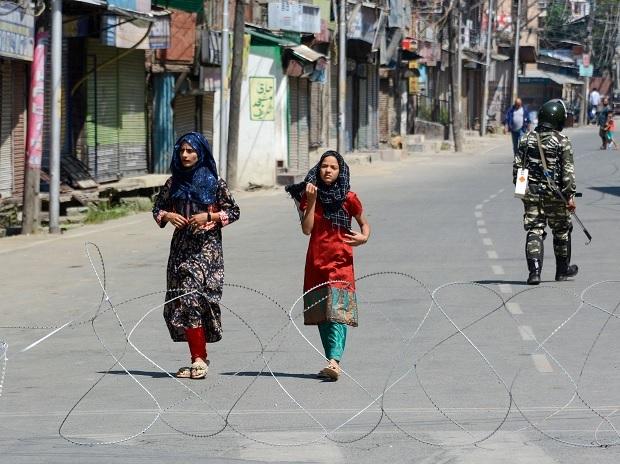
There was a time when several intellectuals and analysts, while articulating Article 370 and Article 35A of the Indian Constitution, used to wonder as to how these legislations were helping the people of Jammu and Kashmir? They got their answer in the post August-2019 scenario, wherein, there was no turbulence in the aftermath of abrogation of the legislations and bifurcation of the state into two Union Territories. It became very apparent that it was not the people, rather the politicians who were rooting for continuance of the legislations and that too for personal agendas.

“Kashmir will burn if Article 370 and Article 35 A are tampered with”, “Central Government should refrain from playing with fire”, are examples of the statements that were made by separatists and so-called tall leaders of the mainstream local parties of Kashmir like the National Conference (NC) and the People’s Democratic Party (PDP). Non-reaction by the people indicated how divorced they were from the ground reality.

The mantle to create an international upheaval on the subject was taken by the Pakistani premier, Imran Khan. He bent backwards to garner international support against the constitutional decision taken by the Indian Parliament. He received no positive response from any quarter, which put his political career at stake as Pakistanis saw him being ignored globally. Imran Khan cannot be faulted since the whole world felt then, and continues to feel today that what has happened in Kashmir is good for the region and its people.

The reality that emerged was that the people had, all through, been against Article 370 and Article 35A but were not ready to speak out openly; however, when the said legislations were abrogated they did not react, instead, they went about their daily routine in a normal manner.

It was so because the said legislations had been anti-people from the very beginning. It has been historically proven that they were incorporated by Pandit Jawaharlal Nehru to favour his good friend Sheikh Abdullah. Many legal luminaries have stated on innumerable occasions that Article 370 was set up as a temporary measure to implement the Indian Constitution fully in Jammu and Kashmir and should have been repealed within six months after having completed the constitutional obligation. The country was already behind time by more than six decades in this regard!

Legal experts have also remained convinced that a bigger damage to the spirit of the Indian Constitution was being done by the provisions of Article 35A which denied residents of the state protection under Article 14 (equality), Article 15 (prohibition of discrimination on basis of religion, caste, race or place of birth), Article 16 (Equality of opportunity in matters of public employment and reservations) and the fundamental rights of the Constitution under Article 19. There is no place in democratic India for such provisions that actively curbs the rights and privileges of the citizens of the country. It would be pertinent to review all the areas where the people of the region were denied facilities and constitutional safeguards due to the two draconian legislations.

Many progressive legislations and provisions of the central government could not be extended to the J&K because they have not been legislated upon by the state government.

Panchayats of the state were constantly fighting for empowerment which was being denied since the 73rd and the 74th amendments to the Constitution of India had not been extended to the state.

More serious was the loss borne by the Scheduled Castes, Scheduled Tribes and Other Backward Classes who are not availing the benefits of central schemes.

Business suffered because people from the rest of the country could not establish infrastructure in the state.

The socio-psychological divide created by the statute negated integration of the youth of the state with other parts of the country. 

The 1947 refugees from Pakistan and people of the Valmiki Samaj were denied citizenship of the state for seven decades since independence.

The state government was not accountable to the nation despite looking for assistance all the time. The Right to Information route could not be applied to find out where the funds went! The poor people remained ignorant while the rich and mighty were in collusion.

Colonization of people in Pakistan-occupied Jammu and Kashmir (POJK) by the federal government of Pakistan was not being addressed in a serious manner.

Women of Jammu and Kashmir, due to provisions of Article 35A, were denied full-fledged rights to land and property in the state. Such women who were state subjects but married a person who was not a state subject forfeited legal and ancestral right to their own property in the state. This was because of the definition of a “permanent resident” of Jammu and Kashmir as given in Article 35A of the Constitution.

The legislation passed by the Indian Parliament on August 5, 2019, sets aside all provisions that were denying aforementioned rights and facilities to the people and brought them at par with their fellow citizens of the nation. Women have emerged as special beneficiaries since those married and settled in other parts of the country and even abroad have now been given full rights on their land and property.

Many looked upon the inability to do away with Article 370 as a failure of the political leadership at both the centre and the state level. The economic and political loss that the people of the state suffered due to continuation of the Articles far outweighs the preferential treatment that it assured. The objective of every law and statute is betterment of the people; if such betterment is not coming by, then legality cannot be quoted as a reason for continuing with it.

There is a new dawn in Jammu Kashmir as the region moves forward to enjoy all fruits of democracy and freedom guaranteed under the Constitution of India. The ball is now entirely in the court of the people; they can make or break their destiny and the future of their younger generations.

Israel-Gaza ceasefire is tenuous

At the special session called by the Security Council to discuss the fighting in Gaza, the Pakistani foreign minister strove to project it a global Islamic issue and tried to invoke the Muslim countries to consider the Israeli attack as nothing short of a “genocide of Palestinian Muslims”. He was more vocal than any other delegate and boasted that the “united effort had brought about the desired pressure on Israel to accept a ceasefire”.

For the last two years, there has been a strong movement led by some pro-active Islamic states to project the “Islamic cause globally” and tell the world that Muslims are subject to repression and have been denied of the right to self-determination. Pak foreign minister had travelled to New York where he hosted a dinner to OIC members and briefed them, rather exhorted them, to act in a manner that Israeli aggression was challenged and aborted for all times to come. He knows that the Islamic countries are not united in having a uniform policy towards the Israel. We do not have the information about what was the reaction of Iranian representative to the dinner meeting thrown by Pak foreign minister.

In his speech at the Security Council, interestingly he did not take the name of Hamas or Iran, the country that helped Hamas take over the control of Gaza in 2007 as a result of which Israel blockaded it as a step toward ensuring the security of the country and national interests.

One should not take the bragging of Shah Qureshi on its face value. A deeper analysis shows that the ceasefire did not emanate from any pressure from the Muslim world much less the fanatical regimes like those in Turkey or Islamabad. The fact is that Germany, France and the USA all did not find any sense in the continuance of violence in Gaza. They had made behind the curtain efforts in convincing the then Premier Netanyahu that the eleven-day fighting must come to an end. France had even circulated a resolution imposing certain restrictions on Israel but it was rejected by the US.

Protestors in Germany hurled rocks at the doors of a synagogue in Bonn. Israeli flag were burnt outside a synagogue in Münster. A man chanted slurs when moving with a convoy of cars in North London. Israeli-Palestinian strife was feeding anti-Semite sentiments in the European countries.

President Biden did not want the initiative of forcing ceasefire to slip out of his hand. That is the reason why he called Netanyahu and gave him a stern warning that the ceasefire must take place that day in any case. President Biden not only appreciated but even supported the initiative taken by Egypt and ultimately ceasefire became a reality.

Israel made no secret of the fact that it wants the head of the Hamas Chief because it was he who had ordered the firing of nearly 3,400 missiles on Israeli territory. Though most of the missiles fired by the Hamas were warded off by the Iron Shield and only some of these could land on the targets.

It has to be remembered that Netanyahu did not make any commitment of ordering a ceasefire when Biden called him. He consulted his general and a unanimous decision of arriving at a ceasefire was made.

Though post-ceasefire parleys are going on and angularities are being ironed out, it is learnt that the Pentagon has agreed to refurbish damages done to Israel’s iron shield considered the most formidable protective shield with any country in the world.

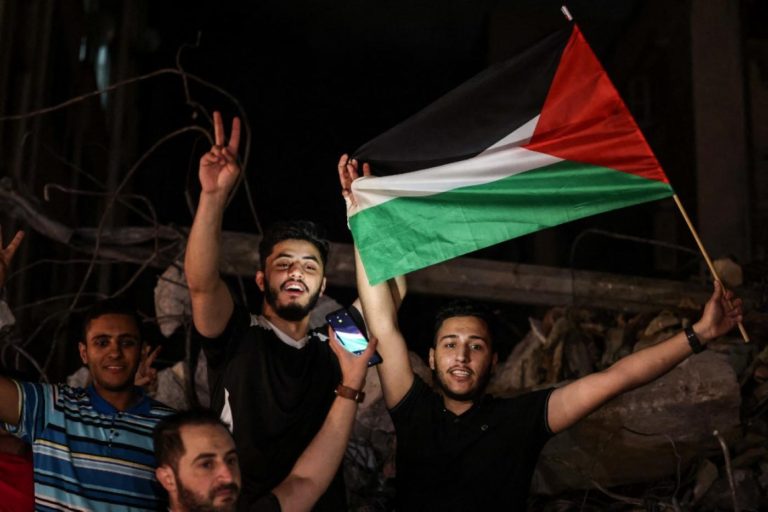
It is amusing that both sides are claiming victory after eleven days of fighting. The Palestinians have staged a high power celebration and call the ceasefire almost acceptance of defeat by Israel. They have lost more than 200 lives and huge damage to infrastructure and buildings. War is not in any side’s interests but, of course, in the interests of those who want disruption and turmoil in a volatile region.

One is amused how the Pakistani foreign minister wants to make it an Islamic issue and persuade Islamic nations to fall in line against Israel when most of the Islamic countries are either neutral or have non-inimical relations with Israel. Saudi Arabia, the most influential Islamic country, is loath to betray open animosity against Israel and would not object to clandestine trade going on with that country. UAE has very recently established diplomatic relations with Israel. It will be remembered that Iran, the arch-enemy of Israel, accepted weapons and ammunition from Israel (via Pakistan) during its war with Iraq.

OIC, which Pakistan and Turkey want to use as a front against Israel, and also against India on Kashmir, is a paper tiger. Its actions never go beyond passing resolutions which are broken as quickly as these are passed. OIC is a house divided against it. Pakistan, which had been in the forefront of ousting Saudi Arabia in Kuala Lampur meet of OIC members, had to eat the humble pie. After suffering humiliation at the hands of the Crown Prince, both the Pakistan Army chief and the PM travelled to Riyadh to acquiesce before the supreme religious authority and beg for pardon for being obdurate in the past.

The Palestinian issue has been complicated by external involvement. Iran and the US have let their proxies fight in the region. As long as that state of affairs continues, peace will be elusive. Iran must explain to the world community what right she has to say openly that her ultimate objective is the decimation of Israel? As long as this mindset continues, Israel will go on arming itself not only for defensive purposes but even something more.

The right to self-determination is easy said than done. Communities and nations have political, economic and social constraints. Above all, these are historical entities having value only as part of the regional and geographical entities. No group or community has been able to attain self-determination by stretching its muscle power because in doing so it has to face a stronger, bigger and mightier power. Today’s world is a complicated one and there are interests within interests just as wheels within wheels. The problem with the Muslim world is that it has yet to learn how to live in peace with other religious denominations. Most of its problems stem from that discrepancy in perception. This is true not only about Palestine but also of Yemen, of Syria, and many more spots on the globe particularly where there is sizeable Muslim diaspora.

In this background, the ceasefire in Gaza has been tenuous then and now, and it will be the same in future. World powers will always try to intervene and provide a respite in fighting but they will not be inclined to work out a lasting solution unless the parties themselves want a solution. For the fighting Palestinians, there are many so-called sympathisers among the Muslim countries who will deliver fiery speeches only to see the flames burning wilder. No Muslim country is prepared to ask why Iran should do all it does to set up the proxy in Hamas which is the root cause of Palestinian issue. The presence of armed and indoctrinated Hamas does not indicate any earnest desire of resolving the issue peacefully. If Iran wants to prove the Muslim world that she is more Islamic than all of them, well nobody will have any objection but she cannot do it at the cost of Israel.

Pak kills Kashmiri intellectual Dr Ghulam Abbas in Kotli, POK

Kashmiri intellectual Dr Ghulam Abbas was shot dead by unidentified gunmen in the wee hours of Monday at Kotli, Pakistan-occupied Kashmir (POK). Dr Ghulam Abbas was a votary of inter-faith harmony in Kashmir and was a liberal leader who had no personal enmity. Local Kashmiris said that anybody who talks about the rights of Kashmiris and is a votary of inter-faith coexistence comes under the hit list of Pakistan’s ISI.

“In all likelihood the unidentified gunmen were hired by the ISI to kill Dr Ghulam Abbas. He was such a nice man who was loved by everyone in Kotli,” a local Kashmiri wrote on his Facebook post. Interestingly, this post was deleted within an hour.

Dr Ghulam Abbas had come to Kotli from Canada to attend the funeral of his father but was himself shot dead at his home. At around 4 AM on Monday morning, armed men rang the doorbell of his house and when Dr Ghulam Abbas opened the door, he was shot dead.

Pakistan-occupied Kashmir (POK) has strict rules for Kashmiris wherein the locals have to compulsorily toe Pakistan Army’s line. Anyone who deviates from the diktats of Pakistan Army is eliminated. Dr Ghulam Abbas was one such intellectual. He talked about unemployment, education and right to dignified living for the local Kashmiris in POK. And was finally eliminated on Monday by unidentified gunmen at the behest Pakistani intelligence agency, ISI.

Worldwide protests to mark 12 yrs of Dr Deen Mohammad’s abduction by Pak regime

In Pakistan-occupied Balochistan (POB), ‘enforced disappearance’ of Baloch people has been going on for the last several decades. Ever since Pakistan illegally occupied Balochistan in 1948, thousands of Baloch have been abducted and disappeared and thousands have been killed under Pakistan’s ‘kill and dump’ policy.

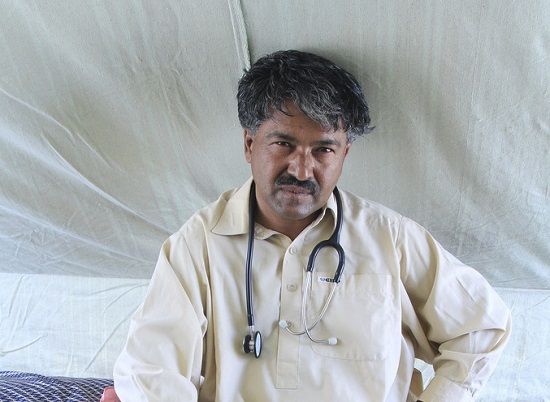
Baloch intelligentsia that includes scientists, doctors, engineers, lawyers and political activists are specifically targeted by the Pakistani regime. Eminent Baloch activist Dr. Deen Mohammad Baloch was abducted on June 28, 2009 by the Pakistani forces. He remains “missing” till today. Dr Deen Mohammad Baloch was former central committee member of the Baloch National Movement (BNM) from Ornach, district Khuzdar. Dr Deen was on duty at the Ornach Civil Hospital when he was abducted by the Pakistani soldiers and ISI.

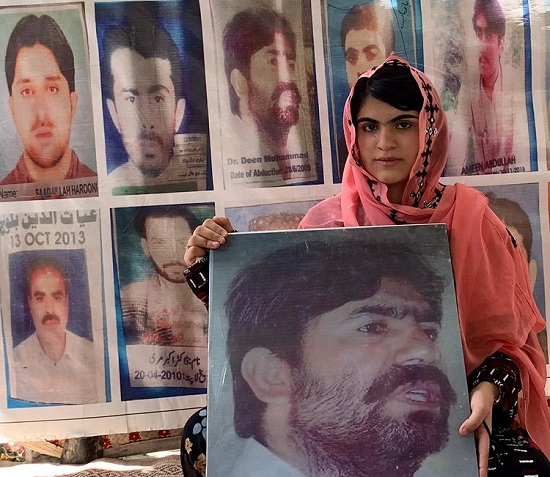
Sammi Baloch, daughter of Dr Deen Mohammad, said that after her father went missing, she and her mother moved to Karachi in 2013 because her mother was indisposed. They rented an apartment in Karachi. Later in the year 2018 their ancestral home in Mashkay was looted and burnt by the Pakistan Army and local Death Squads. All the memories that they had of their father which included hundreds of books were also burnt.

Sammi Deen Baloch and her sister Mehlab Deen Baloch, have been struggling to find their father and have knocked the doors of every court in Pakistan. The sisters spent their childhood in front of Press clubs. Sammi Baloch along with Mama Qadeer, vice chairman of Voice for Baloch Missing Persons (VBMP) also went on a historical long march from Quetta till Karachi then to Islamabad spanning more than 2000 km in 2013, but even this heroic effort failed to secure the release of Dr Deen Mohammad Baloch.

Mehlab Baloch had joined the Missing Persons’ Camp in Quetta, Karachi and Islamabad since the day of her father’s abduction, and has spent a decade in front of press clubs. “After the enforced disappearance of my father the pain that we have been going through, only my family can understand. We have knocked all the doors for justice, but I have to say with regret, that 12 years have passed and we couldn’t get justice,” said Sammi Baloch, with tears in her eyes.

Dr. Deen Mohammad Baloch was born on May 5, 1969 at Mashkay, Balochistan. Dr Deen was a bright student and completed school education at Mashkay with flying colours. He then cleared the entrance examination at Bolan Medical College Quetta. In the year 2000 he was appointed as a medical doctor at Mashkay. He served as a doctor in remote areas of Balochistan where most doctors were hesitant to go.

Dr. Deen Mohammad along with his close friend martyr Dr. Mannan Baloch served in inhospitable places of Awaran, Khuzdar, Jhaoo, and Mashkay in occupied Balochistan. Dr. Mannan Baloch was also the secretary general of Baloch National Movement (BNM). He was martyred by Pakistan Army and death squads in district Mastung.

Dr Mannan Baloch was a towering Baloch intellectual. (Photo: News Intervention)

Early this year, Sammi Baloch along with other 13 Baloch missing persons’ families started a sit-in at the D-Chowk in Islamabad for the safe return of her father Dr. Deen Mohammad Baloch. After spending a week under open sky in Islamabad’s biting cold and sleeping on the roads at D-Chowk, they were assured that Prime Minister Imran Khan would meet them in mid-March and promised that they would be updated about the progress made in this regard. On 18 March, three representatives of Baloch missing persons’ families including Sammi Baloch, accompanied by Minister of Human Rights Shireen Mazari and Zubeida Jalal met Prime Minister Khan with infinite hopes and expectations. However, their meeting remained futile as they were again given only blank assurances and fake promises as earlier. 

Few days after this meeting, Zia Langove, Islamabad’s puppet home minister for in Balochistan said that he was given a list of 400 missing persons out of which 300 Baloch had been recovered and sent home with the help of federal government. All this was a blatant lie. These blank promises and distorted statements only raise further questions about the intent of Pakistani regime.

Daughters of Dr. Deen, Baloch National Movement (BNM) and family members of other Missing Persons of Balochistan have announced a worldwide protest demonstration , on the occasion of the twelfth anniversary of the disappearance of Dr. Deen Mohammad Baloch.

Pak Army gang rapes Baloch women in Panjgur villages

What do Pakistani men in military fatigues brandishing sophisticated guns do in Balochistan? They rape. Yes, you read it right. Rape has always been a lethal weapon of the Pakistan Army, one that it has tried and tested several times. They used it on East Pakistan (now Bangladesh) and have now unleashed against Balochistan. 

Scores of Baloch women, young girls and boys are sexually assaulted and abducted to be kept as sex slaves in cantonments and are made to ‘serve’ Pakistani military personnel and the Chinese contractors of CPEC (China-Pakistan Economic Corridor). These military cantonments in the CPEC zone double up as rape bases.

During the last fortnight Pakistan Army regulars and their propped stooges Death Squad members raided the Keelkor area of Panjgur district. The sole objective of this raid was to subjugate the hapless Baloch people. And what better way to achieve this objective than to rape all the women! The thinking in Rawalpindi is that a community whose women have been ‘violated’ would easily concede to their demands.

Most of the men in Keelkor villages had already been abducted by the Pakistani Frontier Corps (FC) and ISI, and the only people left were old men, women, young boys and girls. What followed would put anybody to shame.

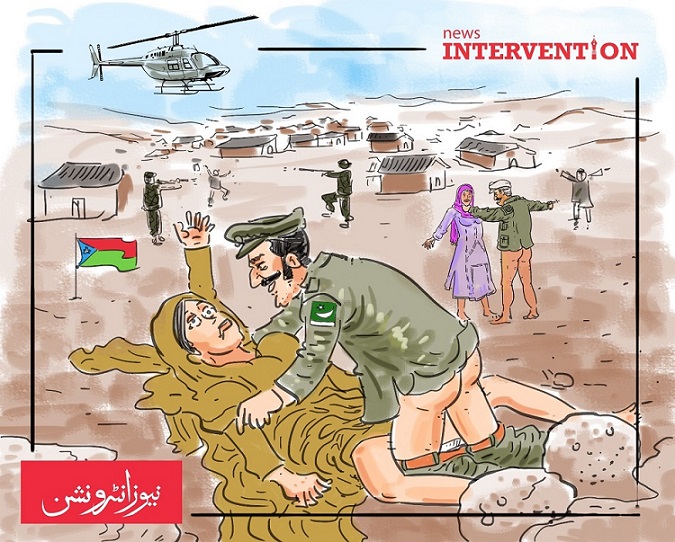
An illustration of Pakistan Army’s ‘rape-raid’ on Keelkor villages in district Panjgur, occupied Balochistan.

All the women across Keelkor villages were rounded up and raped by Pakistan Army soldiers and the members of Death Squads. Girls as young as seven-eight years were not spared either. There young girls and their mothers were raped simultaneously, in front of each other. Local Baloch people say this widespread sexual assault took place in seven Keelkor villages of the district Panjgur.

But why would Pakistanis suddenly raid these Keelkor villages and gang rape all the women? Well, this is not a sudden occurrence. Pakistanis follow a satanic war doctrine, where sexual assault is used as a deadly psychological tool against warring population.

During the 1971 Bangladesh Liberation War the soldiers of Pakistan Army had direct orders from Rawalpindi to rape ALL the Bengali women across Bangladesh. Every day the soldiers were asked about the rape count in their barracks. Rawalpindi’s Panjabi generals thought that the number of Bengalis laying down their arms would be in direct proportion to the Bangladeshi women being raped by Pakistani soldiers. That the Bengalis never surrendered and Bangladesh attained independence is history.

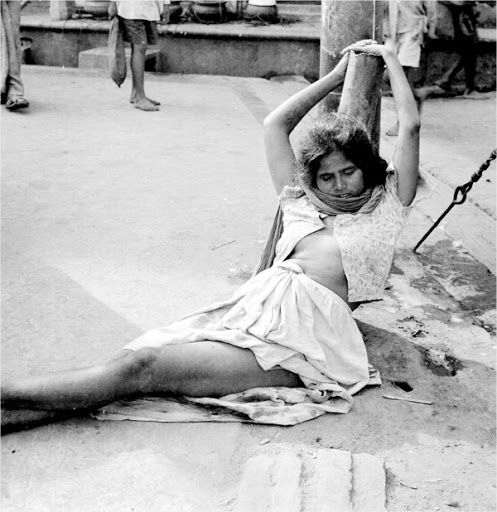
A Bangladeshi woman after being gang raped by Pakistan Army soldiers during the 1971 Bangladesh Liberation War.

Pakistanis, however, never learnt from their own history. And this happened largely because all these Pakistani soldiers were never tried, nor shamed for their despicable war crimes committed on those unlucky Bengali women of Bangladesh. This emboldened Rawalpindi. The stoic silence of the world meant that the 93,000 Pakistani POWs (prisoners of war), after being sent back by the then Indian government as part of Shimla Agreement, began their atrocities with renewed vigour, this time in Balochistan. Since 1973 till 1977-78 the Pakistan Army regulars were looting, killing and raping across Balochistan with impunity. After sexual assaults the Baloch women were taken away to be sold in Heera Mandi, Lahore’s infamous red light area.

There was a slight change in Pakistan’s gambit in Balochistan. Smarting under the ignominious defeat of 1971 Bangladesh war Rawalpindi has now learnt to keep their nefarious activities in Balochistan below the radar. So the first thing was to ban independent media from visiting far flung areas of Balochistan, similarly international human rights organisations and women rights groups were stopped from talking to Baloch women. Any journalist who goes inside Balochistan needs to take permit from Pakistan Army and/or is taken on a guided tour as embedded journalists. Internet and mobile connectivity is non-existent while the ‘rape-raids’ are on. Adequate care is taken that news from far flung Baloch villages do not leak out.

Click on the YouTube link to watch the video

Yet, the Baloch have refused to give up. Over the last decade, freedom struggle in Balochistan has taken a decisive turn. Baloch sarmachaars (freedom fighters) have intensified their revolutionary activities against the loot of Baloch resources in the name of CPEC (China-Pakistan Economic Corridor) and are fighting Pakistani forces with grit and determination.

Pakistani soldiers despite their sophisticated weapons, gunship helicopters and fighter jets are not able to match up the raw courage of Baloch sarmachaars. It’s in this backdrop that the Panjabi generals of Rawalpindi have tried to repeat their Bangladesh misadventure in Balochistan.

And thus, the body of Baloch woman has once again become the battleground for Pakistan Army.

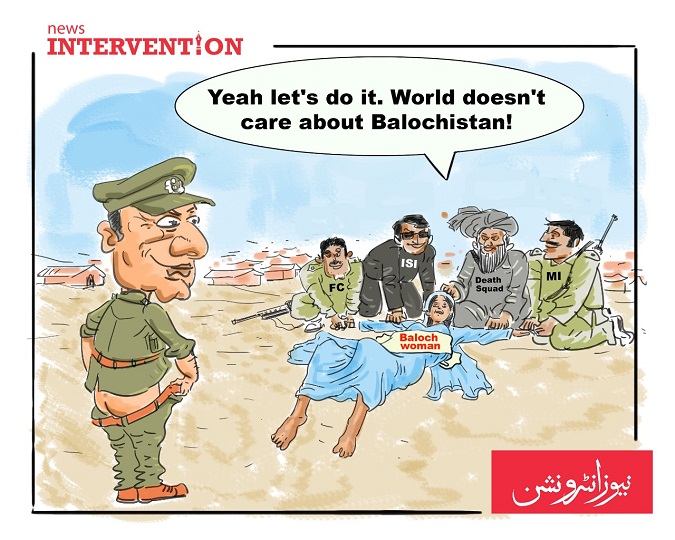
An illustration of how the Frontier Corps (FC), ISI, Pak Army propped Death Squads and the Military Intelligence have synergized their efforts to rape Baloch women.

During the attack on Keelkor villages the area around Panjgur was cordoned off, internet and mobile connectivity was shut down. The vulnerable Baloch women and girls were paraded, raped and humiliated. During one of such ‘rape-raid’ an old Baloch father, Peeri, stood up to save his daughter. Bereft of any weapons he fought the heavily armed Pakistani soldiers with bare hands but was soon overpowered and shot dead. Peeri’s daughter was gang raped alongside the dead body of her father.

Noor Jaan was another proud Baloch father who willingly chose to give up his life when asked by the Paki soldiers to send his daughter to the army cantonment. The story of sexual assault of eleven year old Amir Murad by the Pakistani soldiers at Hoshap proves young Baloch boys are also vulnerable.

Similar ‘rape-raids’ were reported in 2017 at Mashkay in Awaran district as well, wherein twelve Baloch families are still in the custody of Pakistani cantonment. In January this year four women of Akeem Baloch’s family were gang raped by Death Squad members at Mashkay.

The list of such cases may be mere statistics for the champions of human rights and women rights’ activists but shouldn’t the civilized world question Rawalpindi? The world looked the other way when Pakistan illegally and forcibly captured Balochistan, an independent nation, in 1948. Ever since the world continues to maintain its deafening silence to the enforced disappearances, rapes and murders of innocent Baloch people. It’s time we get rid of our ostrich-like approach and help Balochistan attain its independence.  

Let’s get serious about climate change

It was in January this year when Union environment minister Prakash Javadekar said India is the only country to keep its commitments on climate action, despite accounting for only 6-7 percent of world’s total carbon emissions.

It was a significant statement.

The minister admitted again this week that unbridled carbon emissions especially by Europe and the US over the last 200 years, and in the last 40 years by China have caused the climate disaster. The minister also admitted that New Delhi’s contribution to climate change in the last 200 years has been only three per cent.

So it is clear that climate change is the next big issue to be debated across the world and India is in the thick of it. On paper, developed nations owe $1.1 trillion to developing nations as a part of the climate change mitigation under the Paris Agreement.

The rich nations, claimed Javadekar, promised to provide $100 billion each year to help developing nations combat climate change. But nothing has come in the last 11 years. 

Melting glaciers, rising sea levels, dying cloud forests, and struggling wildlife are causing concerns. It is clear that by releasing heat-trapping gases, people have triggered much of the warming of the past century. 

In short, climate change not only entails rising average temperatures, but also severe weather events, changing populations and ecosystems, rising oceans, and a host of devastating impacts.

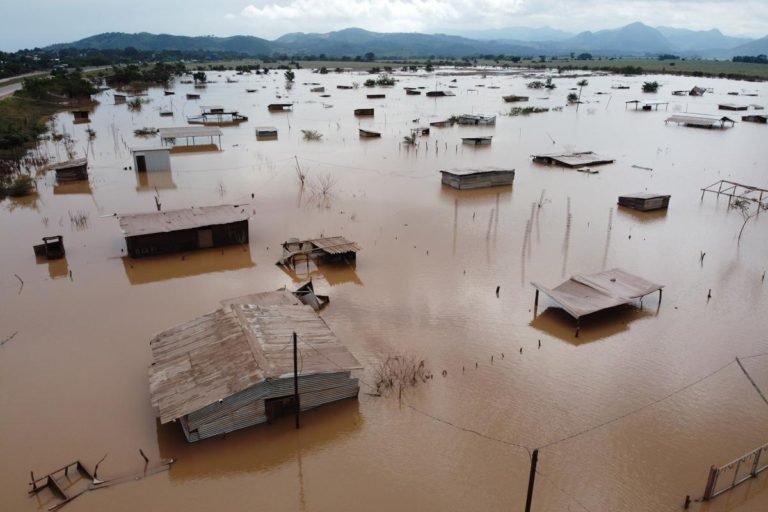
(Representative photo)

Despite the Kyoto Protocol and subsequent efforts, the environment continues to be at risk.

The Kyoto Protocol and the Paris Agreement (which is set to replace the former in December 2020) need immediate reformation if we are to see substantial differences.

A major concern with the protocol and the agreement is the fact that binding targets are not in place for developing nations, which have seen unprecedented growth in emissions due to rapid industrialisation. 

The problems with the Kyoto Protocol is that exemption of developing countries, such as China and India, from having to reduce their greenhouse gas emissions has been widely criticised, especially by Washington. But then, developed countries were major emitters of greenhouse gases at the time of the protocol’s formation and even now. Worse, the protocol does not focus on long term solutions. Instead, there is too much focus on short term targets allowing countries to meet their emission reduction standards. 

Celebrated author Amitav Ghosh in his book The Great Derangement: Climate Change and the Unthinkable said the Laissez Faire ideas are still dominant in the anglosphere and are still central to the Climate Crisis. If emissions of some countries were to be curbed and others were to rise, especially  in the possession of a large number of Carbon Credits, then it is ideally a funnel leading to redistribution of power.

So, Climate Change is not just a threat but a threat multiplier that can potentially deepen the already existing divisions and lead to intensification of a range of conflicts. Perhaps the main obstacle to mitigatory action is the distribution of power in nation states lying at the core of the issue of Climate Change. 

The impetus for industrialisation in countries, part of the trajectories of decolonization and the historical legacy of the conflicts also embedded in the climate negotiations.

The Paris Agreement does not lay out the premises on which targets are based. Again, technological advances to keep Greenhouse gases out of the atmosphere and bury them deep underground are still nascent. Worse, there isn’t the slightest acknowledgement of the things gone wrong, provisions to solve the crisis continue to remain in files.

So what is the alternative?

Instead of the Cap and Trade system that allows developed countries continue business as usual and are expected to purchase indulgences to give small amounts of money to developing countries in forms of offsets and adaptation funds, a progressive carbon tax must be established that would begin at 1$ per gallon of petrol and revenues would be directly returned to the members of the public as a dividend inversely proportional to the carbon footprints. 

Developed countries must put a limit on profits and re-invest the surplus trade profits in the investment of newer technologies. For example: There is a software in Australia called Gofar that is responsible for measuring the amount of fuel/ carbon emitted by the vehicle and provides the driver and the owner of the vehicle regular feedback on the same. As of now, it is available only for private vehicles but through international funding through IMF and World Bank, such a technology should be made accessible to all vehicles especially oriented towards developing countries.

International Climate Finance should be used as a lever to incentivise climate resilient low carbon investments, complementing domestic resources in developing countries.

As for India, the nation needs an outpouring passion for Climate Change, it has not happened despite the existence of innumerable environmental organisations. Political energy has increasingly come to be focused on issues that relate to questions of religion, caste, gender rights etc.

It is evident in the ignorance and the lack of action taken by the respective governments for the victims of the Amphan, and Yaas cyclones. There must be programs launched to promote climate literacy in these areas and as proposed by the Haryana Government; District Irrigation Plans leading to the creation of the State Irrigation Plan (SIP) are being worked upon to maximize the development of water sources within the irrigation network. This ensures solutions to water shortages through rainwater harvesting, distribution networks and by improving efficiencies within farming technologies.

Everything else will fall in place.

May ’21: Pak forces abducted 61 people and looted 200 homes in Balochistan

Special Report
Detailed report on the war crimes of Pakistani regime during the month of May in Pakistan-occupied Balochistan (POB). All the data has been collated from social media posts, reports in various Baloch publications and from reports filed by our journalists.

Let’s take a look at the situation of serious human rights violations, military operations, enforced disappearances, massacres, looting of houses and the ongoing war crimes committed by Pakistani security forces during the month of May 2021.

Pakistan Army and its various agencies conducted more than sixty operations across occupied Balochistan in the month of May. Pakistani forces detained and disappeared 61 Baloch people during these military operations. And during these operations, Pakistani forces looted more than 200 Baloch homes. Pakistani security forces also set several Baloch houses and forests on fire. The forces took away more than 100 cattle.

In the month of May, thirty one bodies of Baloch were recovered from Pakistan-occupied Balochistan. Of these 14 Baloch attained martyrdom at the hands of Pakistani forces. The motive for the cause of death of remaining 16 Baloch could not be ascertained. In Dasht, district Kech, a young Baloch man died when the Pakistanis infused him with an expired intravenous drip.

Pakistani forces set up several new outposts across occupied Balochistan during May. A girls’ school in Dasht was turned into a Pakistan Army camp.

Further during this month, seventeen ‘Missing Persons’ were recovered from the Pakistani forces’ prisons. Of these, one was ‘missing’ since 2016, four since 2018, two since 2019, four since 2020 and six since 2021. All these ‘Missing Persons’ were forcefully abducted and were in the state torture cells and were released in May.

Mir Abdul Nabi, an elderly Baloch pro-freedom activist, was shot dead by Pakistani intelligence personnel in Afghanistan, and a child was killed in Iranian Balochistan. The Pakistani forces also looted cattle from different areas and burnt forests in Jhao, Mashkai, Gichk and Soler.

Ground and aerial military operations of Pakistani forces intensified in Kech, Bolan, Awaran, Panjgur, Kalat and Kohlu districts.

Baloch revolutionaries fighting against the against these occupying Pakistani forces also inflicted heavy blows on them, killing dozens of their heavily armed personnel.

A tragic incident took place in Awaran district when a father committed suicide after being harassed by Pakistani forces. Noor Jan took his own life because the state forces had asked him to send his daughter to the Pakistan Army camp. Noor Jan, being a proud Baloch laid down his life while upholding the Baloch national dignity and conveyed the message to the enemy forces with his blood that the Baloch can give their lives for their honor and dignity.

Noor Jan’s only crime was that he got his daughter married to a Baloch political activist, which in the eyes of Pakistani forces was as an unforgivable crime. The rape of a woman by Pakistani forces in the Mashkai Valley had enraged the Baloch people against Pakistani occupation of Balochistan.

Noor Jan Baloch sacrificed his life to save the honour and dignity of his daughter from Pakistan Army.

The ferociousness of Islamic Pakistan Army in occupied Balochistan is increasing every passing day. Kidnapping women and children from their homes and sexually abusing them has now become the norm for these occupying forces.

However all the religious Imams, Muftis and parliamentarians who chant the slogan of Palestine appear blind to the atrocities committed by Islamic Pakistan Army against Balochistan.

Ironically, this Islamic Pakistan Army that claims to be the protectors of Madinah, are spilling the blood of Baloch people and raping Baloch women and children. And yet the parliamentary politicians are silent about these horrific incidents. Not speaking out against oppression is tantamount to supporting the oppressor.

In addition to targeting civilians, Pakistani forces have now resorted to burning forests in occupied Balochistan. This devious practice of forest burning was started last year and has now gained momentum. Wherever the Pakistanis conduct operations, they burn down the forests in these areas.

In May 2021, forests were set on fire in Awaran, Panjgur and Bolan districts. The Pakistani forces also added poison to the waters of natural springs to kill humans and animals.

Demonstrations against Pakistan’s nuclear blasts also took place across various countries in May. It was in May 28, 1998, when Pakistan simultaneously detonated five nuclear warheads at Chaghi, occupied Balochistan. It was due to these nuclear blasts in 1998 that the nuclear spread radiation across Balochistan.

The Baloch nation is still plagued by this nuclear disaster. The deadly effects of nuclear radiation can be gauged from the numerous diseases that afflict the people of Chaghi. The fertile land of Chaghi is still barren.

Though Pakistan is suffering from severe internal problems due to economic catastrophe and political instability yet it is also facing severe international criticism for putting curbs on the freedom of expression. Despite severe internal problems, the state forces and its intelligence agencies continue to oppress the people. None of the Pakistani mainstream media groups report about these brazen atrocities committed by Pakistan Army on the hapless people of occupied Balochistan.

Pak Army abducts and kills Gowahram Baloch in cold blood

Pakistani security forces killed a Baloch teenager Gowahram on Monday after forcefully abducting him from district Kech in occupied Balochistan. The seventeen year old Gowahram, who was the resident of Konshkalat village of Tump tehsil, suffered extreme torture at the hands of Pakistani forces before being shot dead.

The unrepentant and unabashed Pakistani military personnel called the family of Gowahram and informed them that Gowahram had died the previous night and ordered them to take the body. However, before his family could go to the military cantonment, the Pakistani security forces sent Gowahram’s dead body to his home.

On Tuesday morning after handing over Gowahram’s body to his family at 11:40 AM, the Pakistan Army soldiers cordoned off the Konshkalat village to control public anger.

Gowahram was the son of Nadal Baloch who had forcibly “disappeared” on 12 June 2021, along with there others who are Abdullah, Sattar and Sohrab. Local Baloch people said that Gowahram’s body had marks of violence and forceful injection of some fluids. The soldiers of Pakistan Army did not allow the post mortem of Gowahram’s body fearing intense public reaction.