Home Blog Page 307

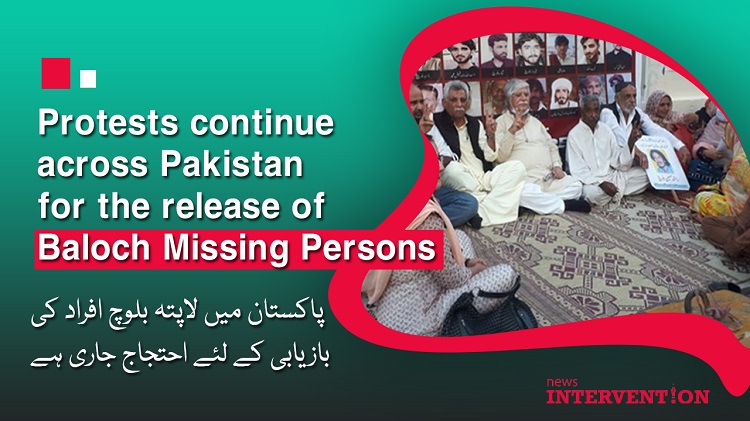
Protests across Pakistan for the release of Baloch Missing Persons

Baloch people are protesting for the release of “Missing Persons”. These “Missing Persons” have been abducted by Pakistani forces and continue to be in jail without any charges against them. Over 30,000 Baloch are “Missing” from occupied Balochistan. Watch this video report to know more.

Click on the YouTube link to watch our news video report

Who are these “Missing” persons in Balochistan? Why are they “Missing”? What happens to these “Missing” persons of Balochistan?

Click on the YouTube link to watch our news video report

Kashmir needs to save youth from indoctrination in terrorism

“I can say this with conviction that today we are able to manage the level of violence in the (Kashmir) Valley. The number of terrorists in the Valley are probably the lowest in one decade… and we would like to keep it that way so that people have some respite,” said Lt. General BS Raju, Corps Commander of the Srinagar-based 15 (Chinar) Corps in an interview to a Television channel a few days earlier.

The General put the total number of terrorists operating in the Kashmir Valley at a little over 200 of which about 125 are locals and 90 are infiltrators from Pakistan. This is indeed a very low number considering that many big cities would have a larger number of armed goons. Also, the present terrorist cadre is low on motivation, training, arms, ammunition and other stores which greatly reduce their strike capability.

A matter of concern is the large number of local cadre in the terrorist fold. These are innocent boys whose insecurities and frustrations are leveraged by the enemy to indoctrinate them into the path of terrorism. In the five year period from 2005 to 2010, the number of locals who joined the terrorist fold was as high as 600 plus. This was the time when Pakistan had been successful in creating poster boys like Burhan Wani who gave impetus to the “lure of terrorism.”

Click on the YouTube link to watch our news report

New Delhi took some affirmative steps to tap the flow; these were augmented with successful counter-terrorist operations by security forces on ground. The end result was a drastic decrease in the number of locals joining the fold of terrorism to about 160 in the period from 2010 to 2015. The numbers have further reduced but, sadly, the intake has not been stopped in totality.

Pakistan is absolutely determined to keep the flame of terrorism alive, at least in the Kashmir Valley if not the entire region. It is coming up with innovative ways to keep the tap flowing. Earlier the focus was on intimidation and indoctrination through the existing terrorist cadre and through persons from within the separatist cadre. A lot of money was invested in this project. With the number of foreign terrorists in the valley having reduced drastically; money flow curtailed and separatists marginalised, the aforementioned option for recruitment has become untenable.

The new methodology is massive propaganda campaigns through social media designed to attract Kashmir’s youth towards the path of terrorism by spread of misinformation. The rhetoric that is being used is unsubstantiated and inflammatory. The youth are told that by picking up the gun they are fighting a holy war. Sustained repetition has a psychological impact on vulnerable minds and the simple boys start believing this to be true. Once vulnerability is identified, the few recruiters available move in for the kill.

The objective is to lure boys from middle class to poor families who are frustrated due to lack of employment or those who are ready to sell their souls for a small amount of money. Drug addicts also form a large segment of the indoctrinated cadre even as some, in the flush of youth, join to impress girls.

The new age terrorist in Kashmir can safely be profiled as an indoctrinated local youth who is both ill-trained and ill-equipped. The instructions given are rudimentary; a rifle or a pistol with a few rounds are handed over and they are left to their own machinations. On top of it, they lack local support.

The aforementioned is a perfect concoction for self-destruction. For Kashmir to move on to the next and final step in its long tryst for peace and prosperity, the complete destruction of this indoctrination process is imperative. The onus of responsibility for this task lies first with civil society and then with the government.

The elders of Kashmir which includes the parents (especially mothers), relatives, political and religious leaders, academicians, teachers, intelligentsia and role models need to get together and stop this nefarious activity. The boys need to be told that there is no element of religiosity and sacrifice in the murderous and perfidious acts of the terrorists and that they need to isolate themselves from the misinformation campaign. They need to be reminded that ‘the pen is mightier than the sword’ for realisation of their aspirations. The government too needs to join in the aforementioned information initiative.

There is also a need for the government to look deeply into the reasons behind the frustration that leads the youth towards pursuing mindless violence and then take affirmative steps to remove the same. Lack of economic opportunity is a major reason behind youth following this debilitating path. In Kashmir 71 percent of the population is under the age of 35, of which, almost half is currently unemployed. Add to it the continuing environment of conflict and we have in hand a young and frustrated populace. The prevalent feeling of desperation, anger and helplessness can easily be exploited as is being done by Pakistan.

There is no denying that the government is making all efforts to uplift the economic condition of the region. This effort needs to be accelerated. Along with the facilities being provided the message should go that responsibility to maintain peace and stability lies with the people.

It is quite heartening to see the resolve with which security forces are targeting terrorists in the Kashmir Valley. The intention to rid the region from the scourge of terrorism is quite obvious. Such pressure needs to be maintained.

It is hoped that the youth of the region will correctly comprehend the changes that are in the pipeline and will come forward to fulfil all such aspirations that have remained dormant due to the long and debilitating shadow of the gun. That is the only method available to break the astounding obduracy that Pakistan is showing in continuing the unholy agenda of continuing with its unholy agenda.

Pakistan’s struggle for Islamic bloc support on Kashmir

How the Biden administration will deal with Pakistan is not an immediate concern for policy planners in Islamabad. Their real concern is how the divided Islamic world patches up and agrees to stand behind her for realizing the Kashmir dream. Pakistan foreign minister’s jaunts to some West Asian countries and the statements emanating from the host as well as the visitor, both, are clear indications that Pakistan wants to mend the fence and bridge the chasm not really for bringing peace and prosperity to Muslims but to garner the support of Islamic radicals for grabbing the entire region of Kashmir. She wants the ummah to believe that Pakistan’s struggle is Islam centric whereas actually, it is Kashmir centric.

The divide between the radicals and rationalists in the ummah (Muslim community) is of fair antiquity and traceable in the rise of the Ismailis in the 10-11th century A.D. In contemporary times it has taken a different shape by making a subtle shift from ideology to politics. Pakistan has made religion a handmaid of politics in Kashmir.

Kashmir is not the quintessential subject that has drawn a wedge between the Saudi Arabian monarchy and the Islamic Republic of Pakistan as the later would like the world to believe. Their discordance is much deeper than what meets the eye. Before December 2019 Kuala Lumpur debacle, Saudi Arabia was infuriated with Pakistan’s refusal to be part of the Saudi-led 39-nation Islamic military alliance against the Houthi Yemen. By giving media hype to its Kashmir “concerns” and bringing in the Saudi related OIC factor into the Kashmir narrative, Pakistan only wanted to arrest the growing realism among the Kashmiri Muslims that Pakistan was incapable of doing anything to derail India’s J&K Reorganization Act 2019.

The Business Standard of 13 April 2017, had reported that the Saudi government had surprised many countries by announcing that it had forged a coalition for coordinating and supporting military operations against terrorism in Iraq, Syria, Libya, Egypt and Afghanistan. Saudi circles inferred that Pakistan’s unwillingness to join the Islamic military alliance stemmed less from the fear of antagonising its next-door Shia neighbour but more from an apprehension that action against terrorists in Afghanistan could expose her clandestine designs as well like the ISI-Haqqani group tie-up.

Saudi Arabia, the traditional epicentre of Islamic conservatism, is willingly responding to the imperatives of contemporary times and, hence, undergoing notable social and cultural change. Having received education in the European and American educational institutions, Crown Prince Salman wants to wriggle out of outdated conservatism and open a new leaf in the history of contemporary Saudi Arabia. This disappoints the conservative non-Semitic bloc of Islamic leaders who feel that a liberalized and modernized Saudi Kingdom means drying up of funding sources and channels that kept them in power and their people stupefied with religious frenzy.  Also, fostering a cordial relationship between Israel and some of the Gulf States — the trust-building diplomacy in which the Saudi monarchy serves as a silent catalyst —  has become an irritant to the non-Semitic Muslim countries like Turkey, Pakistan, Malaysia, etc. Their apparent anti-Israel stance had prompted Iran to jump on the bandwagon of Malaysian Mahathir Muhammad. But on realizing that the Turkey bloc wanted to wrest the centrality of the ummah from Saudi Arabia and shift it to Ankara, the disillusioned Iranian President Hassan Rouhani could not help disappointing them.

Biden’s declaration that the US would not support the war in Yemen and would also impose an arms ban on the kingdom came as a windfall to Pakistan. Islamabad’s perception is that a disappointed and betrayed Saudi monarchy will understand the importance of staying closer to the Islamic fold. Pakistan presupposes a mediator’s role for her in rebuilding confidence between the estranged blocs. It has to be kept in mind that as the lone nuclear power among the 53-odd Islamic countries in the world, Pakistan enjoys a reasonably dominant status in the OIC. Iran and Turkey both aspire for nuclear capability and any souring of Saudi-US relations opens up a fairly good chance for the Kingdom to come closer to China which is the world’s largest importer of Saudi crude oil.

There seems a thaw, at least a tactical one, in Pak-Saudi freeze after the Kuala Lumpur episode. Pak foreign minister was recently on a visit to Egypt where he met with the President and his counterpart Sameh Shoukry. He also met with the Arab League Secretary General Ahmad Aboul Ghat at the latter’s headquarters. In a joint statement, they promised to strengthen bilateral relations and work towards peace and development in Islamic countries.

Following Pak foreign minister’s trip to Cairo, Saudi Arabia and UAE rolled out a loan of US$ 1 billion to Islamabad. Riyadh also disclosed that Saudi oil giant ARAMCO will invest $10 billion in establishing a refinery in the port city of Gwadar. This is to bring parity with Riyadh’s commitment to India for the Mumbai refinery. West Asian analyst at Warsaw’s War Studies Academy told Nikkei Asia that the Turkey-Islamabad-Malaysia bloc which had challenged Saudi Arabia’s leadership will not be affected by these developments.

Islamabad is working at a multi-track approach to its resurgence as an important player in the transnational realignment among the Islamic countries. She is contemplating several joint economic ventures and agreements with Turkey and Iran, like the Islamabad-Tehran-Istanbul railway line and also the Iran-Pakistan gas pipeline to balance relations with the Saudis and Egypt.

These developments are taking shape after the White House received a new inmate. If Biden stands by his restraining policy, Riyadh will be tempted to lean on Beijing. The road runs through Pakistan. In this scenario, the Sino-Saudi partnership will open a new chapter in the strategy of Gulf and Indian Ocean where Pakistan has been assured by both Turkey and China to be provided with sinews to her naval force. It has to be remembered that shortly after the Quad naval exercise in the Indian Ocean, Pakistan hosted China, the USA and the Russian joint naval exercise in the waters of the Indian Ocean.  Long back China had clandestinely supplied some crucial nuclear facility to Pakistan in making the bomb. China could repeat the game and hoodwink the world

In this changing scenario, the significant question that has great bearing on the entire game plan in West Asia is how the united Turko-Saudi block will manage the course of a relationship with Israel once the bloc comes into existence. Is Biden trying to contain the pro-Israel lobby in the US Congress after it had made significant inroads into the West Asian fortification?

Protests across POK as Pakistan refuses to release Tanveer Ahmed

Tanveer Ahmed was not produced in the Pakistan-occupied Kashmir (POK) courts on Tuesday as Pakistanis continued their dubious games to deny the senior journalist his right to a legal redressal. Tanveer Ahmed was arrested in August last year when he took off Pakistan’s flag from Dadyal.

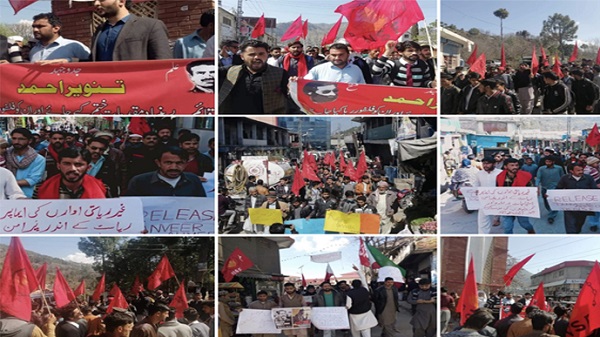
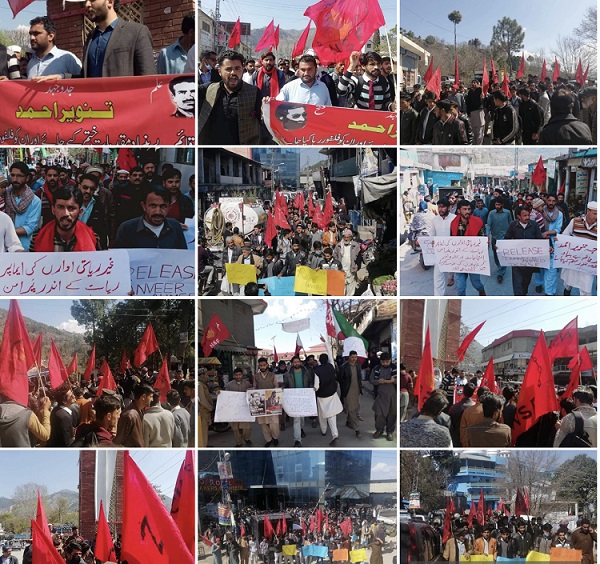
Local Kashmiris in POK said that Tanveer Ahmed’s arrest is illegal and protested against his continued detention. Protests erupted across POK against the illegal detention of Tanveer Ahmed at the call of the Jammu and Kashmir National Student Federation. Protesters shouted slogans and demanded immediate release of Tanveer Ahmed.

Protestors said that the state of Jammu and Kashmir is not a part of Pakistan so hoisting Pakistani flags is illegal. Therefore, the case against Tanveer Ahmed are baseless and his arrest is illegal. Protesters demanded that Tanveer Ahmed be released immediately.

Kashmiris came out in large numbers to protest against illegal detention of Tanveer Ahmed. (Photo: News Intervention)

Who is Tanveer Ahmed?

Tanveer Ahmed is a British Kashmiri citizen who worked with the BBC and is now a freelance journalist and researcher. Tanveer Ahmed is fighting for the identity of the state of Jammu and Kashmir and was recently on a tour of Pakistan-occupied Kashmir to discuss the formation of the People’s Assembly. Some time ago, a burglary took place at Tanveer Ahmed’s house which is being termed as official theft in which Tanveer Ahmed’s laptop and other papers were stolen.

Three years ago, Tanveer Ahmed, despite enduring severe travel restrictions and imprisonment, conducted a poll of 10,000 people from all corners of the ten districts of Pakistan-occupied Kashmir (POK) and released the survey report that described that popular opinion of people across POK. This survey report was published by the newspaper Mujadilla in which 73% of the people of Pakistan-occupied Kashmir were in favor of an independent Jammu and Kashmir.

However, the very next day of publishing Tanveer Ahmed’s survey report the newspaper Mujadilla was shut down and Pakistan imposed a ban on its further publication. Today Tanveer Ahmed has been imprisoned even as he struggles to restore the identity of the state of Jammu and Kashmir.

Social media is awash with outrage over Tanveer Ahmed’s detention and there are talks of launching a movement to remove Pakistani flags from all across Pakistan-occupied Kashmir. Kashmiris are demanding the release of Tanveer Ahmed as well as the restoration of the Mujadila newspaper.

China’s outlook of India shifts from disparity to parity

Reporting that the embattled commanders of India and China in Ladakh have agreed to the disengagement of troops at the Pangong Tso watershed, the Hindustan Times of 16 February quoted an official source making a cryptic remark which no policy planner can afford to ignore. The commentator had said that the speed at which China has moved back its armoured units is not only surprising but it also shows their capacity to deploy the tanks and heavy vehicles again. In case there is a breach of agreement, does India have a corresponding plan which she can put in place? For quite some President Xi Jinping has been exhorting the PLA to be in battle readiness for any challenge of which he has the apprehension. PLA commanders have been conducting field exercises on land and sea.

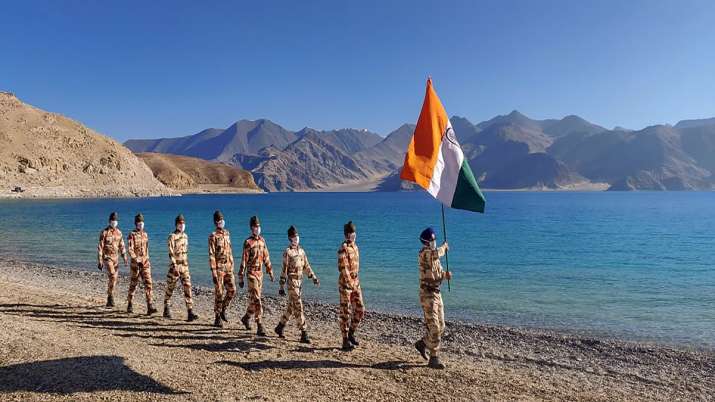
After the completion of Phase I of disengagement in Pangong Tso region that started on February 10 the two sides will resume interaction for disengagement at other friction points along the border. The intention expressed by both sides is to return to their respective positions that existed on 20 April 2020.

Indian field commanders noted that China completed Phase I of the agreement within 4 or 5 days of signing the deal. The speed and smoothness with which China undertook this withdrawal baffled them and the media reporters. Why are they somewhat sceptical about China’s speedy withdrawal much ahead of the agreed time frame? Soon after cobbling the disengagement deal, China began pulling back 200 of her main battle tanks and no fewer than a hundred heavy vehicles that ferried troops from friction points on the north bank to the Srijap sector, the East of Finger 8 (mountainous spur). Observers are rather mystified by a surprising speed with which Chinese commanders have not only withdrawn men and material from the existing point of friction but have also dismantled the bunkers earlier than the expected date.

A former top Indian diplomat is of the view that harsh winter conditions in Ladakh could be the reason for China to agree to the disengagement policy. Furthermore, as this year marks the centenary of the Chinese Communist Party, Beijing thought it desirable to reduce the tension along the border with India and send a message that China wanted peace in the region. However, as far as the harsh winter theory, it is rather an implausible argument since the PLA is well equipped and well-conditioned with assured logistic support to fight mountain warfare in a cold region. The more severe part of the Himalayan winter is already over.

China began pulling back from Phase I region of the agreement and the troops on both sides are supposed to return to pre-April 2020 position whereas the Indian Army will hold its traditional base Dhan Singh post at Finger 3 and PLA will be at Finger 8. No patrolling between F3 and F8 will be allowed.

Some China watchers think that Beijing’s Eastern Ladakh move has a strategic underpinning. It had taken a position vis-a-vis the Indo-US combined sensitivity of the Ladakh border scenario. This position had met with a change as Biden took the reins of administration in the US. China could reinforce its claim to improving relations with India by agreeing to the withdrawal of troops to their traditional position along the Sino–Indian border all along the Himalayan mountain line.

The agreement may be interpreted by China as an expression of the intent of ultimately going back to their permanent bases as existed in April 2020.  But history tells us that such agreements have been there even before the Chinese made the adventure in Eastern Ladakh. What is of importance is honouring the agreements and maintaining their sanctity at any cost. India complains that Beijing has been vacillating on McMahon Line and thus finding a pretext of breaking agreements. China may have rejected the McMahon Line but as long as the British were in the subcontinent, China did not dare to trespass into the Indian side of the Line. How come that no sooner the British left India than China raised the border issue all along the Himalayan line and adopted a belligerent posture in 1962. It was the bullying tactics. We believe the heroic retaliation by the Indian lion-hearts in 2020 has presumably changed the entire landscape of the six-decade-long Sino-Indian border dispute. Its repercussions will be far-reaching.     

The second narrative of China is that India is building infrastructure close to the Chinese positions along the Himalayas that poses a threat to her security. The ground situation is much different as China has been engaged in raising formidable infrastructure like roads, bridges, tunnels, railways, pumping stations and even launching pads very close to the Indian border. To bring railway line to Lhasa which presupposed raising huge infrastructure and military build-up China obtained five thousand square kilometres area at Aksai Chin from the illegal control of Pakistan. The present standoff began after India had inaugurated road connectivity leading to the China border from Lipulekh between India’s Uttarakhand State and the Tibet region of China in April 2020.

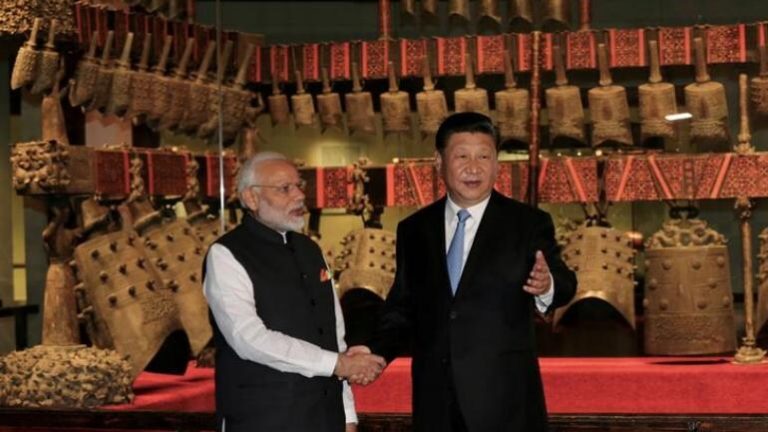
The disengagement pact has come into existence after at least nine rounds of talks between the commanders of the two sides over about six months. Protracted talks, mostly conducted by army commanders and not by political leaders, merit to be analysed from a broad perspective of regional strategy. Chinese agreement to withdrawal is, at least, an indication that China has made a significant shift in her perception of India from disparity to parity.  In all probability, it appears that apart from the local tactical issues, the sides might have broadened the canvas to cover the entire gamut of Sino-India border dispute, and its fall out in the region.  

Some Sinologists consider Ladakh disengagement as a notable turn in China’s unremitting expansionist designs in the Himalayan region.  The Eurasian Times of 12 February bluntly said, “As India and China start disengaging their troops from the contested border in Eastern Ladakh, how will New Delhi position itself in the US-led anti-China bloc, QUAD?  Political punditry will reflect on the subject. In the first place, the disengagement under discussion pertains to only one intrusion viz. Pangong Tso and standoff at other points remain intact. Secondly, China’s known anti-India posturing has served as a clarion call to Indian border policy planners. It will escalate the arms race between the two sides. China has already begun to produce the counterfoil to India’s Rafael arsenal”.

Indications from sections of the western press are that with the signing of the disengagement deal in Ladakh and the promise of carrying the disengagement full circle, India has been rethinking her position in the Quad which, for all intents and purposes is anti-China movement. Can India bailout China provided China concedes its expansionist and Middle Kingdom Utopias?

Secondly, the Quad is a must because it reflects the convergence of joint responsibility of shielding democracy against authoritarian dispensation. The world is standing on the crossroad of rivalling ideologies that specifically would draw the nations to the war of civilizations. Humanity has paid a heavy price for the sustenance of democracy and it must preserve it against a new pattern of a threat today. Indian nation opting for democratic dispensation has made the most significant contribution to the universal growth and strengthening of Indian Sanskriti.

Generally speaking, the foreign policy of big countries is guided by pragmatism or what is technically called realpolitik. International relations are seldom subservient to moral or ethical laws; national interests reign supreme. China has to be suave if she wants to understand the spirit of India.  In a way, modern India is thankful to China for helping her rise from the deep stupor of non-violence. China taught India the truth that “power flows from the barrel of the gun”.  How can India overlook the vicious anti-India policy of China in which she erroneously thinks only of rivalry and not of peaceful coexistence as a choice?

Leaving these assumptions aside, there is unquestionably the economic factor that is playing a role in formulating the contours of a long-term friendly relationship between the two Asian giants. It was Deng Xiaoping, the former President of China, who gave the idea that China’s rise to proverbial Middle Kingdom status was only through reforming China’s own and controlling world economy.

The May 2020 standoff between the two countries resulted in the NDA government imposing tariffs on Chinese goods. Ever since Galwan Valley clash on 15 June 2020, the Indian government has banned more than 100 Chinese apps on the plea of a threat to national security. To thwart dependence on China, Indian Railways cancelled Rs. 471 crore worth deals with a Chinese firm. Government of India instructed the state-owned telecom firm BSNL not to use the gear from a Chinese firm Huawei for a network upgrade in the backdrop of a military standoff. The GOI made it compulsory for all products to have the ‘Country of Origin’ tag on the shopping website to identify China-made products. Import of colour TV sets was placed under restricted category and air conditioners were placed under the prohibited category. Besides these and other measures, many Indian State governments imposed curbs or ban on a partnership with Chinese firms in manufacturing finished products in India. There has been a wave of resentment among the Indians against the aggressive attitude of China and its flexing of muscle power to showdown India. Cool thinking must have cleared the atmosphere for China to understand how much loss she willingly brings to her people and her government. 

Ladakh Disengagement: Heed words of Kargil War Hero Lt. Gen. Joshi

In March-April 2020 taking advantage of the COVID pandemic, the People’s Liberation Army (PLA) of China made India a target of its “wolf-warrior diplomacy” with simultaneous intrusions in Sikkim (Naku La) and the Eastern Ladakh sectors. While the Naku La situation was contained by traditional protocols, the Eastern Ladakh sector witnessed Chinese misadventures to move westward along the Line of Actual Control (LAC) into areas where they had no claim. The Indian response was swift and professional. While the Indian Army was given full liberty to handle the situation on ground, the “whole of nation” strategy to meet the malevolent design was also put in place simultaneously. It included diplomacy, trade barriers and economic repercussions for China. The most significant and potentially disastrous element for the Chinese was the Indian intent to boycott Chinese goods.

Ten months hence, on February 10, 2021 the Chinese relented and agreed to maintain status quo ante in the most contentious Pangong Tso Lake sector. A disengagement process with withdrawal to pre-designated locations well within claim lines on both sides has been put in place. The disengagement involves movement of armour, artillery and infantry elements from the areas North and South of the Pangong Tso Lake.

Against the backdrop of this historic disengagement being carried out on terms favourable to the Indian side, Lt. Gen Yogesh Kumar Joshi, Army Commander of the elite Northern Command of the Indian Army, spoke to a number of media channels and gave a very forthright and factual assessment of the situation on ground.

When the crisis was unfolding, those in the know of defence affairs of India were confident that Lt. Gen Joshi was the best man to deal with it. He is, after all, a highly decorated soldier who has served all of his command appointments in this area. He commanded his battalion in Kargil during the Kargil war and then a Brigade, a Division and finally the 14 Corps in Leh before taking on the duties of Army Commander. This apart, he is the most accomplished China expert in India, having served as Defence Attache to China (2005-2008). He also speaks the Chinese language fluently.

The enemy propaganda machinery was well aware of the accomplishments of General Joshi and it tried its level best to break down his morale and that of the government. Certain vested interests in India were given the responsibility to derogate all actions being taken by the Army and its commanders to deal with the situation. At one time, rumours were also afloat that the General and his Corps Commander, Lt. Gen Harinder Singh, would be replaced for “having been caught napping”. Such propagandists today have egg on their faces with the General and his excellent officers and troops emerging victorious and getting accolades from a grateful nation.

The General had exhibited his steely resolve way back in July 2020 when, in an interview given against the backdrop of the Kargil Vijay Divas, he had said, “The Indian Army has been engaged with PLA of China in a military dialogue to resolve the situation in a manner that would first lead to disengagement and only then transcend to de-escalation.” All through the build up and the challenging nine rounds of military talks with the Chinese, the clarity of the Generals thought process was very visible. Today, the disengagement is taking place in the exact manner that he had predicted.

“What we have achieved in the past 10 months, I think the nation should be proud of their Armed Forces” said the General in his interview with the news channel India Today, exhibiting the high level of pride that he feels for his troops on ground. On the disengagement process, the General clarified that the PLA would move well back from Finger 8 on the Northern Bank and the Pangong Tso Lake after dismantling all infrastructure created between Finer 4 and Finger 8. Since China will no longer be allowed to patrol up to Finger 4 which is her claim line, the Indian side is in a win-win situation there.

The General was very appreciative of the professional manner in which the troops carried out the incisive operations to hold the Kailash ranges and the build up to dominate the Chinese Moldo garrison from Rinchin La, Rezang La, Black Top and further build up to dominate the Spanggur gap from Gurung Hill and Magar Hill. He stated that the Chinese were caught completely by surprise and “did not know what was happening”.

He further clarified that the aforementioned Quid-pro-quo (QPQ) operations gave to India the necessary leverage to negotiate the ongoing disengagement from a position of strength. In negotiations subsequent to the build up, the Chinese kept looking for face-savers but ultimately had to relent. Now, having served the purpose and created the end state of status quo, India would also have to keep her side of the deal and go to status quo ante in the heights.

The General exuded confidence in the ability of the nation to resolve other friction points for which the government has shown determination as expressed by the Union Defence Minister Rajnath Singh in his address in the Rajya Sabha.

So far as Depsang is concerned, the General elucidated that the issue being pre-dated  should be seen in the present context even though negotiation would be carried there too. Presently there is no volatility as no troops are en-massed there.

The General admitted that during the course of the face-off there were some tense moments when the balloon could have gone up considering that so many troops with tanks, etc., were in eyeball to eyeball position. Escalation was avoided by the maturity and professionalism of Indian troops. “To not press the trigger is what requires courage and maturity and grit and determination,” he said.

Even as the disengagement continues with China having lost face there is a strong element of distrust that’s still lingering in the air. The propaganda machinery of the Chinese functioning within India continues to be active with many of their paid stooges giving the usual pessimistic predictions of the other areas of Gogra, Hot Springs, Despang, etc., not being vacated.  These elements quote concocted stories of inimical forces to spread their malicious lies. The best option is to ignore them as they spoke blatant lies earlier too. The more respected strategic analysts of the nation have come out in full support of the manner in which the negotiations have been carried out and the end state that has been achieved. It is best to heed the words of Army Commander, Northern Command and repose full faith in the capacity of our Army to always maintain the sanctity of our borders. The nation remains resolute in its support towards its soldiers at all times.

Pakistan-sponsored social media propaganda in Jammu & Kashmir

India and Pakistan armies have agreed to cease firing along the Line of Control (LoC) from midnight of February 24-25, 2021. The agreement has been reached through deliberations of the Director Generals of Military Operations (DGMO) of the two countries. “The two sides reviewed the situation along the Line of Control and all other sectors in a free, frank and cordial atmosphere. In the interest of achieving mutually beneficial and sustainable peace along the borders, the two DGMOs agreed to address each other’s core issues and concerns which have propensity to disturb peace and lead to violence,” says a joint statement released by the DGMO offices of the two nations.

This development has been viewed with a fair degree of positivity by the people of the two countries and also the international community that wishes to see improving relations, especially so in the wake of the global strain being caused by the COVID-19 pandemic. This however is simply one part of the story. Pakistan has a bigger game plan in place to destabilise Kashmir thorough propaganda.

While the people of Kashmir are very happy with the new environment of freedom and peace, the anti-national and anti-social elements that are active in the region under the payroll of Pakistan’s Inter Services Intelligence (ISI) are not ready to give up on their evil agenda. These paid stooges are now using technology to get their Pakistan-sponsored propaganda across. They have created pseudo organisations that upload hate filled propagandist content on all social media platforms. Well thought out themes aimed at creating a divide in society by giving impetus to distrust and fear are being pushed in.

Every progressive initiative taken by the UT government of Jammu & Kashmir is being subjected to criticism and being projected as an evil design to snatch away the identity of the people. An example to effect is the provision of domicile certificates that has been initiated to extend justice to certain categories of people like West Pakistan Refugees, Valmiki Samaj etc. who have been denied an identity within the state for decades. By this initiative the government is giving domicile to deserving  people; it is not taking away domicile from those who are already residents of the UT, so there is nothing to worry about. Yet, seeds of doubt are being sown in the minds of the innocent people of Kashmir .

It is further being said by these evil propagandists that the social organisation, Rashtriya Swayamsevak Sangh (RSS), is planning to induct eighteen lakh people in the UT with the intention of changing the demographic  pattern. RSS is a pan-India social welfare organisation with an international footprint. It has many education institutions and other social organisations that extend facilities without thought of religion and caste. There are many children of Muslims; Sikhs etc. studying in RSS run schools. They are never told to convert or anything of that sort. The fact is that RSS will not work towards settling even one person in Kashmir if he/she does not wish to, let alone eighteen lakh. The organisation is being demonised by the evil lobbies with a vested interest. They wish to create fear and earn political capital from the fear.

Demographic pattern in Kashmir that has a population of more than 5 million with a vast majority of a particular community will require 5 million or more people of another community to be settled there, which is impossible. Hence, anyone saying that demography can be changed is spreading misinformation and canards. The attempt of divisive forces towards creating a social schism should be summarily rejected.

The UT government is attempting to open up as many job opportunities as possible for the youth within Jammu Kashmir and in the rest of the country too. This positive step is being misconstrued as an attempt to marginalise Kashmiris in favour of other communities. There cannot be a more blatant lie than this. All of India is aware about the suffering of the Kashmiri people due to Pakistan-sponsored terrorism and every Indian citizen is willing to help Kashmiri fellow citizens in every possible manner. It is for this reason that many Kashmiris are running successful businesses across India; they are studying in prestigious institutions and getting jobs in prestigious government and private sectors. The jobs sponsored by the UT government are for all residents of JK regardless of caste, creed or regional affiliation. Already many Kashmir Muslims have benefited from the new schemes and continue to do so. In fact, many initiatives like SEE (J&K), Super-50 etc. are giving a bigger thrust to Kashmir.

Political freedom is another aspect on which a lot of hue and cry is being created. It is being said that the leaders of Kashmir are not being allowed a voice. This is an absolute fallacy. Leaders of Kashmir are totally free, they have joined together as PAGD and contested the DDC elections with very good results for their coalition. Democracy is flourishing in JK.

The contents of the social media posts are emanating from sources that are on the payroll of our enemies especially the ISI. They constitute an unholy, malicious and evil attempt to create fear psychosis amongst innocent people of Kashmir. The biggest targets of this malicious campaign are the lesser educated youth who are specifically targeted to facilitate recruitment in the terrorist fold. This is necessitated by the desperation of the ISI at not being able to infiltrate the required number of terrorists from Pakistan to fill up the depleting strength.

The enemies of the nation and of Kashmir, however, will not succeed since the people know what is good for them and what is not good for them. The government of India and the people of India are proud of the multicultural, multilingual and multi-caste identity of the UT of JK which is a shining example of the unity in diversity that India stands for. There is no intention anywhere of doing anything that would harm the people of Jammu & Kashmir.

Pakistan must stop minority persecution and genocide

Recently, while speaking at a virtual meeting of the United Nations Economic and Social Council on “Reimagining Equality: Eliminating Racism, Xenophobia and Discrimination for all”, Pakistan’s Foreign Minister [FM] Shah Mahmood Qureshi was at his eloquent best, pitching strongly for the “forging a global alliance against the rise and spread of Islamophobic as well as other violent nationalist and racist groups”. He lamented that hateful political rhetoric and inciting violence against vulnerable ethnic and religious groups being practiced in ‘Pakistan’s neighbourhood’ had “resulted in discriminatory citizenship laws, attacks on places of worship and repeated state-sponsored pogroms against minorities”.

Even though Qureshi didn’t specify who was responsible for what, he in his wisdom perceives to be a replay of the Holocaust, there are no prizes for guessing at whom this barb had been directed as this completely unsubstantiated and patently motivated refrain has become Islamabad’s staple fare. What’s most intriguing is that despite having failed to garner any meaningful support for its puerile and ineffectual Kashmir narrative, Islamabad still continues to reiterate it on every conceivable occasion. So, it’s not at all surprising that the exasperated international community has even abandoned the diplomatic nicety of at least acknowledging Pakistan’s concerns, even if they don’t necessarily agree with them.

Domestic compulsions driving Islamabad’s anti-India tirade are understandable. That’s why its insistence to continue harping on a narrative that’s been univocally rejected by both UN and the international community is indeed intriguing-unless of course, the persistent reprise is inspired by Hitler’s propaganda chief Joseph Goebbels’s dictum that “If you tell a lie big enough and keep repeating it, people will eventually come to believe it”. However, it seems that Islamabad isn’t aware of, or doesn’t believe in the adage that ‘whenever one points a finger at others, three fingers are pointing back at the accuser’.

Since Prime Minister Imran Khan had in 2018 announced with great flourish that “We will show the Modi government how to treat minorities”, Qureshi being anguished by “state-sponsored pogroms against minorities” in Pakistan’s neighbourhood is comprehensible. However, it appears that foreign affairs are keeping him so busy that he’s completely ignorant about pitiable conditions of minorities in his own country on which several international organisations have voiced serious concern. However, since both Khan and Qureshi would outrightly “reject” any such report prepared by an external agency no matter how impartial and credible it may be, let’s restrict ourselves to what the Human Rights Commission of Pakistan [HRCP] itself has revealed.

In its annual report [‘State of Human Rights in 2019’], HRCP has listed two damning observations. One, it notes that Religious minorities remained unable to enjoy the freedom of religion or belief guaranteed to them under the constitution [Emphasis added]. For the Ahmadiyya community in Punjab, this included the desecration of several sites of worship”. Second, “Both the Hindu and Christian communities in Sindh and Punjab continued to report cases of forced conversion. In Punjab, girls as young as 14 were forcibly converted and coerced into marriage. In Sindh, the case of two Hindu girls whose families claimed they had been kidnapped for marriage and converted forcibly, drew widespread attention when the Islamabad High Court ruled that the girls were not minors at the time of marriage and allowed them to return to their spouses.” [Emphasis added].

Enforced disappearance is another grave issue that ethnic minorities in Pakistan have to grapple with. The 2019 HRCP report makes the shocking revelation that “Pakistan has yet to criminalise enforced disappearances even after a commitment to this effect made by the incumbent government on several occasions” goes on to state that “The Commission of Inquiry on Enforced Disappearances falls short of being an effective agency to provide relief to the citizens, apportion responsibility and bring perpetrators to justice”. It also mentions that “Since the inception of the Commission of Inquiry on Enforced Disappearances, KP [Khyber Pakhtunkhwa has topped the list in the numbers of missing persons. At end December 2019, the total number of cases registered in KP stood at 2,472.” [KP is home to Pakistan’s Pashtun minority].

Islamabad will most certainly deny any institutionalised persecution of the Pashtun minority. However, if this is true, then how does it explain Director General [DG] of Pakistan army’s media wing Inter Services Public Relations [ISPR] warning Pashtun Tahaffuz Movement [PTM], a social movement for Pashtun human rights based in KP and Balochistan, by saying that “their time is up”? Is the fact that within a month of the DGISPR issuing this not-so-cryptic threat,13 PTM supporters were killed and over 25 others injured near Kharqamar check post in North Waziristan when the army opened fire on peaceful demonstrators, just a mere coincidence?

If Rawalpindi’s contention that soldiers at Kharqamar check post resorted to firing as a last resort after they were attacked by violent PTM demonstrators and had exercised full restraint is really true, three questions still arise. One, if the Pakistan army had really exercised outmost restraint, then how come it ended up inflicting such heavy casualties? Two, if soldiers had acted purely in self-defence, then why was HRCP’s fact finding team stopped by the army from proceeding to the check post for an on-site-investigation? Lastly, as per Rawalpindi, one soldier was killed while five were seriously injured when PTM protesters attacked the Kharqamar check post.  So, if PTM workers had indeed been instigated to attack the check post and had both killed and injured soldiers, then why did the government withdraw the cases against National Assembly members Ali Wazir and Mohsin Dawar who had been arrested by security forces for having incited protesters?

The people of Balochistan too have been bearing the brunt of a brutally violent campaign being carried out by Pakistan army in the garb of anti-terrorist operations and today, this region has become inextricably associated with enforced disappearances. In its ‘Public Statement’ of 12 November 2020, Amnesty International [AI] notes that “Enforced disappearances targeting students, activists, journalists and human rights defenders continue relentlessly in Pakistan’s southwestern province of Balochistan”. In its recommendation, AI has called upon Pakistani authorities to “ensure that all measures are taken to immediately end the practice of enforced disappearance.” Though AI’s explicit statement and recommendation addressed to “Pakistani authorities” gives a clear indication of institutional complicity in the repulsive practice of disappearing people, the Government of Pakistan will obviously reject the same.

However, even if AI’s observation as well as recommendation is disregarded and Islamabad is given benefit of doubt, this issue doesn’t disappear. Readers may recall that during a media interaction session in 2019, when senior journalist Hamid Mir of Geo T.V. expressed concern about enforced disappearances in Balochistan and elsewhere, DGISPR replied, “You have a deep attachment with missing persons [but] so have we. We don’t wish that anyone should be missing. But when its war, you have to do a lot of things- as they say, all is fair in love and war; war is very ruthless.” [Emphasis added]. Now with Pakistan army’s media chief himself admitting that Rawalpindi considers military actions against its own citizens who are resisting exploitation of the region’s natural resources and excesses against their people as ‘war’ and follows the “all is fair in love and war” approach to justify enforced disappearances, is any further proof of institutionalised persecution of ethnic minorities in Pakistan necessary?

So, rather than levelling unproven accusations in an attempt to malign opponents, it would certainly do Islamabad a lot of good if it focuses more on setting its own house in order, because at the end of the day, the international community neither has time nor the inclination to suffer hypocrites peddling lies!

FATF must black list Pakistan, else it will lose credibility

If international terror watchdog Financial Action Task Force [FATF] had thought that the tweet in which it “strongly urges Pakistan to swiftly complete its full action plan by Feb 2021,” would galvanise a reticent Islamabad into action, then it’s sadly mistaken. Similarly, if the people of Pakistan really share Foreign Minister [FM] Shah Mahmood Qureshi’s optimism that the FATF, would in its February 2021 plenary meeting, give a decision “in favour of Pakistan,” then they are in for a really rude shock. Because despite exuding confidence on exiting FATF’s grey list, Islamabad has subtly conceded that this may not happen soon.

Readers may recall that after New Delhi abrogated Article 370, Pakistan’s UN envoy Ms. Maleeha Lodhi had during the 2018 United Nations General Assembly [UNGA] session argued that this move was “in flagrant violation of multiple Security Council resolutions.” Coming from a person with impressive qualifications and vast experience, many of her countrymen and the pro-Pakistan lobby in Kashmir took Ms. Lodhi’s assertion as gospel of truth. However, there were others who weren’t at all convinced since she gave no logical or robust reasons in support of her contention. Moreover, since it’s common knowledge that elected governments can, through provisions of existing laws, amend the constitution of their own country, Ms. Lodhi’s argument simply made no sense!

Absence of any meaningful opposition to Article 370 abrogation was in itself an unambiguous indication that Islamabad’s narrative of this act being a “flagrant violation of multiple Security Council resolutions” didn’t find many takers. Furthermore, UNSC President Joanna Wronecka’s refusal to comment on Pakistan’s letter to UN Secretary General seeking revocation of Article 370 abrogation should have set the alarm bells ringing in Pakistan’s foreign office. However, even though it was abundantly clear that nothing would come out of its attempt to seek UNSC’s intervention on this issue as it was unquestionably India’s internal matter, Islamabad with its characteristic obduracy, chose to go ahead.

The most surprising part was that while on the one hand Islamabad was brimming with unbounded confidence of succeeding in getting UNSC to agree with its viewpoint, FM Qureshi on the other hand was warning his countrymen that “They [UNSC members] are not waiting for you with garlands in their hands.” He also made a seminal observation on the futility of Islamabad’s decision to contest Article 370 abrogation by saying “Giving vent to emotions is easy and raising objections is much easier. However, it is difficult to understand the issue and move forward.” Most importantly, by not fulfilling its much-hyped pledge of taking the Article 370 abrogation issue to International Court of Justice, Islamabad itself sent out a clear message to the world that its case lacked substance!

Pakistan has yet once again displayed its propensity for promising its people a bright and pleasant day while simultaneously advising them that it may be still worthwhile to carry an umbrella- just in case! So, while the FM is sanguine that FATF will give a decision “in favour of Pakistan” when FATF holds its February 2021 plenary meeting, ‘The Express Tribune’ has quoted a “senior Pakistani official” dealing with FATF as saying “If (it) agrees, the FATF on-site visit will help Pakistan come out of the grey list by June this year,” [Emphasis added]. Hence, it’s clear that FM Qureshi’s optimism on this issue is highly misplaced and misleading. What must be even more frustrating for the people of Pakistan is that even the assessment of their country getting out of FATF’s grey list is contingent to the international terror financing watchdog agreeing for an “on-site” visit.

Islamabad hasn’t specified as to what exactly does it have in mind while talking about an “on-site” visit. Being shrouded in secrecy, terror financing is a covert business that doesn’t follow the rules of classic bookkeeping. Hence, the “on-site” visit suggestion makes no sense whatsoever and in all probability is nothing more than just a red herring- and this raises the question that if Islamabad genuinely has ‘zero tolerance’ for terrorism as it claims, then why has it not been able to curb terror financing even after more than two and a half years? Surely, there’s much more than what meets the eye and Islamabad dragging its feet in fulfilling its international responsibility to choke terror funding that’s endangering the entire world, is what should be a matter of grave concern for FATF.

The FATF needs to realise that on the issue of ensuring that terrorist groups are denied financial support, giving defaulter states that continuously fail to curb terror financing a loose rope sets a very wrong precedent and makes the international terror financing watchdog a toothless tiger. Lastly, for the sake of protecting its own fair image, FATF needs to dispel the canard being spread by Islamabad that the terror financing watchdog’s decisions are influenced by extraneous considerations like lobbying by member states. It also needs to caution Pakistan against casting unfounded aspersions on the integrity of member nations since FATF evaluations are derived from an object assessment of ground realities and are hence ‘technical’ and not ‘political’ in nature! 

FATF must act tough on Pakistan

While Pakistan Prime Minister Imran Khan repeatedly talks about his firm resolve to “not allow any militant groups to operate inside Pakistan”, but actions of his government to ensue this doesn’t inspire much confidence. What’s most intriguing is that despite languishing in the grey list of Financial Action Task Force [FATF] since 2018, Islamabad still doesn’t appear to be serious about getting out of the same by overcoming shortcomings listed out by the international terror financing watchdog. So much so that even FATF has felt it necessary to officially nudge Islamabad by tweeting that it “strongly urges Pakistan to swiftly complete its full action plan by Feb 2021”.

Islamabad’s claim of being a “victim of terror” is undoubtedly true, yet its army has no inhibitions in patronising terrorist groups, and this makes Pakistan both the victim and perpetrator of terrorism. In fact, former US Present Donald Trump was spot-on when he tweeted that “The United States has foolishly given Pakistan more than 33 billion dollars in aid over the last 15 years, and they have given us nothing but lies & deceit . . . They give safe haven to the terrorists we hunt in Afghanistan… .”

With FATF due to review Pakistan’s case later this month, Islamabad has once again fallen back to its puerile ways and started crying ‘wolf’ by alleging that India is drumming up anti-Pakistan sentiments within FATF member states-a rather poor attempt to conceal its own inability [or refusal?] to curb terror activities emanating from its soil. Just last week, The Express Tribune quoted a “Pakistani representative in the FATF”, as saying “It’s not that Pakistan is not trying hard to get out of the grey list, but the lobbying against the country by India is very strong”. Isn’t this an unambiguous indication that Islamabad is well aware that its response to FATF action plan against terror financing is far from satisfactory?

After all, how can anyone expect FATF to believe that Lashkar-e-Taiba [LeT] ‘operations commander’ Zakiur Rehman Lakhvi, [who’s one of the confirmed 2008 Mumbai attacks mastermind] is only guilty of running a dispensary in order to raise funds for terror financing? Finding Lakhvi guilty under three sections of Pakistan’s Anti-Terrorism Act and awarding him separate 5-year jail sentences on each count may give an impression that Pakistani courts have come down very hard on him. That Lakvi was convicted as well as sentenced in his very first court appearance on the basis of what the judge said was “sufficient evidence in the form of oral testimonies,” further bolsters this view.

However, the court ruling that all three prison terms would run concurrently tells an entirely different story. It also buttresses the 2018 revelation of Islamabad High Court judge, Justice Shaukat Aziz Siddiqui that “Today the judiciary and media have come in the control of ‘Bandookwala’ [army]. Judiciary is not independent… In different cases, the ISI forms benches of its choice to get desired results.” Here, it’s also pertinent to note that even the US State Department seems to think so, because while its Bureau of South and Central Asian affairs tweeted that it was “encouraged” by Lakhvi’s conviction, but by adding that “his crimes go far beyond financing terrorism”, Washington has sent out a clear signal that despite this conviction, the ends of justice haven’t been met!

So now all that one can do is to wait and watch as to what the FATF makes out of this and many more such incidents. Will it really accept Islamabad’s laughable contention that Lakhvi isn’t the ‘operations commander” of LeT, but just a simple dispensary owner whose only guilt is diversion of money earned for financing terror activities? Or will the FATF go by Washington’s (and the global view) that Lakhvi’s “crimes go far beyond financing terrorism”? Terrorism is bleeding the world white and as such, isn’t the appropriate space for playing petty politics or furthering motivated agendas. Hence, since Hizbul Mujahideen chief and United Jihad Council head Syed Salahuddin has himself admitted that his minions are “fighting Pakistan’s war in Kashmir,” New Delhi needs to take a much tougher stand during the FATF plenary meeting this month because there’s a need to re-sensitize the international community regarding the grave dangers to global security that state patronage to terrorists portends!

The world needs to be reminded that the 2002 abduction and murder of journalist Daniel Pearl could have been averted if Islamabad hadn’t provided sanctuary to its perpetrator Omar Sheikh [who ironically has recently been acquitted by the highest court in Pakistan]. Pearl’s abduction wasn’t Sheikhs first crime; in 1994, he had been arrested in India for kidnapping three British and one American tourist from New Delhi in an attempt to secure release of terrorists in Indian jails. Sheikh was one of the terrorists released in exchange for the passengers and crew of an Air India aircraft hijacked by terrorists in 1999, and after his release in Kandahar, Afghanistan, Sheikh not only made his way to Pakistan but openly resumed his terrorism related activities.

Regrettably, even though he was a fugitive from justice, Islamabad took no action to restrain Sheikh. Even more surprising is that neither Washington, nor London whose nationals had been abducted by Sheikh pressed Islamabad to book him. So, it’s Pakistan’s skewed belief of ‘an enemy’s enemy being a friend’ coupled with the international community’s glaring indifference in ensuring that a terrorist is brought to book is what allowed a potentially dangerous person to roam around freely and this ended with Daniel Pearl’s abduction and decapitation. Hence, it wouldn’t be wrong to say that both Islamabad, USA and UK in particular and the international community in general have the blood of Pearl on their hands!

Released alongwith Sheikh was another incarcerated terrorist Masood Azhar. He too came back to Pakistan and created Jaish-e-Mohammad [JeM] terrorist group. By making public announcements like “I have come here because this is my duty to tell you that Muslims should not rest in peace until we have destroyed India”, he soon became Rawalpindi’s pet. So, even though UNSC listed JeM as being associated with Al Qaida and Taliban in 2001, Islamabad took no action against him or JeM and instead got Beijing to veto international attempts to designate Azar a ‘global terrorist’. The result was a series of major terrorist attacks- on Indian Parliament in 2001 that brought both countries to the brink, the 2016 Pathankot airbase attack and Pulwama car bomb attack of 2019.

However, the irony is that while Foreign Minister Shah Mehmood Qureshi himself confirmed after the Pulwama terrorist attack that Azhar was present in Pakistan, the army’s media wing ISPR denied the same. Ultimately, [like always], Rawalpindi’s words prevailed and just like the second Indian Air Force pilot that Pakistan army claimed was in its custody after the February 2019 air duel ‘disappeared’ within a matter of hours, Azhar too has ‘vanished’. With Islamabad officially declaring that Azhar is “missing”, it’s high time FATF takes a far more serious view of Pakistan’s unabashed farce on terrorism related issues.

Since it is charged with the task of curbing terrorism by choking its funding and support, the FATF has no choice but to be ruthless in imposing its mandate as any compromise would tantamount to betraying millions of faceless terror victims!

Tailpiece: In Shakespeare’s play ‘Macbeth’, Lady Macbeth instigates her husband to kill King Duncan and yet remains unfazed as she knows that “What need we fear who knows it when none can call our power to account?”So, if FATF continues soft-pedalling Pakistan’s duplicitous approach to terrorism by not holding it accountable for the same, then isn’t it but natural that just like Lady Macbeth, Rawalpindi will continue pursuing its fatal obsession with terrorists, aka ‘strategic assets’?