Home Blog Page 318

Karima Baloch’s family urge Canadian authorities to conduct a higher level investigation

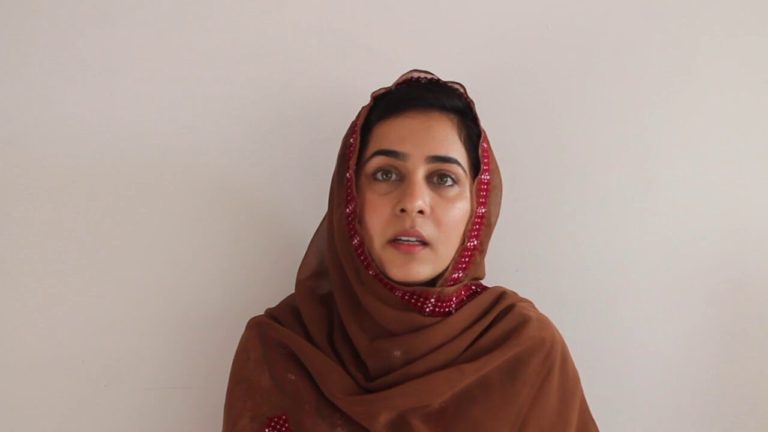
Hammal Haidar, senior leader of BNM (Baloch National Movement) and husband of deceased Karima Baloch, has urged the Canadian authorities to leave no stone unturned in looking into the circumstances of Karima Baloch’s death. In a series of tweets, Hammal Haidar, said that: “Karima Baloch’s death needs further inquiry. My wife was an immensely courageous and spirited person. Her work as an internationally prominent activist speaks for itself.”

He added that it is their right to request the Canadian authorities to leave no stone unturned in looking into the circumstances of Karima’s death as well the threats she had been facing since moving to the country.

Earlier Sameer Mehrab, Karima’s brother, had also urged Canadian authorities to conduct a higher level investigation into his sister’s death.

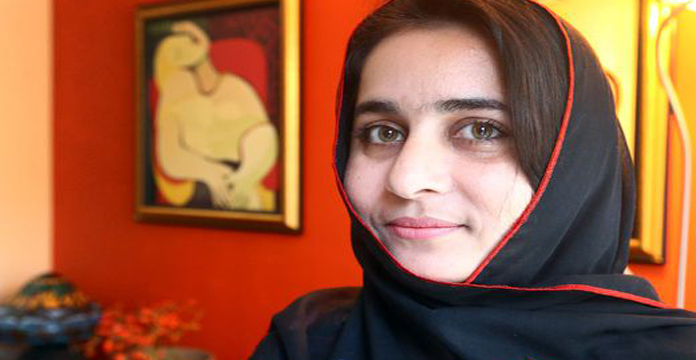
Karima Baloch, a prominent leader of Balochistan, went missing on Sunday, 20th December and a day later her dead body was found from Toronto, Canada. Sameer Mehrab has urged Canadian authorities to conduct a higher level investigation into his sister’s death.

In a series of tweets, Sameer Mehrab, who also resides in Canada, has said that Karima Baloch’s death should be investigated at high levels due to her profile as an activist of international recognition. Sameer also gave reference of “well documented threats” faced by their family.

“All aspects of these threats should be fully investigated as considerable doubts still remain in our minds,” Sameer Mehrab demanded.

He assured that as responsible residents of Canada they are ready to fully cooperate with the authorities.

Karima Baloch’s dead body was found from Toronto, Canada on the 21st December. Her family and Baloch political factions claim that she has been murdered, but the officials in the Toronto police department have termed her death as “non-criminal.”

Karima Baloch was the pioneer of women activism in Balochistan. She had also raised the issue of Balochistan in United Nations session in Switzerland.

BNM rejects Pakistan High Commission’s statement, Canadian Police’s report over Karima’s “murder”

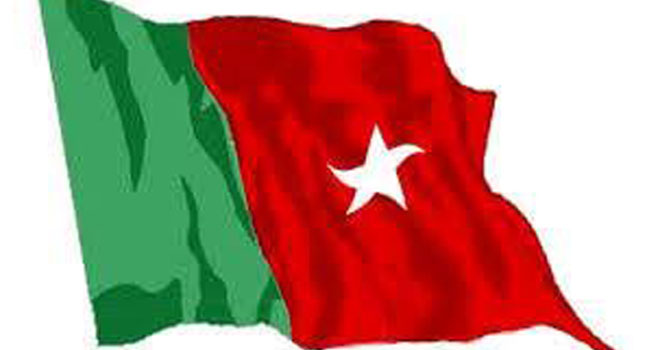
Dr. Murad Baloch, Secretary General of the Baloch National Movement (BNM) has rejected the press release issued by the Pakistan High Commission in Ottawa, regarding the “murder” of Karima Baloch. He said there is no need of Pakistan to contact the Government of Canada, it is only trying to cover up this crime because the whole world knows that thousands of Baloch, including Banuk Karima Baloch, moved to civilised countries to escape the barbarism of Pakistan where they can survive and serve their nation. He questions in the statement that how is Pakistan now engaged in correspondence with the Government of Canada to investigate the “martyrdom” of Karima Baloch?

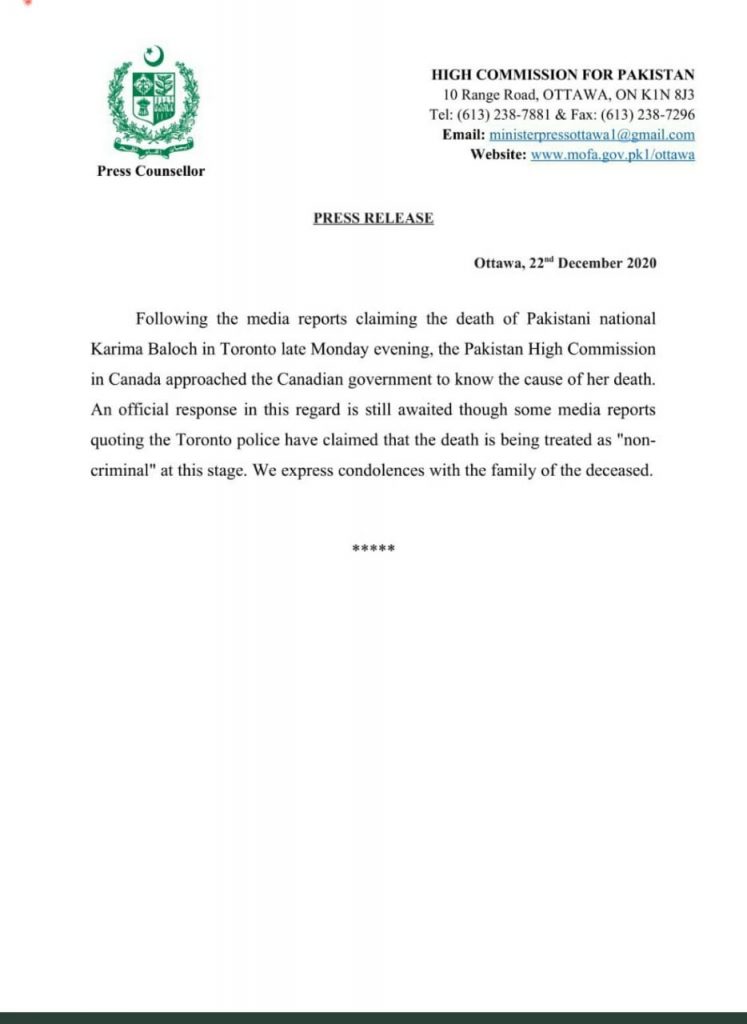
BNM statement comes a day after the Pakistan High Commission in Ottawa, Canada released a  statement saying “Following the media reports claiming the death of Pakistani national Karima Baloch in Toronto late Monday evening, the Pakistan High Commissioner has approached the Canadian authorities to find out the cause of Karima Baloch’s death and an official report in this regard is awaited.”

He said that when Karima Baloch was included in the list of 100 most influential women of the BBC for her important role in the struggle for the independence of Balochistan, the statement of Pakistani officials came to light that the BBC had included her name in negligence. Today, Pakistan’s unwarranted intervention and condolences on her martyrdom is tantamount to adding to the grief of the Baloch nation and sprinkling salt on our wounds. “At the same time, calling Karima Baloch a Pakistani national is an insult to our national struggle and martyrs. No child of the Baloch nation has renounced Balochism and accepted to be a Pakistani. Specially Banuk Karima Baloch has been the head of the organization fighting for independence and was a member of a pro-independence party. Calling Balochs Pakistani is an insult for those who are engaged in the struggle against oppression and barbarism of Pakistan.

Dr. Murad Baloch asked why the Pakistan High Commission is declaring Karima Baloch as its citizen when she was exiled just because of the Pakistani state? She continued to receive threats there (in Canada) as well, even her asylum process in Canada was intercepted. Pakistan must also remember that it has kidnapped, disappeared and martyred many of Karima Baloch’s political friends. Her uncles and cousins ​​have also been martyred. Her home was raided several times to forcibly disappear her and mortars were fired to her house to pressurise her, the statement read.

“We also reject the current statement of the Canadian police,” he said.

According to Canadian Police’s initial report that there were “not believed to be any suspicious circumstances”.

It is pertinent to mention that Karima Baloch’s death is being seen suspicious by Baloch nationalists and rights activists and considered as assassination by Pakistani intelligence agencies. Her husband while talking to the media said “I can’t believe that it’s an act of suicide. She was a strong lady and she left home in a good mood. We can’t rule out foul play as she has been under threats.” Haider said.

Ms Baloch’s sister told the BBC Urdu service on Tuesday that her death was “not only a tragedy for the family, but also for the Baloch national movement”.

“She didn’t go abroad because she wanted to, but because… open activism in Pakistan had become impossible,” Mahganj Baloch said.

Shashi Taroor, a renowned Indian politician and former Minister of State said in a tweet: “Two Baloch activists killed in Sweden and Canada. Speaking up for freedom from Pakistani oppression comes at a very high price.”

On this occasion, Shehnaz Sajid, the widow of exiled journalist, Sajid Hussain said “from the beginning, I never believed Sajid Hussain’s death is an act of suicide or accident. I have requested the Swedish Authorities to hand over me the remaining documents. What I got from Swedish police wasn’t satisfactory. I am not convinced by the investigation and have asked for more evidence from Swedish authorities. Recently, Karima Baloch found dead in the same way my husband did it proves that we cannot rule out foul play.”

Earlier this year, Sajid Hussain, who was living in Sweden on exile, went missing and was later found dead. Swedish police ruled out any “visible wrongdoing” and the cause of death was ruled to be drowning.

While mentioning the interview of Pakistan’s former dictator, General Musharraf’s, Dr Murad said, is a proof of Pakistan’s miscreants. He said Chaudhry Nisar, former Interior Minister of Pakistan, has also admitted that he and Shahbaz Sharif have been forced by General Musharraf to target people abroad and their names will not be mentioned. “The same method was used to assassinate Sajid Hussain Baloch was used to assassinate Karima Baloch. We therefore reject the Pakistani High Commission’s appeal for an inquiry from the Government of Canada and their condolences,” he added.

BNM spokesperson appealed to the United Nations to protect thousands of Baloch who have sought refuge in Europe, Canada, the United States, South Korea, Australia, Iran and Afghanistan. A large number of them are in Afghanistan and Iran. The United Nations High Commissioner for Refugees (UNHCR) should recognize the thousands of Baloch in Afghanistan and Iran as refugees and take steps to protect them. If the Baloch refugees are similarly ignored and left at the mercy of Pakistani atrocities, it will raise many questions about these institutions, Dr. Murad said.

Yet again, Pakistan Army is the eye of storm within Pakistan

A political logjam capable of ushering winds of change in Pakistan is becoming visible. The opposition has joined hands against the incumbent Imran Khan led government. The situation may well lead to a constitutional deadlock.

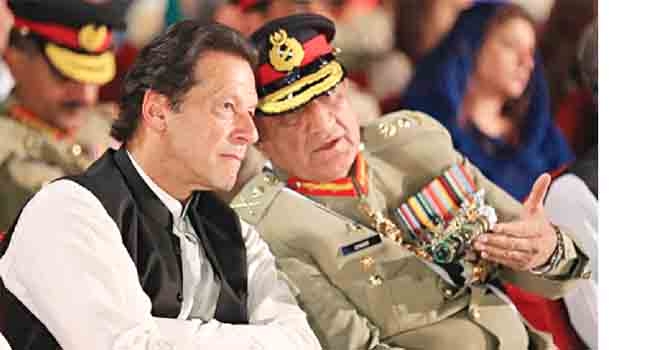
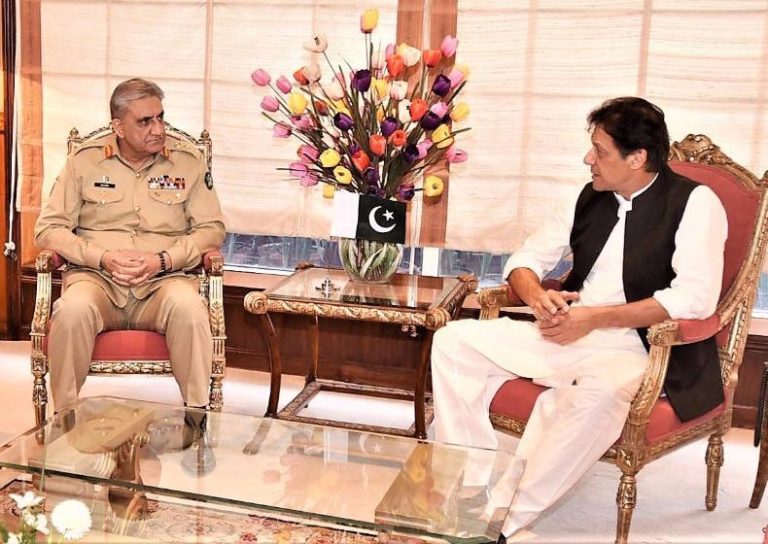
The Pakistan Army, interestingly, is in the eye of the storm. The opposition is using Imran Khan to target the Army, and particularly, the Army Chief General Qamar Bajwa and his ISI head Lt. General Faiz Hameed. The ISI chief, incidentally, is a known favourite of General Bajwa. He was deeply involved in the rigging that brought Imran Khan to power. Such is his clout that he has replaced Lt. General Asim Munir who had been appointed only eight months earlier. Quite naturally any attack on General Bajwa would be incomplete without including his trusted hatchet man.

The opposition roller-coaster started with the 11-party opposition conglomerate, the Pakistan Democratic Movement (PDM), carrying out a three-month long, six-city public protest tour. During one of the rallies held in Quetta on 27 October, former Prime Minister Nawaz Sharif initiated a sharp attack directly on the Army Chief. “General Bajwa, you will have to answer for record rigging in 2018 elections, for horse-trading in Parliament, for making Imran Niazi against people’s wishes [by] tearing apart the constitution and the laws, for pushing people towards poverty and hunger”, he said. He also accused the ISI chief of “interfering in politics for several years with Impunity”.

Significantly, in this instance, the country’s leading and respected newspaper, Dawn, specifically reported Sharif’s statement against the two officers, which is a departure from the normal media practice of glossing over whatever is said against the Army and its hierarchy.

Such strong, incendiary words have never been said publicly in Pakistan and the Army is quite worried. It is reported that General Bajwa and Lt. General Faiz Hameed have been meeting key opposition leaders and asking them to desist from dragging the Army into politics.

Imran Khan, the eternal lapdog of the establishment has also been hitting out against the opposition for targeting the Army. “The former prime minister is trying to stir up a rebellion in the Pakistan Army by alleging  [that] it is involved in politics and calling for changing  the army chief”, he said in a rally at Khyber Pakhtunkhwa. He also slammed Maryam Sharif for accusing the Army of interfering in politics. 

Nawaz Sharif, however, has refused to be intimidated. His party, the PML-(N) hosted a massive Jalsa (rally) at the Minar-e-Pakistan, Lahore on 13 December for all constituents of the PDM. Imran Khan attempted to scuttle the rally but failed to do so. In the meeting, Nawaz Sharif once again made a frontal attack on the Army during. “Due to the massive rigging in 2018 elections, Imran Khan was installed into power so that he could be easily dictated. Time has come to get freedom from this selected set-up”, he said his speech telecast from London via video link. He further accused General Bajwa of ousting him and the Army of having become “a state above a state”. Other leaders also joined the rhetoric by saying that the various elements of the state should function within the “limits of their own jurisdiction”.  The President of the PDM, Maulana Fazlur Rehman, openly urged the ‘establishment’ to stop meddling into the politics and let the leaders chosen by the people govern the country.

Imran Khan, with assistance from the compliant media, attempted to project the Lahore rally as a “flop show”. The PDM, however, is in a high state of morale. It has already announced its intention to march to Islamabad in February, 2012. This would be the culminating point of a huge political initiative to bring down the Imran Khan led government along with General Bajwa and his ISI stooge. The opposition is also aware that if they are unable to get the resignation of Imran Khan they will be left with no option but to tender their own which, in turn, will create a constitutional crisis.

The overall reputation of the Pakistan army is also taking a hit because of burgeoning cases of corruption within its ranks. The people are quite upset with officers like Lt. General Asim Bajwa, Chairman of CPEC authority, whose assets running into billions of dollars have been exposed by a journalist named Ahmed Noorani. Another name doing the rounds for corruption is Lt. General Azhar Naveed Hayat Khan. The Corps Commanders of the army are referred to as “Crore Commanders” in view of the large wealth they accumulate while in service and out of it. 

The PDM has, notably, given a national platform to regional parties and provincial leaders from Balochistan and Khyber Pakhtunkhwa, who have used it to target the Pakistani army, to demand regional autonomy and an end to repression. In Lahore, Baloch leader Akhtar Mengal narrated implicitly the death and misery being inflicted upon his people by the Pakistan army.

The Pakistan army will use each and every trick in its book to suppress the “open revolt” of the civilians against its authority. It could make a scapegoat out of Imran Khan by putting all blame of misgovernance upon him and removing him. This however, will leave for the Army a political vacuum that will be hard to fill. It could opt to take power in its own hands; this too is not a good idea since public mood is quite negative due to sustained economic hardship which will make governance difficult. The third option is to create trouble against India and increase the threshold of militancy and terrorism within Pakistan in order to divert attention. This is the most promising and time tested option. Hence, India needs to remain alert.  What is quite certain is that an unprecedented situation is emerging in Pakistan where the fight against hegemony of the Pakistan Army has entered the decisive level. The wave has started but its momentum can be maintained only by great resolve and iron will.

Saskatchewan, Canada – Catholic Priest Charged with Sexual Assaults

0

According to CTV News, the Roman Catholic Diocese of Saskatoon has been dealing with the sexual assault charges against one of its priests.

The Humboldt RCMP reported on “multiple incidents of a sexual nature” stated to them. 45-year-old Father Anthony Tei Atter has been charged with sexual assaults. Within the Criminal Code, he would be charged with sexual interference alleged to a person under 16 years of age.

The parishes of St. Ann, St. Anthony, and St. Gregory, are under the responsibility of Fr. Atter. The Roman Catholic Diocese of Saskatoon learned of the charges and released a statement.

They stated, “As soon as the diocese learned of these charges, Fr. Anthony Atter was removed from ministry… The diocese will be cooperating fully with police on this matter, and is unable to respond to questions and comments on the case at this time, while it is under investigation and/or before the courts… The Roman Catholic Diocese of Saskatoon takes the matter of sexual abuse and serious misconduct very seriously and is committed to the care and support of victims of sexual abuse.”

Based on reportage from the RCMP, the incidents occurred between September 1 and November 4 of 2020. The only incidences investigated were the ones reported to the Humboldt RCMP at the time of the recent reportage.

Fr. Atter will appear before the Provincial Court on March 22, 2021. No details have been released about the victim, so as to protect identity.

Photo by Josh Applegate on Unsplash

Homeopathy – The Pathology of Pseudomedicine in Canada

1

Homeopathy is a natural system of medicine that uses highly diluted doses of substances to stimulate the body’s own healing mechanism to promote health.

The use of homeopathic medicines – popularly known as remedies – is based on the discovery that natural substances are capable of curing the same symptoms that they can cause.  By studying the symptoms that develop when a healthy person tests or “proves” a remedy, homeopaths can determine which symptoms the remedy is capable of curing.  This is called the Law of Similars or “like cures like.”

A simple example of this principle can be seen with the common onion.  Slicing an onion can cause symptoms of burning and watery eyes, as well as sneezing and a runny nose.  Many hayfever sufferers with symptoms of burning, watery eyes, sneezing, and runny nose have found dramatic relief after taking homeopathic Allium cepa (the remedy made from red onion).  Thus the substance that can cause symptoms can, as a remedy, also cure them.

– Canadian Society of Homeopaths, “What is Homeopathy?

After assessing more than 1,800 studies on homeopathy, Australia’s National Health and Medical Research Council was only able to find 225 that were rigorous enough to analyze. And a systematic review of these studies revealed “no good quality evidence to support the claim that homeopathy is effective in treating health conditions.”

The Australian study, which is the first position statement relying on such an extensive review of medical literature, strikes the latest blow at a 200-year-old alternative treatment developed by a German physician with “no interest in detailed pathology, and none in conventional diagnosis and treatment.” The Washington Post reports that the study’s authors are concerned that people who continue to choose homeopathic remedies over proven medicine face real health risks—including the nearly 4 million Americans who use homeopathic “medicines.”

– Erin Blakemore, “1,800 Studies Later, Scientists Conclude Homeopathy Doesn’t Work

Over the weekend, hundreds of skeptics in more than 25 countries took megadoses of the remedies to demonstrate they do nothing. It was the second annual event organized by the 10:23 Campaign. One bunch in West Virginia took 1 million times the recommended dose of a homeopathic sleep remedy and didn’t die — or even fall asleep.

Now, there’s a $1 million challenge on the table to makers of homeopathic remedies from magician and professional skeptic James Randi. If a rigorous double-blind, controlled study finds the remedies work better than plain water, Randi’s educational foundation will fork over the money. Check out the video for details and the other part of his challenge to retailers to label the remedies accurately.

– Scott Hensley, “Homeopathic Medicine Overdosers Survive Unscathed

Certain homeopathic products (called “nosodes” or “homeopathic immunizations”) have been promoted by some as substitutes for conventional immunizations, but the U.S. Centers for Disease Control and Prevention says there’s no credible scientific evidence to support such claims. The National Center for Complementary and Integrative Health (NCCIH) supports the Centers for Disease Control and Prevention’s recommendations for immunizations/vaccinations. 

National Center for Complementary and Integrative Health, “Homeopathy

Homeopathy is a “treatment” based on the use of highly diluted substances, which practitioners claim can cause the body to heal itself.

2010 House of Commons Science and Technology Committee report on homeopathy said that homeopathic remedies perform no better than placebos (dummy treatments).

The review also said that the principles on which homeopathy is based are “scientifically implausible”.

This is also the view of the Chief Medical Officer, Professor Dame Sally Davies…

…There’s been extensive investigation of the effectiveness of homeopathy. There’s no good-quality evidence that homeopathy is effective as a treatment for any health condition.

United Kingdom National Health Service, “Homeopathy

Chief among medical ignorance comes homeopathy. The descriptions from a legitimate source endorsing of homeopathy provides an overview of the practice proposed as medical, at the top. The further descriptions from legitimate medical authorities present the opposing position.

Something to which individuals aim for some medical care. They’re people in need. They’re people sincerely searching for help with a medical ailment. The question raised by legitimate authorities on this particular health matter: Does homeopathy work?

Based on the substantive research in Australia (and elsewhere), and through the official statements made public by major organizations, homeopathy fails to pass the same medical standards of evidence as others proposed.

So, why is homeopathy pervasive? As it turns out, the answer isn’t complicated, it’s something entirely parochial, common, and unfortunate. People desiring some medical assistance in times of normal medical concern and extreme health distress will pursue alternative treatments.

Those treatments, over time, become a norm of practice for individuals concerned about personal health. Now, in Canadian society, homeopathy is pervasive; in British Columbia, and in Township of Langley, it is in many places, too. Something with the same efficacy and power of prayer, which is to state: None.

Five sets of homeopathic centres, practitioners, or places incorporative the homeopathic remedies appear present in British Columbia alone. These are items needing tackling because this is one of the most obvious failed practices in the world, as with the example of the individuals taking ‘overdoses’ of homeopathic remedies as a skeptic test.

These don’t work. With the principle of the more diluted the substance, then the more effective the substance, it, in some manner, inverts the idea of modern science. More of a substance in, for example, a vaccine helps with the delivery of an innocuous version of a virus for the body to build immune resistance to the virus.

Which is to say, vaccines work. Homeopathy, by this deduction, does not work. Now, in a preliminary search, five sets were found to endorse homeopathy in the province. As follows, these five sets.

The first set: Vitale Homeopathy, Vancouver Centre for Homeopathy, Haney Homeopathy Clinic, Little Mountain Homeopathy, Zettl Homeopathy Vancouver, Rising Sun Homeopathy, Vancouver Homeopathic Academy Ltd., Ethos Sante Homeopathy and Mineral Therapy, Healing with Homeopathy, Bless Homeopathy Clinic, White Rock Homeopathy Clinic, Amie’s Homeo Care (Homeopathic Doctor), Natural Homeopathic Solutions Inc., Canadian Homeopathic Clinic, Pacific Homeopathic Clinic, Healing Solutions & Homeopathy, Aggarwal Health & Wellness Centre, Pure Healing With Homeopathy, Lifecare Homeopathy, and Qasim’s Homeopathic Clinic.

The second set: Serenity Homeopathic Clinic, Capilano Homeopathy (North Shore and Burnaby locations), Trinity Homeopathy Clinic, Ryan Carnahan (Homeopathy), Action Homeopathy, Arnica Homeopathy Centre, Gary Manngat’s Holistic Health Restoration Centre, Lauren Trimble Homeopathy, Restore Homeopathic Clinic, Scott Homeopathic Clinic, Dr. Flores Luis, Optimum Health Homeopathy, Sidhu Homeopathic Clinic, Anke Zimmerman, BSc, FCAH, Classical and Modern, Colin Gillies, Cynthia Shepard Homeopathy, Okanagan Centre for Homeopathy, Family Health Clinic: Naturopathic Medicine and Midwifery Care, Integrated Health Clinic, and Dr. Jiwani Naturopathic Physician Surrey.

The third set: Shuswap Homeopathy Clinic, Opti Balance, Shuswap Homeopathy Clinic, Reviviscent Health, Dr. Heathir Naesgaard, Naturopathic Doctor, H&W House – Acupuncture, Herbs & Homeopathy, Dr. Martin Kwok, ND, Dr. TCM, Dinas Homeopathic Clinic, Surlang Medicine Centre Pharmacy, Jericho Integrated Health Clinic, Practice for Homeopathy, Dr. Jennifer Doan, ND, HOM, RAc., Barbara Gosney (Homeopath), Pangaea Clinic of Naturopathic Medicine Inc. (Dr. Eric Chan & Dr. Tawnya Ward), Richmond Alternative Medical Clinic, Dr. Tonia Winchester, Nanaimo Naturopathic Doctor, Hemkund Remedies Inc., Dr. Tasneem Pirani-Sheriff, ND, Dr. Peter Liu, ND, and Longevity Compounding Pharmacy.

The fourth set: Dr. Penny Seth-Smith, East to West Holistic Pharmacy, Be Well Now Centre for Bowen Technique, Seraphina Capranos, Electra Health, Northern Centre for Integrative Medicine, Broadway Wellness, Finlandia Pharmacy & Natural Health Centre, Euphoria Natural Health, Gibsons Chiropractic, Health and Wellness Centre, Hummingbird Naturopathic Clinic, Be Well Now Centre for Pain & Chronic Disease, Dr. Lise Maltais, Pharmasave Elgin, Coast Therapy, Aaronson’s Compounding Pharmacy, Dr. Michael J. Foran, DC, DCCJP, Animals Body Mind Spirit, Lani Nykilchuk, ND, and Dr. Melissa Carr, Registered Dr. TCM.

The fifth set: Dr. Megan Kimberley, Naturopath, PURA, Transformative Health, Thompson Valley Naturopathic Clinic Inc., Dr. Michael Smith, Kamloops Naturopathic Clinic, Vital Energy Homeopathy, Remedy (Homeopathic Pharmacy), Balance Natural Health Clinic, Dr. Lawrence Brkich, Dr. Michael Tassone, ND, MOVE Therapies, Harpaws Holistic Veterinary Services, The Sppagyricus Institute, and Medpure Natural Pharmacy.

The tragedy is two-fold in the practice of and endorsement of homeopathy. On the one hand, it proposes something efficacious as if it was, when it is known, scientifically and on principle, not to function as hypothesized.

Yet, it is widely available, even pervasive. This nature of homeopathy as a fraudulent is not only a fact about it; it’s a commonly repeated and spread falsehood throughout the province. It should be questioned, dismantled, and dismissed ubiquitously in the province, because it wastes the public’s hope and confused fake medicine, homeopathy, with real medicine, non-alternative medicine.

Furthermore, it is a waste on people’s money. So, not only wasting people’s hopes in regards to a functional medical technology, which isn’t; it’s, as well, wasting time and money on the potential to spend on proper treatment if truly ill.

These treatments can be expensive as another formulation of waste. It’s a travesty medical authorities do not explicitly not simply regulate that which does not work, but ban it, because of false advertising in any way, shape, or form. It doesn’t work, never has, not only on principle, but according to the legitimate medical authorities and the systematic reviews of the literature.

Our province can and should take a lead in directly combatting pseudoscience and pseudomedicine, as it is an ignorance-creeping in the areas of sensitive parts of life – health and wellness.  

Photo by Jong Marshes on Unsplash

No fear, no tear. Kashmiris observe Human Rights Day in full gear

December 10, which coincides with the proclamation of the Universal Declaration of Human Rights (UNDR) by the United Nations in 1948, is observed as the World Human Rights Day. In India, in Jammu and Kashmir, for many years, the day has been marked by protests to project India as an oppressor of human rights on the people of the state. However, this year was different- the day coincided with the fifth phase of the District Development Council (DDC) election in the state, witnessing an overwhelming response from the voters, who came out in numbers and voted enthusiastically. A new concept for the voters of the state, DDC was introduced on October 17 by the Union by amending the Jammu and Kashmir Panchayati Raj Act, 1989, and J&K Panchayati Raj Rules, 1996, with an aim to strengthen grassroots democracy and Panchayati Raj system.

Another welcome event on the occasion was the observance of “National Human Rights Day” by the Legal Services Authorities (LSA) of the Union Territory of Jammu and Kashmir and Union Territory of Ladakh. This was done under the leadership of Justice AM Magrey. Several programmes were held to commemorate the adoption of UDHR.

The recently- concluded DDC elections and a peaceful environment in the newly- created Union Territory has laid to rest all the allegations of Human Rights violations, which has been doing the rounds since decades by some vested interests in the state, with support of inimical foreign forces.  Such fallacious attempts have not elicited any results so far, as they are based on a subjective view and posture. The protests have always been, “full of sound and fury signifying nothing.”

 However, as they say, old habits die hard. Some voices could not be deterred from attempting to vitiate the environment. National Conference President Farooq Abdullah chose this occasion to claim that “unilateral” and “unconstitutional” scrapping of Jammu and Kashmir’s special status has coincided with a steep rise in the infringement of fundamental and human rights in the Union Territory. His statement didn’t elicit much response for obvious reasons- it had a political overtone. 

In the present scenario, where a sincere attempt is being made by the Government of India to usher in absolute freedom and democracy in the region by abolishing the draconian, inhibiting and unconstitutional legislations like Article 370 and Article 35A, voices like those of Farooq Abdullah are at the behest of some very big powers having a vested interest to weaken Kashmir and the whole country.  

Today, Jammu and Kashmir is enjoying the fruits of democracy and experiencing all facets of freedom, which are the basic tenets of a democracy. Political leaders, who had to be detained due to security consideration post the abrogation of Article 370 and change in status of the region in August 2019, are now free and participated actively in the DDC elections.

Another welcome change that has come post the change of status is the marked reduction of violence and disruption in the form of stone pelting, hartals (strikes), bandhs (lockouts), processions etc.  People have realised the fallacy of such disruptive activities that caused loss of life and property. Notably, the wings of the foreign- sponsored perpetrators, who instigated the local population, have also been clipped and their financial conduits sealed.

The people of Jammu and Kashmir should be lauded for challenging foreign-sponsored terrorism with great courage and fortitude to bring normalcy in the UT. Thanks to their courage and incisive counter-terrorist operations, the remaining terrorists are under severe pressure. The best part is that in these operations, ample opportunity for surrender is being given to youth, who have been coerced or misguided into following the self destructive path. In a welcome development, many are availing this opportunity. The peace constituency thus created is giving an opportunity to the local population to move freely without fear or intimidation.

India has a distinguished record in the creation and observance of the UDHR, with New Delhi being a member of the first Commission on Human Rights, in charge of drafting an ‘International Bill of Rights.’ The Indian delegates demonstrated a remarkable degree of magnanimity and foresight in their contributions towards the formation of the UDHR. They were able to translate into words and action lessons learnt from decades of the freedom struggle. The Indian resolution formed was adopted while drafting the UDHR. The UDHR later contributed to the formation of the Constitution of India. In later years, India always stood up for human rights and social justice globally.

India has always been a champion of Human Rights. The problems in Jammu and Kashmir had a foreign signature and were aimed at striking the integrity of the nation. They failed because the country challenged them with the strength of its inherent humanity, righteousness and sense of justice. Human Rights Day, this year, has witnessed a new dawn in Kashmir, a region that has suffered immensely due to rapacious interventions by evil foreign powers.

Rise of a new dawn in Jammu & Kashmir

‘Human Rights Day’ is celebrated globally on 10 December each year. This date coincides with the proclamation of the Universal Declaration of Human Rights (UDHR) by the United Nations General Assembly (UNGA) in 1948. However, for many years in Kashmir, the day has been marked by protests and fallacious attempts to project the Indian state as an oppressor of human rights. This year things have been vastly different. The Human Rights Day coincided with the conduct of the fifth phase of the District Development Council (DDC) elections in Jammu and Kashmir. As the polling for the day began , the State Election Commissioner, Shri K.K. Sharma stated that over 51 per cent of people voted peacefully and enthusiastically across 37 seats that went for polls across the state. 

DDC is a new concept introduced on 17 October by the Government of India by amending the Jammu and Kashmir Panchayati Raj Act, 1989 and J&K Panchayati Raj Rules, 1996. Its objective is to strengthen grassroots democracy and the Panchayati Raj system. The DDC election is being held in eight phases and will culminate on 19 December and the results is scheduled to be declared on 22 December. It is to the credit of the people, the administration and the security forces that the election is being conducted in a peaceful manner. 

Another welcome event on the occasion was observance of ‘National Human Rights Day’ by the Legal Services Authorities (LSA) of the Union Territory of Jammu & Kashmir and Union Territory of Ladakh. This was done under the visionary leadership of Justice A.M. Magrey. Several programmes were held to commemorate the adoption of UDHR.

The peaceful environment prevalent in the state has put paid to all allegations of human rights violations that certain vested interest in the state, with support of inimical foreign forces, attempt to spread year after year. Such fallacious attempts have not elicited any results so far because they are based on a subjective view and posture. The protests have always been, “full of sound and fury but signifying nothing”.

Some voices could not be deterred from attempting to vitiate the environment. National Conference President Farooq Abdullah chose this occasion to claim that “unilateral” and “unconstitutional” scrapping of Jammu & Kashmir’s special status has coincided with a steep rise in the infringement of fundamental and human rights in the Union Territory. His statement has not elicited much consideration since it very obviously and blatantly has a political overtone. 

In the present scenario, where a sincere attempt is being made by the Government of India to usher absolute freedom and democracy in the region by removal of draconian, inhibiting and unconstitutional legislations like Article 370 and Article 35A, voices like that of Farooq Abdullah are at the behest of some very big powers having a vested interest in weakening Kashmir and further the whole of India.  

Jammu &Kashmir today is enjoying the fruits of democracy and experiencing all facets of freedom that being part of a great democratic country like India entails. Such political leaders who had to be detained due to security consideration post the abrogation of Article 370 and change in status of the region in August 2019 are now free and participating actively in the DDC elections in support of their candidates. All people are expressing themselves freely and electing their representatives from the grass roots upwards. Media is covering all issues without inhibition or pressure as it has always been doing; those who insinuate that the media is being muzzled are telling a white lie.

Another welcome change that has come by is the marked reduction of violence and disruption in the form of stone pelting, hartals (strikes), bandhs (lockouts), processions, etc. It is so since the people have realised the fallacy of such disruptive activities that caused avoidable loss of life and property; alongside, the wings of the foreign sponsored perpetrators of these evil activities have also been clipped and their financial conduits sealed. The sponsored nature of the agitations with the help of financial power is now quite apparent.

People have challenged foreign sponsored terrorism with great courage and fortitude to reach to the present situation where it stands virtually eliminated. The few terrorists who are active are under severe pressure through incisive counter-terrorist operations being conducted with minimum collateral damage. In these operations ample opportunity for surrender is being given to such youth who have been coerced or misguided into following the self destructive path. In a welcome development, many are availing of this opportunity. The peace constituency thus created is giving to the people an opportunity to go about their work without fear or intimidation.

India has a distinguished record in the creation and observance of the UDHR having been a member of the first Commission on Human Rights, which was charged with the task of drafting an ‘International Bill of Rights’. The Indian delegates demonstrated a remarkable degree of magnanimity and foresight in their contributions towards the formation of the UDHR. They were able to translate into words and action lessons learnt from decades of the freedom struggle. The Indian resolution formed one of the documents on the basis of which drafting of the UDHR could begin. The UDHR later contributed to the formation of the Constitution of India. In later years India always stood up for human rights and social justice globally.

To insinuate that a civilised and enlightened country like India would do anything that is detrimental to the liberty and rights of its own people is atrocious to say the least. The troubles faced in Jammu & Kashmir had a foreign signature and were aimed at striking the integrity of the nation. They failed because the country challenged them with the strength of its inherent humanity, righteousness and sense of justice. Human Rights Day, this year, has witnessed a new dawn in Kashmir, a region that has suffered immensely due to rapacious interventions by evil foreign powers.

Bedi says no to Jaitley statue at Feroze Shah Kotla

Former Indian skipper Bishen Singh Bedi has protested the decision of the Delhi and District Cricket Association (DDCA), an affiliate of the BCCI, to install a statue of Arun Jaitley at the Feroze Shah Kotla stadium in the Indian Capital. Bedi, considered one of the most outspoken cricketers of his times, has resigned from DDCA in protest.

In a letter to the DDCA president Rohan Jaitley, a copy of which is with News Intervention, Bedi said the following: “It’s WG Grace at Lords, Sir Jack Hobbs at the Oval, Sir Donald Bradman at the SCG, Sir Garfield Sobers at Barbados & Shane Warne of recent vintage at the MCG, who adorn their cricket stadia with the spirit of cricket never out of place. So when the kids walk into these stadiums these majestic statues/busts enhance & enliven the inspiring stories of these past heroes that their elders tell them. Sporting arenas need sporting role models. The place of the administrators is in their glass cabins.”

Bedi said he wrote the letter with a heavy heart & deep sense of embarrassment.

“I’m old enough to know that one doesn’t talk ill of the dead.

“I pride myself as a man of immense tolerance & patience..but all that I’m afraid is running out. DDCA has truly tested me & forced me to take this drastic action. So, Mr. President, I request you to remove my name from the stand named after me with immediate effect. Also, I hereby renounce my DDCA membership. I’ve taken this decision with sufficient deliberations,” wrote Bedi.

Statue of Indian politician Arun Jaitley.

The stadium has various stands named after Virat Kohli, Bishan Singh Bedi, Mohinder Amarnath, and Gautam Gambhir. Another stand is expected to be named in the memory of Chetan Chauhan, a former India opening batsman and DDCA vice-president who passed away this August 16.

The statue of the former Union Minister Arun Jaitley is to be unveiled on his 68th birth anniversary on December 28, 2020. Jaitley was president of the Delhi and District Cricket Association (DDCA) for 14 years, from 1999 to 2013, before he opted out of cricket administration due to the 2014 general elections. 

Presently, DDCA is headed by his son Rohan, 31, who was elected president unopposed on October 17, 2020. The decision to install a statue of Arun Jaitley was taken in the first meeting of the DDCA apex council in October, soon after Rohan, a new treasurer, and four other directors were elected, a source said.

The statue is being designed by the same father-son Suthar duo of Ram Sutar Art Creations Pvt. Ltd and Ram Sutar Fine Arts Pvt. Ltd, which designed Sardar Patel’s Statue of Unity – the world’s tallest at 597 feet — on the banks of river Narmada in Gujarat.

Bedi said his relationship with Jaitley was never quite on the same page. “Let’s say we weren’t really cricketing buddies when he was the President of DDCA. My reservations about the choice of people he hand picked to run the day to day affairs of DDCA is well known. I remember walking out from a meeting at his residence whence he was unable to throw out a rowdy element using terribly foul language. It pains me no end to point out the far from flattering facts about DDCA’s unsavoury past, but trust me it has a context. I was not raised to carry on the fight to the next generation. But I was also taught that if I firmly believe in taking a stand I must stick with it.”

“I pride myself as a man of immense tolerance & patience..but all that I’m afraid is running out,” said the veteran spinner.

“Mr President, if ever you get to travel to the cricket stadiums around the world you will find how aesthetically challenged Kotla is and how it lacks the grandeur of a Test Centre,” wrote Bedi.

Pakistan’s King & his Trumpeter-in-Chief

It may be extremely difficult to ascertain whether Pakistan’s Prime Minister Imran Khan has been elected by the people, (or as opposition parties contend), ‘selected’ by the army. But the one thing certain is that the former star-cricketer seems to have been ‘clean bowled’ by the persona of army chief Gen Qamar Javed Bajwa. What else explains his extraordinary determination to take on both the legislature and judiciary to ensure that Gen Bajwa gets a three-year service extension? Why else would he defend the army chief’s unconstitutional antics like holding a meeting with business honchos minus any government representatives, and even going to the extent of holding secret parleys with opposition leaders and that too without any legislature or government representative being present?

Khan’s phenomenal concern for upholding the army’s image by protecting it from slander is really amazing. His party member Amjad Ali Khan tabled the Criminal Law (Amendment) Bill 2020, which reads,“Whosoever intentionally ridicules, brings into disrepute or defames the Armed Forces of Pakistan or a member thereof, he shall be guilty of an offence punishable with imprisonment for a term which may extend to two years, or with fine which may extend to five hundred thousand rupees, or with both.” [Emphasis added]. Human Rights Minister Shireen Mazari did try her best to disassociate the government from this move by tweeting that “Amjad Ali Khan’s bill to amend the PPC [Pakistan Penal Code] is a private member bill.” But not everyone is convinced, as even an amateur Pakistan watcher will agree that it’s inconceivable that a party legislature could table such an amendment without the explicit permission from its chief Imran Khan as well as approval from Rawalpindi.

Protecting the armed forces from being ‘ridiculed’ is indeed a noble idea. But being an issue, which is abstract and relates to perception and interpretation, even healthy criticism of the armed forces for its own betterment can easily be misconstrued as an intentional act to defame it. Accordingly, the proposed PPC amendment will end up becoming the proverbial Damocles Sword hanging over the heads of not only the media carrying factually correct, albeit negative news about the forces, but also well-intentioned social activists whose sole objective is to highlight the truth so that it can set-off the process of improvements within the armed forces.

But how does the proposed PPC amendment measure up in terms of Article 19 of Pakistan’s constitution [which guarantees freedom of speech and expression] is something that remains debatable!

Despite drawing flak from the opposition and earning the dubious moniker of being a ‘selected’ Prime Minister toeing Rawalpindi’s line, Khan continues to go overboard while acting as the army’s goodwill ambassador, in general, and that of Gen Bajwa, in particular, Khan. Au contraire, he has been so passionate about eulogising the army and Gen Bajwa that he forgets where to draw the line and so, invariably ends up exposing its dark side.

For example, two months ago, in an interview with Nadeem Malik on Samaa TV, while roasting his predecessor Nawaz Sharif for having criticised the army chief, Khan spoke about how Sharif had been nurtured by the army and in this process unwittingly confirming Rawalpindi’s historical role of interfering in the country’s politics. Then, in his attempt to project the army as a model of virtue and portray Sharif as the villain, Khan went on to say that his predecessor had issues with all army chiefs because “he wanted to control them.” In any democracy, the legislature exercises control of the army and so, Khan pointing out Sharif’s attempt to do so as something sacrilegious is indeed an unambiguous admission coming from the horse’s mouth that in Pakistan, the army isn’t prepared to accept supremacy of the legislature.

During an interview on Samaa TV on last Friday, when asked whether Sharif’s offensive tirade against the army was causing resentment within its rank and file, Khan heaped lavish praises on the army chief, whom he described as “an uncomplicated man” who “believes in democracy.” Whereas there’s nothing wrong in admiring the personal qualities of an individual, but things sound scary when the Prime Minister of a country says that “There is composure in him [Gen Bajwa], that is why he is tolerating this. There would be a big reaction if somebody else was leading the army.” Because isn’t the suggestion that had the army chief been less tolerant, such criticism would have led to the military taking things into its own hands- what else does “big reaction” mean? This in turn once again highlights the undeniable fact that even the Prime Minister of Pakistan accepts that the army is above the law!

Since Sharif has been found guilty of financial impropriety by a court of law, he deserves no mercy. But at the same time, one expects the same legal yardstick to be equitably applied across the board with any exceptions. So, while one does appreciate the efforts being made by government of Pakistan to see that proclaimed offender Nawaz Sharif is extradited from UK so that he can serve out his sentence, one also expects similar endeavour to get back another proclaimed offender-former army chief Gen Pervez Musharraf, so that he too can face the law! Any discrimination, whether real or perceived, needs to be dispelled because as in 1924, the then Lord Chief Justice of England Lord Hewart had said, “Justice must not only be done, but must also be seen to be done.”

But in a country where senior sitting High Court judge Shaukat Aziz went on record to say that “the judiciary and media have come in the control of ‘bandookwala’ [army]” and that “the ISI forms benches of its choice to get desired results,” expecting that Sharif would be given the same treatment as Gen Musharraf may be a case of great expectations! The Irony is that even though Dunya News, quoting its December 2016 interview with Gen Musharraf, tweeted, “Musharraf speaks out, says Raheel [Gen Raheel Sharif, the then army chief] influenced the govt and helped me out, behind the scenes our judiciary works under pressure,” Justice Siddiqui who had the moral courage to say just as much two years later, was summarily sacked through a presidential reference against him. The lesson learnt is that in Pakistan, rules applicable to an ex-army chief and a former prime minister are as different as chalk and cheese.

Postscript: So, while the law to take its own convoluted course through the minefield of the military and ISI interference, it would certainly do Gen Bajwa’s image some good if he discontinues using the Prime Minister as his ‘trumpeter-in-chief’, as his performance has been a monumental disaster!

ISI murders Balochistan’s daughter Karima Baloch in Toronto; BNM announces 40 days mourning

The spokesperson of the Baloch National Movement said that the martyrdom of Karima Baloch, a BNM leader living in exile in Canada and former chairperson of BSO Azad, is a great loss to the Baloch nation and the national movement. With the death of Banuk Karima, we have lost a visionary leader and a national symbol. Compensation for this great loss is impossible for centuries.

The spokesperson said that Banuk Karima Baloch had been missing for a day. His body was found by Toronto police in Canada today. The Baloch National Movement has declared 40 days of mourning for the sudden death of its leader and former chairperson of BSO Azad and National Leader Banuk Karima Baloch, and all zones are directed to suspend other activities for 40 days.

The spokesperson said that Banuk Karima Baloch was not only the party leader and former chairperson of BSO but also the first female chairperson in the history of Baloch Student Organization. He took command of the BSO at a time when Pakistani barbarism was on the rise. The organization’s vice chairman, chairman, information secretary and other cabinet members had gone missing at the hands of the state. But the brave leader of the Baloch nation in these difficult times not only led the organization with the best strategy but also rendered significant services to the entire Baloch national movement, and her role for the full participation of women in the Baloch national movement will always be remembered.

He said that Banuk Karima Baloch, due to her courage, bravery and political acumen, will always be alive and will remain as a symbol for the Baloch nation and other oppressed nations of the world. With her ability, commitment and bravery, she achieved a prominent position in the Baloch national movement and internationally. She was named one of the BBC’s 100 Most Influential Women by the leading British broadcaster BBC.