Home Blog Page 331

Has Atal Tunnel got Beijing worried?

If I say that Global Times [GT] serves as Beijing’s ‘unofficially-official’ mouthpiece it would amount to stating the obvious, but this has to done in order to make ‘correct’ sense of op-eds that appear therein. So, when a piece written by Song Zhonping, who has been described as a “Chinese military expert and commentator” [Atal Tunnel to have limited benefit to India in wartime] appeared in October 4, 2020, it did come as a surprise for a host of reasons. 

Firstly, the title of the article gives the reader an erroneous impression that the Atal Tunnel is military oriented project and has some relation to the current Ladakh standoff, but the reality is entirely different. The announcement of linking Manali with Keylong, which falls on the route to Leh through a 9.02 km long tunnel was made two decades ago when Sino-Indian relations were gung-ho and so the military implications of this tunnel were never the driving force behind this project. Au contraire, this venture was initiated with the primary aim of providing travellers a means of reliable surface communication that not only reduces travel time but also avoided delays en route due to perpetual landslides and other hinderances due to the vagaries of weather.

So, unlike in China where military convenience supplants public necessity, in India it’s the other way round and therefore, any military advantages accruing from Atal Tunnel are only incidental.

Yet, while the author has opined that this tunnel would be of “limited benefit to India in wartime,” he has contradicted himself by listing out its numerous advantages. He accepts that, “with the Atal Tunnel opened, Indian troops can be deployed quickly to the border” and that the “transportation of military supplies could go through this tunnel as well.” Lastly [and most importantly], admitting that “it’s true that its introduction could greatly reduce the distance from the rest of India to Leh,” he has honestly concluded that “its usefulness as both a combat readiness tunnel and strategic channel has clear strategic significance to India.”

However, while acknowledging that “the tunnel will be of great help to Indian troops and their provision of supplies in peacetime,” the author feels that “it has no benefit in wartime, especially if military conflict breaks out,” and his view is based on the premise that “the Chinese People’s Liberation Army[PLA] has means to make this tunnel unserviceable.” He goes on to support this opinion by mentioning about there being a “certain gap in combat effectiveness between China and India, especially in terms of India’s systematic combat capability” and concluding that “India is far from reaching China’s level.”

If the PLA has the capability to interdict Atal Tunnel, surely the Indian Army would be aware of this threat and so, wouldn’t it be presumptuous to assume that it still wouldn’t take appropriate actions to deny PLA the opportunity to render the tunnel unserviceable? That preconceived notions can lead to serious troubles is amply clear from Chinese President Xi Jinping’s precipitous action of ordering PLA to intrude across the Line of Actual Control [LAC] in Ladakh in the belief that New Delhi wouldn’t make any hue and cry. New Delhi’s strong resolve not to cow down and the Indian army’s proactive step of occupying dominating heights along the LAC with preparations to stay put as long as it is necessary has shocked not only Xi Jinping but the entire Communist Party of China [CPC]!   

So going purely by statistics, if the author is referring to technological disparity between Indian Army and the PLA when he mentions “systematic combat capability,” then his views are correct. But if victory in war was an unalienable and sole function of the comparative technological index of opposing forces, then why couldn’t the far more technologically superior US-led NATO forces in Afghanistan overwhelm the Taliban that has only rudimentary technology at its disposal? Why instead of winning this much-hyped war on terror, the US has been forced into making a shameful exit by ending its two-decade old war against the Taliban through a Faustian deal that it will ultimately regret? 

Therefore, while technology definitely helps during war, but victory comes to the side with greater grit and courage. I do not wish to get into a comparison of an Indian Army soldier with his PLA counterpart, but suffice it to say that dealing with an unprincipled adversary like the Pakistan Army and fighting terrorists patronised by Rawalpindi to wage proxy war in Jammu and Kashmir, ensures that a ‘jawan’ [soldier] of the Indian Army is baptised by fire. Such is his motivation that he even certain death in the line of duty doesn’t deter him. The May 5 Galwan incident bears testimony to the fact that even though unarmed and outnumbered, Indian soldiers stoutly held their ground and fought like tigers till they fell. That Beijing hasn’t yet released information regarding the casualties that PLA suffered in this incident clearly indicates that the figures are too embarrassing to reveal!

For long, Beijing has been behaving like an international ‘bully’ and unfortunately, also getting away with it. But with New Delhi not acceding to Beijing’s totally unreasonable demand of halting development and upgradation of roads and administrative facilities in Indian territory, as well as that of matching PLA build-up on the LAC with a similar deployment has really peeved Beijing as these retaliatory actions could well embolden other states who are the victim of China’s unjustified intimidation to resist Beijing’s highhandedness.

Xi and the CPC need to appreciate that unlike China, India has never attacked another country and in keeping with its historically peaceful demeanour, New Delhi is prepared to go to any extent in order to avoid an armed conflict. But at the same time Beijing shouldn’t forget that if driven against the wall, the Indian armed forces will fight back with unimaginable fury, the PLA’s so called much touted [but never demonstrated] “systematic combat capability” !
Tanveer Ahmed’s family sits on protest in POK, demands his safe release

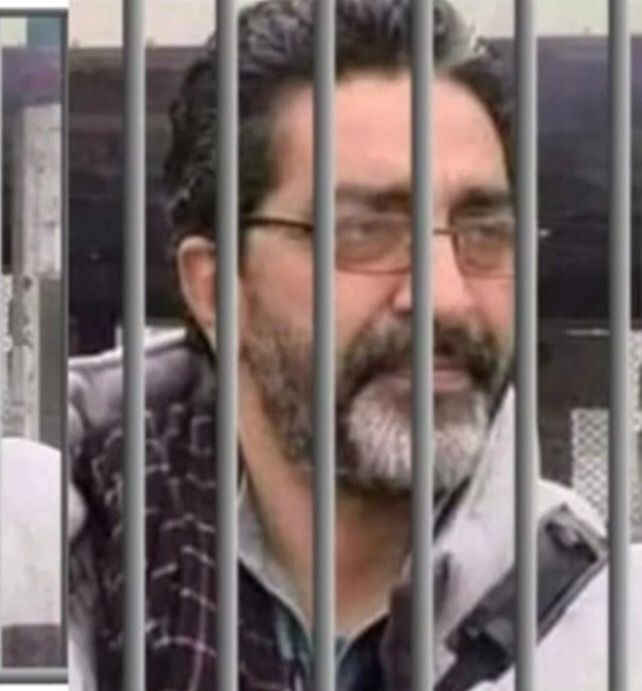
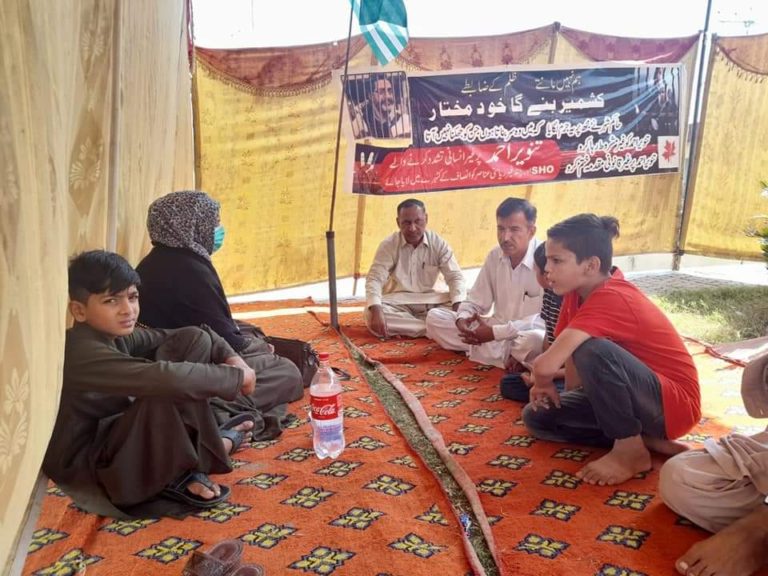
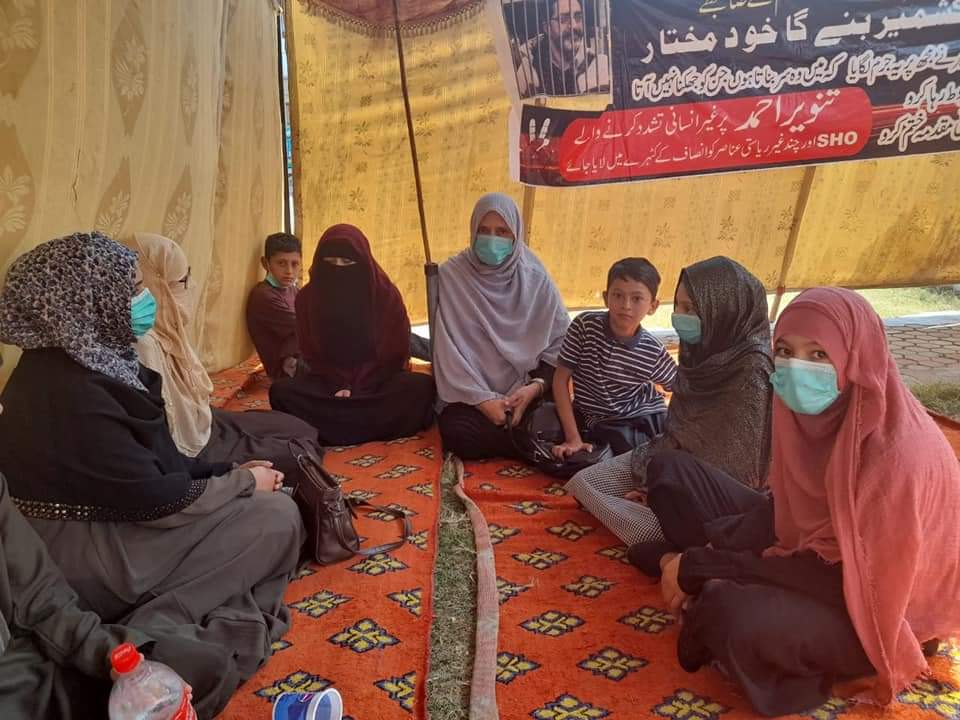
Senior journalist Tanveer Ahmed’s family, friends and well wishers began a sit-in from Sunday at Dadyal, Mirpur in Pakistan-occupied Kashmir (POK) as part of their protest campaign to demand for his safe release from the custody of Pakistani authorities. Tanveer Ahmed was arrested on August 21 when he pulled down the Pakistani flag from Maqbool Bhat Sqaure, Dadyal, he continues to be under arrest ever since then.

Several people from Pakistan-occupied Kashmir (POK) belonging to different walks of life attended the protest camp site and expressed solidarity with the family members of Tanveer Ahmed. “We have come here to demand the release of Tanveer saheb from police custody,” a protester at the sit-in site told News Intervention. Another protester said the Pakistani state has a history of rough handling Kashmiris.

“If my husband Tanveer Ahmed is not released soon then we will set up this sit-in protest camp right outside the Mirpur jail,” wife of Tanveer Ahmed told News Intervention. She further added that Tanveer Ahmed was arrested when he took down a foreign country’s flag from the main chowk …”and after his custody Tanveer saheb has been brutally tortured and his health is now in a critical condition due to these intense tortures.”

The court had earlier rejected Tanveer Ahmed’s bail application and the Pakistani authorities have continued to torture him in custody. Reliable sources within POK said that Pakistani intelligence agents and the local administration have forced Tanveer Ahmed to sign an apology that he had refused from the first day.

People from all walks of life sitting in to demand the release of senior journalist Tanveer Ahmed from Pakistani custody in POK (Pakistan-occupied Kashmir). Photo: News Intervention

Tanveer Ahmed’s family has appealed to human rights organizations and social activists all around the world to raise their voice and demand for the safe recovery of senior journalist Tanveer Ahmed. Hashtag #ReleaseTanveerAhmed can be used by everyone on the social networking websites to express appeal for Tanveer Ahmed’s safe recovery.

Tanveer Ahmed soon after his arrest on August 21, 2020. His health has deteriorated since then. Tanveer Ahmed was arrested by Pakistan after he pulled down Pakistani flag at Dadyal, POK (Pakistan-occupied Kashmir) on August 21. (Photo: News Intervention)

Atal Tunnel: India’s strategic achievement adds to China’s discomfort

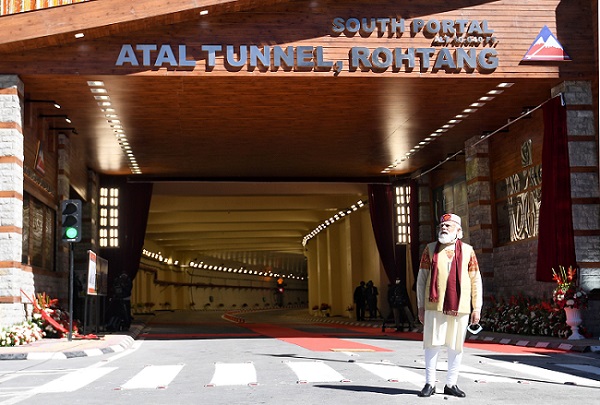
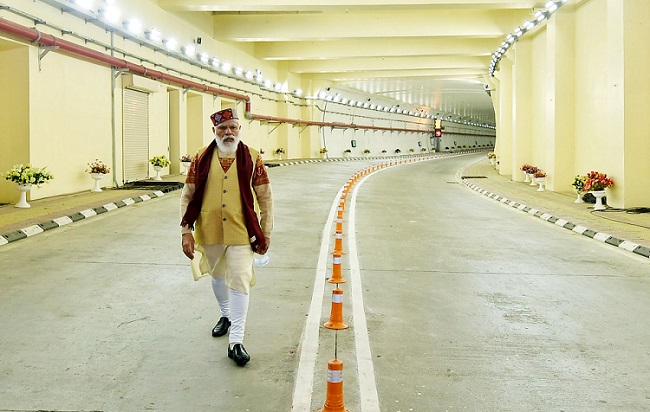
On Saturday, October 3, 2020 Prime Minister Narendra Modi inaugurated the Atal Tunnel. It holds huge strategic and social significance for the country and specifically for Himachal Pradesh and the Union Territory of Ladakh. The Atal Tunnel will reduce the road journey from Manali to Lahaul- Spiti and onwards to Ladakh by at least four to five hours. More importantly, it will enhance all weather connectivity to Ladakh and thus mitigate, to a great degree, the challenge of logistic build up for both military and civilian purposes.

There are two feeder routes available for Ladakh, the Rohtang axis and the Zojila axis. Of these, the Rohtang axis is more secure and less prone to closure due to snowfall in winter. The Zojila axis remains accessible only for about 140 days in a year.

The Atal tunnel has added to the viability of Rohtang axis and positioned it as the main feeder for Ladakh. The earlier movement of stores, stocks and troops from Pathankot to Tandi (near Keylong) was a three days journey one side; but now due to the Atal Tunnel it has been reduced to two days. The overwhelming impact of the reduced turnaround time needs no emphasis. Henceforth, “winter stocking” for Ladakh will not remain as big a nightmare for the Indian Armed Forces as it has been since independence.

PM Narendra Modi inaugurating the Atal Tunnel in Rohtang, Himachal Pradesh on October 3, 2020. Click on the link to watch full video.

In addition, the tunnel will be a boon to the residents of Lahaul-Spiti who remain cut off from the rest of the country in winters for nearly six months due to heavy snowfall. It is also expected to give a big and very welcome boost to tourism and winter sports in both Himachal Pradesh and Ladakh.

It is notable here that the Indo-China War of 1962 was lost by India not because of lack of  bravery of its soldiers or force deployment but because of an inability to meet the logistic requirements. Much has, of course, improved after that. The opening of the tunnel is a very big step towards achieving fool proof logistic capability. This, by itself, reflects the huge strategic dimension of the project.

The 9.02 km-long-tunnel, built by the Border Roads Organisation (BRO) is an engineering marvel. Located at a breathtaking altitude of a little more than 3,000 metres (10,000 feet) above sea level, it is the world’s longest highway tunnel. Cutting through the mighty Pir Panjal range of the Himalayas under the Rohtang Pass, it boasts of ultra-modern specifications. It is horseshoe shaped with an overhead clearance of 5.525 metres and a single-tube double lane configuration supporting a roadway of 8 metres. The south portal of the tunnel is located 25 km from Manali and the north portal is located near village Teling, Sissu, in Lahaul Valley. It cuts 46 km between Manali and Leh and the travel time by about 4 to 5 hours.

The tunnel has been so named since it was envisioned by Shri Atal Bihari Vajpayee when he was the prime minister of the country. The decision to construct the strategic tunnel was taken by the NDA-I government on June 3, 2000, and the foundation stone for the access road to the south portal was laid on May 26, 2002. It is sad to note that the project progressed at a snail’s pace till it was given a strong push by the NDA-II government post-2014.

In his inaugural address, Prime Minister Narendra Modi said, “Atal Tunnel will give new strength to India’s border infrastructure. It is an example of world-class border connectivity. There have been demands to improve border infrastructure but for a long time, such projects either could not get out of the planning stage or got stuck midway….people who live in the mountains would know the significance of cutting down travel time by four or five hours,” he added.

Also present in the inauguration were Defence Minister Rajnath Singh, Chief of Defence Staff (CDS) General Bipin Rawat, Army Chief General MM Naravane and Himachal Pradesh Chief Minister Jairam Thakur.

The great significance of the Atal Tunnel gets reinforced by the fact that it has invoked great displeasure from China. As usual, the misinformation campaign was spearheaded by the Global Times, the biggest propaganda tool of the Chinese Communist Party (CCP). An article titled, ‘Atal Tunnel to have limited benefit to India in wartime’, written by some Song Zhongping admits that with the opening of the Atal Tunnel, Indian troops can be deployed quickly on the border and transportation of military supplies can also go through. The propaganda starts beyond this admission. He goes on to say that, “The Chinese People’s Liberation Army has the means to make this tunnel unserviceable. It is better for India and China to coexist peacefully with each other. India should restrain itself and refrain from provocation as no passage exists that can enhance India’s combat capability.”

The obtuse and graceless article clearly proves that the Chinese are totally disconcerted with the development and more so since it comes at a time when India has taken a firm stand along the Line of Actual Control (LAC) in Eastern Ladakh. The report also says that New Delhi has identified 73 strategic roads along the China-India border that they will continue to build throughout the winters.

Undoubtedly the Atal Tunnel will be a game changer for the Indian Army particularly in the current scenario of clashes between the Indian and Chinese military in Ladakh. Logistically, it has put the Indian Army in a highly comfortable position.

There is, however, a need to further enhance connectivity. The building of a tunnel at the Zojila Pass in Jammu and Kashmir-Ladakh region should be taken up on priority. Even on the Rohtang axis full all-weather connectivity can be ensured only by building tunnels to negotiate the Baralacha, Lachung La and Tanglang La passes. Definitely, experience gained in this project will make future projects easier. What is required most is the political will.

Pak Army refuses to give Baloch martyr bodies to family: Reasons & Repercussions

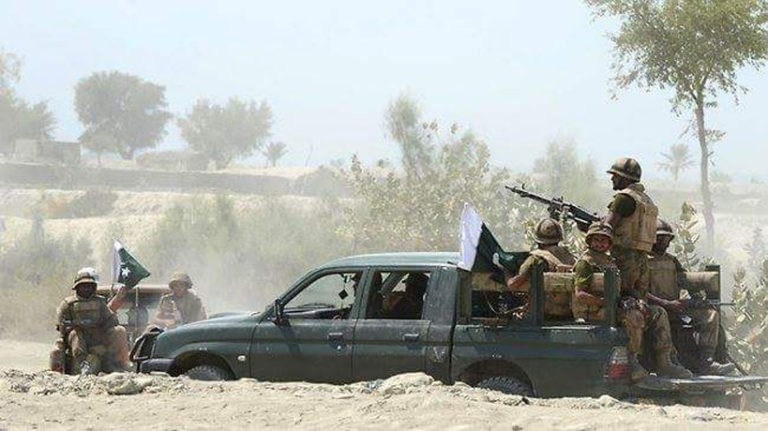
According to reports, on September 6, in pursuance of a major military operation against the Baloch freedom fighters Pakistani Army, in the dark of night, entered the famous Makran mountain range Mazanband from different directions in large numbers. The army was joined by its local spies and death squads. Informants may have informed the army of the presence of a large guerrilla camp of Baloch freedom fighters there, so the army entered the Mazanband ranges with a huge preparation.

No training camp of the Baloch freedom fighters (Sarmachars) could be found in the area. However, unaware of the presence of the army, two Sarmachars came there in the afternoon and got trapped in the enemy’s encirclement. The exchange of fire between the two sides continued till the sunset and then silence prevailed. Both Sarmachars were martyred while fighting the enemy with bravery. In this clash, Sarmachars also inflicted heavy casualties on the occupying Pakistan Army but the army as usual concealed heavy casualties inflicted on it.

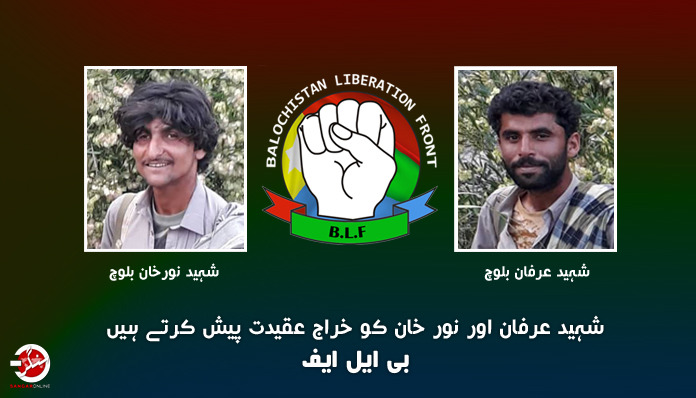
However the death of a Pakistan Army officer, who was killed by the Baloch freedom fighters in Mazanband was reported from another area while the body of an informant namely Munir Ahmed (son of Abdul Rashid), a resident of Tump, was brought by the army and handed over to his family members. Another injured informant was taken to Kech district for treatment. News of his hospitalization also began to circulate. Pakistan Army then released pictures of the bodies of the two martyred Sarmachars (freedom fighters) in the media. On the other hand, the spokesperson of Balochistan Liberation Front (BLF), Major Gwahram Baloch, while confirming the martyrdom of two martyred Sarmachars (freedom fighters) in the clash with the Pakistan Army revealed the identity of martyred freedom fighters as Captain Irfan Baloch, alias Imdad (son of Shaheed Ghulam Mustafa) and Noor Khan Baloch alias Barmash (son of Noor Bakhsh).

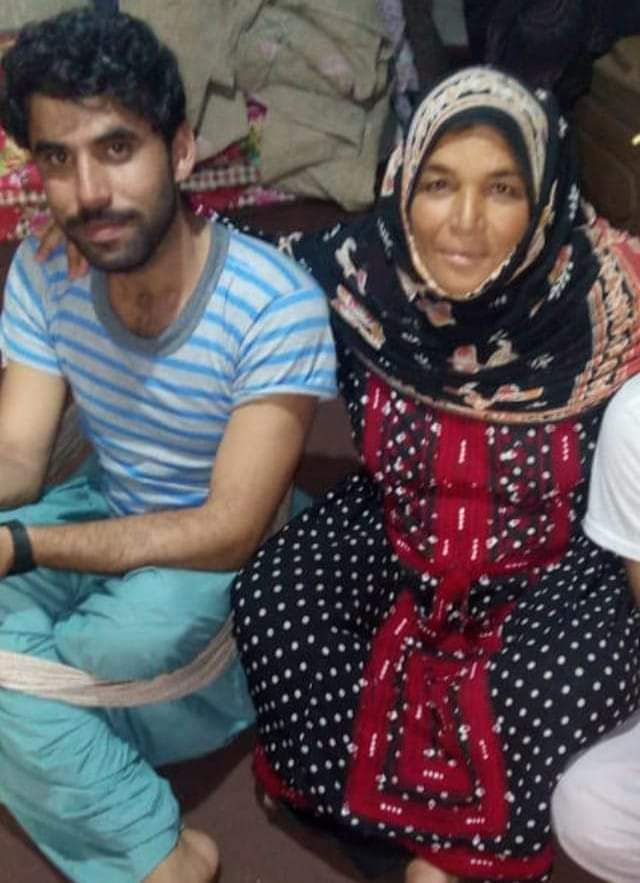
Martyr Captain Irfan Khan Baloch with his mother.

The military personnel came to Tump with the bodies of both the martyrs and the informant. As the identities of the martyrs were revealed, so their family members went to the military camp in Tump to receive the bodies of the martyrs, but instead of handing over the bodies to them, army asked them to wait. The family members of the martyrs waited there for a long time, during which the military personnel mocked them in various ways to harass them so that they would return home without receiving the bodies of the martyrs in fear or despair. But the family members of the martyrs waited patiently. Between ten and eleven o’clock in the night, the family members were finally told to go home as the bodies of the martyrs would be handed over to them the next morning.

It is said that after the family members of the martyrs left, the army dug two pits with a tractor and buried the bodies of the martyrs in them. In the morning, when the family members of the martyrs came to collect the bodies, the army showed them two graves. The family members of the martyrs then demanded that they should be allowed to open the graves and establish the identity of the bodies of their martyrs. They not only wanted to reassure that the bodies buried were indeed of their martyrs who sacrificed their lives for the freedom of the homeland but also to offer the funeral prayers of those brave sons of soil with respect and in accordance with Islamic beliefs.

Pakistan Army refused to allow the alleged graves of the martyrs to be opened or their identities to be established, or for the funeral prayers to be offered and their burial to be done with respect. This led to public outrage against the army and the protest spread from Tump to Makran. The family members of the martyrs held a press conference in Turbat, Kech and also staged a sit-in protest at Shaheed Fida Chowk. Human rights activists, political and social circles also joined the protest in support of the demand of the family members of the martyrs. Even though this demand and protest echoed in Karachi, but despite all this the Pakistan Army refused to hand over the bodies of the martyrs to their family, which not only outraged the public but also cast doubts about the nature of weapons used against the martyrs and the treatment of their bodies.

Doubts are being expressed and all sorts of rumors are circulating. The question is, what does the Pakistan Army want to hide or reprove by burying the bodies of Baloch martyrs in the dark of night? Although this is not the first time that the occupying Pakistani Army has refused to hand over the bodies of Baloch martyrs to their family members for cremation and burial, such incidents have taken place before. The bodies of martyr Akbar Khan Bugti and his comrades were similarly refused to be handed over to their family for cremation and burial.

I examine the reasons for this savage act of not giving the dead bodies of martyrs to their family for funeral and its repercussions on the Baloch society and freedom struggle.

1: Some quarters are expressing concern that the Pakistan Army may have used any prohibited weapons, gas or materials against Irfan Baloch and Noor Khan Baloch and to in order to hide their crime, they have denied handing over the bodies of the martyrs to their family, so that the family of the martyrs do not expose the war crimes of the Pakistan Army by conducting postmortem of the bodies.

2: Shaheed Irfan Baloch and Shaheed Noor Khan Baloch despite being only two men, not only fought bravely against the heavy contingent of the Pakistan Army for more than three hours, but also killed one of their officers and a key informant, including several army personnel. It is possible that the military personnel, outraged by their heavy casualties, desecrated the bodies of the martyrs as an expression of hatred and mutilated them. That’s why the army didn’t hand over the bodies of martyrs and buried them in the dark of night to cover up their crime. They buried them so that no one could see the evidence of army’s hatred and savagery on the corpses. They were Sarmachars (freedom fighters) who inflicted heavy blows on the Pakistan Army during the war. And, due to which the hatred of Pakistan military personnel towards the martyrs and the insult and desecration of corpses due to this hatred at the hands of an unprofessional and uncivilized enemy like the Pakistani Army is not merely a speculation. Instead such a barbaric and an uncivilized act is sure because in case of the assassination of Shaheed Hayat Baloch the whole world has witnessed a glimpse of the Pakistani Army’s barbarism, hatred and animosity towards the Baloch people and its unbridled atrocities in occupied Balochistan.

3: One of the reasons may be that the Pakistan Army wants to bury the Baloch martyrs like unowned people and make them an example so that they can spread fear and terror among the Baloch people and prevent them from conscious struggle and resistance for national liberation. If this is the motive behind this war crime and uncivilized act of the Pakistan Army, then it has failed miserably in achieving this objective because the family of the martyrs and the Baloch people, instead of getting terrorised and being fearful are overwhelmingly standing against such inhuman acts of enemy and they are raising their voice against the army and have chosen the path of protest and resistance. By watching the video message of Shaheed Irfan Baloch’s mother on social media, the army will surely be ashamed and upset over the failure of its brutal strategy.

4: Instead of handing over the bodies of Shaheed Irfan Jan and Shaheed Noor Khan Baloch to their family for funeral, the purpose of burying them secretly in the dark of the night is also to prevent public participation and public mobilization on the occasion of funeral prayers of martyrs. Probably because the occupying Pakistan is terrified of the political and national consciousness and mobilization of the Baloch people. If the purpose of not giving the bodies of the martyrs was to stop mass mobilization, then the army has failed miserably in this purpose as well. People will now pay homage to the martyrs by attending the funeral of the martyrs from Tump and its vicinity. However, due to not handing over the bodies of the martyrs, mass mobilization and protests have spread from Kech to Karachi and people from different areas have condemned the Pakistan Army in the media. The martyrs are being paid homage for their great and proud sacrifice.

Indeed, when there is a bad purpose and ill intention, the intellect stops working and the results of all the measures are inverse. The reaction of the family members of the martyrs and the Baloch people on the issue of uncivilized act of the Pakistani Army of not handing over the bodies of Shaheed Irfan Baloch and Shaheed Noor Khan to their family has put a positive impact on the Baloch society and Baloch independence movement. Such barbaric act and strategy of Pakistan Army further exposed Pakistan’s colonial occupation in Pakistan-occupied Balochistan and its hatred and enmity against the Baloch nation. Not only this, it has also magnified the need for national independence to the Baloch nation, which has led the family of the martyrs and the Baloch people to take the path of protest and resistance instead of being frightened and silent.

Pakistan’s crime-orgy continues across Balochistan

During September this year, Pakistan Army conducted more than 50 military operations in Gichak, Wadi Mushky, various areas of Awaran, Duraski and Dasht areas of Kech, Mand and Tump of occupied Balochistan. These military operations were Pakistani state-sponsored barbarism in Balochistan where gunship combat helicopters shelled and bombed innocent Baloch people along with the ground forces.

According to the available data, 30 people have been abducted by the Pakistani forces during the ongoing operations. The full details of missing persons are yet to come. Also, during the month of September fourteen bodies were recovered of which ten people were martyred due to firing by the Pakistani forces while the exact cause of deaths of others is still being ascertained. A man was rescued from Kech district who was abducted by Pakistani forces a year and a half ago.

During their operations, Pakistani forces looted 258 houses and took away all their belongings while 208 houses were set on fire. The occupying forces of Pakistan burned a large number of forests in Gichak, Wadi Mushky, different areas of Awaran, Ragha, Draski Mand and Dasht, including forests across more than 50 km in Dasht and several kilometers in Tump. Hundreds of cattle have also been killed during these operation during shelling of gunship helicopters by the Pakistan Army.

These statistics are for the month of September this year, and it’s not impossible to estimate the war crimes of the occupying state of Pakistan from these statistics.

Pakistani forces destroyed dozens of human settlements through simultaneous use of gunship helicopters during their ground operations in various areas of Awaran, Mushke Valley, Gachak, Kolwah, Draski and several areas of Ketch, Dasht, Mazanband and Tump. Hundreds of cattle were also killed in this barbarism.

Further, on one hand the state’s barbarism continued, and on the other hand a Baloch journalist, activist and artist Shahina Shaheen was killed by her husband Mehrab Gichki in Kech district. Local sources said that Shahina Shaheen’s husband is a special operative of a religious terrorist group backed by Pakistan.

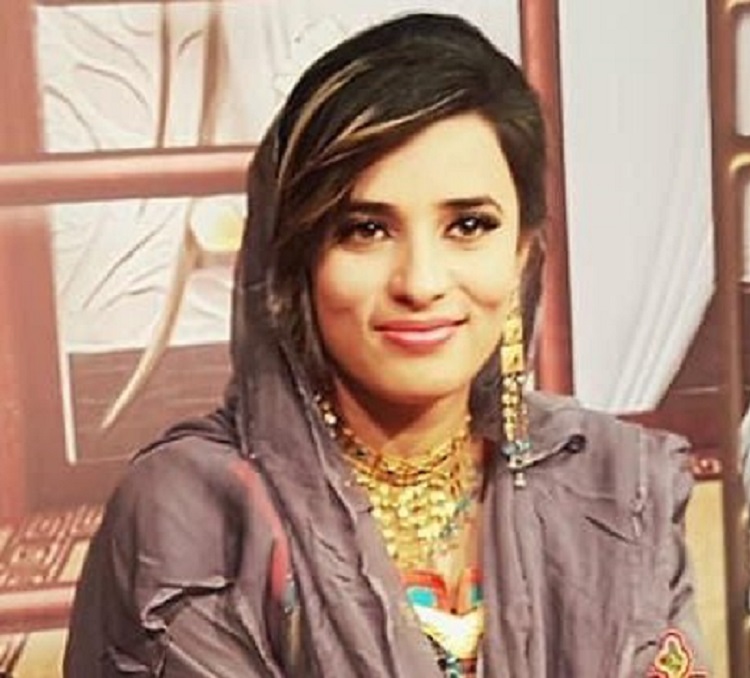
Shahian Shahin, journalist and women rights activist was murdered by her husband Mehrab Gichki on the instructions of Pakistan-sponsored Lashkar-e-Khorasan. (Photo: News Intervention)
Shahina Shahin, journalist and women rights activist was murdered by her husband Mehrab Gichki on the instructions of Pakistan-sponsored Lashkar-e-Khorasan. (Photo: News Intervention)

And just like no action was taken against the killer Pakistani forces of Hayat Baloch, no action has been taken against Shahina Shaheen’s killer husband Mehrab Gichki who is backed by the Pakistani forces. Protests and demonstrations against the brutal killing of Shahina Shaheen and Hyat Baloch are still on across Balochistan but alas, where’s justice in the fate of the unfortunate Baloch!

Regarding Shahina’s killer, the local administration openly protested in front of the people in Turbat and said that he is influential, there is nothing we can do, so there is no justice for the murder of Baloch daughter.

Similarly, sources say that the military personnel accused in Hayat Baloch’s murder have shifted back to the military camp and the SSP has been clearly asked to take action against protesters and bring them to the police station if need be.

In fact, this is everyday situation across Sindh, Pashtunistan and Balochistan. Even in Pakistan-occupied Kashmir (POK) the atrocities are increasing with each passing day.

Baloch Sarmachaar’s Last Bullet

However, just as state barbarism is on the rise in occupied Balochistan, so are the true lovers of the land, the Baloch children, making history with their blood and defeating the occupying enemy on the battlefield. There are dozens of examples in the struggle for independence of Balochistan and the ongoing Baloch revolution that after a long battle with the enemy, when the bullets of Sarmachaar (freedom fighters) are about to run out, they save the last bullet so that they do not fall into the enemy’s hand alive. This philosophy of the Baloch national struggle has paralyzed the enemy mentally.

On Friday, September 18, a confrontation took place between the Baloch Sarmachaars (freedom fighters) and the occupying Pakistani Army in Koraghe Kalan, which led to a two-way clash. In the clash, four BLF commanders, Muslim son of Muhammad Hussain, Second Lieutenant Sikandar son of Muhammad Ibrahim, Mansoor son of Mullah Abdul Qadir and Saadullah, fought valiantly against the enemy army and were martyred. His martyrdom came as the Pakistani military had been conducting military operations in the area for the past two weeks.

In this operation, in violation of the laws of war, the occupying Pakistani forces targeted the civilian population with gunship helicopters. During this time many Baloch homes were set on fire and livestock looted. Paying homage to the martyrs, BLF spokesman Major Gwahram Baloch said in a statement issued in the media that Shaheed Muslim Baloch is the younger brother of martyred BLF commander Suleman and nephew of BLF leader Dr Allah Nazar. Shaheed Sikandar Baloch is the nephew of Dr. Allah Nazar and Shaheed Mansoor is the nephew of Dr. Allah Nazar Baloch. Commander Suleman and Safar Khan Baloch, brother of Dr. Allah Nazar, were martyred by the Pakistan Army on June 30, 2015 when they attacked their house along with his guests and 15 other comrades.

It should be noted that these four Baloch youths kept the honour of the philosophy of keeping last bullet for themselves. It is said that two Sarmachaars (freedom fighters) were martyred while fighting with the Pakistan Army and Shaheed Muslim Jan and his companion saved the last bullet for themselves after their bullets ran out and embraced martyrdom.
The local Pakistani administration confirmed that 20 army personnel were killed on the spot and more than 20 were injured in the clash.

Let me shed some more light on the philosophy of keeping the last bullet for themselves by the Baloch Sarmachaars.

On June 30, 2015 Mehi area of Meshka Valley, the hometown of Baloch national leader Dr. Allah Nazar Baloch was attacked by the Pakistani Army in which 15 Baloch children were martyred, including the elder brother of Dr Allah Nazar and his other family members. This war has a special significance in Baloch history. The nephew of Dr Allah Nazar, Suleiman alias Shaheq Baloch, fought with the Pakistan Army all day. After fighting heroically, Suleiman was seriously wounded and he and other comrades were left with a gun and two bullet magazines. Putting the gun aside for a while, Suleiman filmed these historic moments with a Sarmachaar where he smiles in the video and says that “our destination is freedom”. Suleiman recorded his message for the nation, other Baloch youth and his mother. He then continued to fight bravely against the Pakistan Army, and when the bullets ran out he adopted the philosophy of firing last bullet onto himself and embraced martyrdom.

His younger brother Muslim Jan applied this same philosophy along with the other comrades once again on September 18, 2020, when they embraced martyrdom. Each such martyrdom brings the Baloch goal of national liberation closer.

More than fifty close relatives of Dr. Allah Nazar Baloch have been martyred in the Baloch national struggle. Pakistan’s policy has been to target the relatives of Baloch leaders and put pressure on them. Under this policy, the Pakistani military has targeted, martyred or kidnapped many leaders and relatives of militants. But in response, hatred against Pakistan has increased among the Baloch people. Due to this hatred, state atrocities and patriotism, the Baloch national movement has gained strength and has been going on uninterruptedly for the last twenty years.

On September 28, the Pakistan Army launched a long operation in Dasht-e-Mazanband area of Ketch district. In this operation, SSG commandos also landed alongwith gunship helicopters. Local state informants were also with them. But the Baloch warriors once again annihilated the enemy.

Captain Irfan alias Imdad son of Shaheed Ghulam Mustafa resident of Konshaqlat, Second Lieutenant Noor Khan alias Barmash son of Noor Bakhsh resident of Khairabad were martyred while fighting valiantly.
Major Gwahram Baloch said in a statement that the martyred soldiers fought valiantly against the enemy in the areas of Sedan Pir and Gandhadar, killing more than 15 Pakistan Army personnel and injuring several others.

Munir Ahmed, son of Abdul Rashid, a resident of Tump, was also killed in the same clash. But as usual, the Pakistani Army kept the bodies of the two Baloch children with them for two days instead of handing them over to their families and mutilated them after martyrdom. Residents of the area staged a sit-in in front of the state army camp in Tump for two days, but the Pakistani Army did not allow the bodies to be flown and their last rites were not performed according to Islamic traditions.

Rahim Baloch, an advocate, intellectual, former chairman of BSO and former central secretary general of BNM said in his tweet that Pakistan is even scared of the bodies of Baloch. Despite public protests, Pakistan Army refused to hand over the bodies of Shaheed Irfan Baloch and Shaheed Noor Khan to their heirs for final rites and buried them without a funeral like that of Shaheed Akbar Bugti. Such insult to the martyrs is unbearable.

Baloch nationalist leader Akhtar Nadeem said in his tweet that Baloch resistance would continue till independence. “On the battlefield and on other fronts, the Baloch children are proving it by sacrificing their lives. Shaheed Irfan and Shaheed Noor Khan set another example in Mazanband Dasht. I pay a great tribute to them.”

https://twitter.com/AN_Baluch/status/1311232318372184064

Similarly, BNM Chairman Khalil Baloch in a statement said that the martyrdom of Baloch children in Dasht by the Pakistani state and desecration of their bodies was an inhuman act and said that the nations were in a state of war. “I respect the values of nations. The Baloch have fought many wars against the occupiers over the last seventy years. Two decades have passed since the current war, but so far no body of any enemy soldier has been desecrated because the Baloch are a vibrant and decent nation and the armed forces of the Baloch nation abide by their national values and international law. On some level, we consider the desecration of a corpse an unforgivable crime.”

In September, when state repression by Pakistan was at its height, the Pakistan Army burned 50 km of forest in Mand and Tump. The same process was repeated in Gichak and Draski.

Click on the link to watch full video

The ongoing war crimes of Pakistan across Balochistan are still not effectively being highlighted by Balochistan’s pro-independence political parties in front of the world, which is certainly a matter of grave concern. It’s required that the Baloch liberal leaders and Baloch activists in different organizations are given an effective strategy. Otherwise, even in this modern age, the crimes of the occupying state of Pakistan will continue to increase on Balochistan. At present the global situation is not in Pakistan’s favor and effective diplomacy to expose Pakistan’s war crimes against Balochistan must be our top priority.

Didn’t Supreme Court miss something in Shaheen Bagh verdict?

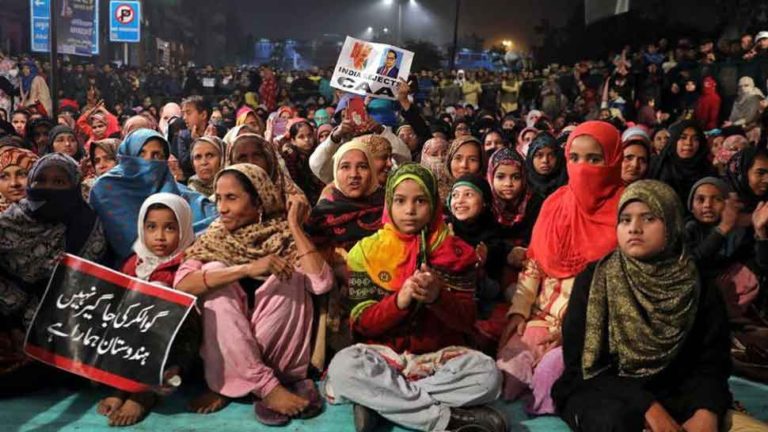
The verdict of the apex court in a petition filed by BJP MLA Nand Kishore Garg has mostly focused on the constitutional and administrative aspects of the last winter’s Shaheen Bagh sit-down agitation that had caused great inconvenience to the public in a crowded part of Indian capital for a long time. The sit-down strike ended in March and the verdict has come seven months later. The long time gap is reflective of rather low priority with which the apex court treated the matter.

The court verdict has not touched on the political and social parameters inherent in the case obviously because the petitioner had not made any direct reference to those areas in his petition. The argument of the petitioner was as this: “It is disappointing that the state machinery is muted and a silent spectator to hooliganism and vandalism of the protesters who are threatening the existential efficacy of the democracy and the rule of law and had already taken the law and order situation in their hand.” This was the first part of the petition and in the second part the petitioner had urgently approached the court that public places must not be allowed to be abused and misused for ulterior and mala fide purposes such as staging a protest against the constitutional amendment in the heart of the capital city and thereby causing incalculable hardships and difficulties to the common people.” The first part of this sentence is loaded with political undertones which the apex court has not taken cognizance of. Hardships and difficulties to common people are the fallout of certain activity by the specific people. The court has addressed the fallout and not the source of the hardship.

Those not disposed to examine the court verdict critically will argue that the court has responded to the plea of the applicant and decreed that public places are not to be used for protest rallies. Therefore, the Supreme Court verdict remains confined to law and order aspect and the issue of causing public inconvenience only. In simpler language, the verdict conveys that it is an administrative matter. There are clear rules and regulations set forth how a democratic state is expected to deal with such situations.

In the larger perspective, one may say that the government has failed to take recourse to the established law of the land in handling the situation in Shaheen Bagh, and as mildly hinted at by the court verdict has it tried to hide behind the court for its inactivity. This is precisely what the court has meant by the comment “Authorities have to act on their own and cannot hide behind courts.” The Supreme Court has censured the government is mild and polite words.

But it has to be noted that the Supreme Court has not reacted to the plea of the petition that “hooliganism and vandalism of the protesters (of Shaheen Bagh) are threatening the existential efficacy of the democracy and the rule of law and had already taken the law and order situation in their hand.” A serious charge of “threat to the existential efficacy of the democracy and the rule of law” has been very conveniently overlooked. A deeper and impartial analysis of the incident should have been attempted to arrive at the crux of the issue.

The apex court of India enjoys supreme powers because of the democratic dispensation of our country. But when there is a petition before it alleging that an existential threat has been posted to the efficacy of democracy and the rule of law in the country, the Supreme Court is obliged to examine whether there is a threat to democracy or not. In either case, it has to justify its ruling. The Supreme Court has simply brushed the matter aside.

Who is threatening democracy and why and how is the crucial issue that arises from the contents of the petition? The least that the Honorable Court could have done was to ask the petitioner to elucidate the charge of threat to democracy and ascertain how the “state machinery was muted and a silent spectator to hooliganism and vandalism of the protesters.” No elucidation is not reflected in its verdict.

The narrative becomes more intricate when we find that the lockdown was implemented by a particular community in a particular area with particular geography and demography. It is not saying too much that the method and manner in which the protest sit down was conducted wore communal complexion. There has been a protest against CAA and domicile rule in some more parts of the country but the protests at Shaheen Bagh resembled the pattern of protests simultaneously held at a couple of Muslim majority towns in the country. It is also worth noting that the entire protest activity was meticulously planned and carried out through agents thoroughly briefed beforehand. For example, anti-national and communal slogans were raised under the banner of the national flag which meant the abuse of the national icon.

The government has now the report of the inquiry commission on the Shaheen Bagh incident. The report is not publicized obviously because of the finger of responsibility points towards a particular community. It is also said that collaborators had travelled to Shaheen Bagh from as far as Kolkata and Trivandrum. Antecedents of some of these collaborators are known to the intelligence authorities. What had brought them to Shaheen Bagh and what was the mission they were assigned and by who? The court verdict does speak of the responsibility of the government in curbing the illegal protest but it does not reprimand the Delhi government for its failure in controlling the situation which was reported to have been soft paddling with the miscreants.

What is more surprising is that the Supreme Court has not taken cognizance of the type of slogans that were raised by the protestors. Moreover, how the media was not allowed by the protestors to enter the cordoned-off area and talk to those who were on sit down strike speaks a lot about the intentions of the protestors. If they were genuinely protesting they would have allowed the media to perform its normal role so that their case would receive a national response.

The fact of the matter is that a widespread anti-national movement by the radicals with roots outside India has been behind the Shaheen Bagh agitation. The agitation was meticulously planned. The women were particularly motivated to leave their homes and kitchens and enjoy the privileged biryani that was served to the sitting mobs for nearly two months. Who funded their catering service, how did they abandon their homes and the daily chores of life and felt relaxed and comfortable in a state of prolonged protest are some of the intriguing questions that ask for an answer.

Finally, the threat to the efficacy of the democratic dispensation lies in mobs violating the law passed by the parliament through due process and the state government choosing to become a silent spectator to the scenario till law and order are taken by the mobs in their hand. The civil society has a right to dispassionately and objectively debate the verdict of the Supreme Court on Shaheen Bagh incident.

Pakistan Army and its deep seated desire to ‘control’ Civil Government

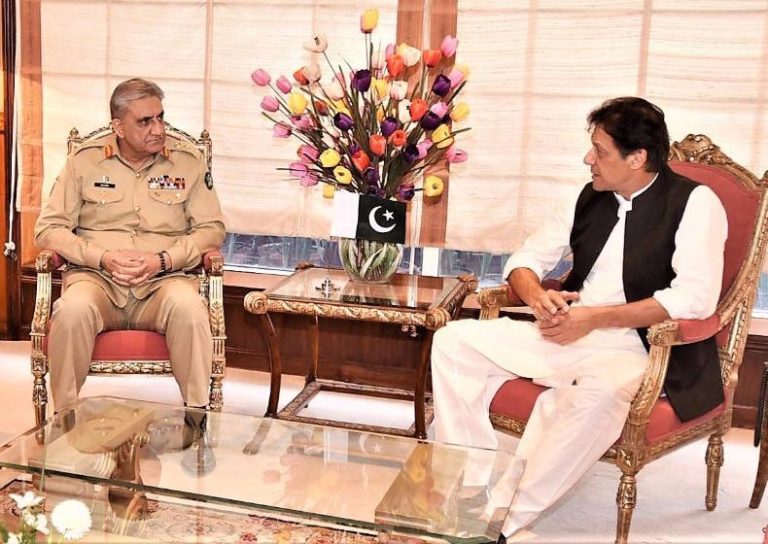
Whatever be the constitutional position, one thing is clear that in the final analysis, political sovereignty in Pakistan resides … where the coercive power resides… which is the ultimate authority in the decision-making process in Pakistan. They decide when to abrogate the Constitution; when it should be held in abeyance; when elected governments should be sacked; and when democracy should be given a chance. Behind the scenes, they also decide whether an elected prime minister shall live or die.2 — Roedad Khan

The battle-lines have been drawn in Pakistan between a combined opposition on the one side and the establishment and government on the other. Pushed to the wall by a spate of accountability cases, Pakistan Muslim League Nawaz (PML-N) leader Nawaz Sharif in several speeches since September 20, 2020 has strongly criticized the establishment for involvement in politics. He has accused it for being ‘a state above the state,’ and described the opposition’s struggle as being against a ‘parallel state’ that had imposed an incapable person on the country through a rigged election process. The opposition has formed an alliance called the Pakistan Democratic Movement (PDM) whose first leader is Maulana Fazlur Rehman of the Jamiat Ulema-e-Islam (JUI-F). While Nawaz and the PMLN have a large vote bank in Punjab, the Maulana is expected to pitch in with street power of his Deobandi religious cadres, especially in Khyber-Pakhtunkhwa and Balochistan. Already an impressive alliance, in case the PPP remains committed, then the addition of its Sindh vote bank would be formidable.

The establishment and government have retaliated with their usual repertoire of tricks — arrests of opposition leaders, filing of cases, trying to create splits in parties and between parties and so on. PM Imran Khan and his ministers have reacted by accusing Sharif of being anti-Pakistan, of serving Indian interests and the opposition wanting to create a rift between the government and the armed forces.

In such a heated atmosphere, it would be useful to step back and look at some historical insights and into the background of the distorted civil-military relations in Pakistan.

In most democracies, civil–military relations are subject to laid-down guidelines and protocol, with the armed forces being responsible to the executive. In Pakistan’s hybrid democracy, however, civil–military relations have been the central issue in governance with the army dominating the civilian governments.

Such a state of affairs could never have been imagined when Pakistan had been created. At the reception given by Jinnah on August 14, 1947 Asghar Khan (later Air Marshal) and Akbar Khan (later Maj. Gen.) complained that they were disappointed that the higher posts in the armed forces had been given to British officers who still controlled their destiny. According to Asghar Khan, ‘the Quaid who had been listening patiently raised his finger and said, “Never forget that you are the servants of the state. You do not make policy. It is we, the people’s representatives, who decide how the country is to be run. Your job is only to obey the decision of your civilian masters.”’3

Could any politician, including current PM Imran Khan have the temerity to say this to the army chief today? The answer has to be a resounding no. Hence, democratic governance in Pakistan instead of being a tripod of the executive, legislature and judiciary looks more like a garden umbrella in which the army is the central pole around which the other organs of the state revolve. Consequently, civilian governments in Pakistan have invariably taken a backseat on crucial issues like national security objectives and strategies to implement them.

The key to the army’s dominance was the advice given by Maj. Gen. Sher Ali Khan Pataudi to Gen. Yahya Khan in 1969 that the army’s ability to rule lay in its being perceived by the people as ‘a mythical entity, a magical force, that would succour them in times of need when all else failed … the army was the final guarantor of Pakistan and its well-being.’4 Every military ruler has made this the cornerstone of his policy. The generals know that they cannot allow the army’s charisma to fade, even if it means sacrificing a government or a leader.

In its essentials, the tussle between civil and military authorities in Pakistan is not just about power and supremacy. It is about the contempt that the military holds the politicians in and about their belief that left to themselves, the political class will destroy Pakistan one way or the other, or, at the minimum, compromise its vital security interests.

A few examples will suffice. A telling comment were the instructions given by the then commander-in-chief Ayub Khan to Pakistan’s first military attaché in Washington DC, Brigadier Ghulam Gillani, in 1952, barely five years after Pakistan was created. He was told that his main task was to procure military equipment from the Pentagon, and he need not take either the ambassador or the Foreign Office into confidence because in his view, ‘these civilians cannot be trusted with such sensitive matters of national security’.5

Another example is what Gen. K.M. Arif wrote about Zia-ul-Haq: ‘Like many other soldiers, he had contempt for politicians; however, his dislike of politicians … was rooted in a knowledge of the seamier aspects of their personal and public behaviour … Zia was convinced that most politicians had a price; and experience confirmed his opinion that only a few were prepared to rise above their petty personal ambitions.’5

Lt Gen. Hamid Gul probably expressed the army’s sentiments well when he told Iqbal Akhund, ‘[A] democratic government by its very nature tended to compromise, and political compromise might sometime run counter to the national interest. So… there must be some means of defining and promoting the national interest, some means of rising above political partisanship and compromise on issues of high policy – such as Afghanistan, Kashmir, or relations with India.’6

Contempt for politicians apart, the army, since the inception of Pakistan, has not really believed that democracy was suited to Pakistan. The key element in the ‘Rawalpindi Conspiracy Case’ hatched in 1949–51 by Maj. Gen. Akbar Khan was his open scorn for politicians ‘whom he blasted for incompetence, indecision and corruption’.7 Seven years later, Gen. Ayub Khan stated: ‘We must understand that democracy cannot work in a hot climate. To have democracy we must have a cold climate like Britain.’8

Echoing Ayub but using Islam instead of climate, Zia at a press conference stated: ‘Our present political edifice is based on the secular democratic system of the West, which has no place in Islam … In Pakistan neither anarchy nor Westernism will work. This country was created in the name of Islam and in Islam there is no provision for Western-type elections.’9 Musharraf gave his own twist by stating, ‘Our democracy is not mature in the country. I think many politicians do not behave in a mature manner … I have a belief that democracy has to be modified to an environment; that is the reason of my retaining the power of dismissing an assembly.’10

Democracy apart, one crucial issue that would come to the fore in the weeks ahead would be the behavior of the army should the religious cadres of the Maulana hit the streets. While the army’s discipline and chain of command has held over the decades, it is useful to remember that there have been several instances where the army has refused to open fire on and under the influence of Islamists. For example, in the 1977 Pakistan National Alliance (PNA) agitation, which was dominated by the religious parties and led to Bhutto’s ouster, the army declined to shoot on protestors in Lahore.11 On 26 September 1995, Maj. Gen. Zahirul Islam Abbasi, along with thirty-five officers, was arrested for plotting to assassinate the corps commanders, during a conference, as well as the cabinet.12 Between 2004 and 2007, there were numerous instances of mass desertions and refusal to fight in the Frontier Corp units deployed to target militants in the then Federally Administered Tribal Areas (FATA).13 There were two attempts to assassinate Gen. Pervez Musharraf in which armed forces personnel were involved.

In May 2011 the army arrested Brig. Ali Khan and four other officers for links with the UK-based Hizb-ut-Tahrir (HT) which believes in establishing an ‘Islamic Caliphate’. Also, the attack onthe Mehran Naval base (May 22, 2011) and the earlier October 10, 2009 attack on the GHQ revealed that the attackers had inside knowledge and knew where the blind spots were. In May 2016, a naval tribunal sentenced five officers to death in the Karachi Naval Dockyard attack case of September 6, 2014. The five were charged with having links with the Islamic State, mutiny, hatching a conspiracy and carrying weapons in the dockyard.14

Such incidents can be termed as isolated and stray, but it would be a mistake to dismiss them out of hand. They are reflective of the weakening of discipline on account of Islamisation of the army that can grow given the trajectory of radicalization in the country. It would certainly raise questions about how the army would deal with the Maulana if push came to shove.

The conundrum faced by the army is that if it does not interfere in the election process, in the formation of governments and allows the civilians’ space to govern, the government will want to control matters that the army has come to believe is its preserve like defence and foreign policies. This would be anathema since the army does not trust the civilians to do the right thing; hence its constant efforts to engineer and ‘select’ the ‘right’ kind of government, like that of Imran Khan. However, without strengthening an independent electoral system and civil governments, without giving them space to govern, the country will continue to face confrontations like the one that could possibly be brewing. It is precisely this meddling in civilian space and in engineering governments that the opposition has come together to fight. However, as history indicates, the opposition would have a mountain to climb to push the army away from its domination of the civilian space.

Ultimately, however, Pakistan has paid a huge cost for the sake of its army’s domestic ambitions. The army would do well to heed the warning of the first C-in-C of the Indian Army after partition: ‘No army which concerns itself with politics is ever of any value. Its discipline is poor, its morale is rotten and its reliability and efficiency is [sic] bound to be of the lowest order. You only have to look at certain foreign armies which are constantly mixed up in politics to realize the truth of what I have to say15—Sir Roy Bucher.

Endnotes

  1. Some sections of the article have been excerpted from the author’s book- Pakistan: Courting the Abyss, NOIDA, Harper Collins India, 2016
  2. Roedad Khan, Pakistan: A Dream Gone Sour, Karachi: OUP, 1997, p. 179.
  3. M. Asghar Khan, We’ve Learnt Nothing from History, Pakistan: Politics & Military Power, Karachi: OUP, 2005, p. 3.
  4. Roedad Khan, ‘The Role of the Military-Bureaucratic Oligarchy’, Dawn, 25 August 2001, cited in Husain Haqqani, Pakistan Between Mosque and Military, Lahore: Vanguard Books, 2005, p. 54.
  5. Mushahid Hussain and Akmal Hussain, Pakistan: Problems of Governance, New Delhi: Konark Publishers, 1993, p. 30.
  6. Gen K.M. Arif, Working With Zia, Karachi: OUP, 1995, p. x.
  7. Iqbal Akhund, Trial and Error The Advent and Eclipse of Benazir Bhutto, Karachi, OUP, 2000 pp. 137–38.
  8. Ayesha Jalal, The Struggle for Pakistan, A Muslim Homeland & Global Politics, Massachusetts: Harvard University Press, 2014, p. 79.
  9. Tariq Ali, The Clash of Fundamentalisms – Crusades, Jihads And Modernity, New York: Verso, 2002, p. 183.
  10. Daily Telegraph, 18 October 1979, cited in Tariq Ali, Can Pakistan Survive: The Death of a State, London: Penguin Books, 1983 p. 138.
  11. ‘Musharraf Favours Tailored Democracy’, The Nation, 16 June 2003, cited in International Crisis Group ‘Unfulfilled Promises: Pakistan’s Failure to Tackle Extremism’ 16 January 2004
  12. Husain Haqqani, Pakistan Between Mosque and Military, Lahore: Vanguard Books, 2005, p.122.
  13. Brian Cloughley, A History of the Pakistan Army: Wars and Insurrections, Karachi: OUP, 1999, p. 355.
  14. Anatol Lieven, Pakistan, A hard Country, London: Penguin Books, 2012 pp. 175–76
  15. Malik Asad, ‘Five “IS-linked” navy officers get death sentence in dockyard attack case’, Dawn, 24 May, 2016.

This article was first published by Vivekananda International Foundation (VIF).

Tarek Fatah: Turkey must be expelled from NATO

A conflict that goes back almost a millennium, in a region few Canadians could locate on the world map, has forced Ottawa to choose sides between Turkey and Armenia. Notwithstanding centuries of conflict between medieval Iran, the Turkish Caliphate and Tzarist Russia, Armenia has the distinction of being the Middle East’s only Christian country.

On its west, Armenia shares a border with Turkey, home to the unforgivable Armenian Genocide of 1915 that killed or uprooted a million, driving them to death, scattering them across the globe, some as far away as Kolkata, India and Boston, while others took refuge in Turkey’s Arab colonies.

In 1918, after the end of the First World War, Christian Armenia and its eastern neighbour Azerbaijan (Shia Turks) both joined the USSR as Soviet Socialist Republics. During the Second World War, tens of thousands of Armenians and Azeris fought side-by-side in the Red Army to successfully stop the Nazi Wehrmacht from reaching the oil-rich Caspian Sea port city of Baku.

Today we are back to square one with both Armenia and Azerbaijan trying to exert power in Nagorno-Karabakh, an Armenian-populated enclave surrounded by Azerbaijan.

Since then, Nagorno-Karabakh has legally been part of Azerbaijan, but only in name. The population has refused to accept Azeri rule and have the backing of the Armenian government.

Considering the fate of non-Muslims or minority Muslims in Islamic countries, one cannot blame the people of Nagorno Karabakh for refusing to live as non-Muslims under Muslim Azerbaijan.

Case in point being Black Muslim Darfuris facing genocide by Arab Janjaweed of Sudan; Muslim Kurds being subjugated by Muslim Turkey; Balochistan’s 50,000 ‘enforced disappearances’ by a Muslim military, and the suffering of Christians and Hindus in Islamic Pakistan. The list goes on and on.

The two sides fought a war that ended in 1994. Negotiations between Armenians in the enclave and Azerbaijan went on for decades but never resulted in a peace treaty.

That is until July this year when Turkey egged its fellow Turks in Azerbaijan to launch an attack on Nagorno-Karabakh, whose residents refer to the territory as the Republic of Artsakh.

As the clashes between both sides took shape in a land and air war, all major nations called for an immediate ceasefire, except Turkey that opened its borders to let Syrian and Pakistani jihadi fighters to join the ranks of the Azeri Turkish regular army.

However, Islamabad has denied reports that its forces are deployed inside Azerbaijan.

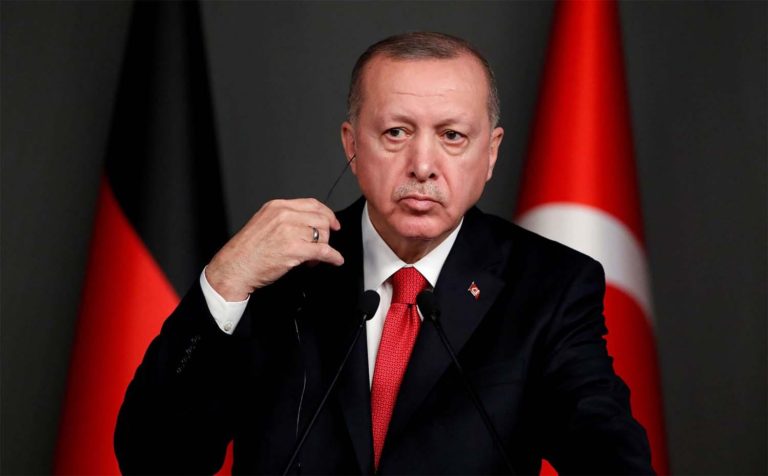
Turkey’s Erdogan denounced the call for a ceasefire and, according to reports, has lent its US-supplied F-16s to Azerbaijan’s forces along with drones that are equipped with Canadian technology.

This forced Ottawa to act. On October 5, Foreign Affairs Minister Francois-Philippe Champagne halted all military export permits to Turkey.

The reaction by Turkey was swift. The foreign ministry in Ankara accused Ottawa of “double standards” arguing: “There is no explanation for blocking defence equipment exports to a NATO ally while.”

NATO ally? That’s quite rich for Turkey’s pan-Islamists to invoke NATO as their defence.

The only role Turkey has played in NATO since the collapse of the USSR is that of a Fifth Column. A country that has been a conduit for ISIS jihadis, the Muslim Brotherhood. A country that deploys refugees to threaten Europe and Greece while occupying Cyprus and festering war in Libya, is no NATO ally.

Time has come for Canada to ask for Turkey’s expulsion from NATO. Turkey is a menace to Greece, Cyprus, Egypt, Syria and Libya. It has eyes on Bulgaria, Rumania and the Balkans, which it had to relinquish in the Lausanne Treaty that is approaching its centennial.

Don’t be surprised if Erdogan annuls the century-old treaty to re-establish the Ottoman Caliphate that will make Central Asia its Turkic backyard after Armenia, the only obstacle, is eliminated.

Pakistan’s move on Gilgit-Baltistan is Chinese compulsion

0

Part of the erstwhile princely state of J&K, Gilgit-Baltistan (GB) that covers an area of 72,921 square km, is an unfortunate piece of land whose people have been worst affected due to what Pakistan refers to as the “unfinished agenda” of partition. Not only was Gilgit-Baltistan (GB) occupied by Pakistan in 1947, but Pakistan handed over the Shaksgam Valley spread over 5,180 square km to China by Pakistan in 1963 for enabling construction of the Karakoram Highway.

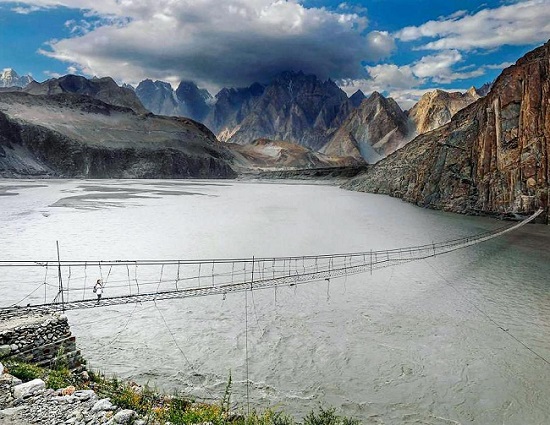
A multilingual region with a rich and historical socio-cultural and ethnic diversity, Gilgit-Baltistan is surrounded by the Hindu Kush and the Karakoram mountains and has a population of 1.8 million and its location is unique. In addition to India and Pakistan, Gilgit-Baltistan shares its borders with Afghanistan and China. It is rich in natural resources which have been exploited by Pakistan, but successive governments have failed to use part of this income generated for the development of the area or upliftment of its residents.

For the last few years, Gilgit-Baltistan has remained frequently in news since the much touted US$46 billion China-Pakistan Economic Corridor (CPEC) connecting the Kashgar area in Xinjiang Autonomous Region (XAR) of China to the Gwadar Port in Pakistan runs through this region. Islamabad has been so taken in by the promises of an influx of revenues due to CPEC that it has already handed over operation of Gwadar port to China, but rather than benefit the locals they are facing unemployment since Chinese construction companies have brought along their own workforce.

Chinese naval activities in Gwadar port and unreasonable restrictions imposed on fishing in the area has hit the fishermen very badly. Thus, there is a general consensus amongst the locals that the CPEC will leave out people from tangible benefits. Residents of the area also apprehend that Chinese domination of Gwadar will lead to widespread displacement of locals and disrupt their way of life.

Residents of Gilgit-Baltistan have grown frustrated with both the Chinese as well as their own government since local resources of the area are being plundered in the most reckless manner. Activists and locals are also alarmed by the huge ecological imbalance that CPEC will cause in the region. However, Islamabad doesn’t seem to be concerned!

Pakistan is now planning to declare Gilgit-Baltistan as its fifth province, a move that has rightly raised concerns in India as the region is part of J&K. Even the people of this region think that constitutional amendment to change the status of the region is designed to help the Chinese rather than the locals as it’s believed that it is China’s concern about the unsettled status of Gilgit-Baltistan that has prompted Pakistan to change its status.

According to an earlier report published in Dawn newspaper, Pakistan is mulling to elevate the constitutional status of the region in a bid to provide legal cover to the CPEC. Experts are of the firm belief that making Gilgit-Baltistan its province is also meant to clear the decks for declaring what it refers to as ‘Azad Kashmir’ (Pakistan-occupied Kashmir or POK) as another province in an attempt to remove all barriers of the conflict.

British Kashmiris under the banner of Kashmir Voice International have condemned Pakistan’s move to integrate Gilgit-Baltistan as a fifth province of the country. They have rightly assessed that this move was a U-turn and “derogatory to the spirit of movement”. They contend that the move would lead to more political instability in Kashmir.

Hardline Hurriyat leader Syed Ali Shah Geelani who is a strong supporter of J&K’s merger with Pakistan surprised everyone when he came down heavily on Pakistan for trying to change the status of Gilgit-Baltistan.  Hurriyat’s representative Abdullah Gilani in Pakistan urged the top brass of Pakistan government to maintain its consistent policy on Kashmir. In our view, this move is laden with disastrous consequences. Pakistan risks not only weakening its position and losing moral high ground but also demoralizing Kashmiri people. “We, therefore, earnestly urge the government of Pakistan to rethink the decision granting provisional provincial status to Gilgit and Baltistan keeping in view all aspects, particularly, the possible detrimental repercussions it would have on the future of Kashmir.”

The polls in Gilgit-Baltistan were to be held on August 18, but Pakistan’s election commission on July 11 postponed them due to the ongoing Coronavirus pandemic and has announced that elections for the legislative assembly of Gilgit-Baltistan will be held on November 15. But India has vehemently opposed Pakistan’s decision to hold general elections in Gilgit-Baltistan and said any action to alter the status of the militarily-occupied region has no legal basis.

Diamer-Bhasha Dam is a highly controversial hydropower project in POK, because of its ecological implications. It will inundate large tracts of land, rendering thousands of people homeless. According to a report, at least 31 villages will be flooded, 3,115 houses destroyed and 1,500 acres of agricultural land inundated by the reservoir.

The area has very little in terms of fertile agricultural land, which if absorbed by the construction of the dam could result in serious food deficit in the region. POK has been facing food shortage in the past; only when the federal government issues directives the other provinces supply the required food material. Also, the dam is located in a seismically sensitive zone and God forbid, should this area experience an earthquake of an intensity similar to the one that hit POK in 2005, the consequences would be horrific!

As a case for future scenario building, POK is immensely significant as its strategic geographic location has consistently been “leveraged” by Pakistan to fulfil its “strategic and economic objectives”. POK shares its borders with several countries – the Punjab and NWFP provinces in Pakistan to the west, the Wakhan Corridor of Afghanistan in the north-west, XAR (Xinjiang Autonomous Region) of the People’s Republic of China to the north and India’s Jammu and Kashmir to the east. It is situated in the vicinity of the two fastest growing economies of the world, but remains extremely backward.

Of course, to what extent China may agree to such a plan remains to be seen. Pakistan’s incorporation of Gilgit-Baltistan as a fifth province of the republic would stand to help China consolidate its significant investments in the region. But at the same time, given the timing New Delhi would irrespective of how the story actually played out in reality suspect Beijing to be a backer, if not outright instigator of this move. This, in turn, could lead to significant hardening of India’s position in the standoff in eastern Ladakh, at a time when diplomatic options to resolve the crisis look fewer with each passing day.

We have nerves of steel to win the guerilla war against Pakistan: Dr Allah Nazar Baloch

Balochistan’s pro-independence leader Dr. Allah Nazar Baloch came down heavily on Pakistan calling it “coward” and an arrogant nation high on power that only understands the language of force. “Our enemy only understands the language of force. We have a coward enemy that is neither aware of its own power nor ours. We fully know our capabilities as well as our enemy’s,” Dr Allah Nazar said in his statement on Wednesday.

“They (Pakistanis) are on a high with arrogance and will never realize that wars are not won with larger numbers or sophisticated weaponry but by nerves of steel, intellect and mass support. This is a nerve-shattering war for the enemy. Because the war zone is Baloch nation’s natural habitat, therefore the Baloch will not suffer as much fatigue and exhaustion as the Punjabi Army of Pakistan. Baloch nation will turn victorious with use of its intellect and wisdom,” said Dr Allah Nazar.

Dr Allah Nazar Baloch commands respect across South Asia and his words have the power of motivate millions in the Indian subcontinent. “The Punjabi state of Pakistan never ever considered the Bengalis (who played a pivotal role in the creation of Pakistan) as humans let alone equals. Bengalis, despite being in the majority, were declared as a minority in order to be ruled over by Punjabis. When Bengalis saw the reality of Pakistan and chose the path of freedom, they bought down the mighty and so-called pious army of Pakistan onto its knees,” he added in his statement.

Dr. Allah Nazar further added: “Today we are waging a guerrilla war. Several so-called Baloch nationalists are calling this war as counterproductive in order to dishearten the common people of Balochistan. We know that like Pakistan, they could also foresee their fate and future which is uncertain and dark.”

The revered Baloch leader explained that in comparison to Pakistan, the Baloch Sarmachaars (freedom fighters) are in a more advantageous position in several ways. “The geography of Balochistan is a heaven for guerrilla warfare. The guerrilla fighters are like fish in the ocean of masses. For the last twenty years, Baloch guerrillas have remained under the protection of the ocean of Baloch masses as well as the geography of Balochistan. Despite using all tricks of barbarity, Pakistan has failed to suppress the popularity and love for Baloch guerrillas.”

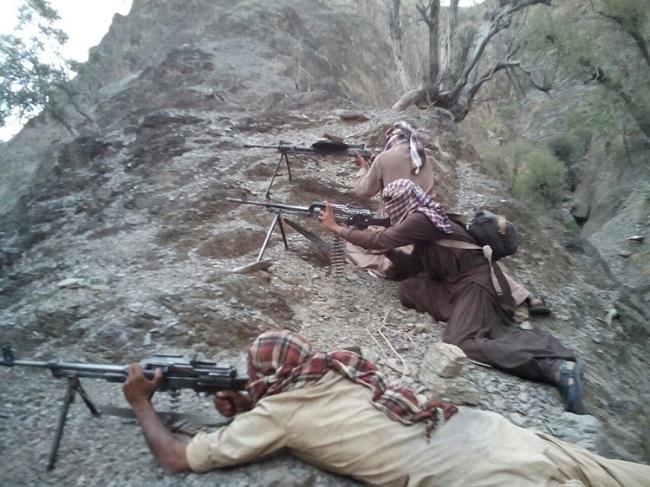
Baloch Sarmachaars (freedom fighters) in action. (Representative photo/News Intervention))
Baloch Sarmachaars (freedom fighters) in action. (Representative photo/News Intervention)

He said, only those people make comparisons on the basis of numerical strength and sophisticated weapons who are unaware of the history of guerrilla warfare. “Guerrillas use their weaknesses as their strength: they are small against the big; hidden against the visible; mobile against the slow. The guerrillas use light weapons yet they force the heavily armed enemy to take heavier casualties with their strong nerves. They use their enemy as their prime supplier of ammunitions, and provisions,” said Dr Allah Nazar.

Baloch history is full of daring fables. Even a cursory look at the last twenty years clearly prove that Pakistan has completely failed in suppressing the Baloch in rural and urban guerrilla warfare. Even today thousands of Baloch fighters are in the mountains of Balochistan and attack their enemies like cheetahs at night with sharp and vigilant eyes. Whereas there is no scarcity of trained guerrillas, sleeper cells, and reserved forces in the cities and towns.

Dr. Allah Nazar said that it is the need of time that our neighboring countries and international powers support both the political and armed wings of Baloch national freedom struggle. “The geography of a free Balochistan and a nation with secular values and vast natural resources can play a vital role in international affairs. And Baloch have the capacity to contribute to perpetual peace, prosperity, and development not only for the region but for the entire world,” he said.