Home Blog Page 367

Pakistan continues to suppress its minorities with rapes and murders

One can only look back with nostalgia at the promise made by Muhammad Ali Jinnah to the people of Pakistan at the time of partition. “You are free; you are free to go to your temples, you are free to go to your mosques or to any other place of worship in this State of Pakistan. You may belong to any religion or caste or creed — that has nothing to do with the business of the State,” Jinnah had said.

Today, a stage has come where the Human Rights Commission of Pakistan (HRCP) has noted that widespread social and economic marginalisation has left the weakest segments of society invisible and unheard in the country. HRCP has termed Pakistan’s human rights record in 2019 as ‘greatly worrisome,’ adding that the ongoing global pandemic, ‘…is likely to cast a long shadow on prospects for human rights.’

According to the HRCP report, Pakistan has failed to protect its most vulnerable. Children of minority communities are being made to work in the mines of Balochistan and also being sexually abused. News of children being raped, murdered and dumped has become frighteningly common. Women continue to bear the brunt of ‘honour’ killing. Prisoners in overpopulated jails live in subhuman conditions; a large number are from minority communities, languishing for years on end without a fair trial.  People reported ‘missing’ is a common occurrence even as “internment centres” continue to be operated without any justification.

Religious minorities are unable to enjoy the freedom of religion or belief guaranteed to them under the Constitution; their places of worship have been desecrated. Forced conversion of young women continues to be common place and constant discrimination in access to employment exists. Journalists face prosecution for speaking against the government and many publications have been banned arbitrarily.

The matters referred to in the HRCP (Human Rights Commission of Pakistan) report have been substantiated by those who have fled from Pakistan and taken refuge in India. They give very sad firsthand accounts about their lives in the country. They confirm the point made by the HRCP that, in Pakistan, minorities live like slaves without any well defined rights as citizens. In the schools, minority students, notwithstanding their religious belief, have to respond during roll call by saying “Allah ho Akbar.” The minorities do not have right to unhindered worship in public places. Most of the age old Hindu Temples, Gurdwaras and Churches have been destroyed. As a result, religious ceremonies are carried out within the confines of the houses and these too are inhibited in times of religious festivals for fear of riots.

To cremate their dead they have to take permission from the police. In the eventuality of being given, they have to find some place in a far flung jungle for the mortal remains to be consigned to flames. Quite often the cremation is done in one’s own house under secretive conditions.

Their women are forcibly converted to Islam and then married to Muslims. When the abduction of a girl from a minority community is carried out, the Police does not take cognizance of complaints by the parents and relatives and no investigation is undertaken. Meanwhile, the girl is made to sign the conversion papers which are then presented in the court that accepts them with great alacrity and declarers the process of conversion and marriage to be valid.

Persecution of Muslims belonging to sects other then the majority Sunnis is rampant. Ahmadiya Muslims were declared non-Muslim in 1974 and were further deprived through an Anti-Ahmadiya Ordinance in 1984. They vote as non-Muslims and are denied equitable job opportunities; there are severe restrictions to their entry in professional institutions which hampers their right to education. Sections 298-B and 298-C of the Pakistan Panel Code debars Ahmadiyas from calling their place of worship a Masjid.

Shia Muslims across Pakistan and especially in the occupied areas of Gilgit-Baltistan have been subjected to massacres and bombings of religious places/congregations, economic deprivation, curbs on right and liberties, restrictions on freedom of speech etc. Law enforcement agencies have extraordinary powers that are used to suppress the people. The authorities can detain anyone without due process of law, engage in electronic surveillance, conduct search and seizures and use military force wherever deemed necessary. Several local leaders are facing terrorism charges.  Innocent people are being framed under Schedule 4 of the Anti-terrorist Act even as actual terrorists are free to create mayhem.

Apart from the Shias of Gilgit-Baltistan, Pakistan is home to about one million Shiite Hazara Muslims residing mainly in Balochistan. This hapless community is being specifically targeted by terrorist groups like Lashkar-e-Jhangvi and Sipah-e-Sabah and is suffering immeasurably.

The Nehru-Liaquat pact had promised rights to minorities in Pakistan as also a guarantee of safeguards. Despite this, four million Hindus from Pakistan have relocated in India between 1951 and 1970 due to persecution in the country. The Hindu population in Pakistan has fallen from 22% in 1951 to around 2% presently. Millions of people have simply vanished in thin air and the remainder continue to seek refuge in India.

Pakistan is determined to exist as an Islamic State comprising only of Sunni Muslims. The unwritten policy to attain this objective is to exterminate the minorities through terror attacks and pogroms or force them to migrate, mainly towards India. Stringent laws that suppress the minorities are being passed and applied with regularity.

The world needs to take cognizance of the genocide that is taking place in Pakistan. Pakistan needs to be compelled to stop the systematic and organised campaign of violence that is specifically targeting minority communities. Pakistan also needs to be stopped from tinkering with the culture, identity and way of life of the minorities. Reversing the established trend will require restructuring of the relationship of the state with its non-Muslim citizens and the role of Islam in governing public lives. Once atrocities are stopped then the issue of the constitutional rights of the people can be arbitrated. These, however, are areas that remain contentious and even hazardous to engage politically.

Did the slain Pashtun leader Sardar Arif Wazir ignore murder signals from Rawalpindi?

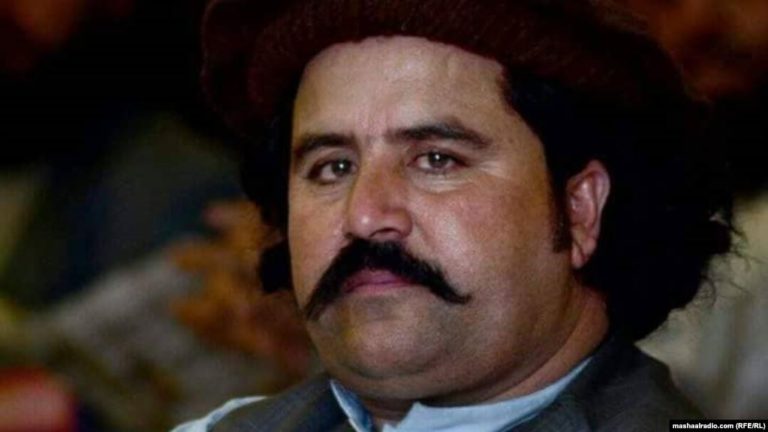
Pashtun Tahafuz Movement (PTM) leader Sardar Arif Wazir, who had been detained by Wana police on April 17 must have been really very happy on being granted bail just 10 days after his arrest, because  such speedy judicial relief isn’t very forthcoming in Pakistan, especially when one stands accused of having made an “anti-Pakistan speech during his visit to Afghanistan.” He must also have been quite relieved that despite former Director General (DG) Inter Services Public Relations (ISPR), Maj Gen Asif Ghafoor directing his foreboding “their time’s up” threat at the PTM during a press conference a year ago, nothing untoward had happened.

Wazir may have dismissed DG-ISPR’s menacing remark believing it to be merely an attempt at intimidating PTM to stop raising issues of military excesses against Pashtuns. But as is their wont, many analysts are now pointing out that the DG-ISPR’s warning was clearly so serious that it shouldn’t have been ignored and are citing numerous cases of how activists in Pakistan whose activities embarrass or expose the Pakistan Army end up either being dead or simply disappear. They also say that since Wazir had already lost 17 male members of his clan in as many years, he should have been more careful, especially when the DG-ISPR’s warning had been very explicit. Most importantly, how could Wazir overlook the fact that Pakistan Army is not into the business of issuing empty threats.

In addition to his ‘time’s up’ warning, Maj Gen Ghafoor’s went on to say that “We are refraining from taking action because we are taking into consideration the people being provoked, otherwise it’s not difficult to deal with you.” In a democracy, for an army man to so brazenly threaten brother citizens may be something unheard of, but it’s not so in Pakistan. Here it’s the Pakistan Army that’s the sole judge of what’s good for the country. So, by accusing PTM of clandestinely receiving funds from spy agencies of Afghanistan and India without furnishing any proof, Maj Gen Ghafoor made it clear that as far as Pakistan Army was concerned, PTM was an anti-national organisation and hence ‘enemy’ of the state. Period.

But Arif Wazir may have also been lulled into complacency as DG-ISPR had also stated that the orders he had received from Pakistan Army chief Gen Qamar Javed Bajwa on dealing with PTM was ‘Do not use a harsh hand with them.” In addition, his assurance that “… the instructions of the army chief will be fully followed; people will not face any sort of problem and neither will any unlawful path be adopted,” may have convinced Sardar Arif Wazir that the ISI wouldn’t order a ‘hit’ on him. Furthermore, he may have interpreted his getting bail in a record time of just 10 days as a sign of Pakistan Army adhering to DG-ISPR’s promise that “Everything will be done lawfully.”

In the last 26 months of his life, Wazir had been detained six times and had cumulatively spent more than 13 months under detention on a series of charges. So, his family too must have been very happy that he had been released on April 27, which was also the fourth day of Ramadan. But in what appears to be a tragic coincidence, exactly on the fourth day after his release (May 1), Wazir was grievously injured in an attack carried out by vehicle borne gunmen while he was strolling outside his house in Ghwa Khwa area of Wana in South Waziristan and succumbed to his injuries the next day. That Sardar Arif Wazir died on his 38th birthday was the cruelest coincidence!

Lack of any official communication indicating Islamabad’s concern regarding this assassination raises suspicion that there’s an official attempt to avoid giving publicity to this incident. Could this be to make it easier to pass off this premeditated murder as just ‘another killing’ linked to some personal or tribal rivalry, which is a common feature in restive South Waziristan? Perhaps that’s why Amnesty International (AI) in its tweet has called upon Pakistani authorities to “carry out an independent and effective investigation” into the murderous attack on Arif Wazir and has demanded that “The suspected perpetrators must be held accountable.”

What will immediately attract attention of even the most casual reader is the unusually stern wordings used by Amnesty International in its tweet. By calling for “an independent and effective investigation,” Amnesty International has clearly expressed its well-founded apprehensions about the obvious attempt by Pakistan’s deep state to scuttle the inquiry so that the perpetrators aren’t brought to book! With the former DG-ISPR’s ‘Time’s up’ threat followed by his boast that “it’s not difficult to deal with you (PTM),” it’s but natural for the needle of suspicion to point directly towards Rawalpindi!

This suspicion is further accentuated by the fact that Wazir had been targeted earlier in 2018 by a so called ‘aman’ (peace) committee. But a report carried by Pakistani newspaper Daily Times mentions that “A senior journalist hailing from North Waziristan, speaking on condition of anonymity, said his sources confirmed that the attack was orchestrated by Mullah Nazir group.” Readers would recall that the Wana-based Mullah (or Maulvi) Nazir group comprises the Ahmadzai Wazir tribe and ever since Maulvi Nazir signed a peace accord with Pakistan Army in 2007, it is considered ‘good’ Taliban by Pakistan Army as it does all the ISI’s ‘dirty work’.

If Wazir really had any personal or tribal enmity of a magnitude that could prove to be ‘life-threatening’, then he would have surely taken precautions, as he had already been targeted earlier. But it appears that he fell for the former DG-ISPR’s false assurances that “Everything will be done lawfully,” and this naivety cost him his life. In the end, while the Pakistan Army and ISI may be guilty of orchestrating Wazir’s extrajudicial ‘execution’, but you can’t blame Rawalpindi for not cautioning him- after all, wasn’t Sardar Arif Wazir told a year ago that “Time’s up”?

Tailpiece: There’s no need to wait for police investigation results or an inquiry committee’s findings on this cold-blooded murder as the outcome can easily be foretold. No evidence of any direct or even indirect involvement of Pakistan Army or its intelligence agency (ISI) will be found and after determining that this killing was due to ‘personal enmity’, the case will be closed. This has been happening all along, and so there’s no reason to believe that it won’t happen again this time too!

Why Shahdad Baloch chose armed struggle? Ask Pak Journalists. Well, here’s the Answer

The question “Why did Shahdad Baloch choose armed struggle?” was raised by Riaz Sohail, a prominent Pakistani journalist working for BBC Urdu Service, in his Urdu article shared by BBC’ News website on May 6, 2020. The background of opening this discussion was that two prominent Baloch youths Shahdad Baloch and Ehsan Baloch attained martyrdom on Friday, May 1, 2020 in an encounter with the Pakistan Army and its locally armed mercenaries in Paarod, a mountainous area between Kalat and Kharan regions of Balochistan. According to a statement of the Baloch Liberation Army (BLA) spokesperson Jeehand Baloch, both Shahdad and Ehsan had joined BLA about one year ago.

Shahdad Baloch, after completing his master’s degree in Defence and Strategic Studies at Quaid-e-Azam (QAU), Islamabad was enrolled in the M.Phil program at the National Institute of Pakistan Studies. Whereas, Ehsan had completed his master’s degree in Gender Studies from the same QAU, Islamabad. He also had a master’s degree in English Literature from Turbat University, Kech Balochistan. So it’s evident that martyrs Shahdad and Ehsan were well educated and decent young men.

However, the circumstances suggest that Shahdad and Ehsan were not widely known because of their being highly educated or ex-students of the Quaid-e-Azam University (QAU) Islamabad, a prestigious educational institution of Pakistan. Rather, Shahdad and Ehsan attained popularity and were discussed due to their patriotism, political thoughts, student and social activism, and for their personal integrity.

The cold blooded murder of Shahdad and Ehsan arouses comparatively a wider discussion on social media platforms about both of them touching the current situation in Balochistan and Baloch freedom movement. Such painful incidents in occupied Balochistan are rampant and happen every day but usually are discussed and condemned only by pro-independence Baloch political parties, Baloch human rights organizations, socio-political and media activists, and by the exiled Baloch online media. Pakistan’s political parties, mainstream media, and civil society organizations usually don’t bother to discuss incidents related to the armed conflict in Balochistan.

Shahdad Baloch and Ehsan Baloch’s murder, after a long time, drew the attention of a comparatively larger segment of Pakistan’s intelligentsia and mainstream media towards the long-standing armed conflict in Balochistan. Pictures and videos of Shahdad Baloch and Ehsan Baloch have been going viral on Twitter, Facebook, Instagram, and other social media platforms since the heart-pinching news of their death was publicized. People expressing their grief, sympathy, concerns and anxiety over their early and violent martyrdom are mostly their ex-colleagues, fellow students, teachers, left-oriented intellectuals, human rights activists, some politicians, and journalists.

Prominent journalist and anchorperson at Geo news Mr. Hamid Mir also took the issue in a Talk Show where he replayed a short video clip of an old seminar held in QAU, Islamabad in 2018. In the video clip Shahdad Baloch can be seen asking a question to Ahsan Iqbal, then a minister in Prime Minister Nawaz Sharif’s cabinet. “…there was Saindak gold and copper project, there was Rekodik gold and copper project, natural gas had also been discovered in the early 1950s in Sui and Dera Bugti areas of Balochistan but those huge projects could not change the fate of Baloch people then how could you say that China-Pakistan Economic Corridor (CPEC ) will change our fate?” Shahdad Baloch posed this pointed question to minister Ahsan Iqbal. This video clip is being widely watched and shared across social media platforms. Link of that talk show is given below–

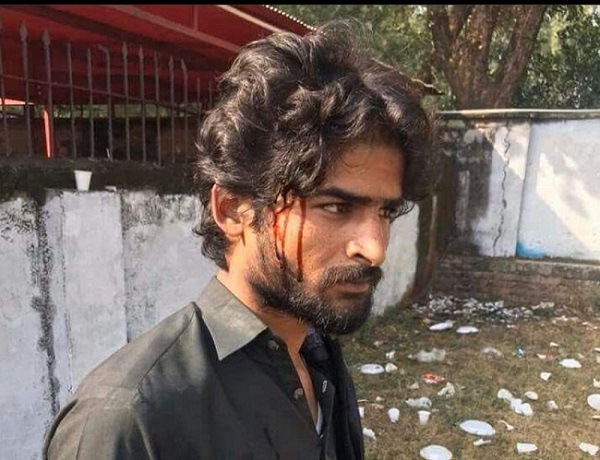
A picture of Shahdad Baloch is also being widely shared by social media users. In that picture martyr Shahdad Baloch can be seen bleeding from his head. This picture pertains to an incident of assault when Shahdad Baloch and many other Baloch and Pashtun students were badly beaten by the members of Islami Jamiat Talaba, the student’s wing of Jama’at Islami, Pakistan Army’s old political vassal.

In that attack by the Islami Jamiat Talaba (IJT), Shahdad Baloch and many other Baloch and Pashtun students received injuries but Punjab Police, instead of arresting the IJT culprits, arrested the victims. Shahdad Baloch and dozens of other Baloch and Pashtun students were among them.

Like numerous other Baloch students, political and human rights activists, Shahdad Baloch was also once abducted, kept “missing”, and tortured by the ISI in Pakistan Army’s illegal dungeons in 2015.

Some points are common in most of the tweets, Facebook, Instagram posts, articles, and blogs shared by the people from Pakistan’s intelligentsia and media. They are expressing their feelings of grief, sympathy, anxiety, and concerns. They acknowledge that both of them were active, sensitive, and vocal critics of Pakistan’s repressive politico-economic policies, army, and intelligence agencies’ brutal operations in Balochistan.

Both Shahdad and Ehsan were unhappy with Pakistan’s persistent policy of plundering Balochistan’s natural resources and its way of ruling Balochistan as a colony. All of Pakistan’s intelligentsia seem to agree on Pakistan’s injustices in Balochistan yet most of them were puzzled over Shahdad and Ehsan’s joining the armed struggle, as both were remarkably brilliant Baloch youth.

They are asking “Why did Shahdad Baloch choose armed struggle?” The answer is very simple. In the light of Pakistan’s forcible occupation of Balochistan in 1948, the Baloch people repeatedly tried to regain their independence from Pakistan. The current worsening situation of Balochistan makes it very easy to understand why Shahdad Baloch and Ehsan Baloch joined the ongoing armed struggle of Baloch people for the independence of their homeland.

Their short story, their curtailed lifespan of peaceful political, social and human rights activism suggests that they saw and felt concerned about fellow Baloch students, leaders, political and human rights activists, intellectuals, journalists and general people being abducted by Pakistan’s Army and intelligence services, who then go “missing” for uncertain periods, being extra-judicially “killed and dumped”. Both had tried for years to pursue peaceful democratic means of struggle for raising their voice against Pakistan’s state terrorism and atrocities but they were responded by Pakistan’s security forces and Punjabi supporters, with extreme hate, violence, and humiliation.

It seems that it was the Pakistani state’s response to their peaceful democratic activism that rightly helped them to choose the armed struggle. By studying history and their own experience, they knew that armed struggle was the more effective means of struggle for getting rid of Pakistan’s subjugation and achieving the independence of Balochistan. The history and nature of Balochistan and Pakistan’s relationship provide enough reasons for a patriotic and prudent person of the oppressed Baloch nation to do what Shahdad and Ehsan did.

Most of Pakistani intelligentsia and media that discussed the issue seemed to avoid honoring the way of struggle that Shahdad and Ehsan chose against Pakistan’s repression. Hamid Mir even termed their joining of Baloch Liberation Army (BLA) as their being misled by BLA. Such comments amount to maligning the political wisdom and conscience of highly talented martyrs. It also amounts to a grave injustice and dishonoring the great sacrifice of our young freedom fighters.

I don’t like to sound judgmental. I can understand why people avoid appreciating the political wisdom of Shahdad and Ehsan, their bravery and their way of struggle. I can also understand why people avoid showing sympathy and support for their noble cause of freedom. No doubt it is Pakistan’s Army and intelligence services’ fascist and chauvinistic approach that shapes the minds and people like intellectuals, journalists, teachers, students, political and human rights activists are as susceptible as the Pakistani masses.

The reaction of the Pakistani state and its supporters towards the demand for independent Balochistan has left no room for peaceful and democratic struggle and activism. The prevailing situation of state terrorism in Balochistan offers a sufficient and self-explanatory reason for understanding Shahdad and Ehsan’s decision of choosing the armed struggle.

Shahdad and Ehsan were neither the first nor will be the last. The persistence of the Baloch freedom movement for the last more than twenty years is indicative of the fact that the ongoing Baloch freedom movement is led by a collective leadership of politically enlightened, educated, highly conscious and committed leaders. Like the many others, their martyrdom is enough to falsify Pakistan’s old dirty propaganda portraying Baloch freedom movement as a resistance of certain anti-development tribal chieftains who allegedly aim to blackmail the authorities for securing some petty interests.

Instead, the martyrdom of Shahdad and Ehsan proves that the Baloch freedom movement is a true indigenous national movement having its firm roots in the masses and drawing leadership, freedom fighters, support, and sympathy from all segments of Baloch society across the occupied Balochistan.

Some people often try to argue that armed struggle is not acceptable to the world powers. They usually argue that armed struggle is against prevailing world order and international laws. They, with malafide intentions try to mingle the Baloch national freedom movement with Islamic jihadist militancy. They try to label Baloch armed struggle for freedom as terrorism. But such efforts and notions are baseless having no legal, practical, and historical foundation.

If Abraham Lincoln, George Washington, Ho Chi Minh, Ahmed Bin Bella, Frantz Fanon, Subhas Chandra Bose, Nelson Mandela, and numerous other freedom fighters cannot be called as terrorists then how can the Baloch freedom fighters be labeled as terrorists?

The United Nation’s Declaration on the Granting of Independence to Colonial Countries and People (UN General Assembly’s resolution number 1514, adopted on 14th December 1960) and UN Resolution Number 55/146 adopted by the United Nation General Assembly in 2000, on the occasion of 40th anniversary of UN Resolution Number 1514 that declared 2001-2010 as the “Second International Decade for the Eradication of Colonialism” provide a legal foundation for Baloch freedom struggle against Pakistan’s forcible occupation and colonial rule and plundering of Balochistan.

Under the umbrella of the United Nations, the US-led armed interference of NATO in Afghanistan, Libya, and Iraq, their support and military partnerships with anti-Taliban, anti-Saddam, anti-Gaddafi armed militias, and American alliance with Kurdish freedom fighters of YGP against the so-called Caliphate of ISIS are recent international practices. Are people, who oppose Baloch armed struggle for freedom, not living on this planet?

Pashtun boy-soldiers sent forcibly to Balochistan war zone are committing suicide

The strategy of deploying Pashtuns in war zone of occupied Balochistan by Pakistan’s Punjabi Generals has begun to backfire. The young Pashtun boys who are forcibly sent to the inhospitable terrains of Balochistan live in a constant fear of sniper attacks by the Balochistan Sarmachars (freedom fighters) and suffer ill-treatment at the hands of their seniors. This has turned them into emotional wrecks. In their desperation these Pashtun soldiers are committing suicide.

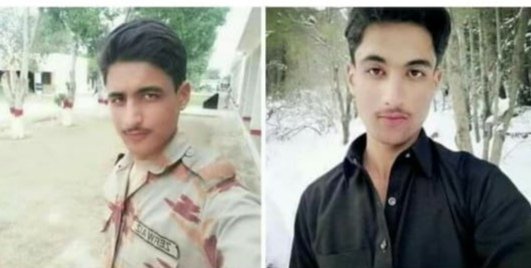
Over the past few days two junior officers of the Pakistan military committed suicide in Kech district of occupied Balochistan. Local sources told this reporter that one Pakistani soldier committed suicide at Gomazi Bunpir area of Kech and another killed himself at Tump in Kech district.

This could have major ramifications for Pakistan’s political stability and can soon snowball into a serious political issue in Pakistan’s north where the Pashtun Tahafuz Movement (PTM) is gaining momentum with each passing day. Ali Wazir, a prominent leader of the Pashtun Tahafuz Movement (PTM) and member of the Pakistan Quami Assembly minced no words and wrote on the micro-blogging platform Twitter that young Pashtun boys of tender age are being recruited in the Frontier Corps and forcibly sent to dangerous areas of occupied Balochistan amidst an ongoing war between Baloch freedom fighters and Pakistani forces. Ali Wazir also shared the photograph of a young Pashtun boy who committed suicide in the Quroai, Dera Ismail Khan region who was on duty on occupied Balochistan.

“Young children are being recruited to the FC (Frontier Corps) and sent to areas of Balochistan where regular fighting is taking place. Yesterday, an FC man on duty in Quroai Dera Ismail Khan committed suicide in Balochistan,” Pashtun leader Ali Wazir tweeted.

A Pakistani police officer speaking strictly on condition of anonymity told this reporter that incidents of suicide has increased amongst Pakistani soldiers posted in Awaran, Bolan, Panjgur, Kech and Sibbi. The police officer added that they have been highlighting these suicide incidents in their “internal reports” being sent to the higher authorities in Islamabad. “We have clearly written that tremendous stress is one of the primary reason for suicides. But there has been no reply,” the police officer said. “…the Baloch Sarmachars (freedom fighters) have changed their combat strategy. They now carry out sniper attacks with precision, which means all Pakistani soldiers posted in Balochistan have a continuous threat to their lives. A large majority of these are Pashtuns who are unable to cope with the stress of war… and due to this extreme stress they are resorting to suicides,” the Pakistani police officer explained.

There has been a marked increase in the sniper attacks by Baloch freedom fighters in Kech, Awaran and Panjgur and several dozens of Pakistani soldiers have lost their lives during the last few months.

The occupied Balochistan consists of extremely difficult inhospitable terrain and comprises vast swathes of rocky mountainous topography where these young and ill-trained Pashtun boy-soldiers are forcibly sent. These soldiers remain under continuous threat of falling prey to a sniper bullet whenever they step out of their bunkers. And so they have to live in a constant state of fear and mental stress of being killed by Baloch Sarmachars (freedom fighters). And it does not end here. Once these hapless boy-soldiers from Pashtunistan come to the dangerous war zone in occupied Balochistan they are made to stay in the inhospitable terrain for several months and denied leave to visit their family in Pashtunistan. Their leave gets cancelled or is delayed for several months apart from being denied other facilities that the Punjabi soldiers enjoy in Rawalpindi.

A mid-rank military officer in the Pakistan Army who spoke strictly on condition of anonymity explained that Punjabi Generals of Pakistan Army deploy a large number of Pashtuns only in those areas of Balochistan that are dangerous and where intense war is on. “Around 90% soldiers being deployed in high combat zones are Pashtuns,” the mid-rank Pakistan Army officer said. He corroborated all that was said by the police officer (quoted above) about stress-related suicides amongst Pakistani soldiers.

In fact, a look at the ethnic profile of Pakistan Army does prove that its creamy layer comprises only of Punjabi Generals who exploit the foot soldiers and use them as cannon fodder, a large segment of whom are Pashtuns that hail from Waziristan.

It’s just a matter of time when Pashtuns turn against the Punjabi Generals of Pakistan Army and revolt. Pashtuns will then fight for their own community, an independent identity and an independent nation. The rapid rise of Pashtun Tahafuz Movement (PTM) across the northern frontiers of Pakistan in Waziristan point towards this impending outcome.

Balochistan has only been a money minting zone for the Punjabi Pakistani Generals who are now using Pashtuns as cannon fodder to loot the region’s rich natural resources. The Baloch Sarmachars (freedom fighters), on their part, are fighting for the independence of their motherland Balochistan. Pashtuns have begun to understand the real context of ongoing war in occupied Balochistan and are questioning the bloodshed of Baloch freedom fighters. Pashtun leaders are now getting vocal by each passing day as to why should young boys of tender age be sent to die at the hands of sniper attacks by Baloch Sarmachars.

Pashtun boy-soldiers know that they are unnecessarily sucked in this war where they get brutally exploited by the Punjabi Generals of Pakistan Army, fall prey to Baloch Sarmachar sniper bullets, and/or turn into an emotional wreck and ultimately commit suicides. Ironically, the United Nations and other international human rights organisations that are quite vocal about other conflict zones seem to conveniently forget about Pakistan’s illegal occupation of Balochistan and the decades long war that has led to the death of thousands of people.

Kashmiri Pandits and the ‘New Domicile Rules’ of Jammu & Kashmir

It is learnt through media sources that an exercise is underway at the Department of Law, Justice and Parliamentary Affairs for framing rules, defining procedures and notifying the competent authority for issuance of domicile certificates in the union territory of Jammu and Kashmir. The exercise has begun in the wake of the J&K Reorganization order issued by the Home Ministry on March 31, 2020. It is also reported that final touches are being given to the draft rules and the task may be completed very soon.

Soon after the Home Ministry announced new domicile rules for the union territory of J&K, there was a wave of resentment in J&K civil society against some clauses of the new rules, but more particularly about the opening of recruitment to non-class IV vacancies in the government service to non-state subjects also. Even the BJP leadership of J&K lodged a strong protest so that the Home Ministry had to withdraw this controversial clause. The quick withdrawal of the contentious clause of the order within 24-hours created an impression with the stakeholders that mandarins responsible for framing the new rules are not conversant with the ground situation in J&K, and the exercise of scribing was done while sitting in the armchairs of a coffee lounge. Some observers even attributed it to the mischief of the insiders. 

Valley-based political leadership and the tendentious vernacular press consider the State Reorganization Act as “war against people” a la the Gupkar Declaration. In Kashmir, Home Ministry’s newly formulated domicile laws do not go down the throat of political dissenters.  Almost all shades of political opinion in the Kashmir Valley converge on the self-styled fiction that the BJP government intends to change the demographic complexion of Kashmir. Because of this, they consider the revised domicile rules highly reprehensible. 

The formulation of new domicile rules for the union territory of Jammu & Kashmir is a sensitive matter and needs to be handled with the utmost care, keeping in mind the historical background and a variety of identities with possible ramifications. All these aspects become more stringent owing to a far-reaching historical decision of the parliament of doing away with the statehood of J&K. 

By way of the low-key but scathing disapproval of the Reorganization Act of the Parliament, and its consequential corollaries, a malicious campaign through local print media has been unleashed by the Valley-based diehard exclusivists to discredit the Home Ministry’s progressive measure of new domicile laws not directly but by projecting Kashmiri Hindu (Pandit) minority as the sacrificial goat. The antics unfold a multi-fold attack to frustrate the Home Ministry’s decisive plans for Kashmir. It aims at creating doubts among the Kashmiri Pandit minorities about the Home Ministry’s earnestness towards their cause; it aims at denigrating the Home Ministry that despite being the “right-wing” it plays ducks and drakes with the Hindu minority community in Kashmir. And thirdly, it is also a subtle move to brainwash the youthful Kashmiri Muslim generation, and to make them believe in a distorted version of the role of Kashmiri Pandits in promoting the interests of entire Kashmiri community. 

The truth is that not only the state subject law but also the idea of a secular democratic political forum for the people of J&K with Sheikh Abdullah as its front leader was the result of the efforts the Kashmir Pandit student community in Lahore around 1920s. They were the most befriended visitors of Allama Iqbal who too was of Kashmiri origin.  

The largest religious minority of the Kashmir Valley, namely the Kashmiri Pandits (now arbitrarily and unjustly designated “migrants” and not the universally recognized category of “internally displaced people”), is that naïve as to be tricked and misled by cronies?  Of course, there are stray black sheep, but they do not make the rule. Pandits know that the reality behind the apparent silence in Kashmir political circles or the sarcastic and provocative profiling of Kashmiri Pandits the exclusivists reflects the drop scene of militancy in Kashmir. The maligning campaign initiated in the print media is the typical trait of a split personality. 

Keeping in view this new scenario, and also that the Department of Law, Justice and Parliamentary Affairs is working hard and procedures for implementing the  new domicile law, the Home Ministry would do well to assert by making its position clear on some crucial points.

The Ministry must provide exact definitions of State Subject, Permanent Residence Certificate (PRC) and Domicile Certificate, because as these terms are making rounds in the current written and spoken discourse related to the new law. Secondly, it must clarify whether registration under new domicile rules applies to one and all in the union territory, including those who have the State Subject Certificates in their possession issued by the State authorities. Thirdly, in the case of Kashmiri Pandit migrants, it is essential to define whether (a) Those registered as “migrants” with the State Relief Commissioner also need to obtain new domicile certificate or not? (b) Whether such KP “migrants” as are registered in any other state of the country,  other than J&K and Delhi, are entitled to the status of the domicile of J&K by birth (which they are) and have they to apply for domicile certificate afresh or not. Fourthly, how will the new domicile law deal with the diaspora of the migrated minority community that had to go to distant places in and outside the country to fend for themselves and their families? The ministry of home affairs must make it clear that Kashmir Pandit Displaced Persons registered in any state of the Union of India are entitled to domicile status of the Union Territory of J&K. This is what the President of AIKS (All India Kashmiri Samaj), New Delhi said in his aid memoir to the Home Minister some weeks back and this is also precisely what the chief spokesman of the newly formed Apni Party has lucidly argued in a statement published in Outlook of May 1, 2020. The President of Kashmiri Pandit Sabha, Jammu, has already sent a memorandum to the Lt. Governor raising almost similar issues.

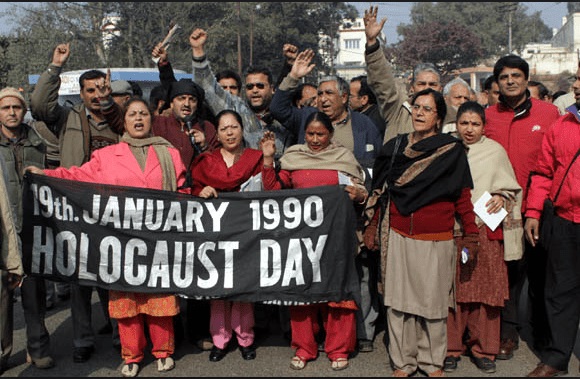
The Home Ministry knows that there was an ethnic cleansing of the Kashmir Valley in 1990 and the entire Kashmir Pandit community was extirpated from its ancient homeland, and is  scattered and dispersed all over the country and in other countries of the world. Their left-over houses, moveable and immoveable properties, orchards, shops, establishments, jobs and everything has been grabbed by the locals and even revenue records have been tampered with by interested parties to cut off their roots from Kashmir. In continuation of this genocidal treatment, now print media in the Valley is being used to declare them “administratively, politically and legally the pariah”, meaning the people who have lost the right right to domicile in Kashmir. This amounts to completing the cycle of ethnic cleansing of this community by their compatriots.

In view of these developments, the Home Ministry needs to clarify its position as regards the internally displaced people, the Kashmiri Pandit religious minority, while its agencies are engaged in framing the rules and procedures for of implementing the new domicile laws.

Mirror, Mirror on the Wall: Which Future is Fairest and Has Us All?

Of the more delightfully positive and ill-considered futures proposed within the technocratic communities with some overlap within the humanist communities comes in the idea of a trans-humanist future and a post-humanist future in which the technological advancements of humanity (“Mankind” seems a little passé) simply run away into the sunset without their lover: human beings, the hyphenations for the “trans-” and the “post-” because of the basis in differential images of technology made sentient and transcending humanity while, in a sense, bringing human beings along for the ride and another in which humanity becomes, in the words of the late Robin Williams, obsolete, human patterns of thought and behaviour aren’t going anywhere. They’re integrated into all possible futures, though some questions arise about the prime focus of the early 21st century.

Why focus on the future with technology so advanced so as to reach the heights of delirious farce and comedy posed as reality? Why fixate on a future of techno-beings and techno-boyfriends and -girlfriends who cater to every whim of the wonderstruck nerd-o-sphere, geek-o-drome, on the long dweeb-a-thon? Why focus on the future at all? Is it all bad simply for the sake of wanting to focus on the future? My proposition: Yes, and no. Yes, we should focus on the future; and no, some of the heights of fancy so as to “space out” on the present conditions of those worse off make a mockery of the utopian orgasmic fantasizing.

Both matter because the science fiction writers of the past, in a sense, wrote the future for themselves as a present (gift and current moment) to us. We live, in some ways, within the wildest fancies of previous writers who thought about the world in terms of the possible and the impossible (to make things interesting) as a proposition of “what could be,” almost as an individual escape from the “what was” of the time. Truly, the spirit of the age is a sense of becoming as if a perpetual adolescent mind with an iron clasp on the mindscape of the culture.

A world in which technology holds the cards and the social environs remains bound to the sensibilities of its youngest members and their dominance of the tech world. Think of the phones, the computers, the laptops, the applications, the gaming consoles, all of the small conveniences as virtues, and as petty (de)vices, to make each day a tad more enjoyable, and trivial. With the technology, we feel as if an inevitable march of progress to some point of convergence. If the world continues to move faster and faster, and if technology is the driver of the “faster and faster,” well, of course, the only possible answer to the question of “What next?” is “faster and faster, until some point of convergence.”

Perhaps, but then again maybe not, it could be different, as we have heard calls of the “End of History” and the ‘return of the Messiah’ before. All for naught, while used to make calls for oughts. Which brings the current incarnation of the transhumanist and the posthumanist visions of the world into glaring and full focus, a proposition of a world with human beings as subsidiary nodes in some vast computational complex or as participants in the recombination of the material constituents of the universe at a local and then a galactic scale at some nth point of progress into the future.

Technology and progressive advancements in the science bringing about the technology become part of the same droning of the technocrats. Have you watched the presentations of the Kurzweils of the world? Are you bored too? It is the same darn thing over and over again. Is this a perpetual claim of inevitability answered and, thus, needing some repeating to the proletariat who vulgar primitives they are require such repetitions, or is it a set of charts with reasonably amorphous claims about the future with thick-enough black markers to draw the trendlines? It pays. That’s one thing. But then, there’s also the long history built by the science fiction writers of old who built the mental landscape of the micro-obsessives.

Those “micro-obsessives” who constructed the foundational technologies for the world seen today in which our lives have been in many ways transformed for the better, and also for the isolatory effects upon a social species. What effects can we expect from such changes? Shall we boot up, chip in, and forget the troubles for a better television or a new first-person shooter? When caught in a time focus on the future, the items of the forever-evolving present moment and the lessons from history can disappear from us, then we can get into some real trouble. Indeed, the systems of technology may be used for ill-begotten purposes against the ideals of the science fictioneers, futurologists.

To miss the present and the past while over-focusing on the future creates a foundation for failure amplified by technic and ahistoricity of the world, though some premises appear true with explicit statement with some further considerations of the matter, human beings as evolved natural objects appear in the world as a natural technology with the capacity for the creation of some technology in a constructed manner rather than a naturalistically evolved manner. All possible human futures derive from the nature drummed into this tribal species with a neocortex, where all constructed rather than evolved technologies will become imprinted with the behavioural and cognitive capacities of the human species and, therefore, make the current here-and-now co-extensive with all possible there-and-thens as a formulation of humanity’s patterns flowering indefinitely into the cosmos.

In this consideration of the future of the human species and divisions into different ‘kinds’ of futures, all functions under the banner of an extended consciousness of humanity apportioned into parts of the future of the universe with a trans-humanism future envisioned as an after-humans future impossible as all futures become human futures in consideration of patterns and unified notions of technology with human patterns of thought and behaviour projected into every possible future. Human beings cannot be obsolete as we cannot be lost in full, only in part, into any possible consideration of the constructed technology timelines and futures over which so much anxiety, hemming, and hawing is had in the world.

Photo by Artur Tumasjan on Unsplash

Conversation with Dan Fisher (Editor-in-Chief, Uncommon Ground Media) on Humanist Materialism

Scott Douglas Jacobsen: We both harbour an affinity for the humanist vision, as seen in the Amsterdam Declaration and in the, probably, 10 or more other declarations and statements devoted to variations of Humanism. In particular, you have a focus on Humanism tied to the philosophical position of Materialism. We live in a material world, or universe of matter and energy. We evolved as a social species. So, we matter to one another as evolved, complex structures with an awareness of social and emotional needs. We are matter, as part of a material order. Bring them together, we have Humanist Materialism. Is this the basic idea?

Dan Fisher: In a sense, yes. Secular Humanism has always had a focus on the material world as opposed to spiritualism. But as we have seen with Humanists UK being captured by the mythology of gender identity, there is room to grow on this matter. 

I have always advocated that reason and compassion need each other – they are useless alone. With Humanist Materialism we can forge the two together inseparably. Never forgetting the realities of the world we live in, never forgetting the value of life. 

It is also a response to the ‘Historical Materialism’ of Marxists. Whether or not it was intended by Marx himself, adherents of his philosophy have demonstrated time and time again their willingness to kill and otherwise violate human rights in pursuit of their goals. 

Since Marxists have never achieved their desired society, what we are left with is a history of blood spilled in service of an elusive end. I too believe we can build a better world, but not by discarding the very principles we should be fighting for. 

Jacobsen: How has a “mythology of gender identity” taken some in the humanist communities? How is this mythos different than more empirical ideas of sex and gender?

Fisher: The science is very clear that there are two sexes, male and female. Intersex conditions affect people who are either genetically male or female. Despite this, intersex conditions as well as normal variations of human physicality have been interpreted as a ‘spectrum’ and this way of thinking is espoused by people including the President of Humanists UK, Professor Alice Roberts. Sex denial has real consequences for both social and medical circumstances and yet is being propagated by people who should know better. 

The purpose of this is to support the belief in ‘gender identity’ which is equivalent to a male or female ‘soul’ separate from the body. This is fundamentally sexist and regressive thinking which has been delivered into public institutions without appropriate scrutiny. 

Jacobsen: How is Historical Materialism of Marx and modern acolytes working to deny fundamental human rights to other human beings? Things they take for granted and harbour unto themselves while ignoring the denials of said rights for others in a denial of moral truisms, including the Golden Rule.

Fisher: I was recently told by someone I previously respected a great deal that we must sometimes sacrifice individuals to protect ‘the cause’. We have seen organisations of all stripes act to cover up, for example, sexual assault scandals, on the grounds that the good work they do is too important to be tarnished. I would argue that such excuses are in themselves what tarnishes the cause. They make a mockery of what we should be standing for. Marx’s focus on the progress of society as a whole enables this overlooking of the rights of the individual in favour of a focus on a promised future. 

Jacobsen: You started a social media presence for this idea. Did you start this philosophy? If so, how? If not, who?

Fisher: Humanist Materialism is the end product of at least half a decade of work on my part. You can see the foundations being laid in my For A New Left series on Uncommon Ground Media. Of course it could never have happened without the inspiration, input and motivation given to me by various philosophers and activists. Two particular wellsprings have been the work of gender critical feminists and the development of the Humanist movement in Africa. 

Jacobsen: How can others find out about the For A New Left series?

Fisher: It can all be found on Uncommon Ground Media . Each article is linked in the introduction of that first one. Consider it a starting point for what I hope to include in the eventual book. 

Jacobsen: What writers, activists, and others have been integral to For A New Left?

Fisher: Historical inspirations include Immanuel Kant, John Stuart Mill and Henry George, as well as more radical sources such as Rosa Luxembourg and Emma Goldman. 

Many of the writers we have published on Uncommon Ground have also helped me shape my own thoughts – Dr. Em, Jennifer Bilek, Angelos Sofocleous and Emeka Ikpeazu for example. Much of it was developed in conversation with my friends and my fiancée Katie Barker.

Jacobsen: Regardless, why form the online community devoted to it?

Fisher: Although the project is only in its infancy, I wanted to share with people the same hope that they have given me. I want to invite people to contribute their own thoughts to the process and build it from the ground up. 

Jacobsen: What are some of the aims and goals of the group for its early stages?

Fisher: One of the first steps will be the publication of a book, drawing from my article series, but also with potential collaboration from other writers. We were planning to organize a conference, but obviously that’s had to be put on hold. In the meantime, then, we want to encourage people to get talking and sharing their own perspectives.

 Jacobsen: How will this expand into the future?

Fisher: There is potential to form an organization, if the interest and the enthusiasm is there.

Jacobsen: Will this be an entirely non-profit or for-profit affair?

Fisher: Non-profit, for sure. Uncommon Ground Media is a commercial project, and any book will be produced on a commercial basis, but any organization for Humanist Materialism will be strictly not for profit.

Jacobsen: Who have been some early adopters of this philosophy? Who, in reflection, adhered to this philosophical position the whole time?

Fisher: It’s hard to say for sure because there is no formal structure, but we’ve definitely had interest from many of those describing themselves as ‘politically homeless’. We also have interest from people within the British Humanist community who have felt let down by Humanists UK. I’m currently in discussions with a number of key figures I hope to bring on board. As you say, there will be many who have already been on this path independently. 

Jacobsen: It is still early. However, what has been some of the feedback to the group, the ideas?

Fisher: Reception has been positive so far. The For A New Left series has prompted some incredible discussions. In particular the article on Metamodernism had a lively response from the philosophy community, much more so than I expected. Meanwhile the economically focused articles were very well received by Basic Income proponents such as Scott Santens. 

Jacobsen: What is the summary statement on Metamodernism?

Fisher: A response to the meaninglessness of postmodernism cannot be derived solely from modernism. Metamodernism seeks to address the weaknesses of modernism which allowed postmodernism to take root.

Jacobsen: Thank you for the opportunity and your time, Dan.

Fisher: You’re very welcome Scott, it’s always a pleasure to talk. 

Image Credit: Dan Fisher.

Cases of Abuse and Cults – William Branham

*Updated May 27, 2020.*

The Roman Catholic Church’s sexual abuse scandal continues apace and reflects a common trend in churches around the world. There are many facets of this to consider, including cults and fringe religious movements or groups, as this happens in and out of the communities of worship and the cults while the communities of worship and the cults provide a formalized structure for this.

Individuals who may not hear about the abuse in the church can be as upstanding citizens, and as moral individuals within some universal conceptualization of morality, as possible; however, other facets remain important for consideration in the context of the abuse of individuals within the church, whether physical abuse or psychological abuse, or sexual abuse. As we can note with some church members, they may state, “But I never heard about it.” One reason is the abuse did not happen at all. Another is some have not seen it because of the high costs to the victim, the culture of denial, and the complicity of the community in protecting the prominent men. This has happened in religious and secular communities. However, we see this more in the religious communities with an assumed divine mandate in support of the higher authority endowed upon the men. It can create some questions around theology.

If trends exist in theology, and if outcomes exist in people coming out of the theology in several churches and around the world independently, then some scrutiny is deserved, rather than necessarily confirming as a diagnosis. However, there appear to be confirmed cases in some churches around the world regarding The Message theology. From Canada to the rest of the world with over 2,000,000 adherents to this day, people after the Western world collapsed due to a second world war wanted answers. Preachers came in to fill the void. The theology of the late purported Prophet William Branham (1909-1965) was one response. A man who arose in the midst of the post-WWII Healing Revival Movement with several prominent figures proclaiming, by themselves, ‘faith healer’ status within a movement continuing to this day with televangelism and the Charismatic movement. Anything in association with Branham should be taken with suspicion and scrutiny, especially with historical cases of abuse in churches, including CloverdalePhoenixColonia DignidadZimbabwe, or the cult compound in Prescott (click name for hyperlink).

There can be a man considered near to or equal to Jesus Christ as a messenger of the Lord of Lords through The Message, i.e., the late Mr. William Branham providing theological – his own – buttresses for the abuse in the churches. To quote Mr. Branham, “Let her daughter stay out all night and come in the next morning with her make-up all over her face and her hair twisted sideways, out drunk somewhere. You know what she would do? She would teach her a lesson with a barrel slat. That’s right.” Another time, “And I’ve see them laying out on the beaches half naked before man stretching themselves out there, say they get a sun-tanning. Brother, I — I may not live. But if God lets me live and keep my right mind, if one of mine does it, she’ll get a son-tanning. It’ll be Mr. Branham’s son with a barrel slat behind her. She’ll be tanned all right. She’ll know where it come from too. Yes, sir.” In this, individual churches of The Message may operate independently. However, the main point is an overarching theology called The Message. In this theology, this may influence some of the men in the private of the home or church, where the victims, if in a particular home or church, stay quiet. The Casting Pearls Project, devoted to abuse survivors coming out of The Message, run by Jennifer Hamilton gathers stories and quotes. From the Casting Pearls Project, we have a statement from Careyann Z.:

My father came from an abusive family. Through becoming a “Message” minister and missionary, he found a purpose and a way to feel accepted. He believed his interpretation or revelation of the “Message” would lead the bride into the rapture. My mother came from a strict Roman Catholic family. When my parents met, my father told my mother, “God told me you’re my wife.” My mother said it felt like a supernatural presence overtook her when my father asked her to marry him which forced her to marry him against her will. A week and a half later, they were married. My father was a very good manipulator. There were numerous healings that took place in my father’s ministry, and some of the things he prophesied took place. I chalk those up to luck. There were also many things that did not come to pass. Fear of God’s wrath effectively controlled his entire family and drove us to do everything he wished. When we went against his wishes, he would prophesy to us, staring deeply into our eyes as his countenance changed and his entire body shook. My father treated my mother like an object, and she just took it faithfully, helping him in all his businesses like a good slave. Once when she was 9 months pregnant and nauseous, she was up on a ladder painting a house. When she climbed down due to the nausea, he yelled at her to get back up on the ladder and finish painting. Whenever she questioned him or he disagreed with something she did, my father would speak in tongues and prophesy against her saying, “This is God speaking,” or “God is going to strike you dead.”

Another from Christine H.:

I married at a very young age (barely 17). It was expected that we marry young and not risk making “mistakes” before marriage. I went from being in a very controlling home, to being married and becoming a submissive wife. I was always raised with the idea that a man was to have the say in the home and that my place was to make him happy (in my mind, at all costs). This wasn’t how my childhood home worked, but it was what I was taught. I already had “pleaser” type of personality. This came from trying to please everyone in hopes of them being proud of me, and the dire need to be good enough. Both sides of the family were very controlling; my family would try to control what I wore and what I did even as a married woman. I never dreamed my life would turn out the way it did. It wasn’t long before the stress of life grabbed our young home, and I found myself in an abusive marriage. After almost 11 years and two children, we ended in a divorce. I felt destroyed, knowing I was committing the forbidden sin. Once again, more hurt and abuse by people that were supposed to love me the most. The pain felt unbearable. Why was I so unlovable? Why could people physically and mentally hurt me, knowing they were causing me pain, but still say they loved me?

The spiral began. My family could only see that their daughter was now divorced and how that was going to look to everyone in the “Message”. I was told I had no rights, but no one wanted to know my story. 

Is the statement about barrel slats unquestioned? Why use this language and metaphor? If one can unquestioningly endorse statements of physical abuse with a barrel slat, then this raises questions about actions towards women following from it, as this man, within The Message, is considered a Prophet. At the same time, in The Message, women are considered of the devil. Branham is considered the Prophet of God. Who is a follower of The Message to question a Voice of God, especially a woman who is of the devil, anyhow? Either Branham was ordinary or not, whether ordinary made prophet of God to become extraordinary or ordinary and a liar about professed prophet status. Even with ignoring these claims about divinity or divine representation of He on High, there can be explicit statements, by the raised standards of today, of sexist statements by Branham, and behaviours within the churches.

Those statements belying particular attitudes with the views reflective of a general philosophy in regards to the roles of men and the roles of women within the “The Message” movement theology and the orientation of general subservience to men alongside a culture of silence. Do not take this from me, take this from an individual with extensive experience with former women members of “The Message,” Hamilton, who I conducted an interview with former member and author John Collins in an educational series where he invited Hamilton into the session, said abuse is normalized in the church. Therefore, this should qualify as a destructive cult.

For those with further interest in researching cults, I would strongly recommend the late Margaret Singer, and Rick Alan Ross, Steven Hassan, and Robert Jay Lifton. All four have been integral to helping hundreds of thousands of people around the continent, and probably the world, in working to combat destructive cults, which remain the main issue or problem now. Collins explained the general context in which the leadership, the pastor even, can further victimize a mother who has been abused by a husband (including the husband abusing the children). The mother was shamed to be in submission to the husband, as per their interpretations of supposedly sacred scripture.

Collins said, “Victims are pressured into keeping silent about abuse. As a result, many members of the group are unaware that sexual abuse exists. Worse, some people that are aware of the abuse have become accustomed to it and view the abuse is ‘normal.’ Some message followers rarely speak up against sexual abuse within the church because they are conditioned to keep silent. In many cases, there seems to be an unspoken rule that ‘if you speak about the problem, then you are the problem.’”

All the while this happens decades after the death of Branham in 1965. We continue to see the admonishments. The thou shalts and thou shalt nots as interpreted of the scriptures for “The Message.” In this case, the message becomes a message of denial of abuse of women’s and children’s bodies and subjugation of the wife to the headship of the husband. Collins described how the culture of abuse can create a situation in which the abused individuals remain accustomed, engendered, to the abuse culture. In the family, this can mean more of the normalization of the abuse in a cult setting with aberrant worship, doctrine, and leadership with destructive consequences under the guise of Christian theology, ethics, and norms. Many Christians would be appalled, probably. Collins only knew of a few situations in which the law enforcement agencies became actively involved in these cases of abuse.

“Typically, one of three scenarios happen when sexual abuse occurs. Unfortunately, more often than not, the victim of rape or sexual assault is afraid to speak up and the abuse is never mentioned to anyone in church authority. The second scenario is that the victim does speak to their pastor or church leader, but the pastor ‘handles’ the situation by either admonishing the abuser privately or dismissing the situation all together,” Hamilton stated, “The third scenario is the less common of the three, but the pastor might bring the offender before the congregation to reprimand them openly. In both instances of speaking out, the victim is almost always shamed and found at some fault. For sexual abuse towards girls and women, teachings of WMB place blame on the female body for being seductive and therefore a temptation.”

Indeed, as Hamilton further explained, they distrust the secular systems of jurisprudence and social services. She explained:

…when sexually abused members do speak out, the leader dictates complete control of the situation without reporting it to the local authorities. 1 Corinth 6:1-2 is most often used to justify this: “Does any one of you, when he has a case against his neighbor, dare to go to law before the unrighteous, and not before the saints? Or do you not know that the saints will judge the world? And if the world is judged by you, are you not competent to constitute the smallest laws courts?” Message pastors have no theological or counseling education and erroneously fail to understand that this passage is about settling civil cases, not criminal ones. In a criminal case, such as physical or sexual abuse, the state opposes the perpetrator in court, not the victim.

Often, cases do not go to the court or to a sufficient authority to deal with these issues. Even if a crime is known to be committed and a charge would be appropriate, and in the case of real consequences for the perpetrator, the punishment for the “rapists and sexual assaulters [are] rarely appropriate for their actions.” Some of these conversations can be seen with some commentary of Nathan J. Robinson from Current Affairs around Joe Biden in a larger sociopolitical context about the Democrats and in extensive commentary about President Donald J. Trump in the examination of the claimants with substantive stories of sexual abuse and rape by the sitting president of the United States of America.

Managing Editor, Sarah Mills, of Uncommon Ground Media (and Min Grob) in “Coercive control activist: ‘Sally Challen case is about more than murder’” wrote on a similar phenomenon of coercive control as an aspect of manipulation through emotional abuse. Another relevant aspect of this cultural phenomenon of cults. Someone in non-normal, aberrant circumstances, where murder became a mind-set induced by coercive control in the case of Challen. A woman who murdered, but who killed someone intentionally with a long background of abuse. In another case from the same outlet, Beatrice Louis or Linda Louis, Business Editor, spoke articulately a couple of years ago about the proposition of “Enforced Monogamy” in the article entitled “What Does Jordan Peterson’s Enforced Monogamy Actually Look Like?“ Short answer: “not good”; long answer: “also, not great,” Louis astutely picked up on the ad hoc manner in which Peterson covers a behind connected to him. Louis highlights this statement, “Of much more interest is the preceding paragraph which is reported as, ‘violent attacks are what happens when men do not have partners, Mr. Peterson says, and society needs to work to make sure those men are married.’”

Louis went on to ask about the factors needing change for incels to stop being incels. To a New Mythologist in Peterson, as I call them, mirroring the New Atheist, formulation of loose, ill-considered philosophizing, Louis nailed the point in a form of a question, a circumlocution punctuated by a question mark, as the surrounding contextualization for this crowd comes in the mantra of “personal responsibility” without nary a notion of the “personal” part in matters of crucial concern: underground, online, misogynist culture with derivative manifestations in the larger sociocultural structure. Society retains a deep interest in the men becoming married. That’s the claim and argument in one. In having this, not the men, but the society or factors external to the individual should hold responsibility for the men, perhaps, the small group of online men who may struggle with heterosexual relations and shifting of norms in some societies towards pragmatic egalitarian norms should focus on individual change. When one claims this, then the double, loose, ill-considered meaning or ad hoc reasoning can mean this all along, while, in fact, the [fill-in-the-blank] was intentionally placed with a surrounding quota of partial truths so as to lead the ‘stallions’ to water. When the cowboy-shepherd is shown to be naked, he meant the more positive egalitarian notion all along. Implication: How could you be so dishonest and stupid to not get the message the whole time? Und so weiter. That’s on a form of a marriage built to industrial efficiency for the subjugation of women and children to the fathers in destructive cult cultures reflected around the world in hundreds of thousands of people’s lives under “The Message” theology.

Mills’ and Grobs’ articulation of some of the emotional and psychological abuse is relevant here too. I love this statement from their article:

Abusive, controlling partners initially shower a potential target with intense flattery designed to seduce them. This is referred to as ‘love bombing,’ a tactic also employed by predatory organisations–like cults–in order to persuade their targets to let their guard down through positive emotional feedback: high self-esteem, a sense of being loved, and belonging. This initial period of idealisation succeeds in forging an intense bond with the abuser, a bond that will later be used against the victim, who will always seek to return to this state, or emotional high, following periods of cruelty.

Exactly, this becomes the basis for the abusive destructive cult tactics one can find in the world created in the post-WWII Healing Revival Movement of William Marrion Branham and others. As we see in the world of coercive control abuse tactics, or in the idealization of a state of nature with God, man, woman, and children, where the man is the head of the household and the woman exists below the man in service of husband and in devotion to the caretaking of the children and the maintenance of the home. God loves you. He is there for you, except during coercive control, during the abuse, after the scars heal while the mind reels, and still while his representative authority in the church shames you. If you come forward, the overwhelming response is a claim as a liar. Some of the most substantial research on rape, as an extreme form of violence against women, represents 8% of the cases as unfounded; thus, the default should be sensitivity and full consideration with the weight of the claims and, as well, the consideration of the claim of, in this instance, rape as highly probable rather than not, based on the statistical evidence gathered by the FBI and the Home Office of the UK – as far as I know, independently.

Hamilton said, “In the cases of the abuser being the pastor or in leadership, the victims are likely labelled liars and disregarded. Abusers in the Message are more protected than their victims through the forced silence. The Message teaches that if the rapist or assaulter confesses, their sin is ‘placed under the blood of Jesus,’ making them as ‘blameless’ as if the crime literally had never happened. Therefore, anyone who speaks about it is shamed for bringing that sin ‘back out from under the blood.’” There is explicit theological backing for these attitudes and behaviours as interpreted within “The Message.” Whether one looks at the more insider knowledge of Hamilton and Collins, or the collegial journalism on coercive control (a classic tactic of cults) and critical commentary of clumsy outmoded thoughts on enforced monogamy, Canadian society, and most other societies know better and, thus, should do better than permit open sanction of such institutional status within borders and cultures, as there have been extreme cases at CloverdalePhoenixColonia DignidadZimbabwe, or the cult compound in Prescott. All functioning independently while under the common theological banner of The Message. Given the history and theology, these seem like plausible hypotheses about the organizations. Is there abuse near you? Are there considerations of trying to get out of community without community reprisal? There is help if you need it. There are the authorities – the police, the secret service agencies, the safe houses, the Casting Pearls Project, or other initiatives devoted to the safety of women (and men) who may be experiencing abuse – who can help you.

To the last question from the interview with Hamilton and Collins, I leave this to them prefaced by the original questions:

Jacobsen: For those who have not faced justice, how can they face it?

Hamilton: Time unfortunately impedes most abusers from facing the justice they deserve. Victims that are now speaking out about the abuse are sometimes unfortunately past their state’s statute of limitations. After leaving the cult, there is a processing period for de-programming and realizing that the abuse had been normalized and that justice was not served. No matter the length of time, victims can contact their local police station or Salvation Army for resources and advocates.

Collins: The only way justice can be served is through education and accountability. Members of any church – cult or not – must hold elders of the church to an acceptable standard of accountability. Leaders of church bodies must be trained in how to respond to abuse, when to report abuse, and how to properly warn members of their church when another member has abusive tendencies. As the proverbial “shepherd of the flock”, they must be held accountable to provide protection for their congregation.

At the same time, members of the church must be educated to recognize signs of abuse and recognize abuse of power. This becomes problematic for leaders, however, in the case of a destructive cult. In all cases where members are trained to recognize abuse of power, those same members become former members.

Photo by vaun0815 on Unsplash

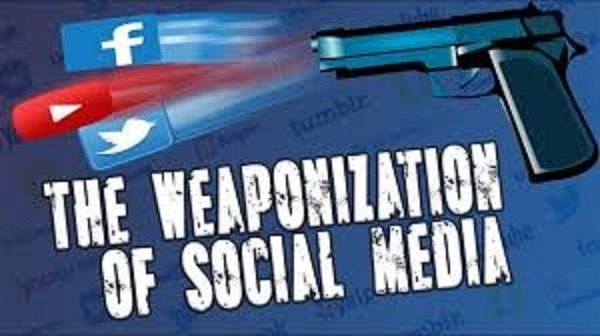
Effective Social Media strategy is a must, in today’s time it helps win War

In the summer of 2014, a motley but brutally violent group of approximately 1500 hardened terrorists/fighters fully armed (even swords) accomplished the impossible in military parlance. They drove away four army divisions and armed police–fully trained and equipped by the US–from Mosul and most parts of Northern Iraq, and later Eastern Syria, and established the caliphate of ISIS (ISIL/ISIS or Daesh in Arabic). This act is a classic case of the power of ‘Social Media’ winning a war. How did this happen?

Well, a propaganda handbook of the IS states that “Media weapons (can) actually be more potent than atomic bomb”. And they were not quiet about it, but announced it to the world months in advance. Theirs was no secret mission but a well-orchestrated, choreographed information and psychological campaign with social media being the pivotal tool. Internet and social media novices, boosted by die-hard fans and amplified by an army of Twitter bots, WhatsApp and Facebook posts covered their march. They even created a smartphone App, so that jihadi fans following along at home could link their social media accounts in solidarity, boosting the invaders’ messages even further.

By using an appropriate hashtag #AllEyesOnISIS they ensured that the message went viral and became the top-trending hashtag on Arabic Twitter. They delighted in showcasing their brutality, gruesome torture and execution of those who dared to resist. Their ‘shock and awe’ strategy achieved global coverage: ISIS took on the power of a non-kinetic artillery barrage, its thousands of messages spiralling out in front of the advancing force. It sowed terror, disunion, and defection. Sunni Youth copied the brutal acts of IS even before their arrival. Turks, Kurds, Sunni and Shia neighbours eyed each other with suspicion, and the Iraqi Army stood guard with fear even before IS arrival and wondered if they should fight or flee.

Slowly the trickle became a flood as both the Iraqi Army and Police slipped away along with more than half a million civilians. Slowly the ISIS ranks filled with eager volunteers from all over the world, as if drawn to a magnet. The IS succeeded in subverting the minds of all commanders and the local population psychologically, and used the internet as a weapon to carry out a blitzkrieg. Images and videos moved faster than the truth, and mix of religiosity and ultra-violence was horrifying to many; to some, however, it was intoxicating. Military and defence professionals talk of ‘cyber security and cyberwar’, but ironically, the IS had no real cyber capabilities but won an improbable victory. IS hadn’t hacked the network but hacked the information on it.

Influencing US presidential elections of 2016; impact of President Trump’s impromptu tweets sending his staff, diplomats and even other national leaders into a tizzy to the bemusement of the world, are further examples. Closer home and recent, outcome of Balakot air strike, Wuhan Summit (meeting of PM Modi and President Xi), fate of refugees from war-torn countries, were significantly shaped by social media. After all, human minds (especially leaders, military commanders and local populace) are principal cognitive elements of decision making, and social media deals with information and the mind, and shapes public opinion.

Statistical Inputs

According to Internet World Stats beginning 2020, out of an estimated world population of 7.8 billion, there are 4.57 billion that is 58.7% of the world’s population of internet users. This provides an extraordinary growth rate of 1.16% from 2000 to 2019. India alone has over 670 million net users (almost 50% of population) and 25.1 million Facebook users. Around 65% of all mobile phone users access the Internet from their mobile phone. There are over four billion global mobile internet users currently. E-commerce is valued at $3.6 billion globally and social media impacts it directly.

(Representative image)

Contrary to the original vision of pioneers, internet has become a battlefield and is not purely a harbinger of peace and understanding. It is also addictive and ironically, in the IOT (internet of things), facts matter the least in the outcome/hits/influence rather the manipulation of facts using psychological, algorithmic analysis of people’s echo chambers, political and social leanings does. Facebook, Google and few other search engines and social media sites are the arbiters of information and become extremely powerful. While they may state that they simply provide a platform it is not so simplistic. Fake news is the order of the day, and with the advent of artificial intelligence it is virtually impossible to verify.

We live in a 24X7 multi-polar (US, China, Russia, EU) and multi-domain world, where nations are dynamically cooperating, competing, confronting and if necessary conflicting with one other across multiple domains and adopting balancing to retain their strategic space, which is dynamically forming allied groupings and bilateral relations. The domains cover a vast spectrum ranging from geography, socio-politico-economic, resources, diplomatic and security/military. Military domain too has enhanced from the traditional land, sea, air to include non-kinetic (cyber, electro-magnetic spectrum, psychological, computer networks, information). And also the newer technology such as nano, AI (artificial intelligence), robotics, big data, hyper-velocity weapon system, among others.

Soft power of Social Media

Today’s world is of ‘persistent engagement’ among nations, groups and even individuals. Security too is seen through the same prism. But the most impactful, potent domain, with the widest spectrum of application is information and psychological where the medium of “Social Media” with its ubiquitous, powerful and effective presence forms the pivot of operations. That is not to say that warfare is less important, but now it becomes the final arbiter, and with advent of accurate weapons of mass destruction (even non-nuclear), it is preferred to achieve national aims and objectives without waging a kinetic and destructive war. As Sun Tsu says, “to subdue the enemy without fighting is the acme of skill”.

There has been a seismic change in the character of conflict. Today the warriors are not just soldiers but also bankers, scientists, journalists, hackers and cyber warriors. As journalist David Patrikarakos notes, platforms like YouTube, Twitter and Facebook allow individuals to “resonate globally, with a power and reach once reserved for large media institutions or governments.”

Social Media, according to media experts PW Singer and Emerson has “become a battlefield where information itself is weaponized.” This makes the psychological dimension of conflict exceptionally complex and fast-changing. Most armed forces around the globe including the US– which was the first of the block– and India are grappling with how to set an aim/end state, plan, coordinate, fine tune, prosecute timely, and institutionalise structures, develop and train manpower and use social media to prosecute information and psychological operations. It is an essential component of counter insurgency/terrorist operations, and ironically the terrorists seem to be winning the round. Social Media can also produce destructive and kinetic effects that includes terrorist recruitment and incidents, lynching, mass protests, coordinated stone throwing etc.

‘Social Media’ cannot be segmented into a military and civilian sphere in ways that we do it traditionally. One cannot declare an exclusive “information zone” or even a “war zone” in this information domain. It’s the best space for conducting grey zone operations, as attribution, intentions and even final impact are very difficult to discern. That makes calculating proportional responses problematic. Through the weaponization of social media, the internet is changing war and politics, just as war and politics are changing the internet.

‘Social Media’ has the power to paralyse/degrade nations, including its people’s capability and capacity to wage war and more importantly stay within the boundaries of adversarial nations and its allies’ red lines for military retaliation.

Our immediate neighbours especially China and its client Pakistan are conducting social media WAR against India as I write. Countering them is a challenge especially against opaque, digitally isolated China. In the spectrum of ‘no war, no peace’ military capabilities may not be an effective tool to deter a particular adversary’s action, making other instruments of power the primary deterrent, of which social media may well become the deciding constituent. One needs to add here, that there is a striking similarity on the impact of social media in the corporate and civil world.

Social media coupled with cyber warfare/interference can be game changers in security and economic domains. Their influence and potency can be gauged by the fact that Gen Alexander who was the Director of National Security Agency (NSA) and US Cyber Command when questioned during confirmation hearings by senators in the Congressional Committee about information and cyber war/operations said, “…if America responded with force in cyberspace it would be in keeping with the rules of war and the principles of military necessity, discrimination, and proportionality”. There is talk of cyber and information deterrence, because in today’s digitized world, a nation/corporate/group can be paralysed. The alarming part is that these can be operated and mastered by ANYBODY (nation or even individual), signals ambiguous attributions thus making specific proportionate responses difficult. India like all big powers needs to counter this threat both institutionally, constantly and pro-actively.

In most nations, decision making powers for regulating media is fairly centralized, with governments making the final call when it comes to policies and regulations. Politicians naturally show a keen interest in news media regulation owing to the high degree of political ownership in the sector, ensuring that political and electoral logic shapes media regulation. Controlling, policing (even moral), censoring, managing social media is a very touchy issue since maintenance of freedom, thought and speech gets coupled. Apart from endorsing certain specific ‘red lines’ this issue is left for another day. A multi-layered, multi-ethnic, multi-lingual, multi-religious and diverse India with its geographical span can very easily spin into instability with adversaries’ information and psychological operations mainly through ‘Social Media’, and urgently needs to be countered.

BLF freedom fighters attack Pakistan Army, kill 4 soldiers

The freedom fighters of Balochistan Liberation Front (BLF) attacked a Pakistan Army camp at Kech district in occupied Balochistan and killed four Pakistan military personnel. This is the second major attack by Baloch freedom fighters (Sarmachars) on Pakistan soldiers this month.

Balochistan Liberation Front (BLF) spokesperson Major Gwahram Baloch in a statement claimed responsibility for the death of four Pakistani military personnel in the Kech district of occupied Balochistan.

“On Sunday evening BLF freedom fighters attacked a Pakistan Army camp at Kad-e-Hotel in Kech district with rockets, sophisticated weapons and sniper attacks. This attack killed three Pakistanis and injured several others,” Major Gwahram Baloch said in his statement. He added that a sniper attack at a military check post in Aspar area of Kech district on Sunday killed another Pakistani military personnel.

Major Gwahram Baloch reiterated that the attacks on occupying forces of Pakistan would continue till the independence of Balochistan.

Balochistan was an independent nation that attained its independence on August 11, 1947, which was four days before India and Pakistan attained their independence on August 15, 1947. However, despite Pakistan’s formal acceptance about the independent status of Balochistan it attacked Balochistan and illegally occupied it on March 27, 1948. Pakistan continues to illegally occupy Balochistan since this day and has been committing worst forms of human rights abuses on the innocent Baloch people.

As a matter of state policy Pakistani forces continue to abduct, rape and kill Baloch people with impunity. More than 30,000 people continue to be “missing” in Balochistan and over 10,000 Baloch people have been killed in cold blood by Pakistani forces in cold blood.

Even the UN-led institutions have never questioned Pakistan over its “kill and dump” policy wherein Pakistan Army abducts Baloch people including women and children. These abducted Baloch people are subjected to inhuman torture and killed in cold blood by the Pakistan Army. The bodies are then dumped at remote locations in Balochistan.

During the last one month while the world was fighting Coronavirus pandemic, Pakistan Army diverted the millions of dollars it received as aid to inflict a reign of terror across Balochistan.

The Baloch Sarmachars (freedom fighters) attack Pakistani military as a retaliation to their unprovoked attacks on Baloch people. Unfortunately, Islamabad and Rawalpindi dub these attacks by Baloch people as terrorist attacks to justify further military action on Balochistan.

The Balochistan Liberation Front (BLF) under the leadership of Dr Allah Nazar Baloch is fighting for the independence of Balochistan.