Home Blog Page 368

Mirror, Mirror on the Wall: Which Future is Fairest and Has Us All?

Of the more delightfully positive and ill-considered futures proposed within the technocratic communities with some overlap within the humanist communities comes in the idea of a trans-humanist future and a post-humanist future in which the technological advancements of humanity (“Mankind” seems a little passé) simply run away into the sunset without their lover: human beings, the hyphenations for the “trans-” and the “post-” because of the basis in differential images of technology made sentient and transcending humanity while, in a sense, bringing human beings along for the ride and another in which humanity becomes, in the words of the late Robin Williams, obsolete, human patterns of thought and behaviour aren’t going anywhere. They’re integrated into all possible futures, though some questions arise about the prime focus of the early 21st century.

Why focus on the future with technology so advanced so as to reach the heights of delirious farce and comedy posed as reality? Why fixate on a future of techno-beings and techno-boyfriends and -girlfriends who cater to every whim of the wonderstruck nerd-o-sphere, geek-o-drome, on the long dweeb-a-thon? Why focus on the future at all? Is it all bad simply for the sake of wanting to focus on the future? My proposition: Yes, and no. Yes, we should focus on the future; and no, some of the heights of fancy so as to “space out” on the present conditions of those worse off make a mockery of the utopian orgasmic fantasizing.

Both matter because the science fiction writers of the past, in a sense, wrote the future for themselves as a present (gift and current moment) to us. We live, in some ways, within the wildest fancies of previous writers who thought about the world in terms of the possible and the impossible (to make things interesting) as a proposition of “what could be,” almost as an individual escape from the “what was” of the time. Truly, the spirit of the age is a sense of becoming as if a perpetual adolescent mind with an iron clasp on the mindscape of the culture.

A world in which technology holds the cards and the social environs remains bound to the sensibilities of its youngest members and their dominance of the tech world. Think of the phones, the computers, the laptops, the applications, the gaming consoles, all of the small conveniences as virtues, and as petty (de)vices, to make each day a tad more enjoyable, and trivial. With the technology, we feel as if an inevitable march of progress to some point of convergence. If the world continues to move faster and faster, and if technology is the driver of the “faster and faster,” well, of course, the only possible answer to the question of “What next?” is “faster and faster, until some point of convergence.”

Perhaps, but then again maybe not, it could be different, as we have heard calls of the “End of History” and the ‘return of the Messiah’ before. All for naught, while used to make calls for oughts. Which brings the current incarnation of the transhumanist and the posthumanist visions of the world into glaring and full focus, a proposition of a world with human beings as subsidiary nodes in some vast computational complex or as participants in the recombination of the material constituents of the universe at a local and then a galactic scale at some nth point of progress into the future.

Technology and progressive advancements in the science bringing about the technology become part of the same droning of the technocrats. Have you watched the presentations of the Kurzweils of the world? Are you bored too? It is the same darn thing over and over again. Is this a perpetual claim of inevitability answered and, thus, needing some repeating to the proletariat who vulgar primitives they are require such repetitions, or is it a set of charts with reasonably amorphous claims about the future with thick-enough black markers to draw the trendlines? It pays. That’s one thing. But then, there’s also the long history built by the science fiction writers of old who built the mental landscape of the micro-obsessives.

Those “micro-obsessives” who constructed the foundational technologies for the world seen today in which our lives have been in many ways transformed for the better, and also for the isolatory effects upon a social species. What effects can we expect from such changes? Shall we boot up, chip in, and forget the troubles for a better television or a new first-person shooter? When caught in a time focus on the future, the items of the forever-evolving present moment and the lessons from history can disappear from us, then we can get into some real trouble. Indeed, the systems of technology may be used for ill-begotten purposes against the ideals of the science fictioneers, futurologists.

To miss the present and the past while over-focusing on the future creates a foundation for failure amplified by technic and ahistoricity of the world, though some premises appear true with explicit statement with some further considerations of the matter, human beings as evolved natural objects appear in the world as a natural technology with the capacity for the creation of some technology in a constructed manner rather than a naturalistically evolved manner. All possible human futures derive from the nature drummed into this tribal species with a neocortex, where all constructed rather than evolved technologies will become imprinted with the behavioural and cognitive capacities of the human species and, therefore, make the current here-and-now co-extensive with all possible there-and-thens as a formulation of humanity’s patterns flowering indefinitely into the cosmos.

In this consideration of the future of the human species and divisions into different ‘kinds’ of futures, all functions under the banner of an extended consciousness of humanity apportioned into parts of the future of the universe with a trans-humanism future envisioned as an after-humans future impossible as all futures become human futures in consideration of patterns and unified notions of technology with human patterns of thought and behaviour projected into every possible future. Human beings cannot be obsolete as we cannot be lost in full, only in part, into any possible consideration of the constructed technology timelines and futures over which so much anxiety, hemming, and hawing is had in the world.

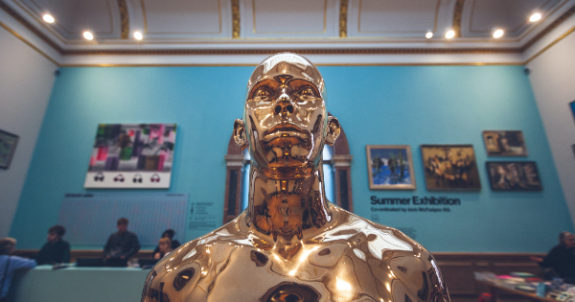
Photo by Artur Tumasjan on Unsplash

Conversation with Dan Fisher (Editor-in-Chief, Uncommon Ground Media) on Humanist Materialism

Scott Douglas Jacobsen: We both harbour an affinity for the humanist vision, as seen in the Amsterdam Declaration and in the, probably, 10 or more other declarations and statements devoted to variations of Humanism. In particular, you have a focus on Humanism tied to the philosophical position of Materialism. We live in a material world, or universe of matter and energy. We evolved as a social species. So, we matter to one another as evolved, complex structures with an awareness of social and emotional needs. We are matter, as part of a material order. Bring them together, we have Humanist Materialism. Is this the basic idea?

Dan Fisher: In a sense, yes. Secular Humanism has always had a focus on the material world as opposed to spiritualism. But as we have seen with Humanists UK being captured by the mythology of gender identity, there is room to grow on this matter. 

I have always advocated that reason and compassion need each other – they are useless alone. With Humanist Materialism we can forge the two together inseparably. Never forgetting the realities of the world we live in, never forgetting the value of life. 

It is also a response to the ‘Historical Materialism’ of Marxists. Whether or not it was intended by Marx himself, adherents of his philosophy have demonstrated time and time again their willingness to kill and otherwise violate human rights in pursuit of their goals. 

Since Marxists have never achieved their desired society, what we are left with is a history of blood spilled in service of an elusive end. I too believe we can build a better world, but not by discarding the very principles we should be fighting for. 

Jacobsen: How has a “mythology of gender identity” taken some in the humanist communities? How is this mythos different than more empirical ideas of sex and gender?

Fisher: The science is very clear that there are two sexes, male and female. Intersex conditions affect people who are either genetically male or female. Despite this, intersex conditions as well as normal variations of human physicality have been interpreted as a ‘spectrum’ and this way of thinking is espoused by people including the President of Humanists UK, Professor Alice Roberts. Sex denial has real consequences for both social and medical circumstances and yet is being propagated by people who should know better. 

The purpose of this is to support the belief in ‘gender identity’ which is equivalent to a male or female ‘soul’ separate from the body. This is fundamentally sexist and regressive thinking which has been delivered into public institutions without appropriate scrutiny. 

Jacobsen: How is Historical Materialism of Marx and modern acolytes working to deny fundamental human rights to other human beings? Things they take for granted and harbour unto themselves while ignoring the denials of said rights for others in a denial of moral truisms, including the Golden Rule.

Fisher: I was recently told by someone I previously respected a great deal that we must sometimes sacrifice individuals to protect ‘the cause’. We have seen organisations of all stripes act to cover up, for example, sexual assault scandals, on the grounds that the good work they do is too important to be tarnished. I would argue that such excuses are in themselves what tarnishes the cause. They make a mockery of what we should be standing for. Marx’s focus on the progress of society as a whole enables this overlooking of the rights of the individual in favour of a focus on a promised future. 

Jacobsen: You started a social media presence for this idea. Did you start this philosophy? If so, how? If not, who?

Fisher: Humanist Materialism is the end product of at least half a decade of work on my part. You can see the foundations being laid in my For A New Left series on Uncommon Ground Media. Of course it could never have happened without the inspiration, input and motivation given to me by various philosophers and activists. Two particular wellsprings have been the work of gender critical feminists and the development of the Humanist movement in Africa. 

Jacobsen: How can others find out about the For A New Left series?

Fisher: It can all be found on Uncommon Ground Media . Each article is linked in the introduction of that first one. Consider it a starting point for what I hope to include in the eventual book. 

Jacobsen: What writers, activists, and others have been integral to For A New Left?

Fisher: Historical inspirations include Immanuel Kant, John Stuart Mill and Henry George, as well as more radical sources such as Rosa Luxembourg and Emma Goldman. 

Many of the writers we have published on Uncommon Ground have also helped me shape my own thoughts – Dr. Em, Jennifer Bilek, Angelos Sofocleous and Emeka Ikpeazu for example. Much of it was developed in conversation with my friends and my fiancée Katie Barker.

Jacobsen: Regardless, why form the online community devoted to it?

Fisher: Although the project is only in its infancy, I wanted to share with people the same hope that they have given me. I want to invite people to contribute their own thoughts to the process and build it from the ground up. 

Jacobsen: What are some of the aims and goals of the group for its early stages?

Fisher: One of the first steps will be the publication of a book, drawing from my article series, but also with potential collaboration from other writers. We were planning to organize a conference, but obviously that’s had to be put on hold. In the meantime, then, we want to encourage people to get talking and sharing their own perspectives.

 Jacobsen: How will this expand into the future?

Fisher: There is potential to form an organization, if the interest and the enthusiasm is there.

Jacobsen: Will this be an entirely non-profit or for-profit affair?

Fisher: Non-profit, for sure. Uncommon Ground Media is a commercial project, and any book will be produced on a commercial basis, but any organization for Humanist Materialism will be strictly not for profit.

Jacobsen: Who have been some early adopters of this philosophy? Who, in reflection, adhered to this philosophical position the whole time?

Fisher: It’s hard to say for sure because there is no formal structure, but we’ve definitely had interest from many of those describing themselves as ‘politically homeless’. We also have interest from people within the British Humanist community who have felt let down by Humanists UK. I’m currently in discussions with a number of key figures I hope to bring on board. As you say, there will be many who have already been on this path independently. 

Jacobsen: It is still early. However, what has been some of the feedback to the group, the ideas?

Fisher: Reception has been positive so far. The For A New Left series has prompted some incredible discussions. In particular the article on Metamodernism had a lively response from the philosophy community, much more so than I expected. Meanwhile the economically focused articles were very well received by Basic Income proponents such as Scott Santens. 

Jacobsen: What is the summary statement on Metamodernism?

Fisher: A response to the meaninglessness of postmodernism cannot be derived solely from modernism. Metamodernism seeks to address the weaknesses of modernism which allowed postmodernism to take root.

Jacobsen: Thank you for the opportunity and your time, Dan.

Fisher: You’re very welcome Scott, it’s always a pleasure to talk. 

Image Credit: Dan Fisher.

Cases of Abuse and Cults – William Branham

*Updated May 27, 2020.*

The Roman Catholic Church’s sexual abuse scandal continues apace and reflects a common trend in churches around the world. There are many facets of this to consider, including cults and fringe religious movements or groups, as this happens in and out of the communities of worship and the cults while the communities of worship and the cults provide a formalized structure for this.

Individuals who may not hear about the abuse in the church can be as upstanding citizens, and as moral individuals within some universal conceptualization of morality, as possible; however, other facets remain important for consideration in the context of the abuse of individuals within the church, whether physical abuse or psychological abuse, or sexual abuse. As we can note with some church members, they may state, “But I never heard about it.” One reason is the abuse did not happen at all. Another is some have not seen it because of the high costs to the victim, the culture of denial, and the complicity of the community in protecting the prominent men. This has happened in religious and secular communities. However, we see this more in the religious communities with an assumed divine mandate in support of the higher authority endowed upon the men. It can create some questions around theology.

If trends exist in theology, and if outcomes exist in people coming out of the theology in several churches and around the world independently, then some scrutiny is deserved, rather than necessarily confirming as a diagnosis. However, there appear to be confirmed cases in some churches around the world regarding The Message theology. From Canada to the rest of the world with over 2,000,000 adherents to this day, people after the Western world collapsed due to a second world war wanted answers. Preachers came in to fill the void. The theology of the late purported Prophet William Branham (1909-1965) was one response. A man who arose in the midst of the post-WWII Healing Revival Movement with several prominent figures proclaiming, by themselves, ‘faith healer’ status within a movement continuing to this day with televangelism and the Charismatic movement. Anything in association with Branham should be taken with suspicion and scrutiny, especially with historical cases of abuse in churches, including CloverdalePhoenixColonia DignidadZimbabwe, or the cult compound in Prescott (click name for hyperlink).

There can be a man considered near to or equal to Jesus Christ as a messenger of the Lord of Lords through The Message, i.e., the late Mr. William Branham providing theological – his own – buttresses for the abuse in the churches. To quote Mr. Branham, “Let her daughter stay out all night and come in the next morning with her make-up all over her face and her hair twisted sideways, out drunk somewhere. You know what she would do? She would teach her a lesson with a barrel slat. That’s right.” Another time, “And I’ve see them laying out on the beaches half naked before man stretching themselves out there, say they get a sun-tanning. Brother, I — I may not live. But if God lets me live and keep my right mind, if one of mine does it, she’ll get a son-tanning. It’ll be Mr. Branham’s son with a barrel slat behind her. She’ll be tanned all right. She’ll know where it come from too. Yes, sir.” In this, individual churches of The Message may operate independently. However, the main point is an overarching theology called The Message. In this theology, this may influence some of the men in the private of the home or church, where the victims, if in a particular home or church, stay quiet. The Casting Pearls Project, devoted to abuse survivors coming out of The Message, run by Jennifer Hamilton gathers stories and quotes. From the Casting Pearls Project, we have a statement from Careyann Z.:

My father came from an abusive family. Through becoming a “Message” minister and missionary, he found a purpose and a way to feel accepted. He believed his interpretation or revelation of the “Message” would lead the bride into the rapture. My mother came from a strict Roman Catholic family. When my parents met, my father told my mother, “God told me you’re my wife.” My mother said it felt like a supernatural presence overtook her when my father asked her to marry him which forced her to marry him against her will. A week and a half later, they were married. My father was a very good manipulator. There were numerous healings that took place in my father’s ministry, and some of the things he prophesied took place. I chalk those up to luck. There were also many things that did not come to pass. Fear of God’s wrath effectively controlled his entire family and drove us to do everything he wished. When we went against his wishes, he would prophesy to us, staring deeply into our eyes as his countenance changed and his entire body shook. My father treated my mother like an object, and she just took it faithfully, helping him in all his businesses like a good slave. Once when she was 9 months pregnant and nauseous, she was up on a ladder painting a house. When she climbed down due to the nausea, he yelled at her to get back up on the ladder and finish painting. Whenever she questioned him or he disagreed with something she did, my father would speak in tongues and prophesy against her saying, “This is God speaking,” or “God is going to strike you dead.”

Another from Christine H.:

I married at a very young age (barely 17). It was expected that we marry young and not risk making “mistakes” before marriage. I went from being in a very controlling home, to being married and becoming a submissive wife. I was always raised with the idea that a man was to have the say in the home and that my place was to make him happy (in my mind, at all costs). This wasn’t how my childhood home worked, but it was what I was taught. I already had “pleaser” type of personality. This came from trying to please everyone in hopes of them being proud of me, and the dire need to be good enough. Both sides of the family were very controlling; my family would try to control what I wore and what I did even as a married woman. I never dreamed my life would turn out the way it did. It wasn’t long before the stress of life grabbed our young home, and I found myself in an abusive marriage. After almost 11 years and two children, we ended in a divorce. I felt destroyed, knowing I was committing the forbidden sin. Once again, more hurt and abuse by people that were supposed to love me the most. The pain felt unbearable. Why was I so unlovable? Why could people physically and mentally hurt me, knowing they were causing me pain, but still say they loved me?

The spiral began. My family could only see that their daughter was now divorced and how that was going to look to everyone in the “Message”. I was told I had no rights, but no one wanted to know my story. 

Is the statement about barrel slats unquestioned? Why use this language and metaphor? If one can unquestioningly endorse statements of physical abuse with a barrel slat, then this raises questions about actions towards women following from it, as this man, within The Message, is considered a Prophet. At the same time, in The Message, women are considered of the devil. Branham is considered the Prophet of God. Who is a follower of The Message to question a Voice of God, especially a woman who is of the devil, anyhow? Either Branham was ordinary or not, whether ordinary made prophet of God to become extraordinary or ordinary and a liar about professed prophet status. Even with ignoring these claims about divinity or divine representation of He on High, there can be explicit statements, by the raised standards of today, of sexist statements by Branham, and behaviours within the churches.

Those statements belying particular attitudes with the views reflective of a general philosophy in regards to the roles of men and the roles of women within the “The Message” movement theology and the orientation of general subservience to men alongside a culture of silence. Do not take this from me, take this from an individual with extensive experience with former women members of “The Message,” Hamilton, who I conducted an interview with former member and author John Collins in an educational series where he invited Hamilton into the session, said abuse is normalized in the church. Therefore, this should qualify as a destructive cult.

For those with further interest in researching cults, I would strongly recommend the late Margaret Singer, and Rick Alan Ross, Steven Hassan, and Robert Jay Lifton. All four have been integral to helping hundreds of thousands of people around the continent, and probably the world, in working to combat destructive cults, which remain the main issue or problem now. Collins explained the general context in which the leadership, the pastor even, can further victimize a mother who has been abused by a husband (including the husband abusing the children). The mother was shamed to be in submission to the husband, as per their interpretations of supposedly sacred scripture.

Collins said, “Victims are pressured into keeping silent about abuse. As a result, many members of the group are unaware that sexual abuse exists. Worse, some people that are aware of the abuse have become accustomed to it and view the abuse is ‘normal.’ Some message followers rarely speak up against sexual abuse within the church because they are conditioned to keep silent. In many cases, there seems to be an unspoken rule that ‘if you speak about the problem, then you are the problem.’”

All the while this happens decades after the death of Branham in 1965. We continue to see the admonishments. The thou shalts and thou shalt nots as interpreted of the scriptures for “The Message.” In this case, the message becomes a message of denial of abuse of women’s and children’s bodies and subjugation of the wife to the headship of the husband. Collins described how the culture of abuse can create a situation in which the abused individuals remain accustomed, engendered, to the abuse culture. In the family, this can mean more of the normalization of the abuse in a cult setting with aberrant worship, doctrine, and leadership with destructive consequences under the guise of Christian theology, ethics, and norms. Many Christians would be appalled, probably. Collins only knew of a few situations in which the law enforcement agencies became actively involved in these cases of abuse.

“Typically, one of three scenarios happen when sexual abuse occurs. Unfortunately, more often than not, the victim of rape or sexual assault is afraid to speak up and the abuse is never mentioned to anyone in church authority. The second scenario is that the victim does speak to their pastor or church leader, but the pastor ‘handles’ the situation by either admonishing the abuser privately or dismissing the situation all together,” Hamilton stated, “The third scenario is the less common of the three, but the pastor might bring the offender before the congregation to reprimand them openly. In both instances of speaking out, the victim is almost always shamed and found at some fault. For sexual abuse towards girls and women, teachings of WMB place blame on the female body for being seductive and therefore a temptation.”

Indeed, as Hamilton further explained, they distrust the secular systems of jurisprudence and social services. She explained:

…when sexually abused members do speak out, the leader dictates complete control of the situation without reporting it to the local authorities. 1 Corinth 6:1-2 is most often used to justify this: “Does any one of you, when he has a case against his neighbor, dare to go to law before the unrighteous, and not before the saints? Or do you not know that the saints will judge the world? And if the world is judged by you, are you not competent to constitute the smallest laws courts?” Message pastors have no theological or counseling education and erroneously fail to understand that this passage is about settling civil cases, not criminal ones. In a criminal case, such as physical or sexual abuse, the state opposes the perpetrator in court, not the victim.

Often, cases do not go to the court or to a sufficient authority to deal with these issues. Even if a crime is known to be committed and a charge would be appropriate, and in the case of real consequences for the perpetrator, the punishment for the “rapists and sexual assaulters [are] rarely appropriate for their actions.” Some of these conversations can be seen with some commentary of Nathan J. Robinson from Current Affairs around Joe Biden in a larger sociopolitical context about the Democrats and in extensive commentary about President Donald J. Trump in the examination of the claimants with substantive stories of sexual abuse and rape by the sitting president of the United States of America.

Managing Editor, Sarah Mills, of Uncommon Ground Media (and Min Grob) in “Coercive control activist: ‘Sally Challen case is about more than murder’” wrote on a similar phenomenon of coercive control as an aspect of manipulation through emotional abuse. Another relevant aspect of this cultural phenomenon of cults. Someone in non-normal, aberrant circumstances, where murder became a mind-set induced by coercive control in the case of Challen. A woman who murdered, but who killed someone intentionally with a long background of abuse. In another case from the same outlet, Beatrice Louis or Linda Louis, Business Editor, spoke articulately a couple of years ago about the proposition of “Enforced Monogamy” in the article entitled “What Does Jordan Peterson’s Enforced Monogamy Actually Look Like?“ Short answer: “not good”; long answer: “also, not great,” Louis astutely picked up on the ad hoc manner in which Peterson covers a behind connected to him. Louis highlights this statement, “Of much more interest is the preceding paragraph which is reported as, ‘violent attacks are what happens when men do not have partners, Mr. Peterson says, and society needs to work to make sure those men are married.’”

Louis went on to ask about the factors needing change for incels to stop being incels. To a New Mythologist in Peterson, as I call them, mirroring the New Atheist, formulation of loose, ill-considered philosophizing, Louis nailed the point in a form of a question, a circumlocution punctuated by a question mark, as the surrounding contextualization for this crowd comes in the mantra of “personal responsibility” without nary a notion of the “personal” part in matters of crucial concern: underground, online, misogynist culture with derivative manifestations in the larger sociocultural structure. Society retains a deep interest in the men becoming married. That’s the claim and argument in one. In having this, not the men, but the society or factors external to the individual should hold responsibility for the men, perhaps, the small group of online men who may struggle with heterosexual relations and shifting of norms in some societies towards pragmatic egalitarian norms should focus on individual change. When one claims this, then the double, loose, ill-considered meaning or ad hoc reasoning can mean this all along, while, in fact, the [fill-in-the-blank] was intentionally placed with a surrounding quota of partial truths so as to lead the ‘stallions’ to water. When the cowboy-shepherd is shown to be naked, he meant the more positive egalitarian notion all along. Implication: How could you be so dishonest and stupid to not get the message the whole time? Und so weiter. That’s on a form of a marriage built to industrial efficiency for the subjugation of women and children to the fathers in destructive cult cultures reflected around the world in hundreds of thousands of people’s lives under “The Message” theology.

Mills’ and Grobs’ articulation of some of the emotional and psychological abuse is relevant here too. I love this statement from their article:

Abusive, controlling partners initially shower a potential target with intense flattery designed to seduce them. This is referred to as ‘love bombing,’ a tactic also employed by predatory organisations–like cults–in order to persuade their targets to let their guard down through positive emotional feedback: high self-esteem, a sense of being loved, and belonging. This initial period of idealisation succeeds in forging an intense bond with the abuser, a bond that will later be used against the victim, who will always seek to return to this state, or emotional high, following periods of cruelty.

Exactly, this becomes the basis for the abusive destructive cult tactics one can find in the world created in the post-WWII Healing Revival Movement of William Marrion Branham and others. As we see in the world of coercive control abuse tactics, or in the idealization of a state of nature with God, man, woman, and children, where the man is the head of the household and the woman exists below the man in service of husband and in devotion to the caretaking of the children and the maintenance of the home. God loves you. He is there for you, except during coercive control, during the abuse, after the scars heal while the mind reels, and still while his representative authority in the church shames you. If you come forward, the overwhelming response is a claim as a liar. Some of the most substantial research on rape, as an extreme form of violence against women, represents 8% of the cases as unfounded; thus, the default should be sensitivity and full consideration with the weight of the claims and, as well, the consideration of the claim of, in this instance, rape as highly probable rather than not, based on the statistical evidence gathered by the FBI and the Home Office of the UK – as far as I know, independently.

Hamilton said, “In the cases of the abuser being the pastor or in leadership, the victims are likely labelled liars and disregarded. Abusers in the Message are more protected than their victims through the forced silence. The Message teaches that if the rapist or assaulter confesses, their sin is ‘placed under the blood of Jesus,’ making them as ‘blameless’ as if the crime literally had never happened. Therefore, anyone who speaks about it is shamed for bringing that sin ‘back out from under the blood.’” There is explicit theological backing for these attitudes and behaviours as interpreted within “The Message.” Whether one looks at the more insider knowledge of Hamilton and Collins, or the collegial journalism on coercive control (a classic tactic of cults) and critical commentary of clumsy outmoded thoughts on enforced monogamy, Canadian society, and most other societies know better and, thus, should do better than permit open sanction of such institutional status within borders and cultures, as there have been extreme cases at CloverdalePhoenixColonia DignidadZimbabwe, or the cult compound in Prescott. All functioning independently while under the common theological banner of The Message. Given the history and theology, these seem like plausible hypotheses about the organizations. Is there abuse near you? Are there considerations of trying to get out of community without community reprisal? There is help if you need it. There are the authorities – the police, the secret service agencies, the safe houses, the Casting Pearls Project, or other initiatives devoted to the safety of women (and men) who may be experiencing abuse – who can help you.

To the last question from the interview with Hamilton and Collins, I leave this to them prefaced by the original questions:

Jacobsen: For those who have not faced justice, how can they face it?

Hamilton: Time unfortunately impedes most abusers from facing the justice they deserve. Victims that are now speaking out about the abuse are sometimes unfortunately past their state’s statute of limitations. After leaving the cult, there is a processing period for de-programming and realizing that the abuse had been normalized and that justice was not served. No matter the length of time, victims can contact their local police station or Salvation Army for resources and advocates.

Collins: The only way justice can be served is through education and accountability. Members of any church – cult or not – must hold elders of the church to an acceptable standard of accountability. Leaders of church bodies must be trained in how to respond to abuse, when to report abuse, and how to properly warn members of their church when another member has abusive tendencies. As the proverbial “shepherd of the flock”, they must be held accountable to provide protection for their congregation.

At the same time, members of the church must be educated to recognize signs of abuse and recognize abuse of power. This becomes problematic for leaders, however, in the case of a destructive cult. In all cases where members are trained to recognize abuse of power, those same members become former members.

Photo by vaun0815 on Unsplash

Effective Social Media strategy is a must, in today’s time it helps win War

In the summer of 2014, a motley but brutally violent group of approximately 1500 hardened terrorists/fighters fully armed (even swords) accomplished the impossible in military parlance. They drove away four army divisions and armed police–fully trained and equipped by the US–from Mosul and most parts of Northern Iraq, and later Eastern Syria, and established the caliphate of ISIS (ISIL/ISIS or Daesh in Arabic). This act is a classic case of the power of ‘Social Media’ winning a war. How did this happen?

Well, a propaganda handbook of the IS states that “Media weapons (can) actually be more potent than atomic bomb”. And they were not quiet about it, but announced it to the world months in advance. Theirs was no secret mission but a well-orchestrated, choreographed information and psychological campaign with social media being the pivotal tool. Internet and social media novices, boosted by die-hard fans and amplified by an army of Twitter bots, WhatsApp and Facebook posts covered their march. They even created a smartphone App, so that jihadi fans following along at home could link their social media accounts in solidarity, boosting the invaders’ messages even further.

By using an appropriate hashtag #AllEyesOnISIS they ensured that the message went viral and became the top-trending hashtag on Arabic Twitter. They delighted in showcasing their brutality, gruesome torture and execution of those who dared to resist. Their ‘shock and awe’ strategy achieved global coverage: ISIS took on the power of a non-kinetic artillery barrage, its thousands of messages spiralling out in front of the advancing force. It sowed terror, disunion, and defection. Sunni Youth copied the brutal acts of IS even before their arrival. Turks, Kurds, Sunni and Shia neighbours eyed each other with suspicion, and the Iraqi Army stood guard with fear even before IS arrival and wondered if they should fight or flee.

Slowly the trickle became a flood as both the Iraqi Army and Police slipped away along with more than half a million civilians. Slowly the ISIS ranks filled with eager volunteers from all over the world, as if drawn to a magnet. The IS succeeded in subverting the minds of all commanders and the local population psychologically, and used the internet as a weapon to carry out a blitzkrieg. Images and videos moved faster than the truth, and mix of religiosity and ultra-violence was horrifying to many; to some, however, it was intoxicating. Military and defence professionals talk of ‘cyber security and cyberwar’, but ironically, the IS had no real cyber capabilities but won an improbable victory. IS hadn’t hacked the network but hacked the information on it.

Influencing US presidential elections of 2016; impact of President Trump’s impromptu tweets sending his staff, diplomats and even other national leaders into a tizzy to the bemusement of the world, are further examples. Closer home and recent, outcome of Balakot air strike, Wuhan Summit (meeting of PM Modi and President Xi), fate of refugees from war-torn countries, were significantly shaped by social media. After all, human minds (especially leaders, military commanders and local populace) are principal cognitive elements of decision making, and social media deals with information and the mind, and shapes public opinion.

Statistical Inputs

According to Internet World Stats beginning 2020, out of an estimated world population of 7.8 billion, there are 4.57 billion that is 58.7% of the world’s population of internet users. This provides an extraordinary growth rate of 1.16% from 2000 to 2019. India alone has over 670 million net users (almost 50% of population) and 25.1 million Facebook users. Around 65% of all mobile phone users access the Internet from their mobile phone. There are over four billion global mobile internet users currently. E-commerce is valued at $3.6 billion globally and social media impacts it directly.

(Representative image)

Contrary to the original vision of pioneers, internet has become a battlefield and is not purely a harbinger of peace and understanding. It is also addictive and ironically, in the IOT (internet of things), facts matter the least in the outcome/hits/influence rather the manipulation of facts using psychological, algorithmic analysis of people’s echo chambers, political and social leanings does. Facebook, Google and few other search engines and social media sites are the arbiters of information and become extremely powerful. While they may state that they simply provide a platform it is not so simplistic. Fake news is the order of the day, and with the advent of artificial intelligence it is virtually impossible to verify.

We live in a 24X7 multi-polar (US, China, Russia, EU) and multi-domain world, where nations are dynamically cooperating, competing, confronting and if necessary conflicting with one other across multiple domains and adopting balancing to retain their strategic space, which is dynamically forming allied groupings and bilateral relations. The domains cover a vast spectrum ranging from geography, socio-politico-economic, resources, diplomatic and security/military. Military domain too has enhanced from the traditional land, sea, air to include non-kinetic (cyber, electro-magnetic spectrum, psychological, computer networks, information). And also the newer technology such as nano, AI (artificial intelligence), robotics, big data, hyper-velocity weapon system, among others.

Soft power of Social Media

Today’s world is of ‘persistent engagement’ among nations, groups and even individuals. Security too is seen through the same prism. But the most impactful, potent domain, with the widest spectrum of application is information and psychological where the medium of “Social Media” with its ubiquitous, powerful and effective presence forms the pivot of operations. That is not to say that warfare is less important, but now it becomes the final arbiter, and with advent of accurate weapons of mass destruction (even non-nuclear), it is preferred to achieve national aims and objectives without waging a kinetic and destructive war. As Sun Tsu says, “to subdue the enemy without fighting is the acme of skill”.

There has been a seismic change in the character of conflict. Today the warriors are not just soldiers but also bankers, scientists, journalists, hackers and cyber warriors. As journalist David Patrikarakos notes, platforms like YouTube, Twitter and Facebook allow individuals to “resonate globally, with a power and reach once reserved for large media institutions or governments.”

Social Media, according to media experts PW Singer and Emerson has “become a battlefield where information itself is weaponized.” This makes the psychological dimension of conflict exceptionally complex and fast-changing. Most armed forces around the globe including the US– which was the first of the block– and India are grappling with how to set an aim/end state, plan, coordinate, fine tune, prosecute timely, and institutionalise structures, develop and train manpower and use social media to prosecute information and psychological operations. It is an essential component of counter insurgency/terrorist operations, and ironically the terrorists seem to be winning the round. Social Media can also produce destructive and kinetic effects that includes terrorist recruitment and incidents, lynching, mass protests, coordinated stone throwing etc.

‘Social Media’ cannot be segmented into a military and civilian sphere in ways that we do it traditionally. One cannot declare an exclusive “information zone” or even a “war zone” in this information domain. It’s the best space for conducting grey zone operations, as attribution, intentions and even final impact are very difficult to discern. That makes calculating proportional responses problematic. Through the weaponization of social media, the internet is changing war and politics, just as war and politics are changing the internet.

‘Social Media’ has the power to paralyse/degrade nations, including its people’s capability and capacity to wage war and more importantly stay within the boundaries of adversarial nations and its allies’ red lines for military retaliation.

Our immediate neighbours especially China and its client Pakistan are conducting social media WAR against India as I write. Countering them is a challenge especially against opaque, digitally isolated China. In the spectrum of ‘no war, no peace’ military capabilities may not be an effective tool to deter a particular adversary’s action, making other instruments of power the primary deterrent, of which social media may well become the deciding constituent. One needs to add here, that there is a striking similarity on the impact of social media in the corporate and civil world.

Social media coupled with cyber warfare/interference can be game changers in security and economic domains. Their influence and potency can be gauged by the fact that Gen Alexander who was the Director of National Security Agency (NSA) and US Cyber Command when questioned during confirmation hearings by senators in the Congressional Committee about information and cyber war/operations said, “…if America responded with force in cyberspace it would be in keeping with the rules of war and the principles of military necessity, discrimination, and proportionality”. There is talk of cyber and information deterrence, because in today’s digitized world, a nation/corporate/group can be paralysed. The alarming part is that these can be operated and mastered by ANYBODY (nation or even individual), signals ambiguous attributions thus making specific proportionate responses difficult. India like all big powers needs to counter this threat both institutionally, constantly and pro-actively.

In most nations, decision making powers for regulating media is fairly centralized, with governments making the final call when it comes to policies and regulations. Politicians naturally show a keen interest in news media regulation owing to the high degree of political ownership in the sector, ensuring that political and electoral logic shapes media regulation. Controlling, policing (even moral), censoring, managing social media is a very touchy issue since maintenance of freedom, thought and speech gets coupled. Apart from endorsing certain specific ‘red lines’ this issue is left for another day. A multi-layered, multi-ethnic, multi-lingual, multi-religious and diverse India with its geographical span can very easily spin into instability with adversaries’ information and psychological operations mainly through ‘Social Media’, and urgently needs to be countered.

BLF freedom fighters attack Pakistan Army, kill 4 soldiers

The freedom fighters of Balochistan Liberation Front (BLF) attacked a Pakistan Army camp at Kech district in occupied Balochistan and killed four Pakistan military personnel. This is the second major attack by Baloch freedom fighters (Sarmachars) on Pakistan soldiers this month.

Balochistan Liberation Front (BLF) spokesperson Major Gwahram Baloch in a statement claimed responsibility for the death of four Pakistani military personnel in the Kech district of occupied Balochistan.

“On Sunday evening BLF freedom fighters attacked a Pakistan Army camp at Kad-e-Hotel in Kech district with rockets, sophisticated weapons and sniper attacks. This attack killed three Pakistanis and injured several others,” Major Gwahram Baloch said in his statement. He added that a sniper attack at a military check post in Aspar area of Kech district on Sunday killed another Pakistani military personnel.

Major Gwahram Baloch reiterated that the attacks on occupying forces of Pakistan would continue till the independence of Balochistan.

Balochistan was an independent nation that attained its independence on August 11, 1947, which was four days before India and Pakistan attained their independence on August 15, 1947. However, despite Pakistan’s formal acceptance about the independent status of Balochistan it attacked Balochistan and illegally occupied it on March 27, 1948. Pakistan continues to illegally occupy Balochistan since this day and has been committing worst forms of human rights abuses on the innocent Baloch people.

As a matter of state policy Pakistani forces continue to abduct, rape and kill Baloch people with impunity. More than 30,000 people continue to be “missing” in Balochistan and over 10,000 Baloch people have been killed in cold blood by Pakistani forces in cold blood.

Even the UN-led institutions have never questioned Pakistan over its “kill and dump” policy wherein Pakistan Army abducts Baloch people including women and children. These abducted Baloch people are subjected to inhuman torture and killed in cold blood by the Pakistan Army. The bodies are then dumped at remote locations in Balochistan.

During the last one month while the world was fighting Coronavirus pandemic, Pakistan Army diverted the millions of dollars it received as aid to inflict a reign of terror across Balochistan.

The Baloch Sarmachars (freedom fighters) attack Pakistani military as a retaliation to their unprovoked attacks on Baloch people. Unfortunately, Islamabad and Rawalpindi dub these attacks by Baloch people as terrorist attacks to justify further military action on Balochistan.

The Balochistan Liberation Front (BLF) under the leadership of Dr Allah Nazar Baloch is fighting for the independence of Balochistan.

People are disappeared at will in Balochistan: Mir Mohammad Talpur

The scourge of ‘enforced disappearances’ in Pakistan has severely eroded the foundations of society’s conscience and confidence. This crime against humanity has been going on for so long and so systematically in Balochistan that it has come to be considered as a normal state of affairs. But a vast majority remain unperturbed by the atrocity inflicted on the victims and all those connected to them.

Bertolt Bretcht in his 1935 poem “When evil-doing comes like falling rain” has put this attitude very poignantly: “The first time it was reported that our friends were being butchered there was a cry of horror. Then a hundred were butchered. But when a thousand were butchered and there was no end to the butchery, a blanket of silence spread. When evil-doing comes like falling rain, no body calls out “stop!” When crimes begin to pile up, they become invisible. When sufferings become unendurable the cries are no longer heard. The cries, too, fall like rain in summer.”

The confidence has been eroded because no one is exempt, be it Ms. Gul Bukhari, Comrade Wahid Baloch or Idris Khattak because those who commit this crime enjoy complete immunity in the prevailing culture of impunity for such crimes.

Pakistan has still not signed the “International Convention for the Protection of All Persons from Enforced Disappearance” because of reservations, especially regarding Section 26 which allows United Nations’ body to conduct surprise visits to check for ‘missing persons’. To date it has not criminalized ‘enforced disappearances’. All this certainly gives the confidence and immunity to those who are involved in this heinous crime.

Are surprise visits really an issue? Let’s see how the UN Working Group on Enforced or Involuntary Disappearances (WGEID) fared in its September 2012 visit here. A junior minister in the National Assembly criticizing it said, “It would be the first step leading towards the disintegration of the country.” The Chief Justice refused to meet as the matter was sub judice and the Inspector General of FC (Frontier Corps) Balochistan declined too.

The icing on the cake was that on 24th September 2012 the Parliamentary Committee on National Security decided that in the future no United Nations group would be allowed to visit Pakistan to discuss “sensitive issues”. Senator Raza Rabbani asked the foreign and interior ministries to abstain from welcoming international intervention in local issues.

Apparently, it is futile to insist Pakistan to sign it because although Pakistan has ratified the Convention on Torture in 2010, those who ‘pick up’ people and the police of the area, violate it with impunity both in practice and spirit.

The scourge of ‘enforced disappearances’ in Balochistan isn’t a recent phenomenon either. Baloch have been its victims since 1960s when Sher Mohammad Marri began resisting injustices against his people. I know Marris’ of that era who were picked up, tortured but were lucky to be released. This approach, however, changed during the 1973 Balochistan insurgency as most of those picked up were never heard of again. Asadullah Mengal son of Sardar Ataullah Mengal and Ahmad Shah Kurd were picked from Karachi in 1976 and there was no information about them.

My own friend Duleep Dass and Sher Ali Marri were picked up by the army at Belpat, Balochistan in 1975. We never heard of them again. My Marri friends Bahar Khan Lalwani, Shafi Muhammad Badni, Dost Muhammad Durkani and Allah Bakhsh Pirdadani were picked up and suffered the same fate. The same fate awaited those who were picked up from Mengal and other areas.

The last wave of disappearances began in Balochistan in 2002; Asghar Bangulzai was picked up and is still missing. Dr. Allah Nazar too was picked up with others in 2005 but was released in a near-death condition. The vicious and vile ‘abduct, kill and dump’ ‘policy’ began in 2008 and has claimed thousands of victims.

There never has been prosecution let alone punishment for those responsible for ‘enforced disappearances’. During Iftikhar Chaudhary’s tenure as Chief Justice of Supreme Court, high profile hearings on missing persons were held but to no avail. During a hearing on 20th March 2013 in Quetta the DIG of Criminal Investigation Department (CID) Balochistan Feroze Shah submitted a report. He told the Bench that, “Following the statements of 12 missing persons after they returned home the Balochistan police asked the Frontier Corps to trace the whereabouts of the accused army men including two Lt Colonels, six Majors and two Subedars”. (Daily Times March 21st 2013) Not even a Subedar was punished.

The disease of ‘enforced disappearances’ can never remain localized because with nothing to deter the perpetrators they make systematic use of it.

Moving on, in January 2017 bloggers Salman Haider, Asim Saeed, Waqass Goraya, Ahmed Raza Naseer, and Samar Abbas were disappeared and later released. No charges or court trial pointed out that they were incarcerated, tortured for criticizing the establishment’s policies; no one was held accountable for messing up their lives.

The situation for the victims of enforced disappearances has worsened as now even Courts refuse to take cognizance of the issue and people are now disappeared at will. The National Commission of Human Rights here is dysfunctional because they who disappear people do not want even an internal body to question them. The Commission for Missing Persons confounds the issue rather than solves it.

In the past few months some missing persons like Sagheer Baloch, Mohammad Atta Baloch, Abdul Wahab Baloch have been released as were Comrade Wahid Baloch and some others before. Release certainly is a relief for the victims and families and probably a consolation for the politicians who have agreed to support the government on condition of release of missing persons.

However, these releases raise more questions than answers. It is essential to know who disappeared them, why were they disappeared, where they were kept, why weren’t they produced before courts, why were they tortured, has anyone been held responsible for the trauma the victims and their families suffered, why do the released victims refuse to speak of their ordeals?

Unless these questions are answered and more importantly those responsible for the disappearances are named and punished the scourge of ‘enforced disappearances’ will continue unabated. They will release a couple and disappear a dozen knowing that they can do this with impunity. Moreover, it is downright dishonest to say that the abductors are ‘unknown persons’ for only a state institution which knows it can get away with this brazen illegality, keeps doing it.

More significantly it is not that all those disappeared are only kept indefinitely incarcerated because some of them like Gazzain Qambarani and Sulaiman Qambarani who were abducted in July 2015 from Qilli Qambarani ended up being displayed as terrorists killed in encounter on 13th August 2016. Again, on March 4th two students, Hizbullah Qambarani and Hassaan Qambarani, were taken away from Qilli Qambarani in broad daylight; Hassan is brother of Sulaiman and their families fear the worst.

In the transient euphoria generated by release of a few lucky ones the mass of missing persons keeps getting forgotten and forsaken and sadly those reported as killed in encounters get as much justice as did the hundreds of victims of notorious Rao Anwar did in Karachi. These disappearances and killings have dire consequences for the society and individuals because an atmosphere of fear and insecurity prevails and people are denied the safe environment conducive to development of a society necessary for a peaceful and civilized life.

Above all these ‘enforced disappearances’ undermine the very basis of humanity by dehumanizing society as a whole.

(Special Thanks to Mir Muhammad Talpur saheb and VoicePk for permitting News Intervention to re-publish this article)

Pakistan Army abducts two Baloch students, they are now “missing”

Pakistani Army abducted two Baloch students on Sunday from Turbat city of district Kech, occupied Balochistan and took them to an unknown location.

According to details provided by local Baloch residents, two students Nasir  son of Pahlan and Janzahaib son of Rafiq were abducted by the Pakistan Army from Turbat Absar as part of Pakistan’s policy of harassing innocent Baloch people.

As per local Baloch residents, Nasir is a student of Bahauddin Zakaria University in Multan Punjab and Janzahaib studies at Uthal University in Balochistan. Both were arrested without any instigation by the Pakistani army and have now “disappeared”.

This phenomenon of “enforced disappearances” by Pakistani security forces has given birth to the decades-long “Missing Persons” crisis in occupied Balochistan. Around 30,000 innocent Baloch people have went missing at the hands of Pakistani security forces over the last several years. Even as the world is fighting Coronavirus pandemic Pakistan Army has continued its military operations across occupied Balochistan and is fighting innocent Baloch people with sophisticated weaponry and helicopter gunships.

Trusting Pakistan was a major strategic blunder for the US: Lawrence Sellin

Lawrence Sellin is a retired US Army Colonel. He is a veteran of Afghanistan, Iraq and West Africa and trained in Arabic & Kurdish. In this interview with Sangar Media Group and News Intervention, Lawrence Sellin gave fresh insights and an objective analysis on an array of geostrategic issues of South Asia.

Dosten Baloch/VivekSinha: US & NATO joint attack toppled the Taliban regime in Afghanistan because Taliban had given refuge to Osama bin Laden. However, after this US-led attack on Afghanistan, it was Pakistan that gave a sanctuary to the same Osama bin Laden along with Al Zawahiri, Mullah Omar and thousands of other hard core jihadists, and yet US rewarded Pakistan with billions of dollars. Isn’t this a huge contradiction in US’ policy and narrative? If yes, then what is the reason for this contradiction? If no, then how do you explain this contradictory policy of the US?

Lawrence Sellin: It is a huge contradiction, but an explainable one.
A lack of awareness by the United States of the extent of Pakistani duplicity was already evident in the 1980s when the Central Intelligence Agency (CIA) outsourced the funding and supply of the Mujahideen fighting the Soviet Union to Pakistan’s Inter-Service Intelligence (ISI), who gave preference to pro-Pakistan Islamists rather than Afghan nationalists, which eventually led to a Taliban takeover of Afghanistan.

The American approach to Pakistan after 9/11 was based primarily on wishful thinking, in which the application of a proper combination of bribery and arm-twisting would convince Pakistan to support the goals of the U.S. and NATO in Afghanistan. It did not. Pakistan continued its support for the Taliban and other extremist groups.
Trusting Pakistan was a major strategic blunder for the United States.

Dosten Baloch/VivekSinha: Pakistan Army promotes and uses the ideology of Islamic jihad as a state policy and exports it in the form of terrorism to Afghanistan, Balochistan and Kashmir. Why Pakistan isn’t being made accountable for creating this ‘mess’, like the other non-state jihadists on world forums?

Lawrence Sellin: Unlike stateless extremist groups like al-Qaeda and the Islamic State, Pakistan is officially part of the world community of nations, even though Pakistan uses terrorism as an element of its foreign policy. Because of its status as a nation-state, Pakistan can leverage alliances, for example, with China as well as use international institutions like the United Nations to avoid responsibility for its reckless behavior by framing any use of terrorism as an insurgency or a response to religious oppression. In actually, Pakistan is a state sponsor of terrorism.

Dosten Baloch/VivekSinha: The joint forces of US & NATO attacked and destroyed ISIS Caliphate for its human rights abuses, war crimes, terrorism and crimes against humanity. Pakistan Army commits these same crimes in Balochistan. Pakistan Army plunders, rapes, murders, bombs and burns the villages across Balochistan with impunity. Pakistani security forces have displaced civilians, and continues to forcibly abduct and disappear Baloch people, it also tortures, kills and dumps them. Why do the US, UN and other global human rights organisations not take notice of such war crimes by Pakistan in Balochistan?

Lawrence Sellin: The US, the UN and global human rights organisations do not take notice of war crimes committed by Pakistan in Balochistan for the same reasons I described earlier. Being part of the international community, Pakistan claims that it is within its rights as a sovereign nation to suppress “dissent” within its territory. Such claims are seldom challenged internationally regardless of the extent of the human rights abuses because, quite frankly, so many other nations are doing similar things and no one wants to open Pandora’s Box.

Pakistan Army has been using helicopter gunships to shoot at innocent civilians in Balochistan.

Dosten Baloch/VivekSinha: Isn’t this right time to support Baloch freedom struggle for an independent, secular and democratic Balochistan and thereby root out Islamic extremism and jihad from the entire region?

Lawrence Sellin: I have long thought a secular, democratic and independent Balochistan could provide enormous benefits to South Asia, both as a bulwark against the spread of extremism and jihad, particularly emanating from Pakistan, but also as an inspiration to oppressed ethnic minorities in the region, who have been subjected to human rights abuses.

Footprint of destruction after the relentless attacks by Pakistan Army in Balochistan

Dosten Baloch/VivekSinha: While the US has struck a deal with Taliban and has formed a road map to exit Afghanistan, Pakistan’s ISI has begun spreading its tentacles in Afghanistan’s government formation. Do you think US exit from Afghanistan coupled with Pak’s active involvement will push Afghanistan to pre-9/11 days? If this happens how could it affect South Asian politics?

Lawrence Sellin: Yes, unfortunately a return of Taliban control of Afghanistan appears likely. It would cause a significant shift in the regional strategic dynamics favoring the China-Pakistan alliance to the detriment of India. It will also be a huge encouragement to extremist groups within Pakistan and elsewhere in the world.

Dosten Baloch/VivekSinha: Pashtun Tahafuz Movement (PTM) is gaining momentum across Waziristan that was once jihadists’ main launching pad of Pakistan. Isn’t this the right time to support and turn it into a movement for Pashtuns joining in from Afghanistan?

Lawrence Sellin: I support the Pashtun Tahafuz Movement (PTM) and ethnic self-determination for Pakistan’s politically oppressed groups. The Durand Line has always been an obstacle to Pashtun self-determination, an artificial border that Pakistan wants to maintain. The time to reconsider the legitimacy of the Durand Line is long overdue.

Dosten Baloch/VivekSinha: Kurds, like the Baloch people, are one of the largest ethnic groups that do not have their nation and continue to be persecuted. What impact can the developments in South Asia have on the Kurds’ armed resistance in near future?

Lawrence Sellin: A Pakistani victory in Afghanistan through its proxies, the Taliban, will have a negative impact on the self-determination of the Kurds, Baloch, Pashtuns and other oppressed minorities in the region. Pakistan’s alliance with authoritarian China will only add to an anti-democratic effect. 

Dosten Baloch/VivekSinha: India has begun to assert its rightful claim over Pakistan-occupied Kashmir (Gilgit-Baltistan). How does the West look at these recent developments in Kashmir?

Lawrence Sellin: Gilgit-Baltistan is an Indian territory and has always been considered as such, making Pakistan’s occupation illegal. Unfortunately, like its avoidance of responsibility for its use of terrorism as an instrument of its foreign policy, Pakistan has so far successfully leveraged its position as a nation-state and has used international institutions like the UN to avoid responsibility for its illegal occupation of Gilgit-Baltistan. Regrettably, I do not expect a major change in Western ambivalence towards Pakistan’s reckless disregard of international law.

Dosten Baloch/VivekSinha: Coronavirus pandemic, pro-democracy protests in Hong Kong and China’s frigid relations with Taiwan. How will these developments affect South Asia? Do you see the possibility of international borders being redrawn?

Lawrence Sellin: In the short term, I do not anticipate borders being redrawn. Significant strategic change in South Asia will occur if the Taliban take control of Afghanistan with the negative consequences I have already described. China’s regional ambitions in South Asia might be set back due to international retribution resulting from the Coronavirus pandemic and China’s role in its origin and spread.

Dosten Baloch/VivekSinha: If Republicans led by Donald Trump come back to power do you expect a fresh trade war between US and China? If this happens how will it affect the existing world order?

Lawrence Sellin: If President Trump is re-elected I do not expect a major change in US foreign policy. There will be a continued readjustment of the trade relations between the US and China with a focus on fair trade, rather than free trade. Like in South Asia, China’s global ambitions will be set back because it will be rightfully blamed for the Coronavirus pandemic. Although I do not now see a major change in the world order, I do expect the US to continue to improve its relationship with India at both an economic and military level to oppose Chinese regional aggression and maintain a balance of power in South Asia.

Dosten Baloch is Editor-in-Chief of Sangar Media Group.
Follow him on Twitter @DostenBaloch1
Sangar Media Group: @DailySangar

Empowered mothers of Kashmir can change the course of history

Mother’s Day is being celebrated on May 10, with great enthusiasm despite the lock down restrictions. Messages extolling mothers are flowing on social media; each family has a special programme in place to honour mothers. The love and honour that is being showered on motherhood is well justified since a family can be only as good as the mother of the house; it is she who instills the right values in her children and steers them in the right direction.

Kashmir has a chequered history of foreign conquest and social turmoil. Through all such difficult times the mothers of Kashmir have acquitted their responsibility with exemplary resilience and courage. They have made supreme sacrifices during long periods of violent disorder and successfully overcome insurmountable challenges to keep their families intact, safe and morally righteous.

The cult of terrorism, disruption and divisiveness that Kashmir is facing may well be the most formidable challenge for the Kashmiri mothers so far. It is all the more ominous due to the involvement of a determined foreign inimical power ready to go to any immoral and evil extent to gain control of the region. In its evil designs, the enemy finds support from such locals who are ready to sell their soul and their people for money and political power. The enemy has found in the youth of the region a lucrative target in furthering its evil agenda.

It cannot be denied that the Kashmiri youth, especially teenage boys, have lived under continuous shadow of the gun. A disrupted education and an uncertain future has had a negative impact on their young minds. It has instilled in them a sense of insecurity and  victimhood, giving rise to negative emotions of frustration and anger.

Happily, the scenario is changing, Kashmir today is standing on the cusp of unprecedented progress and development triggered by the recent political change. Now, people have complete freedom to chart out their destiny in the manner that they consider best. The entire Nation is standing firmly in support of their fellow citizens of Kashmir.

It is time for the people of Kashmir to introspect, to look at reality in the face and to be honest with themselves. It does not serve any purpose to remain emotionally suppressed. Problems like lack of economic opportunities, unemployment and bad infrastructure are not specific to Kashmir alone. They are prevalent in other parts of the country and the world. The idea is to work consistently towards removing these road blocks and also evolving despite them.

We have many examples of Kashmiri youth excelling in competitive exams and other fields like sports. Their laudable achievements are directly contributing to the betterment of Kashmiri society as they serve as a source of inspiration for others. They have made their families and especially their mothers proud. In every society the energy of young blood has to be diverted towards gainful purposes, in Kashmir, this is literally an existential need.

The challenges that Kashmir faces today can be overcome by involvement of the mothers. They need to shoulder the huge responsibility of saving their wards from inimical and evil designs of the enemy and also guide them towards gainful activities. It is only they who can break the lure of self destructive activities like stone pelting and ultimate graduation to becoming terrorists.  They can guide the youth towards the path of honest hard work to achieve prosperity and stature.

The women of the state have every reason to feel empowered and confident now that the shackles that were constraining them stand removed through the latest political developments in the region. They now have full-fledged rights to land and property in the state which was earlier denied to them. Women can now take full advantage of central schemes like Rashtriya Mahila Kosh (RMK), Support to Trainees and Employment Programme (STEP), Swayam Sidha Women Empowerment Programme (SWEP) etc. Benefit and empowerment for women is also bound to flow from the flagship central schemes like Beti Bachao, Beti Padhao; Sakhi, Nirbhaya and others.

Such initiatives will strengthen the hands of the mothers and also ensure that the mothers of tomorrow are more integrated and productive members of society. Kashmiri mothers need to take full benefit from the opportunity that has come their way and leverage the same to carve out a progressive society for themselves and their families.

The scope of the challenge is so huge that mothers cannot be expected to face it alone. They require the support of the Kashmiri civil society as a whole. It is here that leaders, elders, intellectuals, religious teachers’ et al have a big role to play in support of the mothers.

While mothers exercise the most essential element of soft power, it is the elders who will have to articulate the negative impact of the foreign sponsored terrorism and impress the same upon the younger generation. Hence the need for a new, dynamic, selfless, nationalist, motivated leadership that can work hand in hand with the mothers.

It is also time for the youth to realise that it is the mother who is the most distressed and shattered when her son meets an untimely and avoidable end in a gunfight with security forces. Any act of a son that brings tears in the eyes of the mother and breaks her heart is a sin, a sign of ingratitude towards one who has sacrificed her everything to ensure that he lives a long and happy life.

Mothers are the pillars of strength in all societies, if they take a lead others have no option but to follow. History is replete with instances of women having changed to course of society and the same can happen in Kashmir too. It is hoped that on Mother’s Day, the great women of the great land of Kashmir will pledge to save their children from the curse of mindless violence and will, once again, emerge victorious.

Extended Conversation with Angelos Sofocleous on the Context Now

Angelos Sofocleous, M.A. is a Philosophy Ph.D. student at University of York who works as an Interviews Editor at The Definite Article, Deputy Science Editor at Nouse Philosophy, and the Editor-in-Chief at Secular Nation Magazine. Here we talk more in-depth about updates since December, 2018 on the fallout of the reactions to a tweet and an article.

Scott Douglas Jacobsen: We’ve written a decent amount together. In fact, we have seen a development of secularism in Greece and in its education, and some of the aspects of personal and professional history for you (bumpy). Mario Zucconi quoted you and I in EU Influence Beyond Conditionality: Turkey Plus/Minus the EUOne of the most recent, relevant developments came in the form of firing or considered resignation from several positions as editor or leader followed by some opprobrium in public. You were President-Elect for Humanist Students, which has a triplet setup for incumbent and leaving presidents. Recently, you were a hated person. Some stood by you. Some still hate you. What was the feeling in the interlude since the last interview in 2018?

Angelos Sofocleous: Let me first start with a recollection of what had happened, for reminding those who were following the case when it happened, and informing those who will hear about the incidents for the first time.

On August 21st 2018, I retweeted a tweet reading “RT if women don’t have penises”. The original tweet was accompanied by an article from The Spectator titled “Is it a crime to say ‘women don’t have penises’?” The retweet was part of other statements and articles that I had written about sex, gender, and the transgender movement which included certain criticisms of the movement as well as suggestions on how it can be improved so that society can achieve overcoming sex and gender stereotypes. Through my statements, I also wished to express and support the view that humans are a dimorphic species; that is, a human being can be a male or female, allowing for certain cases of intersex individuals who, however, seem to be unrepresented, underrepresented or even misrepresented by the transgender movement.

Despite me deleting the retweet a day after, I was forced to resign from the position of President-Elect of Humanists UK, and a few days later I was fired by Ry Lo and Sebastián Sánchez-Schilling from the position of Assistant Editor of Critique, Durham University Philosophy Society’s journal, and by Anastasia Maseychik from the position of Editor of The Bubble, a Durham University magazine. These dismissals were found to be ‘unfair and undemocratic’ by Durham Students’ Union as they did not follow the procedures outlined by Durham Students’ Union, did not give me an opportunity to explain my views, did not gather a vote of no confidence from their members, and did not give me an opportunity to appeal the decision. Durham Students’ Union called for the journal and the magazine to apologize. The SU too, as did the magazine, but I have not yet received an apology from the journal.

As I noted in my resignation statement from Humanists UK “[my] views were taken to be ‘transphobic’ by individuals who cannot tolerate any criticism, either of their movement or their ideas, and are unable to engage in a civilized conversation on issues they disagree on. These are individuals who think they hold the absolute right to determine which ideas can be discussed and what language can be used in a public forum.”

“Living in a free society and being present and active in a public forum means that one often witnesses comments that she may judge as offensive, divisive, or derogatory. Living in a democracy means that one will often offend and get offended. That’s the price one pays for being a member of a democracy and not existing into her own bubble.”

The incident with the Durham University Philosophy Society journal was cited in the Supreme Court of the United States case R.G. & G.R. Harris Funeral Homes, INC., V. Equal Employment Opportunity Commission and Aimee Stephens. The Supreme Court explicitly says:

“In the U.K., Angelos Sofocleous was dismissed from Durham University’s philosophy journal Critique because he used his social media account to share another individual’s comment noting that “women don’t have penises.”

[…] As this Court rightly stated in Barnett, “[i]f there is any fixed star in our constitutional constellation, it is that no official, high or petty, can prescribe what shall be orthodox in politics, nationalism, religion, or other matters of opinion, or force citizens to confess by word or act their faith therein.” This Court should adhere to that same principle today, and refuse to compel the R.G. and G.R. Harris Funeral Homes, or anyone else, to believe that men can be women.”

My deleted retweet was not taken favourably by Durham University’s Philosophy Department either. Following the incidents, I was bullied and harassed by Dr Clare Mac Cumhaill, an academic at the Department. Dr Mac Cumhaill had called me in her office and told me I had no freedom of speech for my views, was illegally in possession of my Bachelor’s grades which she used to belittle me, threatened me with expulsion from the University, falsely accused me of misgendering someone on Twitter, and other equally appalling and unfounded accusations. Prof Sophie Gibb, then Head of Department, was dismissive of my allegations and did not act according to the rules and regulations, and Prof Stephen Mumford, current Head of Department, recently issued a non-apology saying “I am sorry that you feel we fell short in your case.” after a complaint of mine against Dr Mac cumhaill and the Department was upheld following an investigation by the University’s Student Conduct office.

Such an apology is by no means an apology for various reasons:

a) An apology is not honest or heartfelt if it’s communicated via a third party. The mere fact that this was sent to the Student Conduct Office which then sent it to me leaves me doubting whether the Philosophy Department understood what they did wrong and why they needed to apologize. It feels as if Stephen Mumford, the Head of Department (HoD) was forced to issue the apology.

b) There was no reason for Stephen Mumford to mention that “While your complaint was not upheld”, other than out of spite and wanting to stress that the Department did nothing wrong, regardless of the fact that they did not follow procedure and acted against both University and Department rules and regulations, and included a number of lies and inaccuracies in their statement to the complaint and review investigators which I am exposing as I further appeal my case.

This is particularly weird to me as in my culture such a thing would never happen. An apology will never be communicated via a third party but directly to the person to whom you are apologizing or publicly so that the parties involved have assured each other that the issue is settled and that the apology has been received as intended.

c) “I am sorry that you feel that we fell short in your case”. This is a clear usage of a gaslighting technique and victim blaming. Stephen Mumford shifts the blame from the Department to me, essentially saying that the problem is not that they fell short in my case but my feeling that they fell short in my case. “I am sorry that we fell short in your case” is the appropriate response. To put it bluntly to make this point clear – “I am sorry I raped you” and “I am sorry about how you felt after I raped you” communicate two entirely different things, the latter alleviating any blame from the perpetrator.

d) The letter puts a lot of emphasis on the need of the Department to process things quicker. That was the least of my concerns regarding the harassment and bullying I received and I am surprised the Department is putting so much focus on that. The point of my initial complaint and the review request was about harassment and bullying. Regardless of the fact that this took a lot of time and that the Department allegedly decided to issue an apology to me 12 months ago (which was never communicated and I question whether such a decision was even taken), there are far more important issues with my complaint, some of which are of legal nature.

e) The complaint was not from, or on behalf of, the academic against whom I initiated the complaint. My complaint was primarily against the academic and only secondarily against the Department.

Due to the inadequacy of Durham University and Durham University Philosophy Department to deal with this case adequately and with respect, as well as the horrible and evil behaviour I experienced from Claire Mac Cumhaill, I am now appealing the outcome of my complaint to the Office of the Independent Adjudicator and also seeking legal advice due to the severity of the harassment incident and what this has caused me.

You said in your question that I was “a hated person”. This was indeed true – I faced a lot of hatred on Twitter and other social media, as well as in Durham University. This is also a symptom of depression – feeling that everyone hates you, that everyone wants to hurt you. In my case though it was not just an unjustified feeling of mine, but something true as I was experiencing, on a daily basis, people telling me how much they hated me or expressing hatred in their own vile ways. What for? For a deleted retweet.

There is this quote: ‘If you have haters, you must be doing something right’. This is by no means a rule as it can be easily misapplied and we can think of cases where this is not true. However, for a lot of time before the ‘women don’t have penises’ incident, although I was involved in activist circles and was publicly expressing my views on a variety of topics, I did not have any haters, I had never received a death threat, no one was disagreeing with me, and no one was exposing me publicly. Because of this, I felt I was doing something wrong. The fact that these things weren’t happening did not show that I was right in what I was saying, rather that I had not done enough to get outside my bubble and my comfort circle. You aren’t much of an activist or an opinion writer if you are only active within your own circles – you have to get out.

Once people started hating me, I realized I was doing something right – not that my ideas were right but that I was getting outside my bubble. A good analogy would be that I was previously within fans of my own football team and I felt comfortable and safe being in between them, but now I had gotten into the playing field, ready to get into an ideological battle with individuals who disagreed with me.

However, we don’t necessarily need to think of debate as two sides which are polar opposites of each other. Philosophy is the quest to truth and in a philosophical debate all sides should strive to build onto each other’s argument to reach a truth or a consensus.

Being hated is the price one pays for striving to be a public figure or expressing their opinions publicly. If you imagine you are speaking at an audience of a thousand individuals for years on a variety of topics, it is extremely unlikely if not impossible that there will not be something which offends someone or is hurtful to someone. Your job as a public figure is not to make everyone feel comfortable – we are not in kindergarten. Rather, your aim is to spark conversation and debate and give food for thought to individuals as well as the opportunity to challenge you.

Do your own thing. Haters will hate you anyway.

Jacobsen: Looking back, what were the long-term effects of these to your mental and emotional well-being?

Sofocleous: I fell into major depression. The backlash of that single retweet was immense. I would never have thought that I would make national news because I said “women don’t have penises”. It was so comical but at the same time it was something that had a huge negative effect on me. I felt that my whole life and my future in journalism and academia was collapsing.

What pushed me into depression was certainly the actions of Andrew Copson and Hannah Timson from Humanists UK, Ry Lo and Sebastián Sánchez-Schilling from Critique, and Anastasia Maseychik from The Bubble. And of course the compliance of Prof Sophie Gibb and Prof Stephen Mumford to me experiencing severe distress, bullying and harassment within their own Department. However, it was Claire Mac Cumhaill’s bullying and harassment that pushed me into depression.

No person who has not experienced depression can understand what depression is like. When you experience depression, you feel surrounded by a black fog, losing all connection to yourself, other people, and the world. The world of depression is gray, colourless, with no meaning or hope. You feel immense guilt all the time, as well as that everyone hates you.

Everything takes an incredible amount of effort to be done. Getting out of bed, making a cup of tea, getting in the shower; it’s all a struggle. You feel unable to concentrate on or pay attention to anything and focusing on getting things done seems impossible.

The weeks after I was bullied and harassed by Claire Mac Cumhaill in her office, the gas system at my house stopped working. I couldn’t even make the effort of informing the landlord or telephoning the gas company. I ended up washing dishes in the shower, which had an electric boiler, and slept feeling the cold of Durham, even though fixing the gas system was just a phone call away. The bathroom light was faulty too and wouldn’t turn on. It was a special light, not one which I could find at a supermarket. I showered with my phone light for weeks until I managed to make the effort to inform my landlord that the bathroom light needed to be replaced.

Everytime I went out; to the grocery store, to an event, to the library, to a lecture – I felt this fog around me and was unable to pay attention to anyone or anything people were telling me. I felt that people hated me and that everyone knew about the incidents and turned themselves against me. This is the world of depression, a place which I wouldn’t wish my worst enemy to experience.

The incident with Clare Mac Cumhaill took place in October 2018. I only lasted for two more months in Durham and left in early December 2018 due to the fact that I couldn’t continue belonging in a Department in which I felt I was hated and marginalized. I continued my studies as normal as I could do work from home. I only returned to Durham in February 2018, to complete a module I had during that term, and in August 2018, to complete my dissertation.

In September 2019 I contacted Clare, expressing to her how horrible I felt after the meeting we had and how her actions have pushed me into depression. Not only she denied any of my allegations, but she did not even have the slightest courage or decency to apologize for what had happened.

Now, this is very strange to me due to the fact that, in my culture, if someone tells you that you have done something that made them feel horribly bad, you apologize even if you don’t feel you have done anything wrong. This is the kindness and respect for fellow human beings that I’m talking about. If you tell me that I did something that hurt you, I will apologize, even if I think that I did nothing wrong or acted with good intentions (as Clare claimed). An individual who does not respond to another’s bad emotional situation which she caused is nothing else than wicked.

Nevertheless, I also learned a lot of lessons: People can be vile and evil – some people want to see you suffer and get joy from seeing you suffer. Some people like to experience schadenfreude in its most absolute form. There were people that were emailing my University to expel me. How can any human being wish that for another individual? One would have thought that with the development of modern civilization and democracy we would get rid of the animal inside us, but that will never happen.

We will always organize ourselves in tribes and form mobs to attack members of the other tribe. The only thing that has changed is that instead of these happening in the fields with real weapons, it takes place over the Internet with keyboards.

Twitter will be an excellent tool for future historians in understanding the toxicity of human nature.

Also, it was a good coincidence that while I was experiencing depression, I was attending the “Phenomenology and the Cognitive Sciences” class. Phenomenology is the branch of philosophy that studies subjective experiences of emotions of people. The seminar leader, Dr Benedict Smith, was excellent and the topic particularly interesting and exciting. Some of the classes were about the phenomenology of mental illnesses, one of them on the phenomenology of depression. I researched more and more into the phenomenology of depression as this helped me better understand my condition and also found comfort realizing that other individuals had the potential of understanding what I was feeling. One of the things you will find if you look at narratives of people who have experienced depression is the disappointment and loss of hope due to the feeling that no one is able to understand what depression is like. Indeed, it is not something one can fully describe – that’s why we are using these metaphors which are close to what we are feeling (emptiness, black fog, colourless, gray, numb) but can never accurately depict it.

Due to the fact that I became interested in the phenomenology of depression, I chose to complete my dissertation on that particular area and now I’m pursuing a PhD which focuses on the phenomenology of depression. I would like to take the opportunity to thank those who pushed me into depression because without them I wouldn’t be pursuing a PhD in this extremely interesting area of philosophy.

Jacobsen: Some happenings in the interim, too, included the restriction, in some manner, on freedom of expression, as reported by Dan Fisher in “Terror Tactics Triumph, Silence Freedom of Speech at Bristol University.” What happened?

Sofocleous: Correct. Because of the incidents following my retweet, the Bristol Free Speech Society had invited me to be a speaker at their panel discussion event in February 2019, in which three panelists would discuss freedom of speech, each having a different approach.

While the event was scheduled to take place, less than a week before the event, Bristol Students’ Union contacted the Bristol Free Speech Society informing them that I was disinvited as a speaker saying that I was no longer allowed to be present on the panel amidst ‘security concerns’. Bristol SU never said what those security concerns were nor how they were justified. My appearance on the panel was announced weeks before the event but no student society, organization, or individual student had protested against my participation or had called for me to be disinvited.

The Bristol SU was merely succumbing to the global paranoia that currently takes place in universities in which people get de-platformed and disinvited from giving speeches or participating in conferences just because they might offend someone.

It is funny to me how the act of speaking or voicing your opinion can be a ‘security concern’. The neo-liberal will immediately reply to this: Yes, but what about Hitler? He was voicing hateful, and obviously wrong, opinions.

The neo-liberal is correct. Hitler was, in fact, voicing deeply hateful and divisive opinions which were wrong beyond doubt. However, if we think that we would get rid of Nazism simply by banning the Nazi party or by fining or putting Hitler and his peers in prison for hate speech we would be very wrong.

We would be very wrong because we would ignore the system through which Nazism arose and developed. No hateful idea appears out of nowhere. We should treat a dangerous and hateful idea like a virus. Now, with the emergence of a global pandemic, the virus analogy is as timely as ever.

Dangerous ideas are viruses. But they cannot be treated in the same way as we treat biological viruses.

One would think that we need to restrict the idea to a certain area in society in a way that it cannot spread through society, as we would do with a biological virus. The thing with viruses is that they are not able to organise themselves in a way which is similar to how human societies organise. A virus can simply be marginalised to a certain part of the body where it affects healthy cells at a minimum level, and subsequently be exterminated. The viruses themselves are not going to organise and fight back to the healthy part of the body.

Think about how the majority of countries deal with the coronavirus. They impose a lockdown, and citizens in those countries face legal consequences if they do not isolate themselves at home. In order for a biological virus to be fought, people need to be isolated so that the virus does not spread and those who have the virus are strictly isolated so that they do not spread it onto others. Take the island of Spinalonga in Greece, for example. Spinalonga served as a leper colony. People with leprosy were sent there to be treated and to not infect the healthy population of Greece. The illness is restricted within a geographical area and is controlled.

However, we cannot do the same with a social virus. If you decide to marginalize or isolate individuals who follow a hateful ideology, those individuals still have the opportunity to fight back against ideologically healthy individuals. The fact that YouTube or Facebook bans individuals with unscientific or hateful ideas may restrict their ideas from spreading, but it does nothing to prevent those ideologies from emerging through other parts of society or in real life. White supremacists and fascists will still find ways to organize themselves and infiltrate society.

What is important to note here is that by attempting to punish individuals or making an ideology illegal, we are not reaching the root of the problem. It is as if we discover that a particular disease stems from unhealthy practices (eating certain kinds of animals, in the COVID-19 case) and yet we continue those practices. We need not simply try to eliminate coronavirus cases or find a vaccine, but to examine why and how the virus emerged in the first place, and once we identify the reason(s), we fight so that we create a society which does not have those kinds of threats.

In a similar manner, a hateful and divisive ideology is part of the system in which it exists. It comes from how children are educated, from biased history books, from false family narratives, from the agenda of political parties. If we want to kill a beast we must find it in its lair and not in the wild.

With a social virus, the antibodies can be developed beforehand through education. Education is for social viruses what a vaccine is for biological viruses. If enough individuals are taught logic, rational thinking, how to respect other people, how to argue with others, how to be kind toward each other, how to value human life and show admiration toward anything alive, including nature, then society will develop ‘herd immunity’ toward any hateful or divisive ideas.

So, with the above thoughts in mind, I decided to attend the scheduled event of Bristol Free Speech Society as an audience member. The event organizers were planning on holding the event without me as a panel member. However, as soon as some members of the audience realized that I was present, they called for me to appear on the panel.

The President of the Bristol Free Speech Society, listening to people’s demands, asked whether there is anyone from the audience who objected to me being on the panel.

No even one person from an audience of 200 people had any objection in me being present on the panel. All committee members of the Society favoured me being on the panel, as well as the other panel members. As responsible adults who can take matters into their own hands, people showed their power and decided that there was no risk associated with me being on the panel.

Bristol SU had acted in a patronizing manner, treating its own students like children who have the need to be disciplined and do not know to judge for themselves whether they want to listen to certain views or not.

The event went on as normal and everyone treated each other with respect and kindness, as human beings do when they grow up in a civil environment in which they learn to challenge and not cancel each other’s ideas. Universities and Student Unions so often succumb to the tiny minority of students who think they have the right to dictate what is discussed in a public forum and have the privilege to feel offended by little and unimportant things.

Being de-platformed from an event on free speech is the absolute example of the current state of universities in the UK. You can’t get more ironic than that.

Jacobsen: Following from the previous question, why were you considered a security risk within the confines of the event? This may relate to legitimate reasons of uncivil, violent protests from the left or the right, or from illegitimate reasons for the perception of words as violence when done in a controlled panel setting in which the topic, the speakers, and the time and place are known well ahead of time, i.e., if you don’t like it, then don’t go to it.

Sofocleous: It is everyone’s right to protest against the appearance of any individual who has been invited to speak at any institution, private or public. What individuals cannot do is restrict that individual from speaking or trying to ‘de-platorm’ them.

This is the beauty of being a citizen of a democratic country. You have the right to listen to all kinds of opinions and views, challenge them, ridicule them, follow them, unfollow them, without any one forcing you to believe one thing or another. When a dangerous idea appears, you challenge it and attack it publicly with reason and evidence and attack it to its core.

The fact that people from all over the political spectrum might respond to certain people speaking with violence is a huge problem. We have witnessed people entering lecture rooms or conference venues and disrupting an otherwise peaceful talk. If they disagree with what the speaker is saying, they can sit in a civil manner amongst the audience, take notes, form their questions, and then challenge the speaker during the Q&A and demonstrate in front of everyone why the speaker is so obviously wrong.

We must not succumb to people who use violence as their form of protest in these circumstances. Any historical period in which ideas were silenced or censored is a dark period. We should not let that happen again.

There were no legitimate reasons for uncivil or violent protests to take place due to me participating in the panel.

I am not a criminal, I have done nothing to justify such an abhorrent behaviour by the Bristol SU, and their stance only adds to confirming the already troubled state of free speech in UK universities.

And if there were legitimate reasons for uncivil or violent protests, this is not something that should concern the panel members, but this is the Bristol SU’s problem. If someone is offended because I speak my views on freedom of speech, then they might consider isolating themselves at home and not accessing social media because they are the kind of people that will get offended by anything. And not only they will get offended by anything but they will tell you to stop talking because they are offended.

If Bristol SU was worried that there would be protests at the event, then they should have given themselves enough time to assure police presence at the event. They had not cited security concerns until the last minute which puts their motives and aims into question.

There were never any legitimate reasons for there being any protests at the event and Bristol SU’s reaction was wholly unjustifiable.

Jacobsen: David Verry in “Banned speaker joins panel to speak at Bristol free speech event” stated, “Sofocleous complaining that the ‘authoritarian’ SU had ‘de-platformed’…SU had asked for a delay.” Reading this reportage by Verry, the language of “delay” seems too downplayed and “authoritarian” seems overplayed. With some time to reflect on the event, what seems like the correct orientation for the interpretation of the events’ proceedings?

Sofocleous: There was no reason for the SU to ask for the event to be delayed. The fact that they waited until the last minute to ask for the delay shows that they were ill-intentioned and not interested in providing a space in which ideas and views could be presented and challenged, but rather they wanted to present the event as a threat to everyone involved and to the University.

Bristol SU did, in fact, act in an authoritarian and patronizing manner. Students at the University of Bristol, one of the best universities in the country, are bright enough to decide for themselves whether they want to attend an event or not and whether they want to follow an idea they listen to or not.

As I told you earlier, there were no protests at the event, or any disruption caused by any student. This is what happens when responsible, civil, and kind adults decide to discuss an issue. They will respect the other’s opinion and will challenge it publicly. They won’t be scared of the idea or try to marginalize it. As I supported, marginalizing ideas or isolating individuals who hold them is not conducive to battling those ideas and making them disappear from society.

Let’s finally get this straight: You will never get everyone to agree with you. So the best thing you can do is learn to argue and debate. Violence is not the answer.

We talked before about the individuals who will read the tweet – “Women’ don’t have penises” – while others will skim the article, and fewer will read the entire set of the arguments into the view for you, including on Keingenderism. Lucy Connolly in UNILAD, in an article entitled “Student Who Said ‘Women Don’t Have Penises’ Was Barred From Free Speech Debate,” recounted the statement by the Bristol Free Speech Society:

We are saddened to inform you that due to Student Union bureaucracy we have been forced to cancel the invitation we extended to Angelos Sofocleous to be on our panel discussion on free speech. We have given the SU plenty of notice for this event. But they felt it proper to cancel his attendance in the last minute, citing “security concerns”. For context, Angelos is a full time student at Durham University who lives amongst students on campus. We leave it to the public to reach their own conclusions with regards to the SU’s intentions.

Taking a generous view, what were the positive intentions of the SU and the Bristol Free Speech Society? I state a “generous view” because I would assume individuals within the BFSS or the SU wuld argue for good intentions or working for the greater good insofar as they deem it, see it.

Sofocleous: The Bristol Free Speech Society, being a student society which is affiliated to the Bristol Students’ Union, is bound to follow certain rules and regulations of the SU. Societies in most UK universities must submit a speakers’ list to their SU for approval when they are hosting a guest speaker. This is also what the Bristol Free Speech Society had done on this occasion. Because of my retweet, Bristol SU decided that I was a security threat and called for my de-platforming and for the event to be postponed.

Bristol Free Speech Society acted in accordance with the SU’s rules and regulations. Me being amongst the audience members was not something that went against the rules and regulations, nor my eventual participation on the panel. SUs cannot decide for their students. If more than 200 students decided that they wanted to see me on the panel, then Bristol SU saying no to that would be nothing else than patronizing and disrespectful to its own students.

Bristol SU wanted to obviously avoid any protests taking place at the event and within its premises. They also wanted to protect their students from supposedly dangerous ideas.

Nevertheless, I fail to see the relation between words and violence. Certainly, people might call for violence with their words, and that’s a crime. But, as I said earlier, any comments that are misrepresentative or derogatory toward certain groups cannot be dealt with simply be censoring or de-platforming. When someone utters deeply xenophobic or racist insults this is just the result of an ill political, educational, societal, family system. If we want to change the situation, we need to attack the system, not merely the individual who is a victim of the system.

SUs and Universities should be champions of free speech, not the ones who will suppress it.

Obviously, in their terms, they were acting in good intention and protecting the greater good. However, this behaviour is no different from the behaviour of religious fundamentalists who send death threats to people or authoritarian regimes who get rid of their opponents.

Religious fundamentalists and authoritarian regimes, too, act in good intentions, in their terms, and say that they protect the greater good.

However, I fail to see how any individual or organization which de-platforms or censors anyone can act for the greater good. This is not to say that they are evil – to say that would be a false dichotomy. They are just not acting for the greater good. Period.

Jacobsen: What were the negative consequences of the aforementioned “positive intentions”? I ask because this goes back to the old aphorism on good intentions leading to bad consequences.

Sofocleous: As I said, I don’t think these individuals or organizations are evil or they want to hurt people with their censorship. But what they are doing goes against any notion of democracy and freedom. It doesn’t have to be about intentions – because they have neither good nor bad intentions.

They just want to satisfy the tiny minority of students who might get offended. But, of course, it is impossible to find a topic which won’t insult or offend someone. Israel-Palestine, global warming, veganism, colonialism, capitalism, communism, transgender issues, homosexuality – it’s impossible to pick a topic in each of these that won’t offend someone. Does this mean we have to stop arguing in order to not hurt people’s feelings? No.

Dangerous ideas exist in society and we must come to know about them. That’s the only way we are going to confront them. Because if these ideas exist and emerge from underground we will not be ready to battle them. Let’s face them, challenge them, and eradicate them while there is still time.

The bad consequences of Bristol SU’s actions is that they are appeasing a student generation which has learned that it has the right to determine which ideas others can and cannot hear. This generation also thinks that it has the right to never feel uncomfortable or even slightly distressed, or be protected from ideas they do not like. Universities should mirror society – but the way universities are currently managed and operated only present an elite and privileged form of society, which differs substantially from how the real world operates or functions.

Jacobsen: The tweet became the main point of focus for much of the reportage over the last while now, even for stuff on the free speech event, or as if a super-dangerous conspiratorial secret plot to have you – a surreptitious tweeter and panel participant. This is in spite of other interesting writing and news on Mars colonization, clarification in The Spectator on the free speech campus event, or running for Communications Officer in the University of York GSA, etc. You’re a busy person with an intellectual life insofar as I knew and know you. In other words, the idea of ‘opinions being expressed on Twitter.’ Your views tend to come in essays, interviews, and articles, not tweets. The tweet may be offensive to some, but not all. That’s the main point. If individuals wanted to review the personal opinions of yours, they can review some of the articles relevant to the subject matter deemed important by them. As far as I can tell, this was not done by either the SU or the BFSS. Any advice of reading your views before concluding on your moral worth based on one sentence from an old tweet?

Sofocleous: I said earlier how I thought Twitter will be valuable for future historians. The modern world has become incredibly fast-paced. Speed-read a book. Form your opinion about someone’s views in 240 characters or less. Double-speed your podcast. Digest your daily news in 5 minutes. Get notifications about every email, every Facebook notification, every Twitter mention, every Instagram like – it’s become incredibly exhausting and we cannot keep up with it.

The world has been divided into good and bad people, everyone you don’t agree with is a fascist and everyone calls each other names or derogatory terms all the time. We have become extremely polarised and yet we feel that we need to belong somewhere and adjust to whatever our ideology dictates. We were never as individualistic as we are now, in the history of humankind. Yet, we have lost ourselves. Unfortunately, this comes at a cost of being unable to have a civil discussion with another human being

Let’s take the time and get to know others, have a discussion with them about their views, their opinions, their background, their upbringing, their ideas, their dreams about life. We will find that we share more than what divides us.

Let’s not conclude one’s moral worth in a single tweet – we can do much better than that!

Jacobsen: What’s next?

Sofocleous: That we have to not conclude someone’s moral worth from a sentence they uttered does not mean that we should not strive for justice to be served to those who, having evil intentions, wanted to harm us.

For this reason, I am continuing my appeal to the Office of the Independent Adjudicator against the University of Durham and specifically Dr Clare Mac Cumhaill for her harassment and bullying, and Prof Sophie Gibb and Prof Stephen Mumford for being complicit to harassment and bullying and for doing absolutely nothing to correct Clare’s behaviour.

I will also be taking legal action.

Other than that, I am continuing my PhD in Philosophy at the University of York, focusing on the phenomenology of depression. Alongside, among other things, I am involved in some publications (Nouse, Secular Nation, The Definite Article), I am active within the Cypriot reconciliation movement, and doing research on a paper and a book review which I’m writing.

Image Credit: Newcastle Chronicle/Angelos Sofocleous.