Home Blog Page 379

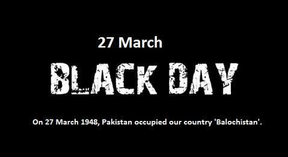
Baloch National Movement urges everyone to observe 27th March as Black Day

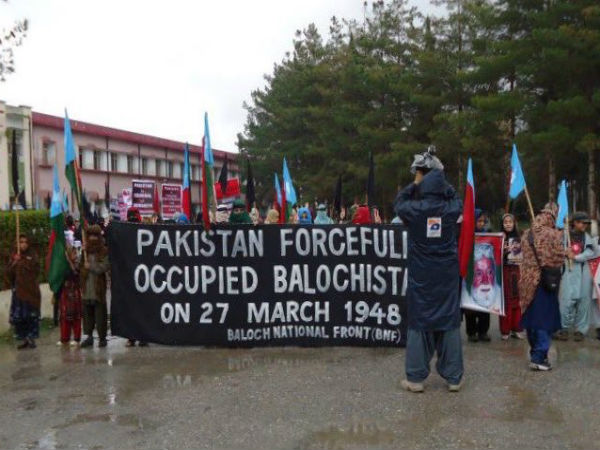
Baloch National Movement (BNM) has called upon to observe 27th March as a Black Day. The spokesperson of Baloch National Movement, in a statement, said, “Like in the past years, this year also we will observe 27th March as Black day. All zones of the Baloch National Movement will organize reference programs in Balochistan as well as at the international level in Germany, Netherlands, Australia, South Korea, England, and Canada. BNM’s different zones will demonstrate and protest.”

The BNM spokesman said that 27th March, 1948 will always remain etched in the Baloch history. On this day, Pakistan had occupied the newly formed state of Balochistan, which had its own history of thousand years, through brute military power and after that Pakistan turned the Baloch nation into its colony. From this day Baloch national identity, its culture, traditions and high moral values fell prey at the hands of a state that completely lacks history and culture. The sole purpose of the formation of a state like Pakistan was to safeguard the vested interests of the West.

The spokesman of Baloch National Movement (BNM) also said that from 27th March 1948 Pakistan has caused destructive impact on Baloch history, culture, and tradition. “On this day we lost our freedom and were forced to live a wretched life of slavery. The living and active nations never forget the days of national significance, rather observe it with the fullest intensity and draw policies according to the requirements and importance of such occasions. Therefore it is our national responsibility to educate our youth and the world about the historical significance of 27th March. On 27th March 1948, Pakistan occupied Balochistan and turned us into colonized people. Hence, the Baloch nation rejected the occupation of Balochistan and has been struggling against Pakistani occupation from the very first day. This national movement of the Baloch nation has gone through several ups and downs, and it is still going on with fullest vigor towards its cherished destination. The Baloch nation has offered infinite sacrifices in this journey; the series of sacrifices will continue until the final destination of national liberation.”

He added that Pakistan had been targeting political activists, social workers, students, professors, doctors, engineers, lawyers, literary persons and people from all fields of life in order to crush the national struggle and enslave Baloch nation for eternity. Thousands of Baloch have been martyred and thousands more had been enduring the atrocities and inhuman torture in the custody of the Pakistani Army.

“Today Baloch nation is facing an all out genocide which has continued in different ways from the first day of the occupation of Balochistan.”

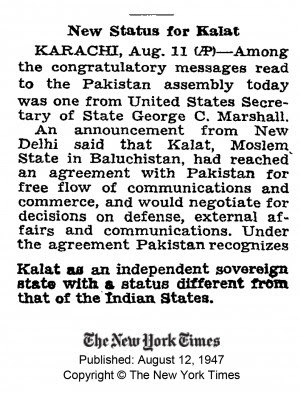
The BNM spokesman further explained: “The ruler of Balochistan Mir Ahmedyar Khan on 11th August 1947 announced the freedom of Balochistan from the British empire that was broadcast by All India Radio Delhi and on 12th August 1947, New York Times also published this news of the freedom of the State of Kalat (Balochistan). After the fourth day of the freedom of Balochistan, on 15th August 1947, Britain declared the independence of subcontinent while creating two different states India and Pakistan,”

“The ruler of Balochistan, Khan of Kalat revived the old traditional system of ruling through establishing a bicameral parliament, Dewan-e- Aam (House of Representatives) and Dewan-e-Khas (House of Lords) by following the cabinet system of Great Britain. Meanwhile, Mohammad Ali Jinnah having the backing of Britain started exerting pressure on the state of Kalat to join Pakistan. In this regard, the first parliamentarian session of the lower chamber of Balochistan was convened in Dadar in order to discuss the question of accession to Pakistan between 12th to 15th December 1947. Balochistan’s House of Representatives (Dewan-e-Aam) unanimously rejected the idea of accession to Pakistan. Similarly, Dewan-e-Khas (House of Lords) rejected the motion of joining Pakistan on 4th January 1948. The Parliament of Kalat in its second session on 27th February 1948 once again rejected the idea of joining Pakistan.”

He further added, “After this Pakistan sent its regular army into Balochistan and occupied Balochistan by brute military force on 27th March 1948. Baloch nation opted to resist this military aggression of Pakistan which has continued as one of the extremely successful resistance movements till today.”

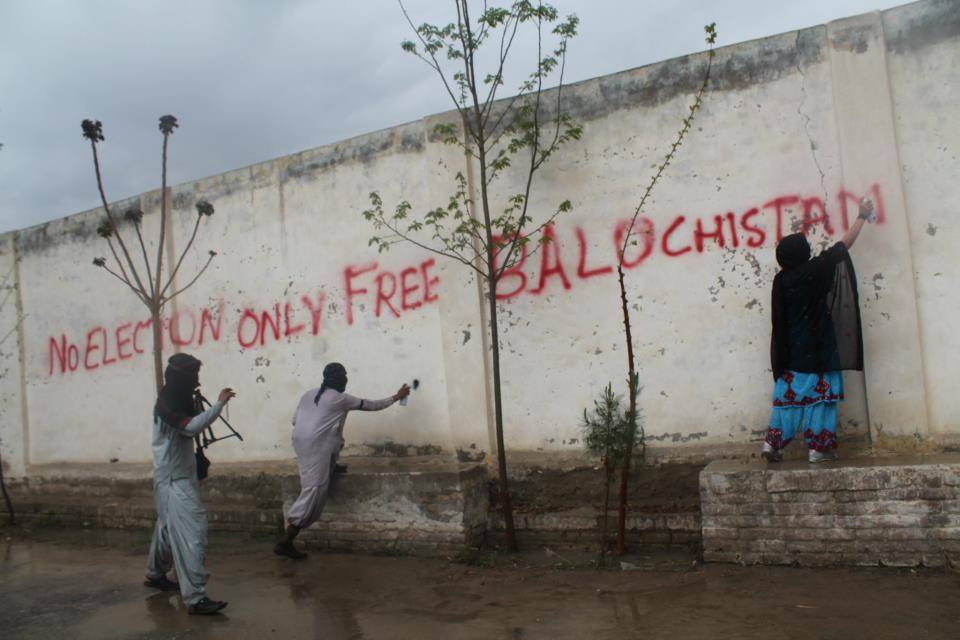
Free Balochistan: The Writing is on the Wall !

He said, the Baloch nation is known for its hospitality, bravery, resilience, secularism, religious tolerance and abiding by agreed accords. The Baloch nation has always resisted the foreign invaders and struggled against the expansionists. The historical event of resistance against Alexander, Iranian empires, Arabs, Mongols, and Central Asian invaders are a golden part of our history of resistance. This is the reason Balochistan has always been a hard nut for the foreign invaders to chew.

He explained further: “On 13th November 1839 under the leadership of Major Wilshire, the British Army attacked Kalat. But the ruler of Balochistan instead of surrendering to the British Army opted to resist the advancing army and preferred martyrdom. Even amidst the intrigues of British, Balochistan maintained its existence and sovereignty till 27th March 1948. But the British remain successful in dividing India into two parts. They needed a client state in this region to protect their interests in the future. They remained successful in galloping Muslim League and Mohammad Ali Jinnah as their pawns that successfully worked in their favour.”

History witnesses Pakistani occupation of Balochistan through the conspiracy of Britain. It is also the hard part of history that during the conference of 4th August between the ruler of Balochistan and Viceroy of India, the leaders of Muslim League, Mohammad Ali Jinnah and Liaquat Ali Khan were also present where the freedom of Balochistan (State of Kalat) and the return of British Balochistan were discussed. As well as the position of Balochistan was kept separated from the other states of India and Balochistan was declared a separate sovereign state.

The spokesperson of BNM said that Baloch nation observes 27th March as Black Day every year, because this day Pakistani Army stormed into Balochistan and forcefully occupied Balochistan on 27th March 1948 against the wishes of the people of Balochistan. “We have lost our national identity after becoming a colony of Pakistan. Not only we have been deprived of our motherland, but also soon after the occupation of Balochistan Pakistan Army set on atrocities and genocide of a Baloch nation.”

Previously Baloch nation has gone through four waves of national genocide, the fifth waves of Baloch national genocide has started with the beginning of the 21st century. In comparison, to the previous episodes, this phase of the Baloch national genocide is much more intense and extended. Thousands of Baloch are killed and thousands more lie in the custody of the Pakistani state and millions of people have been forced to migrate. But unlike past, this time the Baloch nation is more committed and determined in its struggle to attain national freedom. This is the obvious symbol of the love and sacrifice of the Baloch nation for the freedom of their motherland.

“Baloch National Movement (BNM) will run an online campaign on social media while using the hashtag of #27MarchBlackDay. It is an appeal to all social media users and human rights activists to take part in this online campaign,” the BNM spokesperson said.

Discrimination due to skin colour must stop. Now.

A month ago the Indian government introduced a bill seeking ban on promotion of fairness creams and other products. The punishment, in case of a violation, could be a jail term of five years and a fine of Rs 50 lakh. Yes, this is an extremely commendable move and this social issue should have been discussed at length—that unfortunately did not happen. For years, we have seen fairness creams being promoted brazenly on television channels, radio and the print media. And of course, Bollywood has played its part. Mega stars including Shahrukh Khan and Yami Gautam have shamelessly featured in advertisements showcasing fairness creams.

The ads had one message—life was in shambles due to the colour of the skin and the moment the skin tone changed and became lighter or fairer, things brightened up. How terrible and absurd can that be!

India, like the world over, has been obsessed with fair skin and this is not just a development of recent times, the trait can be traced back to the country’s ancient history. We have been taught how the Aryans were conscious of their skin colour and therefore considered themselves superior to the Dravidians who had darker skin complexion.

This trait, unfortunately has stubbornly remained etched in the country’s social order. It is no secret how matrimonial columns read in India. It was considered absolutely normal to “want” beautiful, slim and fair girls as brides. Again if the groom was well educated with a good job, it was almost as a matter of right that he and his family would seek a beautiful and fair girl.

During my growing up years, I have seen how the society celebrated girls and women with fair skin tone. I spent most of my growing up years in Kolkata, a city known for its culture and intellect. But unfortunately things were not very different even there. In the 1990s and 2000s, being fair skinned was an advantage and clearly mostly those who qualified being “fair” often displayed a sense of superiority.

Barring Kajol, we hadn’t seen a Bollywood star, especially around that time who looked “normal” – like a girl next door. They had to be fair and being fair meant being beautiful.

Several comedians on television programmes or movies have ridiculed people especially girls for being dark. And worse, this was never considered rude or offensive. Small wonder that Hindustan Unilever Limited’s signature brand Fair & Lovely has been one of the most demanded products for many years. Words like “kallu” (slang for Black) and descriptions such as “kali bhains” (Black Buffalo) among many others were just as normal as they could be.

What is even more baffling is the fact that Indians often complain of racial discrimination when they go outside the country. Yes, they may have been subject to discrimination due to their skin colour but is it okay to complain when we ourselves are utterly racial in our innate behaviour?

Even today, many wouldn’t admit or agree but the society does discriminate against people of other nationalities who are dark skinned. Often they have to face up to excessive aggression by many of us and that is shameful. Simply put, many Indians complaining of racial discrimination are racists themselves and have biases against those with dark skin colour.

Earlier this year Norway banned Fair & Lovely creams as they found toxic ingredients in it posing health hazards. While it does make many feel elated that the ads for these products have been banned but it would have been better if they had been taken off the shelves for social and ethical reasons.

The silver lining: Things are starting to change. We have seen several activists including Nandita Das coming forth. It is also heartening to see things gradually change in Bollywood, which is nothing less than religion in India. Remember in the Ranveer Singh-Alia Bhatt blockbuster Gully Boy, the message was clear—shun Fair & Lovely or any fairness products.

As we gear up to celebrate yet another Woman’s Day on March 8, let us ensure that no girl or woman is discriminated because of her colour. It is not only important to ban promotion of fairness creams but it is time we ban the usage of those products.

Despite current normalcy in Kashmir, the danger is far from over

This time of the year, in 2019, there were great tensions between India and Pakistan. The immoral terrorist attack on a CRPF convoy at Pulwama, Kashmir, on 14th February elicited a strong riposte from India. Indian Air Force carried out a very successful air strike on a terrorist camp at Balakot, deep inside the Pakistani territory on 26th February. More than 300 terrorists trained and ready for infiltration into India were killed in the strike.

The very next day, a weak aerial response from Pakistan was met with strong opposition from the Indian Air Force and the Pakistani jets were forced to withdraw. In the heat of the air battle a daring Indian pilot, Wing Commander Abhinandan, shot down a Pakistani F-16 aircraft. The aircraft of Wing Commander Abhinandan also got hit and he ejected successfully, but inside the Pakistani territory and was taken as a prisoner. After hair raising negotiations, where India maintained a strong and righteous stand, the pilot was returned back to India on 1st March, 2019.

The release was appreciated as a good gesture by Pakistan, but, it did not have any impact on the situation along the Line of Control (LOC) and the hinterland in Jammu and Kashmir. Ceasefire violations and terrorist initiated violence continued unabated.

Post the General Elections in India, BJP came back to power. One of the first actions that it took was to bring about the long awaited and much desired change of political status of Jammu and Kashmir. In an act hailed as both righteous and justified, the new government passed legislation to dilute the draconian Article 370 and Article 35A and also bifurcated the state into two manageable Union Territories.

Anti-India separatist forces led by Pakistan predicted massive riots and disruption of normal life in the wake of the new dispensation. Their predictions, however, proved terribly wrong with the people accepting wholeheartedly the new set up as one that would be of benefit to them.

Considerable credit for this peaceful transition lies on the broad shoulders of the Indian Army. The force remained sensitive to the emerging challenges. Pakistani attempts to increase the threshold of violence both along the LOC and in the hinterland were thwarted effectively. The army worked in close coordination with other security forces and gave them the confidence to function in the very difficult conditions.

The end result was that the government was able to bring about the legislated change on schedule despite all threats of dire consequences. The two Union Territories under their respective Lieutenant Governors became effective on the night of October 31st, 2019 as planned.

Even as the political process continues smoothly, the Indian Army and other security forces have enough cause to remain ever vigilant against machinations of a very determined enemy – Pakistan. The year 2019 witnessed a record 1,586 incidents of ceasefire violations. This year has been no better with 646 ceasefire violations already recorded in the first two months up to 23rd February. The singular objective of ceasefire violations is to infiltrate terrorists into Kashmir since the existing strength is dwindling at an alarming pace, much to the discomfiture of the Pakistan Army and its ISI.

The period from declaration of the new status of Jammu and Kashmir on August 5th, last year to the present has witnessed 27 encounters of security forces with terrorists in Kashmir; a sizeable number considering the depleted condition of the terrorist cadre. The terrorists operating in Kashmir had been given a “fight to the finish” diktat by their masters sitting across the border. 

In the interim, there has been a change in command of the Indian Army with General MM Naravane taking over as Army Chief. As expected, he is giving full attention to the region. General Naravane has extended full support to the new political dispensation put in place in the region, and has made no bones about the proactive policy that the Indian Army would follow in eliminating the scourge of terrorism. “The scrapping of Article 370 — a historic step — has adversely affected the plans of the western neighbour and its proxies. It will help integrate Jammu and Kashmir with the mainstream,” he said, further adding that the armed forces would have “zero tolerance against terrorism.” “The army has many options to counter those who promote terrorism. We will not hesitate to use them…We will respond in equal measure,” he said in a strong message to terrorists.

“We have evolved a strategy of resolute punitive response against sponsored terrorism. If Pakistan does not stop state-sponsored terrorism, we reserve right to pre-emptively strike at sources of terror,” was the direct message that General Naravane gave to Pakistan.

Recently, Lt. General KJS Dhillon has completed an eventful and successful tenure as General Officer Commanding of the Chinar Corps of the Indian Army, whose operational area falls in the Kashmir Valley. The army has chosen as his replacement, Lt General BS Raju, who has great experience in the region having commanded a Brigade and a Rashtriya Rifles Force Headquarter there. On taking over command, Lt General Raju, spoke of the marginalisation of the separatist and militant movement. “I believe that those nurturing separatist feelings have been shown the door,” he said. He, however, also held forth a word of caution with respect to the security scenario by stating that there are indications that Pakistan may try to push terrorists into India. “We are prepared to give them a befitting reply and defeat their nefarious designs,” he added.

Many positive changes have taken place in the last one year and things are moving smoothly, but the danger is far from over. The new political dispensation is firmly embedded but Pakistan has no intention of shelving its malevolent designs for the region. The security forces, led by the Indian Army, need to remain ever vigilant and proactive so as to provide the platform of normality on which the political process can take roots.  

US-Taliban peace deal shows American desperation to quit Afghanistan

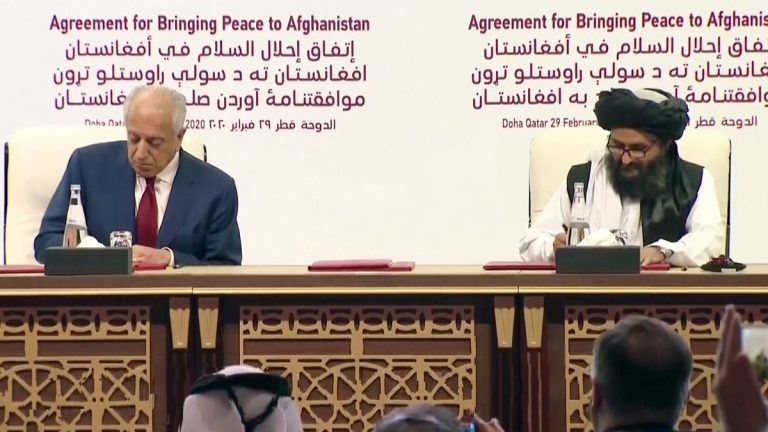
Every nation works in the best interests of its people and so there’s nothing wrong with Washington making an agreement with the Taliban to end the nearly two-decade old conflict in Afghanistan in order to get its soldiers back home. But who would have ever thought that a country that talks so big about its unconditional commitment to fight the scourge of terrorism worldwide, would abandon this stated principle so shamefully for exiting Afghanistan? Yet, what has happened is right there in front of us to see and current developments don’t inspire much confidence that this so-called ‘peace deal’ will work out as is evident from the renewed attacks by Taliban within just two days of the accord being signed.

But then, what’s happening is on the expected lines because in its tearing hurry to get out of Afghanistan, Washington has made two cardinal mistakes. The first one is that even though US President Donald Trump correctly identified Pakistan as being the patron of Taliban (remember his 2018 tweet “They (Pakistan Government and Army) give safe haven to the terrorists we hunt in Afghanistan?” and yet Washington’s efforts to discipline Islamabad weren’t either sustained or determined. Whereas the US did impose certain restrictions on financial aid to Islamabad for “not doing enough” in its war against terror, it seems that the US State Department was over awed by Pakistan Foreign Minister’s Khawaja Asif’s open threat that Washington couldn’t win its war on terrorism “by excluding or confronting Pakistan.”

Trump’s second blunder was making his sheer desperation to exit Afghanistan so evident that it emboldened the Pakistan Army not only to continue patronising Taliban but also discreetly pushing it to dictate ridiculous terms and preconditions. Taliban’s proclivity for violence is well known and its car bombing in Kabul that killed a US serviceman in September last year forcing Trump to call-off the peace deal that was in its final stages is ample proof of this. Yet, rather insisting upon that the Taliban should display its seriousness by ensuring a reasonable period of peace as a prelude to signing the accord for American troops withdrawal from Afghanistan, Washington surprisingly settled for merely a “reduction in violence” clause, and that too for just one week. But the most astonishing thing is that this weird one-week long “reduction in violence” condition wasn’t been set by Washington but thrust upon it by the Taliban.

This leaves one in no doubt as to who’s calling the shots during the US-Taliban negotiations and it’s because of this that the proposed peace deal appears to be a non-starter. Already, the Taliban has put an unreasonable precondition that 5,000 of its captured fighters should be freed before negotiations can proceed any further and Taliban spokesman Zabihullah Mujahid has already warned that, “If our 5,000 prisoners – 100 or 200 more or less does not matter – do not get released there will be no intra-Afghan talks.” It’s quite likely that in its desperation to exit Afghanistan, Washington may oblige to release these prisoners; but doing so will be a humungous blunder because once its captured fighters are released, the Taliban will have no reason to honour an agreement that questions its supremacy.

Even if the accord works out and gives an honourable closure to the US-led military operation in Afghanistan (officially christened “Operation Enduring Freedom”), the one thing certain is that peace will continue to elude Afghanistan! The Taliban doesn’t recognise the democratically elected Government of Afghanistan (and since Rawalpindi too isn’t quite happy with it), a bloody power struggle between Afghan forces and the Taliban after US troop withdrawal is inevitable. The Taliban has already made this clear by launching 43 attacks on Afghan security check-posts on Tuesday and though these attacks are obviously meant to pressurise the Ashraf Ghani government into releasing Taliban fighters from Kabul’s custody, it also serves as a message that the Taliban will use guns to resolve its differences with the Afghanistan government, which it refers to as “the Kabul puppet administration.”  

Whereas the US has retaliated to the Helmand attacks with an airstrike against the Taliban, but by taking pains to clarify that this was a “defensive” strike, the Americans have exhibited an apologetic stance. But what’s most disturbing is that instead of issuing a strong and unambiguous warning of appropriate retribution in case such attacks don’t cease, the US military spokesperson Col. Sonny Leggett came up with a politically sounding tweet saying, “We call on the Taliban to stop needless attacks and uphold their commitments.” Whereas the US military may not be wanting to jeopardise the ongoing talks by adopting a belligerent approach, but by saying things that convey an impression of being willing to accept any compromise for saving the accord will only embolden the Taliban to violate the reached agreement.

Lastly, by demanding that the Taliban should take necessary measures to “prevent any group or individual, including Al Qaeda, from using the soil of Afghanistan to threaten the security of the United States and its allies,” the Americans may give an impression of being very concerned about the wellbeing of their allies. But by conveniently missing out the seeking of a similar safeguard in terms of Taliban not threatening the security of the Afghan government, Washington is literally ushering in an all-out civil war that would obviously culminate in the Taliban’s return to power in Afghanistan and replay of the dark 1996-2001 period that saw unspeakable atrocities being committed on innocent men and women.

Postscript- It was America’s Faustian deal with Pakistan in the 1980s that not only saw the rise of Taliban but also created a fertile breeding ground for the spawning of religious fundamentalism and radical Islam. Four decades down the line, we are once again witnessing Washington making another Faustian compromise that will accord official recognition to the Taliban terrorist group. Strange as it may sound, but the reality is that while America wants the world to shun Tehran for allegedly patronising terrorist activities, but by turning a blind eye to Pakistan which (by Prime Minister Imran Khan’s own admission) has been providing sanctuary to many internationally proscribed terrorist groups, Washington has fared no better!

Karnataka government presents ‘Child Budget’

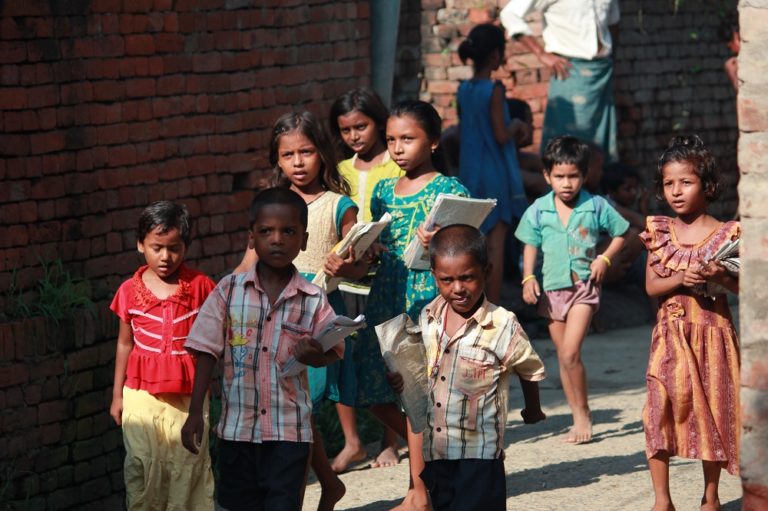
Bringing child-centric issues and relevant policies in focus, for the first time in India, Karnataka government presented a ‘Child Budget’ on Thursday. Chief Minister B.S. Yediyurappa said this budget, as a special feature, consolidates all the policies and programmes for the development of children aged below 18. It has 279 programmes with an allocation of ₹36,340 crore, which constitutes 15.28% of the total volume of the State Budget.

The Child Budget lists a range of issues — survival, protection, and development — from different departments. The maximum funds in this Budget are from the Department of Primary and Secondary Education and the Department of Women and Child Development. Experts feel that this kind of budgetary focus  will facilitate better programme monitoring and expenditure on child-centric issues.

The Chief Minister also announced modernising Mahila Supplementary Nutrition Production and Training Centres, aimed at better nutrition at anganwadi centres. “To enhance the production capacity by modernising these centres, it is proposed to provide interest-free loan from ₹15 lakh to ₹20 lakh under the Marginal Loan Scheme of the Karnataka State Women Development Corporation,” he said.

It was also announced that youngsters who are discharged from Bala Mandiras after 21 years will be given a financial assistance of ₹5,000 a month for a maximum of three years under the ‘Upakara’ scheme. Skill Development Training will also be provided to these young men and women.

The government will repair 842 anganwadis damaged in floods last year at a cost of Rs 138 crore.

Another interesting announcement that was made was about bag free classes. Two Saturdays a month, school students in Karnataka will attend classes free from a load of school bags. “By making two Saturdays a month as bag-free days, ‘Sambhrama Shanivara’ will be observed with the objective of creating a joyful learning experience by reducing the burden of textbooks,” stated the Karnataka CM. There will be an effort to create awareness, through a range of activities, on topics that are necessary for students to be ideal citizens.

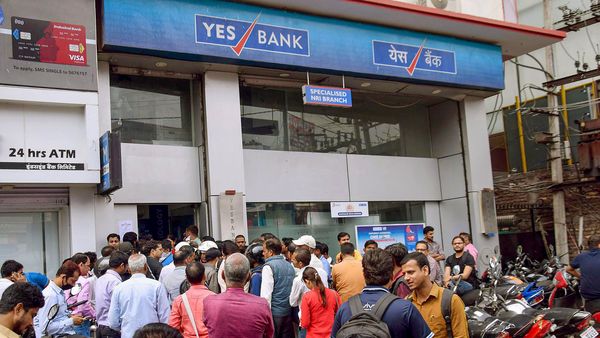
Finance Minister Nirmala Sitharaman tries to allay fears amidst Yes Bank crisis

Finance Minister Nirmala Sitharaman on Friday said the government has asked the Reserve Bank to look into what went wrong at Yes Bank and fix individual responsibilities.

Addressing a press conference after the RBI superseded the board of Yes Bank and placed withdrawal restrictions, she said the bank was being monitored since 2017 and developments relating to it were being monitored on a day-to-day basis.

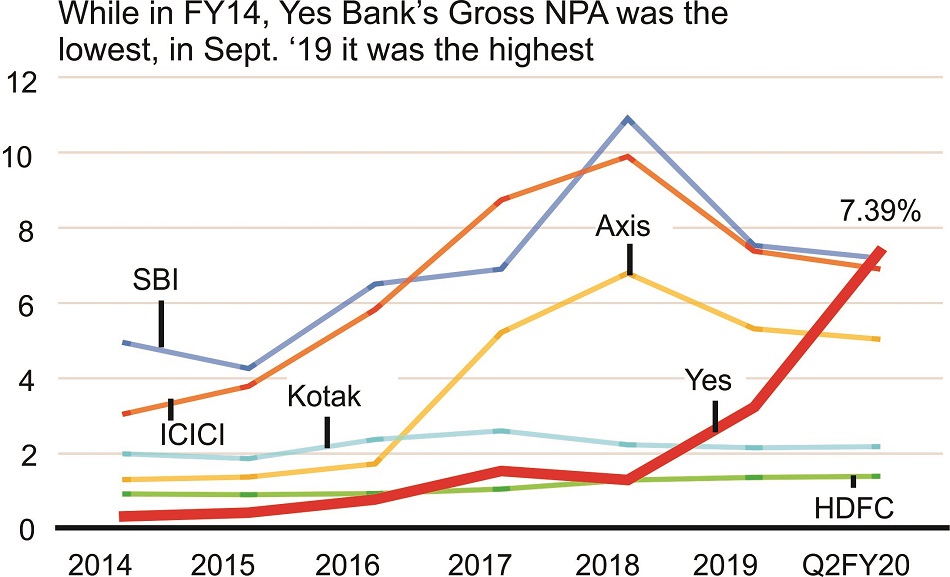
Since 2017, the central bank noticed governance issues and weak regulatory compliance at Yes Bank, besides wrong asset classification and risky credit decisions, she said.

Finance Minister Nirmala Sitharaman said that Reserve Bank of India is working towards for early resolution of Yes Bank issue. RBI governor has assured that there will be no loss to any Yes Bank depositor, the finance minister said, adding that the steps taken to take control of Yes Bank is in interest of depositors, bank and the economy.

“I want to assure every depositor’s money is safe, and I’m in constant touch with RBI. Both RBI and government are looking at Yes Bank issue in detail and the course of action will be in everyone’s interest. The immediate priority is to ensure Yes Bank customers are able to withdraw money within ₹50,000,” Finance Minister Nirmala Sitharaman said.

State Bank of India said on Thursday that “an in-principal approval has been given by the board to explore investment opportunity” in Yes Bank.

Ahead of Women’s Day, Pakistan Army murders Baloch woman in cold blood

Pakistan Army continues its atrocities across Balochistan. In its latest act of cruelty a Baloch woman was detained, tortured and killed in cold blood while she was in illegal custody of the Pakistan Army. The woman was arrested along with others and shifted to an unknown location.

A few days ago, Pakistani forces had arrested and moved Zar Gul who is the daughter of Rahim Bakhsh Baloch to an unknown location from Mashkay Mangoli Zemro area of Balochistan. According to local sources, the detained woman has been killed after several violent attacks and her body has been handed over to her relatives, but Pakistani forces have threatened that the entire family will be punished, if news about the woman’s murder comes out.

Pakistani government officials have not yet commented on the incident.
Human Rights Council of Balochistan’s Deputy Coordinator, Lateef Johar Baloch, expressed his views on Twitter, “Very Disturbing! According to locals, a Baloch woman, Zar Gul, died from the tortures of Pakistan army. She was abducted… from Mashkay, Balochistan 2 days ago. The abduction & killings of civilians must be stopped. Pakistan must be accountable for the killing.”


He further added in another tweet: “Eight other family members of Zar Gul were also murdered by Pakistani army in an air attack on her uncle’s house in Mashkay, Balochistan in 2012. I am a witness to that incident; we went there just after the attack. There was no help for the wounded. It was extremely painful.”

In a separate incident, two sisters Sameena Baloch and Zubaida Baloch daughters of Murad Baloch were detained by the Pakistani forces when they were traveling from their hometown of Tijaban to Turbat area of district Kech. They were released later on.

The matter of enforced disappearances in Balochistan has become a serious problem. The relatives of the missing persons are continuously protesting.

Eminent Citizens Petition Governor for Implementation of CAA in Punjab

Eminent citizens of Punjab met Hon’ble Governor of Punjab VP Singh Bandore and petitioned the Government of Punjab, through his good offices, to make full use of the provisions of CAA and to grant early Citizenship in India to Hindu,  Sikh, Christian, Jain and Buddhist minorities of Pakistan who have fled the country, due to intolerable persecution and taken refuge in Punjab, India.

This group comprising of prominent Military and Police Officers, Bureaucrats, Academicians, Journalists and Lawyers belonging to Punjab had organised a discussion on, “Citizenship (Amendment) Act, 2019 (CAA): Implications for Punjab” on 7th February 2020 at Union Territory Guest House in Chandigarh.

Members of some families from Pakistan that have taken refuge in Punjab, India, also participated in the discussion and gave their firsthand account of the situation in Pakistan and the problems faced by them after their arrival in India.

The refugees from Pakistan related heart-rending stories of restraint on freedom and blatant persecution of the aforementioned minorities in Pakistan. They said that they and their kin were not allowed to hold marriage celebrations or even cremate their dead in accordance to their customs without permission of authorities. The young girls of minority communities are forcibly converted to Islam and then married to Muslims. Police does not bother about their complaints and no investigation is undertaken. They were denied education and equality in job offers and converted into second class citizens to live always under the shadow of fear and intimidation.

It was further established that a large number of persecuted Hindu and Sikh families in Pakistan are even now looking for means to leave the country but finding it difficult due to enhanced and stringent restrictions on their applications for a Visa to visit India.

Those who have managed to come to India have got their freedom but their troubles are far from over. The process of getting Indian citizenship is long and arduous so they are living a life devoid of any identity. This adversely affects their progress and that of their children.

“These unfortunate people feel that it is only Punjab that can understand their problem and their plight,” said Jaibans Singh, one of the steering members of the group that met the Hon’ble Governor. “If Punjab does not come forth to assist us then who will?” he added.  

The refugees sent a fervent appeal to the Government of Punjab to take the lead in applying the provisions of CAA and get them Indian Citizenship. The meeting of eminent citizens, thus, resolved to project the case of the refugees to the Government and it was in pursuance of this promise that the Hon’ble Governor was petitioned

Asian Elephant, Jaguar and Great Indian Bustard added to Global Wildlife Agreement

The Thirteenth Meeting of the Conference of the Parties to the Convention on the Conservation of Migratory Species of Wild Animals (CMS COP13), which concluded recently in Gandhinagar, led to the adoption of a number of significant resolutions and decisions to address the conservation needs and threats facing migratory species around the globe.

CMS Executive Secretary Amy Fraenkel said: “With COP13, the important role of CMS in protecting nature around the world has been strongly embraced. CMS is uniquely positioned to address the conservation of migratory species and their habitats, and to contribute to reversing the trends of species and biodiversity loss worldwide.”

CMS COP13 was the largest ever in the history of the Convention, with 2,550 people attending including 263 delegates representing 82 Parties, 11 delegates from 5 non-Party countries, 50 representatives from United Nations agencies, 70 representatives of international NGOs, 127 representatives of national NGOs and over 100 members of both national and international media.

Ten new species were added to CMS Appendices at COP13. Seven species were added to Appendix I, which provides the strictest protection: the Asian Elephant, Jaguar, Great Indian Bustard, Bengal Florican, Little Bustard, Antipodean Albatross and the Oceanic White-tip Shark. 

The Urial, Smooth Hammerhead Shark and the Tope Shark were listed for protection under Appendix II, which covers migratory species that have an unfavourable conservation status and would benefit from enhanced international cooperation and conservation actions. 

New and extended Concerted Actions with targeted conservation plans were agreed for 14 species. For a full list of Concerted Actions, please click here.

CMS COP13 also adopted the Gandhinagar Declaration, which will send a message to the first negotiating session of the Open-ended Working Group on the Post-2020 Global Biodiversity Framework convening in Rome next week.  The Declaration calls for migratory species and the concept of ‘ecological connectivity’ to be integrated and prioritized in the new Framework, which is expected to be adopted at the UN Biodiversity Conference in October.

The first ever report on the Status of Migratory Species, presented to CMS COP13, shows that despite some success stories, the populations of most migratory species covered by CMS are declining. COP13 agreed that a more comprehensive review should be undertaken to better understand the status of individual species and the main threats they face.

“The initial status report has been a real wake up call for the Convention, and Parties recognized, the importance of a more thorough analysis. CMS COP13 has given a clear mandate to prepare a flagship report on the status of migratory species which will give us a better idea of what is happening on the ground, and also provide a much needed tool for understanding where we need to focus our work,”  Ms. Fraenkel said.  

The COP also agreed on a number of cross-cutting policy measures to address threats to migratory species:

  • Integrate biodiversity and migratory species considerations into national energy and climate policy and promote wildlife-friendly renewable energy;
  • Strengthen initiatives to combat the illegal killing, taking and trade of migratory birds;
  • Mitigate the impacts of linear infrastructure such as roads and railways on migratory species;
  • Address the unsustainable use of aquatic wild meat;
  • Undertake a review of bycatch levels of sharks and rays, and further implement bycatch mitigation measures for marine mammals in national fishing operations;
  • Deepen our understanding of the importance of animal culture and social complexity for the conservation of endangered species;
  • To investigate possible trade in CMS Appendix I species and the implications for their conservation status.

CMS COP13 was the first of a series of international nature-related meetings in 2020, which will culminate in the UN Biodiversity Conference at the end of this year, when a new global biodiversity strategy for the next decade will be adopted – the Post-2020 Global Biodiversity Framework.

NID to design the exterior of 90-year-old iconic Deccan Queen Express

One of the most prestigious trains with rich heritage value of Indian Railways namely the Deccan Queen Express (Train No. 12123/12124) running between Mumbai and Pune in Maharashtra is gearing up for a major revamp. Firstly, the 90-year old train is now proposed to be upgraded with the German design Linke Hofmann Busch (LHB) coaches. LHB coaches have a better safety features and improved travelling experience – better suspension system and better riding comfort. Secondly, there is proposed revamp of external livery design of the train which will be used in the proposed LHB rake of the train. Presently, Deccan Queen has a unique existing livery colour of blue and white with a red band. Thirdly, there is also a proposal for a New Logo of the proposed LHB upgrade of the train.

Central Railway which operates this train has started this exercise of revamping external livery design of this proposed LHB upgrade of DQ. In light of deep emotional connect of rail commuters with this train, the Central Railway has sought customer opinion on the preferred external livery design. Based on various consultation and customer feedback, the Central Railway has prepared eight different livery design along with their ranking as per the customer voting. A new logo design has also been proposed incorporating an image of the UNESCO listed Mumbai-CSMT station. On the advice of the Railway Board, the Central Railway has engaged National Institute of Design (NID), Ahmedabad, an autonomous Institution under the Ministry of Commerce & Industry, Government of India to provide their professional inputs on the livery designs. Central Railway has made all the eight different livery designs, logo design and other related material available to NID.

Accordingly, the NID team has visited Mumbai to inspect the existing train and travelled in DQ and interacted with the customers to gain the first-hand experience. They also visited the UNESCO certified CSMT building. During their visit, the team is doing data collection, measurements, photography, filming, interaction with the railway officials and passengers. They are expected to submit their report sometime later this month. This exercise is an excellent example of synergy between two Ministries of Government of India namely Ministry of Railways and Ministry of Commerce & Industry.

This train is well-patronised service since 1930. It also has many records like India’s first superfast train, first long distance electric hauled train, first vestibuled train, first train to have ladies’ only car, first train to feature a dining car.

The introduction of “Deccan Queen’’ between the two premier cities of Maharashtra on 1st June 1930 was a major landmark in the history of the Great Indian Peninsula Railway, the forerunner of the Central Railway. This was the first deluxe train introduced on the railway to serve 2 important cities of the region and was aptly named after Pune, which is also known as “Queen of Deccan’’ (“Dakkhan ki Rani’’).