Home Blog Page 380

Good Cop, Bad Cop 1 on Religion in American Politics

*Conducted December 31, 2019.*

By Scott Douglas Jacobsen and Rick Rosner

Rick Rosner: Right now, religion is most prevalent in America where it is being abused. Where Evangelicals largely support Trump because they support his agenda, I don’t know if it mostly revolves around getting rid of Roe v Wade, which would make abortion illegal throughout the United States. That is the most prevalent issue. 

If you look at the history of abortion, then it didn’t become a moral issue. Until, it was harnessed to become a political issue. For most of the 19th century, it was largely accepted. It wasn’t a moral issue, as long as you did it before quickening, which is when you can feel the fetus moving around. The issue in the 19th century was not a moral one, but many of the ways that induced abortion killed the mom.

So, when abortion started getting outlawed, it was to try and stop people from dying from trying to get an abortion. It wasn’t because people had moral objections. Even the Catholic Church tacitly accepted abortions with the belief being that the ensoulment of the fetus didn’t happen until many weeks after conception, so, it is not like there’s always been a feeling among Christians or aborting a fetus is killing a human being with a soul.

That is a fairly recent development. It was a belief that came to the fore after 1880, which speaks to it being a political thing. It is not like we became more moral about this issue in 1880. It is something tangled up with getting people riled up to vote Republican. There are plenty of other things that religion does in the United States that aren’t cynical and are helpful.

Scott Douglas Jacobsen: Some of the worst aspects of American freedom comes in the form of abusing sincere religious belief for discriminatory policies. Arrogant, simple-minded sloganeering intended to manipulate real sensibilities and feelings in ordinary believers. The overt extension of this is the Christian Right in the United States. Looking South across the border, we have some of the issues in Canada. But it’s just not the same in extent or kind. American fundamentalist is another beast. It is primarily political and secondarily spiritual (moral lessons and ritualism).

Rosner: I would guess that, demographically, the U.S. is more Christian, probably has a higher percentage of the population calling themselves Christians, than any other demographic of the country. Certainly, in terms of raw numbers, you have more people calling themselves Christians than about anybody else. That means Christians are demographically exploitable through appeals to their Christianity.

It also means that terrible forms of manipulation can be successfully done in super Christian parts of the country, like science denial. The more scientifically literate and oriented a population is; the less cynical politicians can get away with manipulating people with ridiculous arguments. One argument that popped up, the ridiculous argument that popped up, throughout 2018 and 2019 was that democrats, liberals, want abortion to be legal and at will. All the way to birth and even after birth.

Jacobsen: [Laughing].

Rosner: It was a setup. Republicans would present legislation that forced Democrats to veto or not support it, because it prohibited children born with devastating and fatal congenital and genetic defects. That they had to be given all the lifesaving procedures that a kid with a reasonable expectation of living a normal life would be given. In other words, the Democrats didn’t want to pass legislation or support legislation that would force doctors to keep a baby born without a brain on life support indefinitely. 

Maybe, 1/10th of 1% of kids are born with anencephaly. They lack a brain. They have enough of the brainstem to keep them breathing, sometimes, for a variety of reasons. In that case and other similar catastrophic cases of birth defects, the most compassionate and the least wasteful of medical resources is to let babies, who will die in a couple of days anyway, live out their limited 1 or 2 day or couple hour lifespans without putting them on respirators

Obviously, in the case of kids born without brains, you would want to do whatever it takes, e.g., CT scans, ultrasounds, etc., to confirm that these are babies without brains. Once that is confirmed, often, babies born like this look normal. Even behave somewhat normally, in that, babies don’t have large behavioural repertoires anyway. You would want the parents to have the chance to hold the baby.

You do not want to limit doctors in what they can do with babies who won’t make it. Republicans have been construing this as simply letting people abort babies, even after birth, because the babies are inconvenient. This is super stupid and has been promulgated by Republicans. It is believed by a significant segment of Republican voters. 

Scientific ignorance makes voters manipulatable by stupid arguments.

Jacobsen: And what about the infusion of Evangelical Christianity as a political force in America. Your current president was impeached, President Trump, or has been but is in the processing stage of it. His Vice President is Mike Pence, who has spoken out against abortion and evolution. He wants Creationism all throughout the education system and abortion banned outright. These are coming from a concerted effort of mostly white Evangelical Christians to impose their religious values on the secular state. I find this boorish and against the whole tradition of American admirable secularism and science education.

Rosner: For instance, it is in several states, including California, that have made it illegal to practice conversion therapy – ‘pray away the gay.’ Therapists who promote the idea that you can take somebody who is gay and turn them not gay via psychological therapy, which leads to all sorts of misery. Republicans argue a) that you can do that, where people don’t have to be gay and b) that legislation around priests and rabbis, or anyone who people talk to about being gay, might be subject to being arrested, which is horse shit.

If somebody is 11, or 14, or 25, or 40, and wants to speak to a clergyperson, saying, “I think I’m gay.” They are wondering how to proceed with their life. Of course, you would want to talk to someone who’s job it is to help people guide and make decisions with their lives. That is not praying away the gay. That is simply talking about being gay or the aspect of this person as gay.

Pence was Governor of Indiana. Indiana passed one of the statutes that got North Carolina in all sorts of trouble, saying that people did not have to perform services for gay people if doing so went against their religious beliefs. With the standard example being, under statutes like this, bakeries do not have to bake cakes for gay weddings. In the case of Indiana, the statute pissed off enough people and was threatening to fuck up business enough in the state that they fairly quickly rescinded it.

Pence, also, presided over a resurgence in people being infected by HIV in Indiana. I don’t know all the details. It was related to, maybe, getting rid of a needle exchange program and rooted in his disapproval of gayness. Pence’s wife teaches at a school that doesn’t let gay people on the staff and may not allow gay people in the student body. It is the stuff that smaller, more advanced countries; I tend to go to the Nordic countries.

They tend to be models of people believing reasonably. Countries that would say this stuff is bullshit.

You go!

Jacobsen: You mentioned poor countries. In poor countries, this happens a lot more. There are studies looking at the positive relationship between the more religiosity and the more poverty, and the reverse for less religiosity and wealth, at a national level. It is more of a ritual rather than a need for social services in different contexts.

Rosner: What science does is provide on Earth, things that we hope God would provide: health, longer lives, etc. Science takes over for God whose action tends to be random and unevenly distributed, whose benefits tend to be unevenly distributed, and not provably linked to prayer.

Jacobsen: That’s one issue. It will poorer countries, so localized generally. In richer countries, the trade will be linked up. So, okay, we have to deal with the most powerful country in the history of the world with an ignoramus in charge and a religious fundamentalist base who believe in this as a flawed and bad person who God is working through, nonetheless. This is magical thinking. And it’s tens of millions of Americans. It is giving justification around the world for ignorant charlatans and political strongmen to re-affirm and re-entrench themselves. It’s being used to restrict women’s bodily autonomy, harm LGBTI persons, and encourage a rhetoric and a culture of hate and discrimination. What is the way forward, Rick?

Rosner: American religion has changed from the 1940s until now from the benign belief to the strident un-Christian Christianity. Evangelical Christianity has been tethered to political activity. But there are other forms of American Christianity that are more spiritual, more mystical, and are more linked to a feeling or a Golden Rule. Unitarianism or Reform Judaism, where the spiritual dictates or the rules of the religion are relaxed [Ed. Rick follows Reform Judaism], I grew up under Reform Judaism in Colorado. 

There is not as strong a Jewish culture as in the big cities, as in America’s big cities. [Ed. as he has noted before, Reform Jews do not know specifically what they are supposed to believe in any specific context] Although, there are Reform Jews who know their dogma. Most do not. Non-Evangelicals in America are linked with a loathing of Trump and a loathing of what Evangelicals have become.

So, it will take a long time for people to become, if Christianity is ever cleaned up and becomes less corrupt, less corrupt. It will take time, even if this happens, for non-Evangelicals to trust them. Republicans have been engaging in anti-democratic practices, scheming to hold political advantage. Although, on issues not supported by a majority of Americans, that’s what I got on religion and America.

*High range testing (HRT) should be taken with honest skepticism grounded in the limited empirical development of the field at present, even in spite of honest and sincere efforts. If a higher general intelligence score, then the greater the variability in, and margin of error in, the general intelligence scores because of the greater rarity in the population.*

Rick Rosner: “According to some semi-reputable sources gathered in a listing hereRick G. Rosner may have among America’s, North America’s, and the world’s highest measured IQs at or above 190 (S.D. 15)/196 (S.D. 16) based on several high range test performances created by Christopher HardingJason BettsPaul Cooijmans, and Ronald Hoeflin. He earned 12 years of college credit in less than a year and graduated with the equivalent of 8 majors. He has received 8 Writers Guild Awards and Emmy nominations, and was titled 2013 North American Genius of the Year by The World Genius Directory with the main “Genius” listing here.

He has written for Remote ControlCrank YankersThe Man ShowThe EmmysThe Grammys, and Jimmy Kimmel Live!. He worked as a bouncer, a nude art model, a roller-skating waiter, and a stripper. In a television commercialDomino’s Pizza named him the “World’s Smartest Man.” The commercial was taken off the air after Subway sandwiches issued a cease-and-desist. He was named “Best Bouncer” in the Denver Area, Colorado, by Westwood Magazine.

Rosner spent much of the late Disco Era as an undercover high school student. In addition, he spent 25 years as a bar bouncer and American fake ID-catcher, and 25+ years as a stripper, and nearly 30 years as a writer for more than 2,500 hours of network television. Errol Morris featured Rosner in the interview series entitled First Person, where some of this history was covered by Morris. He came in second, or lost, on Jeopardy!, sued Who Wants to Be a Millionaire? over a flawed question and lost the lawsuit. He won one game and lost one game on Are You Smarter Than a Drunk Person? (He was drunk). Finally, he spent 37+ years working on a time-invariant variation of the Big Bang Theory.

Currently, Rosner sits tweeting in a bathrobe (winter) or a towel (summer). He lives in Los AngelesCalifornia with his wife, dog, and goldfish. He and his wife have a daughter. You can send him money or questions at LanceVersusRick@Gmail.Com, or a direct message via Twitter, or find him on LinkedIn, or see him on YouTube.”

Photo by Matthias Kinsella on Unsplash

‘Adopt the Salad Bowl approach to assimilate tribals into Indian mainstream’

0

Tribal Rights Activist Ananya Paul Dodmani has been working with tribals across the country, especially in the North East, for more than a decade. In this interview with Vivek Sinha she offers insights about the pressing issues amongst Indian tribes. As opposed to the “Melting Pot” approach where several cultures blend together to look homogeneous, Ananya Paul advocated the “Salad Bowl” approach where each culture coexists in complete harmony, and yet retains its distinct cultural identity.

Vivek Sinha: You have been working for the welfare of tribal societies for a long time. What are some of the key issues amongst the North East tribes of India?
Ananya Paul Dodmani: North East India has been plagued with different issues over centuries that include economic, political and otherwise. For instance, the tribals in North East do not have proper access to good educational infrastructure, good roads and good health centres just to mention a few. There’s a major lack of stable income facilities among these tribals because of poor educational skills.

Vivek Sinha: What do the tribal communities aspire for? Are their dreams and aspirations similar to that of a city dweller? If no, then what do they aspire for in their life?
Ananya Paul Dodmani: I have been working with the tribals across India for more than a decade now. The simplicity and the minimalist approach that they follow in everyday life is commendable and something that ‘we’ city dwellers should imbibe and learn from. Having said that, the struggle and the everyday fight for a better and united community as a whole which we witness in the tribal habitat is gradually fading off with the coming of modern technologies in their life.

Yet, the tribal kids do not have too much of aspirations to make it “big” in the outside world. They definitely want to study and bring a major change in their own habitats and communities they live in. They look forward to a better livelihood module and wish for more income generations without having to compromise their own ethnic way of life, which I feel is really commendable. The contentment in their everyday lives is reflected in the way they think and look at the outside world.

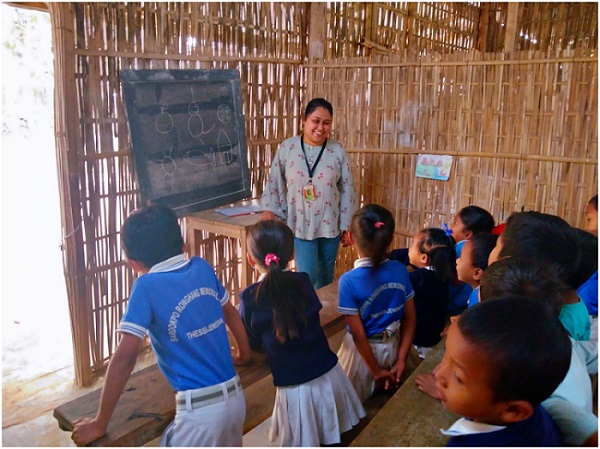
Ananya Paul Dodmani teaching tribal children at a remote village school in Karbi Anglong, Assam.

Vivek Sinha: Most often the government departments have an ethnocentric approach such that they try to thrust their own belief systems on to the tribes, which in most cases is rejected by the tribals. What do you think should be the role of government?
Ananya Paul Dodmani: Majorly the government should strive for better awareness and development of educational infrastructure and its modules, apart from imparting life skill training and the high income generation modules rather than thrusting their opinionated and fixed ideas to the ethnic tribes.

Vivek Sinha: You have been working with the tribals for over a decade. Tell us something about your work. What impact have you been able to create on the tribes of North East?
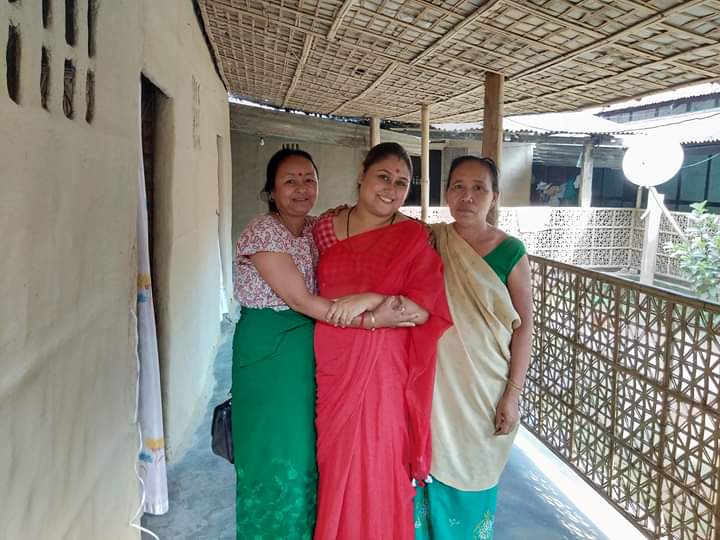
Ananya Paul Dodmani: I feel that the major and primary instrument which could change the way we look at North Eastern India is better education, health & sanitation facilities and better income structures. I have single-handedly built community rooms, changing rooms for girls in the Karbi village in Assam. I counsel and teach them the basics of education, go to each house in the tribal habitat personally counselling them on various life skills like stitching, paper bag making, composting, rearing of Eri silkworms and ethnic tribal weaving. We promote all these through the Saksham Foundation for a better marketing in the mainland.

Vivek Sinha: Tell us about your experience while working in the Karbi village, which is the remotest village and is affected by militancy. What are the core issues for the tribals in this village?
Ananya Paul Dodmani: In any part of the India’s North East issues remain more or less the same. The terrain is very difficult to work, communications from getting one tribal habitat to another remains a big time challenge with practically less or no accessibility in terms of road facilities. In the Karbi village, I am now focusing on the major issues with women’s health and sanitation. The female student dropout rate is quite high in this village where there are no toilets or health centres around. Also, after they reach adolescence they have practically no connection with the outside world and no modern educational amenities. Add to these the lack of good income facilities. All these make them prone to exploitation and often they are forced to indulge in unconstitutional activities affecting peace and harmony in the region.

Vivek Sinha: I read about your Sustainable Menstrual Program for the tribal women and your initiative to teach them prepare biodegradable sanitary pads. Please tell us more about this project. Can your model be replicated in other parts of India, in remote Indian villages, for instance?
Ananya Paul Dodmani: The project “Brave in Red” is my brainchild and it was primarily conceived with an idea to promote an awareness about sustainable menstrual hygiene amongst tribal women. Till now through the “Brave in Red” project I have reached over 10,000 tribal women and girls across India wherein I have conducted free workshops about sustainable menstrual hygiene and helped them shed the taboo around menstrual health. I have a patent for making biodegradable menstrual pads, which I teach the tribal women across India for free so that they can use it themselves and also sell them for earning a livelihood. And yes, this can easily be replicated in any part of the country.

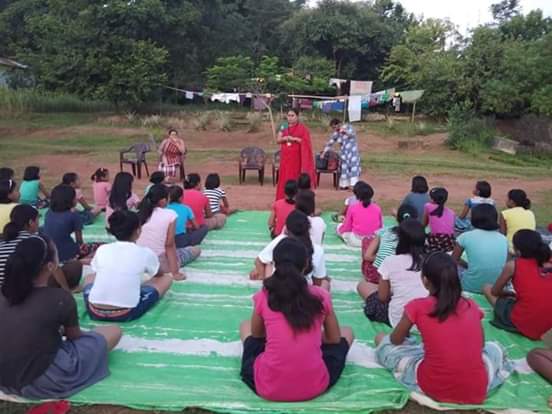
“Brave in Red” project promotes awareness about sustainable menstrual health among tribal women

Vivek Sinha: Tribals are closest to the nature and possess unique knowledge about herbal and natural medicines. What has been your experience? Can the modern medical science gain some knowledge from the traditional medicinal wisdom of North East tribes?
Ananya Paul Dodmani: Yes this is very true that tribals are very close to nature and are blessed with ample knowledge about natural herbs and plants which can be used by all. Even in their day to day life the tribals use this knowledge about medicinal herbs to cure common ailments for which the urban dwellers rely on modern medicines. I would like to share a personal experience of mine, wherein I personally did not use the prescribed antibiotic to cure a tract infection in my body. This incident happened during my last stay at Karbi Anglong in Assam when I had contracted some infection due to change of place and water. The generous people of the village gave me some herbs that was boiled with water and after taking a glass of the boiled water with these herbs my tract infection was gone. In this case I was about to take Ofloxacin-200 but this herbal drink worked like wonder.

I would definitely say that though modern medicine has been very effective in treating diseases that were considered dangerous some years back, but it does has side effects also as it is prepared in a lab and it is synthetic. All I can say is that most of the modern drugs take herbal extracts into their composition and it is a widely known fact. But if you can take these herbs at an early stage of any disease as a precaution most of the common problems can be resolved with those herbs without getting any side effect. Modern science as you have mentioned is already using herbs and plants extracts and yet the wisdom about healing properties of herbs remains in practice amongst tribals. So, I think there is nothing new to that, yet one can always learn from the tribals.

Vivek Sinha: Would you prefer the “melting pot” approach or the “salad bowl” approach to integrate North East tribes with rest of India? Why?
Ananya Paul Dodmani: When we speak of India, we are such a diverse nation in terms of culture, language and ethnicity that I would never approach the “melting pot” concept. The concept of “melting pot” which is basically a metaphor for diverse heterogeneous culture becoming homogeneous cannot stand true in the case of India. The tribes of North East are already a part of our country and they add or bring in lot of ethnic values to our rich cultural heritage. So, I would like to approach the “salad bowl” method and place them with mainstream India which is already a salad platter with twenty eight states and nine union territories and we still are united in this diverse country. So for tribals in India my take is the “Salad Bowl” approach.

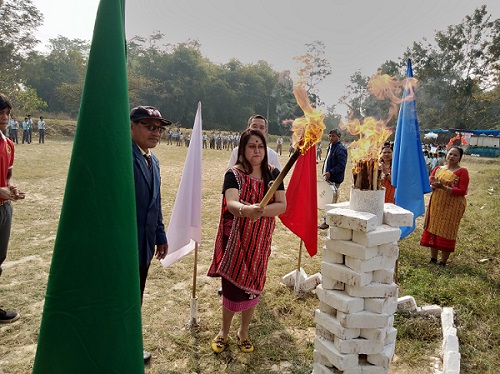
Lighting the Holy Flame at an annual event at village Karbi Anglong, Assam

Vivek Sinha: How does the racist approach by rest of India towards people of North East in general, and to the North East tribes in particular, affect the cultural assimilation of tribals into the Indian mainstream?
Ananya Paul Dodmani: Racism is a very sensitive topic and I would not like to comment on this. But speaking in general, people have become more acceptable these days when you speak of any culture other than yours. Cultural assimilation is already there as you can find North Eastern students all over India these days with their ethnic language, food, music and costumes. And when we speak of North East, we here are speaking of eight states, more than a hundred dialects, thousands of cuisines and costumes. You can find North East food, dresses etc. across all major cities of India. Indians as a whole have accepted this fact and I think the racist approach towards them has dropped largely and you hardly hear news about racism these days!

Spread of Coronavirus from Pakistan to South Asia is a potential economic and medical hazard

The world looks on with a fair degree of anxiety towards China, a global giant fighting a massive battle with the deadly Coronavirus. India, Pakistan, Bangladesh and other countries of the South Asian region that are in close proximity to China and have extensive trade links with the country are now looking at the situation with great concern.

Internationally a bleak picture is being painted with predictions of break down in supply chains and manufacturing that will directly impact demand and supply of essential goods. With the problem showing no signs of abating, laying-off of the workers across global industries has commenced which would lead to dampening of economic activity. Stocks are plummeting with no prediction of even nominal growth during the current financial year.

Within China purchasing is at an all time low and tourism non-existent; even businessmen are not travelling to the country. All of this is leading to a massive meltdown of the economy.

Closer home, it is Pakistan that is under severe stress due to the epidemic. Dependent upon China for support in all areas ranging from economic to defence and diplomacy, Pakistan is looking at the fast dwindling support with considerable distress. The worst effect will be felt upon the China-Pakistan Economic Corridor (CPEC).

Due to virus induced shortage of vehicles in Xinjiang, essential goods that are the lifeline of the Pakistani economy have got stuck on the Khunjerab Pass, the only entry point between the two countries along the CPEC route. This has severely impacted both trade and supply. Things are looking bleaker since any improvement in the situation seems to be unlikely in the near future.

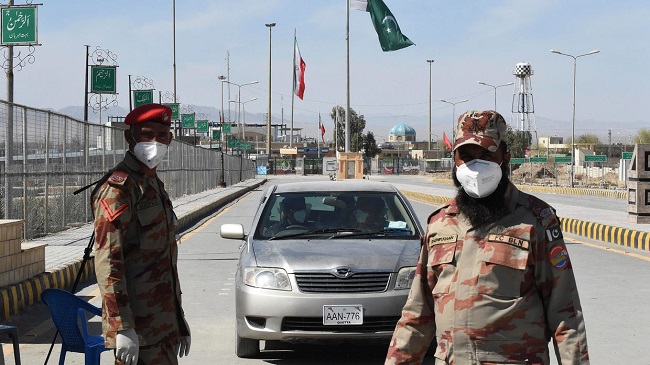
A bigger worry is the infection spreading into Pakistan. This worry is particularly applicable to the Gilgit-Baltistan region from where all movement takes place. There is an effort being made to carry out medical checks at the border outpost and isolate those found carrying the infection, but considering the notorious inefficiency of Pakistan’s administrative machinery and especially so in Gilgit-Baltistan not much credence can be given to these efforts. The second and bigger threat is posed by the Chinese who are working in Pakistan. They have been going back to their homes regularly before the outbreak of the virus was announced and the possibility of their having carried the infection back is very much present. When many European and Middle East countries have already registered infection how can Pakistan remain safe? Though the government is officially denying the existence of the virus in Pakistan there are media reports of a few cases already having been detected.

Pakistan does not have wherewithal akin to the Chinese or European countries to control the virus, should it hit the country. Health experts feel that the Pakistani population is more vulnerable because it is generally unhealthy and suffering from diseases like diabetes, TB, etc. The risk, therefore, is very much there and very critical.

For India the biggest risk is the spread of the disease from Pakistan and that too in Kashmir. It has to be remembered that the terrorist movement is from Gilgit-Baltistan and Pakistan-Occupied Kashmir (POK), and both areas are most risk prone to Coronavirus at this point in time. These terrorists, on being infiltrated, get into close proximity of the Kashmiri handlers and Over Ground Workers (OGWs). Given the density of population in Kashmir even a few cases can burgeon into something unmanageable.

Due to business being at an all time low and the US-Taliban deal in Afghanistan, there will be no dearth of terrorists being prepared for infiltration into Kashmir. The few who will inevitable pass through could well be more dangerous as carriers of Coronavirus than the capacity to generate violence.

On the economic front, India, as a net importer of goods worth $56 billion from China, will also get affected by the manufacturing meltdown. The electronics industry, Pharmaceuticals sector and consumer durables are likely to be the worst affected. Considerable exports from India to China will also take a hit.

India, unlike Pakistan, has the resilience to take the economic hit in line with the rest of the world. She will steer through the economic emergency as well if not better than the European countries and the rest of the world.

It may sound a little insensitive but India has, in fact, a potential to gain from the situation if she shores up her manufacturing capacities to take over the space that is being created due to Chinese meltdown. In such a situation, India will have to compete with countries like Indonesia, Vietnam and Bangladesh etc. that are also resurgent manufacturing hubs and will need to move very fast on its reforms with respect to taxation, regulatory mechanism, bureaucratic stranglehold and red-tape etc. If road blocks in economic activity can be removed the skilled labour available in India will be able to give to the country a competitive edge.

Hence, it is very necessary to remain isolated from the outbreak of the virus that has already registered a presence in many countries. It is time to gear up for challenges on multiple verticals if the country wishes to come out of this global catastrophe unscathed. In this matter, too, Pakistan gains critical importance for India since the source of the virus may be most prevalent there. Within the country it is Kashmir that may need maximum medical attention.

Meet your next door kidney harvesters

I had once briefly met T Ram Kumar Rao, who had by then already conned over 16,000 people, mostly poor and extremely gullible, and harvested their kidneys for some big bucks. Harvesting kidneys sounds like harvesting apples, probably because there’s loads of cash in the business. 

Conning over 16,000 people is not a joke. It was 2016 September and I was shocked when a cop narrated about Rao’s empire, his modus operandi. Rao was the Sansar Chand — the tiger poacher — of kidney business, operations spanning across the whole world. His clients came from the far, faraway Caribbean countries and Japan. You can easily imagine the grip he had on the world kidney bazar where India is the dominant leader.

And every time he was caught, powerful lawyers pulled him away from the jails.

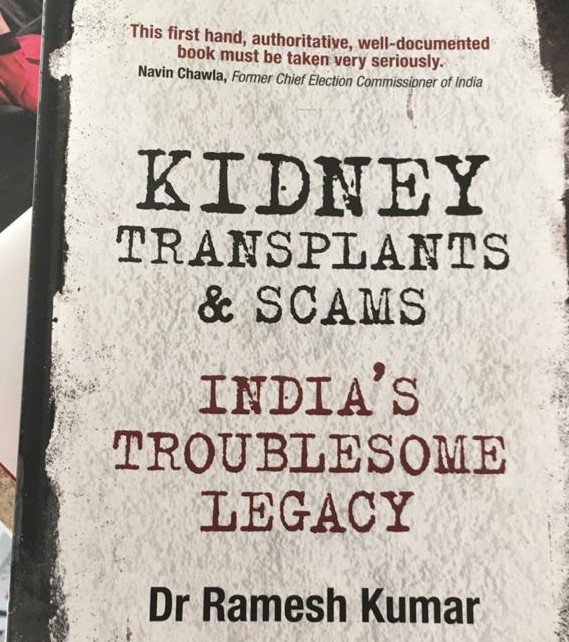
Kidney Transplants & Scams: India’s Troublesome Legacy from Sage Publications reminded me of those days of interaction with the kidney merchants who operated out of plush buildings, Apple computers and drank expensive Darjeeling tea and offered a wide array of sandwiches, savouries and desserts to visitors. Some came willingly to sell their kidneys and a large number of visitors were conned.

It is a brilliant read. The author, Dr Ramesh Kumar, counted among the country’s top kidney specialists, opens up a whole new world to his readers, listing examples after examples of how and when these operations take place across India. And how these illegal harvesters pocket cash. Most interestingly, the book highlights why kidney sale is the biggest organ transplant business in India, the rates much higher than that of open heart surgeries. The author observed the market from within the hospitals, the cops tracked the illegal business from offices set up across India.

So how does it work? Smooth as silk, a young operator once told me. People from the hinterland are lured, almost everyone is promised anywhere between ₹ 40-45 lakhs and then sent to the operation theater (read gallows). The author cites several examples. Some of them, interestingly, were known to me. There was one Sangeeta who shifted to the Indian Capital from Kanpur. Her husband was promised a good job. She and her husband were over the moon. The couple was promised ₹ 40 lakhs. But tensions started once they were in Delhi and put up in a flat in Ghaziabad. Sangeeta was asked to do medical tests because it was mandatory before getting a job. But once paramedics started asking her to change her name to Amina Begum, she smelt the rat. She and her husband rushed back to Kanpur. She thought the worst was over but the nightmare had only begun. Her husband’s friend trailed them back to Kanpur and tried to convince her that she should sell her kidney. If not, she would have to pay Rs 50,000 for her travel and medical expenses. Frightened and broke, she approached the local cops and an FIR was filed. And then, the lid was blown off on one of India’s biggest kidney rackets.

In chapter after chapter, Dr Kumar narrates how the illegal kidney racket continues to flourish in India. Delhi, as expected, is the epicenter of this illegal bazaar and the web of criminals include cops, physicians, paramedics, hospital administration staff and kidney donors. The market is a little over Rs 250 crore. In the latest case, 15 people, including the CEO of Pushpawati Singhania Research Institute (PSRI), Deepak Shukla, were arrested, and notices served to two leading doctors at Fortis Hospital in Delhi for violation of the Transplantation of Human Organs (and Tissue) Act, 1994. But this was just the tip of the iceberg. As Dr Kumar says in the book, the market is thriving despite several raids and laws against it because those who sell their organs are desperate for money. It is a solid trade, a genuine trade and one that guarantees high profit. Why not? India needs 150,000 kidneys every year. For the records, the Health Ministry says  against the demand of 2 lakh kidneys, only 6,000 were available. And against the demand of 30,000 livers only 1,500 were available, and against the demand of 50,000 hearts merely 15 were available in India. Worse, in India, the deceased organ donation programme is largely restricted to big institutions and the private sector which makes it less accessible for all. 

The book says why it is not easy to crack the system and nab the operators. Top private hospitals that are protected by a battery of lawyers and donors — mostly poor — hardly want to testify before the cops. In most cases, the patients are paid Rs 2-4 lakhs and the harvesters pocket 50 lakhs, the rest — 10-12 lakhs — is distributed to those who keep the big chain smooth.

The poor in India have no saviours, rightly says the author and they continue to get exploited. It is a pity that the Indian government has not pushed a law that would enable the cops to hand over road accident victims, unclaimed bodies for such transplants. Former Chief Election Commissioner Navin Chawla wrote in the foreword how Delhi alone has eight to ten fatalities. The laws are strange in India. Under the present law, only those related to the patient are allowed to donate organs. That means there will be a huge reduction in the number of prospective organ donors. If you take a random sample, you will realise that out of 300 patients declared brain dead in just one hospital in a month in Delhi, only 10-12 are potential organ donors. A large, probably larger section of Indians believe donating a person’s organs after death would affect the Next Life. 

So someone needs to bell the cat.

But who will bell the cat in this country, will the health minister spare sometime to think about the big kidney racket and put in some stringent rules in place or will it be another big debate in the two houses of Parliament?

If this happens, India will be able to check and mate the big kidney bazaar. If it does not happen, then gullible donors will be forced to join the gang and seek more and more kidneys. It works in the same way sex workers do their business. One girl is lured and forced into prostitution, and when she attains middle age, she starts another cycle. And then the cycle gives birth to more, more and more cycles. That is the way body hunters work, that is very much the way kidney harvesters work, it is largely by word of mouth.

It is certainly not a beautiful world.

It’s not CAA, pent-up anger on Kashmir and Ayodhya led to Delhi riots

The mayhem in Delhi streets has calmed down and the metropolis is limping back to normalcy. Amidst this eerie normalcy it’s time for some serious soul searching about the real reasons of communal riots in India’s capital. As videos, photographs and heart-wrenching stories continue to flash across the mainstream media and on various social media platforms the naïve Indians and blockbuster opinion makers from across the world are busy peddling the narrative that India is hell bent upon antagonizing the 25 crore (250 million) Muslims residing peacefully in the country. What was the need to introduce this contentious CAA (Citizenship Amendment Act-2019) that has triggered these communal riots, massive unrest and suspicion amongst this huge Muslim population of India, they ask.

Well, first things first. Nationwide protests followed by the Delhi riots after CAA was passed by the Indian Parliament on 11th December 2019 has nothing do with the CAA per se. Yes you read it right. These nationwide protests and, of course, the Delhi riots have nothing do with the new Citizenship Act. Protesters in the streets against CAA and those shouting their lungs out at public forums know it very well that the CAA has got nothing to do with Indian Muslims. It’s just a one-time provision that will directly affect religiously persecuted Hindus, Sikhs, Jains, Buddhists, Parsi and Christians who had escaped from Pakistan, Afghanistan and Bangladesh. The CAA grants Indian citizenship to around 15 lakh people who are already living in India. It does have a cut-off date of December 31, 2014.

All these film actors, comedians, 5-star journalists and shrewd politicians –the Lutyen’s coterie, know these facts quite well. It would be naïve to think that the likes of Mamata Banerjee, Ghulam Nabi Azad, Pinarayi Vijayan, Kanhaiya Kumar, Swara Bhaskar, Sharjeel Imam, Shehla Rashid, etc. etc. would not have read the finer provisions of CAA. And yet they went around the world spreading falsities that the Narendra Modi government is planning to put Muslims in detention centres and would strip them off their citizenship. Blatant lie. Yet this Lutyen’s coterie continues to shamelessly peddle this lie. The big question is why?

In fact, all this is a well-planned strategy. This rage is not about the CAA, rather it’s the pent-up anger about abolition of Art 370 in Kashmir and the Supreme Court’s unanimous judgement in favour of the Shri Ram Janmabhoomi Temple at Ayodhya. In order to understand the heartburn we need to step back and look at the turn of events over the last year.

Secessionist “Azadi” slogans inscribed on the walls in riot affected areas of Delhi.
(Photo: PTI)

This Lutyen’s coterie has a penchant for fancy names such as “civil society members”, “liberals”, “seculars”, “free speech champions” etc. due to which they are darlings of international media and self-proclaimed custodians of Indian democracy and also the self-appointed spokesperson for Indians. However, despite their high decibel campaign to oust Narendra Modi during the 2019 General Elections he was voted back, this time with a larger majority. Modi getting back to the driving seat in New Delhi upset the plans of this conniving coterie who had been relegated to the sidelines during Modi’s first term. So dubious government funding for superfluous projects had stopped and illegal foreign grants put under scrutiny. They had hoped for the old order to come back if Modi was unseated. This did not happen and Narendra Modi took oath as India’s Prime Minister on May 30th 2019.  This was the first shock. With a massive mandate there was no chance to topple the government at New Delhi and so this coterie was left licking its wounds.

And to make matters worse, Modi 2.0 hit the ground running. The lighting struck on August 5th 2019. The contentious and controversial Art 370 & Art 35A were revoked, Jammu & Kashmir was bifurcated and downgraded into two separate union territories Jammu-Kashmir and Laddakh. This meant another stream of dubious funds dried up. Mind you this was August 2019, barely two months after Modi had returned at the hot seat in New Delhi. The gang got down to the drawing board to think of their future strategies. It was a question of survival for them. Falsities about Kashmir under lockdown and fake stories of human rights violations were doled out. But these conniving stratagems were exposed with equal zeal by the new age reporters, digital media organizations and social media warriors. The agenda of yesteryears did not work this time in Kashmir.

And then came November 9th 2019. Five-judge bench of the Supreme Court passed a unanimous judgement in favour of the Shri Ram Janmabhoomi Temple at Ayodhya. All the arguments put forward by the coterie’s “eminent historians” were summarily rejected. Historical arguments (read pulp-fiction) that had been used to build false narratives over last several decades in favour of the Babri Mosque were dismissed in toto. The Lutyen’s gang was exposed in full public view. It hurt them that it was archaeologist KK Muhammed (a Muslim) who gave clinching evidence in favour of Shri Ram Janmabhoomi Temple at Ayodhya. Hindu nationalists and Muslim rationalists were having a field day. They were thinking of building a new India where Muslims and Hindus could live in peace and harmony. KK Muhammed was seen as the new role model of Indian Muslims. The Muslim-as-a-victim narrative was fading away, or so it seemed.  

The five Supreme Court Judges who delivered the Unanimous Judgement on Ayodhya. Standing from Left to Right -- Justice Ashok Bhushan, Justice SA Bobde, Chief Justice of India Ranjan Gogoi, Justice DY Chandrachud and Justice S Abdul Nazeer.
The five Supreme Court Judges who delivered the Unanimous Judgement on Ayodhya. Standing from Left to Right — Justice Ashok Bhushan, Chief Justice of India (current) Justice SA Bobde, former Chief Justice of India Ranjan Gogoi, Justice DY Chandrachud and Justice S Abdul Nazeer.

How naïve are we? We just could not fathom the strike capabilities of this Lutyen’s coterie. After all they had to fight for their survival! It was in this backdrop that when the Narendra Modi government announced the Citizenship Amendment Bill (CAB), they sniffed an opportunity for themselves. The botched up NRC (National Register of Citizens) in Assam had already sowed seeds of mistrust in the minds of Muslims. Rumours had begun floating around in Muslim ghettoes across the country, and almost immediately this peep-hole was turned into a large window by the Lutyen’s brigade. They now began using this window to gleefully spread the vicious propaganda.

Even a cursory look at the statements emanating from a few 5-star journalists, film actors, comedians and, of course, the shrewd politicians will reveal that this malicious propaganda was started simultaneously by all and sundry in the coterie. Each one talked about how CAA has been brought in to strip the Muslims of their Indian citizenship rights that they will be asked to provide documents of their ancestors, failing which they would be “expelled” from India. Yes all of this is untrue and factually incorrect. But when did Lutyen’s coterie bother for facts?

Graffiti against the Citizenship Amendment Act (CAA) on Delhi roads. (Photo: PTI)

As the Parliament passed the Citizenship Bill and it became an Act this hysteria of disinformation campaign reached a crescendo. Almost everybody questioned CAA and started talking of the CAA and NRC in the same breath. Rumours started flying thick and fast. With insecurity in the mind of a large section of Muslims strengthened, the fear psychosis was accentuated. Modi government was left grappling for answers, it was clearly on the back foot.

Dirty money running into hundreds of crore rupees was distributed to foster unrest on the CAA. Enforcement Directorate revealed that radical Islamic organisation Popular Front of India (PFI) received around Rs 120 crore that was used to fuel rumours and discontent. In a well thought out strategy Muslim women were brought to the forefront. Shaheen Bagh in East Delhi became the new flashpoint. All this while, ministers in the Modi government, politicians and foot soldiers from the ruling BJP were busy dispelling myths about CAA while the Lutyen’s coterie was busy fanning rumours about imaginary atrocities on Muslims. Slowly but steadily the coterie became successful in painting all previous decisions as discriminatory to Muslims, so by the dawn of New Year 2020 questions were being raised over revocation of Art 370 and fictitious stories about the Shri Ram Janmabhoomi Temple at Ayodhya started floating around.

The 32-year old Arun Modern Senior Secondary School was burnt down by rioters in North East Delhi. (Photo: PTI)

In this saga, the Modi government made a strategic mistake of thinking that this nationwide agitation was against some imaginary provisions of the CAA. The government thought that as people will get to know about the true picture about provisions in the CAA, these protests would die a natural death. This was their biggest mistake. It was due to this strategic mistake that protests in Shaheen Bagh was allowed to fester, which was ably used by vested international media groups to paint India as prejudiced against its vast Muslim population. The inaction at Shaheen Bagh also emboldened the radical Muslim groups and the Lutyen’s coterie who were waiting for an opportune time to strike back. Together they planned the Delhi pogrom to coincide with US President Donald Trump’s visit. The arms, ammunition and Molotov cocktails (petrol bombs) widely available with the rioters point to the fact that the widespread Delhi riots were not spontaneous rather they had been planned to the last minute.

Bottles of Molotov cocktail (petrol bombs) recovered from the terrace of AAP politician Tahir Hussain in North East Delhi. Tahir Hussain has been charged with the murder of Intelligence Bureau (IB) sleuth Ankit Sharma.

Postscript– Narendra Modi government has made tremendous gains in international diplomacy and on defence and security related matters, which no doubt is lot more than any previous governments. But Modi must realise that his government has no voice in the soft power centres such as the media, art, culture, academia, films and entertainment. Delhi riots are a proof that the Lutyen’s coterie is still a superpower in these realms. And soft power is as important as defence and security. Narendra Modi needs to address these soft power centres lest it becomes the Achilles’ heel for his government.

India must counter Pak’s gambit to neutralise FATF

It is business as usual so far as Pakistan and the Financial Action Task Force (FATF) are concerned. In the periodic ritual of reassessing Pakistan’s position the organisation has, once again, maintained the status quo of keeping the country on the “Grey List.” Pakistan, as usual, has taken some superficial actions to get its name struck from the Grey List.

In order to reduce pressure, Pakistan, a little before the plenary session was due, formulated a brazen plan of getting a lower court to convict the terrorist Hafiz Saeed for two terror crimes. The conviction also coincided with the visit of UN Secretary General, Antonio Guterres, to Pakistan. The sentence holds no consequence since it is liable for appeal in a higher court, but, is was enough for the friends of Pakistan in the FATF to bring down the pressure and see the country continuing in the Grey List for another six months. Blacklisting was deemed to be a more appropriate action by many members of the organisation.

Unwavering support by China is the predominant factor that comes to the aid of Pakistan in the FATF meetings. In the latest instance also the FATF Plenary held on February 19th and February 20th, was chaired by the Chinese President of the organisation Xiangmin Liu.

A big difference was that, this time round, the FATF was quite vocal in its censure of Pakistan. Its press release dated February 21st, expressed “concerns about Pakistan’s failure to complete its action plan in line with the agreed timelines and in light of the terrorist financing risks emanating from the jurisdiction.”

The dissatisfaction was followed by a warning to Pakistan to attend to the actionable items on the agenda and failing which stricter action would be considered in the next plenary to be held in June 2020.

Pakistan, however, is quite used to such threats that it has been facing since 2018, when it first came on the Grey List (as on earlier occasions too). It has taken an obdurate position of making only cosmetic efforts to reverse the situation. It probably does not look for the foreign investments that the FATF can stop since not much is coming or is expected to come, in any case. Its larger interest lies in staying out of the Black List which good friend China is in a position to ensure; hence, the very apparent ambivalence in its position.

As things stand now Pakistan is convinced that the FAFT pressure is because of the insistence of US President on the country taking affirmative action against terrorism. Instead of looking at the insistence with the degree of seriousness that it requires, Pakistan is depending upon heavy lobbying to turn the situation around to its favour. It has a strong belief that it will succeed considering that the current year will witness Presidential elections in the US and President Trump will need Pakistan’s support to deliver on Afghanistan.

In the meantime, Pakistan is managing to mull along despite a precarious financial position and restrictions on support due to FATF listing. The question is how?  Once again the biggest financial bailout is coming from China and the International Monetary Fund (IMF). In his article, “Pakistan: Terror and Impunity – Analysis,” the author, Ajit Kumar Singh, notes that IMF made a lot of noises about an Extended Fund Facility (EFF) for about US $6 billion being given to Pakistan “subject to the timely implementation of prior actions and confirmation of international partners’ financial commitments”. Among other commitments, Pakistan was expected to continue “anti-money laundering and combating the financing of terrorism efforts.” None of this has happened, Pakistan continues to remain on the FATF Grey List, and yet, on July 3rd 2019, the Executive Board of the IMF approved the EFF. Under such circumstances what reason has Pakistan got to dismantle its terror sponsoring infrastructure?

More than the Grey List, it is the blacklisting by the FATF that is a devastating nightmare for Pakistan. The country, however, is convinced that such a situation will not come by. It feels that it can leverage the political nature of the FATF to conduct horse trading that is excels in and stay afloat. After all, only three out of the 36 votes in the organisation can keep it out of the blacklist and such support is available in the form of China, Malaysia and Turkey. It is, therefore, looking only at getting itself removed from the Grey List with political lobbying and engineering of abstentions etc.

Many in the world feel that an upgrade of the country to the Black List would be justified. After all, if Iran can figure in the Black List then why not Pakistan with its unending resource of Islamic militants/terrorists and terrorist warlords like Hafiz Saeed, Maulana Azar Masood etc. It is apparent that Pakistan has its road map for neutralising the FATF threat chalked out, even as the world remains ambivalent to the threats posed.

India is directly affected by the terror activities that emanate from Pakistani soil and needs to move fast and strong if she wishes to expose the malevolent designs of Pakistan. The need of the hour is to strongly expose the direct involvement of the notorious Pakistani Inter-Services Intelligence (ISI) in all terrorist activities directed against India and in the support of militancy in Afghanistan. India also needs to emphasise its concerns regarding the fake Indian currency racket being run by Pakistan. The Pakistani proclivity to play the victim card needs to be exposed for its inherent duplicity.

Upon India now rests the mantle of generating a global consensus with regards to Pakistani involvement in proliferation of international terrorism. The recent very successful visit of US President Donald Trump to India, during which the need for the two countries to jointly fight terrorism has been emphasized should form the basis of renewed efforts by India to bring Pakistan to the dock not only in FATF but in other global forums as well.

Government of India announces Maiden Summit on Artificial Intelligence

The Government of India (GoI) has announced the mega event, RAISE 2020- ‘Responsible AI for Social Empowerment 2020,’ and will be held from April 11-12 in New Delhi. RAISE 2020 is India’s first Artificial Intelligence summit to be organized by the Government in partnership with Industry & Academia. The summit will be a global meeting of minds to exchange ideas and charter a course to use AI for social empowerment, inclusion and transformation in key areas like Healthcare, Agriculture, Education and Smart Mobility amongst other sectors. Prime Minister, Narendra Modi will inaugurate the summit.

Ahead of the summit, MeitY organized an Industry Consultation with industry representatives to bring in synergies within India’s Artificial Intelligence landscape. The consultation was chaired by Ajay Prakash Sawhney, Secretary, Ministry of Electronics and Information Technology (MeitY); Gopalakrishnan S., Additional Secretary, MeitY; Jyoti Arora, Additional Secretary & Financial Advisor, MeitY; Sanjay Goel, Joint Secretary, MeitY; Saurabh Gaur, Joint Secretary, MeitY and Abhishek Singh, President and CEO, National e-Governance Division (NeGD) from the Government. Apart from the Government, Industry associations including FICCI, CII, ASSOCHAM & NASSCOM and corporates namely Intel, AWS, KPMG, IBM, Oracle and AI startups amongst others participated in the consultation.

Speaking on the occasion, Ajay Prakash Sawhney, Secretary,Ministry of Electronics and Information Technology (MeitY), said,“We are extremely delighted to announce the first of its kind two-day summit- ‘Responsible AI for Social Empowerment 2020’. In our opinion, a data-rich environment like India has the potential to be the world’s leading AI laboratory which can eventually transform lives globally. AI technology is a powerful tool that can be used to create a positive impact in the Indian context, further becoming the AI destination for the world.”

Explaining in detail about the first of its kind event, Abhishek Singh, President and CEO, National e-Governance Division (NeGD), said, “The name ‘RAISE 2020’ came into being because we want to leverage responsible AI practices for enabling the masses. Through this summit we will outline India’s vision for utilizing the power of Artificial Intelligence to responsibly transform the social landscape for a better tomorrow. RAISE 2020 will facilitate an exchange of ideas to further create a mass awareness about the need to ethically develop and practice AI in the digital era.”

During session, the Government also launched the AI-Startup Challenge and the event website as a part of championing the AI movement in India.

RAISE 2020 is a first of its kind, global meeting of minds on Artificial Intelligence to drive India’s vision and roadmap for social empowerment, inclusion and transformation through responsible AI.  The event will start with a Startup Challenge – Pitchfest followed by the two-day summit, organized by Government of India along with Ministry of Electronics and Information Technology will witness robust participation from global industry leaders, key opinion makers, Government representatives and academia.

Making urban sanitation services inclusive and participatory

Government of India had launched Swachh Bharat Mission (SBM) – Urban on 2 October 2014 to accelerate the universal sanitation coverage in Indian cities. One of the objectives of the Mission was to ‘elimination of open defecation’. Under Swachh Bharat Mission (SBM) – Urban, toilet facilities have been created at a massive scale across the country. Till October, 2019, a total of 60,96,135 Individual Household Latrines (IHHLs) and 5,61,298 Community and Public Toilets (CTs/PTs) have been completed. In all over India, a total of 3,992 towns have been declared Open Defecation Free (ODF). In Rajasthan 90.10% (173) cities, in Uttar Pradesh 97.60% (650) cities and in Bihar 82.79% (101) cities have been declared as ODF.

The SBM-U also provided a significant impetus to collection, segregation, transportation and processing of Solid Waste Management (SWM). Since 2014, a total of 80,100 Municipal Wards (94.77% of all the Municipal Wards) have adopted 100% door to door collection solid waste. Of these, a total of 60,833 Municipal Wards now practice 100% segregation of solid waste. The Government of India has also introduced a Garbage Free City (GFC) star rating system to encourage the cities to strive for improving the SWM services.

Over the last six years, Indian cities with the support from the central and state governments on one hand and the community based organisations, civil society, academic and research institutions, media and other stakeholders on the other hand, have made significant improvement insanitation services including access to toilets, scientific treatment of solid and liquid waste management, and involving citizens in the operation chain of sanitation services. However, the biggest challenge here is the sustainability of the positive gains from this massive programme. The sustainability of the enhanced urban sanitation services will be contingent upon sustained citizen participation and behaviour changes along with enhanced capacities of ULBs and the city-level institutional ecosystem.

This sets thecontext for a National Conference on “Future of Urban Sanitation in India” that will be organized on Feb 27-28, 2020 in New Delhi by Participatory Research in Asia (PRIA), a global centre for participatory research and training. This consultation forum is an effort to identify solutions to the challenges of sustainable, inclusive and participatory management of urban sanitation services in the next decade.

According to Dr. Rajesh Tandon, Founder-President, Participatory Research in Asia (PRIA), “Indian policy-makers and development professionals have begun to recognise the growing opportunities from increasing urbanisation. However, it is only in the past six years that significant policy and programming push to urban development has begun to reach to small and medium towns of the country. Effective and accountable sanitation services, including access to and use of toilets, are critical for health of a city. Emerging lessons around inclusion and participation of all stake-holders for effective sanitation need to be shared so that new India can emerge in its many urban centres soon.”

Importantly, Society for Participatory Research in Asia (PRIA) has been implementing “Engaged Citizens Responsive City (ECRC)” project in Ajmer, Rajasthan; Jhansi, Uttar Pradesh; and Muzaffarpur, Bihar with the support from the European Union. The objective of the project is to enhance the participation of urban poor in planning, implementation and monitoring of urban sanitation services. Over the last four years, ECRC project has fostered numerous innovative practices to engage citizens with a particular focus on the urban poor in bottom-up participatory planning based on authentic data generated by the communities.

The National Conference will be inaugurated by Hardeep Singh Puri, Minister for State, Ministry of Housing and Urban Affairs (MoHUA), Government of India. A special objective of the National Conference is developing consensus on a framework, methodology, and mechanism for localising Sustainable Development Goals (SDGs) in Indian cities with a particular focus on SDG 11. It will also showcase scalable innovative solutions from across the country to address the challenges of inclusive urban sanitation services and creating a learning and knowledge platform by bringing together policy makers, researchers, experts, and practitioners on inclusive urban sanitation services.

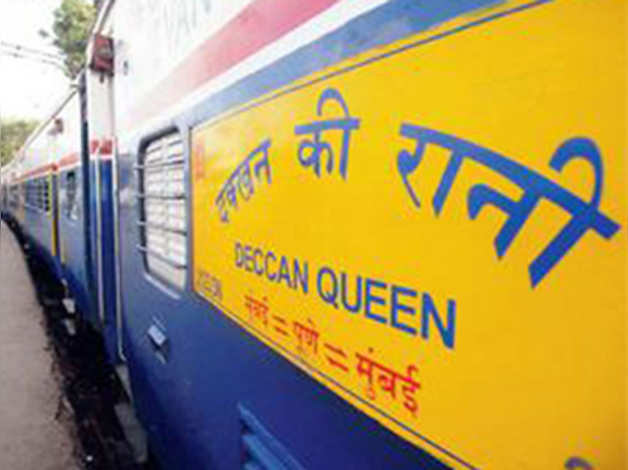
Best ever safety record of Indian Railways with no passenger deaths in last 11 months

Indian Railways has registered the best ever safety record in the current financial year 2019-20. In the year so far (from 01.04.2019 to 24.02.2020) there has been no fatality of any railway passenger in any consequential railway accident. The remarkable feat has been achieved for the first time in the year 2019-20 since introduction of Railway System in India 166 years ago in the year 1853. The zero passenger fatalities in the last 11 months is a result of continuous efforts by Indian Railways to improve safety performance in all respects. Safety being the topmost priority always, the measures undertaken for safety improvement include massive renewal of railway tracks, effective track maintenance, stringent monitoring of safety aspects, improved training of railway staff, improvements in signaling system, use of modern technology for safety works, switching over to modern and safer LHB coaches in phases from the conventional ICF coaches. Also total elimination of Unmanned Level Crossings Gates on broad gauge has resulted in elimination of accidents on this score thus giving huge impetus to safety of train operations.

All the above could become possible with inputs in the system in the form of Rashtriya Rail Sanraksha Kosh (RRSK) introduced in the year 2017-18 with a corpus of Rs1 lakh crore to be spent in next five years, having annual outlay of Rs 20,000 crore. With this fund, it has been possible to undertake very critical safety works of urgent nature and results are evident.

How are films “Passed” by the “Censor Board” in India?

0

We enjoy watching films and documentaries. And quite often we also hear controversies around the “Censor Board” that has been mandated with the task to certify films and documentaries. But do you know that “Censor Board” is a wrong terminology. The correct word is CBFC (Central Board of Film Certification) and its job is not to “censor” but to certify films. Surprised? Watch this conversation between Mr. Rajendra Bhatt, former Regional Officer CBFC and Vivek Sinha, Founder-Editor News Intervention where Mr Rajendra Bhatt explains several interesting facets about how films are cleared by the CBFC.