With the Parliament passing
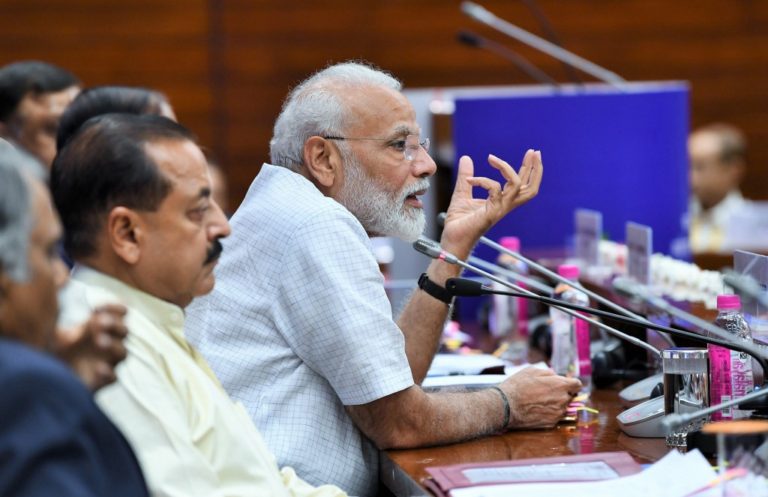
the Muslim Women (Protection of Rights on Marriage) Bill 2019, Prime Minister Narendra
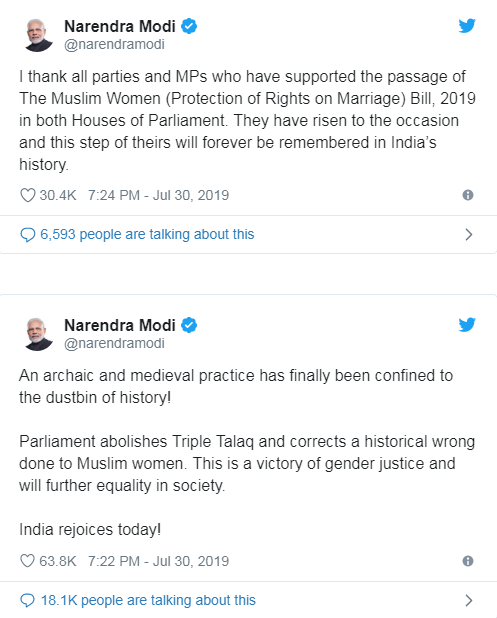
Modi thanked all the parties and MPs who have supported the passage of the
Muslim Women (Protection of Rights on Marriage) Bill, 2019 in both Houses of
Parliament. He said that they have risen to the occasion and this step of
theirs will be forever remembered in India’s history.
In a series of tweets he said
that “An archaic and medieval practice has finally been confined to the dustbin
of history! Parliament abolishes Triple Talaq and corrects a historical wrong
done to Muslim women. This is a victory of gender justice and will further
equality in society. India rejoices today!”
He further tweeted that “This
is an occasion to salute the remarkable courage of those Muslim women who have
suffered great wrongs just due to the practice of Triple Talaq.The abolition of
Triple Talaq will contribute to women empowerment and give women the dignity
they deserve in our society.”
Union Minister for Home
Affairs, Amit Shah congratulated Prime Minister Narendra Modi for fulfilling
his commitment and ensuring that a law is made to ban Triple Talaq.
Expressing satisfaction over
this landmark moment, the Home Minister also congratulated Muslim women by saying,
“On the passage of this Bill, I congratulate the Muslim sisters across the
country on getting rid of the Triple Talaq curse. This act will free Muslim
women from the curse of this regressive practice”
Shah said that the Modi
government is dedicated to protecting women’s rights and ensuring their
empowerment. This bill is a historic step to protect the dignity of Muslim
women and keep it intact. It will bring a new era of hope and respect in the
lives of Muslim women. From now on, the door to unlimited possibilities will
open for Muslim women and they would now be able to play an effective role in
the creation of ‘New India’.
“Today is a great day for
India’s democracy. I thank all parties who supported this historic bill”, Shri
Shah said while thanking all the members of Parliament yesterday.
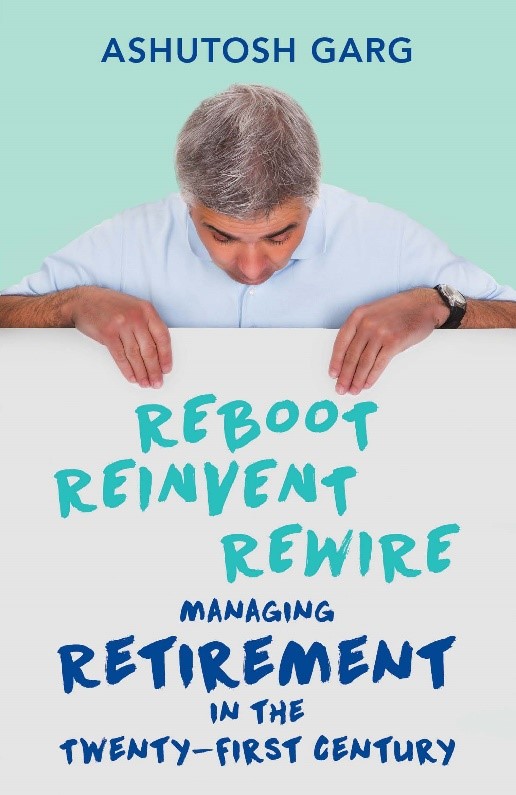
Loneliness
is a big problem at any age and in retirement with a loss of self-worth
accompanied with stress related to financial security, loneliness can be a
serious problem.
Social
isolation and loneliness are well known as causes of depression, mental health
problems and physical illness. They are conditions usually associated with
older people, who may experience the profoundly isolating effects of
retirement, loss of a partner and children moving away.
There
have been several cases where loneliness has led to depression, high blood
pressure and other psychosomatic illnesses. Those retirees who are married at
least have a companion but for those retirees who have remained single or have
separated or have lost their spouse, the problems of loneliness get compounded
very significantly.
Loneliness
is something that often creeps up on people in retirement. Loneliness can be
twice as unhealthy as obesity,
according to researchers who found that feelings of isolation can have a
devastating impact on older people.
Even
the most gregarious and sociable of people can find themselves in the
unfamiliar territory of feeling lonely and isolated, and this in turn can lead
to depression. Often loneliness comes from the death of a spouse, the loss of
close friends, or the development of a debilitating illness – all things that
we don’t want to think about, but unfortunately are inevitable as we get older.
Retirees
sometimes go through multiple changes in their lives that contribute to
loneliness in a relatively short period of time.
Adult children move out of the house and sometimes far away from home
Around the same time, people lose
their ready-made social circle at work. Most people have not taken the trouble
to create a social network outside work while they were working and to try and
break into an existing social network post retirement is challenging to say the
least.
It is not uncommon to lose a partner
at some point during the later years of life. Loss of a spouse is seen as one
of the top traumas a human being experiences in one’s life.
People
who are socially comfortable and well-connected may easily make new friends,
but if you are socially awkward and have traditionally found it difficult to
make friends you need to find structured activities that will help you to
create social contacts.
It
only takes a little effort to make new friends and stave off those feelings of
loneliness that can be so damaging to your mental health in retirement. What’s
more, there is growing evidence that social isolation is connected with an
increased risk of physical ill health as well, so combating loneliness may also
improve your health too.
An
increasing number of senior retirees have only got their television for company
and this is a serious challenge that we need to address. Is there no way that
we can engage with these elderly citizens so that they live the remaining years
in contact with a few people?
“Human
contact is my oxygen. I try to keep myself occupied but the chance of human
contact is more important than anything to me. The touch of another human being
is more so” said one person when he was talking to me.
“It
makes me feel sad. I no longer feel of use to the society but much of the time
I mask my feelings with a mindset to keep going. People tell me that I am lucky
to have my memories but this doesn’t help. I want to make the most of my life
now” said another.
After
speaking to several very elderly retirees, I found that they missed the
all-important social contact with their friends and family. As they grew older
and as one or both of them slowed down and were not able to reciprocate the
social niceties that had done all their lives, they could see that gradually
they were dropped from their social circle and the invitations dropped off. It
reached a stage where they would see no one except their domestic staff for
many weeks at a time.
We
have read so many cases of police finding the body of a senior citizen in their
home when the neighbours complained of a “foul smell” from the apartment. Nothing
could emphasize the seriousness of loneliness of an elderly retiree than a
person who has died alone with no one to attend to them for possibly, several
days.
Loneliness
is contagious. Older adults who feel lonely are more prone to behave in ways
that may cause other people to not want to be around them.
A recent survey revealed that while only 10% of
Indian seniors living in joint families felt isolated, nearly 68% of those
living with nuclear families reported loneliness. The survey also found that older
people living in rural areas have more social interactions and feel the pain of
loneliness less in comparison to the urban elderly. It was also found that
older Indian men are more prone to isolation than older women.
Tackling loneliness
Based
on discussions with some care givers to the elderly and infirm, the following
were some of the points that came up to tackle loneliness.
Stay Social
– Maintain long-standing relationships to combat loneliness. Reconnect with
friends with whom you have lost touch and establish regular routines with
friends near you. Join social networking websites to get re-acquainted with
people from your past. Long-standing relationships are more beneficial in
fighting loneliness than new friendships.
Senior
citizens living in condominiums have managed to find a way to stay social and
several resident welfare associations have provided for specific areas where
the senior citizens can sit together for a cup of coffee every morning and
evening.
Explore New Interests
– As a retiree, you probably have less commitments and obligations. Take
advantage of this to explore your interests, whether you are volunteering at
the local school, joining a book club, playing an instrument or writing.
The
activity is not as important as the meaningful interactions you will have with
other people as you develop a whole new circle of friends of all ages, who like
you, have a similar interest.
Stay Positive
– Talking to yourself to challenge your pessimistic or negative thoughts has
been found to be very effective. Perceived loneliness is often due to incorrect
or irrational interpretations of current life situations. Identify these
thoughts and argue against them, utilizing contrary evidence. If this is
difficult or you need assistance, you can work with a counsellor or with a
friend who you can trust.
Get a Pet –
A dog or a cat have been known to be great companions for lonely people. If you
and your spouse like a pet and are willing to take on the responsibility of
looking after another living being then bring a pet into your home.
Mother
Teresa had once said that “loneliness and the feeling of being unwanted is the
most terrible poverty”.
While
the developed economies have understood the loneliness needs of the retirees
and the senior citizens, we have yet to get an appreciation of their needs in
India. We assume that once a person has retired, he / she will be happy with
their television sets watching “serials” and have some of their friends for
company. We need to watch and listen more. Older people often claim they are
fine, and they don’t want to be a burden but most people need human contact.
Older
people are a treasure and should be treated as such.
Indonesia and India share deep and strong cultural relations build over several centuries of mutual respect and friendship. Indonesians hold Indians in high regard and treat them with utmost respect. However, a recent incident, in which an Indian family was caught stealing in a Bali hotel, could be a big spoiler for Indian tourists.
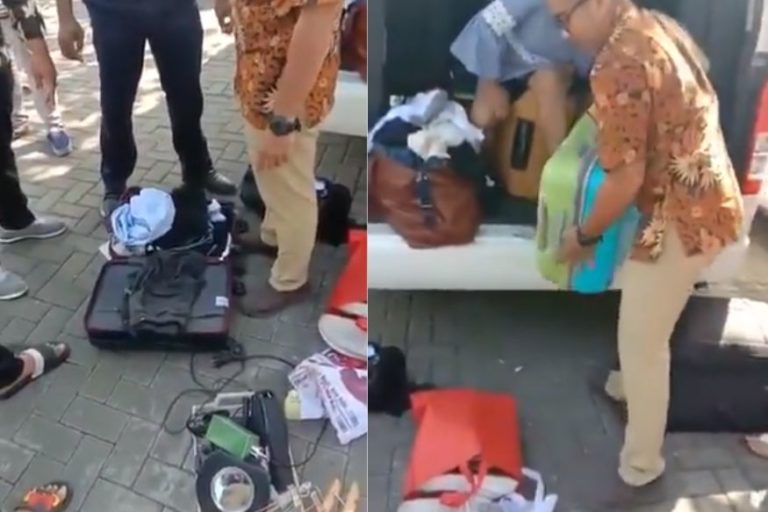
In an embarrassing incident, an Indian family was caught escaping with accessories they had stolen from a hotel in Indonesia’s Bali. A video of the incident has now gone viral on social media. The video, which is 2:20 minutes long, shows one of the hotel staff scanning the family’s luggage as they were on their way out from the hotel.
The video was originally posted
on Twitter by a user named Hemanth, who wrote “this family was caught
stealing hotel accessories. Such an embarrassment for India. Each of us
carrying an #IndianPassport must remember that we are ambassadors of the nation
and behave accordingly. India must start cancelling passports of people who
erode our credibility.”
In the video, a woman can be seen
arguing with the officials from the hotel who seem to be vigorously going
through the suitcases. Apparently, the family had “stolen” whatever
they could get their hands on – which included decorative items, toiletries,
electronics, towels and so on. The security officials can be seen telling the
family that they’d managed to steal ‘everything’ from the hotel room, including
hangars.
She repeatedly asks the officials
to let them go since they had a flight to catch. She even offers to pay for the
stuff they’d stolen. “We are sorry. This is a family tour, we will pay you,”
the family members can be heard saying. The staff, however, appeared to be in
no mood to accept compensation for the behaviour of the family. “I know you
have a lot of money, but this is no respect,” one of them responded to the
family’s repeated offers to pay.
The video had Twitterati fuming who called the whole incident disgraceful. One of the user @rumilife0612, wrote, “Why do Indians do this I just can’t understand. One should maintain a certain kind of dignity and class ..What is this,” and also shared the video. The tweet has received over 90 thousand likes. As the incident came to light, many Twitter users demanded that the passports of the family be revoked.
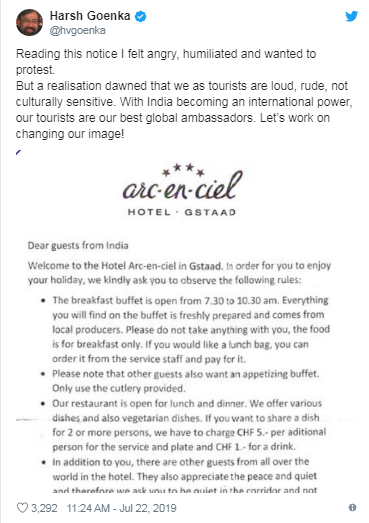
Earlier, industrialist Harsh
Goenka took to Twitter to criticise a Swiss hotel for specifically issuing a
“code of conduct” for Indian guests, saying he felt “angry” and “humiliated”.
Now, with the video of an Indian
family being shamed by staff for allegedly stealing from a hotel going viral, it
once again bring into focus why Indians need to follow a ‘code of conduct’ abroad.
Col (Retd.) Jaibans Singh, a reputed Defence and Security Expert, addressed gatherings of students, academicians and eminent citizens at University of Gujarat in the morning of 26th July at the University Campus and a similar gathering at MS University, Vadodra, in the evening.
He described the Kargil battle as one with no comparison in the annals of military history. The courage and commitment of young Indian soldiers who fought the war under leadership of committed and professional senior officers caused an ignominious defeat to Pakistan Army who had ingressed Indian territories in a duplicitous manner.
Jaibans Singh explained that Pakistan launched the operation on the basis of a weak plan mainly to avenge the humiliation of its losing the Siachen Glacier to India. In the process it led to certain death of its soldiers from the Northern Light Infantry, who were chosen to be the cannon fodder for their misadventure. These simple soldiers of the Northern Light Infantry belong to the Gilgit-Baltistan region of Pakistan Occupied Jammu and Kashmir.
India needs to ensure that its armed forces are not found wanting in any military requirement so that the enemy remains dissuaded from planning any such misadventure in future.
While speaking on the current situation in Jammu and Kashmir, Col. Singh said that the policy of the government to boost development with zero tolerance to terror and disruptive activities is being welcomed by the common man of the region and paying good political and social dividends. Jammu and Kashmir is witnessing an unprecedented era of peace and prosperity. Terrorism is on the decline and will soon be totally eradicated.
As new Home Minister of India, Mr. Amit
Shah has generated astronomical hopes in the hearts of those crores (billions) of
Indian citizens who have been waiting for a decisive end to the violence and
turbulence going on in Kashmir for past over seven decades. There is no
shortage of Indians who believe that Shah is the new incarnation of Sardar
Patel who has returned to complete his unfinished agenda of a seamlessly
unified India.
Over past few years he has acquired the
image of a skilled surgeon who picks up his scalpel only after he has
identified the fountainhead of the ailment. No surprise he has decided to start
with a fresh delimitation of electoral constituencies of J&K.
Truly speaking, problems in Jammu &
Kashmir started on the day when Jawaharlal Nehru arbitrarily appointed Mohammed
Sheikh Abdullah as the ‘Prime Minister’ of J&K immediately after Maharaja
Hari Singh signed the accession of his State into newly emerging Republic of
India. He did so despite absence of any public mandate in favour of the Sheikh.
Sheikh Abdullah’s Arbitrary Delimitation
Even before his government appointed the
first Delimitation Commission in 1952 for holding elections in India, Nehru had
already delegated this job of delimitation in J&K to Sheikh Abdullah in
1951. And Sheikh, without going through a proper exercise of appointing a
Delimitation Commission, arbitrarily decided to have a State Legislative
Assembly with 100 members. Out of these 100 seats he assigned 43 to Kashmir
Valley, 30 to Jammu region and 2 to Ladakh. He decided that remaining 25 seats
would be left vacant till the day Pakistan Occupied Kashmir (POK) comes back to
India.
Unlike rest of India none of the four basic
factors namely population, terrain, judicious assigning of reserved seats and
reservation for Scheduled Castes and Scheduled Tribes were applied. Fact being
that Kashmir Valley forms about 8% of the original J&K and less than 16% of
the part remaining in India. Jammu forms about 26% and Ladakh 58% of the State
remaining with India.
This was a clever ploy of Sheikh to
permanently keep the majority legislative power of the State Assembly in the
hands of Kashmir Valley. Although mainland India has had four delimitations in
1952, 1962, 1972 and 2002, yet J&K was never asked to hold a proper
delimitation in past seven decades. In 1993 the State constituencies were
reorganized during Jagmohan’s Governor’s Rule but it was done without a systematic
delimitation exercise. Rather, this ‘delimitation’ only helped in further
perpetuating Kashmir Valley’s manipulated majority in the Assembly.
Total number of seats was increased to 111
but 24 seats were left permanently vacant in the name of lost POK areas. Out of
the functional 87 seats 46 were given to Kashmir, 37 to Jammu and 4 distributed
equally among the two bifurcated regions of Leh and Kargil of Ladakh. A
provision of seven reserved constituencies too was made for Scheduled Castes
but all of these seats have been taken from Jammu’s share while not a single
reserved seat was kept in the Kashmir Valley.
Communal Social Engineering
A close scrutiny of this exercise in redrawing
the new constituencies exposes a communally biased social engineering exercise which
ensured that odds were heavily loaded against non-Muslim candidates wherever
possible. For example in the Zanskar constituency of Kargil in Ladakh, three
Muslim majority areas of Langhartse, Barsu and Bartoo which have no geographic
contiguity with the Zanskar Valley but contribute 60% of total population of
this constituency, were taken out of the Kargil constituency and added to it.
Interestingly the Supreme Court refused to take up the case of Zanskar citizens,
who challenged this reorganization, citing its limitations due to Article 370.
Similar communal manipulation is quite visible and resented by non-Muslims in
many constituencies of Jammu like Poonch Haveli, Kalakot and Rajouri.
Constitutional Rigging
This reorganization exercise of 1993 has
lead to an anomaly which many in the Jammu and Ladakh regions term as permanent
‘constitutional rigging’. The average voter
size of a constituency in J&K was 83,053 during the last Assemble elections
of 2015, but 22 constituencies of Kashmir Valley have far less voters than this
average. For example Gurez has only 17,554 voters, Karnah has 32,794, Khanyar
50,849 and Habbakadal has 54,484 voters. Compare it with Jammu constituencies: Gandhi
Nagar has 166,132, Jammu-West 151,311, Rajauri 112,732 and Leh has 67,736
voters. And thanks to perpetual and forcible ejection of non-Muslim population
from the Valley to Jammu and other parts of India over past seven decades, the
population of Jammu region is today far above that of Kashmir.
It is not surprising that Farooq Abdullah’s
National Conference used its brute majority (57 out of 87 total seats) in the
following elections in Sep 1996 to amend the J&K Representation of the
People Act 1957 and its Section 47(3) which, strangely, provides that
“until the relevant figures for the first census taken after the year 2026
have been published, it shall not be necessary to readjust the total number of
seats in the Legislative Assembly for the State and the division of the State
into territorial constituencies under this sub-section.” When put to
practice in letter and spirit, this law means that 2032 Assembly elections can
be held under a new delimitation only if the 2031 census data is ‘published’
and fresh delimitation is completed before these elections. Which only means
that any new attempt to amend the ongoing ‘manipulated majority’ of Kashmir
valley can be undertaken only for Assembly elections of 2038.
Impact of Manipulated Majority
It is no rocket science to understand how
and what kind of political-social havocs and inhuman practices have been played
in Jammu and Kashmir under this manipulated electoral democracy. The road
roller majority of Kashmir Valley has been used to adopt and impose dozens of
many such laws and rules which will put even Hitler’s Nazi Germy to shame.
Just a few examples: The arcane laws of J&K prohibits the following groups of people from voting in J&K Assembly, Panchayat or Cooperative elections– Migrant of Partition days (1947); POK refugees who settled or were forced to settle outside the State; Gorkha soldiers of Maharaja Hari Singh’s Army living in the State for over 100 years; Safai Karmcharis (cleaners) who were especially brought in personally by late Sheikh Abdullah from neighboring Punjab in 1950s; even Central government officers (including IAS, IPS) who serve the state government on deputation as well as the children of all these groups, born over past 70 years. These groups of people cannot even seek admission in higher educational institutions in the state or apply for jobs in the state departments. (Unlike the migrant Kashmiri Pandits who have been given remote voting rights, the POK refugee community and its descendants, numbering over a million today, have no right to the vacant 24 Assembly seats). A law passed on the strength of Kashmiri majority bars women citizens of the State from marrying men from other parts of India. Yet another law passed by the Assembly openly invited Pakistani citizens who had migrated during Partition to return and take possession of their old properties as legal ‘State Subjects of J&K’. It is surely this Kashmiri majority in Assembly which, instead of punishing stone pelters and attackers on Indian forces, offers them government jobs (including in police services).
No surprise that Mr. Amit Shah has
identified delimitation as the real fountainhead of all political troubles in
the state of J&K. This job is surely not going to be easy because he is
bound to be opposed and condemned by all those forces who subscribe to a
systematically built Kashmiri narrative or have deep vested interests in
keeping the pot of troubles boiling in the state. But then, the job of his
previous incarnation (late Sardar Patel) also was no easy either.
Union Minister of Petroleum &
Natural Gas and Steel Dharmendra Pradhan, recently held a meeting with H.E.
Khalid Al-Falih, Minister of Energy, Industry and Mineral Resources of Saudi
Arabia and Chairman of Saudi Aramco. Both the Ministers discussed about further
enhancing India-Saudi Arabia hydrocarbon cooperation to become a strong pillar
of the existing overall strategic partnership between the two countries.
Minister Al-Falih emphasized the need for capitalizing on the growing momentum
in bilateral hydrocarbon cooperation.
Pradhan discussed about the
current developments in the global oil & gas markets, and raised India’s
concerns on the recent increase in Asian Premium, disturbances in the Strait of
Hormuz impacting the movement of oil / LNG tankers and the decision of OPEC
Plus members on extending production cuts, leading to oil price volatility. He
also highlighted the adverse impact that these developments are having on the
Indian economy. He also highlighted the need for responsible and reasonable
crude pricing in the larger interest of both consuming & producing
countries
Minister Pradhan highlighted the
long-term energy partnership between India and Saudi Arabia and reiterated the
invitation to Saudi’s state oil company ARAMCO to participate in India’s Strategic
Petroleum Reserve Program.
Both the Ministers also reviewed
the progress on Saudi investments in Indian oil and gas sector, including the
West Coast refinery.
Prime Minister Narendra Modi’s pitch for a “new political culture” has been lauded by Union Minister of Petroleum & Natural Gas and Steel Dharmendra Pradhan. Praising Prime Minister Modi’s announcement to build a museum for all former Prime Ministers, he called it a ‘part of New India’. In his tweet, Pradhan writes that New India is an India which honors every contribution made towards taking the nation forward. He also added that Prime Minister Narendra Modi believes that India has been made by collective efforts of leaders and people and every Prime Minister’s legacy should be honored, preserved and showcased.
“Hon. PM Shri @narendramodi believes, India has been
made by the collective efforts of leaders and people. Every PM’s legacy should
be honoured, preserved and showcased,” Pradhan, who is also the Minister
for Petroleum and Natural Gas, said in a tweet.
Earlier, Prime Minister Narendra
Modi pitched for a “new political culture” to get rid of
“political untouchability”. He was speaking during an event to
release a book on former Prime Minister Chandra Shekhar. During the occasion he
announced that a grand museum dedicated to all the former Prime Ministers of
the country will be built in Delhi. He also
invited families of former Prime Ministers to share aspects of the lives of
former PMs. The PM added that there was an attempt in the past to diminish the
legacy of some prime ministers as part of a strategy. Earlier, Prime Minister
Narendra Modi had acknowledged the roles of previous Prime Ministers and
Government both from the Red fort and in his Parliament speech.
The “Museum on Prime Ministers
of India” will be set up in the premises of Teen Murti Estate. The museum would
be a single institution where the visitors can learn about the Prime Minister’s
Office, its evolution, role & centrality to governance at the Union level,
and also about the individual Prime Ministers. It will provide an interactive
and informative experience to the visitors and youth of India through state of
the art audio-visual technology and effective modes of communication.
It is heartening to see New Delhi exhibit a rare confidence in dealing
with the situation in trouble torn Kashmir. Undoubtedly, there is political and
social pressure accentuated by a shrill media but it has not deterred the
government from pursuing a well laid out policy. It has adopted a consistent
posture and is working on it with a transparent approach. One gets an
impression that the government is quite sure of getting the desired result of
ushering peace and development in the trouble torn region sooner rather than
later.
While the government has given an open-ended sanction to the security
forces to eliminate terrorism while tackling violence and disruption with a
firm hand, it is pursuing its development agenda aggressively. There are many
voices in favour of Governor’s rule since it is providing the social and
economic stability that the people aspire for. The panchayat and local urban
body elections held last year are reaping excellent results with the
development effort flowing directly to the grass roots level. This may well
emerge as a game-changer in the state, especially the Kashmir Valley.
However, in a democracy, Governor’s rule cannot and should not remain
beyond a stipulated period, hence there is a need to install democratic
government at the soonest possible date. It now remains to be seen whether the elected
government will take a leaf out of the well liked Governor’s rule and provide a
neat, pro-active government or will it regress back to corruption, cronyism and
inefficiency as earlier.
Pakistan is in the throes of a massive financial crisis that, it knows, cannot be overcome without tackling Islamic fundamentalism and terrorism that breed on its soil. The government of Pakistan has arrested the internationally wanted terrorist Hafiz Saeed and has removed the well known Khalistani, Gopal Chawla, from the Kartarpur Corridor Committee. Sadly, these are no more than cosmetic steps; Hafiz Saeed has been arrested eight times earlier but never charged, Chawla has been replaced by yet another puppet of the Pakistan Army. In any case, no member of the minority in Pakistan can go openly against their all-powerful army, so, if the army wants to support the Khalistan movement all Sikhs residing in the country will have to play ball, like it or not. Hence, removal of Chawla is no more that a diplomatic sleight of hand.
India is very right in sticking to the position of holding no talks with
Pakistan till such time that all terror structures operating in the country are
eradicated. This would include disbanding terror organisation like the
Lashkar-e-Taiba and Jaish-e-Mohammad in totality. If Pakistan feels that it can
take a few steps and prevail upon the international community to pressurise the
Indian government into opening dialogue then it is living in a fool’s paradise.
Prime Minister Narendra Modi is made of much sterner stuff as the whole world
knows. On the diplomatic front, PM Modi has successfully convinced world
leaders to come together in the fight against terrorism and Pakistan has been
universally identified as the chief global sponsor of terror. Pakistan, as
such, is becoming quite isolated worldwide as its perfidy gets exposed more and
more. Also, the military, political and diplomatic misadventures that Pakistan
has a proclivity to indulge in, are receiving great punishment along the line
of control.
In the realm of dialogue with Kashmir Valley’s separatists the government
has, despite pressure from many quarters, maintained a righteous stand of not
opening talks on their terms. Of course, the door has been kept open for reasonable
dialogue but only if there is a doable agenda on the table.
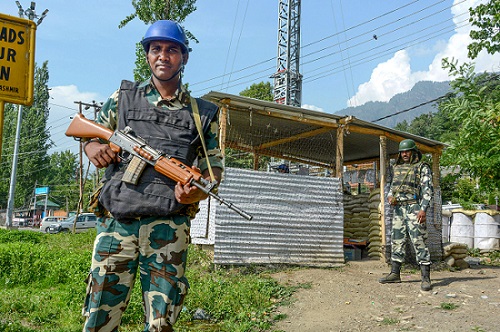
Meanwhile, counter-terrorist operations in the hinterland in Kashmir
spearheaded by the Indian Army and conducted with complete support of Jammu
Kashmir Police (JKP) and paramilitary forces have witnessed astounding results.
Reports suggest that more than 100 terrorists, including senior commanders of
the LeT and Hizbul Mujahedeen, have been eliminated this year itself of which a
major number have been killed in the last month and a half.
When terrorists of local origin come in the dragnet of security forces,
people gather into a crowd, pelt stones and interfere in the operation in a
desperate bid to save them. The security forces have complete sanction from the
government to carry on with their work regardless of this interference.
Pressure from media and other political avenues is not being allowed to play on
the minds of the security forces in pursuance of their duties. Of course, standard operating procedures are
in place to keep the locals at bay while ensuring their safety. Quite clearly,
the government has the will and determination to take the battle into the
enemy’s turf.
A segment of media is trying its level best to somehow mute down the
pressure with a “cry wolf” approach and terming the policy as tough and
inflexible. If seen outside the prism of self-serving politics and with application
of a deeper understanding, the modus operandi comes across as firm,
unambiguous and righteous. Most importantly, it is producing the desired
results. Thankfully the government is steadfast and resolute in following the
chosen path, criticism by media and other elements notwithstanding.
Gone are the days when the separatists, the terrorist and Pakistan had
their space; now they stand exposed and are clearly running for cover, Pakistan
does not wish to loosen its grip on the lumpen elements that it nurtures in Kashmir
but is too hard pressed to do anything tangible. The government today has
charted a path that meets the aspirations of the people by providing to them
what they need the most — peace and development. An ability to sustain its
confidence is bound to reap good results.
The holy Amarnath Yatra for the year 2019 officially commenced
on Monday, July 1st, with first batch of pilgrims making their way
towards the holy cave from their respective base camps in Baltal and Pahalgam
and Governor Satya Pal Malik participating in the ‘Pratham Pooja’ (first
prayer) in the cave shrine. It was reported that he prayed for peace in the
state.
Over the last 20 days, the Yatra witnessed a record footfall that has crossed two lakh mark on the 16th day itself, which is the highest number recorded over the last four years. It is notable here that barely half the period of the Yatra has been covered so far since it is scheduled to culminate on August 15th, the auspicious day of Raksha Bandhan.
Elaborate security arrangements, of a degree much
higher than what was seen during previous pilgrimages, have been put in place
this year. These include state of the art technology like
bar-coding, radio-frequency identification (RFID) tags, satellite monitoring,
live CCTV of national highway showing real-time footage and use of drones etc. Due
to the bar-coding each Yatri and each vehicle is accounted for all the time. The
boots on ground have also witnessed an increase with more companies of the CRPF
being inducted.
Special Quick Action Teams of the Army and the CRPF have been
earmarked to guard the highway. A three-tier security of Army, JK Police and CRPF
is in place to secure the routes of the Yatra right up to the holy cave.
The attention being paid to security was also noticeable from the
many reviews carried out at the highest level. On June, 26, the Northern Army
Commander, Lieutenant General Ranbir Singh visited units deployed for security
of Amarnath Yatra on the axis of Baltal and Pahalgam for a last minute check.
This was followed with a visit by Union Home Minister Amit Shah who also went
through a detailed security brief. “We have made adequate security
arrangements. Whatever has to be done for the security of the Yatris will be
done whether they are in the camps or moving in convoys. We are using
technology to best effect,” said Dilbagh Singh, DGP JK Police on
commencement of the pilgrimage.
The pilgrimage has been moving smoothly since then; it was
suspended only for one day on Monday, July 8th,
as a precautionary measure following a strike called by separatists in the
Kashmir valley to mark the third death anniversary of former Hizbul Mujahedeen
terrorist Burhan Wani.
Under the circumstances, a statement by Mehbooba Mufti, former
chief minister of the state alleging “inconvenience to the common people” comes
as a surprise. “Amarnath Yatra is taking place since years. But
unfortunately, the arrangements done this year are against the people of
Kashmir. It’s causing a lot of trouble in the day-to-day lives of local people.
I would like to request the governor to intervene in this,” she is
reported to have said. She was probably referring to a restriction on the use
of Jammu-Srinagar highway by civilians during Amarnath Yatra.
It would be prudent here to remind Mehbooba Mufti that on July 10th,
2017, when she was the chief minister of state, terrorists attacked a bus
carrying pilgrims of Amarnath Yatra on the road and killed eight of them, while
eighteen were injured.
There should be no doubt that the only reason why terrorists,
especially the foreign variety, are not striking is because they are not
getting an opportunity to do so. In order to make the pilgrimage incident free
the people would be expected to adopt laid down security protocols willingly
and proactively in the larger interest. The slight inconvenience is for their
own good and for the good of the pilgrims. The people should also keep in mind
the extreme inconvenience and great stress being faced by the security forces
in ensuring day and night vigil over such a vast area from Jammu to the cave
shrine 24×7 and should cooperate wholeheartedly with them. By so doing they
would show their appreciation for the challenging task that is being undertaken
and keep the morale of the forces high.
None other than Mehbooba Mufti has raised any issue of
inconvenience. The civilian officials, in fact, are quite satisfied with the
manner in which the Amarnath Yatra is progressing even as they pray fervently
that it remains peaceful and incident free till the very end.
Junaid Mattoo, the Mayor of Srinagar has made a reference to the
steps being taken at the civilian level to ensure security and comfort of the
Yatris. “Security forces apparatus and police grid are taking all
precautions. They are on their toes. As far as the city is concerned we are
reviewing all hotels, public facility and conveniences to ensure that Yatris
are comfortable and secure. Temples and Dharamshalas are being taken care of in
the city as several visitors visit them during Yatra,” he has said while
speaking of the arrangements.
Despite the turmoil of terrorism in
Jammu and Kashmir, importance of the Amarnath Yatra has never diluted. Lakhs of
pilgrims from all parts of the country visit the shrine every year regardless
of the security threat. Even during the peak of terrorism, the number of
pilgrims was always more than what the government could allow due to security
reasons and time constraints; it continues to be so and this year is surpassing
all records.
Notwithstanding the religious sentiments
of the people, politicians of all shades and hues do not relent from
politicising the Shri Amarnath Yatra as and when an opportunity presents
itself. Year after year, the conduct of the Yatra is subject to avoidable
political rhetoric with security taking centre stage. It cannot be
overemphasised that implicit adherence to
security protocols is imperative. It would be
best to ignore such political utterance that can jeopardise the smooth conduct
of the Yatra and follow laid down security protocols to ensure safety and
security of all concerned.
When the Bharatiya Janata Party (BJP) got a thumping majority in the Lok Sabha elections in May 2019, it was quite expected that Dharmendra Pradhan will be a part of Narendra Modi’s new team. His relentless work, in the previous government that ensured energy access to crores of poor people had made him Modi’s man of action. In Team Modi 2.0, Dharmendra Pradhan has been given a major responsibility to oversee India’s energy security needs amidst severe uncertainty in the global energy markets. A long-time party worker and known for his go-getter outlook towards work, Dharmendra Pradhan took challenges head-on during his previous stint with ministries of petroleum, and skill development and entrepreneurship. Pradhan proved to be an effective administrator and key achievements to his credit include the Ujjwala scheme, policy decisions like natural gas pricing, new round of oil and gas auctions and increased cooking gas penetration from 56 % to 95 %.
Reforms to revitalize the energy sector
Under Pradhan’s leadership the ministry of petroleum and natural gas ushered in a slew of reforms including diesel de-regulation, new market-linked gas pricing guidelines, daily revision of fuel prices, new Hydrocarbon Exploration and Licensing Policy (HELP), PAHAL-Direct benefit transfer for LPG consumers, breaking the deadlock between Odisha government and Indian Oil Corporation over Paradip refinery and success of Pradhan Mantri Ujjwala Yojna (PMUY), among others.
Schemes like Ujjwala—to provide access to LPG connections to women from below-poverty-line households— and expansion of city gas distribution (CGD) networks proved to be game-changer in drastically ramping up access to clean cooking fuel to millions of common people. Such initiatives are not only leading to energy justice, as envisaged by PM Modi, but also creating business opportunities and addressing climate change as well as local pollution concerns. Vice President of India, M Venkaiah Naidu, also lauded the commendable efforts made under Ujjwala and has said, “This has been the world’s largest poverty alleviation programme. There has been no comparable achievement by recent governments. LPG coverage stood at 50% of the country in 2014 when the scheme started. It has now grown to 90% in December 2018.”
Prime Minister Narendra Modi handing over the LPG connection papers to a rural woman under the Ujjwala scheme.
But this was not an overnight achievement. Infact, this was made possible by his sheer commitment and involvement in the planning and execution of the scheme, since its inception. From 2014 onwards, when Pradhan was inducted into the Modi government as minister of state for the petroleum and oil ministry, he focussed his energies on making Modi’s flagship programme, the Pradhan Mantri Ujjwala Yojana (PMUY), a success. Similar achievement was scripted under the PAHAL scheme. Recognized by the Guinness Book of World Record as the world’s largest cash benefit transfer scheme, the PAHAL scheme was an initiative by the oil ministry aimed at directly transferring subsidy of LPG cylinders directly into the bank accounts of the consumers. It not only helped the government save more than Rs. 20,000 crore by cutting out ghost beneficiaries but also helped propel the oil ministry’s image as a pro-poor and consumer-friendly ministry. In September 2017, in a cabinet reshuffle, Modi elevated Dharmendra Pradhan to the rank of union minister for the same ministry, with an additional charge of the ministry of skill development and entrepreneurship. This promotion was reportedly a reward for his work on the PMUY.
At the helm of energy diplomacy
India imports more than 80% of its oil requirements and around 18% of the natural gas it needs. Global oil dynamics has major impact on the economic growth of the country. Dharmendra Pradhan resumed office against the backdrop of tightening US sanctions against Iran, and production curbs by the OPEC, which have driven up oil prices. Higher oil prices stoke inflation and hurt economic growth in India, whose energy needs are primarily met through imports.
Pradhan who is a well-known figure in the energy capitals of the world, is the perfect man to protect India’s energy interest amidst global oil diplomatic slugfest. He has been in close contact with Saudi Arabia’s energy minister Khalid Al-Falih to help meet India’s energy requirements.
“India’s voice as a large, reliable energy consuming nation is heard with respect. We have been able to convince the oil suppliers about India’s as well as all consuming nations justified stand for a responsible and reasonable pricing. We have been able to simplify and reform our oil and gas sector policies and guidelines to attract new investors and inject new technologies.”
Dharmendra Pradhan, Minister of Petroleum & Natural Gas at the PetroTech-2019
The 49-year old, soft spoken leader is among few young politicians who continue to play a dominant role in the party at the center as well as in his home state. Pradhan started his political career through the Akhil Bharatiya Vidayarthi Parishad (ABVP) in 1983 and in 2004, won the Lok Sabha election from the Deogarh constituency. During the next one decade, his influence in the BJP’s central leadership continued to grow, as he served the party’s state in charge and election in charge in Bihar, Jharkhand and Karnataka. In 2010, the party appointed Pradhan as one of its general secretaries. He was also the organiser of party activities in Karnataka, Uttarakhand and Odisha. Two years later, he was given a Rajya Sabha membership by the BJP, from Bihar. At the end of his term, in 2018, the party sent him to the Rajya Sabha again, this time from Madhya Pradesh.
In a relatively short span of time, Pradhan has carved a crucial identity for himself in the national politics. He is now a close confidant of Narendra Modi and was one of the chief architects for the victory of BJP in Bihar in the 2014 General Elections. He delivered a good show in Odisha in 2019 as well, where the BJP won eight Lok Sabha seats as compared to one in 2014.
Odisha’s change maker
Dharmendra Pradhan is seen as a charismatic young leader in Odisha, who is always available for his people. During the cyclone Fani, he ensured his presence on the ground, advising, directing and ensuring that relief is provided to the people at the earliest. He was seen advising the officials involved in relief and rescue operations to increase the relief operations under the CSR schemes by the companies associated with Petroleum Ministry. Many times Dharmendra Pradhan was seen personally monitoring the schemes of relief and rescue operations. He had crucial meetings with Railways and Bank officials to restore services in the minimum possible time. People recall, the Khurda Railway Board was hit the most by Fani storm and it had affected the movement of trains on Khordha Road-Cuttack-Puri-Bhubaneswar road. Pradhan quickly organized meetings with railway officials and asked them to complete the repair work of Fani storm affected railway track before organizing ‘Rathayatra’. Also, packed drinking water, charging facilities at railway stations and food arrangements at very affordable rates were also organized at the railway stations. Similarly, the Union Minister, accompanied by representatives of RBI and SBI, and representatives of other government and private banks and officials, increased the pace of restoration of banking services in the affected areas.
Odisha is a key state for BJP, for
its rising east strategy. Through his dedication and ground work Pradhan has
helped the party significantly bolster its ground-level cadre over the last five
years in the state, and the result was quite visible in the recent elections. This
year BJP won eight Lok Sabha seats compared to one in 2014, and 23 seats in Odisha
assembly elections, as compared to 10 seats in the 2014 assembly elections.
With Dharmendra Pradhan, once again, at the helm of the crucial petroleum and natural gas ministry, efforts towards delivering energy justice to the poorest of the poor by adopting the four pillars visualized by Prime Minister Modi – Energy access, Energy efficiency, Energy sustainability and Energy security, will definitely see a major momentum. This will re-write the growth trajectory of the country in the coming years.
We use cookies on our website to give you the most relevant experience by remembering your preferences and repeat visits. By clicking “Accept All”, you consent to the use of ALL the cookies. However, you may visit "Cookie Settings" to provide a controlled consent.
This website uses cookies to improve your experience while you navigate through the website. Out of these, the cookies that are categorized as necessary are stored on your browser as they are essential for the working of basic functionalities of the website. We also use third-party cookies that help us analyze and understand how you use this website. These cookies will be stored in your browser only with your consent. You also have the option to opt-out of these cookies. But opting out of some of these cookies may affect your browsing experience.
Functional cookies help to perform certain functionalities like sharing the content of the website on social media platforms, collect feedbacks, and other third-party features.
Performance cookies are used to understand and analyze the key performance indexes of the website which helps in delivering a better user experience for the visitors.
Analytical cookies are used to understand how visitors interact with the website. These cookies help provide information on metrics the number of visitors, bounce rate, traffic source, etc.
Advertisement cookies are used to provide visitors with relevant ads and marketing campaigns. These cookies track visitors across websites and collect information to provide customized ads.
Necessary cookies are absolutely essential for the website to function properly. These cookies ensure basic functionalities and security features of the website, anonymously.
Cookie
Duration
Description
cookielawinfo-checkbox-analytics
11 months
This cookie is set by GDPR Cookie Consent plugin. The cookie is used to store the user consent for the cookies in the category "Analytics".
cookielawinfo-checkbox-functional
11 months
The cookie is set by GDPR cookie consent to record the user consent for the cookies in the category "Functional".
cookielawinfo-checkbox-necessary
11 months
This cookie is set by GDPR Cookie Consent plugin. The cookies is used to store the user consent for the cookies in the category "Necessary".
cookielawinfo-checkbox-others
11 months
This cookie is set by GDPR Cookie Consent plugin. The cookie is used to store the user consent for the cookies in the category "Other.
cookielawinfo-checkbox-performance
11 months
This cookie is set by GDPR Cookie Consent plugin. The cookie is used to store the user consent for the cookies in the category "Performance".
viewed_cookie_policy
11 months
The cookie is set by the GDPR Cookie Consent plugin and is used to store whether or not user has consented to the use of cookies. It does not store any personal data.