Home Blog Page 424

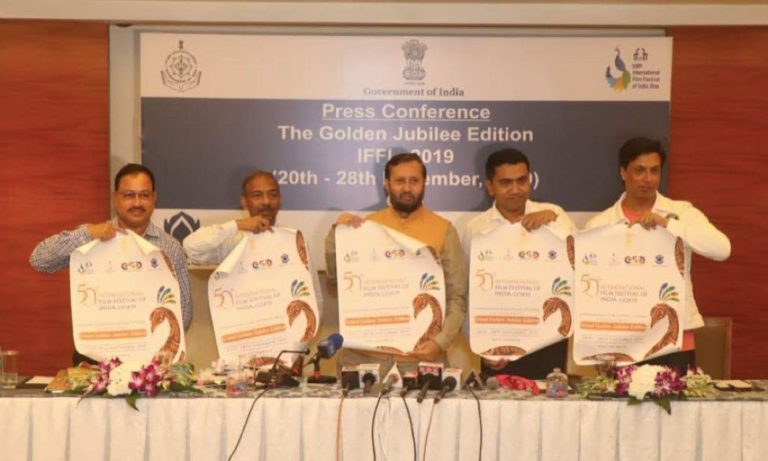
Special IFFI Golden Jubilee Poster released

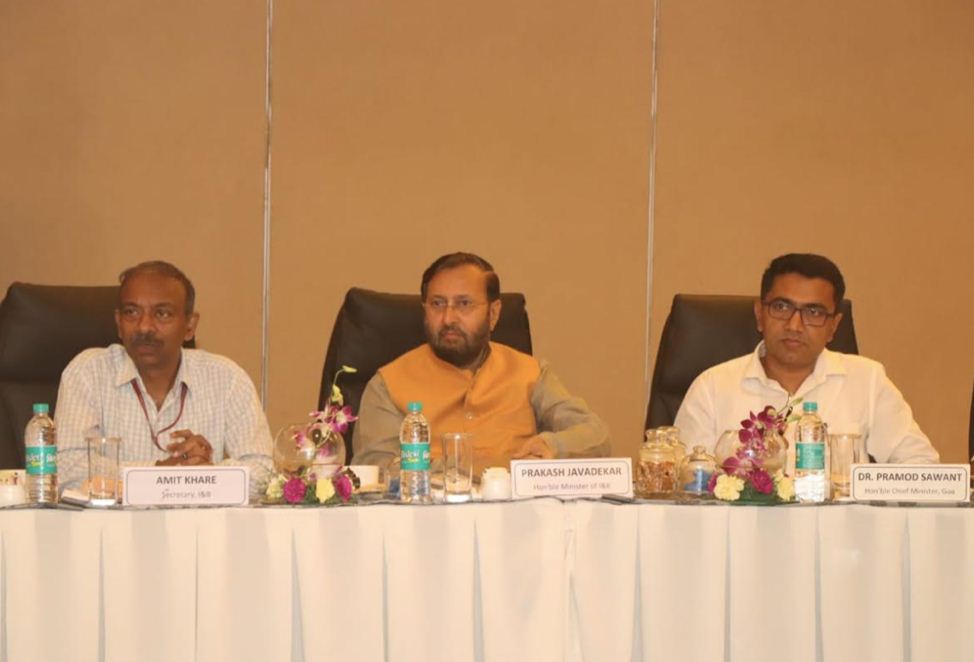
IFFI is India’s pride; this year’s IFFI is especially significant since it marks the Golden Jubilee Edition, said Union Minister Prakash Javadekar while interacting with media post the First Steering Committee Meeting for IFFI, 2019 which is set to take place from 20th to 28th November in Goa. The Steering Committee Meeting was held earlier today to ensure the necessary coordination between key stakeholders involved in the process of organizing the Festival.

Javadekar announced that John Bailey, the President of Academy of Motion Pictures Arts and Sciences has confirmed his participation for this year’s IFFI. Roadshows will be conducted across seven cities in India to reach out to film fraternity for developing a buzz for the Festival. Business Exhibitions to display relevant technologies for films and Exhibition marking the 150thAnniversary of Mahatma Gandhi will also be organized with this year’s Festival. The number of private theatres taken on board for showing films during the Festival will be further increased to cater to the high demand for extra screening of popular films. Russia may be on board as the country focus this year, said the Minister during the media briefing. Students of premier film institutes including FTII and SRFTI will be involved in management of this year’s Festival. The list of films to be shown is aimed to be finalized by September this year to give sufficient time for cine lovers to plan for attending the Festival. The Minister also added that this year’s Festival will pay tribute to ex-Chief Minister of Goa Manohar Parrikar, who was instrumental in making Goa the permanent venue for IFFI.

Goa Chief Minister Pramod Sawant said that organization of 50thIFFI is a proud moment for the state and his government will leave no stones unturned to ensure top notch infrastructure and hospitality arrangement to make this Edition of the Festival a memorable one. A special IFFI Golden Jubilee Edition poster was also released by Union Minister Prakash Javadekar and Goa CM Dr. Pramod Sawant during the event.

The Steering Committee Meeting was attended by Union Minister Prakash Javadekar; Chief Minister of Goa Dr. Pramod Sawant; I&B Secretary Amit Khare; Chief Secretary, Goa, Parimal Rai; Vice Chairman, Entertainment Society of Goa (ESG), Subhash Phal Dessai; representatives of the film community including Shaji N Karun, AK Bir, Rahul Rawail, Manju Borah, Ravi Kottarakara and Madhur Bhandarkar; senior officials of Directorate of Film Festivals, Entertainment Society of Goa, I&B Ministry and Goa Government. It was also informed that eminent film personalities including Karan Johar, Siddharth Roy Kapoor, Feroze Abbas Khan and Subhash Ghai will also be part of the Steering Committee.

Fifty percent construction work completed on Dera Baba Nanak – Kartarpur corridor Highway

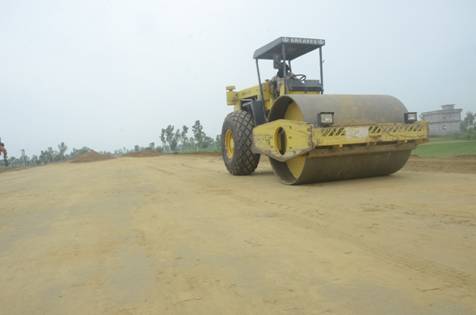
The construction work on a four-lane Highway connecting Dera Baba Nanak from Gurdaspur-Amritsar Highway to International border is progressing in full swing. The 4.19 km long Highway is being built at a cost of Rs 120 crores. The Government of India approved development of Karatarpur Sahib Corridor project on 22.11.2018 and the foundation stone was laid by Vice President of India, M. Venkaiah Naidu on 26.11.2018.

The land acquisition process for the project was initiated on 14.01.2019 and concluded on 21.05.2019. So far,50% of the project work has been completed and the Highway would be completed by September 30, 2019.

The substructure construction work of the bridge i.e. piling, pile caps has been completed on the Indian side. Piers and Piers caps casting work is under progress along with girder casting work.

So far three technical level talks have been held with the Pakistani technical team to discuss issues related to this project such as zero point coordinates, finished road level, width of bridge at zero point etc. The Pakistan Authorities were apprised that India is constructing a bridge at the Ravi Creek on Indian side of International Border and requested Pakistan side to also construct a bridge on Budhi Ravi Channel on their side. But Pakistan side initially proposed road on embankment and later on proposed causeway. Both these options are not acceptable as there will be danger to habitations on the Indian side in case of flood, and also the road will not be all weather.

US likely to impose 5 billion dollar fine on Facebook due to privacy issues

As per reports, the US regulators have approved a USD 5 billion penalty to be levied on Facebook to settle a probe into the social network’s privacy and data protection lapses.  According to the Wall Street Journal the Federal Trade Commission (FTC) approved the settlement in a 3-2 vote, with the two Democratic members of the consumer protection agency dissenting.

Although details have not yet been released, the deal will likely include restrictions on how Facebook is able to use personal data. The FTC announced last year it reopened its investigation into a 2011 privacy settlement with Facebook after revelations that personal data on tens of millions of users was hijacked by the political consultancy Cambridge Analytica, which was working on the Donald Trump campaign in 2016. According to the report, the deal, which would be the largest penalty ever imposed by the FTC for privacy violations, still needs approval from the Justice Department before it is finalized.

Facebook has also faced questions about whether it improperly shared user data with business partners in violation of the earlier settlement. The leading social network with more than two billion users worldwide has also been facing inquiries on privacy from authorities in US states and regulators around the world.

The settlement would be in line with Facebook’s estimate earlier this year when it said it expected to pay USD 3 billion to USD 5 billion for legal settlements on “user data practices.” The fine is unlikely to hurt Facebook, which logged a profit of USD 2.4 billion on revenue that climbed 26 per cent to USD 15.1 billion in the first three months of this year. Facebook’s stock value increased 1.8 per cent after the fine was announced, closing at nearly USD 205, the highest it has been all year.

Some Facebook critics have argued the company should face tougher sanctions including monitoring of its data practices, or that chief executive Mark Zuckerberg should be personally liable for penalties.

There are increasing calls to dismantle the massive social network. In May, one of Facebook’s co-founders called for the social media behemoth to be broken up, warning that Zuckerberg had become far too powerful. “It’s time to break up Facebook,” said Chris Hughes in an editorial for The New York Times, saying it had become necessary to separate the social network from Facebook’s Instagram and WhatsApp services.

Meet ‘Kargil Girl’ on the Big Screen

‘Dhadak’ star Janhvi Kapoor is all set for her next film titled ‘Kargil Girl’. The film is based on the real-life story of Gunjan Saxena, who was the first woman combat aviator who entered the war zone in the 1999 Kargil War. While missiles, rocket launchers, and cannon balls were being fired, Gunjan was flying helicopters. Not only this, but she also did the responsibility of delivering the necessary goods to the soldiers. Because of her work in the war, she was awarded the Shaurya Chakra Award.

The biopic on Indian Air Force’s first female combat pilot, has entered into second phase of shooting. It will be shot in high altitude regions of Georgia in the northeastern part of the country in a town called Kazbegi. According to the source in the report, Janhvi and Angad will leave in the end of July. They will shoot first in the main capital before heading to Kazbegi. The town is a mountainous area set over 5700 feet above sea level. The film’s first schedule was shot in Lucknow and the second schedule is set to be more intense and action packed.

Gunjan Saxena was born in 1975, in an army family. Both her father and brother were in the army, and they also decided to join the army. After completing her schooling, Gunjan went to Delhi to study for graduation, where she took admission in Hansraj College of Delhi University and together she started learning the basics tips of Flying from Safdarjung Flying Club, and after a few months, Gunjan joined the Air Force.

Pakistan’s Deep State unleashes malicious disinformation campaign in Punjab

Desperate times require desperate measures. And when desperation sets within the Pakistani Deep State, they resort to their most potent weapon: Disinformation. Over the last seven decades Pakistan’s Deep State has been running their disinformation campaign in Kashmir, but New Delhi’s relentless hot pursuit of terrorists, separatists and their sympathisers has now pushed them into a corner. With their tactics failing in Kashmir, Pakistani Deep State has now directed its sinister disinformation campaign towards Punjab.

Pakistan’s Deep State comprises an elite coterie of officers from the Pakistan Army, its propaganda arm ISPR (Inter-Services Public Relations), and their rogue intelligence agency ISI (Inter-Services Intelligence). After being cornered in Kashmir, they have chosen Operation Woodrose as part of their disinformation campaign. A few disgruntled and criminal elements from Punjab have been bribed, who, in turn, have put out videos, articles and online propaganda literature that point to excesses by the Indian Army during Operation Woodrose that was launched close on the heels of Operation Blue Star.

It’s being said that during Operation Woodrose, the Indian Army arrested over 100,000 Sikhs across Punjab and of these around 20,000 Sikhs were brutally murdered in cold blood. “…it was a state-sponsored pogrom that was aimed at wiping out Sikhism from Punjab,” claims the disinformation propaganda videos and other literature.

All of this is false. I spoke to several officers from the Indian Army, intelligence services and the Punjab Police who were at the helm of affairs during the eighties and were privy to inside information during Operation Woodrose. All of these officers, several of whom are Sikh, denied any such systematic massacre by the Indian Army.

Background

Operation Blue Star was launched on June 1st, 1984, when Indian Army, after receiving orders from Indira Gandhi, the then Indian Prime Minister, launched an attack on Shri Harminder Sahib (Golden Temple), the holiest shrine of Sikhs at Amritsar, Punjab. This extreme step was necessitated due to the presence of a Sikh militant leader Jarnail Singh Bhindranwala who, along with his close aides, was holed up inside the Gurdwara complex. Operation Blue Star was aimed at flushing out these militants who were using the holy Gurdwara as their base since 1982. The operation was hastily planned and executed. Major General (later Lt. Gen) KS Brar, the Indian Army officer who was tasked to conduct this operation, was all set to leave on a vacation along with his wife when he was called upon to cancel his leave plans and execute the Operation Blue Star.

Army veterans recollect that there was a strong probability of Pakistan’s direct attack on India during this operation and hence the Amritsar-based 15 Infantry Division was not put into this operation, instead the Meerut-based 9 Infantry Division was put in charge of this sensitive operation.

After laying siege around the Gurdwara, the Indian Army first sanitised the area and when it finally entered the premises it encountered heavy fire from machine guns and automatic weapons. The hastily planned operation met with difficulties and was extended to over a week. There were several casualties on both sides before the holy place (by then badly damaged) was cleared.

Operation Blue Star had two specific parts: Operation Metal and Operation Shop. While the Operation Metal was meant to clean up the Gurdwara complex of militants, the Operation Shop’s objective was to raid militant hideouts across Punjab and to arrest remainder militants hiding in the countryside.

Operation Woodrose

Alongside the Operation Blue Star, Operation Woodrose was conducted by operational divisions deployed along the international border with Pakistan to strengthen our guard on the border areas. This was done by replacing BSF (Border Security Force) pickets with regular troops.

It is here that the propaganda and disinformation campaign is being created at the behest of Pakistan to say that Operation Woodrose was carried out in the months after Operation Blue Star to “prevent the outbreak of widespread public protest in Punjab”. It is being widely circulated that the Indian Army, by virtue of special powers given to it, took about 100,000 Sikh youths into custody within four to six weeks after launch of this operation. And that several thousands of these young men, mostly innocent boys, “disappeared” from Army’s custody. It’s also alleged that several others crossed over to Pakistan for their safety.

Jaibans Singh, a retired Indian Army officer and author of several books on geo-strategy, strongly contests these allegations. “The first question to be asked is where and in which prison were these one lakh Sikhs detained. It is not an easy task to imprison around 100,000 people without the world knowing about it. Secondly, it is utterly baseless to say that Indian Army murdered 20,000 Sikhs in cold blood. No dead bodies of 20, 000 boys alleged to be murdered by the Army was ever found. They cannot be made to disappear overnight. The contention that they crossed over is not plausible since the Indian Army, post Operation Blue Star, had effectively sealed the border,” explains Singh. Jaibans Singh is himself a Sikh and has keenly followed Punjab politics over the last several years. He further explains that there was a media censorship during Operation Blue Star but it was revoked immediately afterwards. “In fact, foreign media had turned a keen eye on the happenings in Punjab. Under the circumstances, such widespread carnage could not have gone unnoticed,” he adds.

Brigadier (retd.) SK Chatterjee agrees. “…Operation Woodrose was carried out in conjunction with the Punjab police. It is a fine example of not just a successful counter-insurgency operation but also about keeping collateral damage to the minimum. The operation carried out by the forces were intelligence based and executed most professionally,” Brig. Chatterjee reminisced about the operation. He went on to explain that till today Punjab sends a higher percentage of officers and soldiers to the Indian Army as compared to other states of India, and as such no gross violation of human rights can possibly be even contemplated in Punjab, and “…perhaps that’s the reason why Indian Army is still close to the people of Punjab even today.”

A senior officer of the Intelligence Bureau (IB) who had handled Sikh militancy during eighties also concurred that the allegation of thousands killed by the Army is baseless. “It is a mischievous propaganda that is apparently being carried out at the behest of Pakistan’s ISI,” the officer said, who requested not to be named. The IB officer added that those few Sikhs who are working to further this Pakistani disinformation campaign and are now spearheading this malicious campaign are doing a great disservice to their brethren who have seamlessly integrated into the political and economic system of India.

Iqbal Singh Lalpura, who was the AIG (Additional Inspector General) in Punjab Police during the execution of Operation Blue Star and Operation Woodrose flatly denied any wrong doing by the Indian Army. It was Iqbal Singh Lalpura who spearheaded the operations against miscreants in Punjab during those tough times in the eighties. “The Army did not kill anyone in Punjab. Their role was to support the Punjab Police,” he said. Lalpura is a Sikh and categorically refused to acknowledge that Sikhs are against India or want a separate state.

Details about Operation Blue Star is well documented and much is already known about it. There has been considerable criticism about this operation both in the political as well as military domain. However, not many know about Operation Woodrose, and this is where the Pakistani Deep State sniffed an opportunity to drive its propaganda and foment trouble in Punjab.

It’s true that for a few days after the attack on Shri Harmandir Sahib (Golden Temple) the Indian Army carried out mopping operations under Operation Shop. Premises of Gurdwaras across the state and other suspect areas were searched. A considerable cache of arms and ammunition were found that were handed over to the police and state government authorities.

A few days later the Army formation (9 Division) finished its task and went back to its permanent location. Operation Woodrose was then carried out by the holding formations along the international border with Pakistan.

Further, several logical deductions also puncture hole into the Pakistan’s sinister campaign. For instance, Indian Army never carried out such barbaric acts even while fighting peak insurgency in the North-East and in Jammu and Kashmir, where the intensity has been far greater and have simmered for a longer time than in Punjab. Also, the army was taken by surprise during their execution of Operation Blue Star, how could it create facilities and infrastructure to detain 100,000 people and also torture them?

The media censorship was immediately removed after Operation Blue Star. Thereafter all happenings across Punjab took place under the watchful eyes of media. Under these circumstances, such massive carnage could not have gone unnoticed. Also, the Army personnel in charge of these operations that range from officers and junior commissioned officers and include thousands of Sikh soldiers deny any such widespread atrocity committed by the Indian Army.

All allegations of extra judicial atrocity by Army personnel in Punjab under Operation Woodrose or otherwise are false and designed to tarnish the good name of Indian Army and foment trouble in Punjab.

Govt. gives major push to rural road connectivity as Cabinet approves PMGSY-III

In a major boost to rural road connectivity across the country, the Cabinet Committee on Economic Affairs, chaired by the Prime Minister Narendra Modi, has given its approval for the launch of Pradhan Mantri Gram Sadak Yojana-lll (PMGSY-III). Under the PMGSY-III Scheme, it is proposed to consolidate 1,25,000 Km road length in the states. The Scheme will also include Through Routes and Major Rural Links that connect habitations to Gramin Agricultural Markets (GrAMs), Higher Secondary Schools and Hospitals.

This would facilitate easy and faster movement to and from Gramin Agricultural Markets (GrAMs), Higher Secondary Schools and Hospitals. Roads constructed under PMGSY would also be maintained properly.

It will entail an estimated cost of Rs 80,250 crore (Central Share-Rs. 53,800 crore, State Share- Rs 26,450 crore). The funds would be shared in the ratio of 60:40 between the Centre and State for all States except for 8 North Eastern and 3 Himalayan States (Jammu & Kashmir, Himachal Pradesh & Uttarakhand) for which it is 90:10.

Project period would be 2019-20 to 2024-25. Selection of candidate roads will be done based on the sum total of the marks obtained by particular road on the basis of parameters of population served, market, educational and medical facilities, etc. Under the scheme, construction of bridges upto 150 m in plain areas and 200 m in Himalayan and NE States proposed, as against the existing provisions of 75 m and 100 m in plain areas and Himalayan and NE States respectively. The States shall be asked to enter into a Memorandum of Understanding (MoU) before launching of PMGSY-III in the concerned State for providing adequate funds for maintenance of roads constructed under PMGSY post 5-year construction maintenance period.

Under PMGSY, a total of 5,99,090 Km road length has been constructed under the scheme since inception till April, 2019 (inclusive of PMGSY-I, PMGSY-II and RCPLWEA Scheme.

PMGSY-III scheme was announced by the Finance Minister in Budget Speech for the year 2018-19. The CCEA in its meeting held on 9th August, 2018 approved continuation of PMGSY-I & II beyond 12th Five Year Plan and covering of balance eligible habitations under PMGSY-I by March 2019, PMGSY-II, and habitations under identified LWE blocks (100-249 population) by March 2020.

PMGSY was launched in December, 2000 with an objective to provide single all-weather road connectivity to eligible unconnected habitation of designated population size (500+ in plain areas and 250+ in North-East, hill, tribal and desert areas as per Census, 2001) for overall socio-economic development of the areas. 97% of the eligible and feasible habitations have already been connected by all-weather road.

PM approves provision of stringent punishment for sexual crimes against children

In a historic decision to protect the children from sexual offences, the Union Cabinet chaired by Prime Minister Narendra Modi has approved the Amendments in the Protection of Children from Sexual   Offences (POCSO) Act, 2012. It will make punishment more stringent for committing sexual crimes against children including death penalty. The amendments also provide for levy of fines and imprisonment to curb child pornography.

The amendment is expected to discourage the trend of child sexual abuse by acting as a deterrent due to strong penal provisions incorporated in the Act. It intends to protect the interest of vulnerable children in times of distress and ensures their safety and dignity. The amendment is aimed to establish clarity regarding the aspects of child abuse and punishment thereof.

The POCSO Act, 2012 was enacted to Protect the Children from Offences of Sexual Assault, Sexual harassment and pornography with due regard for safeguarding the interest and well-being of children. The Act defines a child as any person below eighteen years of age, and regards the best interests and welfare of the child as matter of paramount importance at every stage, to ensure the healthy physical, emotional, intellectual and social development of the child. The act is gender neutral.

Ideas Beyond Borders and Wikipedia Arabic Educational Outreach

Faisal Saeed Al Mutar is the founder of Ideas Beyond Borders and Bayt Al-Hikma 2.0, Global Secular Humanist Movement, and a columnist for Free Inquiry

Scott Douglas Jacobsen: What are some other milestones?

Faisal Saeed Al Mutar: There have been some pretty amazing milestones since our last conversation. Over the last few months, we have Wiki groups in the Levant mainly.

We have a number of translators and people focused on different subjects emphasizing the Arabic language. Unfortunately, the Wikipedia Arabic used to be the 18th language.

But, fortunately, we were able to translate more than a 1,000 articles as we speak. These articles never existed before in Arabic. This would be the Civil Rights movement figures.

Today, I was reading a story about how Saudi women’s rights activist for driving was inspired by Rosa Parks. That has been translated into Arabic by our group.

Also, the library of evolution has been translation. It is a banned subject in many education systems across the Arabic world. I have been focusing over the past few months until now on the building of a full library of evolution.

It would be from the beginning to the end. It is already gaining us a lot of momentum with partnering with groups in the Middle East. We are really definitely creating and institutionalizing a movement that is very helpful for new ideas.

The Wikipedia Arabic project has been working really well. We have expanded our translation efforts to expand to Kurdish too. We have expanded beyond just the Arabic language.

Now, we have included articles in Kurdish and about 15 or so in Farsi. These have been in subjects including freedom of the press, pluralism, John Stuart Mill and the concept of liberty, progressive values, and also the values of the Enlightenment.

Many of these articles did not exist in these languages before. We are happy to be a part of this movement. We are expecting other countries in the Middle East, including Iran and the Northern part of Iraq and Kurdistan.

It has been going perfectly. We are releasing our books very slowly as we are trying to make sure that the reach and the partnerships that we are building in the region will help distribute them, to make sure it is a success and the quality of the translation is the highest possible in the organization.

We are very happy to work with experts in translation.

Jacobsen: Thank you for the opportunity and your time, Faisal.

Photo by mostafa meraji on Unsplash

Big B and Aamir Khan endorse PM Modi’s ‘Jal Shakti Abhiyan’

Prime Minister Narendra Modi in the recent episode of his second series of radio programme “Mann Ki Baat” had expressed concern about the water problem in the country and shared the importance of the new Jal Shakti Ministry. He had urged the people to make water conservation a national movement. In response to PM’s call Bollywood superstars Amitabh Bachchan and Aamir Khan have asked people to take steps towards water conservation.

The two superstars recently shot special videos urging the citizens to use water judiciously, save rainwater, clean water bodies, in the country’s battle against drought and water scarcity. They also informed the details of the movement, which involves top authorities of the government visiting the affected villages and discussing with the people the possible efforts to resolve the crisis so that we can succeed in saving the ‘valuable treasure.’

In a video posted by the official Twitter page of ‘Jal Shakti Abhiyan’, Aamir, who is involved with water conservation efforts in Maharashtra through his Paani Foundation, can be heard saying, “Jal hai to kal hai. That is the reason we have to save a valuable treasure like water. Use it judiciously and protect it. Not just for today, but for the upcoming generations and our children. To battle water scarcity and drought, under Prime Minister Narendra Modi’s leadership, through the ‘Jal Shakti Abhiyan’, the top authorities of the government are working in the villages suffering from the crisis. This team will discuss with you the efforts that can be taken over the issue, so that water is easily available for all villages in every season. Let us all, in this monsoon, save rainwater, clean our water bodies and make ‘Jal Shakti Abhiyan’ a successful mission.”

“It is critical that we save water today for a better tomorrow, for our future generations and nation.” – Mr. @aamir_khan urges everyone to take a step forward and do their bit in conserving water to secure our future. #JanShakti4JalShakti @narendramodi @PMOIndia @gssjodhpur

Amitabh Bachchan, echoing Aamir’s comments, said that Indian government’s ‘Jal Shakti Abhiyan’ means ‘Sanchay Jal, Behtar kal’ (save water for better tomorrow). The veteran actor added, “Water is our Earth and our life’s valuable asset. To battle water scarcity and drought, we need to do ‘Jal Sanchay’ which means to collect and ‘Jal Sanrakshan’, to protect it, save it and make this a true water movement.”

.@SrBachchan urges everyone to take a step towards conserving water at their own level during this upcoming monsoon and contribute to a better future. #JanShakti4JalShakti @narendramodi @PMOIndia @gssjodhpur

PM Modi replied to the two, terming their comments as ‘wise words’, ‘valid points’. The PM said, “Extremely valid points by @aamir_khan on the need to conserve water and create awareness at the grassroots level. #JanShakti4JalShakti.” He also said, “Wise words from @SrBachchan, which will surely inspire you towards conserving water and urging others to do so as well!”

Zambian wildlife adventure for Bollywood actor Kriti Sanon

Bollywood star Kriti Sanon is currently enjoying her vacations in Zambia and her pictures on Instagram have attracted millions of followers. Zambia is considered the land of the legendary African walking safari, Victoria Falls, the wild Zambezi River, abundant wildlife and raw wilderness.

Sanon, who is on an adventurous holiday, interacted with cheetahs and giraffes. The actor shared selfies and videos of her time in Lusaka, Zambia on Instagram. Kriti shared a picture of herself, sharing the frame with a cheetah and captioned it, “He wanted a selfie!! Couldn’t say no.. #Zambia.” While a few celebrities and fans liked the picture, there were many who criticised the actor for posing with wild animals. The actor also shared a video of a cheetah drinking water from her hand on her Instagram stories. Another picture shared by her shows her walking the cheetah with a leash.

She also visited the Victoria Falls with her friends and shared stunning pictures with the waterfall in the background. Besides acting, Kriti also writes poetry and often shares her work on Instagram. She recently shared a picture from her flight along with a small poem.

Zambia, in southern Africa, is a landlocked country of rugged terrain and diverse wildlife, with many parks and safari areas. On its border with Zimbabwe is famed Victoria Falls, plunging a misty 108m into narrow Batoka Gorge. Spanning the Zambezi River just below the falls is Victoria Falls Bridge, a spectacular viewpoint. Blessed with awe-inspiring natural wonders, an abundance of wildlife, huge water bodies and vast open spaces, Zambia offers unforgettable holidays exploring the real Africa.