Home Blog Page 477

There’s a glimmer of hope that peace and normalcy will return to Kashmir

0

Even though 2018 may have been one of the bloodiest years that Kashmir has seen in recent times, yet there are several reasons to be optimistic. The most significant development during the year gone by has been the successful conduct of Panchayat elections in the state and three things make this event even more special. First, the Panchayat elections were held after a gap of 13 years. Second, people once again disregarded the election boycott call given by Separatists. And the Third, which is also the important achievement, is that despite Hizbul Mujahideen (HM) threatening candidates and voters, the elections went ahead as scheduled.

Threat from terrorists failed to deter the electoral candidates, such that in Pulwama, which is considered to be a hotbed of terrorism and a secessionist stronghold, as many as 151 candidates filed their nomination. Similarly, even the voters defied threats from terrorists and came out to cast their ballot, embarrassing both the All Parties Hurriyat Conference (APHC) which gave a poll-boycott call and terrorists who issued death threats to those being involved in the election process in any way. Though the Hurriyat tried to use the low turnout percentage as a ‘fig-leaf’ by claiming that its poll-boycott call was successful, but the very fact that even after all these threats as many as 33% of the people in Kashmir valley turned up for voting debunks Hurriyat’s claims. This also goes to prove that despite all the turmoil in Kashmir and Hurriyat’s claims of public resentment against “sham elections” being conducted in the state, the people of Kashmir continue to repose faith in the democratic process.

Creating an atmosphere conducive for the conduct of Panchayat elections wasn’t an easy task and the security forces, law enforcement agencies and even the public had to shed a lot of blood, sweat and tears for this purpose. The biggest challenge came from terrorists who embarked upon a bloody campaign of intimidating people by abducting and killing innocent civilians whom they suspected of working as spies for government forces. In order to terrorise local Kashmiris, the Hizbul Mujahideen even tried to copy Islamic State’s (IS) methods by posting graphic videos on social media of helpless boys in their teens being forced to ‘confess’ that they were passing information about terrorists to government forces and then being mercilessly gunned down. Though this has been happening ever since terrorism started in Kashmir, 2018 saw many cases, where parents of those killed on suspicion of being informers have openly challenged the terrorists to prove that their sons were indeed spies. However, no terrorist group has done so even in a single case and this exposes the web of lies that they weave.

With more than 250 terrorists being neutralised in 2018, it is evident that despite threats from terrorists, the public is actively cooperating with government forces by providing them precise information regarding whereabouts of terrorists. The terrorist groups and the Hurriyat allege that a only few ‘bad hats’ are spying for the government forces in exchange for pecuniary gains but they fail to provide a convincing answer to the question that when death is the only ‘punishment’ for informers, why would so many risk their lives just for a little bit of money? Having failed on this account, terrorists tried to intimidate local Kashmiris serving in security forces or police by abducting those who had come home on leave, forcing out confessions of having participated in operations against terrorists and then killing them. The Hizbul Mujahideen also ordered Special Police Officers (SPOs) to quit or be prepared to die and to demonstrate that this was no idle threat they even killed many SPOs but barring a handful, the entire rank and file of these dedicated policemen continues to serve with full enthusiasm.

The next positive development in Kashmir during 2018 is that there is a discernable decline in the number of youth joining terrorism when compared to the previous year.  In 2016, the total number of local youth who joined terrorism stood at 84 but this figure shot up to 128 in 2017, which was the highest ever recorded in the last one decade. However, the number of locals who joined terrorism in 2018 stands in the pre-2017 region of 80 to 85 (once we discount those who quit terrorism by surrendering to the government forces or police). This is again the cumulative result of public resentment against terrorists killing their own people and the humane approach adopted by security forces and J&K Police, who are performing the role of facilitating surrender of terrorists and bringing them back into the mainstream through compassion and counseling with full commitment.

The year 2018 also saw a drastic reduction in the number of shutdowns in Kashmir and the credit for this goes entirely to the public whose resentment against frequent shutdowns in 2016 and 2017 forced the Hurriyat to finally admit in November 2018 that it was looking for alternatives to ‘hartal politics’. Reduction in the number and frequency of protests and shutdowns has given the ailing tourism industry of Kashmir the much needed shot in the arm and statistics prove this beyond any doubt. While the tourist inflow in 2017 was lowest in six years, there has been a considerable increase in the number of tourists who visited Kashmir in 2018 and this has helped thousands of locals who rely on the tourism industry for their daily bread and butter.

It may be a bit premature to pronounce that normalcy has returned to Kashmir but it wouldn’t be an exaggeration to say that the abnormal spike in the graph of terrorism related incidents in the last two years has receded considerably. This spectacular achievement is due to consummate professionalism in the face of grave provocation and enhanced risks posed by mobs appearing at encounter sites as well as immense sacrifices made by the government forces. In 2018, nearly 50 security forces personnel and policemen attained martyrdom in their line of duty and what makes this sacrifice even more praiseworthy is that despite being specifically targeted by terrorists local Kashmiris serving with the security forces and police haven’t got intimidated by threats from terrorists or even by incidents of their unarmed colleagues being murdered by terrorists.

The year gone by will be remembered as the one during which government forces were able to successfully reverse the negative trend of escalating violence in Kashmir and all this was made possible by active cooperation of the public.

Kashmir’s conflict driven narrative can change only through right Education

0

A growing number of young people in Kashmir are suffering from emotional despair, low self-esteem, a lack of cultural connectivity and loss of values. They are angry with the prevailing state of affairs and this makes them extremely susceptible to manipulators who seek to profit from their situation.

If the current negative attitude that permeates’ through Kashmiri society is not dealt with, the situation will worsen. The remedy may lie in the education system. If the current teaching methods are supplemented with peace driven initiatives the youth of Kashmir may get a platform to express their views and shake away inhibitions.

Young Kashmiri people in the last 28 years of violence, disturbances and shut downs have lost pride in their roots and the rich cultural heritage of their homeland. Parents and grandparents who earlier had time for their children and grandchildren are caught up in their own turmoil. Whatever little conversation happens within the family, invariably comprises of cribbing against the system and speaking of difficulties in dealing with the insecure environment. All of this has a very debilitating impact on the young minds.

Due to the exodus of Kashmiri Pandits, Kashmir has become a predominantly Muslim region, and due to this the young people have no experience of co-existence, communal harmony, and the historical diversity that was the pride of this region which is referred to as Kashmiriyat. The current environment of social apathy, decadent values, divisive polity, anger and aggressiveness is slowly poisoning young minds and this ends up in a vicious cycle of ignorance, violence, anger, hatred, despair and response that impacts relationships, both politically and socially.

In conflict situations education plays an important role in peace building. It can play a very constructive role in development of peace-building perspective and thereby promoting socio-economic development and prevention of recurring violence. Educating young people about the virtues of peace would mean covering those aspects of daily life which are deeply connected to ones identity. It is vital for transforming the culture of violence into a situation where hatred isn’t allowed to subdue amity. Peace building is more of a permanent transformational agenda than short term measure taken to overcome the conflict ridden situation. Therefore, reconstructing education in Kashmir should be given highest priority.

The effort should be directed towards opening the minds of the youth that are completely closed to new thoughts and solutions. A restructured educational initiative will open a new window and give the space to discuss ideas, express honest opinions, learning to solve problems and maintaining a positive outlook.

As the issue of bringing peace through educational interventions in conflict zones is not the focus of any single agency or organization, it requires the contribution of all actors. Education should not remain the responsibility of the institutions alone. Internal actors are the ones who have in some way personally experienced conflict and lived with its consequences. Therefore, in a conflict zone like Kashmir it is ultimately the internal actors who can play an integral role in building peace and rebuilding normalcy. All community specialists, including lawyers, economists, scholars, educators, and teachers must be involved in contributing their expertise to help create awareness among the youth and carry out peace building efforts.

An appropriate approach to building peace is to put together a solid structure of relationships with the intervention of key political leaders, military officers and religious leaders. It is believed that the greatest resource for sustaining peace in the long term is always rooted in the local people and their culture. Building on cultural resources and utilising local mechanisms for handling disputes can be quite effective in resolving conflicts and transforming relationships.

The youth, on their part, are required to take a lead as they constitute a new hope for the society. In my personal interaction with youth of Kashmir, I have found them to be very vibrant and full of new ideas, very hardworking and dedicated towards their goals. Though they are very upset with the system but they must never forget that where there is a will there is always a way. They have potential to bring a very positive change in the society. So the young and intelligent youth must take the charge of initiating education and peace building programmes to make a positive impact on conflict resolution dynamics.

Peace-building measures must target all aspects of the state structure and get a wide variety of agents for implementation. An all encompassing approach that is locally driven and designed to change the education and information spectrum will pay handsome dividends towards ushering peace and amity in Kashmir. 

Philosophy of Economics Crash Course 6

Dr. Alexander Douglas specialises in the history of philosophy and the philosophy of economics. He is a faculty member at the University of St. Andrews in the School of Philosophical, Anthropological and Film Studies. In this series, we will discuss the philosophy of economics.

Scott Douglas Jacobsen: How is philosophising about economics useful in the development of insights into economics itself?

Dr. Alexander Douglas: Many economists doubt that it is. They can argue that they get along just fine without reading any philosophy of economics. And I suppose they do, given their goals. Companies and governments keep on hiring them to give advice and make forecasts. Philosophers can criticise their models for being not scientific enough, or ignore what is of real human value. Anyone can criticise their forecasting record based on whatever external standard they deem appropriate. But the economists can always reply: ‘If we’re so wrong, why are we always consulted?’ I think philosophers of economics ought to think about that question. But doing so would mean moving in the direction of social critique and away from contributing to economics as such.

Joan Robinson claims, in Freedom and Necessity, that the task of the social sciences is very different to that of the natural sciences. It is, she says, to provide society with an organ of self-consciousness. I think contemporary economics fails at this task. Economists build models in which the system works a certain way; they plug in values and predict outcomes, and policymakers and others base their decisions on these predictions. What is left out is the amount of social control required to keep the systems working in this theoretically tractable way. Economists rarely discuss this, as far as I know. Nor do they acknowledge the extent to which their models are self-fulfilling prophecies: the systems they describe work the way that they do because decision-makers unconsciously internalise the models that describe them working in that way. A real organ of social self-consciousness would make us aware of all this. If economists don’t provide one, maybe philosophers will have to.“Contemporary economics fails at this task.. of providing society with an organ of self-consciousness.”

Jacobsen: How will the economics of the future change – as the implicit philosophy and descriptions around it change into the future?

Douglas: I’m not sure what the engine of change would be. While economics is heavily criticised in certain portions of the media, economists are still, as I said, routinely hired to produce the analyses which government agencies and businesses use to determine their strategies. The analyses are based on models, the basic types of which were developed in the 1970s. Economists criticise some of the types and promote others. But, from the outside, I don’t see a huge amount of theoretical innovation; within the economic profession, improvement is just about making the right upgrades to the classic machines.

To me, this theoretical conservatism goes with political conservatism. We theorise how we govern, and vice-versa. Economic modelling is all about predicting and controlling human actions with increasing precision – winning that little bit more margin by tracking us with better algorithms. Politics works to render us algorithmically tractable. The goals work in a positive feedback loop. The more our political institutions can trap our behaviour into predictable patterns, the better the economic models can track us; the better the models track us, the better the institutions can control us. If we refuse to be described in this way, we can refuse to be governed in this way, but we can’t successfully refuse the one and not the other.

Jacobsen: Do you think the era of individual economic philosophy is almost dead, where a pluralistic approach becomes ideal because of the complexity of an international economy such as our own?

Douglas: Pluralism sounds nice. But the problem is that different approaches are non-diversa sed opposita. They are at odds with each other more than they complement each other.

Take the most fundamental question: how the entire economy, in the most general sense, works. One answer appeals to the idea of a ‘dynamic’ general equilibrium. Households maximise their utility over an entire lifetime, looking over the menu of goods that exist now and will be produced in the future. Firms decide which goods to produce by optimising a profit function, which is partly determined by the household utility functions. The government tries to minimise losses from inflation and unemployment, and this policy can, as Michael Woodford demonstrated, be derived from household utility functions. Samuel Bowles called this picture ‘utopian capitalism’. I think most economists see the real economy as an approximation, though perhaps a distant one, to this utopian picture (some might call it dystopian).

Here is an entirely different picture, which I tried to sketch in my book. Institutions determine the prices, production, and allocation of goods, in a way that is almost entirely independent of household utility. Companies get big enough to hold spare capacity and run operations too complicated for their shareholders to understand. They don’t need to worry about profit maximisation. Smaller firms, rather than competing with the market leaders, simply copy their apparently successful strategies. The government, meanwhile, chooses its policy targets by thinking about what will win votes, not what will maximise household utility. And production decisions are primarily determined by central bank policy.

Here is a concrete example of the latter. If you’re a bank in the UK, and you issue a mortgage, you can swap the mortgage with the Bank of England for pure cash (or a reserve balance): mortgages are on the Eligible Collateral List. Their placement there was a political choice. If, on the other hand, you issue a loan to an entrepreneur, you can’t swap the loan for cash (unless you find someone to buy it), and you’re stuck with the loss in case of default. Unsurprisingly, the financial sector is much more interested in lending to house-buyers and aspiring ‘property asset managers’ than to entrepreneurs in other sectors. And so we get a British economy obsessed with trading in property and doing very little else. Households readily internalise this obsession, but I doubt that it came from them originally. I think this is a pretty clear case of the economy being directed from the top, by political decisions that have nothing to do with maximising household utility.

The first picture is of a traditional free-market economy; the second is of a command economy. I suspect we live in a command economy. For all the rhetoric about free enterprise, the defeat of the Soviet Union by the Western powers was the victory of one sort of command economy over another – one controlled through the monetary system rather than through the industrial system. But whether or not you agree with me depends on which approach to economics you take. I don’t think we can avoid this argument by taking some ecumenical approach.

Jacobsen: Does modern economics imply a certain amount of faith in particular axioms? If so, what is the faith? What axioms?

Douglas: Yes, at the broadest level most economic theory (including Marxist theory, I should say), implies faith in the existence of a market system, in which capitalists pursue profit by producing at the lowest possible cost the goods that people want. I’ve never seen much evidence that our system works like that. Certainly its behaviour resembles that model to some degree of approximation, but then it resembles anything to some degree of approximation.

Above I tried to sketch out another model – not a mathematical model, but a verbal one – that I think our system resembles a greater degree of approximation. The production and allocation of goods are decided by the executive decisions of committees whose members got there by a combination of inherited privilege and blind chance.

Economists can reply that a verbal ‘model’ of this sort is unscientific: it is a satirical caricature with no mathematical precision. But then caricatures and models are the same in one way: they flatten reality by emphasising certain features and ignoring many others. Mathematical models can deliver precise predictions, but caricatures can predict outcomes in a different way – more generic, but perhaps more nuanced in a deeper sense. Which is preferable depends on what our ultimate purposes are: what we want our economic theory for. I return to Robinson: if we are after an organ of social self-consciousness, caricature might be preferable to mathematics. But if we want to sustain the status quo at the lowest possible cost, economists are probably getting it about right.

Scott Jacobsen: Let’s move into your new research, as those who have followed the previous sessions know, you have an expertise in the philosophy of economics. Dr. Stephen Law recommended you. How else can social sciences differentiate from and inform society in contrast to the natural sciences?

Dr. Alexander Douglas: I class psychology as a natural science rather than a social science. I think psychological research can serve many important social functions – for example educating us out of moral prejudices, but this is not what you’re asking about.

Social sciences can be what Joan Robinson called “an organ of self-consciousness” because they can expose the origins of our social institutions. This can lead us to see them in a different light. And then, sometimes, they exercise less control over us.

For example, René Girard, whom I admire very much, went as far as he possibly could in identifying scapegoating as the hidden mechanism that underlies many of our institutions and social practices. He found that art, theatre, worship, criminal trials, marriage – there are many more examples – have their origin in scapegoating rituals. This is in stark contrast to the more rationalistic functional explanations given by other social scientists.

While I have no expertise to pronounce on whether or not he was right, I admire his work because it inspires us to take a second look at our institutions, to see that they really are what we think they are. It was crucial for Girard that once we recognise a practice as a scapegoating practice, we can no longer commit to it. Scapegoating only works when those participating in it think they’re doing something else, i.e., prosecuting a deserving criminal.

This is, perhaps, an example of what Joan Robinson was talking about. When we become self-conscious in our institutions, they stop working on us. In political economy, when we start to see that what we have been institutionalised to think of as a market composed of individual exchanges might be in fact something quite different, we begin to wriggle loose from an ideology that controls much of our social life. Likewise with many other social practices and institutionalised forms of life.

In future work, I plan to look at early modern theories of society, particularly those of Spinoza, Hobbes, and some of their contemporaries.

Spinoza was the most philosophically radical thinker of the Early Modern period, at least in Western Europe. He challenged the theological prejudices of his day while retaining the grand and sweeping cast of mind of a religious thinker.

Jacobsen: You have a deep interest and have published research on Spinoza. Who was Spinoza? Does his work inform your own on the philosophy of economics?

Douglas: Spinoza was the most philosophically radical thinker of the Early Modern period, at least in Western Europe. He challenged the theological prejudices of his day while retaining the grand and sweeping cast of mind of a religious thinker. He believed in the power of pure reason with a conviction seldom found elsewhere in Europe, outside of the period of ‘Idealist’ philosophy.

His work informs my views on everything, including on the philosophy of economics. One thing I’ve been interested in lately is the treatment of time inconsistency in economic models. A time-inconsistent policy is, roughly, one that determines what it is best to do nowversus what it is best to do in the future. The inconsistency arises from what was previously ‘the future’ eventually becoming ‘now’, in which case the same policy delivers a different result inconsistent with the first. Spinoza was one of the first philosophers, to my knowledge, to consider time-inconsistency. The last few propositions of Part Four of his masterpiece, Ethics Demonstrated in Geometrical Order, discuss how a crucial component of rationality is the avoidance of time-inconsistency.

Spinoza also deals with the social aspects of human desire, in a way that I find more insightful than the standard liberal tradition. Spinoza notices how insecure we often are in our desires: we’re really very unsure about what we want. One effect of this is that we both model our desires on those we seem to observe in others and aim at being emulated in our desires. Having others around us wanting certain things confirms our belief that we really want those things. This plays havoc with the transactions that economists treat as basic and standard. Exchange, for example, is profoundly complicated by the tendency of desires to converge on certain goods rather than being spread stably across diverse goods.

This is, I believe, part of the explanation of why one of Spinoza’s chief influences, Hobbes did not believe that any stable allocation of goods could temper the tendency to rivalrous violence in the ‘state of nature’. This insight puzzled his contemporaries, but Spinoza’s psychological account fills in some crucial details. Here I take inspiration from the work of Paul Dumouchel and Jean-Pierre Dupuy, who have looked from this angle at Hobbes, Adam Smith, and other supposed founding figures in the liberal tradition.

Jacobsen: Spinoza had an interest in Ibn Khaldoun, who was the father of trickle-down economics. Why did Spinoza have this interest? What is behind the philosophy of trickle-down economics in past and the present?

Douglas: I don’t know of any evidence that Spinoza read Ibn Khaldoun. I’m not sure Khaldoun was very well known in Western Europe until after Spinoza’s time. But Spinoza was more connected, via the Hebrew tradition, to the medieval Arabic literature than many of his contemporaries.

I don’t really know much about the history of trickle-down economics. Arthur Laffer wrote an article on his famous ‘curve’, showing some historical precedents for the central idea. The Laffer Curve is, roughly, the idea that increasing tax rates up to some point increases overall revenue to the Exchequer, but increasing it past that point decreases overall revenue due to a detrimental effect on national income. It’s often cited as a prime example of an economic idea with very little practical importance, due to the strength of its assumptions and its abstraction from complicating issues.

Spinoza has very little to say about taxation as such. In the Political Treatise (ch.6, §12) he argues that during peacetime there should be no taxation, though all land and housing should be publicly owned and then leased from the government. In this sense, he can be interpreted as an early proponent of the Land Value Tax famously promoted by Henry George in the nineteenth century. But trickle-down economics doesn’t seem to me to appear anywhere in his writings.

The Laffer Curve is, roughly, the idea that increasing tax rates up to some point increases overall revenue to the Exchequer, but increasing it past that point decreases overall revenue due to a detrimental effect on national income.

Jacobsen: Were there any social and cultural values – including freedom of speech – that Spinoza supported in order for the economic flourishing of society?

Douglas: It’s almost the other way around for Spinoza. He argues that commercial relations foster peaceful cooperation among people so that they can bind together under a common law and sovereign power. For him, the best guarantee of free speech is a powerful sovereign authority, subject to the democratic control of the citizens, which acts to protect freedom of speech from the soft power of religious and private institutions. So long as the citizens know what is good for them, they will insist upon the sovereign power acting in this way.

Commercial relations support the stability of the state, and thus the authority of the sovereign power, which is the protector of freedom of speech and other rights of citizens. Commerce is important because it keeps the citizens interested in each other’s welfare; “everyone defends the cause of another just so far as he believes that in this way he makes his own situation more stable” (Political Treatise, ch.7, §8). And there’s a positive feedback loop since, as Spinoza argues in the Theologico-Political Treatise, support for free speech and other civic rights ends up strengthening the sovereign authority and the rule of law.

On the other hand, Spinoza is well aware that economic institutions can often work to divide people rather than bringing them together. In the Political Treatise he has a few suggestions for ensuring that the institutions work in the right way; also in the Theologico-Political Treatise he speaks favourably of the Biblical debt jubilee. But, as I’ve argued in a recent paper (“Spinoza, money, and desire”), there is always a risk, on Spinoza’s theory, that our economic institutions will foster socially destructive passions rather than working in more pro-social ways.

Original publication in Conatus News.

Photo by shayd johnson on Unsplash



Kashmir: 2018 contained Terrorism, 2019 calls for Political Consolidation

0

In 2018, the state of Jammu & Kashmir witnessed a modicum of peace which translated into unhindered social and economic activity. The going was, however, not totally smooth. Many issues came up, some due to circumstances and others most cleverly orchestrated by inimical vested interests.

The year started with an IED (improvised explosive device) blast in Sopore (the first in the Kashmir Valley since 2015) that left four police officers martyred and two injured. Pakistan reactivated its terror machinery in a big way leading to concerted ceasefire violations along the Line of Control (LOC) and the International Border (IB). Terrorist activity in the hinterland also spiked. It became quite apparent that Pakistan sponsored terrorism would need to be tackled head-on.

The Indian response was two pronged with enhanced vigil along the International Border and LOC and the crackdown on terrorists operating in hinterland. During counter-terrorist operations, the Pakistan-sponsored baiters attempted to disrupt proceedings by orchestrating stone-pelting and riot like situations. Yet, the security forces remained undeterred and functioned in a seamless coordination.  The result has been elimination of more than more than 350 terrorists during 2018.

Big results came early in April 2018, when the security forces successfully eliminated 13 terrorists in multiple encounters in the Shopian district of Kashmir. Frustrated terrorists then resorted to cowardly acts of abducting and killing of security personnel with an objective of spreading panic and fear. Earlier in the year 2018, Constable Kultar Singh and Constable Farooq Ahmed Yatoo, two honest policemen were brutally killed by terrorists while on duty on February 25. Yet again, in September, terrorists resorted to kidnapping of the families of police personnel. Later on their families were released. But what became apparent was the terrorist’s intent to go to any length in keeping their movement and their fear among the people alive. 

An attempt was made to project the influx of educated local youth into the folds of terrorism.  A case in point is the built up around the killing of Manan Bashir Wani in October. He was a PhD student, but he chose to pursue the path of terrorism and was eliminated by the security forces. Thereafter, sponsored upheaval, disorder and disruption was engineered. Kashmir’s local media, suitably egged on by the separatists projected him as a “Scholar Militant.” There were many other such instances through the year. The world, however, was not taken in by this psychological campaign and no international pressure to curb the counter-terrorist operations was directed towards India.

Another trend that elicited a lot of media attention was the targeting of security personnel by snipers. This was given an information boost to instil fear among security personnel. The soldiers remained undeterred and the failed campaign died a natural death.

The immense pressure in Kashmir led to an attempt by terrorist organisations to revive terrorism in areas south of the Pir Panjal. An attempt was made in April to infiltrate terrorists into the Sunderbani area of the Rajouri district. This infiltration attempt was unsuccessful.

A bigger security situation was created by the dastardly murder on November 1, 2018 of the BJP (Bharatiya Janata Party) leader, Anil Parihar and his brother Ajit, in Kishtwar. There were angry protests immediately after the incident but timely action by the government agencies helped to diffuse the situation. It is to the credit of the locals that the funeral, that was attended by more the ten thousand people, went off peacefully and without incident even though a few anti-Pakistan slogans were raised.

Politically, the year saw a lot of activity. Not all of it was conducive for the environment of stability that the state yearns for. The centre, at the behest of Chief Minister Mehbooba Mufti, agreed for “suspension of operations” in Kashmir during the holy month of Ramazan. The decision was welcomed by the National Conference too. It was a big security risk taken by the NDA government.  The gruesome murder of a noted journalist of Kashmir Sujaat Bhukhari, a day before Eid, broke down the initiative. His elimination was ordered by Pakistan’s ISI (Inter-Services Intelligence). His killer identified as a Pakistani terrorist, Naveed Jatt, was eliminated in November.

It was during this period that Home Minister Rajnath Singh reiterated the centre’s offer for talks; he, in fact, expanded the scope by expressing readiness to talk to those who may not necessarily be “like minded.” Unfortunately, there were no takers among the separatists to his offer and status quo prevailed.

New Delhi was, very rightly, hesitant to extend the ceasefire but Mehbooba Mufti insisted for the same. As the chasm between the coalition partners increased the inevitable breakup took place in June leading to the imposition of Governors’ rule. This came as a big relief to the people who were deeply worried by the coalition contradictions.

The first responsibility that fell upon Governor NN Vohra was smooth conduct of the Shri Amarnath Yatra (pilgrimage). Creditably, the Yatra went off smoothly without any incident of violence. NN Vohra opted out, having finished two terms. He was replaced by Satya Pal Malik, a person with vast experience in the field of politics.

The first Key Result Area (KRA) for Governor Malik was the successful conduct of the Urban Local Bodies and Panchayat elections that were already delayed by more than a year. The scheduled elections also led to intense political posturing. The National Conference (NC) and the Peoples Democratic Party (PDP) refused to participate. Separatists and terrorists threatened prospective candidates with violent reprisals. Terrorist initiated incidents and infiltration along LOC and the International Border witnessed a marked spike.

However, all of this did not accrue the desired results for the separatists and the terrorists. In mid-September, the Chief Electoral Officer (CEO) declared a nine phase conduct of the Panchayat polls from November 17 to December 11. The elections culminated without violence by December-end 2018, and all elected members took on their responsibilities. This came across a big positive in the political spectrum during in the year.

To summarise, this so-called ‘armed struggle’ in Kashmir which, in fact, is foreign sponsored violence has completely failed. Pakistan is exposed as a perpetrator of terror and is now on the back foot.  The localised nature of terrorism, the tactical dominance of the security forces, the difficulty that Pakistan is facing in sending reinforcements, the problem of logistics that the terrorists are facing, cumulatively point towards a situation where terrorism remains controlled. It’s now time for the political dimension to gain centre stage. Kashmir is ripe for a political initiative with youth as the centre of gravity. Focus in the right direction will pay handsome dividends.

Philosophy of Economics Crash Course 5


Dr. Alexander Douglas specialises in the history of philosophy and the philosophy of economics. He is a faculty member at the University of St. Andrews in the School of Philosophical, Anthropological and Film Studies. In this series, we will discuss the philosophy of economics.

Scott Douglas Jacobsen: How is philosophising about economics useful in the development of insights into economics itself?

Dr. Alexander Douglas: Many economists doubt that it is. They can argue that they get along just fine without reading any philosophy of economics. And I suppose they do, given their goals. Companies and governments keep on hiring them to give advice and make forecasts. Philosophers can criticise their models for being not scientific enough, or ignore what is of real human value. Anyone can criticise their forecasting record based on whatever external standard they deem appropriate. But the economists can always reply: ‘If we’re so wrong, why are we always consulted?’ I think philosophers of economics ought to think about that question. But doing so would mean moving in the direction of social critique and away from contributing to economics as such.

Joan Robinson claims, in Freedom and Necessity, that the task of the social sciences is very different to that of the natural sciences. It is, she says, to provide society with an organ of self-consciousness. I think contemporary economics fails at this task. Economists build models in which the system works a certain way; they plug in values and predict outcomes, and policymakers and others base their decisions on these predictions. What is left out is the amount of social control required to keep the systems working in this theoretically tractable way. Economists rarely discuss this, as far as I know. Nor do they acknowledge the extent to which their models are self-fulfilling prophecies: the systems they describe work the way that they do because decision-makers unconsciously internalise the models that describe them working in that way. A real organ of social self-consciousness would make us aware of all this. If economists don’t provide one, maybe philosophers will have to.“Contemporary economics fails at this task.. of providing society with an organ of self-consciousness.”

Jacobsen: How will the economics of the future change – as the implicit philosophy and descriptions around it change into the future?

Douglas: I’m not sure what the engine of change would be. While economics is heavily criticised in certain portions of the media, economists are still, as I said, routinely hired to produce the analyses which government agencies and businesses use to determine their strategies. The analyses are based on models, the basic types of which were developed in the 1970s. Economists criticise some of the types and promote others. But, from the outside, I don’t see a huge amount of theoretical innovation; within the economic profession, improvement is just about making the right upgrades to the classic machines.

To me, this theoretical conservatism goes with political conservatism. We theorise how we govern, and vice-versa. Economic modelling is all about predicting and controlling human actions with increasing precision – winning that little bit more margin by tracking us with better algorithms. Politics works to render us algorithmically tractable. The goals work in a positive feedback loop. The more our political institutions can trap our behaviour into predictable patterns, the better the economic models can track us; the better the models track us, the better the institutions can control us. If we refuse to be described in this way, we can refuse to be governed in this way, but we can’t successfully refuse the one and not the other.

Jacobsen: Do you think the era of individual economic philosophy is almost dead, where a pluralistic approach becomes ideal because of the complexity of an international economy such as our own?

Douglas: Pluralism sounds nice. But the problem is that different approaches are non-diversa sed opposita. They are at odds with each other more than they complement each other.

Take the most fundamental question: how the entire economy, in the most general sense, works. One answer appeals to the idea of a ‘dynamic’ general equilibrium. Households maximise their utility over an entire lifetime, looking over the menu of goods that exist now and will be produced in the future. Firms decide which goods to produce by optimising a profit function, which is partly determined by the household utility functions. The government tries to minimise losses from inflation and unemployment, and this policy can, as Michael Woodford demonstrated, be derived from household utility functions. Samuel Bowles called this picture ‘utopian capitalism’. I think most economists see the real economy as an approximation, though perhaps a distant one, to this utopian picture (some might call it dystopian).

Here is an entirely different picture, which I tried to sketch in my book. Institutions determine the prices, production, and allocation of goods, in a way that is almost entirely independent of household utility. Companies get big enough to hold spare capacity and run operations too complicated for their shareholders to understand. They don’t need to worry about profit maximisation. Smaller firms, rather than competing with the market leaders, simply copy their apparently successful strategies. The government, meanwhile, chooses its policy targets by thinking about what will win votes, not what will maximise household utility. And production decisions are primarily determined by central bank policy.

Here is a concrete example of the latter. If you’re a bank in the UK, and you issue a mortgage, you can swap the mortgage with the Bank of England for pure cash (or a reserve balance): mortgages are on the Eligible Collateral List. Their placement there was a political choice. If, on the other hand, you issue a loan to an entrepreneur, you can’t swap the loan for cash (unless you find someone to buy it), and you’re stuck with the loss in case of default. Unsurprisingly, the financial sector is much more interested in lending to house-buyers and aspiring ‘property asset managers’ than to entrepreneurs in other sectors. And so we get a British economy obsessed with trading in property and doing very little else. Households readily internalise this obsession, but I doubt that it came from them originally. I think this is a pretty clear case of the economy being directed from the top, by political decisions that have nothing to do with maximising household utility.

The first picture is of a traditional free-market economy; the second is of a command economy. I suspect we live in a command economy. For all the rhetoric about free enterprise, the defeat of the Soviet Union by the Western powers was the victory of one sort of command economy over another – one controlled through the monetary system rather than through the industrial system. But whether or not you agree with me depends on which approach to economics you take. I don’t think we can avoid this argument by taking some ecumenical approach.

Jacobsen: Does modern economics imply a certain amount of faith in particular axioms? If so, what is the faith? What axioms?

Douglas: Yes, at the broadest level most economic theory (including Marxist theory, I should say), implies faith in the existence of a market system, in which capitalists pursue profit by producing at the lowest possible cost the goods that people want. I’ve never seen much evidence that our system works like that. Certainly its behaviour resembles that model to some degree of approximation, but then it resembles anything to some degree of approximation.

Above I tried to sketch out another model – not a mathematical model, but a verbal one – that I think our system resembles a greater degree of approximation. The production and allocation of goods are decided by the executive decisions of committees whose members got there by a combination of inherited privilege and blind chance.

Economists can reply that a verbal ‘model’ of this sort is unscientific: it is a satirical caricature with no mathematical precision. But then caricatures and models are the same in one way: they flatten reality by emphasising certain features and ignoring many others. Mathematical models can deliver precise predictions, but caricatures can predict outcomes in a different way – more generic, but perhaps more nuanced in a deeper sense. Which is preferable depends on what our ultimate purposes are: what we want our economic theory for. I return to Robinson: if we are after an organ of social self-consciousness, caricature might be preferable to mathematics. But if we want to sustain the status quo at the lowest possible cost, economists are probably getting it about right.

Original publication in Conatus News.

Photo by Kalen Emsley on Unsplash


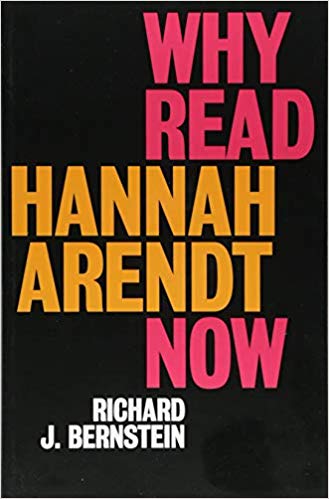
Book Review: Why Read Hannah Arendt Now

Richard J. Bernstein’s book Why Read Hannah Arendt Now (Polity, 2018) attempts to draw significant parallels between the historical problems and perplexities that Arendt addressed in her own lifetime and a seemingly similar set of dangerous tendencies in current political affairs. The application of Arendt’s perceptive analyses of past political phenomenon to illuminate our understanding of current problems is admirable, because so many of her insights are of enduring value and relevance.

Bernstein concentrates on a set of central themes or undercurrents in Arendt’s writing that certainly appear to be relevant today. However, while there are superficial parallels between post-WWI (World War I) migrants and the current European immigration crisis, or between past and current right wing nationalist movements, to reductively transpose the situations Arendt’s writing addressed to the current European or American milieu would be to fall prey to exactly the kind of unreflective, facile assumptions that so vexed her. As Arendt herself wrote in The Origins of Totalitarianism, “Caution in handing generally accepted opinions that claim to explain whole trends of history is especially important for the historian of modern times, because the last century has produced an abundance of ideologies that pretend to be keys to history but are actually nothing but desperate efforts to escape responsibility.”

While Berstein’s book makes some mildly feasible comparisons, it is somewhat too selective in its application of Arendt’s ideas. For example, he likens the Kafkaesque difficulties that European Jewish refugees experienced to the obstacles that Syrian Muslim refugees now confront in seeking legal entry into the United States, noting the “suspicion and hostility” directed at both groups. However, what Bernstein does not mention is that Syrian Muslims have been a privileged category of refugee in The United States and the United Kingdom, where there has been an ongoing pattern of discrimination since at least 2015 favouring Muslims over Yazidis and Christians – two groups that face severe persecution from ISIS in Syria. Since the beginning of the Syrian conflict, approximately 96% of the Syrian refugees admitted to the United States by the Obama administration have been Sunni Muslim.1 This despite the fact that US Secretary of State John Kerry claimed that ISIS was committing genocide against groups under its control including Yazidis, Christians and Shiite Muslims, but not Sunni Muslims.

Bernstein may also not know that, instead of facing labyrinthine bureaucratic obstacles to enter the United States, a 2018 Department of Homeland Security audit report on the United States Immigration and Customs Enforcement (ICE) screening procedures for known or suspected terrorists showed that it had not complied with correct procedures in every single case that was checked, often failing even to run initial background checks.2

“Suspicion and hostility” seem to be conspicuously absent, not only from the Immigration and Customs Enforcement agency, but also from the establishment’s liberal media which gave sweeping public support to immigrants and refugees. At the peak of the migration crisis, when thought, speech and debate about the future implications of mass migration from mostly Muslim majority countries ought to have been at a zenith, Facebook CEO Mark Zuckerberg was overheard being pressured by the German Chancellor to stem criticisms of her migration policy on social media, The Guardian turned off its “comments” section on the topic, and anyone who attempted to raise the issue of how mass migration of religiously-defined identity groups could impact upon European values was unambiguously tarred with the “right wing” brush.

The United Nations Global Compact for Safe, Orderly and Regular Migration is an inter-governmentally negotiated agreement that was prepared ahead of a meeting held on 10 – 11 December, 2018 in Marrakech, Morocco under the auspices of the United Nations. The participating countries signed this joint agreement and while it is not legally binding, it is intended to provide the legal framework on which the participating countries commit themselves to build new legislation extending hate speech to cover criticism of migration policies. Because it declares migration as a human right it will have the effect of outlawing criticism of governmental migration policies as instances of hate speech. Marcel De Graff, a member of the European Parliament said in response to the pact, “The agreement wants to criminalise migration speech. Criticism of migration will become a criminal offence.” 

A 2015 report showed that Kuwait had put the most money toward resettlement of Syrian refugees with over $101 million, but had offered no resettlement places to Syrian refugees. Neither have Saudi Arabia, the United Arab Emirates, Qatar or Bahrain.3 Yet none of the Western media’s news reports cast aspersions on these Arabic states for their xenophobia or inhumanity.

Bernstein quotes Arendt’s warning against “credibility gaps” and “invisible government” — forces that extinguish the public’s illumination of “the affairs of men” (Men in Dark Times,1968). But while heart-rending broadcasts about the immigration crisis abounded, there was no serious analysis as to its causes or the relationship between mass immigration to Europe and North America and the machinations of shadowy supra-national organisations such as the ‘Istanbul Process’ or the ‘Budapest Process’ and their aims of developing, in their own words, “comprehensive and sustainable systems for orderly migration”.

Bernstein’s book also revisits Arendt’s Zionism and her self-correcting defection from the movement. But here too Bernstein limits his focus primarily to her recommendations for dealing with the Arab-Jewish problem in Palestine, which included a federated state based on mixed Jewish-Arab local councils. Bernstein underscores her warning that Israel as a Jewish nation-state would continue to be plagued by the issue of how to protect the rights and citizenship of its Arab population and laments that her observations were not taken seriously at the time.

This does have remarkable relevance today but so too do Arendt’s own realisations about her romanticisation of Zionism. As Bernstein notes, Arendt responded to the ominous ascendency of Nazism by allying and working with her Zionist friends. She even secured employment in Zionist organisations, and wrote about a new category of human being – one that is put into concentration camps by their foes and into internment camps by their friends. Bernstein empahsises that she eventually grew uneasy with Zionism’s extreme revisionism and its growing demands for ideological conformity. Zionists at the time, says Bernstein, saw no alternative to their dream of founding a Jewish nation-state that Arendt perceived would only lead to militant nationalism on both sides. But this is where Bernstein’s parallels stop.

Arendt herself realised that she had been duped by her own prejudices and background beliefs into aligning herself with a fanatical movement that had become a glaring example of the very brand of intolerant chauvinism she had meant to oppose. She realised that socialism’s once inspirational, revolutionary and progressive ideals had fallen under the spell of ‘dialectical necessity’ and unambiguous victimhood. Consequently the socialist, revolutionary Jewish national movement with its lofty ideals had been transformed into an intolerant aggressor guilty of the very crimes of which it had claimed to be a victim. Just as Arendt’s critique of the Zionist movement’s chauvinism made her a scandal, so today have ex-Muslims Maajid Nawaz and Ayaan Hirsi Ali been demonised as ‘right-wing’ and ‘Islamophobic’ for speaking honestly about Salafi-Wahhabism’s colonising ambitions to impose a caliphate and sharia law, and its deceptive victim narrative that has captivated leftist anti-War activists and Marxists who share with Islamists a common frustration at the lack of success in opposing Western military interventionism and hypocrisy. But Bernstein never draws this parallel, nor does he mention the glaring similarities between Arendt’s naive courtship of Zionism and the liberal left’s current exploitation by Islamist strategists who have successfully exploited various European leftists’ existing grievances against the West or capitalism. For example, because of shared opposition to the West, Stop The War Coalition (STwC), whose officers span the Labour Party, Green Party, Respect, National Union of Students, trade unions and far-Left groups, have a cordial relationship with the Islamist group CAGE. In cooperating with Islamists, some Marxists maintained an underlying assumption that they would eventually steer Muslims by degrees from Islamism to socialism. In reality the steering seems to have gone the other way round.

Despite her lifelong condemnation of racist ideology and the deeds to which it leads, Arendt distinguished between social prejudices (against which she thought the state should not legislate) and officially sanctioned, state-sponsored discrimination (which she saw as far more dangerous and unconstitutional). Similarly, today many people (including Muslims) agree that social customs like the burqa and hijab are symbols of patriarchal sexism and gender apartheid, but nevertheless they do not think that the state should legislate against social customs. Arendt saw discrimination in the social realm as unfortunate but thought that it would be wrong to legislate against it because to do so would be to impose a state-sponsored moral code on everyone, which amounted to ideological totalitarianism. Instead, she thought that civil liberties could better be protected by barring the legal enforcement of prejudiced customs.

Bernstein finds fault with Arendt’s principled stance against federally imposed integration of public schools. She worried about the legal enforcement of social integration because she did not see a need to legislate against the social custom of voluntary segregation, which was practiced on both sides of America’s racial divide. Instead, the remedy for voluntary segregation is voluntary de-segregation and social activism among non-prejudiced people, including spontaneous actions like public speech about the ills of racial segregation, freely associating with the ‘other’, etcetera. In other words, racial desegregation in America should happen in the same way that liberals today believe gender desegregation will happen among conservative Muslims – by individual agency and choice. Arendt correctly saw the miscegenation laws that existed in 29 states as a more flagrant breach of the constitution than the unenforced but habitual segregation of schools. She was not against desegregation as such but only the proposed means of bringing it about.

Bernstein seems to think Arendt is only right when she agrees with his views on racism. For example, while he disparages her opposition to state-enforced integration, he cites her prediction that state-enforced integration would not work anyway in solving de facto segregation to add credence to his view that racial segregation and discrimination are as bad or worse today than they were in 1957. But there is a credibility gap between Bernstein’s picture of the situation, which resembles that of the mainstream media’s, and the colossal hegemonic taboo of racism of which the current moral panic over racism is symptomatic.

Likewise, Bernstein conspicuously waters down Arendt’s highly relevant remarks on white guilt, constraining his mention of this topic to her critique of “collective guilt” and showing how it applied to her post-War critique of the Adenauer administration for its reluctance to put on trial Nazi’s who had been personally responsible for murder. So, while he does cite On Violence (1970), he never mentions her highly relevant observation that it had become fashionable among white liberals to cry “we are all guilty” in response to Negro grievances. Where all are guilty, she says, no one is. Confessions of collective guilt are the best safeguard against the discovery of culprits, and the very magnitude of the crime becomes an excuse for resignation. This kind of abstract, heightened ‘racism’ was, she thought, dangerous because it is highly mythological and sets up an irreconcilable conflict between collective guilt and collective innocence. The slogan that “all white men are guilty”, was, in her view, racism in reverse and an irrational escape from reality (On Violence, 1970, p. 65).

Since much of her writing is imbued with a dread of ideology, we should be wary of any simple ideological reading of suggestive juxtapositions. Ideological propaganda works by exploiting existing totems and taboos rather than trying to instill entirely new ways of thinking into the masses. Propagandists use parcels of truth to weave overarching lies. This makes issues such as racism a powerful tool in the arsenal of cynical ideologues. Propaganda experts like Arendt, Jacques Ellul and Edward Bernays have observed that ideologies begin by problematising some area of life in order to prepare their audience to accept as necessary their proffered solutions. So it is important that in our diagnosis of today’s problems we are cautious in deciphering between problems that exist because of the neoliberal establishment’s propaganda machine and those that exist in the real (unmediated) world that we can observe through the evidence of our senses.

Arendt’s philosophical works can serve both as a warning about present-day nationalism in Europe and Israel and, less obviously, can also give us reason to pause and take stock of the mythological peddling of ubiquitous ‘Islamophobia’ or racism.

———————————————————————————————————————

1Klein, Joseph A., CFP United Nations Columnist, ‘Obama’s Syrian Refugee Policy Discriminates Against Christian Victims of Genocide’, Canadian Free Press, June 3, 2016, accessed at: https://canadafreepress.com/article/obamas-syrian-refugee-policy-discriminates-against-christian-victims-of-gen

2Harrington, Elizabeth, ‘Obama’s ICE Didn’t Follow Procedure For Checking Illegal Immigrants Ties to Terror’, at Washinton Free Beacon, January 16, 2018. Accessed online at: https://freebeacon.com/national-security/obamas-ice-didnt-follow-procedure-for-checking-illegal-immigrants-ties-to-terrorism/ AND Homeland Security report of the Office of the Inspector General, 5 January, 2018. PDF version Here: https://www.oversight.gov/sites/default/files/oig-reports/OIG-18-36-Jan18.pdf

3  Amnesty International, ‘Facts & Figures: Syria refugee crisis and internatoinal resettlement’, 5 December, 2014, accessed online at https://www.amnesty.org/en/latest/news/2014/12/facts-figures-syria-refugee-crisis-international-resettlement/ See Also, The Daily Hive (Vancouver), ‘How Much Money are Countries Spending on teh Syrian refugee Crisis?’, Sept. 4, 2015 accessed online at: https://dailyhive.com/vancouver/money-countries-spending-syrian-refugee-crisis/

The inspirational martyrdom of Sahibzada Zorawar Singh and Sahibzada Fateh Singh

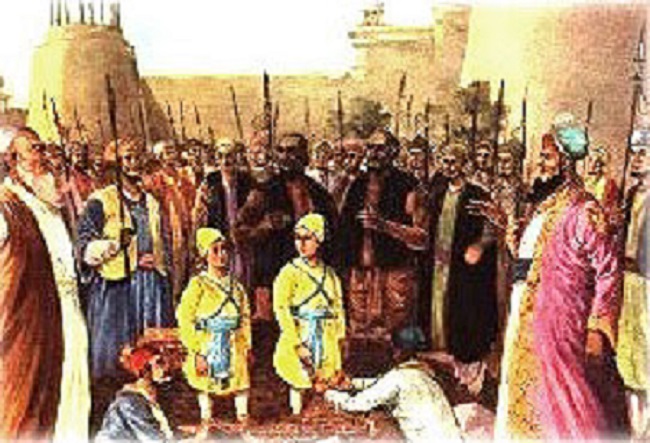
Some acts and deeds are so profound that they change the course of history. One such is the martyrdom of the two younger sons of the tenth Guru of the Sikhs, Guru Gobind Singh Ji. The young and innocent boys, Sahibzada (Prince) Zorawar Singh and Sahibzada Fateh Singh attained martyrdom on December 26, 1705 when they were brutally murdered by Wazir Khan — the Mughal Governor of Sirhind.

The month of December has a special significance for the Sikh community. It was in this month that the combined forces of the Mughals and the small hill principalities used perfidious deceit to draw out Guru Gobind Singh, his family and followers from the Anandpur Sahib Fortress and then sought their destruction. These forces, under Wazir Khan, promised the Guru a safe passage from Anandpur Sahib but attacked them with overwhelming numbers when they came out. The two Sahibzadas’ aged nine years and seven years, along with their grandmother Mata Gurjar Kaur got separated from the main contingent as they left the fort. They were promised refuge by an old retainer named Gangu in his native village Sahedi, but were handed over to the Sirhind administration of the Mughals, in what can be termed as the worst possible breach of trust and faith.

It is notable here that the main contingent of the Sikhs fought to the last man at Chamkaur where Guru Gobind Singh took up a defensive position with a handful of Sikhs. The elder sons of the Guru, Sahibzada Ajit Singh and Sahibzada Jujhar Singh attained martyrdom while fighting in the Battle of Chamkaur. The Guru lost his four sons and his mother in the ensuing tragic turn of events, but was saved in person by the bravery and sacrifice of his dedicated followers.

Wazir Khan came back to Sirhind as a defeated and frustrated man having failed to kill or arrest the Guru. He would have been filled with fear at the prospect of the Guru’s reprisal for the deceitful manner in which he had behaved. It was against the backdrop of this fear and frustration that he attempted to gain control over the young Sahibzadas’ by converting them to Islam and then keeping them captive in his custody.

In order to achieve his evil objective Wazir Khan subjected the young princes to the worst forms of torture and intimidation, he kept them and their grandmother in a Thanda Burj (a cold tower) that was designed to capture the cool night breezes of air drawn over water channels– a perfect place for summers but very uncomfortable indeed in the middle of winters and that too at night, especially so for the very young Sahibzadas’.

Wazir Khan subjected the princes to a trial in his court which lasted for two days. On the first day the princes were cajoled to embrace Islam and were offered immense riches and power on agreeing to do so. The princes rejected the offer with absolute disdain which left Wazir Khan flustered and very angry. On the next day in court he tried to pass off the sentencing to Sher Mohd Khan, the Nawab of Malerkotla, whose two brothers had been killed in battle by Guru Gobind Singh. Sher Mohd Kahn exhibited the highest form of chivalry by refusing to take revenge from ladies and children and advised Wazir Khan to release the Sahibzadas’ and their grandmother.

It was at this stage that Wazir Khan committed the most gruesome act which goes against all tenets of honour and principle. He declared the two innocent boys to be enemies of the Mughal Empire and ordered them to be bricked alive. The execution was slated for the next day.

History chronicles other atrocities and torture that were committed on the young boys, even as last minute attempts were made to intimidate them into changing their mind and converting to Islam. The courageous princes refused and were incarcerated alive within the wall. The wall, however, broke down before the boys lost their breath and were then committed to the most ghastly acts of all. Wazir Khan ordered the executioners to slit the throats of the young princes. On hearing the news of the martyrdom of Sahibzadas’ their grandmother Mata Gurjar Kaur also breathed her last.

The manner in which the two Sahibzadas’ stood against injustice and discrimination has no parallels in the annals of history.  The ruthless depravity of their prosecutors constitutes the other side of the spectrum. The courage and fortitude exhibited by the young princes galvanised the Sikh/Khalsa community into rising against persecution and injustice. Guru Gobind Singh Ji charged his disciple, Baba Banda Singh Bahadur, to avenge the murder of the Sahibzadas. Baba Banda Singh Bahadur came from Nanded (in modern day Maharashtra) to Punjab for the ordained task. Sikhs in large numbers joined him. Banda Singh Bahadur first took Samana and Sadhaura on the periphery of Sirhind and finally attacked Wazir Khan. The ensuing clash known as the Battle of Chappar Chiri took place on May 22, 1710. It witnessed the larger Mughal forces being crushed by the Sikhs. Wazir Khan was killed in the battle and Sirhind was occupied in the next two days.

The martyrdom of the Sahibzadas’ thus heralded the creation of the Sikh Empire from the debris of Mughal as well as the Afghan principalities, changing the very destiny of the South Asian region in general and Punjab in particular. The subsequent Sikh Empire created by Maharaja Ranjit Singh, though short lived, is known for a just, benevolent and secular rule based in the tenets of law.

Independent India has witnessed a similar sense of righteous nationalism permeating from the small Sikh community that remains in the forefront of every national endeavour, be it safeguarding of the sovereignty of the nation or contributing to its progress and prosperity. All of this finds motivation, in no small measure, from the story of the young Sahibzadas’.

The story of the Sahibzadas’, needs to be disseminated far and wide within India and across the world as a true example of standing up for what is just and righteous. Effort needs to be directed towards this end by the Sikh community and its institutions as also by the Indian government and other cultural bodies of the nation. There is a need for institute studies and creation of literature. Efforts need to be made to disseminate the historical facts in a manner such that they motivate all humanity.

Research on INA’s military history was sealed by Nehru. It’s time to make it public, says grandnephew of Netaji Subhas Chandra Bose

Chandra Kumar Bose, Netaji’s grandnephew, welcomed Narendra Modi’s decision to rename the islands of Andaman & Nicobar. In a free-wheeling chat with News Intervention, Bose explained how several facts about INA have been systematically distorted over the last seven decades and it’s time to present correct history to the world.

Excerpts:

Q. Government of India has decided to rename the three islands of Andaman & Nicobar—Havelock Island, Neil Island and Ross Island—as a tribute to Netaji Subhas Chandra Bose. What are your thoughts?

Ans: It was a long-standing demand from the people of this country to rename Ross Island, Neil Island and Havelock Island to ‘Netaji Subhas Chandra Bose Island’, ‘Shaheed Dweep’ and ‘Swaraj Dweep’, respectively. Japan had captured these three Islands from British during the Second World, and later on it was handed over to Netaji Subhas Chandra Bose. It was on these Islands that Netaji had first hoisted the Indian National Flag, as the first Prime Minister of undivided free India on December 30, 1943, and he had called it “Shaheed Swaraj Island”.
We got dominion status on August 15, 1947, and ideally, Jawaharlal Nehru should have gone to these Islands on December 30, 1947, and should have renamed these Islands as Shaheed and Swaraj Islands. But it took 72 long years to rename it and honour the soldiers of Azad Hind Fauj. Thanks to Prime Minister Modi for doing so.  The new names are indeed a tribute to Netaji.

Q. How do you see the role of Bose in retaining Andaman & Nicobar despite multiple claims on these Islands?

Ans: If Andaman & Nicobar Islands had not been liberated under Netaji’s leadership, then it would have gone in some others’ hand. Many nations were eyeing the Islands to make it their strategic base, and if they had succeeded then it would have been a significant threat to our national security. The British were compelled to cede the Islands to India only because of Bose. 

Q. We often hear about Japanese atrocities on the people of these Islands, and that they were against Azad Hind Fauj. How true is that?

Ans: All claims about Japanese atrocities are baseless. Several stooges who earlier used to work for the British, are now working for the Congress party in our country. It is these stooges who say time and again that the local people of the Island do not like Netaji. They talk about the Japanese atrocities, but there is nothing like this. Over the last seven years, I have been to the Islands many times and during these visits I spoke to many people. They have a huge respect for Netaji. He is worshipped as a hero there.
Look, the Japanese came to the Andamans on March 23, 1942 and within 4 months they captured these Islands from British. Azad Hind Government subsequently took charge on December 30, 1943. When Netaji took over the Islands, he gave explicit instructions to General Hideki Tojo, the then Prime Minister of Japan not to hurt even a single person. “I will not tolerate harassment of my people” were the words of Netaji. These facts are documented.

Q. What was the contribution of Azad Hind Fauz towards India’s Independence?

Ans: The first battle of India’s Independence started in 1857 which was the Sepoy Mutiny, and a sepoy named Mangal Pandey fired the first shot of the uprising. This independence war later on was continued by Shaheed Bhagat Singh, Khudiram Bose, Chandra Shekhar Azad, Raj Guru who sacrificed their lives for India’s Independence. Then came the non-violence movement of Gandhi ji.
It is true that Gandhi ji played an important role in India’s Independence; he had the impact, but the final onslaught on British Imperialism was the battle of Azad Hind Fauj and Netaji. These are not my words, even the book, “Bose: An Indian Samurai” by General GD Bakshi revealed the quotes from a conversation between former British Prime Minister Clement Attlee and the then Governor of West Bengal Justice Phani Bhusan Chakraborty.
In 1956, Clement Attlee had come to India and stayed in Kolkata Raj Bhavan as a guest of the then Governor. Clement Richard Attlee was British Prime Minister between 1945 and 1951, and he had signed off on the decision to grant Independence to India.
PB Chakraborty was at that time the Chief Justice of Calcutta High Court and was also serving as the acting Governor of West Bengal. He wrote a letter to the publisher of RC Majumdar’s book, A History of Bengal. In this letter, the Chief Justice wrote, “When I was acting Governor, Lord Attlee, who had given us independence by withdrawing British rule from India, spent two days in the Governor’s palace at Calcutta during his tour of India. At that time I had a prolonged discussion with him regarding the real factors that had led the British to quit India.”
Chakraborty adds, “My direct question to Attlee was that since Gandhi’s Quit India movement had tapered off quite some time ago and in 1947 no such new compelling situation had arisen that would necessitate a hasty British departure, why did they had to leave?”
“In his reply, Attlee cited several reasons, the principal among them being the erosion of loyalty to the British Crown among the Indian Army and Navy personnel as a result of the military activities of Netaji,” Justice Chakraborty elaborated.

That’s not all.

On Mahatma Gandhi role in attaining Independence and Gandhi’s non-violent movement, Chakraborty says, “Towards the end of our discussion I asked Attlee what was the extent of Gandhi’s influence upon the British decision to quit India. Hearing this question, Attlee’s lips became twisted in a sarcastic smile as he slowly chewed out the word,  m-i-n-i-m-a-l (minimal)!”
In fact, India would have attained freedom on April 14, 1944, when Colonel Shaukat Ali Malik, an officer of the INA (Indian National Army aka Azad Hind Fauj) led a unit of the Bahadur Group brigade in the capture of Moirang during the initial phases of the INA’s Imphal Campaign during World War-II. Moirang was the first territory within India to be captured by the INA and also the first place within mainland India to be held by the Azad Hind Government.
Malik hoisted the Indian Flag at Moirang on 14 April 1944.  At that time, INA gave the slogan of ‘Chalo Delhi’ to hoist the Indian flag at Red Fort. Unfortunately it failed. Some senior Congress leaders in Delhi were internally hand-in-glove with the then British Government and had opposed the Azad Hind Government. We would have got ‘Purna Swaraj’ (complete independence) in 1944. Netaji was never in favour of Partition. Even GD Bakshi claims in his book that “Without Azad Hind Fauz, India would have been under British rule for another 50-60 years”.
These truths are never told. It is time to tell the people about the real history. Truth cannot be suppressed for too long. Time has come to bring out the real history.

Q. Many school textbooks are still dominated by the role played by non-violent movement, while the role of INA is dismissed in a few paragraphs…

Ans: It is a complete distortion of the history of India’s freedom struggle by the historians who worked as stooges of British and later of the Nehru-Congress regime. There is no connection between Mahatma Gandhi and the present Congress. Congress thinks that Gandhi is their property. Now this Congress Party has fallen into the hands of elites that are largely hostile to the Indian tradition and culture which the Mahatma embodied. It is now in the hands of individuals representing interests and values far away from the people of India.
After India’s Independence, Gandhi ji clearly said that the purpose of Congress is diluted and it should be disbanded. My father Amiya Nath Bose was very close to Mahatma Gandhi. He met Gandhi ji in Pune after Independence. Gandhi ji was very upset. My father along with Sarojini Naidu was sitting with Gandhi ji in a room where Mahatma Gandhi clearly said “I think I backed the wrong horse. Supporting Nehru was my biggest fault, and now it is too late”.
Narendra Modi-led NDA Government is attempting to correct the distorted history of India’s Independence. Opposition calls it ‘Rewriting of History’, but it is ‘Correction of History’.

Q. How can the masses, especially the youth, be made aware of the role of Subhas Chandra Bose and INA in India’s freedom struggle?

Ans: The government should immediately publish the real history of INA in the textbooks and the reference books. The three-volume work by Ramesh Chandra Majumdar on the Indian Freedom Movement should be included in the textbooks as a reference point. He was a great historian.
Even Nehru had asked Majumdar to write the history of India’s Independence. When Majumdar wrote it and gave it to Nehru, he discarded it claiming that this is not the one he (Nehru) was looking for as the book did not talk too much about Congress’ role in attaining freedom.
Regarding INA’s military history, Professor Pratul Chandra Gupta has done excellent work on Azad Hind Fauj’s history which Nehru has sealed and kept it in the Defence Archives in Delhi. The work of Pratul Chandra needs to be brought in the public. I have requested many people to bring it out and publish it. Let the students go through this. 
This is high time, and we need to correct the distortions. We need another five years to correct the distorted history.
The history of Indian freedom struggle is not what it is seen or said, instead there is a different story behind it, and people must be aware of it. For the last 70 years, our students have been taught a distorted history. The new generation will not forgive us if we continue to teach them the wrong history. The time has come to “teach the real history to posterity”.

Philosophy of Economics Crash Course 4

Dr. Alexander Douglas specialises in the history of philosophy and the philosophy of economics. He is a faculty member at the University of St. Andrews in the School of Philosophical, Anthropological and Film Studies. In this series, we will discuss the philosophy of economics.

Scott Douglas Jacobsen: Dr. Douglas, as previously discussed, a gap in knowledge, theory, and predictable consequences have developed in economics. When did this occur?

Dr. Alexander Douglas: Economics didn’t always seek status as a precise empirical science. Adam Smith famously declared disinterest in what he called “political arithmetic”. He might have been thinking of William Petty’s Political Arithmetick (1690), which attempted to advise the king on the specific economic effects of various policies. Smith, at least as I read him, was more interested in the moral psychology of economic activity, such as the sorts of motivations that drive people into economic interaction and the psychological effects of being engaged in it. I think he was closer to a novelist than a scientist. He sought to dramatize capitalism and present the sorts of character that inhabit it. There is a world of difference between this, and the ambition to use economic theory to forecast the specific effects of various policies or institutional changes.

The mania for the latter sort of calculated forecasting took off with the innovations in national accounting statistics that began with the development of the National Bureau of Economic Research in the United States, and in other similar departments around the globe, in the middle of the twentieth century. Now economic aggregates are treated as the report card for the standing government. The government takes credit when the numbers look good. The opposition blames the government when the numbers look bad. Both agree to propound the illusion that the government somehow controls these numbers.

Jacobsen: What might be the upper limit in predicting human choices?

Douglas: I don’t know. Neuroscience might one day discover some algorithm that predicts precise behavioural outputs from easily-sorted classes of inputs. We’d then have a precise method for predicting behavioural responses of human agents to environmental changes. But, again, even if this were possible, who knows whether it would be of any predictive use. Huge differences in behavioural outcomes might be made by differences too small for the instruments to measure.

At any rate, I don’t see why we should be trying to predict human behaviour – or what I’d rather call human action. The eighteenth-century materialist Baron D’Holbach dreamed of a day when the government could “hold the magnet” to move its citizens around like iron filings, after having developed a complete science of psychological “magnetism”. He was, in other words, an early advocate of governance by manipulation of incentives – perhaps an ancestor of today’s proponents of “nudge” theory. I find this idea disturbing. I believe that the unpredictability of human action is a precious thing that should be preserved, and instead of trying to render human action predictable and thus controllable, I’d rather we strove to develop an ethics and a politics that fully embraces uncertainty. Maybe if we stopped trying to control each other so much, we’d find that the world is becoming less dangerous rather than more.

What really worries me is that in developing a theory that treats people as cipher-like “pleasure machines” – to use Geoffrey Hodgson’s term – and in designing our institutions on the basis of that theory, we will end up reducing people to what the theory treats them as being. Economists often say that their theory is value-neutral, that they aren’t telling us how people should be, but merely telling us how people are. They treat opposition to their project as a superstitious reaction against scientific enquiry. But they don’t consider that the prevailing theory of human nature can end up transforming human nature. For example, if you regard humans as little more than consumers, you might cover the landscape with advertising, seeking to tap into this lucrative monomania. Then when the advertising becomes so abundant that people have nothing else to look at, they really do become the monomaniacal consumers they were assumed to be. This is, I think, what Ruskin was getting at in the first part of Unto This Last. A key job for philosophers is to fight this tendency that degrades the human spirit in practice by underestimating it in theory.

Jacobsen: Could the rules for economic behaviour – exchange of products and services – become looser with weakened social ties, and thus loosen the Wittgensteinian view on “rules”?

Douglas: In the ‘Wittgensteinian’ view that I proposed (which may not really have much to do with Wittgenstein), rules are instantiated at the level of communities, not individuals. Certainly we could explain the exchange of products and services by identifying the various social rules that drive these exchanges, beginning our analysis at the level of the community rather than the individual. But in doing so we would be giving up a crucial principle of mainstream economics, namely methodological individualism: the principle that the unit of explanation for economic behaviour are individuals. Individuals, in mainstream economic theory, are supposed to have preference-orderings, which are rules governing their behaviour (“swap one apple for two or more oranges, but not less”).

The ‘Wittgensteinian’ argument I hinted at has the conclusion that preferences can’t pertain to individuals on their own. A rule requires a crowd in order to be concretely instantiated. A rule that isn’t properly binding has no concrete reality; it exists as a mere abstraction. But a rule that I impose on myself isn’t properly binding. I always have absolute power to exempt myself from the rule. The same holds for a small group, who can always conspire to excuse themselves. But a crowd develops an inner tendency towards conformism, exercising peer-pressure and the “tyranny of public opinion” to keep its members in the fold. If (concretely existing) rules are peculiar to crowds, then so are preferences. Individuals explore and experiment; it is the crowd that gives rise to the rigid preferences from which economists begin their analyses.

Jacobsen: How do economic choices (tendencies) change over the course of an individual’s life?

Douglas: Well, it is only in the middle of our lives that we can expect much from the Invisible Hand – and that’s only for those who are able and legally permitted to sell their labour. During childhood and old age, we can only count on what others are obliged to give us. I believe that our societies pitifully under-provides for the non-working population. Young children are packed into classrooms in ugly buildings, often taught by inadequately-trained assistants. The elderly languish in miserable and understaffed care facilities, or are left alone at home. Provision for the disabled is always strongly urged as it is inadequately funded. For centuries the domestic labour of women, unrecognised as a commodity by the market, was at best remunerated with a bare subsistence living; and to some extent this remains true. Meanwhile, income-earners get to enjoy the highest material standard of living in history: things that used to be luxury commodities – holidays abroad, designer clothing, exotic cuisine –are now mass-produced for widespread enjoyment by the waged.

John Kenneth Galbraith once depicted an American family meditating on “the curious unevenness of its blessings” – an engorgement of private consumer goods alongside threadbare public services. Today this unevenness translates into a massive inequality between income-earners, who can access the consumer goods with which the market is gavaged, and non-income-earners, who are stuck with the vanishing trickle of public services.

There is no reason to expect anything different according to standard economic theory. Why would a market society produce anything for those who have no commodities to offer in exchange, or are not permitted to exchange what they have to offer, or offer a sort of value that is not recognised as a legitimate commodity by the market? Critics of capitalism often focus on the exploitation of the worker, but, as Joan Robinson said, it is often worse under capitalism to not have your labour exploited – at least not in the labour market.

Jacobsen: Thank you once again Dr. Douglas.

Original publication in Conatus News.

Photo by Trevor Bobyk on Unsplash

Philosophy of Economics Crash Course 3

Dr. Alexander Douglas specialises in the history of philosophy and the philosophy of economics. He is a faculty member at the University of St. Andrews in the School of Philosophical, Anthropological and Film Studies. In this series, we will discuss the the philosophy of economics.

Scott Douglas Jacobsen: Is there a lack of consistency in the terminologies used by economists?

Dr. Alexander Douglas: There’s a question about whether economists use terms consistently. But there’s another pressing issue, which is the gap between the language academic economists use and the language of public discourse.

I wonder if the retreat of economics into higher- and higher-level mathematics has done damage to democracy. Although there was a near-consensus among macro-economists in Britain that first austerity and then Brexit were bad policies, the government received popular support for both. The problem was that the macro-economists could say what they believed, but they couldn’t really explain why they believed it. The official argument rested on some of the most complex mathematics in the world, and there was no convincing ‘entry-level’ version.

Effectively, macro-economists have to ask the public to trust their expertise, even though we can’t see into their black boxes. It was easy for the media to portray the economic experts as elites with hidden agendas and vested interests. Normally the way to fend off that sort of ad hominem argument is to say, “Never mind me or my motives, just look at my argument”. But you can’t do that when the simplest compelling version of your argument consists of hundreds of differential equations.

I think this is a major problem. There is no bridge between the concepts of academic economics and the concepts we use to think about our day-to-day lives. Politics happens in the domain of the everyday concepts.

Jacobsen: What do you think of  neuroeconomics?

Douglas: Neuroeconomics is very interesting and something I know little about. Philosophically, it raises more ‘conceptual bridge’ puzzles, this time between the scientific study of brain-events causing behaviour and the ordinary explanations we give for human actions. Some philosophers call this “folk psychology”. There are a range of opinions on this. The most extreme , “eliminative materialism”, suggests that our ordinary explanations, e.g. “Jane crossed the road because she prefers to walk in the sun”, are simply wrong and will one day be entirely replaced by explanations at the physiological/neurological level: Jane’s body moved in such-and-such a way because such-and-such events occurred in her brain. Standard choice theory in economics is, in my view, a regimented version of “folk psychology”. So one interesting question is whether the end game for neuro – economics is to entirely replace standard economics or whether it can somehow be fitted into the existing paradigm.

Jacobsen: What is the healthy perspective – the accurate view – on human economic decisions? What drives us?

Douglas: I’m not convinced that the individual economic agent is the right starting point. You can start instead at the sub-personal level, as the eliminative materialists propose. You can also start with institutions, which have their own ways of behaving that sometimes seem independent of the agents composing them. J.K. Galbraith’s entertaining book, The New Industrial State, is full of plausible-sounding claims about how committees, boards, and so on have their own strange ways of making decisions, which differ from the ways that individual people make decisions. His book on the 1929 stock market crash contains equally plausible descriptions of crowd behaviour, which can be very unlike the behaviour of individuals on their own.

Academic economists are beginning to study institutions in more formal and rigorous ways. The ‘New Institutionalists’ build models to explain why (rational) individuals might submit to the authority of an institution in order to avoid the transaction costs that accompany free exchange in the market. Economists like Herbert Gintis use models from evolutionary biology and game theory to model social norms and other emergent properties of social systems (properties that can’t be explained in terms of facts about the individual agents).

I’m sometimes tempted towards a much more radical view. There is philosophical literature that emerged from the work of the later Wittgenstein, concerning the nature of rule-following behaviour. One central claim is that rules can’t exist for an individual on her own; they can only exist for a whole community. Another is that the relation between a rule and the behaviour it governs can’t be captured by any causal relation – it is not the case, for instance, that knowledge of a rule causes behaviour in accordance with that rule. Rather, the relation is more akin to a logical connection: the rule and the behaviour stand in a similar relation to that of the premise and conclusion in an argument. I believe that preferences are effectively rules: a preference for A over B is a rule: choose A over B. This theory of preferences-as-rules, combined with the Wittgensteinian ideas about rules, suggests to me that both methodological individualism and the search for causalexplanations of choice-guided behaviour might be mistakes. If so, much of modern economics would rest upon a mistake.

Jacobsen: Can you imagine a future with ubiquitous artificial intelligence where mathematical models and algorithms could accurately predict all human behaviour?

Douglas: To the extent that the physical world is determinate then there should in principle be a system of equations that could accurately predict all human behaviour. Of course, the physical world might not be determinate. And even if it is, the finding of the relevant equations might be beyond not only our cognitive capacities but those of any cognitive system capable of existing.

Moreover, there is no reason to expect that any workable model will look anything like the choice theory used by economists. The perfect explanation of human behaviour might make no reference to choices at all; again, it might just track the motion of particles around the human brain and body, or it might track patterns at the institutional level. We don’t know what sorts of causes the perfect model would quantify over. Thus you don’t have to believe that there’s a perfect mathematical model of individual choice, even if you think there’s guaranteed to be a perfect causal model that explains and predicts all observable human behaviour.

Original publication in Conatus News.

Photo by Olivia Leger on Unsplash